REVIEW 1 major objections 6 minor 97 references
Interactions and charge transfer dynamics of an Al$^+$ ion immersed in ultracold Rb and Sr atoms
T0 review · 1 major / 6 minor · reviewed 2026-08-14 · deepseek-v4-flash
Pith's one-line read This paper predicts that an Al$^+$ ion immersed in ultracold Rb or Sr reacts only through slow radiative charge transfer and association, with reactive rates at least $10^4$ times below the Langevin limit.
desk verdict First ab initio interaction and charge-transfer data for Al+ with Rb and Sr, worth a serious referee, with the R-independent spin-orbit approximation as the main caveat. read the letter →
The pith
A machine-rendered reading of the paper's core claim, the machinery that carries it, and where it could break.
The reading
What carries the argument
The load-bearing object is the set of ab initio potential energy curves and transition electric dipole moments for $(\mathrm{Al+Rb})^+$ and $(\mathrm{Al+Sr})^+$, computed with RCCSD(T) and MRCISD+Q methods using scalar-relativistic pseudopotentials for Rb and Sr, with spin-orbit coupling added perturbatively by diagonalizing the non-relativistic curves with constant SO matrix elements. These curves feed a time-independent scattering calculation whose $S$ matrices yield the elastic and inelastic rate constants. The spin-orbit mixing, effective mainly near dissociation, is what converts the simple non-relativistic branching pattern into the relativistic branching ratios and opens formally forbidden triplet channels.
What would settle it
A cold hybrid ion-atom experiment that measures the products of Al$^+$ + Rb collisions would test the central claim: the paper predicts a fine-structure ratio $K_{\rm RCT}(\mathrm{Al}({}^2P_{1/2})):K_{\rm RCT}(\mathrm{Al}({}^2P_{3/2}))$ near 5:1 and all reactive rates at least $10^4$ times below the Langevin rate; observing a ratio near 1:1 or reactive rates within an order of magnitude of Langevin would contradict it.
Extended reading notes
Core claim
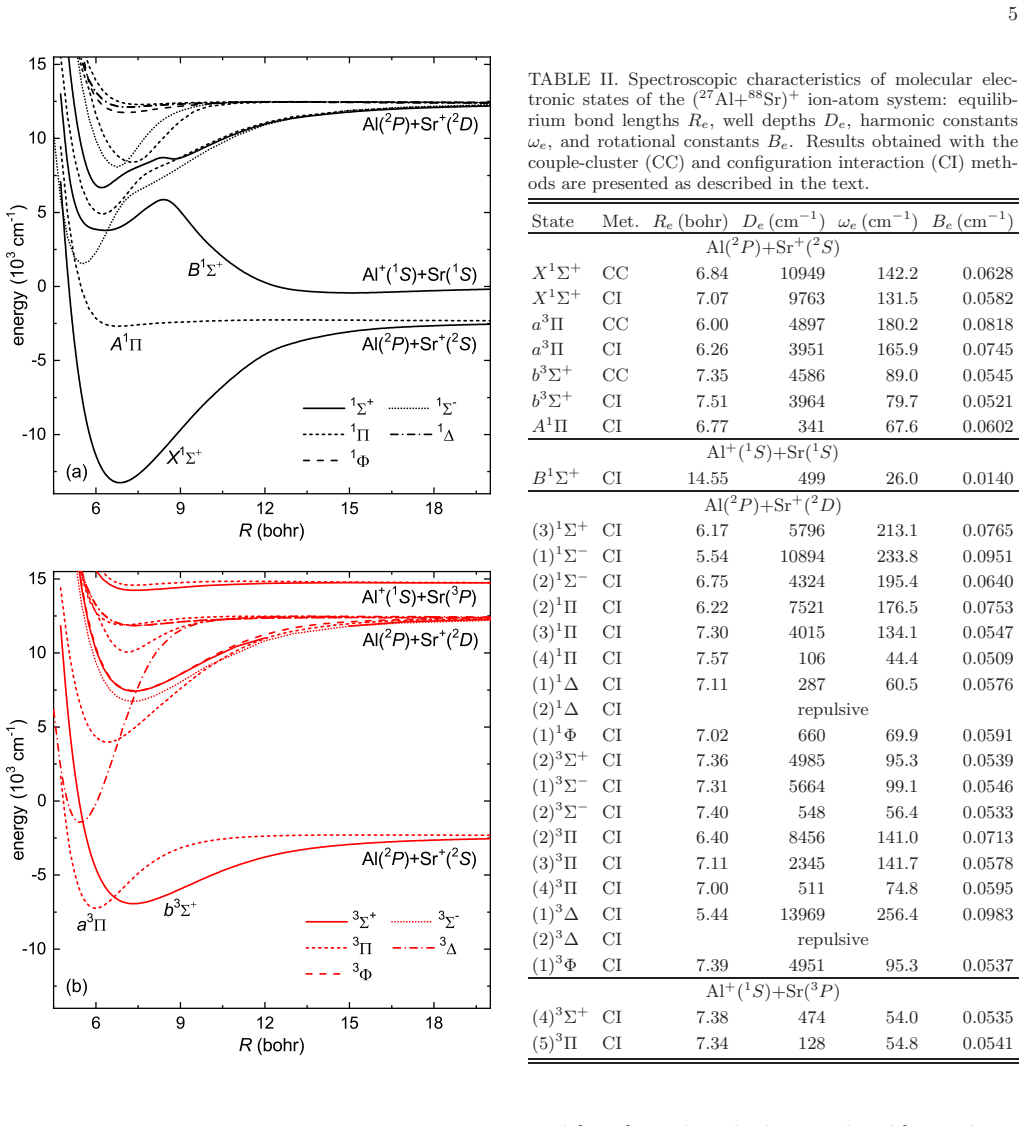
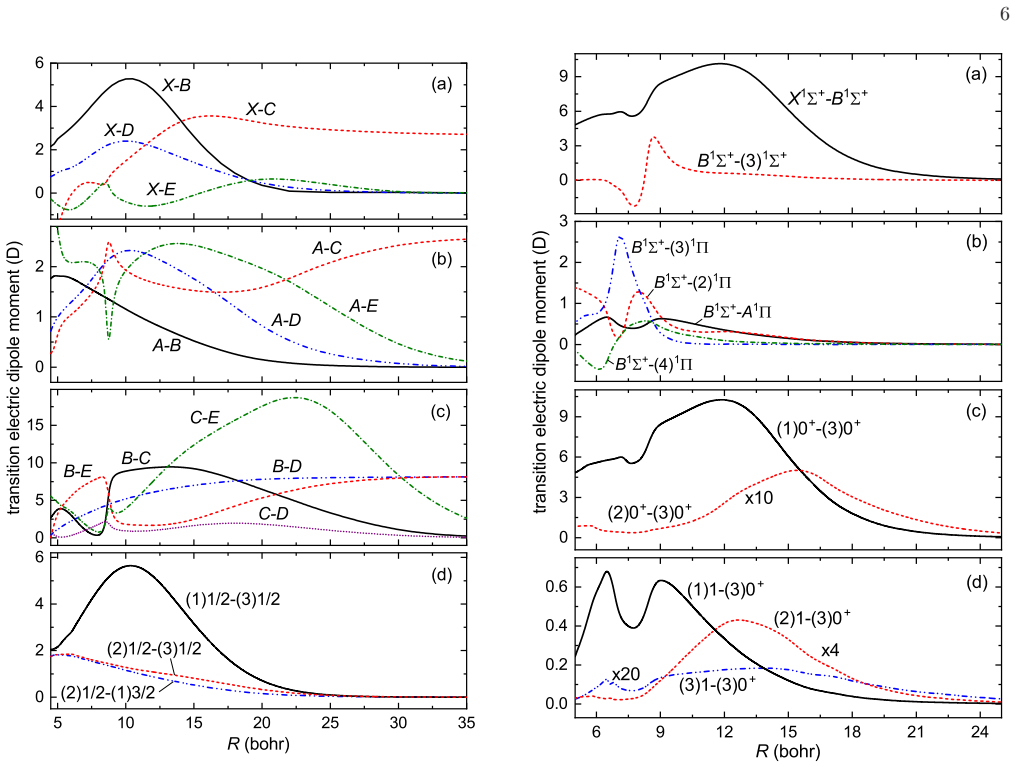
The central discovery is a new class of cold ion-atom systems based on a closed-shell Al$^+$ ion, whose interaction with Rb or Sr is governed by one entrance potential curve ($B\,{}^2\Sigma^+$ or $B\,{}^1\Sigma^+$) but whose charge transfer populates several relativistic states of the $\mathrm{Al}({}^2P_J) + X^+$ asymptote. From first-principles electronic structure, the authors obtain the full non-relativistic and spin-orbit coupled curves and transition dipole moments, and show that radiative charge transfer dominates radiative association for Al$^+$+Sr (by a factor of about 250 for $B\to X$) while the two processes are comparable for Al$^+$+Rb (association is about twice charge transfer for $B\to X$). They also find strong final-state selectivity: charge transfer into the ground $X$ ($\Sigma$) state exceeds that into $A$ ($\Pi$) by factors of 15 (Rb) and 25 (Sr), and spin-orbit mixing enhances the relativistic $(2)_{1/2}$ channel in Rb by factors of 2--3, while in Sr the ratio of charge-transfer rates into Al(${}^2P_{1/2}$) and Al(${}^2P_{3/2}$) is about 1:2.
Load-bearing premise
The predicted branching ratios assume the spin-orbit coupling matrix elements between molecular electronic states are constant and equal to their asymptotic atomic values, so if short-range relativistic mixing differs materially from those values, the relativistic rates and fine-structure ratios would change.
Editorial extensions
If this is right
- In Al$^+$+Rb cold collisions, the dominant reactive process is radiative association into $X\,{}^2\Sigma^+$, with a rate constant near $9\times10^{-14}$ cm$^3$/s, about twice the radiative charge transfer rate into the same state.
- In Al$^+$+Sr collisions the ordering reverses: radiative charge transfer into $X\,{}^1\Sigma^+$ is about 250 times faster than radiative association into that state.
- Charge transfer strongly favors the ground $\Sigma$ state over the excited $\Pi$ state in both systems, by factors of 15 (Rb) and 25 (Sr).
- All reactive rate constants are at least $10^4$ times smaller than the Langevin capture rate, so thousands of ion-atom collisions are needed per reactive event.
- The narrow Al$^+$ clock transition, read out through a co-trapped ion by quantum logic spectroscopy, can serve as a state-sensitive monitor of these rare collision events.
Reading between the lines
- The same electronic-structure and scattering pipeline should transfer to other closed-shell main-group ions such as Ga$^+$ or In$^+$ paired with alkali or alkaline-earth atoms, where the same one-entrance-curve, spin-orbit-selected radiative exit structure is likely.
- The predicted $\approx 5$ fine-structure branching ratio in Rb and $\approx 1/2$ in Sr could be tested by spectrally resolving the emitted photon in radiative charge transfer, which would give a direct read on the constant-SO-matrix-element approximation.
- The very low reactive rates imply sympathetic cooling of Al$^+$ by Rb or Sr should be limited by micromotion heating rather than by charge-transfer loss; the paper notes the heating challenge but does not fold this into the rate analysis.
- The vibrational transition-dipole maps the paper reports could support two-photon schemes to form deeply bound AlRb$^+$ and AlSr$^+$ molecular ions, but the paper does not optimize such pulses.
Signed reviews
Editorial analysis
A structured set of objections, weighed in public.
Referee Report
Summary. The manuscript reports ab initio potential energy curves and transition electric dipole moments for the (Al+Rb)+ and (Al+Sr)+ ion-atom systems, computed with RCCSD(T) and MRCISD+Q methods using small-core relativistic pseudopotentials for Rb and Sr. Long-range interaction coefficients are obtained from perturbation theory and compared with the supermolecular curves. These electronic structure data are used in quantum scattering calculations to predict elastic scattering, radiative charge transfer, and radiative association rate constants. Relativistic effects are included by diagonalizing spin-orbit Hamiltonians with R-independent matrix elements fixed at the asymptotic atomic values of the Al fine-structure splitting. Representative predictions include KRCT(B2Σ+→X2Σ+) ≈ 4.5×10^-14 cm^3/s and KRA ≈ 9×10^-14 cm^3/s for Al+Rb, with substantially smaller rates for Al+Sr, and all reactive rates at least 10^4 times smaller than the Langevin rate. The authors propose probing these processes by monitoring the Al+ clock transition via quantum logic spectroscopy.
Significance. The paper makes a valuable contribution by extending cold hybrid ion-atom collision studies to an Al+ ion, a species not previously treated in this context, and by proposing a concrete experimental detection scheme using quantum logic spectroscopy. The electronic structure calculations are benchmarked against NIST ionization potentials and atomic excitation energies to within 0.5%, and the long-range multipole expansion matches the ab initio curves over a broad range, lending confidence to the non-relativistic potentials and transition moments. The scattering calculations follow standard quantum methods, and the presentation of both non-relativistic and relativistic branching ratios is informative for future experiments. The principal weakness is that the relativistic branching ratios rely on an R-independent spin-orbit approximation that is not quantitatively validated; if this approximation is shown to be adequate or a sensitivity analysis confirms stability, the fine-structure-resolved predictions would be an important resource.
major comments (1)
- [Sec. II (Eqs. (2)–(6))] The spin-orbit coupling matrix elements are taken to be R-independent and equal to their asymptotic atomic values, with the justification that the dynamics is dominated by intermediate- and long-range distances. This approximation is load-bearing for the relativistic branching ratios reported in Sec. III B, such as KRCT((3)1/2 → (2)1/2) ≈ 2·KRCT(B2Σ+ → A2Π), KRCT((3)0+ → (1)0+) ≈ 0.1·KRCT(B1Σ+ → X1Σ+), and KRCT((3)0+ → (2)0+) ≈ 0.2·KRCT(B1Σ+ → X1Σ+). These ratios are determined by the mixing coefficients obtained by diagonalizing the spin-orbit Hamiltonians, and the mixing is most sensitive at internuclear distances where the non-relativistic energy gaps (e.g., the X/A or X/a3Π separations) are comparable to the spin-orbit coupling scale of ~112 cm^-1. At those distances, an R-dependence of the spin-orbit matrix elements could materially change the mixing and hence the branching ratios. The manuscript does not provide R-dependent spin-orbit curves or a sensitivity analysis (e.g., varying the SO constants by 10–20%). The factor-10 suppression in the (1)0+ channel and the nonzero rate into the nominally dark (2)0+ channel indicate that the rates are indeed sensitive to the mixing. I recommend that the authors either compute R-dependent spin-orbit matrix elements from the MRCI wavefunctions or add a sensitivity analysis demonstrating that the branching ratios are stable under reasonable variations of the spin-orbit constants.
minor comments (6)
- [Sec. III B] The ratio of KRCT(B1Σ+ → X1Σ+) to KRCT(B1Σ+ → A1Π) in Al+Sr is quoted as 25, but the listed values 1.4×10^-17 and 5×10^-19 give a factor of 28; please reconcile.
- [Sec. III B] The sentence 'the radiative charge transfer is 250 times more probable than the radiative association for Al++Sr collisions' contradicts the quoted rates (KRA ≈ 3.5×10^-15 cm3/s vs KRCT ≈ 1.4×10^-17 cm3/s), which instead show that radiative association is about 250 times larger; please correct.
- [Sec. III B] The ratio of KRCT(B2Σ+ → A2Π) to KRA(B2Σ+ → A2Π) in Al+Rb is quoted as 13.5, but the listed values 3×10^-15 and 2×10^-16 give a factor of 15; please reconcile.
- [Sec. III B] The statement that non-radiative charge transfer rates are 'at least ten orders (one order) of magnitude smaller' is ambiguous; please state explicitly whether the intended meaning is ten orders of magnitude for Rb and one order of magnitude for Sr.
- [Throughout] There are several typographical errors: 'ulracold' should be 'ultracold', 'relatvistic' should be 'relativistic', 'equalibrium' should be 'equilibrium', 'patter' should be 'pattern', and 'rotational consonants' should be 'rotational constants'.
- [Sec. III A] The electronic structure data are stated to be available from the authors upon request; consider placing them in a public repository to support reproducibility.
Circularity Check
No significant circularity: the ab initio potentials, transition moments, and scattering rates are derived from independent electronic-structure inputs; self-citations are methodological and not load-bearing.
full rationale
The paper's central results are the ab initio potential energy curves, transition electric dipole moments, long-range coefficients, and the cold-collision rate constants built from them. These are obtained from coupled-cluster and MRCISD+Q electronic-structure calculations on the (Al+Rb)+ and (Al+Sr)+ systems, with the atomic properties cross-checked against external benchmarks such as the NIST Atomic Spectra Database and previously published polarizabilities. No equation defines a target result in terms of a fitted parameter: the scattering lengths are scanned (as=0.5 R4 and 1.5 R4) rather than fitted, and the reported rates are computed from the stated interaction potentials and transition moments. The relativistic branching ratios, e.g., KRCT((3)0+ -> (1)0+) ≈ 0.1 * KRCT(B1Σ+ -> X1Σ+), follow from diagonalizing the spin-orbit Hamiltonians in Eqs. (2)-(6); they are consequences of the model, not inputs renamed as predictions. The paper's self-citations, mainly Refs. [48,51,67] for the scattering implementation and Ref. [49] for the electronic-structure scheme, are methodological citations to prior work by the same group; they do not supply the central results or invoke any uniqueness theorem that forces the conclusions. The one stated limitation, 'we neglect the R-dependence of the matrix elements of the spin-orbit coupling assuming their asymptotic values,' is a genuine approximation with potential quantitative impact on the relativistic branching ratios, but it is an accuracy concern, not circularity: the approximation is an input assumption, and the derived rates would change if it were relaxed, which is exactly what a non-circular derivation should do. Similarly, the statement that 'non-radiative charge transfer ... estimated using Landau-Zener formula ... are at least ten orders ... of magnitude smaller' is an external estimate used to justify neglect, not a self-referential conclusion. Overall, the derivation chain is self-contained against external benchmarks and the central predictions do not reduce to their inputs by construction.
Assumptions & free parameters
free parameters (1)
- Entrance-channel scattering length as =
as = 0.5 R4 and as = 1.5 R4
assumptions (5)
- domain assumption Born-Oppenheimer separation of electronic and nuclear motion.
- ad hoc to paper Spin-orbit coupling matrix elements are R-independent and set to their asymptotic values.
- domain assumption Hyperfine structure is negligible for entrance-channel scattering.
- domain assumption Non-adiabatic radial couplings can be neglected relative to radiative charge transfer.
- standard math Radiative transitions can be treated in first order via Fermi golden rule and Einstein coefficients.
Cite this review
Pith. "Pith review of Interactions and charge transfer dynamics of an Al$^+$ ion immersed in ultracold Rb and Sr atoms." pith.science (2026). https://pith.science/paper/IAPGK7R2
@misc{pith2026190807492,
  author       = {Pith},
  title        = {Pith review of: Interactions and charge transfer dynamics of an Al$^+$ ion immersed in ultracold Rb and Sr atoms},
  year         = {2026},
  howpublished = {\url{https://pith.science/paper/IAPGK7R2}},
  note         = {Machine review of arXiv:1908.07492}
}
abstract
Atomic clocks based on an Al$^+$ ion sympathetically cooled by a laser-cooled alkaline-earth ion have achieved unprecedented accuracy. Here, we investigate theoretically interactions and charge transfer dynamics of an Al$^+$ ion immersed in an ultracold gas of Rb and Sr atoms. We calculate potential energy curves and transition electric dipole moments for the (Al+Rb)$^+$ and (Al+Sr)$^+$ ion-atom systems using coupled cluster and multireference configuration interaction methods with scalar relativistic effects included within the small-core energy-consistent pseudopotentials in Rb and Sr atoms. The long-range interaction coefficients are also reported. We use the electronic structure data to investigate cold collisions and charge transfer dynamics. Scattering of an Al$^+$ ion with alkali-metal or alkaline-earth-metal atom is governed by one potential energy curve whereas charge transfer can lead to several electronic states mixed by the relativistic spin-orbit coupling. We examine the branching ratios resulting from the interplay of the short- and long-range effects, as well as the prospects for the laser-field control and formation of molecular ions. We propose to employ the atomic clock transition in an Al$^+$ ion to monitor ion-atom scattering dynamics via quantum logic spectroscopy. The presented results pave the way for the application of atomic ions other than alkali-metal and alkaline-earth-metal ones in the field of cold hybrid ion-atom experiments.
Figures


Figures from the paper (3 more)


Reference graph
Works this paper leans on
-
[1]
where the Al + ion and the X=Rb(Sr) atom sponta- neously form an Al X + molecular ion emitting a pho- ton of energy hv
5R4 are presented. where the Al + ion and the X=Rb(Sr) atom sponta- neously form an Al X + molecular ion emitting a pho- ton of energy hv. Scattering of the Al + ion with the Rb(Sr) atom is governed by one potential energy curve of the B2Σ+(B1Σ+) symmetry, whereas the charge transfer driven by the transition electric dipole moment can lead to two electron...
2000
-
[2]
and (3). The leading long-range induction interaction given by the C4 coefficient for the Al + ion interacting with the Rb or Sr atom determines the characteristic interac- tion length scale R4 = √ 2µC 4/ ℏ2 and the related en- ergy scale E4 = ℏ2/ 2µR 2 4 relevant for ultracold ion- atom collisions [ 15]. For the Al ++Rb and Al ++Sr sys- tems they take valu...
-
[3]
Blatt and C
R. Blatt and C. Roos, Nat. Phys. 8, 277 (2012)
2012
-
[4]
D. J. Wineland, J. C. Bergquist, J. J. Bollinger, R. E. Drullinger, and W. M. Itano, Proc. 6th Symp. Frequency Standards and Metrology (2002)
2002
-
[5]
C. L. Degen, F. Reinhard, and P. Cappellaro, Rev. Mod. Phys. 89, 035002 (2017)
2017
-
[6]
D. J. Wineland, Rev. Mod. Phys. 85, 1103 (2013)
2013
-
[7]
Both approaches TABLE III
ob- tained within the perturbation theory. Both approaches TABLE III. Electrostatic, induction, and dispersion inter ac- tion coefficients (in atomic units) describing the long-rang e part of the interaction potentials between the Al + ion and the Rb or Sr atom and between the Rb + or Sr + ion and the Al atom, all in the ground electronic state. System Sym....
-
[8]
Haeffner, C
H. Haeffner, C. F. Roos, and R. Blatt, Phys. Rep. 469, 155 (2008)
2008
Show all 97 references
-
[9]
In Al++Rb collisions, the formation of molecular ions in vibrational levels with the vibrational quantum number around v = 24 and the binding energy around 2155 cm−1 of the X 2Σ+ electronic state is the most probable. In Al++Sr collisions, the formation of molecular ions in vi...
2016
-
[10]
Huntemann, C
N. Huntemann, C. Sanner, B. Lipphardt, C. Tamm, and E. Peik, Phys. Rev. Lett. 116, 063001 (2016)
2016
-
[11]
M. G. Kozlov, M. S. Safronova, J. R. Cre- spo L´ opez-Urrutia, and P. O. Schmidt, Rev. Mod. Phys. 90, 045005 (2018)
2018
-
[12]
P. O. Schmidt, T. Rosenband, C. Langer, W. M. Itano, J. C. Bergquist, and D. J. Wineland, Science 309, 749 (2005)
2005
-
[13]
Rosenband, D
T. Rosenband, D. B. Hume, P. O. Schmidt, C. W. Chou, A. Brusch, L. Lorini, W. H. Oskay, R. E. Drullinger, T. M. Fortier, J. E. Stalnaker, S. A. Diddams, W. C. Swann, N. R. Newbury, W. M. Itano, D. J. Wineland, and J. C. Bergquist, Science 319, 1808 (2008)
2008
-
[14]
C. W. Chou, D. B. Hume, J. C. J. Koele- meij, D. J. Wineland, and T. Rosenband, Phys. Rev. Lett. 104, 070802 (2010)
2010
-
[15]
Tomza, K
M. Tomza, K. Jachymski, R. Gerritsma, A. Ne- gretti, T. Calarco, Z. Idziaszek, and P. S. Julienne, Rev. Mod. Phys. 91, 035001 (2019)
2019
-
[16]
J.-S. Chen, S. M. Brewer, C. W. Chou, D. J. Wineland, D. R. Leibrandt, and D. B. Hume, Phys. Rev. Lett. 118, 053002 (2017)
2017
-
[17]
S. M. Brewer, J.-S. Chen, A. M. Hankin, E. R. Clements, C. W. Chou, D. J. Wineland, D. B. Hume, and D. R. Leibrandt, Phys. Rev. Lett. 123, 033201 (2019)
2019
-
[18]
H¨ arter and J
A. H¨ arter and J. H. Denschlag, Contemp. Phys. 55, 33 (2014)
2014
-
[19]
Cˆ ot´ e,Adv
R. Cˆ ot´ e,Adv. At. Mol. Opt. Phys. 65, 67 (2016)
2016
-
[20]
K. Ravi, S. Lee, A. Sharma, G. Werth, and S. Rangwala, Nat. Commun. 3, 1126 (2012)
2012
-
[21]
Bloch, J
I. Bloch, J. Dalibard, and W. Zwerger, Rev. Mod. Phys. 80, 885 (2008)
2008
-
[22]
Gross and I
C. Gross and I. Bloch, Science 357, 995 (2017)
2017
-
[23]
Cˆ ot´ e and A
R. Cˆ ot´ e and A. Dalgarno, Phys. Rev. A 62, 012709 (2000)
2000
-
[24]
Zipkes, S
C. Zipkes, S. Palzer, C. Sias, and M. K¨ ohl, Nature 464, 388 (2010)
2010
-
[25]
O. P. Makarov, R. Cˆ ot´ e, H. Michels, and W. W. Smith, Phys. Rev. A 67, 042705 (2003)
2003
-
[26]
H¨ oltkemeier, P
B. H¨ oltkemeier, P. Weckesser, H. L´ opez-Carrera, and M. Weidem¨ uller,Phys. Rev. Lett. 116, 233003 (2016)
2016
-
[27]
Petrov, C
A. Petrov, C. Makrides, and S. Kotochigova, J. Chem. Phys. 146, 084304 (2017)
2017
-
[28]
Feldker, H
T. Feldker, H. F¨ urst, H. Hirzler, N. Ewald, M. Mazzanti, D. Wiater, M. Tomza, and R. Gerritsma, arXiv preprint arXiv:1907.10926 (2019)
2019 arXiv
-
[29]
F. H. J. Hall and S. Willitsch, Phys. Rev. Lett. 109, 233202 (2012)
2012
-
[30]
Saito, S
R. Saito, S. Haze, M. Sasakawa, R. Nakai, M. Raoult, H. Da Silva, O. Dulieu, and T. Mukaiyama, Phys. Rev. A 95, 032709 (2017)
2017
-
[31]
Ratschbacher, C
L. Ratschbacher, C. Zipkes, C. Sias, and M. Kohl, Nat. Phys. 8, 649 (2012)
2012
-
[32]
F¨ urst, T
H. F¨ urst, T. Feldker, N. V. Ewald, J. Joger, M. Tomza, and R. Gerritsma, Phys. Rev. A 98, 012713 (2018)
2018
-
[33]
Sikorsky, M
T. Sikorsky, M. Morita, Z. Meir, A. A. Buchachenko, R. Ben-shlomi, N. Akerman, E. Narevicius, T. V. Tscher- bul, and R. Ozeri, Phys. Rev. Lett. 121, 173402 (2018)
2018
-
[34]
Cˆ ot´ e and I
R. Cˆ ot´ e and I. Simbotin, Phys. Rev. Lett. 121, 173401 (2018)
2018
-
[35]
F. H. Hall, P. Eberle, G. Hegi, M. Raoult, M. Aymar, O. Dulieu, and S. Willitsch, Mol. Phys. 111, 2020 (2013)
2013
-
[36]
Sikorsky, Z
T. Sikorsky, Z. Meir, R. Ben-shlomi, N. Akerman, and R. Ozeri, Nat. Comm. 9, 920 (2018)
2018
-
[37]
Bissbort, D
U. Bissbort, D. Cocks, A. Negretti, Z. Idziaszek, T. Calarco, F. Schmidt-Kaler, W. Hofstetter, and R. Gerritsma, Phys. Rev. Lett. 111, 080501 (2013)
2013
-
[38]
Doerk, Z
H. Doerk, Z. Idziaszek, and T. Calarco, Phys. Rev. A 81, 012708 (2010)
2010
-
[39]
A. T. Grier, M. Cetina, F. Oruˇ cevi´ c, and V. Vuleti´ c, Phys. Rev. Lett. 102, 223201 (2009)
2009
-
[40]
Smith, D
W. Smith, D. Goodman, I. Sivarajah, J. Wells, S. Baner- jee, R. Cˆ ot´ e, H. Michels, J. A. Mongtomery, and F. Nar- ducci, Appl. Phys. B 114, 75 (2014)
2014
-
[41]
S. T. Sullivan, W. G. Rellergert, S. Kotochigova, and E. R. Hudson, Phys. Rev. Lett. 109, 223002 (2012)
2012
-
[42]
W. G. Rellergert, S. T. Sullivan, S. Kotochigova, A. Petrov, K. Chen, S. J. Schowalter, and E. R. Hudson, Phys. Rev. Lett. 107, 243201 (2011)
2011
-
[43]
S. Haze, S. Hata, M. Fujinaga, and T. Mukaiyama, Phys. Rev. A 87, 052715 (2013)
2013
-
[44]
F. H. J. Hall, M. Aymar, N. Bouloufa-Maafa, O. Dulieu, and S. Willitsch, Phys. Rev. Lett. 107, 243202 (2011)
2011
-
[45]
Jyothi, T
S. Jyothi, T. Ray, S. Dutta, A. R. Allouche, R. Vexiau, O. Dulieu, and S. A. Rangwala, Phys. Rev. Lett. 117, 213002 (2016)
2016
-
[46]
Joger, H
J. Joger, H. F¨ urst, N. Ewald, T. Feldker, M. Tomza, and R. Gerritsma, Phys. Rev. A 96, 030703 (2017)
2017
-
[47]
Z. Meir, T. Sikorsky, R. Ben-shlomi, N. Akerman, Y. Dal- lal, and R. Ozeri, Phys. Rev. Lett. 117, 243401 (2016)
2016
-
[48]
H¨ arter, A
A. H¨ arter, A. Kr¨ ukow, A. Brunner, W. Schnit- zler, S. Schmid, and J. Hecker Denschlag, Phys. Rev. Lett. 109, 123201 (2012)
2012
-
[49]
Deiglmayr, A
J. Deiglmayr, A. G¨ oritz, T. Best, M. Weidem¨ uller, and R. Wester, Phys. Rev. A 86, 043438 (2012)
2012
-
[50]
Tomza, M
M. Tomza, M. H. Goerz, M. Musia/suppress l, R. Moszynski, and C. P. Koch, Phys. Rev. A 86, 043424 (2012). 13
2012
-
[51]
K. S. Kleinbach, F. Engel, T. Dieterle, R. L¨ ow, T. Pfau, and F. Meinert, Phys. Rev. Lett. 120, 193401 (2018)
2018
-
[52]
Schmid, C
T. Schmid, C. Veit, N. Zuber, R. L¨ ow, T. Pfau, M. Tarana, and M. Tomza, Phys. Rev. Lett. 120, 153401 (2018)
2018
-
[53]
Tomza, Phys
M. Tomza, Phys. Rev. A 92, 062701 (2015)
2015
-
[54]
Tomza, F
M. Tomza, F. Pawlowski, M. Jeziorska, C. P. Koch, and R. Moszynski, Phys. Chem. Chem. Phys. 13, 18893 (2011)
2011
-
[55]
D. E. Woon and T. H. Dunning Jr, J. Chem. Phys. 98, 1358 (1993)
1993
-
[56]
Tomza, C
M. Tomza, C. P. Koch, and R. Moszynski, Phys. Rev. A 91, 042706 (2015)
2015
-
[57]
Werner and P
H. Werner and P. J. Knowles, J. Chem. Phys. 89, 5803 (1988)
1988
-
[58]
P. J. Knowles, C. Hampel, and H.-J. Werner, J. Chem. Phys. 99, 5219 (1993)
1993
-
[59]
Boys and F
S. Boys and F. Bernardi, Mol. Phys. 19, 553 (1970)
1970
-
[60]
Tao and Y.-K
F.-M. Tao and Y.-K. Pan, J. Chem. Phys. 97, 4989 (1992)
1992
-
[61]
Dolg and X
M. Dolg and X. Cao, Chem. Rev. 112, 403 (2012)
2012
-
[62]
I. S. Lim, P. Schwerdtfeger, B. Metz, and H. Stoll, J. Chem. Phys. 122, 104103 (2005)
2005
-
[63]
I. S. Lim, H. Stoll, and P. Schwerdtfeger, J. Chem. Phys. 124, 034107 (2006)
2006
-
[64]
Tomza, W
M. Tomza, W. Skomorowski, M. Musial, R. Gon- zalez Ferez, C. P. Koch, and R. Moszynski, Mol. Phys. 111, 1781 (2013)
2013
-
[65]
Derevianko, S
A. Derevianko, S. G. Porsev, and J. F. Babb, At. Data Nucl. Data Tables 96, 323 (2010)
2010
-
[66]
Molpro, version 2012.1, a package of ab initio pro- grams,
H.-J. Werner, P. J. Knowles, G. Knizia, F. R. Manby, M. Sch¨ utz, P. Celani, T. Korona, R. Lindh, A. Mitrushenkov, G. Rauhut, K. R. Shamasundar, T. B. Adler, R. D. Amos, A. Bernhardsson, A. Berning, D. L. Cooper, M. J. O. Deegan, A. J. Dobbyn, F. Eckert, E. Goll, C. Hampel, A....
2012
-
[67]
K. G. Dyall and K. Fægri Jr, Introduction to relativistic quantum chemistry (Oxford University Press, 2007)
2007
-
[68]
NIST Atomic Spectra Database http://physics.nist.gov/PhysRefData/ASD
-
[69]
Jeziorski, R
B. Jeziorski, R. Moszynski, and K. Szalewicz, Chem. Rev. 94, 1887 (1994)
1994
-
[70]
M. Li, M. Mills, P. Puri, A. Petrov, E. R. Hudson, and S. Kotochigova, Phys. Rev. A 99, 062706 (2019)
2019
-
[71]
Korona, M
T. Korona, M. Przybytek, and B. Jeziorski, Mol. Phys. 104, 2303 (2006)
2006
-
[72]
Tomza, R
M. Tomza, R. Gonz´ alez-F´ erez, C. P. Koch, and R. Moszynski, Phys. Rev. Lett. 112, 113201 (2014)
2014
-
[73]
B. R. Johnson, J. Chem. Phys. 69, 4678 (1978)
1978
-
[74]
E. R. Sayfutyarova, A. A. Buchachenko, S. A. Yakovleva, and A. K. Belyaev, Phys. Rev. A 87, 052717 (2013)
2013
-
[75]
Rouse and S
I. Rouse and S. Willitsch, Phys. Rev. Lett. 118, 143401 (2017)
2017
-
[76]
Mitroy, M
J. Mitroy, M. S. Safronova, and C. W. Clark, J. Phys. B: At. Mol. Opt. Phys. 43, 202001 (2010)
2010
-
[77]
Krych, W
M. Krych, W. Skomorowski, F. Paw/suppress lowski, R. Moszynski, and Z. Idziaszek, Phys. Rev. A 83, 032723 (2011)
2011
-
[78]
Idziaszek, A
Z. Idziaszek, A. Simoni, T. Calarco, and P. S. Julienne, New J. Phys. 13, 083005 (2011)
2011
-
[79]
da Silva Jr, M
H. da Silva Jr, M. Raoult, M. Aymar, and O. Dulieu, New J. Phys. 17, 045015 (2015)
2015
-
[80]
Z. Meir, M. Pinkas, T. Sikorsky, R. Ben- shlomi, N. Akerman, and R. Ozeri, Phys. Rev. Lett. 121, 053402 (2018)
2018
-
[81]
R. D. Levine, Molecular reaction dynamics (Cambridge University Press, 2009)
2009
-
[82]
A. K. Belyaev and O. V. Lebedev, Phys. Rev. A 84, 014701 (2011)
2011
-
[83]
S. M. Brewer, J.-S. Chen, K. Beloy, A. M. Han- kin, E. R. Clements, C. W. Chou, W. F. Mc- Grew, X. Zhang, R. J. Fasano, D. Nicolodi, H. Leop- ardi, T. M. Fortier, S. A. Diddams, A. D. Ludlow, D. J. Wineland, D. R. Leibrandt, and D. B. Hume, Phys. Rev. A 100, 013409 (2019)
2019
-
[84]
Guggemos, M
M. Guggemos, M. Guevara-Bertsch, D. Heinrich, O. A. Herrera-Sancho, Y. Colombe, R. Blatt, and C. F. Roos, New J. Phys. 21, 103003 (2019)
2019
-
[85]
N. V. Vitanov, A. A. Rangelov, B. W. Shore, and K. Bergmann, Rev. Mod. Phys. 89, 015006 (2017)
2017
-
[86]
Cetina, A
M. Cetina, A. T. Grier, and V. Vuleti´ c, Phys. Rev. Lett. 109, 253201 (2012)
2012
-
[87]
Schmidt, P
J. Schmidt, P. Weckesser, F. Thielemann, T. Schaetz, and L. Karpa, arXiv preprint arXiv:1909.08352 (2019)
2019 arXiv
-
[88]
Schneider, M
C. Schneider, M. Enderlein, T. Huber, and T. Schaetz, Nat. Photon. 4, 772 (2010)
2010
-
[89]
Gacesa, J
M. Gacesa, J. A. Montgomery, H. H. Michels, and R. Cˆ ot´ e,Phys. Rev. A 94, 013407 (2016)
2016
- [90]
-
[91]
K. Chen, S. J. Schowalter, S. Kotochigova, A. Petrov, W. G. Rellergert, S. T. Sullivan, and E. R. Hudson, Phys. Rev. A 83, 030501 (2011)
2011
-
[92]
F. Wolf, Y. Wan, J. C. Heip, F. Gebert, C. Shi, and P. O. Schmidt, Nature 530, 457 (2016)
2016
-
[93]
Gibble, Phys
K. Gibble, Phys. Rev. Lett. 110, 180802 (2013)
2013
-
[94]
A. C. Vutha, T. Kirchner, and P. Dub´ e, Phys. Rev. A 96, 022704 (2017)
2017
-
[96]
Hankin, E
A. Hankin, E. Clements, Y. Huang, S. Brewer, J.-S. Chen, C. Chou, D. Hume, and D. Leibrandt, arXiv preprint arXiv:1902.08701 (2019)
2019 arXiv
- [97]
-
[112]
A 2Π / 2Π SO (R → ∞) = A 3Σ / 3Π SO (R → ∞) = A 3Σ / 1Π SO (R → ∞ ) = A 3Π / 1Π SO (R → ∞ ) = ∆ EAl fs / 3 and A 2Σ / 2Π SO (R → ∞ ) = A 1Σ / 3Π SO (R → ∞ ) = √ 2∆EAl fs / 3
1 cm−1 [ 63]. A 2Π / 2Π SO (R → ∞) = A 3Σ / 3Π SO (R → ∞) = A 3Σ / 1Π SO (R → ∞ ) = A 3Π / 1Π SO (R → ∞ ) = ∆ EAl fs / 3 and A 2Σ / 2Π SO (R → ∞ ) = A 1Σ / 3Π SO (R → ∞ ) = √ 2∆EAl fs / 3. In the present study, we neglect the R-dependence of the matrix elements of the spin-orb...
Reviewed August 14, 2026 · model on record in the stance chip above.
Discussion (0). Continue with ORCID to comment.