Input-schema identifiability limits in physics-informed surrogates for mechanics-governed flow
Pith reviewed 2026-06-27 13:50 UTC · model grok-4.3
The pith
An input-schema identifiability certificate decomposes target fields in physics-informed flow surrogates into geometry-measurable, boundary-condition, and symmetry-ambiguous components.
A machine-rendered reading of the paper's core claim, the machinery that carries it, and where it could break.
Core claim
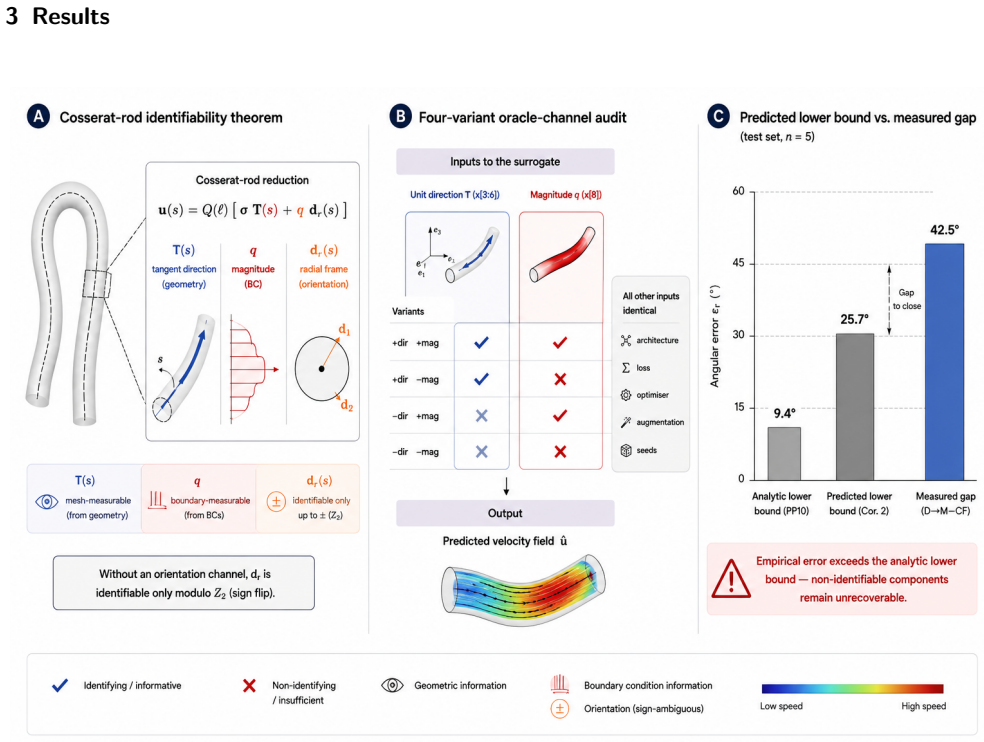
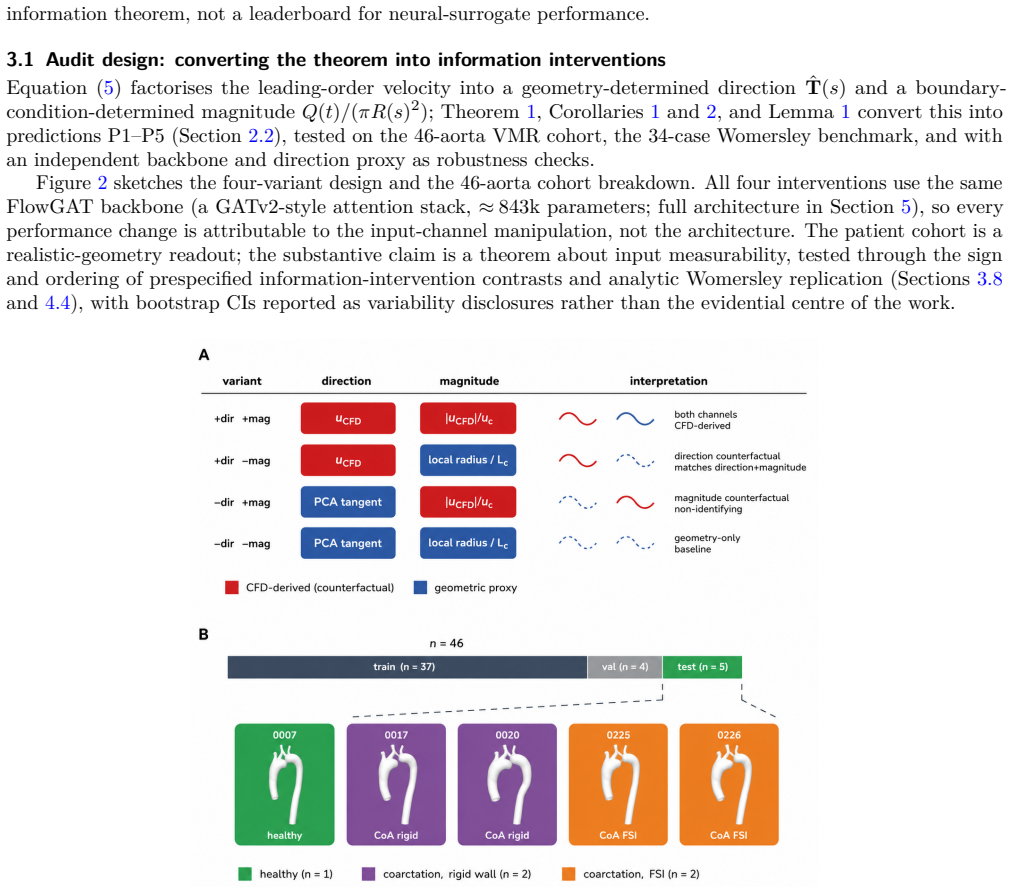
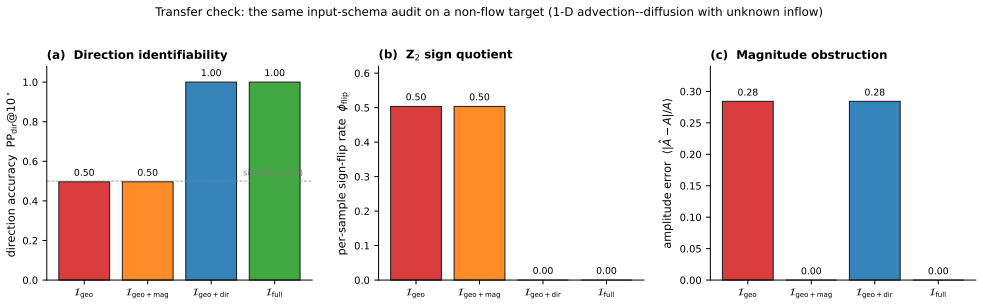
Starting from the Cosserat-rod reduction of incompressible tubular flow, the input-schema identifiability certificate decomposes lumen velocity into a tangent direction measurable directly from the mesh, a magnitude that depends on boundary conditions, and a signed-orientation ambiguity that persists regardless of model changes; this decomposition predicts in advance which oracle-channel interventions will reduce surrogate error and which will leave irreducible ambiguity.
What carries the argument
Input-schema identifiability certificate, which uses a reduced physical model to partition a target field into geometry-measurable, boundary-condition-dependent, and symmetry-quotient components.
If this is right
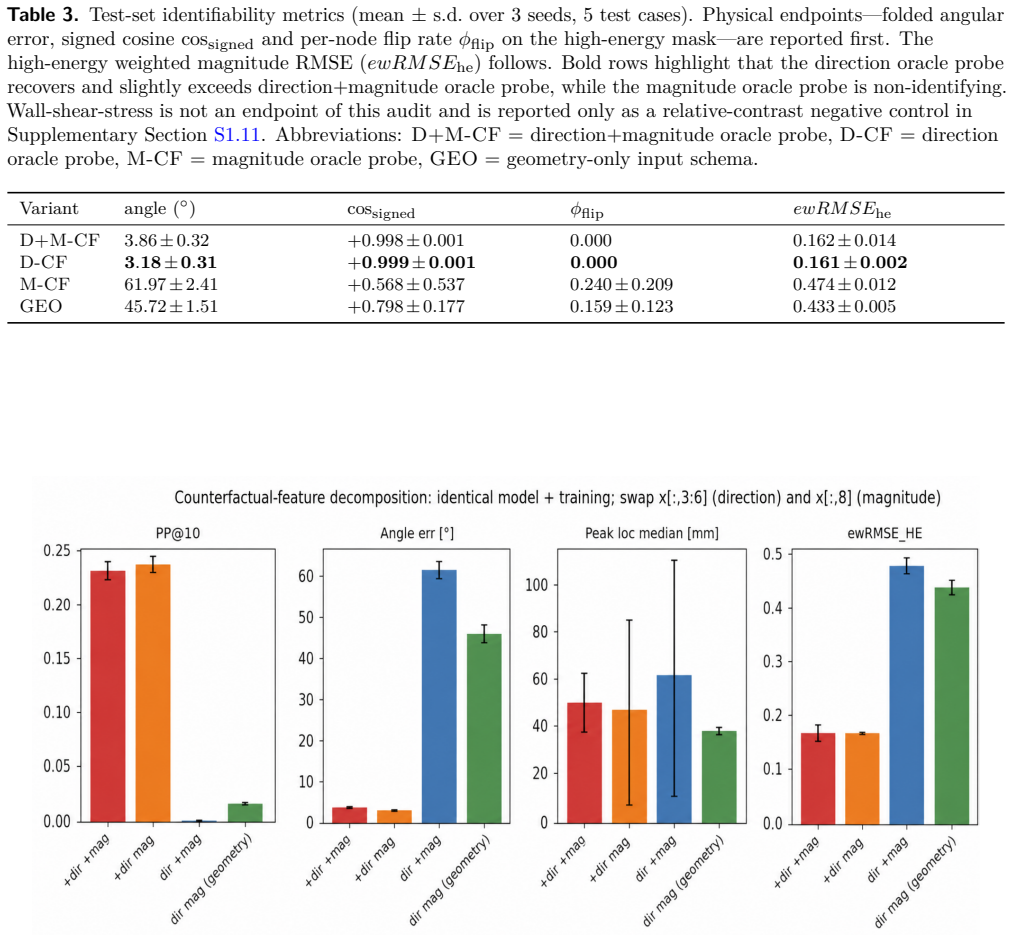
- Supplying signed direction information collapses angular error to the oracle regime.
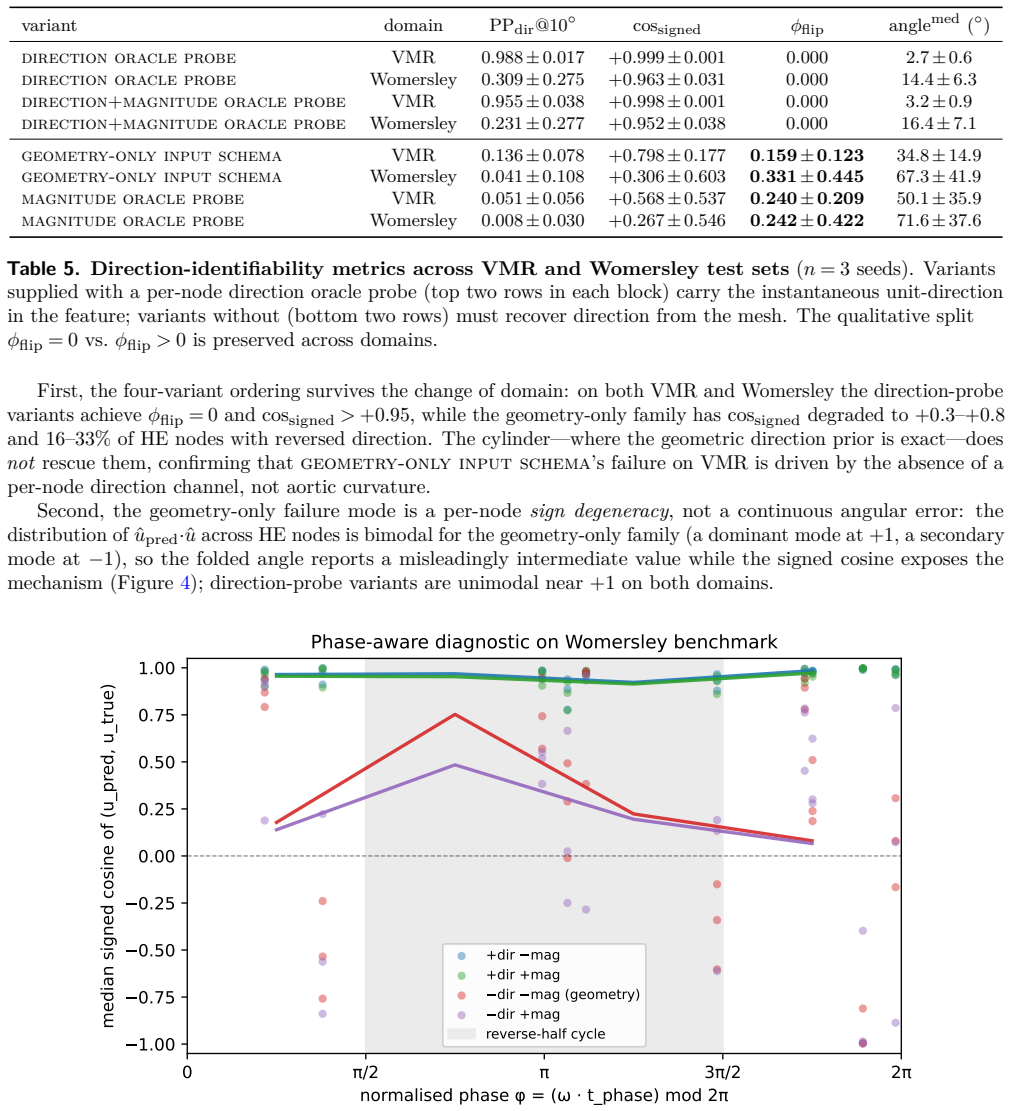
- Supplying magnitude without orientation leaves the sign ambiguity intact and produces 16-33 percent per-node sign flips.
- Ambiguities arising from symmetry cannot be removed by altering architecture, loss, optimizer, or sample size.
- The certificate provides a pre-training diagnostic for deciding whether a surrogate modeling task is physically identifiable.
Where Pith is reading between the lines
- The certificate could be applied to other reduced-order models in fluid mechanics to audit the feasibility of surrogate tasks before data collection.
- In practice it could guide which boundary-condition measurements to prioritize when building training sets for patient-specific flow predictions.
- Aggregate error metrics may conceal the physical sign ambiguity, so per-component diagnostics become necessary for reliable surrogate evaluation.
Load-bearing premise
The Cosserat-rod reduction of incompressible tubular flow correctly separates the lumen velocity into a mesh-measurable tangent direction, a boundary-condition-dependent magnitude, and a signed-orientation ambiguity.
What would settle it
A controlled experiment in which supplying signed direction fails to bring angular error down to the oracle regime, or in which magnitude input alone eliminates the predicted 16-33 percent per-node sign flips, would disprove the certificate's predictions.
Figures
read the original abstract
Physics-informed and data-driven surrogates are increasingly used to approximate mechanics-governed flow fields, but the target quantities assigned to such models are not always identifiable from the input variables available at prediction time. We introduce an input-schema identifiability certificate for computational surrogates. Starting from a reduced physical model, the certificate decomposes a target field into components that are measurable from geometry, components that require boundary-condition information, and components identifiable only up to a symmetry quotient. This yields a pre-training audit: it predicts which oracle-channel interventions should reduce error, which should fail, and which ambiguity cannot be removed by changing the architecture, loss, optimizer, or sample size. We instantiate the framework for incompressible tubular flow using a Cosserat-rod reduction, where lumen velocity separates into a mesh-measurable tangent direction, a boundary-condition-dependent magnitude, and a signed-orientation ambiguity. Controlled experiments on patient-specific aortic CFD geometries, analytic Womersley flows, and an advection-diffusion transfer problem confirm the predicted pattern: supplying signed direction collapses angular error to the oracle regime, whereas supplying magnitude without orientation leaves the predicted sign ambiguity and yields 16-33 percent per-node sign flips. The results provide a mechanics-based diagnostic for deciding whether a surrogate modelling task is physically identifiable before training, and expose failure modes that aggregate error metrics can hide.
Editorial analysis
A structured set of objections, weighed in public.
Referee Report
Summary. The paper introduces an 'input-schema identifiability certificate' derived from a Cosserat-rod reduction of incompressible tubular flow. The certificate decomposes the target lumen velocity into a mesh-measurable tangent direction, a boundary-condition-dependent magnitude, and a signed-orientation symmetry quotient. This decomposition is used to predict, before training, which input interventions (oracle channels) will reduce error, which will fail, and which ambiguities are irreducible by architecture/loss/optimizer/sample size changes. Controlled experiments on patient-specific aortic CFD geometries, analytic Womersley flows, and an advection-diffusion problem are reported to confirm the predicted error patterns, including 16-33% per-node sign flips when signed direction is withheld.
Significance. If the Cosserat-rod decomposition holds to the required accuracy, the certificate supplies a mechanics-grounded pre-training audit that can expose failure modes hidden by aggregate error metrics and guide whether a surrogate task is physically identifiable. The controlled intervention experiments that directly test the certificate's predictions (signed direction collapses error to oracle regime; magnitude alone leaves sign ambiguity) constitute a clear methodological strength.
major comments (2)
- [reduction section / abstract] The load-bearing assumption is the claim that the Cosserat-rod reduction cleanly separates lumen velocity into mesh-measurable tangent, BC-dependent magnitude, and signed-orientation quotient (abstract and the reduction section). No quantitative comparison of this decomposition against the underlying 3D CFD velocity fields is reported; without such a check it is unclear whether secondary flows, wall compliance, or non-circular sections in the aortic geometries introduce errors comparable to the 16-33% sign-flip rates that the certificate is meant to predict.
- [experiments section] The experiments are stated to 'confirm the predicted pattern,' yet the manuscript provides no table or figure that directly maps each intervention (signed direction supplied vs. magnitude only) to the certificate's a-priori forecast for that intervention. Without this explicit mapping, the claim that the certificate 'predicts which oracle-channel interventions should reduce error' rests on post-hoc pattern matching rather than a pre-specified test.
minor comments (1)
- [introduction] Notation for the symmetry quotient and the 'input-schema' is introduced without a compact definition or comparison to related concepts such as identifiability in inverse problems; a short dedicated paragraph would improve readability.
Simulated Author's Rebuttal
We thank the referee for their insightful comments on our manuscript. We provide point-by-point responses below and indicate where revisions will be made.
read point-by-point responses
-
Referee: [reduction section / abstract] The load-bearing assumption is the claim that the Cosserat-rod reduction cleanly separates lumen velocity into mesh-measurable tangent, BC-dependent magnitude, and signed-orientation quotient (abstract and the reduction section). No quantitative comparison of this decomposition against the underlying 3D CFD velocity fields is reported; without such a check it is unclear whether secondary flows, wall compliance, or non-circular sections in the aortic geometries introduce errors comparable to the 16-33% sign-flip rates that the certificate is meant to predict.
Authors: The referee correctly identifies that a quantitative validation of the decomposition accuracy is not provided. While the Cosserat-rod model is a standard reduction for flow in slender tubes and holds exactly for the Womersley analytic cases, its fidelity on the patient-specific aortic geometries (which may include secondary flows and non-circular sections) requires explicit checking. We will add a new appendix section that performs this comparison on the aortic CFD data, quantifying the error in the extracted tangent direction and magnitude relative to the full 3D velocity field. This will allow readers to assess whether the decomposition error is negligible compared to the reported sign-flip rates. revision: yes
-
Referee: [experiments section] The experiments are stated to 'confirm the predicted pattern,' yet the manuscript provides no table or figure that directly maps each intervention (signed direction supplied vs. magnitude only) to the certificate's a-priori forecast for that intervention. Without this explicit mapping, the claim that the certificate 'predicts which oracle-channel interventions should reduce error' rests on post-hoc pattern matching rather than a pre-specified test.
Authors: We agree that presenting an explicit mapping between the a-priori predictions from the certificate and the experimental outcomes would strengthen the validation and clarify that the tests were pre-specified. Although the predictions were derived directly from the certificate before conducting the interventions, this linkage was not tabulated. In the revised manuscript, we will include a table in the experiments section that explicitly lists each oracle-channel intervention, the certificate's predicted impact on error and residual ambiguity, and the corresponding observed results. This will demonstrate the predictive power of the certificate. revision: yes
Circularity Check
No circularity: certificate derived directly from reduced physical model without reduction to fits or self-citations.
full rationale
The paper constructs the input-schema identifiability certificate by starting from the Cosserat-rod reduction of incompressible tubular flow and decomposing the lumen velocity field into mesh-measurable tangent, boundary-condition-dependent magnitude, and signed-orientation components. This decomposition is presented as following from the reduced model equations rather than from any fitted parameters, self-referential definitions, or load-bearing self-citations. The subsequent predictions about oracle interventions and sign ambiguities are tested via controlled experiments on aortic CFD, Womersley flows, and advection-diffusion problems, which serve as external validation rather than tautological confirmation. No steps match the enumerated circularity patterns; the central claim remains independent of its inputs.
Axiom & Free-Parameter Ledger
axioms (1)
- domain assumption The Cosserat-rod reduction of incompressible tubular flow provides a valid decomposition of lumen velocity into mesh-measurable, boundary-condition-dependent, and symmetry-ambiguous components.
invented entities (1)
-
input-schema identifiability certificate
no independent evidence
Reference graph
Works this paper leans on
-
[1]
Raissi, M., Perdikaris, P. & Karniadakis, G. E. Physics-informed neural networks: A deep learning framework for solving forward and inverse problems involving nonlinear partial differential equations.J. Comput. Phys. 378, 686–707, DOI: 10.1016/j.jcp.2018.10.045 (2019)
-
[2]
E.et al.Physics-informed machine learning.Nat
Karniadakis, G. E.et al.Physics-informed machine learning.Nat. Rev. Phys.3, 422–440, DOI: 10.1038/ s42254-021-00314-5 (2021)
2021
-
[3]
G., Hoogeboom, E
Satorras, V. G., Hoogeboom, E. & Welling, M. E(n) equivariant graph neural networks. InInternational Conference on Machine Learning (ICML)(2021)
2021
-
[4]
& Wolterink, J
Suk, J., de Haan, P., Lippe, P., Brune, C. & Wolterink, J. M. LaB-GATr: Geometric algebra transformer for large-scale biomedical surface and volume meshes. InMedical Image Computing and Computer-Assisted Intervention – MICCAI 2024(2024)
2024
-
[5]
InInternational Conference on Learning Representations (ICLR)(2021)
Li, Z.et al.Fourier neural operator for parametric partial differential equations. InInternational Conference on Learning Representations (ICLR)(2021)
2021
-
[6]
Kontolati, K., Goswami, S., Karniadakis, G. E. & Shields, M. D. Learning nonlinear operators in latent spaces for real-time predictions of complex dynamics in physical systems.Nat. Commun.15, 5101, DOI: 10.1038/s41467-024-49411-w (2024)
-
[7]
Vinuesa, R. & Brunton, S. L. Enhancing computational fluid dynamics with machine learning.Nat. Comput. Sci.DOI: 10.1038/s43588-022-00264-7 (2022)
-
[8]
Cremades, A., Hoyas, S. & Vinuesa, R. Classically studied coherent structures only paint a partial picture of wall-bounded turbulence.Nat. Commun.DOI: 10.1038/s41467-025-65199-9 (2025)
-
[9]
Commun.14, 1043, DOI: 10.1038/s41467-023-36657-z (2023)
Fajardo-Fontiveros, O.et al.Fundamental limits to learning closed-form mathematical models from data.Nat. Commun.14, 1043, DOI: 10.1038/s41467-023-36657-z (2023)
-
[10]
Ku, D. N. Blood flow in arteries.Annu. Rev. Fluid Mech.29, 399–434, DOI: 10.1146/annurev.fluid.29.1.399 (1997)
-
[11]
Steinman, D. A. Image-based computational fluid dynamics modeling in realistic arterial geometries.Annals Biomed. Eng.30, 483–497, DOI: 10.1114/1.1467679 (2002)
-
[12]
Formaggia, L., Lamponi, D. & Quarteroni, A. One-dimensional models for blood flow in arteries.J. Eng. Math. 47, 251–276, DOI: 10.1023/B:ENGI.0000007980.01347.29 (2003)
-
[13]
Sherwin, S. J., Franke, V., Peiró, J. & Parker, K. One-dimensional modelling of a vascular network in space-time variables.J. Eng. Math.47, 217–250, DOI: 10.1023/B:ENGI.0000007979.32871.e2 (2003)
-
[14]
& Wolterink, J
Suk, J., de Haan, P., Lippe, P., Brune, C. & Wolterink, J. M. SE(3)-equivariant graph neural networks for learning glymphatic fluid dynamics: GEM-GCN for vessel wall shear stress.Comput. Biol. Medicine(2024)
2024
-
[15]
Reports16, DOI: 10.1038/s41598-026-47410-z (2026)
Luo, T.-T., Yang, L., Chen, J.et al.Physics-informed graph neural networks for real-time prediction of wall shear stress in stenotic coronary arteries.Sci. Reports16, DOI: 10.1038/s41598-026-47410-z (2026)
-
[16]
Cardiovasc
Pegolotti, L.et al.Reduced-order graph neural network surrogates for cardiovascular hemodynamics.Front. Cardiovasc. Medicine(2024)
2024
-
[17]
Methods Programs Biomed.257, 108427, DOI: 10.1016/j.cmpb.2024.108427 (2024)
Sen, A.et al.Physics-informed graph neural networks to solve 1-D equations of blood flow.Comput. Methods Programs Biomed.257, 108427, DOI: 10.1016/j.cmpb.2024.108427 (2024)
-
[18]
Medicine9, 212, DOI: 10.1038/s41746-026-02404-z (2026)
Lannelongue, V.et al.Physics constrained graph neural network for real time prediction of intracranial aneurysm hemodynamics.npj Digit. Medicine9, 212, DOI: 10.1038/s41746-026-02404-z (2026)
-
[19]
Leakage and the reproducibility crisis in machine-learning-based science.Patterns, 4(9):100804, 2023
Kapoor, S. & Narayanan, A. Leakage and the reproducibility crisis in machine-learning-based science.Patterns 4, 100804, DOI: 10.1016/j.patter.2023.100804 (2023)
-
[20]
Young, A.et al.Data leakage in deep learning for Alzheimer’s disease diagnosis: a scoping review of method- ological rigor and performance inflation.Diagnostics(2025)
2025
-
[21]
S.Nonlinear Problems of Elasticity, vol
Antman, S. S.Nonlinear Problems of Elasticity, vol. 107 ofApplied Mathematical Sciences(Springer, 2005), 2nd edn
2005
-
[22]
Westerhof, N., Lankhaar, J.-W. & Westerhof, B. E. The arterial Windkessel.Med. & Biol. Eng. & Comput.47, 131–141, DOI: 10.1007/s11517-008-0359-2 (2009). 33/34
-
[23]
Liu, X.-Y., Zhu, M. & Wang, J.-X. Multi-resolution partial differential equations preserved learning framework for spatiotemporal dynamics.Commun. Phys.7, 31, DOI: 10.1038/s42005-024-01521-z (2024)
-
[24]
& Fink, O
Sharma, V. & Fink, O. A physics-informed graph neural network conserving linear and angular momentum for dynamical systems.Nat. Commun.(2025)
2025
-
[25]
& Kozerke, S
Dirix, P., Jacobs, L., Buoso, S. & Kozerke, S. Synthesizing scalable CFD-enhanced aortic 4D flow MRI for assessing accuracy and precision of deep-learning image reconstruction and segmentation tasks. InInternational Workshop on Simulation and Synthesis in Medical Imaging, 157–166 (2024)
2024
-
[26]
Womersley, J. R. Method for the calculation of velocity, rate of flow and viscous drag in arteries when the pressure gradient is known.The J. Physiol.127, 553–563, DOI: 10.1113/jphysiol.1955.sp005276 (1955)
-
[27]
Hsu, T. W., Fang, Z., Bansil, A.et al.Accurate prediction of tensorial spectra using equivariant graph neural network.Nat. Commun.17, 3330, DOI: 10.1038/s41467-026-69159-9 (2026)
-
[28]
Grimm, V., Heinlein, A. & Klawonn, A. Learning the solution operator of two-dimensional incompressible Navier–Stokes equations using physics-aware convolutional neural networks.J. Comput. Phys.538, 114027, DOI: 10.1016/j.jcp.2025.114027 (2025)
-
[29]
Ouyang, W., Shin, Y., Liu, S.-W. & Lu, L. Neural-operator element method: efficient and scalable finite element method enabled by reusable neural operators.Nat. Comput. Sci.6, 417–429, DOI: 10.1038/s43588-026-00974-2 (2026)
-
[30]
Biomech.(2020)
Ferdian, E.et al.Deep learning for time-resolved 3d velocity field reconstruction in the aorta from 4D flow MRI.J. Biomech.(2020). 31.Vascular Model Repository. Vascular model repository (2024). https://www.vascularmodel.com. 34/34
2020
discussion (0)
Sign in with ORCID, Apple, or X to comment. Anyone can read and Pith papers without signing in.