REVIEW 5 major objections 6 minor 109 references
Typical Output States of Monitored Random Clifford Circuits: A Graph-Theoretic Approach
T0 review · 5 major / 6 minor · reviewed 2026-08-15 · deepseek-v4-flash
Pith's one-line read Typical output states of monitored random Clifford circuits are governed by an emergent dense random subgraph that acts as a smaller unitary circuit.
desk verdict The GHZ even-odd result is real and worth taking seriously; the emergent G(N_sub,1/2) subgraph claim is a suggestive heuristic that needs more than the marginal-edge argument the paper actually supplies. read the letter →
The pith
A machine-rendered reading of the paper's core claim, the machinery that carries it, and where it could break.
The reading
What carries the argument
The central object is the canonical extended graph state: a stabilizer state written as local Clifford gates applied to a graph state, with a numbering gauge that makes the correspondence one-to-one. The argument is carried by classifying the graph updates induced by each Clifford gate and measurement into three edge-toggle types, $C_0$, $C_1$, and $C_2$. The $C_2$ toggles—nonlocal moves that flip a remote edge when two neighbors of the gate are connected—are shown to drive any subgraph whose averaged edge density exceeds $N^{-1/2}$ into the uniformly random form $G(N_{\mathrm{sub}},1/2)$; the $C_1$ toggles, which act as local interactions among adjacency-matrix entries, are then used in a mean-field equation that determines $p_c$.
What would settle it
Take an output state at $p=0.14$ with $N=1000$, extract its adjacency matrix, identify the dense subgraph by vertex degree, and compare its edge-count distribution or triangle count with that of $G(N_{\mathrm{sub}},1/2)$; a systematic deviation—for instance, a subgraph whose edge probability depends on $p$ or on spatial position—would falsify the claim that the subgraph is Erdős–Rényi at $r=1/2$. A more direct check is to measure whether the edge probability of the dense subgraph stays at $1/2$ as $p$ approaches $p_c$ from below.
Extended reading notes
Core claim
On its own terms, the central discovery is that the graph encoding of a stabilizer state is not just a bookkeeping device: in the thermodynamic limit, the graphs of uniformly random stabilizer states converge to the Erdős–Rényi ensemble $G(N,1/2)$, making the nullity of the adjacency matrix the natural carrier of tripartite GHZ entanglement. For monitored one-dimensional Clifford circuits in the volume-law phase, the paper finds that the output-state adjacency matrix contains a dense subgraph of exactly the same class, $G(N_{\mathrm{sub}},1/2)$, regardless of the measurement rate $p$, with $N_{\mathrm{sub}}/N$ shrinking toward the area-law phase. Because $G(N,1/2)$ is precisely the graph ensemble produced by deep unitary Clifford circuits, the paper concludes that the monitored output state is, up to weakly entangled 'sparse' qubits, the output of a unitary circuit on $N_{\mathrm{sub}}$ qubits. This hidden unitary circuit is then identified as the mechanism behind the plateau in GHZ content ($\langle g_3\rangle\approx 1.25$) across the volume-law phase and behind the error-correcting properties previously observed there. The paper also derives the measurement-induced transition critical point $p_c=0.1608$ from a mean-field treatment of one class of edge toggles.
Load-bearing premise
The derivation of the emergent dense subgraph assumes that long-range edges are so sparse and so uniformly distributed that each remote pair of qubits is toggled independently, ignoring correlations between edges, fluctuations in vertex degree, and gates that delete edges.
Editorial extensions
If this is right
- The GHZ content of random stabilizer states becomes $\langle g_3\rangle = 1.204$ for even $N$ and $1.325$ for odd $N$, resolving the even–odd effect and explaining why the GHZ plateau in monitored circuits hovers near $1.25$ across the volume-law phase.
- The output state of a monitored circuit in the volume-law phase is, up to weakly entangled corrections, the output of a unitary Clifford circuit on $N_{\mathrm{sub}}$ qubits, so $N_{\mathrm{sub}}/N$ serves as an order parameter for the measurement-induced transition.
- The volume-law phase inherits good quantum error-correcting codes from the hidden unitary subgraph, which directly accounts for dynamical purification and error-correction behavior observed in monitored circuits.
- The mean-field equation for the $C_1$ toggles places the critical measurement rate at $p_c = 0.1608$, matching numerical estimates near $0.16$.
- Dense vertices cluster along the one-dimensional chain in a way captured by an infection-recovery model, suggesting that the measurement-induced transition can be viewed as an absorbing-state phase transition.
Reading between the lines
- A testable extension: if the hidden unitary circuit is real, logical operators of the embedded error-correcting code should be supported mainly on the dense subgraph; one could verify this by computing the code distance of the subgraph alone and comparing it with the full-state code distance.
- The infection-recovery toy model's absorbing-state transition invites a critical-exponent analysis: scaling of the dense-vertex density near $p_c=0.1608$ could reveal whether the measurement-induced transition belongs to the directed percolation universality class, a question the paper leaves open.
- The same graph-toggle decomposition could carry over to circuits with non-Clifford gates, where the $C_1$ toggles' interpretation as local interactions between adjacency-matrix entries suggests a route toward a kinetic theory of magic or stabilizer entropy, though the paper does not pursue this.
- The nullity-based formula $g_3 = \dim\ker\Gamma - \sum_\omega \dim\ker\Gamma_\omega$ suggests that other adjacency-matrix invariants, such as rank statistics over the real numbers, may correspond to as-yet-unidentified multipartite entanglement measures in stabilizer states.
Signed reviews
Editorial analysis
A structured set of objections, weighed in public.
Referee Report
Summary. The paper develops a graph-state framework for characterizing typical output states of monitored random Clifford circuits. It first argues that the graph part of random stabilizer states in the Hu–Khesin canonical form approaches the Erdős–Rényi ensemble G(N,1/2) at large N, and uses this to derive the average GHZ content of random stabilizer states, reporting 1.204 for even N and 1.325 for odd N via a rank count of symmetric binary matrices over F2. Turning to monitored 1D circuits, the paper classifies graph updates into C0, C1, and C2 edge toggles, claims that C2 toggles generate an emergent dense induced subgraph G(N_sub,1/2) in the volume-law phase, and uses this picture to explain the GHZ plateau and the quantum error-correcting capability of the volume-law phase. It also presents an infection-recovery toy model for the spatial clustering of dense vertices and a mean-field analysis of C1 toggles giving p_c = 0.1608, in agreement with the numerically known value p_c ≈ 0.16.
Significance. If the central structural claim is correct, the framework would be a genuinely useful complement to replica and clipped-gauge methods: it provides analytic values for a quantity previously studied only numerically or asymptotically, offers a concrete picture of the volume-law phase as a hidden unitary circuit, and produces a graph-theoretic estimate of the MIPT critical point. The GHZ derivation is the strongest part of the paper: the rank-even lemma, the counting of rank-2m adjacency matrices over F2, and the reduction to dim ker Γ through the V_ω subspaces are coherent and checkable, and Appendix A gives a useful universality argument for independent Bernoulli entries. The monitored-circuit part is considerably more heuristic: the emergent-subgraph mechanism in Sec. VI C rests on independence and sparseness assumptions that are not controlled, and the numerical evidence checks only the degree distribution, not the joint edge distribution. The paper is therefore significant in potential but currently falls short of establishing its headline structural claim.
major comments (5)
- [Sec. VI C, Eq. (39)] The step from the parity calculation to the conclusion that the induced subgraph is G(N_sub,1/2) is not justified. Equation (39) computes only the marginal probability that a fixed remote pair is toggled an odd number of times, and it does so by treating the N/2 gate events as independent Bernoulli trials with common probability q = 0.4r^2. The events {i ∈ µ(k) and j ∈ µ(k+1)} are correlated across different k because vertex neighborhoods overlap and because the graph co-evolves during the circuit; moreover, several gates in Table I (for example (X,X):(1∼2) and (Y,Y):(1∼2)) delete existing edges as a side effect, so the net update is not a sequence of independent flips. The derivation therefore yields a marginal probability, not the joint distribution of the edge indicators. The numerical check in Fig. 8(b) verifies only the normalized degree distribution (r_sub ≈ 0.5), which is consistent with many correlated graph ensembles. Please either prove asymptotic independence or negative correlation of the edge indicators, or test the G(N_sub,1/2) hypothesis directly by comparing quantities sensitive to the joint distribution, such as triangle counts, edge-correlation functions, or the adjacency spectrum. Until then, the hidden-unitary-circuit picture and the resulting explanation of the GHZ plateau and of quantum error correction remain heuristic.
- [Sec. VI C and Sec. IV A] The regime of validity of Eq. (39) is unclear. The calculation assumes a sparse graph with an infinitesimal homogeneous long-range averaged edge density r → 0^+, but Sec. IV A and Figs. 3 and 4 show a finite long-range AED in the volume-law phase, with O(1) values for p well below p_c. The text argues that C2 toggles create a gap between o(N^{-1/2}) and 1/2 in the scaling of r, but it does not explain how the dense/sparse classification emerges dynamically from a graph whose bulk AED is not infinitesimal, nor why the off-diagonal blocks in Fig. 7(b) should have r = o(N^{-1/2}) in the thermodynamic limit. Please specify precisely which density r enters Eq. (39), how the dense subset is selected, and provide numerical evidence that the complementary blocks are indeed o(N^{-1/2}) rather than merely small at the system sizes shown.
- [Sec. III A and Sec. III D] The statement that random stabilizer states converge to G(N,1/2) is stronger than what is actually shown. Equation (11) establishes only the marginal probability of an edge, with an O(2^{-k}) bias for edges incident to the kth vertex, and the canonical extended-graph construction imposes additional constraints (the role of H vertices and the exclusion of the empty edge set in the connected case) that correlate different edges. The bound on the fraction of biased edges does not by itself imply convergence in total variation nor convergence of nonlinear functionals such as the nullity distribution. Since the GHZ derivation in Sec. III D replaces the actual ensemble by G(N,1/2), and Appendix A proves universality only for independent Bernoulli entries, the paper needs either a universality argument for the actual dependent near-Bernoulli ensemble or a more modest statement of the convergence result that is actually used.
- [Sec. VI C, item 2] The claim that the output state is equivalent to a unitary circuit on N_sub qubits weakly perturbed by N−N_sub qubits carrying little entanglement needs a precise metric, and the text's own edge counting casts doubt on it. The paper states that edges connecting the dense subgraph to the outside contribute O(N^{1/2}) per vertex, i.e., O(N^{3/2}) cross edges in total. For a graph state, the entanglement across the dense/sparse partition is controlled by the rank over F2 of the off-diagonal adjacency block, not by the normalized edge density; a random off-diagonal block with density o(N^{-1/2}) can still have rank proportional to min(N_sub, N−N_sub), giving volume-law entanglement between the two parts. The notion of 'weakly perturbed' must therefore be specified (for example, closeness of local reduced density matrices, preservation of code distance, or a bound on the rank of the off-diagonal block), and the relevant quantity should be checked numerically. Without this, the quantum error-correction interpretation is not established by the present argument.
- [Sec. VI D and Sec. VI E] The critical-point estimate p_c = 0.1608 is presented as a prediction, but the derivation in Eq. (40) relies on uncontrolled approximations: C2 toggles are neglected, gates with 'negative price' are dropped, and the critical point is assumed to have a homogeneous edge density without a demonstrated justification. In addition, the infection-recovery toy model in Sec. VI D places its absorbing transition near p ≈ 0.16 only after choosing the gate-induced infection rate α_u(p) = 0.4 − 0.1⟨Γ1⟩, while the earlier discussion selects α_≁ = 0.35 'in hindsight' to match the dense-fraction data. I recommend that Eqs. (38)–(40) be explicitly labeled as a heuristic mean-field estimate and that the abstract and conclusions soften the claim that the graph argument determines the critical point.
minor comments (6)
- [Abstract and Introduction] The phrase 'weekly perturbed' should be 'weakly perturbed' in the abstract and in the corresponding sentence in Sec. I B.
- [Sec. VI D] In the paragraph introducing the infection-recovery model, 'see Ref. VI D' should be 'see Sec. VI D'.
- [Sec. VI C] The text says C2 toggles are also seen in 'X- and Z-measurements', but according to Table I it is X- and Y-measurements that generate the relevant multi-edge toggles; Z-measurements only isolate the measured vertex. This appears to be a typo.
- [Sec. I] The Introduction writes 'Shur–Weyl duality'; the standard spelling is 'Schur–Weyl duality'.
- [References] Reference [64] contains a malformed DOI ('10.1103/fl34-h1p1') and should be corrected.
- [Sec. III D, Eq. (34)] The asymptotic limits 1.204 and 1.325 are asserted without showing the evaluation of the sum or a reproducible calculation. Since these are headline quantitative results, please include the asymptotic analysis or a short derivation (or a small code snippet) so that the values can be independently checked.
Circularity Check
No significant circularity; the GHZ and p_c derivations are self-contained, while the emergent-G(N_sub,1/2) claim rests on acknowledged heuristics rather than on fitted outputs.
full rationale
The central GHZ calculation (Sec. III) is an independent F2 rank-counting problem: Eq. (13) expresses g3 in graph-nullity terms, Eq. (32) counts rank-2m adjacency matrices, and Eq. (34) gives the asymptotic even/odd values 1.204 and 1.325 without any input from the monitored-circuit numerics. The p_c = 0.1608 result (Sec. VI E) is likewise solved from the self-consistency condition Eq. (40), with rates 0.2, 0.35, and 0.4 derived from the gate classification in Tab. I rather than fitted to the numerical p_c; the comparison with p_c ≈ 0.16 is an external benchmark, not an input. The emergent G(N_sub,1/2) subgraph argument in Sec. VI C is heuristic: Eq. (39) computes a marginal edge probability under assumptions of sparsity, homogeneous long-range AED, and independent edge toggles, and the step from this marginal result to a full Erdős–Rényi joint distribution is an approximation rather than a proof. That is a correctness or rigor concern, not a circularity. The toy-model infection and recovery rates include openly acknowledged 'in hindsight' choices (e.g., 0.35 and 0.4) used to reproduce numerical densities and the transition location, but this is an illustrative calibration, not a disguised prediction of the paper's main results. The self-citation [31] supplies numerical comparison data for the GHZ plateau and is not load-bearing for any analytical derivation. Overall, the derivation chain does not reduce to its inputs by construction.
Assumptions & free parameters
free parameters (3)
- alpha_neq (gate infection rate for disconnected dense-sparse pair) =
0.35
- alpha_sim (gate infection rate for connected dense-sparse pair) =
0.3
- measurement-induced infection probability coefficient =
2/3
assumptions (5)
- domain assumption The Hu-Khesin canonical extended graph state is a bijection onto N-qubit stabilizer states for a fixed vertex numbering, so uniform stabilizer states map to uniformly distributed canonical graphs.
- domain assumption The graph-update rules in Table I, with local Clifford corrections pushed forward to the final layer, correctly describe the canonical graph of the state throughout the circuit.
- ad hoc to paper For the emergent-subgraph argument, the long-range averaged edge density is homogeneous and infinitesimal, and C2 edge toggles act independently.
- ad hoc to paper At the critical point, the edge density in the bulk is homogeneous, and C1 gates that delete edges as a side effect can be ignored in the mean-field equilibrium.
- standard math Standard finite-field counting formulas for GL(N,F2), Sp(2m,F2), and the even rank of alternating matrices over F2 are correct.
Cite this review
Pith. "Pith review of Typical Output States of Monitored Random Clifford Circuits: A Graph-Theoretic Approach." pith.science (2026). https://pith.science/paper/IBR4AM4W
@misc{pith2026260803102,
  author       = {Pith},
  title        = {Pith review of: Typical Output States of Monitored Random Clifford Circuits: A Graph-Theoretic Approach},
  year         = {2026},
  howpublished = {\url{https://pith.science/paper/IBR4AM4W}},
  note         = {Machine review of arXiv:2608.03102}
}
abstract
Monitored random Clifford circuit is a paradigmatic platform for exploring non-equilibrium quantum many-body dynamics using quantum-information methods. It is well-known for exhibiting a measurement-induced phase transition (MIPT) between volume-law and area-law phases of bipartite entanglement. In this Article, we develop a graph-state based framework that grants direct access to the typical output states of monitored random Clifford circuits. We first show that, in the large-$N$ limit, where $N$ denotes qubit number, the graph representations of random stabilizer states converge to the Erd\H{o}s--R\'{e}nyi random graph ensemble $G(N,1/2)$. This observation allows us to resolve the open problem of Greenberger--Horne--Zeilinger (GHZ) entanglement in random stabilizer states. We derive analytically the mean GHZ content, $\langle g_3\rangle=1.204$ for even $N$ and $1.325$ for odd $N$. For monitored one dimensional (1D) circuits in the volume-law phase, we uncover an emergent dense subgraph of the form $G(N_{\mathrm{sub}},1/2)$ in the output-state graphs. This implies that the output state of a monitored circuit is equivalent to an output of a unitary circuit on $N_{\mathrm{sub}}$ qubits, weakly perturbed by the remaining $N-N_{\mathrm{sub}}$ qubits carrying little entanglement. This result directly accounts for the quantum error-correcting capability of the volume-law phase. We further identify a clustering effect in the spatial distribution of the dense subgraph along the 1D qubit chain, and reproduce it with an infection-recovery toy model that exhibits a measurement-induced absorbing-state phase transition. Finally, we locate the critical point of the MIPT at $p_c = 0.1608$ through a mean-field argument on the graph, in excellent agreement with the numerical result $p_c\approx 0.16$.
Figures


Figures from the paper (8 more)




Reference graph
Works this paper leans on
-
[1]
thermodynamic limit
A more rigorous treatment The above argument is heuristic but captures the es- sential physics. Here we present another proof having more sense of rigor. Due to Eq. (7), the binary symplectic representation of the stabilizer group of a graph state is S={(x,Γx)|x∈F N 2 }.(16) A stabilizer isnot supportedon partyω∈{A,B,C}if and only ifx ω = 0 and (Γx) ω = 0...
-
[2]
[31] is that in each state trajectory of unitary circuit,g 3 al- ways changes by multiples of two
The rank ofΓis even An interesting numerical observation made in Ref. [31] is that in each state trajectory of unitary circuit,g 3 al- ways changes by multiples of two. From the perspective of graph theory, it simply follows from the fact that the rank of any adjacency matrix overF2 is always even. This is a well-know result about skew-symmetric matrix. W...
-
[3]
Thus, the restriction of Γ to span{⃗ v,⃗ v∗,⃗ w,⃗ w∗}decomposes into two identical 2×2 blocks, each of rank 2
Once⃗ wis fixed in this manner, the non-degeneracy of the form on the quotient space guarantees the exis- tence of a conjugate vector⃗ w∗ satisfying⃗ wT ∗ Γ⃗ w= 1, ⃗ wT ∗ Γ⃗ v= 0, and⃗ wT ∗ Γ⃗ v∗ = 0. Thus, the restriction of Γ to span{⃗ v,⃗ v∗,⃗ w,⃗ w∗}decomposes into two identical 2×2 blocks, each of rank 2. Repeating this procedure itera- tively exhaus...
-
[4]
isolatedv 1
The Even–Odd Effect Here we count the number of rank-2madjacency ma- trix withman integer. Since the adjacency matrix can be transformed into blocks of 0 1 1 0 , a new graph can be obtained by congruence, i.e.,hΓ 2mhT, from a stan- dard graph Γ2m. Therein,hbelongs to the general linear matrix group overF 2,h∈GL(N,F 2), and Γ 2m is the block-diagonal matri...
-
[5]
dense” and “sparse
Emergent Erd˝ os–R´ enyi SubgraphG(Nsub,1/2) There areN/2 independent gates in each circuit layer, and every gate has a chance ofq= 0.4r 2 to establish aC 2 toggle for (vi≁v j). Thus, they are connected eventually, Γij→1, only if suchC 2 toggle occurs for an odd number of gates among allN/2 gates. The probability for this to happen turns out to be Pr(Γij|...
-
[6]
The same reasoning also applies to dynamics
Perhaps not many people have questioned, but it strongly suggests that MIPT is a phase transi- tion rather than a crossover, considering the de- pendence of steady-state long-range AEDronp will experience a leap. The same reasoning also applies to dynamics. A dynamical phase transi- tion is observed for the emergence of GHZ entan- glement [31]: AED is bui...
-
[7]
It implies that the output state of a monitored random Clifford circuits can be un- 13 derstood as the output of a unitary Clifford cir- cuits overN sub qubits (see Sec
The subgraph isG(N sub,1/2) rather than any other G(N′ sub,r <1/2). It implies that the output state of a monitored random Clifford circuits can be un- 13 derstood as the output of a unitary Clifford cir- cuits overN sub qubits (see Sec. III A), which are then perturbed byN−N sub qubits with little en- tanglement. This result directly relates the output o...
-
[8]
interaction
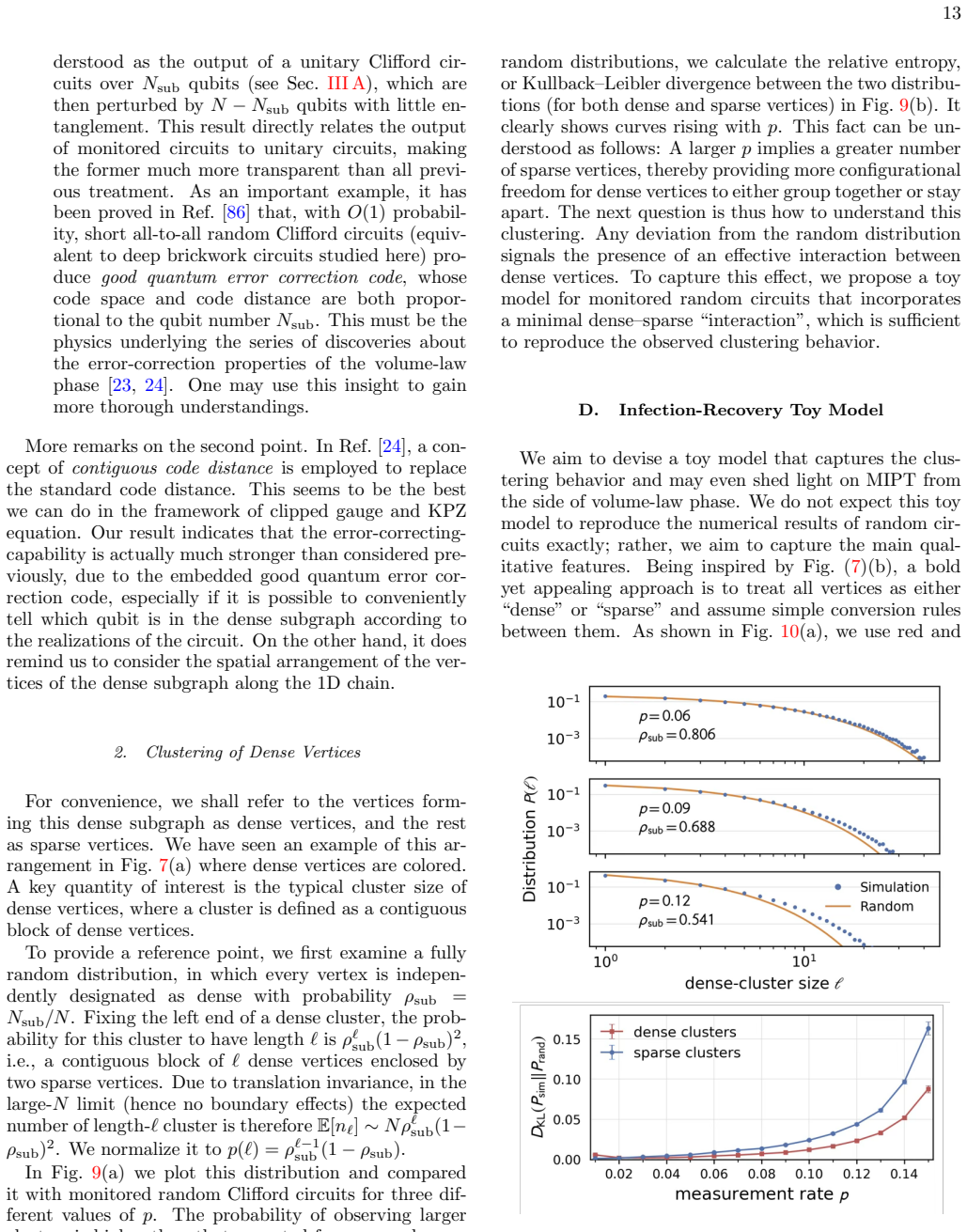
Clustering of Dense Vertices For convenience, we shall refer to the vertices form- ing this dense subgraph as dense vertices, and the rest as sparse vertices. We have seen an example of this ar- rangement in Fig. 7(a) where dense vertices are colored. A key quantity of interest is the typical cluster size of dense vertices, where a cluster is defined as a...
Show all 109 references
-
[9]
10(b): Assumingv 1 is a sparse vertex whilev 2 is dense, we need to determine the rate of infection by unitary gate
Rate of Infection via Gates Firstly, we consider the left configuration of Fig. 10(b): Assumingv 1 is a sparse vertex whilev 2 is dense, we need to determine the rate of infection by unitary gate. Refer- ring to Tab. I, whenv 1 andv 2 are connected (v 1∼v 2), we examine ifG P,...
-
[10]
The dynamics is controlled by a single parameterp∈[0,1], which tunes the recovery probability
Summary of the Toy Model To summarize, we consider a 1D chain ofNsites. The dynamics is controlled by a single parameterp∈[0,1], which tunes the recovery probability. We sweep over the chain simulating the brickwork circuits. If a nearest- neighboring pair have opposite colors...
-
[11]
interaction
Numerical Results We simulated the infection-recovery toy model with an initial state with 100% red sites and show the results of (normalized) cluster-size distribution for three values ofpin Fig. 11(a). More details about the simulation is listed in the caption thereof. Clust...
-
[12]
We established that uniformly random stabilizer states correspond asymptotically to Erd˝ os–R´ enyi random graphsG(N,1/2), which allowed us to de- rive the statistics of GHZ entanglement and resolve the even-odd effect analytically
-
[13]
This classifica- tion is proved to be useful as it helps us to quickly capture a series of important features
We demonstrated that the graph-update rules re- duce to three types of edge toggles. This classifica- tion is proved to be useful as it helps us to quickly capture a series of important features
-
[14]
It enables the straightforward understanding of the volume- law phase by the relatively simpler unitary circuits
We found that the nonlocalC 2 toggles generate the emergent subgraph in the class ofG(N sub,1/2), rendering a physical picture that the output of monitored circuits can be obtained from that of an smaller but unitary circuits by a slight coupling to qubits carrying little enta...
-
[15]
The model is perhaps over-simplified but it still captures the clustering of dense vertices and the MIPT in the form of an absorbing-state phase transition
We also propose a toy model, where the interplay between the dense subgraph and its sparse comple- ment by local interactions of infection and recov- ery. The model is perhaps over-simplified but it still captures the clustering of dense vertices and the MIPT in the form of an...
-
[16]
Then, a mean-field treatment of theC 1 tog- gles leads to an estimatep c = 0.1608, in excellent agreement with numerical simulations
We show thatC 1 toggles are actually local interac- tions between the entries of graph adjacency ma- trix. Then, a mean-field treatment of theC 1 tog- gles leads to an estimatep c = 0.1608, in excellent agreement with numerical simulations. Our results demonstrate that the gra...
-
[17]
Universality of the nullity distribution for Erd˝ os–R´ enyi random graphs We learn that the nullity distribution isr-independent from a universality theorem of Nguyen and Wood for ran- dom skew-symmetric matrices [88]. Their result concerns integer-valued skew-symmetric matri...
-
[18]
Stabilizers of the post-measurement states (I± P1)|Γ⟩are different by some signs
Graph operations for Gates The new stateG P,Q|Γ⟩can be expanded as 1 2 (I+P 1) +Q 2(I−P 1)|Γ⟩ ,(B10) where (I±P 1) is the projector onto the±1 eigenstate ofP 1. Stabilizers of the post-measurement states (I± P1)|Γ⟩are different by some signs. It means that the states themselve...
-
[19]
This operation is based on the formula [84] HaHb|Γ⟩=Z aZb Y i∈µ∗(x) Y j∈µ∗(y) CZi,j|Γ⟩,(B12) which is conditioned on (va,vb) is connected
Graph operations for the canonical form If the two ends of an edge are both assigned a Hadamard gate, or the vertex larger numbered is as- signed a Hadamard, extra graph operations are neces- sary to bring it into the canonical form. This operation is based on the formula [84]...
-
[20]
M. P. Fisher, V. Khemani, A. Nahum, and S. Vijay, Random quantum circuits, Annual Review of Condensed Matter Physics14, 335 (2023)
2023
-
[21]
Gottesman, The Heisenberg representation of quan- tum computers (1998), arXiv:quant-ph/9807006 [quant- ph]
D. Gottesman, The Heisenberg representation of quan- tum computers (1998), arXiv:quant-ph/9807006 [quant- ph]
1998 arXiv
-
[22]
Aaronson and D
S. Aaronson and D. Gottesman, Improved simulation of stabilizer circuits, Phys. Rev. A70, 052328 (2004)
2004
-
[23]
Anders and H
S. Anders and H. J. Briegel, Fast simulation of stabilizer circuits using a graph-state representation, Phys. Rev. A 73, 022334 (2006)
2006
-
[24]
Y. Li, X. Chen, and M. P. A. Fisher, Quantum zeno effect and the many-body entanglement transition, Phys. Rev. B98, 205136 (2018)
2018
-
[25]
A. Chan, R. M. Nandkishore, M. Pretko, and G. Smith, Unitary-projective entanglement dynamics, Phys. Rev. B 99, 224307 (2019)
2019
-
[26]
Skinner, J
B. Skinner, J. Ruhman, and A. Nahum, Measurement- induced phase transitions in the dynamics of entangle- ment, Phys. Rev. X9, 031009 (2019)
2019
-
[27]
Szyniszewski, A
M. Szyniszewski, A. Romito, and H. Schomerus, Entan- glement transition from variable-strength weak measure- ments, Phys. Rev. B100, 064204 (2019)
2019
-
[28]
Nahum, S
A. Nahum, S. Roy, B. Skinner, and J. Ruhman, Mea- surement and entanglement phase transitions in all-to- all quantum circuits, on quantum trees, and in landau- ginsburg theory, PRX Quantum2, 010352 (2021)
2021
-
[29]
Block, Y
M. Block, Y. Bao, S. Choi, E. Altman, and N. Y. Yao, Measurement-induced transition in long-range in- teracting quantum circuits, Phys. Rev. Lett.128, 010604 (2022)
2022
-
[30]
Sharma, X
S. Sharma, X. Turkeshi, R. Fazio, and M. Dalmonte, Measurement-induced criticality in extended and long- range unitary circuits, SciPost Phys. Core5, 023 (2022)
2022
-
[31]
Lavasani, Y
A. Lavasani, Y. Alavirad, and M. Barkeshli, Topologi- cal order and criticality in (2 + 1)D monitored random quantum circuits, Phys. Rev. Lett.127, 235701 (2021)
2021
-
[32]
Lavasani, Y
A. Lavasani, Y. Alavirad, and M. Barkeshli, Measurement-induced topological entanglement transi- tions in symmetric random quantum circuits, Nature Physics17, 342 (2021)
2021
-
[33]
Ippoliti and V
M. Ippoliti and V. Khemani, Postselection-free entangle- ment dynamics via spacetime duality, Phys. Rev. Lett. 126, 060501 (2021)
2021
-
[34]
Lu and T
T.-C. Lu and T. Grover, Spacetime duality between local- ization transitions and measurement-induced transitions, PRX Quantum2, 040319 (2021)
2021
-
[35]
Ippoliti, T
M. Ippoliti, T. Rakovszky, and V. Khemani, Fractal, log- arithmic, and volume-law entangled nonthermal steady states via spacetime duality, Phys. Rev. X12, 011045 (2022)
2022
-
[36]
Turkeshi, R
X. Turkeshi, R. Fazio, and M. Dalmonte, Measurement- induced criticality in (2+1)-dimensional hybrid quantum circuits, Phys. Rev. B102, 014315 (2020)
2020
-
[37]
Sierant, M
P. Sierant, M. Schir` o, M. Lewenstein, and X. Turkeshi, Measurement-induced phase transitions in (d+ 1)- dimensional stabilizer circuits, Phys. Rev. B106, 214316 (2022)
2022
-
[38]
H. Liu, T. Zhou, and X. Chen, Measurement-induced en- tanglement transition in a two-dimensional shallow cir- cuit, Phys. Rev. B106, 144311 (2022)
2022
-
[39]
X. Feng, B. Skinner, and A. Nahum, Measurement- induced phase transitions on dynamical quantum trees, PRX Quantum4, 030333 (2023)
2023
-
[40]
Z.-Y. Wei, J. Nelson, J. Rajakumar, E. Cruz, A. V. Gor- shkov, M. J. Gullans, and D. Malz, Measurement-induced entanglement in noisy 2d random clifford circuits (2026), arXiv:2510.12743 [quant-ph]
2026 arXiv
-
[41]
S. Choi, Y. Bao, X.-L. Qi, and E. Altman, Quantum er- ror correction in scrambling dynamics and measurement- induced phase transition, Phys. Rev. Lett.125, 030505 (2020)
2020
-
[42]
M. J. Gullans and D. A. Huse, Dynamical purifica- tion phase transition induced by quantum measurements, Phys. Rev. X10, 041020 (2020)
2020
-
[43]
Li and M
Y. Li and M. P. A. Fisher, Statistical mechanics of quan- tum error correcting codes, Phys. Rev. B103, 104306 (2021)
2021
-
[44]
Y. Li, X. Chen, A. W. W. Ludwig, and M. P. A. Fisher, Conformal invariance and quantum nonlocality in critical hybrid circuits, Phys. Rev. B104, 104305 (2021)
2021
-
[45]
O. Lunt, M. Szyniszewski, and A. Pal, Measurement- induced criticality and entanglement clusters: A study of one-dimensional and two-dimensional clifford circuits, Phys. Rev. B104, 155111 (2021)
2021
-
[46]
Ippoliti, M
M. Ippoliti, M. J. Gullans, S. Gopalakrishnan, D. A. Huse, and V. Khemani, Entanglement phase transitions in measurement-only dynamics, Phys. Rev. X11, 011030 (2021)
2021
-
[47]
Lavasani, Y
A. Lavasani, Y. Alavirad, and M. Barkeshli, Measurement-induced topological entanglement transi- tions in symmetric random quantum circuits, Nat. Phys. 17, 342 (2021)
2021
-
[48]
Sang and T
S. Sang and T. H. Hsieh, Measurement-protected quan- tum phases, Phys. Rev. Research3, 023200 (2021)
2021
-
[49]
Morral-Yepes, F
R. Morral-Yepes, F. Pollmann, and I. Lovas, Detect- ing and stabilizing measurement-induced symmetry- protected topological phases in generalized cluster mod- els, Phys. Rev. B108, 224304 (2023)
2023
-
[50]
Xu and Y.-X
G. Xu and Y.-X. Zhang, Multipartite greenberger-horne- zeilinger entanglement in monitored random clifford cir- cuits, Phys. Rev. B112, 184314 (2025)
2025
-
[51]
Sharma and E
V. Sharma and E. J. Mueller, Fractal structure of mul- tipartite entanglement in monitored quantum circuits, Phys. Rev. A113, L060402 (2026). 21
2026
-
[52]
G. E. Fux, E. Tirrito, M. Dalmonte, and R. Fazio, Entanglement–nonstabilizerness separation in hybrid quantum circuits, Phys. Rev. Research6, L042030 (2024)
2024
-
[53]
Bejan, C
M. Bejan, C. McLauchlan, and B. B´ eri, Dynamical magic transitions in monitored Clifford+tcircuits, PRX Quan- tum5, 030332 (2024)
2024
-
[54]
Scocco, W.-K
A. Scocco, W.-K. Mok, L. Aolita, M. Collura, and T. Haug, Rise and fall of nonstabilizerness via random measurements, Phys. Rev. Research8, 013217 (2026)
2026
-
[55]
A. B. Watts, D. Gosset, Y. Liu, and M. Soleimanifar, Quantum advantage from measurement-induced entan- glement in random shallow circuits, PRX Quantum6, 010356 (2025)
2025
-
[56]
Nahum, J
A. Nahum, J. Ruhman, S. Vijay, and J. Haah, Quantum entanglement growth under random unitary dynamics, Phys. Rev. X7, 031016 (2017)
2017
-
[57]
K¨ ostenberger, Weingarten calculus (2021), arXiv:2101.00921 [math.PR]
G. K¨ ostenberger, Weingarten calculus (2021), arXiv:2101.00921 [math.PR]
2021 arXiv
-
[58]
Y. Bao, S. Choi, and E. Altman, Theory of the phase transition in random unitary circuits with measurements, Phys. Rev. B101, 104301 (2020)
2020
-
[59]
Jian, Y.-Z
C.-M. Jian, Y.-Z. You, R. Vasseur, and A. W. W. Ludwig, Measurement-induced criticality in random quantum cir- cuits, Phys. Rev. B101, 104302 (2020)
2020
-
[60]
Zhou and A
T. Zhou and A. Nahum, Emergent statistical mechanics of entanglement in random unitary circuits, Phys. Rev. B99, 174205 (2019)
2019
-
[61]
Gross, S
D. Gross, S. Nezami, and M. Walter, Schur–weyl duality for the clifford group with applications: Property test- ing, a robust hudson theorem, and de finetti represen- tations, Communications in Mathematical Physics385, 1325 (2021)
2021
-
[62]
Y. Li, R. Vasseur, M. P. A. Fisher, and A. W. W. Ludwig, Statistical mechanics model for clifford random tensor networks and monitored quantum circuits, Phys. Rev. B 109, 174307 (2024)
2024
-
[63]
Zhu, Multiqubit clifford groups are unitary 3-designs, Phys
H. Zhu, Multiqubit clifford groups are unitary 3-designs, Phys. Rev. A96, 062336 (2017)
2017
-
[64]
Halpin-Healy and Y.-C
T. Halpin-Healy and Y.-C. Zhang, Kinetic roughening phenomena, stochastic growth, directed polymers and all that. aspects of multidisciplinary statistical mechanics, Physics Reports254, 215 (1995)
1995
-
[65]
Kardar, G
M. Kardar, G. Parisi, and Y.-C. Zhang, Dynamic scaling of growing interfaces, Phys. Rev. Lett.56, 889 (1986)
1986
-
[66]
Nezami and M
S. Nezami and M. Walter, Multipartite entanglement in stabilizer tensor networks, Phys. Rev. Lett.125, 241602 (2020)
2020
-
[67]
K. Siva, Y. Zou, T. Soejima, R. S. K. Mong, and M. P. Za- letel, Universal tripartite entanglement signature of un- gappable edge states, Phys. Rev. B106, L041107 (2022)
2022
-
[68]
P. M. Tam, M. Claassen, and C. L. Kane, Topological multipartite entanglement in a fermi liquid, Phys. Rev. X12, 031022 (2022)
2022
-
[69]
Y. Liu, Y. Kusuki, J. Kudler-Flam, R. Sohal, and S. Ryu, Multipartite entanglement in two-dimensional chiral topological liquids, Phys. Rev. B109, 085108 (2024)
2024
-
[70]
Sheffer, A
Y. Sheffer, A. Stern, and E. Berg, Extracting topological spins from bulk multipartite entanglement, Phys. Rev. Lett.135, 086601 (2025)
2025
-
[71]
Y. Zou, K. Siva, T. Soejima, R. S. K. Mong, and M. P. Zaletel, Universal tripartite entanglement in one- dimensional many-body systems, Phys. Rev. Lett.126, 120501 (2021)
2021
-
[72]
L. Lyu, P. Lauand, and W. Witczak-Krempa, Network- irreducible multiparty entanglement in quantum matter, arXiv:2512.11118
-
[73]
Z. Zhou, R. Zhang, and Y.-X. Zhang, Operational mean- ing of markov gap in tripartite entanglement of quantum dynamics (2026), arXiv:2607.08615 [quant-ph]
2026 arXiv
-
[74]
Akers and P
C. Akers and P. Rath, Entanglement wedge cross sections require tripartite entanglement, Journal of High Energy Physics2020, 208 (2020)
2020
-
[75]
Hayden, O
P. Hayden, O. Parrikar, and J. Sorce, The markov gap for geometric reflected entropy, Journal of High Energy Physics2021, 47 (2021)
2021
-
[76]
Balasubramanian, M
V. Balasubramanian, M. J. Kang, C. Murdia, and S. F. Ross, Signals of multiparty entanglement and hologra- phy, Journal of High Energy Physics2025, 68 (2025)
2025
-
[77]
Iizuka, A
N. Iizuka, A. Miyata, and M. Nishida, Multipartite markov gaps and entanglement wedge multiway cuts, Journal of High Energy Physics2025, 148 (2025)
2025
-
[78]
Gadde, V
A. Gadde, V. Krishna, and T. Sharma, New multipartite entanglement measure and its holographic dual, Phys. Rev. D106, 126001 (2022)
2022
-
[79]
Akers, R
C. Akers, R. M. Soni, and A. Y. Wei, Multipartite edge modes and tensor networks, SciPost Phys. Core7, 070 (2024)
2024
-
[80]
Iizuka and M
N. Iizuka and M. Nishida, Genuine multi-entropy and holography (2025), arXiv:2502.07995 [hep-th]
2025 arXiv
-
[81]
Iizuka, S
N. Iizuka, S. Lin, and M. Nishida, More on genuine multi- entropy and holography (2025), arXiv:2504.16589 [hep- th]
2025 arXiv
-
[82]
Balasubramanian, M
V. Balasubramanian, M. J. Kang, C. Cummings, C. Mur- dia, and S. F. Ross, Purely greenberger-horne-zeilinger– like entanglement is forbidden in holography, Phys. Rev. Lett.136, 031602 (2026)
2026
-
[83]
Lira-Solanilla, X
A. Lira-Solanilla, X. Turkeshi, and S. Pappalardi, Mul- tipartite entanglement structure of monitored quantum circuits, Physical Review Letters135, 10.1103/fl34-h1p1 (2025)
2025 doi
-
[84]
Fattal, T
D. Fattal, T. S. Cubitt, Y. Yamamoto, S. Bravyi, and I. L. Chuang, Entanglement in the stabilizer formalism (2004), arXiv:quant-ph/0406168 [quant-ph]
2004 arXiv
-
[85]
Bravyi, D
S. Bravyi, D. Fattal, and D. Gottesman, Ghz extraction yield for multipartite stabilizer states, Journal of Math- ematical Physics47, 062106 (2006)
2006
-
[86]
Smith and D
G. Smith and D. Leung, Typical entanglement of stabi- lizer states, Phys. Rev. A74, 062314 (2006)
2006
-
[87]
S. Sang, Y. Li, T. Zhou, X. Chen, T. H. Hsieh, and M. P. Fisher, Entanglement negativity at measurement- induced criticality, PRX Quantum2, 030313 (2021)
2021
-
[88]
Bertini, K
B. Bertini, K. Klobas, and T.-C. Lu, Entanglement neg- ativity and mutual information after a quantum quench: Exact link from space-time duality, Phys. Rev. Lett.129, 140503 (2022)
2022
-
[89]
Vidal and R
G. Vidal and R. F. Werner, Computable measure of en- tanglement, Phys. Rev. A65, 032314 (2002)
2002
-
[90]
Calabrese and J
P. Calabrese and J. Cardy, Evolution of entanglement entropy in one-dimensional systems, J. Stat. Mech.2005, P04010 (2005)
2005
-
[91]
Calabrese, J
P. Calabrese, J. Cardy, and E. Tonni, Entanglement neg- ativity in quantum field theory, Phys. Rev. Lett.109, 130502 (2012)
2012
-
[92]
Y. Li, S. Vijay, and M. P. Fisher, Entanglement domain walls in monitored quantum circuits and the directed polymer in a random environment, PRX Quantum4, 22 010331 (2023)
2023
-
[93]
Weinstein, Y
Z. Weinstein, Y. Bao, and E. Altman, Measurement- induced power-law negativity in an open monitored quan- tum circuit, Phys. Rev. Lett.129, 080501 (2022)
2022
-
[94]
Schlingemann and R
D. Schlingemann and R. F. Werner, Quantum error- correcting codes associated with graphs, Phys. Rev. A 65, 012308 (2001)
2001
-
[95]
Raussendorf, D
R. Raussendorf, D. E. Browne, and H. J. Briegel, Measurement-based quantum computation on cluster states, Phys. Rev. A68, 022312 (2003)
2003
-
[96]
Kotzig, Eulerian lines in finite 4-valent graphs and their transformations., Colloqium on Graph Theory Ti- hany 1966 , 219 (1968)
A. Kotzig, Eulerian lines in finite 4-valent graphs and their transformations., Colloqium on Graph Theory Ti- hany 1966 , 219 (1968)
1968
-
[97]
A. T. Hu and A. B. Khesin, Improved graph formalism for quantum circuit simulation, Phys. Rev. A105, 022432 (2022)
2022
-
[98]
Erd¨ os and A
P. Erd¨ os and A. R´ enyi, On the evolution of random graphs, Publication of the Mathematical Institute of the Hungarian Academy of Sciences5, 17 (1960)
1960
-
[99]
E. N. Gilbert, Random Graphs, The Annals of Mathe- matical Statistics30, 1141 (1959)
1959
-
[100]
M. A. Nielsen and I. L. Chuang,Quantum Computa- tion and Quantum Information: 10th Anniversary Edi- tion(Cambridge University Press, 2010)
2010
-
[101]
Van den Nest, J
M. Van den Nest, J. Dehaene, and B. De Moor, Effi- cient algorithm to recognize the local clifford equivalence of graph states, Physical Review A70, 10.1103/phys- reva.70.034302 (2004)
2004 doi
-
[102]
F. G. S. L. Brand˜ ao, A. W. Harrow, and M. Horodecki, Local random quantum circuits are approximate polynomial-designs, Communications in Mathematical Physics346, 397 (2016)
2016
-
[103]
M. B. Elliott, B. Eastin, and C. M. Caves, Graphical description of the action of clifford operators on stabilizer states, Phys. Rev. A77, 042307 (2008)
2008
-
[104]
M. Hein, J. Eisert, and H. J. Briegel, Multiparty entan- glement in graph states, Phys. Rev. A69, 062311 (2004)
2004
-
[105]
Brown and O
W. Brown and O. Fawzi, Short random circuits define good quantum error correcting codes, in2013 IEEE In- ternational Symposium on Information Theory(IEEE,
-
[106]
K. P. Costello and V. H. Vu, The rank of random graphs, Random Structures & Algorithms33, 269 (2008), https://onlinelibrary.wiley.com/doi/pdf/10.1002/rsa.20219
2008 doi
-
[107]
H. H. Nguyen and M. M. Wood, Local and Global Uni- versality of Random Matrix Cokernels, Mathematische Annalen391, 5117 (2025)
2025
-
[108]
Van den Nest, J
M. Van den Nest, J. Dehaene, and B. De Moor, Graphical description of the action of local clifford transformations on graph states, Phys. Rev. A69, 022316 (2004)
2004
-
[109]
A. B. Khesin and K. Ren, Extending the graph formalism to higher-order gates (2021), arXiv:2108.02686 [quant- ph]
2021 arXiv
Reviewed August 15, 2026 · model on record in the stance chip above.
Discussion (0). Continue with ORCID to comment.