REVIEW 4 major objections 6 minor 34 references
TReB: A Comprehensive Benchmark for Evaluating Table Reasoning Capabilities of Large Language Models
T0 review · 4 major / 6 minor · reviewed 2026-08-06 · deepseek-v4-flash
Pith's one-line read The paper introduces TReB, a 26-subtask benchmark with three inference modes, and reports that current LLMs still have significant room to improve on table reasoning.
desk verdict Useful benchmark artifact, but the headline ranking is internally contradicted and the unvalidated LLM judge makes the leaderboard unreliable until fixed. read the letter →
The pith
A machine-rendered reading of the paper's core claim, the machinery that carries it, and where it could break.
The reading
What carries the argument
The central mechanism is the comparison of three inference modes under one evaluation pipeline. Textual Chain-of-Thought (TCoT) has the model reason and answer in plain text; Program-of-Thought (PoT) has it write executable code in a sandbox and returns the execution result; Interleaved Chain-of-Thought (ICoT) alternates planning, code execution, and feedback so the model can correct its own mistakes. The second load-bearing component is the evaluation metric: an LLM-as-a-judge model scores semantic correctness of the final answer, supplemented by ROUGE-L for text output and exact-match accuracy for single-number answers. Together these components let the benchmark attribute model failure to textual reasoning, code generation, or lack of iterative correction.
What would settle it
Take a random sample of student answers from several subtasks, have human annotators score them on the same rubric, and compare those scores with the judge model's scores. If the judge disagrees systematically with humans on particular subtasks or phrasing styles, the reported model rankings and the ICoT-over-TCoT conclusion would not be trustworthy.
Extended reading notes
Core claim
The paper's central claim is that TReB offers a comprehensive, objective, and multi-dimensional evaluation system for table reasoning. The dataset spans six core skills—natural language understanding, table understanding, basic table operations, computational operations, data analysis, and advanced multi-step analysis—and the evaluation framework scores eligible tasks under three inference modes. The headline empirical finding is that existing LLMs still have significant room for improvement: the best model reaches 69.51 on the judge-based overall metric, and exact-match accuracy on numeric answers tops out at 59.66. The authors take these results as evidence that the benchmark can support fair, reproducible comparisons and reveal where current models fall short.
Load-bearing premise
The load-bearing premise is that the LLM-as-a-judge scorer, used without being validated against human ratings on this benchmark, produces unbiased and precise scores; the paper acknowledges residual judge bias as a limitation in Section 6.1.
Editorial extensions
If this is right
- A publicly available 26-subtask benchmark makes table-reasoning results comparable across models, so a new model can be placed on the same ranking rather than being measured on an idiosyncratic task set.
- ICoT's advantage on multi-step and calculation-heavy tasks suggests that practical table-reasoning systems should let the model write code, execute it, receive feedback, and revise.
- The low exact-match ceiling on numeric answers indicates that current LLMs cannot be trusted for precise table arithmetic without programmatic support.
- Reporting both ROUGE-L and judge-based scores matters because they mostly agree on rankings but diverge on individual valid answers.
Reading between the lines
- A direct extension would validate the judge metric against human ratings on a sample of TReB items; unless agreement is high, the reported ordering could reflect judge preferences rather than table-reasoning skill.
- The six-skill hierarchy suggests a cheap diagnostic: models that pass table understanding but fail advanced analysis have a multi-step reasoning bottleneck, while models that fail all skills may not parse tables reliably at all.
- Because PoT and ICoT hide the table from the model until it loads it by code, performance on large tables may depend as much on file-handling and data-frame skills as on reasoning; adding a mode that exposes the same table as text would separate the two.
Editorial analysis
A structured set of objections, weighed in public.
Referee Report
Summary. The paper introduces TReB, a table-reasoning benchmark comprising 7,790 samples across 26 subtasks organized under six core skills (NLU, TU, TBO, TCO, DA, ADA), with three inference modes (TCoT, PoT, ICoT) and multiple evaluation metrics (ROUGE-L, LLM-as-a-judge, exact match accuracy). The authors describe a multi-source data collection pipeline, rule-based and LLM-based generation, a multi-stage cleaning procedure with LLM voting and manual review, and benchmark results for 26 LLMs. The central claim is that TReB provides a comprehensive, objective, multi-dimensional evaluation system and that current LLMs still have substantial room for improvement on table reasoning.
Significance. If the benchmark and its evaluation protocol are trustworthy, TReB would be a useful community resource: it is openly released, covers a wider range of subtasks than most prior table benchmarks, and explicitly supports three inference modes, which is valuable for comparing reasoning paradigms. The inclusion of exact-match accuracy for numeric answers and the emphasis on cleaning real-world tables are also positive design choices. However, the paper's empirical conclusions — in particular the model leaderboard and the ICoT-versus-TCoT comparisons — rest on assumptions that are not yet established: the LLM-as-a-judge metric is not validated against human ratings, the ground-truth cleaning pipeline can replace original answers with LLM consensus, and several subtasks contain very few samples. The reported rankings therefore should be treated as preliminary until these issues are addressed.
major comments (4)
- [Section 4.2.1 and Table 3] The text states that 'QwQ-32B achieves the highest overall score,' but Table 3 reports Qwen3-32B with an overall LLM-as-a-judge score of 69.97 versus 69.51 for QwQ-32B. This internal contradiction directly affects the paper's headline leaderboard claim and must be resolved, either by correcting the text or by explaining why QwQ-32B is considered the top model despite the lower reported score.
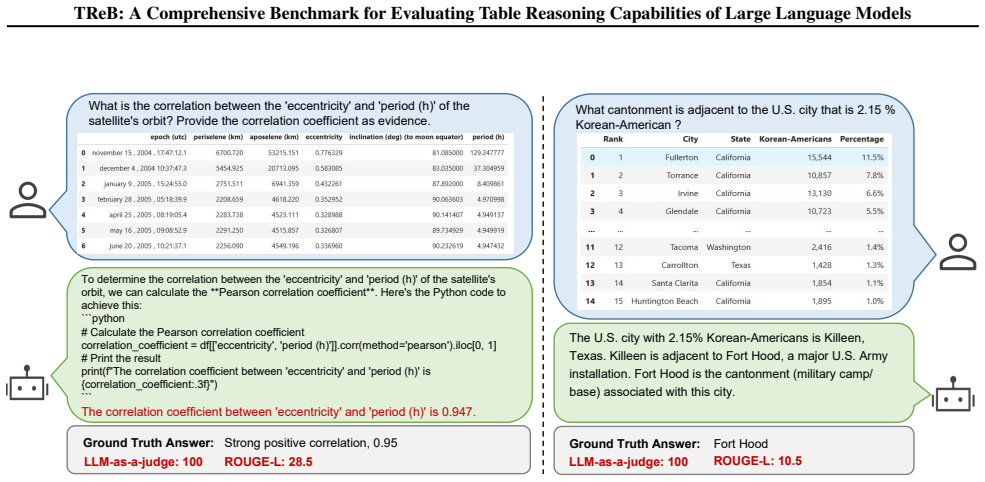
- [Section 3.4.2 and Section 6.1] The LLM-as-a-judge metric uses Qwen2-72B-Instruct as the sole judge and is never validated against human ratings on any TReB subtask; the paper only cites RLHF alignment and shows two cherry-picked examples in Figure 3. Since the judge is from the Qwen family and many evaluated models are also Qwen-family or Qwen-distilled models, systematic judge bias could reorder the leaderboard. The authors should report human-judge agreement (e.g., Cohen's kappa or accuracy on a stratified sample) per subtask, or at minimum evaluate with multiple judge models and show rank stability.
- [Section 2.4, 'QA Pair Cleaning'] The cleaning pipeline replaces the original ground-truth answer with the consensus of three candidate LLMs whenever all three agree but differ from the original answer. This means a portion of the benchmark labels are derived from model outputs, and the fraction of replaced answers is not reported. Because 'High-Quality' status can be assigned through unanimous LLM agreement without expert review, the evaluation may be biased toward what LLMs produce. The authors should quantify how many QA pairs were replaced, report expert-review results on those cases, and analyze whether measured accuracies change when only expert-confirmed labels are used.
- [Table 1 and Tables 2, 3, 5] Several subtasks have very small sample sizes — Table Plausibility Verification (15), Table Outlier Detection (43), Table Hypothesis Testing (42), Multi-step Conditional Calculation (17) — yet no error bars, confidence intervals, or significance tests are reported anywhere in Tables 2, 3, or 5. Without such information, small overall-score differences such as 69.97 versus 69.51 cannot be distinguished from sampling noise, and the per-subtask conclusions drawn in Section 4.2 are not statistically grounded. The authors should report per-subtask sample sizes and either provide bootstrap confidence intervals or explicitly refrain from ranking models on subtasks with very small n.
minor comments (6)
- [Abstract] The abstract says 'table reasoning evolution benchmark'; this should read 'evaluation benchmark'.
- [Section 2.4 and Section 2.5] Section 2.4 reports '2.75 million high-quality data,' while Section 2.5 says the final evaluation dataset comprises 7,790 samples; the relationship between these numbers should be clarified so readers understand how the large cleaned corpus maps to the final benchmark.
- [Section 4.1.2] The statement that the experiments result in '1,794 experimental groups' is not obviously consistent with 26 models, 26 tasks, and up to three inference modes; the computation should be explained.
- [Section 3.3.3] The phrase 'compared to ToT and PoT' should be 'compared to TCoT and PoT,' since ToT (Tree-of-Thoughts) is not one of the three modes introduced in this paper.
- [Section 4.2.2] The claim that ROUGE-L and LLM-as-a-judge rankings are 'highly similar' is not supported by a rank-correlation coefficient or any quantitative comparison; adding Spearman's rho would make this claim testable.
- [Figure 2] The left panel labels the comparison as covering 'all tasks,' but NLU is excluded because it uses TCoT only; the caption should state this explicitly.
Circularity Check
No significant circularity: TReB is a benchmark-and-evaluation paper whose ground truth is anchored in external datasets, deterministic rules, and human review, and whose LLM-judge metric is a validity limitation rather than a by-construction reduction.
full rationale
TReB does not derive a result from an input in a way that makes the output equivalent to the input. The dataset is assembled from external public corpora (Section 2.2: MMLU, GSM8K, AIT-QA, ToTTo, HybridQA, etc.), deterministic rule-based generation (Section 2.3), and manual expert review (Section 2.4: 'Manual Review Intervention. Domain experts re-annotate these cases'; Section 2.5: 'Each instance undergoes manual annotation and a dual quality-control process'). The evaluation metric in question, LLM-as-a-judge with Qwen2-72B-Instruct, is an external model explicitly excluded from the evaluated set (Section 4.1.2), and the paper also reports exact-match accuracy on numeric tasks (Section 4.2.5, Table 5), which does not depend on the judge. The framework's effectiveness claims are empirical (cross-mode score comparisons in Figure 2; a code-execution case study in Figure 4), not reduction-by-construction. The acknowledged limitation in Section 6.1 that LLM-as-a-judge 'may inadvertently introduce biases' is a validity threat to rankings, but it is disclosed and does not make the rankings equivalent to the benchmark's inputs by definition. There are no load-bearing self-citations or imported uniqueness theorems. The internal inconsistency between the Section 4.2.1 claim that QwQ-32B achieves the highest overall score and Table 3 showing Qwen3-32B at 69.97 versus QwQ-32B at 69.51 is a reporting/correctness problem, not circularity.
Assumptions & free parameters
free parameters (3)
- table cell character limit =
30000
- maximum empty cell proportion =
0.7
- number of candidate LLMs in QA cleaning =
3
assumptions (4)
- domain assumption The six core skills and 26 subtasks cover the full spectrum of table reasoning abilities.
- domain assumption LLM-as-a-judge scores approximate human judgment of answer correctness.
- domain assumption Tables with a single-row header, at most 30,000 characters, and at most 70% empty cells are representative of real-world tables for evaluation.
- domain assumption General natural language datasets are valid components of a table reasoning benchmark.
Cite this review
Pith. "Pith review of TReB: A Comprehensive Benchmark for Evaluating Table Reasoning Capabilities of Large Language Models." pith.science (2026). https://pith.science/paper/IBY5SVFD
@misc{pith2026250618421,
  author       = {Pith},
  title        = {Pith review of: TReB: A Comprehensive Benchmark for Evaluating Table Reasoning Capabilities of Large Language Models},
  year         = {2026},
  howpublished = {\url{https://pith.science/paper/IBY5SVFD}},
  note         = {Machine review of arXiv:2506.18421}
}
read the original abstract
The majority of data in businesses and industries is stored in tables, databases, and data warehouses. Reasoning with table-structured data poses significant challenges for large language models (LLMs) due to its hidden semantics, inherent complexity, and structured nature. One of these challenges is lacking an effective evaluation benchmark fairly reflecting the performances of LLMs on broad table reasoning abilities. In this paper, we fill in this gap, presenting a comprehensive table reasoning evolution benchmark, TReB, which measures both shallow table understanding abilities and deep table reasoning abilities, a total of 26 sub-tasks. We construct a high quality dataset through an iterative data processing procedure. We create an evaluation framework to robustly measure table reasoning capabilities with three distinct inference modes, TCoT, PoT and ICoT. Further, we benchmark over 20 state-of-the-art LLMs using this frame work and prove its effectiveness. Experimental results reveal that existing LLMs still have significant room for improvement in addressing the complex and real world Table related tasks. Both the dataset and evaluation framework are publicly available, with the dataset hosted on huggingface.co/datasets/JT-LM/JIUTIAN-TReB and the framework on github.com/JT-LM/jiutian-treb.
Figures


Figures from the paper (1 more)

Reference graph
Works this paper leans on
-
[1]
L., Almeida, D., Altenschmidt, J., Altman, S., Anadkat, S., et al
Achiam, J., Adler, S., Agarwal, S., Ahmad, L., Akkaya, I., Aleman, F. L., Almeida, D., Altenschmidt, J., Altman, S., Anadkat, S., et al. Gpt-4 technical report. arXiv preprint arXiv:2303.08774,
-
[5]
Chen, W., Ma, X., Wang, X., and Cohen, W. W. Program of thoughts prompting: Disentangling computation from reasoning for numerical reasoning tasks. arXiv preprint arXiv:2211.12588,
-
[6]
Chen, Z., Chen, W., Smiley, C., Shah, S., Borova, I., Lang- don, D., Moussa, R., Beane, M., Huang, T.-H., Routledge, B. R., et al. Finqa: A dataset of numerical reasoning over financial data. In Proceedings of the 2021 Conference on Empirical Methods in Natural Language Processing, pp. 3697–3711,
work page 2021
-
[7]
Training verifiers to solve math word problems
Cobbe, K., Kosaraju, V ., Bavarian, M., Chen, M., Jun, H., Kaiser, L., Plappert, M., Tworek, J., Hilton, J., Nakano, R., et al. Training verifiers to solve math word problems. arXiv preprint arXiv:2110.14168,
-
[10]
Rlhf workflow: From reward modeling to online rlhf
Dong, H., Xiong, W., Pang, B., Wang, H., Zhao, H., Zhou, Y ., Jiang, N., Sahoo, D., Xiong, C., and Zhang, T. Rlhf workflow: From reward modeling to online rlhf. arXiv preprint arXiv:2405.07863,
-
[11]
Grattafiori, A., Dubey, A., Jauhri, A., Pandey, A., Kadian, A., Al-Dahle, A., Letman, A., Mathur, A., Schelten, A., Vaughan, A., et al. The llama 3 herd of models. arXiv preprint arXiv:2407.21783,
-
[12]
Gu, J., Jiang, X., Shi, Z., Tan, H., Zhai, X., Xu, C., Li, W., Shen, Y ., Ma, S., Liu, H., et al. A survey on llm-as-a- judge. arXiv preprint arXiv:2411.15594,
-
[13]
K., Luo, F., Xiong, Y ., and Liang, W
Guo, D., Zhu, Q., Yang, D., Xie, Z., Dong, K., Zhang, W., Chen, G., Bi, X., Wu, Y ., Li, Y . K., Luo, F., Xiong, Y ., and Liang, W. Deepseek-coder: When the large language model meets programming – the rise of code intelligence. arXiv preprint arXiv:2401.14196,
Show all 34 references
-
[14]
Measuring math- ematical problem solving with the math dataset
Hendrycks, D., Burns, C., Kadavath, S., Arora, A., Basart, S., Tang, E., Song, D., and Steinhardt, J. Measuring math- ematical problem solving with the math dataset. arXiv preprint arXiv:2103.03874,
-
[15]
Hui, B., Yang, J., Cui, Z., Yang, J., Liu, D., Zhang, L., Liu, T., Zhang, J., Yu, B., Dang, K., et al. Qwen2. 5-coder technical report. arXiv preprint arXiv:2409.12186,
-
[17]
Followeval: A multi-dimensional bench- mark for assessing the instruction-following capability of large language models
Jing, Y ., Jin, R., Hu, J., Qiu, H., Wang, X., Wang, P., and Xiong, D. Followeval: A multi-dimensional bench- mark for assessing the instruction-following capability of large language models. arXiv preprint arXiv:2311.09829,
-
[18]
Ait-qa: Question answering dataset over complex tables in the airline industry
Katsis, Y ., Chemmengath, S., Kumar, V ., Bharadwaj, S., Canim, M., Glass, M., Gliozzo, A., Pan, F., Sen, J., Sankaranarayanan, K., et al. Ait-qa: Question answering dataset over complex tables in the airline industry. InPro- ceedings of the 2022 Conference of the North Americ...
2022
-
[20]
Kim, Y ., Yim, M., and Song, K. Y . Tablevqa-bench: A visual question answering benchmark on multiple table domains. arXiv preprint arXiv:2404.19205,
-
[21]
Tableqakit: a com- prehensive and practical toolkit for table-based question answering
Lei, F., Luo, T., Yang, P., Liu, W., Liu, H., Lei, J., Huang, Y ., Wei, Y ., He, S., Zhao, J., et al. Tableqakit: a com- prehensive and practical toolkit for table-based question answering. arXiv preprint arXiv:2310.15075,
-
[22]
Uhgeval: Benchmarking the hallucination of chinese large language models via unconstrained generation
Liang, X., Song, S., Niu, S., Li, Z., Xiong, F., Tang, B., Wang, Y ., He, D., Cheng, P., Wang, Z., et al. Uhgeval: Benchmarking the hallucination of chinese large language models via unconstrained generation. arXiv preprint arXiv:2311.15296,
-
[26]
Deepseekmath: Push- ing the limits of mathematical reasoning in open language models
Shao, Z., Wang, P., Zhu, Q., Xu, R., Song, J., Bi, X., Zhang, H., Zhang, M., Li, Y ., Wu, Y ., et al. Deepseekmath: Push- ing the limits of mathematical reasoning in open language models. arXiv preprint arXiv:2402.03300,
-
[27]
Tablegpt2: A large multimodal model with tabular data integration
Su, A., Wang, A., Ye, C., Zhou, C., Zhang, G., Chen, G., Zhu, G., Wang, H., Xu, H., Chen, H., et al. Tablegpt2: A large multimodal model with tabular data integration. arXiv preprint arXiv:2411.02059,
-
[28]
H., and Li, B
Wang, B., Xu, C., Wang, S., Gan, Z., Cheng, Y ., Gao, J., Awadallah, A. H., and Li, B. Adversarial glue: A multi- task benchmark for robustness evaluation of language models. arXiv preprint arXiv:2111.02840,
-
[29]
Mac-sql: A multi-agent collaborative framework for text-to-sql.arXiv preprint arXiv:2312.11242,
Wang, B., Ren, C., Yang, J., Liang, X., Bai, J., Chai, L., Yan, Z., Zhang, Q.-W., Yin, D., Sun, X., et al. Mac-sql: A multi-agent collaborative framework for text-to-sql.arXiv preprint arXiv:2312.11242,
-
[30]
D., Sung, F., Vinyes, M., Ying, Z., Zhu, Z., et al
Wang, H., Unsal, M., Lin, X., Baksys, M., Liu, J., Santos, M. D., Sung, F., Vinyes, M., Ying, Z., Zhu, Z., et al. Kimina-prover preview: Towards large formal reason- ing models with reinforcement learning. arXiv preprint arXiv:2504.11354,
-
[31]
Mmqa: Evaluating llms with multi-table multi-hop complex questions
Wu, J., Yang, L., Li, D., Ji, Y ., Okumura, M., and Zhang, Y . Mmqa: Evaluating llms with multi-table multi-hop complex questions. In The Thirteenth International Con- ference on Learning Representations (ICLR), 2025a. Wu, X., Yang, J., Chai, L., Zhang, G., Liu, J., Du, X., Li...
- [32]
-
[33]
Spider: A large-scale human-labeled dataset for complex and cross- domain semantic parsing and text-to-sql task
Yu, T., Zhang, R., Yang, K., Yasunaga, M., Wang, D., Li, Z., Ma, J., Li, I., Yao, Q., Roman, S., et al. Spider: A large-scale human-labeled dataset for complex and cross- domain semantic parsing and text-to-sql task. In Proceed- ings of the 2018 Conference on Empirical Methods...
2018
-
[34]
Y ., Vu, M
Zhuo, T. Y ., Vu, M. C., Chim, J., Hu, H., Yu, W., Widyasari, R., Yusuf, I. N. B., Zhan, H., He, J., Paul, I., et al. Big- codebench: Benchmarking code generation with diverse function calls and complex instructions. arXiv preprint arXiv:2406.15877,
-
[2002]
Totto: A controlled table- to-text generation dataset
Parikh, A., Wang, X., Gehrmann, S., Faruqui, M., Dhingra, B., Yang, D., and Das, D. Totto: A controlled table- to-text generation dataset. In Proceedings of the 2020 Conference on Empirical Methods in Natural Language Processing (EMNLP), pp. 1173–1186,
2020
-
[2004]
Math- bench: Evaluating the theory and application proficiency of llms with a hierarchical mathematics benchmark.arXiv preprint arXiv:2405.12209,
Liu, H., Zheng, Z., Qiao, Y ., Duan, H., Fei, Z., Zhou, F., Zhang, W., Zhang, S., Lin, D., and Chen, K. Math- bench: Evaluating the theory and application proficiency of llms with a hierarchical mathematics benchmark.arXiv preprint arXiv:2405.12209,
-
[2015]
Tqa-bench: Evaluating llms for multi-table question answering with scalable context and symbolic extension
Qiu, Z., Peng, Y ., He, G., Yuan, B., and Wang, C. Tqa-bench: Evaluating llms for multi-table question answering with scalable context and symbolic extension. arXiv preprint arXiv:2411.19504,
-
[2017]
Q., Sablayrolles, A., Mensch, A., Bamford, C., Chaplot, D
Jiang, A. Q., Sablayrolles, A., Mensch, A., Bamford, C., Chaplot, D. S., de las Casas, D., Bressand, F., Lengyel, G., Lample, G., et al. Mistral 7b. arXiv preprint arXiv:2310.06825,
-
[2020]
Mceval: Massively multilingual code evaluation
Chai, L., Liu, S., Yang, J., Yin, Y ., Jin, K., Liu, J., Sun, T., Zhang, G., Ren, C., Guo, H., et al. Mceval: Massively multilingual code evaluation. arXiv preprint arXiv:2406.07436,
-
[2021]
Deepseek-r1: Incentivizing reasoning capa- bility in llms via reinforcement learning
DeepSeek-AI. Deepseek-r1: Incentivizing reasoning capa- bility in llms via reinforcement learning. arXiv preprint arXiv:2501.12948,
-
[2022]
J., Lefebvre, F., Brison, G., Perez-Lebel, A., and Varoquaux, G
Kim, M. J., Lefebvre, F., Brison, G., Perez-Lebel, A., and Varoquaux, G. Table foundation models: on knowl- edge pre-training for tabular learning. arXiv preprint arXiv:2505.14415,
-
[2023]
D., Dhariwal, P., Neelakantan, A., Shyam, P., Sastry, G., Askell, A., et al
Brown, T., Mann, B., Ryder, N., Subbiah, M., Kaplan, J. D., Dhariwal, P., Neelakantan, A., Shyam, P., Sastry, G., Askell, A., et al. Language models are few-shot learners. Advances in neural information processing systems, 33: 1877–1901,
1901
-
[2024]
Chen, W., Zha, H., Chen, Z., Xiong, W., Wang, H., and Wang, W. Y . Hybridqa: A dataset of multi-hop question answering over tabular and textual data. In Findings of the Association for Computational Linguistics: EMNLP 2020, pp. 1026–1036,
2020
-
[2025]
Tables as texts or images: Evaluating the table reasoning ability of llms and mllms
16 TReB: A Comprehensive Benchmark for Evaluating Table Reasoning Capabilities of Large Language Models Deng, N., Sun, Z., He, R., Sikka, A., Chen, Y ., Ma, L., Zhang, Y ., and Mihalcea, R. Tables as texts or images: Evaluating the table reasoning ability of llms and mllms. In...
2024
Reviewed August 6, 2026 · model on record in the stance chip above.
Discussion (0). Sign in to comment.