REVIEW 3 major objections 8 minor 19 references
Slot-Guided Adaptation of Pre-trained Diffusion Models for Object-Centric Learning and Compositional Generation
T0 review · 3 major / 8 minor · reviewed 2026-08-10 · deepseek-v4-flash
Pith's one-line read SlotAdapt conditions a frozen pretrained diffusion model on slots through adapter layers and a mutual attention guidance loss, reporting state-of-the-art unsupervised object discovery, generation, and compositional editing on COCO.
desk verdict A clean, well-ablated empirical contribution that delivers first slot-based compositional generation on COCO; the mutual guidance loss is the weakest link but not a fatal one. read the letter →
The pith
A machine-rendered reading of the paper's core claim, the machinery that carries it, and where it could break.
The reading
What carries the argument
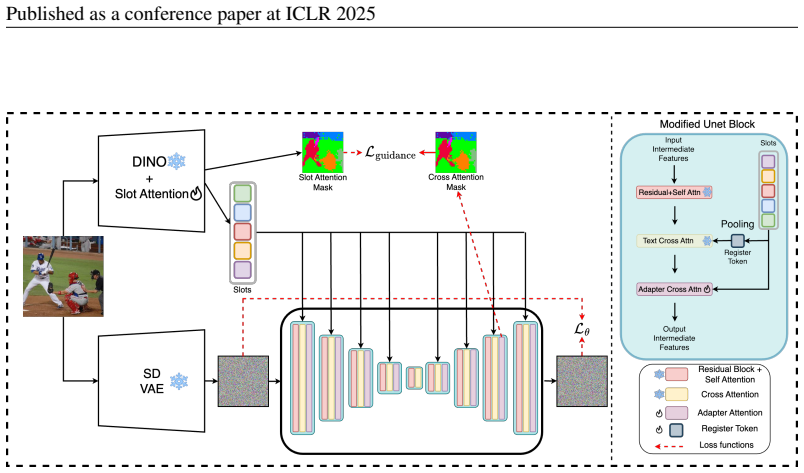
The load-bearing machinery is the adapter cross-attention layer: an extra cross-attention block inserted after every existing cross-attention layer in all downsampling and upsampling blocks of the frozen Stable Diffusion UNet, taking the extracted slots as conditioning input instead of text embeddings. A register token, computed by mean-pooling the slots (or, in an ablation, the image features), is fed to the original text cross-attention layers to absorb background and global context. The mutual attention guidance loss is $L_{\mathrm{guidance}} = \mathrm{BCE}(A^{SA}, A^{DM\top})$, where $A^{SA}$ is the slot attention mask and $A^{DM}$ is the adapter cross-attention mask averaged over heads; the paper finds that joint guidance (no gradient stopping) works best, and applies the guidance only in the third upsampling block, where masks align best with objects. The full objective is $L = L_{\theta} + \lambda L_{\mathrm{guidance}}$, with $\lambda$ ramped from 0 to 0.025 after 40K iterations.
What would settle it
Train SlotAdapt on COCO after breaking the alignment, for example by shuffling slot identities in the guidance loss, and check whether segmentation and generation metrics drop; if the metrics barely change, or if $A^{SA}$ and $A^{DM}$ align by collapsing to the same background-dominated map, the mutual guidance loss is not doing the object-alignment work claimed.
Extended reading notes
Core claim
SlotAdapt's central claim is that a frozen pretrained Stable Diffusion model can serve as an object-centric decoder when conditioned through dedicated adapter cross-attention layers rather than through its text-trained cross-attention. Slots extracted by slot attention from visual backbone features are fed to adapters inserted after every cross-attention layer in the UNet, while a register token formed by mean-pooling the slots is fed to the original text cross-attention to absorb global scene context. A mutual guidance loss applies binary cross-entropy between the slot attention mask and the transposed adapter cross-attention mask (averaged over heads), trained jointly without gradient stopping, so that both masks converge toward object-level segmentation. The paper reports that this configuration outperforms prior slot-based diffusion and self-supervised baselines in object discovery and generation on MOVi-E, VOC, and COCO, and presents the first compositional generation and slot-editing results (object removal, replacement, addition) on COCO, all without external supervision.
Load-bearing premise
The load-bearing premise is that binary cross-entropy between the slot attention mask and the transposed adapter cross-attention mask, trained jointly without gradient stopping, drives both masks toward genuine object-level structure instead of a trivial or degenerate agreement.
Editorial extensions
If this is right
- A frozen pretrained diffusion decoder can be repurposed for slot conditioning without retraining its weights, so object-centric models keep the full generative prior.
- Because slots no longer need to live in text embedding space, they can bind to object instances rather than semantic classes, which the reported instance-level mBO gains on COCO support.
- The register token gives global context a dedicated pathway, allowing slots to focus on distinct objects; the paper's ablations show consistent gains from adding it.
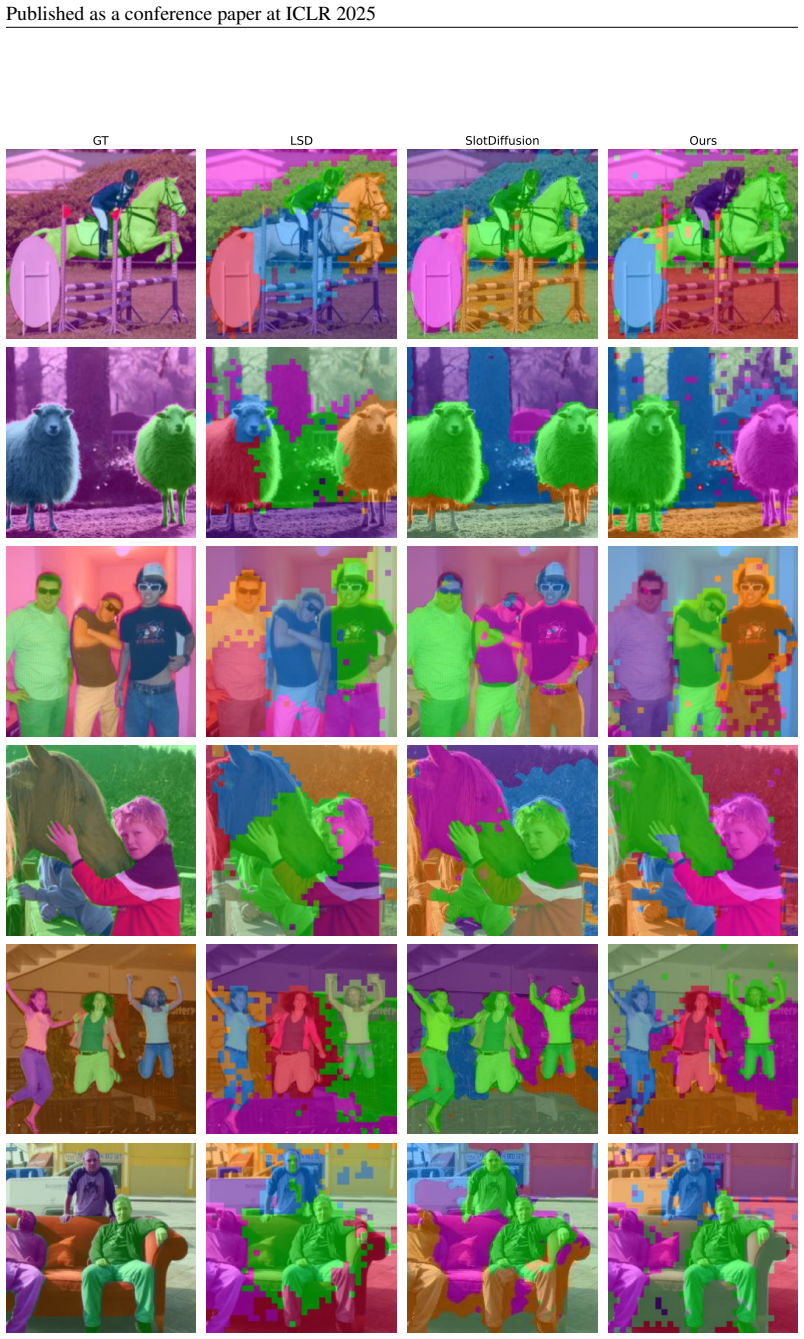
- Joint mask guidance improves object-level alignment and reduces part-whole fragmentation, and the gains transfer to generation: COCO reconstruction FID drops from 19.448 (SlotDiffusion) to 10.857.
- Slots become an editing interface: removing, replacing, or adding slots produces coherent compositional edits on real COCO images, which the paper reports as the first such results.
Reading between the lines
- A next step beyond the paper is to learn a mapping from slots to text embeddings so compositional edits could be requested by prompt rather than by manually selecting slots.
- The adapter-plus-guidance recipe may transfer to other non-text conditioning signals for frozen diffusion models, using cross-attention masks as a general self-supervisory alignment signal.
- Because the paper reports that 80 slots degrade performance relative to 7, slot merging and splitting, acknowledged as a limitation, would test whether the mask-alignment objective scales to denser scenes.
- The mutual mask-alignment loss could also be evaluated as a binding objective for slot-based video or world models, where temporal consistency of attention masks might replace image reconstruction as the training signal.
Editorial analysis
A structured set of objections, weighed in public.
Referee Report
Summary. The paper proposes SlotAdapt, an object-centric learning method that conditions a frozen pretrained Stable Diffusion decoder on slots produced by a DINOv2/CNN slot-attention encoder. Two additions are proposed: adapter cross-attention layers dedicated to slot conditioning, with a pooled 'register' token routed through the original text cross-attention, and a mutual guidance loss that aligns the slot-attention mask with the adapter cross-attention mask via binary cross-entropy (Eq. 5). The method is evaluated on MOVi-E, VOC, and COCO with FG-ARI, mBO, mIoU, and reconstruction/compositional FID/KID; the authors report gains over LSD and SlotDiffusion, e.g., COCO FG-ARI 41.4–42.3 vs 37.2, instance mBO 35.1 vs 31.0, and reconstruction FID 10.857 vs 19.448, plus qualitative compositional editing on COCO.
Significance. If its claims hold, the paper makes a useful contribution: it shows that adapter-based conditioning can transfer pretrained diffusion generative power to slot-based decoders without text-centric cross-attention, with large FID/KID improvements over both training-from-scratch (SlotDiffusion) and pretrained-but-text-conditioned (LSD) baselines. Strengths include the use of standard benchmarks and metrics, comparisons against both unsupervised and externally supervised concurrent work (GLASS, SPOT), and a reasonably complete set of ablations (conditioning blocks, register token, guidance variants, slot count, CFG scale). The main novel component, the mutual attention guidance loss, is mechanistically underspecified and its ablation evidence is mixed (Table 2): the explanation of why it helps is not supported by the mathematics in Eqs. (4)–(5). Because the no-guidance variant already outperforms the baselines on most metrics, the paper's headline empirical ranking is plausibly robust to a reframing of the guidance mechanism, but the loss's role needs to be restated and better evidenced.
major comments (3)
- [§3.2, Eqs. (4)–(5)] The claimed mechanism of the mutual guidance loss is not compatible with the definitions in Eqs. (4)–(5). ASA is a P×N row-softmax (each pixel row sums to 1, total mass P) and ADM is an N×P row-softmax (each slot row sums to 1, so ADM^T has column sums of 1, total mass N). For P=1024 and N=7, exact equality ASA = ADM^T is impossible because the total mass would have to be both P and N; the text's statement that ADM 'should converge to the transpose of the instance segmentation mask' cannot hold in any exact sense, and the BCE objective in Eq. (5) instead settles at a compromise between two incompatible normalizations. This matters because the guidance loss is the paper's main novel component and is credited in the Conclusion with the SOTA results. The Table 2 ablation is consistent with the loss acting as a renormalization rather than an object-level alignment: joint guidance raises mBOi (31.5 to 35.1) and mBOc (34.8 to 39.2) but lowers FG-ARI (42.3 to 41.4). Please (i) explicitly acknowledge the normalization mismatch and reframe the loss as a soft, regularizing alignment, or modify the normalization (e.g., row-normalize both masks over pixels, or use a cost that accounts for the differing marginals); (ii) report a direct measure of agreement between ASA and ADM^T over training to substantiate 'alignment'; and (iii) discuss the FG-ARI decrease under joint guidance.
- [§4, Tables 2 and 4] All quantitative results in the paper are single runs with no error bars and no stated number of seeds. This is load-bearing for the guidance claim because the Table 2 differences are small in absolute terms (FG-ARI 42.3 vs 41.4 vs 43.3; mBOi 31.5 vs 35.1) and slot-attention training is known to have run-to-run variance of this order. Please report mean ± std over at least three seeds for the guidance ablations and the main VOC/COCO comparisons, and state the seed count; if the guidance gains are within noise on some metrics, say so explicitly.
- [§4, Table 3] The compositional generation results, which support the headline claim of 'first successful compositional generation on COCO', are not reproducible as reported: the text gives no protocol for how the right half of Table 3 was computed (which slot manipulations were used, how many images, which reference set, sampling steps, CFG value). Please add a full experimental protocol for the compositional FID/KID evaluation, including the exact editing operations and sample counts, or clearly label these numbers as qualitative-illustration-level.
minor comments (8)
- [§1 and Table 11] The Introduction claims 'significantly reduced computational requirements' relative to GLASS, but no runtime, parameter-count, or memory comparison appears anywhere in the paper or appendix; please quantify or remove this claim.
- [Appendix A.2, Table 9] The 'Slot Average Token' row reports FG-ARI 42.3, mBOi 31.5, and mBOc 34.8, which match the 'No guidance' configuration of Table 2 rather than the joint-guidance main model (41.4, 35.1, 39.2); please clarify which configuration this row represents.
- [§3.2, Eq. (4)] Please state explicitly that the slot-attention and adapter cross-attention mechanisms operate at different resolutions and feature dimensions, and that each softmax in Eq. (4) is scaled by its own query/key dimension; as written the shared √D is misleading.
- [Appendix A.1] There are several typos, including 'arhictectural' at the start of A.1, 'and and our approach' in the same section, and inconsistently spaced 'V AE' throughout; a final proofread is needed.
- [Appendix A.4, Table 11] In the VOC panel, GLASS reports mBOc 36.1 while GLASS† reports 68.4; given the caption's description of the two variants this gap is confusing, and the exact supervision used by each variant (and why the class-level overlap differs so strongly) should be stated.
- [§4, Metrics paragraph] The statement that FG-ARI 'does not account for object masks larger than the ground-truth' is unclear; the ARI is computed over the full clustering and would change with mask sizes, so please state precisely which limitation is intended.
- [Appendix A.1, Guidance loss schedule] Only a single guidance weight (λ=0.025 with a 40K-iteration warm-up) is reported; a short sensitivity check for λ would strengthen the Table 2 conclusion that joint guidance 'significantly improves' over no guidance.
- [Overall reproducibility] No code release is mentioned; given the many implementation details in Appendix A.1, providing training and evaluation code would substantially aid reproducibility of the compositional experiments.
Circularity Check
No significant circularity: the guidance loss is a trained mutual-alignment objective, not a derivation from itself.
full rationale
After walking the paper's claimed derivation chain (Eqs. 1-6 and the experimental comparisons), I find no step where a prediction or first-principles result is equivalent to its inputs by construction. SlotAdapt's central mechanism is an empirical training objective: Eq. 3 is the standard noise-prediction loss anchored to input latents, and Eq. 5 is an auxiliary BCE loss between two attention matrices (Eq. 4) that are both functions of the same slot vectors and image features. This is mutual self-supervision, not a circular derivation: neither ASA nor ADM is defined in terms of the other, and the reconstruction term anchors the alignment to the input image. The incompatible row/column normalization of the two softmax masks (rows of ASA and columns of ADM^T each sum to 1, making exact equality impossible when the number of pixels differs from the number of slots) is a technical weakness of the loss, but it is a correctness or optimization concern, not circularity. The headline claims are supported by comparisons against external baselines (SLATE, LSD, SlotDiffusion, DINOSAUR, GLASS, SPOT) on MOVi-E, VOC, and COCO. The only self-citations (Akan et al. 2021; Akan and Guney 2022 in Section A.1) are contextual and not load-bearing. The paper's acknowledged limitations (slight image changes under editing, under/over-segmentation, limited synthetic-domain adaptability) also do not indicate circularity. Hence the score is 0.
Assumptions & free parameters
free parameters (6)
- Guidance loss weight lambda =
0.025 (warmup 0 to 0.025 between 40K and 50K iterations)
- Classifier-free guidance scale =
1.3
- Number of slots =
7 for VOC and COCO, 24 for MOVi-E
- Guidance loss start iteration =
40K
- Register token pooling =
slot pooling (MOVi-E, COCO); feature pooling (VOC)
- Conditioning blocks =
all downsampling and upsampling blocks
assumptions (4)
- domain assumption A frozen pretrained Stable Diffusion UNet can be conditioned on slot vectors through added adapter cross-attention layers without losing its generative prior.
- domain assumption DINOv2 features are suitable for slot attention on real-world images.
- domain assumption Reconstruction via noise prediction is a sufficient learning signal for object-centric slot discovery.
- domain assumption The cross-attention mask from the third upsampling block is the most object-aligned layer for guidance.
Cite this review
Pith. "Pith review of Slot-Guided Adaptation of Pre-trained Diffusion Models for Object-Centric Learning and Compositional Generation." pith.science (2026). https://pith.science/paper/IC2SQOEK
@misc{pith2026250115878,
  author       = {Pith},
  title        = {Pith review of: Slot-Guided Adaptation of Pre-trained Diffusion Models for Object-Centric Learning and Compositional Generation},
  year         = {2026},
  howpublished = {\url{https://pith.science/paper/IC2SQOEK}},
  note         = {Machine review of arXiv:2501.15878}
}
read the original abstract
We present SlotAdapt, an object-centric learning method that combines slot attention with pretrained diffusion models by introducing adapters for slot-based conditioning. Our method preserves the generative power of pretrained diffusion models, while avoiding their text-centric conditioning bias. We also incorporate an additional guidance loss into our architecture to align cross-attention from adapter layers with slot attention. This enhances the alignment of our model with the objects in the input image without using external supervision. Experimental results show that our method outperforms state-of-the-art techniques in object discovery and image generation tasks across multiple datasets, including those with real images. Furthermore, we demonstrate through experiments that our method performs remarkably well on complex real-world images for compositional generation, in contrast to other slot-based generative methods in the literature. The project page can be found at https://kaanakan.github.io/SlotAdapt/.
Figures


Figures from the paper (15 more)




Reference graph
Works this paper leans on
-
[3]
Table 11 presents a quantitative comparison of our method with GLASS and SPOT
without explicit labeling. Table 11 presents a quantitative comparison of our method with GLASS and SPOT. In terms of se- mantic overlap, GLASS excels, which is attributable to its use of semantic masks for supervision. However, on complex datasets like COCO, which features multiple instances per image, SlotAdapt achieves comparable performance without an...
work page 2025
-
[4]
On the binding problem in artificial neural networks
11 Published as a conference paper at ICLR 2025 Klaus Greff, Sjoerd Van Steenkiste, and J ¨urgen Schmidhuber. On the binding problem in artificial neural networks. arXiv preprint arXiv:2012.05208,
arXiv 2025
-
[5]
We observe significant improvements in almost all metrics, particularly with an approximate 10% enhancement in object discovery and segmentation accuracy. Better Segmentation Model: In this part, we replace Slot Attention with BOQ-SA, which is an improved version of slot attention where the slot initialization is also optimized, Jia et al. (2023). The res...
work page 2023
-
[6]
Building machines that learn and think like people
12 Published as a conference paper at ICLR 2025 Brenden M Lake, Tomer D Ullman, Joshua B Tenenbaum, and Samuel J Gershman. Building machines that learn and think like people. Behavioral and Brain Sciences, 40,
work page 2025
-
[8]
Illiterate dall-e learns to compose
13 Published as a conference paper at ICLR 2025 Gautam Singh, Fei Deng, and Sungjin Ahn. Illiterate dall-e learns to compose. In Proc. of the International Conf. on Learning Representations (ICLR),
work page 2025
-
[10]
Nicholas Watters, Loic Matthey, Christopher P Burgess, and Alexander Lerchner. Spatial broadcast decoder: A simple architecture for learning disentangled representations in V AEs.arXiv preprint arXiv:1901.07017,
arXiv 1901
-
[11]
SlotFormer: Unsupervised visual dynamics simulation with object-centric models
Ziyi Wu, Nikita Dvornik, Klaus Greff, Thomas Kipf, and Animesh Garg. SlotFormer: Unsupervised visual dynamics simulation with object-centric models. In Proc. of the International Conf. on Learning Representations (ICLR), 2023a. Ziyi Wu, Jingyu Hu, Wuyue Lu, Igor Gilitschenski, and Animesh Garg. Slotdiffusion: Object- centric generative modeling with diffu...
-
[13]
and COCO Lin et al. (2014) datasets: Stable Diffusion v1.5 • VOC (Everingham et al., 2010): Stable Diffusion v2.1 After initialization, we inject adapter layers following each downsampling and upsampling block in the UNet. Each adapter layer comprises a cross-attention mechanism and a feedforward network, both preceded by layer normalization. V AE: We emp...
work page 2014
Show all 19 references
-
[14]
trainaug
configuration (slot size: 192, iterations: 3, slots: 24). We append four linear projectors to align slot dimensions with adapter attention layers. 15 Published as a conference paper at ICLR 2025 Table 5: Comparative evaluation on MOVi-E:(Left) Segmentation results, (Right) Rep...
2022
-
[16]
show that using BOQ-SA instead of Slot Attention results in modest im- provements across several metrics. Slot Number: We investigate the impact of slot count by comparing our original configuration of 7 slots with an increased count of 80 slots, departing from the convention ...
2023
-
[17]
part-whole
Additional Token for Slot Attention as a register token:We investigate an alternative approach to capturing global scene information in our architecture. Instead of using the average of all slot tokens as a global register token, we modified the slot attention module to includ...
2022
-
[18]
Methodological Distinctions: GLASS leverages extra information, such as class labels or image captions, to enhance its performance
and SPOT (Kakogeorgiou et al., 2024), highlighting both quantitative and qualitative differences. Methodological Distinctions: GLASS leverages extra information, such as class labels or image captions, to enhance its performance. While this approach yields certain advantages, ...
2024
-
[2018]
MONet: Unsupervised scene decomposition and representa- tion
Christopher P Burgess, Loic Matthey, Nicholas Watters, Rishabh Kabra, Irina Higgins, Matt Botvinick, and Alexander Lerchner. MONet: Unsupervised scene decomposition and representa- tion. arXiv preprint arXiv:1901.11390,
1901 arXiv
-
[2019]
Sonicdiffusion: Audio-driven image generation and editing with pretrained diffu- sion models
Burak Can Biner, Farrin Marouf Sofian, Umur Berkay Karakas ¸, Duygu Ceylan, Erkut Erdem, and Aykut Erdem. Sonicdiffusion: Audio-driven image generation and editing with pretrained diffu- sion models. arXiv preprint arXiv:2405.00878,
-
[2020]
It is organized into three parts: • Training and Architectural Details (section A.1): We explain how we trained our model SlotAdapt and describe its structure in depth
14 Published as a conference paper at ICLR 2025 A A PPENDIX In this appendix, we provide more details and results about our work. It is organized into three parts: • Training and Architectural Details (section A.1): We explain how we trained our model SlotAdapt and describe it...
2021
-
[2021]
Classifier-free diffusion guidance
Jonathan Ho and Tim Salimans. Classifier-free diffusion guidance. arXiv preprint arXiv:2207.12598,
-
[2022]
Guided latent slot diffusion for object- centric learning
Krishnakant Singh, Simone Schaub-Meyer, and Stefan Roth. Guided latent slot diffusion for object- centric learning. arXiv preprint arXiv:2407.17929,
-
[2023]
Hierarchical text- conditional image generation with clip latents
Aditya Ramesh, Prafulla Dhariwal, Alex Nichol, Casey Chu, and Mark Chen. Hierarchical text- conditional image generation with clip latents. arXiv preprint arXiv:2204.06125,
-
[2024]
Demystifying mmd gans
Mikołaj Bi´nkowski, Danica J Sutherland, Michael Arbel, and Arthur Gretton. Demystifying mmd gans. arXiv preprint arXiv:1801.01401,
Reviewed August 10, 2026 · model on record in the stance chip above.
Discussion (0). Continue with ORCID to comment.