REVIEW 2 major objections 5 minor 42 references
On the Shortcut Learning in Multilingual Neural Machine Translation
T0 review · 2 major / 5 minor · reviewed 2026-08-12 · deepseek-v4-flash
Pith's one-line read The off-target failures of zero-shot multilingual translation are caused by the model overlearning the supervised mapping into the hub language, and can be largely undone by spending the final training steps only on hub-to-other-language…
desk verdict Genuine gains, but the 'shortcut forgetting' mechanism is likely recency; worth reviewing with controls. read the letter →
The pith
A machine-rendered reading of the paper's core claim, the machinery that carries it, and where it could break.
The reading
What carries the argument
The central object is the language-mapping shortcut: the spurious correlation between non-centric source languages and the centric language that the model absorbs from supervised (non-centric, centric) pairs. The mechanism that removes it is generalization training, a two-phase schedule in which the first $N-G$ steps follow standard training on the full data and the final $G$ steps train only on (centric, non-centric) pairs. It relies on catastrophic forgetting, the tendency of NMT models to overwrite previously learned patterns with the most recent data distribution; because the (non-centric, centric) examples no longer appear in the final phase, that mapping is forgotten while the (centric, non-centric) mapping, and the target tag's role, are strengthened.
What would settle it
Train a single-centric MNMT model with generalization training, but in the final $G$ steps train on only a subset of (centric, non-centric) pairs that excludes one non-centric language entirely. If zero-shot translations out of that excluded language stay on-target, the improvement comes from forgetting the shortcut rather than from continued exposure to that language's data; if they drift off-target again, the mechanism requires sustained training on the excluded direction's mappings, which would weaken the forgetting story. A more direct falsifier is to decode zero-shot sentences and measure the model's probability mass on the centric language versus the requested target before and after the generalization phase; the forgetting account predicts a specific drop in centric-language probability for non-centric sources, not just a general re-ranking of all output languages.
Extended reading notes
Core claim
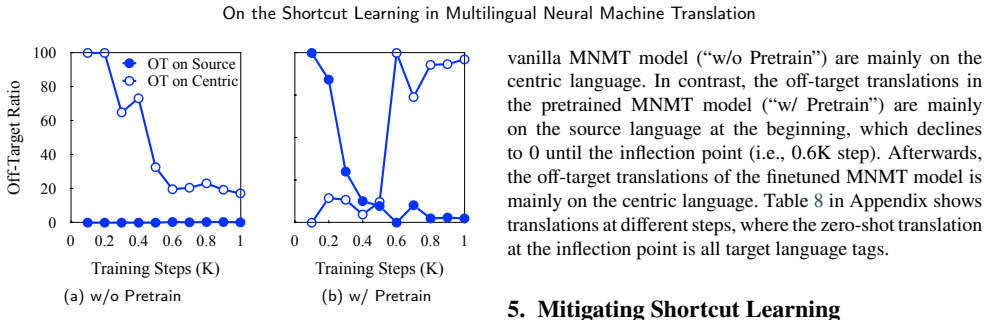
On its own terms, the paper establishes that the off-target issue in single-centric MNMT is the overfitting of a shortcut: the supervised (non-centric, centric) language mapping. When the source is non-centric, the model learns to ignore the target tag and generate the centric language, which is exactly what appears in the supervised training data, and zero-shot directions are the victims. Analyzing learning dynamics shows the shortcut is acquired in the later stage of training, and multilingual pretraining accelerates and aggravates it because the denoising objective teaches a copy-the-source shortcut that shares the key property of ignoring the target tag when the source is non-centric. The paper then shows that removing (non-centric, centric) instances from the final training steps makes the model forget the shortcut and restores in-target zero-shot translation.
Load-bearing premise
The method assumes that catastrophic forgetting in the final $G$ steps selectively removes the overfitted (non-centric, centric) mapping while preserving enough general translation knowledge; if forgetting is not selective, the observed zero-shot gains could come from a generic shift toward target languages rather than from forgetting the specific shortcut.
Editorial extensions
If this is right
- Zero-shot translation in single-centric MNMT can be made nearly off-target-free with zero extra data or computation: averaged over six balanced 6-language benchmarks with pretraining, the off-target ratio drops from 59.3% to 2.3%.
- The late-stage forgetting result means early stopping or checkpoint selection alone will not fix off-target translation; the final training distribution, not the stopping time, is what determines the shortcut.
- Supervised translation is largely preserved by the schedule, and the only observable loss is on the (non-centric, centric) directions whose examples are intentionally removed late in training.
- The findings explain why multilingual pretraining (e.g., mBART-style denoising) hurts zero-shot translation even though it helps supervised translation: the pretraining shortcut and the finetuning shortcut share the same target-tag-ignoring behavior, so pretraining transfers the bias rather than the general skill.
Reading between the lines
- If the mechanism is the single-hub distribution, then any multilingual system trained with one pivot language should show the same late-training off-target drift; a cheap probe is to monitor off-target ratios on held-out non-centric pairs during training and stop the shortcut before it is learned, by early-stopping on zero-shot off-target rate instead of supervised BLEU.
- The pretraining-acceleration result suggests that denoising pretraining with a copy-heavy objective is mismatched with any finetuning task that requires respecting target tags; a testable extension is to compare pretraining objectives (masked span versus full denoising) for their zero-shot contamination effect in MNMT.
- The paper's appendix note on large language models extends the shortcut logic to alignment data that overweights English: LLMs translating between two non-English languages should display centric (English) off-target outputs, and the same forgetting-based remedy, a late alignment phase without English-centric pairs, could be tested at model scale.
Editorial analysis
A structured set of objections, weighed in public.
Referee Report
Summary. The paper studies the off-target problem in multilingual neural machine translation (MNMT) with a single centric language. Across six centric languages, 16-language and 50-language datasets, and with or without mBART50 initialization, the authors show that off-target outputs are almost always in the centric language and that multilingual pretraining sharply aggravates the problem. Tag-manipulation experiments and learning-curve analyses are used to argue that the model overfits the supervised (non-centric, centric) language mapping, ignoring the target tag for zero-shot directions. The authors then propose 'generalization training': after standard training for N-G steps, the final G steps use only (centric, non-centric) pairs. This consistently improves zero-shot BLEU and off-target ratio with no added compute, and it also combines with prior architectural fixes. The empirical pattern is compelling, but I find the causal mechanism—that the final phase works by catastrophic forgetting of the shortcut—under-supported.
Significance. If the causal story is correct, the paper identifies a previously uncharacterized side-effect of mBART-style pretraining and offers a zero-cost training remedy that transfers across balanced/imbalanced settings, 6-50 languages, and two model sizes. The evaluation is unusually broad, and the tag-swap and learning-dynamics analyses are strong evidence that off-target behavior is tied to the centric language. The main weakness is that the success of GenTrain does not uniquely support the shortcut-forgetting explanation, because a recency/output-prior account predicts the same empirical results. The work is nevertheless a solid empirical contribution: it documents a robust phenomenon, proposes a simple and effective intervention, and presents a falsifiable mechanism that a control experiment can test.
major comments (2)
- [§5.1, Table 7, Figure 5] The central causal claim—that GenTrain 'leverage[s] the forgetting nature of model training to forget the overfitted (non-centric, centric) language mapping'—is not uniquely supported by the evidence. During the final G steps the model trains only on (centric, non-centric) pairs, so the decoder's output-language distribution is shifted toward non-centric languages by recency; this alone would lower off-target ratio and raise zero-shot BLEU, even if no specific shortcut mapping were forgotten. Table 7 shows that supervised X→C BLEU drops only marginally (31.8→31.1 without pretraining, 32.4→31.7 with pretraining), so the model has not broadly forgotten the X→C mapping; the claimed locus of 'forgetting' is therefore underspecified. Figure 5—where adding as little as 0.1% X→C data in the final phase restores off-target behavior for pretrained models—is equally consistent with recency: a few recent centric outputs restore the output prior. I recommend adding a control that matches the recency of non-centric output targets while not removing X→C data, for example a final phase trained on all data but with heavy oversampling of (centric, non-centric) pairs. If the OTR reduction is similar to GenTrain under such a control, the selective-forgetting story would be weakened; if the reduction disappears, it would be supported. Until such a control is provided, the paper should present GenTrain as an effective training schedule and soften the 'forgetting' mechanism claim.
- [§5.2] The sentence 'This finding dispels the possibility of gradually reducing the number of (non-centric, centric) instances during training' overstates what Figure 5 shows. The figure varies the proportion of X→C instances in the final-phase window only; it does not test a curriculum in which X→C data is removed gradually from the beginning of training. A gradual schedule could behave differently from a final-phase filter, and its failure or success would speak to the learning dynamics claim in §4.3. Please either add such an experiment or rephrase this as a limitation of the current evidence.
minor comments (5)
- [Throughout] There are typos: 'Tabel 8' and 'Tabel 9' should be 'Table 8' and 'Table 9', and 'data effecient' in Appendix 7.5 should be 'data-efficient'.
- [Table 8] In the bullet list under Table 8, 'non-central' should be 'non-centric' for consistency with the rest of the paper.
- [§3.3] OTR is a central metric, but language identification is reported as 93.7% accurate. For low-resource languages in OPUS50, accuracy may be lower. Please report per-language or per-family langid accuracy, or at least note how a 6.3% error rate could affect the reported OTR gaps.
- [Figure 5] The x-axis label '(X, En) : (En, X)' with values 1, 0.1, 0.01, 0.001, 0 is not immediately clear; please spell out that the ratio is the proportion of retained (X, En) instances relative to the standard full training set, and that 0 denotes the proposed GenTrain.
- [§7.4] The citation 'Wu et al., 2024' for the claim that GPT-4 still suffers from off-target issues is about document-level MT adaptation; a more direct evaluation of off-target behavior in LLMs would be a better reference.
Circularity Check
No significant circularity: the causal intervention and the evaluated outcome are distinct, and the load-bearing citations are external.
full rationale
The paper's derivation chain is empirical rather than definitional. The central claim—that off-target translations in single-centric MNMT models arise from overfitting the supervised (non-centric, centric) language mapping—is operationalized by two independent instruments: tag-manipulation experiments (Table 3) show that non-centric source sentences are decoded into the centric language regardless of target tag, and learning curves (Figures 2-3) localize the growth of centric-language off-targets to the late training stage. The proposed generalization training removes (non-centric, centric) instances in the final G steps; the evaluated outcome (zero-shot BLEU/OTR on unseen directions) is not the same quantity as the intervention (training-data composition), so the improvement is not forced by construction. The hyperparameter G is tuned on validation, but the ablation in Figure 4 shows monotonic behavior across G, and the main results are reported on held-out Flores test sets across multiple language counts and data distributions. The catastrophic-forgetting premise is cited to Shao and Feng (2022), an external source; self-citations (Wang et al. 2022a,b; Jiao et al. 2023) support peripheral claims (pretraining over-copying, OPUS-100 noise, LLM evaluation) and are not load-bearing for the central mechanism. The residual concern that final-phase gains could partly reflect recency of non-centric output targets rather than selective forgetting of the X-to-C shortcut is an alternative-explanation and underdetermination issue, not a circular reduction; the paper's Table 7 also shows only a small X-to-C BLEU decline, which weakens the 'forgetting' narrative but does not make the derivation tautological. One incidental completeness issue: Appendix 7.5 promises 'a novel and data effecient method' based on multi-centric observations but never describes it; this is a missing-support artifact, not circularity. No self-definitional, fitted-input-as-prediction, or self-citation-load-bearing step was found.
Assumptions & free parameters
free parameters (1)
- G (generalization training steps) =
10K
assumptions (3)
- domain assumption Neural MT models forget previously learned mappings when the training data distribution changes
- domain assumption Off-target ratio can be measured by the langid language identification tool
- domain assumption The output language is controlled by the target language tag and by learned mapping patterns
Cite this review
Pith. "Pith review of On the Shortcut Learning in Multilingual Neural Machine Translation." pith.science (2026). https://pith.science/paper/ICDJYAKZ
@misc{pith2026241110581,
  author       = {Pith},
  title        = {Pith review of: On the Shortcut Learning in Multilingual Neural Machine Translation},
  year         = {2026},
  howpublished = {\url{https://pith.science/paper/ICDJYAKZ}},
  note         = {Machine review of arXiv:2411.10581}
}
read the original abstract
In this study, we revisit the commonly-cited off-target issue in multilingual neural machine translation (MNMT). By carefully designing experiments on different MNMT scenarios and models, we attribute the off-target issue to the overfitting of the shortcuts of (non-centric, centric) language mappings. Specifically, the learned shortcuts biases MNMT to mistakenly translate non-centric languages into the centric language instead of the expected non-centric language for zero-shot translation. Analyses on learning dynamics show that the shortcut learning generally occurs in the later stage of model training, and multilingual pretraining accelerates and aggravates the shortcut learning. Based on these observations, we propose a simple and effective training strategy to eliminate the shortcuts in MNMT models by leveraging the forgetting nature of model training. The only difference from the standard training is that we remove the training instances that may induce the shortcut learning in the later stage of model training. Without introducing any additional data and computational costs, our approach can consistently and significantly improve the zero-shot translation performance by alleviating the shortcut learning for different MNMT models and benchmarks.
Figures


Figures from the paper (2 more)


Reference graph
Works this paper leans on
-
[1]
author Aharoni, R. , author Johnson, M. , author Firat, O. , year 2019 . title Massively multilingual neural machine translation , in: booktitle NAACL
work page 2019
-
[2]
author Bahdanau, D. , author Cho, K. , author Bengio, Y. , year 2014 . title Neural machine translation by jointly learning to align and translate . journal ICLR
work page 2014
-
[3]
author Brown, T.B. , author Mann, B. , author Ryder, N. , author Subbiah, M. , author Kaplan, J. , author Dhariwal, P. , author Neelakantan, A. , author Shyam, P. , author Sastry, G. , author Askell, A. , author Agarwal, S. , author Herbert-Voss, A. , author Krueger, G. , author Henighan, T.J. , author Child, R. , author Ramesh, A. , author Ziegler, D.M. ...
work page 2020
-
[4]
author Conneau, A. , author Khandelwal, K. , author Goyal, N. , author Chaudhary, V. , author Wenzek, G. , author Guzm \'a n, F. , author Grave, E. , author Ott, M. , author Zettlemoyer, L. , author Stoyanov, V. , year 2020 . title Unsupervised cross-lingual representation learning at scale , in: booktitle ACL
work page 2020
-
[5]
author Du, M. , author He, F. , author Zou, N. , author Tao, D. , author Hu, X. , year 2022 . title Shortcut learning of large language models in natural language understanding: A survey . journal arXiv
work page 2022
-
[6]
author Durmus, E. , author Ladhak, F. , author Hashimoto, T. , year 2022 . title Spurious correlations in reference-free evaluation of text generation , in: booktitle ACL (Long Papers)
work page 2022
-
[7]
author Fan, A. , author Bhosale, S. , author Schwenk, H. , author Ma, Z. , author El-Kishky, A. , author Goyal, S. , author Baines, M. , author Çelebi, O. , author Wenzek, G. , author Chaudhary, V. , author Goyal, N. , author Birch, T. , author Liptchinsky, V. , author Edunov, S. , author Grave, E. , author Auli, M. , author Joulin, A. , year 2021 . title...
work page 2021
-
[8]
, author Jacobsen, J.H
author Geirhos, R. , author Jacobsen, J.H. , author Michaelis, C. , author Zemel, R. , author Brendel, W. , author Bethge, M. , author Wichmann, F.A. , year 2020 . title Shortcut learning in deep neural networks . journal Nature Machine Intelligence volume 2 , pages 665--673
2020
Show all 42 references
-
[9]
, author Gao, C
author Goyal, N. , author Gao, C. , author Chaudhary, V. , author Chen, P.J. , author Wenzek, G. , author Ju, D. , author Krishnan, S. , author Ranzato, M. , author Guzman, F. , author Fan, A. , year 2021 . title The flores-101 evaluation benchmark for low-resource and multili...
2021
-
[10]
, author Wang, Y
author Gu, J. , author Wang, Y. , author Cho, K. , author Li, V. , year 2019 . title Improved zero-shot neural machine translation via ignoring spurious correlations , in: booktitle ACL
2019
-
[11]
, author Niehues, J
author Ha, T.L. , author Niehues, J. , author Waibel, A. , year 2016 . title Toward multilingual neural machine translation with universal encoder and decoder . journal arXiv
2016
-
[12]
, author Jorge, J
author Iranzo-S \'a nchez, J. , author Jorge, J. , author Baquero-Arnal, P. , author Silvestre-Cerd \`a , J.A. , author Gim \'e nez, A. , author Saiz, J.C. , author Sanch \'i s, A. , author Juan, A. , year 2021 . title Streaming cascade-based speech translation leveraged by a ...
2021
-
[13]
, author Wang, W
author Jiao, W. , author Wang, W. , author tse Huang, J. , author Wang, X. , author Tu, Z. , year 2023 . title Is chatgpt a good translator? a preliminary study . journal ArXiv volume abs/2301.08745 . https://api.semanticscholar.org/CorpusID:256105255
2023 arXiv
-
[14]
, author Schuster, M
author Johnson, M. , author Schuster, M. , author Le, Q.V. , author Krikun, M. , author Wu, Y. , author Chen, Z. , author Thorat, N. , author Vi \' e gas, F.B. , author Wattenberg, M. , author Corrado, G. , author Hughes, M. , author Dean, J. , year 2017 . title Google's multi...
2017
-
[15]
, author Lee, J
author Ko, M. , author Lee, J. , author Kim, H. , author Kim, G. , author Kang, J. , year 2020 . title Look at the first sentence: Position bias in question answering , in: booktitle EMNLP
2020
-
[16]
, author Zhang, C
author Lai, Y. , author Zhang, C. , author Feng, Y. , author Huang, Q. , author Zhao, D. , year 2021 . title Why machine reading comprehension models learn shortcuts? , in: booktitle Findings of ACL-IJCNLP
2021
-
[17]
, author Liu, Y
author Lewis, M. , author Liu, Y. , author Goyal, N. , author Ghazvininejad, M. , author Mohamed, A. , author Levy, O. , author Stoyanov, V. , author Zettlemoyer, L. , year 2020 . title BART : Denoising sequence-to-sequence pre-training for natural language generation, transla...
2020
-
[18]
, author Niehues, J
author Liu, D. , author Niehues, J. , author Cross, J. , author Guzm \'a n, F. , author Li, X. , year 2021 a. title Improving zero-shot translation by disentangling positional information , in: booktitle ACL
2021
-
[19]
, author Wang, L
author Liu, X. , author Wang, L. , author Wong, D.F. , author Ding, L. , author Chao, L.S. , author Shi, S. , author Tu, Z. , year 2021 b. title On the copying behaviors of pre-training for neural machine translation , in: booktitle ACL Findings
2021
-
[20]
, author Gu, J
author Liu, Y. , author Gu, J. , author Goyal, N. , author Li, X. , author Edunov, S. , author Ghazvininejad, M. , author Lewis, M. , author Zettlemoyer, L. , year 2020 . title Multilingual denoising pre-training for neural machine translation . journal TACL
2020
-
[21]
, author Xie, L
author Mi, C. , author Xie, L. , author Zhang, Y. , year 2022 . title Improving data augmentation for low resource speech-to-text translation with diverse paraphrasing . journal Neural networks : the official journal of the International Neural Network Society
2022
-
[22]
, author Kao, H.Y
author Niven, T. , author Kao, H.Y. , year 2019 . title Probing neural network comprehension of natural language arguments , in: booktitle ACL
2019
-
[23]
title Gpt-4 technical report
author OpenAI , year 2023 . title Gpt-4 technical report . https://api.semanticscholar.org/CorpusID:257532815
2023
-
[24]
, author Roukos, S
author Papineni, K. , author Roukos, S. , author Ward, T. , author Zhu, W.J. , year 2002 . title Bleu: a method for automatic evaluation of machine translation , in: booktitle ACL
2002
-
[25]
, author Stanovsky, G
author Schwartz, R. , author Stanovsky, G. , year 2022 . title On the limitations of dataset balancing: The lost battle against spurious correlations , in: booktitle NAACL Findings
2022
-
[26]
, author Wenzek, G
author Schwenk, H. , author Wenzek, G. , author Edunov, S. , author Grave, E. , author Joulin, A. , year 2021 . title Ccmatrix: Mining billions of high-quality parallel sentences on the web , in: booktitle ACL
2021
-
[27]
, author Feng, Y
author Shao, C. , author Feng, Y. , year 2022 . title Overcoming catastrophic forgetting beyond continual learning: Balanced training for neural machine translation , in: booktitle ACL
2022
-
[28]
, author Tan, X
author Song, K. , author Tan, X. , author Qin, T. , author Lu, J. , author Liu, T. , year 2019 . title MASS: masked sequence to sequence pre-training for language generation , in: booktitle ICML
2019
-
[29]
, author Vinyals, O
author Sutskever, I. , author Vinyals, O. , author Le, Q.V. , year 2014 . title Sequence to sequence learning with neural networks . journal NIPS
2014
-
[30]
, author Tran, C
author Tang, Y. , author Tran, C. , author Li, X. , author Chen, P.J. , author Goyal, N. , author Chaudhary, V. , author Gu, J. , author Fan, A. , year 2021 . title Multilingual translation with extensible multilingual pretraining and finetuning , in: booktitle ACL
2021
-
[31]
, author Jiao, W
author Wang, W. , author Jiao, W. , author Hao, Y. , author Wang, X. , author Shi, S. , author Tu, Z. , author Lyu, M. , year 2022 a. title Understanding and improving sequence-to-sequence pretraining for neural machine translation , in: booktitle ACL
2022
-
[32]
, author Jiao, W
author Wang, W. , author Jiao, W. , author Wang, S. , author Tu, Z. , author Lyu, M. , year 2022 b. title Understanding and mitigating the uncertainty in zero-shot translation , in: booktitle arXiv
2022
-
[33]
, author Zhang, Z
author Wang, W. , author Zhang, Z. , author Du, Y. , author Chen, B. , author Xie, J. , author Luo, W. , year 2021 . title Rethinking zero-shot neural machine translation: From a perspective of latent variables , in: booktitle EMNLP Findings
2021
-
[34]
, author Chaudhary, V
author Wenzek, G. , author Chaudhary, V. , author Fan, A. , author Gomez, S. , author Goyal, N. , author Jain, S. , author Kiela, D. , author Thrush, T. , author Guzm \'a n, F. , year 2021 . title Findings of the wmt 2021 shared task on large-scale multilingual machine transla...
2021
-
[35]
, author Cheng, S
author Wu, L. , author Cheng, S. , author Wang, M. , author Li, L. , year 2021 . title Language tags matter for zero-shot neural machine translation , in: booktitle ACL Findings
2021
-
[36]
, author Vu, T.T
author Wu, M. , author Vu, T.T. , author Qu, L. , author Foster, G. , author Haffari, G. , year 2024 . title Adapting large language models for document-level machine translation . journal ArXiv volume abs/2401.06468 . https://api.semanticscholar.org/CorpusID:266976998
2024 arXiv
-
[37]
, author Eriguchi, A
author Yang, Y. , author Eriguchi, A. , author Muzio, A. , author Tadepalli, P. , author Lee, S. , author Hassan, H. , year 2021 . title Improving multilingual translation by representation and gradient regularization , in: booktitle EMNLP
2021
-
[38]
, author Chang, T
author Yu, W. , author Chang, T. , author Guo, X. , author Wang, M. , author Wang, X. , year 2021 . title An interaction-modeling mechanism for context-dependent text-to-sql translation based on heterogeneous graph aggregation . journal Neural networks : the official journal o...
2021
-
[39]
, author Williams, P
author Zhang, B. , author Williams, P. , author Titov, I. , author Sennrich, R. , year 2020 . title Improving massively multilingual neural machine translation and zero-shot translation , in: booktitle ACL
2020
-
[40]
, author Bai, L
author Zhang, H. , author Bai, L. , year 2023 . title Few-shot link prediction for temporal knowledge graphs based on time-aware translation and attention mechanism . journal Neural networks : the official journal of the International Neural Network Society
2023
-
[41]
, author Liu, H
author Zhu, W. , author Liu, H. , author Dong, Q. , author Xu, J. , author Kong, L. , author Chen, J. , author Li, L. , author Huang, S. , year 2023 . title Multilingual machine translation with large language models: Empirical results and analysis . journal ArXiv volume abs/2...
2023 arXiv
-
[42]
write newline
" write newline "" before.all 'output.state := FUNCTION n.dashify 't := "" t empty not t #1 #1 substring "-" = t #1 #2 substring "--" = not "--" * t #2 global.max substring 't := t #1 #1 substring "-" = "-" * t #2 global.max substring 't := while if t #1 #1 substring * t #2 gl...
Reviewed August 12, 2026 · model on record in the stance chip above.
Discussion (0). Continue with ORCID to comment.