REVIEW 3 major objections 5 minor 2 cited by
The paper claims that the ethical landscape of AI in text-based online counselling splits into three distinct territories according to where the AI sits in the counsellor-counsellee dyad: as a replacement for the counsellor, as a stand-in f
Reviewed by Pith at T0; open to challenge. T0 means a machine referee read the full paper against a public rubric. the ladder, T0–T4 →
T0 review · deepseek-v4-flash
2026-08-03 11:03 UTC pith:IDAQHEIF
load-bearing objection A genuinely useful conceptual mapping of three AI roles in text-based counselling, with a defensible central claim; the main soft spot is the hand-wavy derivation of the four-principle framework, but that does not sink the paper. the 3 major comments →
AI Systems in Text-Based Online Counselling: Ethical Considerations Across Three Implementation Approaches
The pith
A machine-rendered reading of the paper's core claim, the machinery that carries it, and where it could break.
Core claim
On the paper's own terms, the central discovery is a role-based mapping of ethical risk in AI-assisted text-based counselling. Examining three established implementation approaches—autonomous counsellor bots, AI counsellee simulators, and counsellor-facing augmentation tools—the paper shows that each placement within the counselling dyad reconfigures the relationship and therefore the meaning of privacy, fairness, autonomy, and accountability. Autonomous bots carry the heaviest burden, with fairness failures becoming potentially fatal and accountability lacking a clear human subject; simulators reorient ethics away from protecting counsellees toward the integrity of professional education; a
What carries the argument
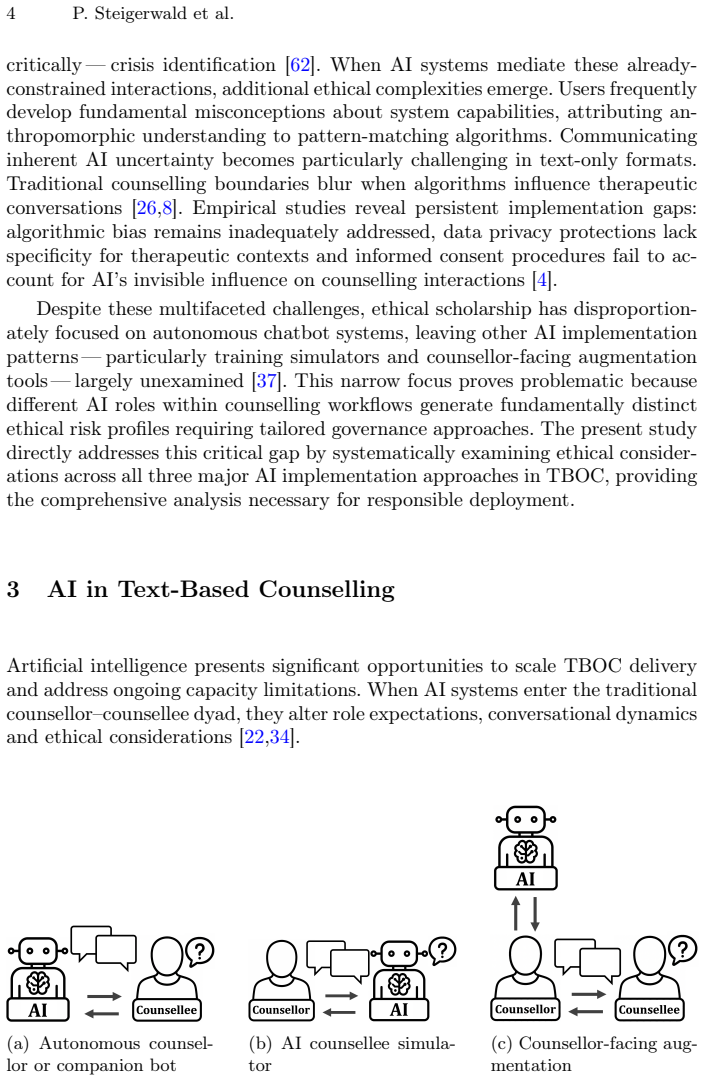
The organising device is a taxonomy of three AI implementation approaches defined by their position in the counsellor-counsellee interaction: (1) autonomous counsellor or companion bots, which substitute for the human counsellor; (2) AI counsellee simulators, which stand in for the counsellee in professional training; and (3) counsellor-facing augmentation tools, which operate invisibly in the counsellor's workspace. The analysis works by asking, for each approach, how each of the four principles (privacy, fairness, autonomy, accountability) translates into concrete requirements when that approach processes sensitive personal data during moments of vulnerability.
Load-bearing premise
The entire analysis rests on the premise that privacy, fairness, autonomy, and accountability capture all ethically relevant dimensions of AI in text-based counselling, drawn from a review focused on European and North American sources.
What would settle it
A documented case where an AI counselling tool caused harm that cannot be mapped onto any of the four principles—for example, a relational or cultural harm arising purely from the loss of shared humanity—would undercut the claim that these four principles are sufficient. A systematic review of non-Western mental health AI deployments would provide the clearest concrete test.
If this is right
- Regulators and developers should stop treating 'counselling AI' as a single category; risk tiers should follow the AI's role in the counselling dyad.
- Autonomous counsellor bots require fail-safe handoff protocols so that a counsellee in crisis can always reach a human, even if the system itself fails.
- Training simulators need outcome validation: evidence that skills practiced on synthetic counsellees actually transfer to real counselling, not just high realism scores.
- Augmentation tools should include monitoring for automation bias, since counsellors may unknowingly adopt AI suggestions under time pressure.
- Consent procedures for augmentation tools may need to inform counsellees that AI processes their messages, introducing transient processing where possible.
Where Pith is reading between the lines
- The same role-based logic could extend to other text-based helping professions, such as crisis hotlines or online education, where the distinction between replacement, simulation, and augmentation may predict distinct ethical hazards.
- The paper's framework implies a practical audit design: for each of the three roles, a separate checklist derived from the four principles, usable by ethics reviewers before deployment.
- Because the source base is largely European and North American, testing the framework against non-Western counselling traditions, including community-based and family-oriented care models, would either strengthen or revise the four-principle foundation.
- The three roles can be read as points on a spectrum of AI autonomy; if that spectrum holds, regulatory risk-tiering (like the EU AI Act's use-case tiers) could be mapped onto it, though the paper does not itself draw this regulatory conclusion.
Editorial analysis
A structured set of objections, weighed in public.
Referee Report
Summary. The paper is a conceptual analysis of ethical issues raised by AI systems in text-based online counselling (TBOC). It distinguishes three implementation approaches—autonomous counsellor/companion bots, AI counsellee simulators for training, and counsellor-facing augmentation tools—and argues that each produces a distinct ethical risk profile requiring tailored governance. It proposes four core ethical principles (privacy, fairness, autonomy, accountability) drawn from professional codes, regulatory frameworks, and selected literature, and applies them separately to each implementation approach. The paper concludes that TBOC's textual nature both creates opportunities for AI and demands implementation-specific safeguards.
Significance. If the central claim is accepted, the paper makes a useful contribution by moving ethical analysis beyond autonomous chatbots to comparatively neglected simulator and augmentation settings, and by organizing concrete ethical hazards around a small set of principles. The three-way taxonomy and the mapping of each principle onto each implementation approach are clear and well-illustrated with representative systems. The authors also explicitly acknowledge limitations: the source base is Western-centric, the analysis is conceptual rather than empirically validated, and emerging hybrid configurations may require further work. These candid statements strengthen the paper's credibility. However, the paper's normative weight depends on the claim that the four chosen principles are the correct and sufficient framework; this premise is not established with the methodological transparency the claim requires.
major comments (3)
- [§4.1, with §1 and §5] The derivation of the four principles—privacy, fairness, autonomy, accountability—is load-bearing, because all subsequent analysis in §§4.2–4.4 is organized around them. Yet the paper says only that a 'comprehensive analysis' of professional codes, regulatory frameworks, and scholarly literature reveals convergence; no search strategy, inclusion criteria, coding scheme, or method for synthesizing sources is reported. The Conclusion concedes that the literature 'primarily draws from European and North American contexts,' and §4.1 dismisses other candidate principles (transparency, beneficence, non-maleficence, justice, trust, explicability, environmental sustainability) as 'typically elaborating' the four without argument. As written, the sufficiency claim is asserted, not demonstrated. I request either a systematic methodology or a reframing of the claim as 'commonly prioritized principl
- [§3.4] The statement that emerging hybrid approaches 'will require entirely new ethical frameworks' conflicts with the paper's earlier claim that the four principles form a stable basis for analysis. If entirely new frameworks are needed, then the tailored-governance conclusion based on the four principles does not generalize beyond the three established approaches. The paper should reconcile this tension—for example, by specifying whether the four principles are meant to be necessary but not sufficient, or whether 'new frameworks' are extensions rather than replacements. As it stands, the universality claim in §4.1 and the 'entirely new' claim in §3.4 are in tension.
- [§3.2, §3.3, references [46], [52], [13]] Two of the three representative systems used to illustrate the taxonomy are from the authors' own group (VirCo in §3.2, CAIA in §3.3). This is not by itself a problem, and the paper does occasionally flag conflicts of interest for external systems (e.g., Woebot, Wysa), but the authors' own systems are presented as neutral evidence of the categories. Please explicitly disclose that these are the authors' systems and discuss how selection of representative systems was made. Otherwise the taxonomy risks being shaped by convenient, self-authored examples.
minor comments (5)
- [§4.1 / References [60], [61]] The text refers to a '2024 addendum' from WHO, but the cited reference [61] is dated 2025. Please harmonize the in-text date and the reference list.
- [§1 / Abstract] The abstract says 'Textual constraints may enable AI integration'; this phrasing is slightly paradoxical. Consider clarifying that the absence of non-verbal cues reduces the input complexity for AI, while the same constraints create new risks.
- [§4.3] The claim that 'current validation studies often measure simulator performance rather than subsequent real-world competence' is important but unsupported by a citation. Please add evidence or soften the wording.
- [§2.3] The sentence 'Empirical studies reveal persistent implementation gaps' is followed by references [4] and others. Consider giving more detail on which studies reveal which gaps, to strengthen the basis for the gap statement.
- [Throughout] The word 'systematically' is used in several places (e.g., §2.3, §4.1) to describe the analysis, but no systematic method is reported. Using 'systematically' may overstate methodological rigor; consider 'comprehensively' or 'in a structured manner.'
Circularity Check
No significant circularity: the taxonomy and ethical framework are grounded in external codes and multiple independent systems; self-citations are only illustrative examples.
full rationale
The paper's derivation chain is non-circular. The central claim—that the three AI implementation approaches generate distinct ethical risk profiles—is established by a taxonomy grounded in many independent systems (Woebot, Wysa, Limbic, PARRY, Patient-Ψ, HAILEY, CARE, etc.), not in the authors' own systems. The four ethical principles (privacy, fairness, autonomy, accountability) are explicitly sourced to external instruments: the APA Ethical Principles and Code of Conduct, WHO guidance, the EU AI Act, and literature reviews such as Jobin et al. (2019). The paper's self-citations (VirCo, CAIA, automated feedback work) appear only as illustrative representative systems and are not used to justify the framework or the pattern-specific conclusions. No equation is fitted and no prediction is made from an input; the passage about additional considerations 'typically elaborat[ing] the four core principles' is an interpretive assertion, not a circular derivation. The acknowledged limitation that the reviewed literature primarily draws from European and North American contexts weakens external validity but is not a circularity concern under the stated rules.
Axiom & Free-Parameter Ledger
axioms (3)
- domain assumption Privacy, fairness, autonomy, and accountability are the four core ethical principles for AI in TBOC.
- domain assumption The three implementation approaches (autonomous bots, simulators, augmentation) are the primary categories of AI in TBOC.
- domain assumption Current ethical scholarship has disproportionately focused on autonomous chatbots, leaving simulators and augmentation tools underexamined.
read the original abstract
Text-based online counselling scales across geographical and stigma barriers, yet faces practitioner shortages, lacks non-verbal cues and suffers inconsistent quality assurance. Whilst artificial intelligence offers promising solutions, its use in mental health counselling raises distinct ethical challenges. This paper analyses three AI implementation approaches - autonomous counsellor bots, AI training simulators and counsellor-facing augmentation tools. Drawing on professional codes, regulatory frameworks and scholarly literature, we identify four ethical principles - privacy, fairness, autonomy and accountability - and demonstrate their distinct manifestations across implementation approaches. Textual constraints may enable AI integration whilst requiring attention to implementation-specific hazards. This conceptual paper sensitises developers, researchers and practitioners to navigate AI-enhanced counselling ethics whilst preserving human values central to mental health support.
Figures
Forward citations
Cited by 2 Pith papers
-
Transition-Matrix Regularization for Next Dialogue Act Prediction in Counselling Conversations
KL regularization aligning model predictions with empirical transition patterns improves macro-F1 by 9-42% in next dialogue act prediction on German counselling data and transfers to other datasets.
-
A Computational Ethical Framework for Financial Digital Phenotyping for Mental Health
Ethical rules for financial digital phenotyping can be written as deontic temporal constraints whose violations Z3 proves unsatisfiable inside the formal model.
Reference graph
Works this paper leans on
-
[1]
The Lancet Global Health11(8), e1162–e1164 (Aug 2023)
Agyeman-Manu, K., Ghebreyesus, T.A., Maait, M., Rafila, A., Tom, L., Lima, N.T., Wangmo, D.: Prioritising the health and care workforce shortage: protect, invest, together. The Lancet Global Health11(8), e1162–e1164 (Aug 2023)
2023
-
[2]
ICERI2024 Pro- ceedings pp
Albrecht,J.,Rudolph,E.,Poltermann,A.,Lehmann,R.:TheVirtualClient:Lever- aging Generative AI for Innovative Online-Counselor Education. ICERI2024 Pro- ceedings pp. 1522–1531 (2024)
2024
-
[3]
American Psychological Association: Ethical principles of psychologists and code of conduct. Tech. rep., American Psychological Association (2017)
2017
-
[4]
Journal of Medical Internet Research26, e53986 (Nov 2024)
Blaß, M., Gimpel, H., Karnebogen, P.: A Taxonomy and Archetypes of AI-Based Health Care Services: Qualitative Study. Journal of Medical Internet Research26, e53986 (Nov 2024)
2024
-
[5]
Current Treatment Options in Psychiatry12(1), 5 (Dec 2024)
Blease, C., Rodman, A.: Generative Artificial Intelligence in Mental Healthcare: An Ethical Evaluation. Current Treatment Options in Psychiatry12(1), 5 (Dec 2024)
2024
-
[6]
BMC Public Health 23(1), 984 (May 2023)
de Boer, T.R., Mérelle, S., Bhulai, S., Gilissen, R., van der Mei, R.: Forecasting call and chat volumes at online helplines for mental health. BMC Public Health 23(1), 984 (May 2023)
2023
-
[7]
Journal of Medical Internet Research23(3), e24387 (Mar 2021)
Borghouts, J., Eikey, E., Mark, G., Leon, C.D., Schueller, S.M., Schneider, M., Stadnick, N., Zheng, K., Mukamel, D., Sorkin, D.H.: Barriers to and Facilitators of User Engagement With Digital Mental Health Interventions: Systematic Review. Journal of Medical Internet Research23(3), e24387 (Mar 2021)
2021
-
[8]
Digital Health9, 20552076231183542 (Jun 2023)
Coghlan, S., Leins, K., Sheldrick, S., Cheong, M., Gooding, P., D’Alfonso, S.: To chat or bot to chat: Ethical issues with using chatbots in mental health. Digital Health9, 20552076231183542 (Jun 2023)
2023
-
[9]
Artificial Intelligence3, 199–221 (Jan 1972)
Colby, K.M., Hilf, F.D., Weber, S., Kraemer, H.C.: Turing-like indistinguishability tests for the validation of a computer simulation of paranoid processes. Artificial Intelligence3, 199–221 (Jan 1972)
1972
-
[10]
European Parliament and Council of the European Union: Regulation (EU) 2024/1689 laying down harmonised rules on artificial intelligence (Artificial In- telligence Act) (Aug 2024)
2024
-
[11]
JMIR Mental Health4(2), e19 (Jun 2017)
Fitzpatrick, K.K., Darcy, A., Vierhile, M.: Delivering Cognitive Behavior Therapy to Young Adults With Symptoms of Depression and Anxiety Using a Fully Au- tomated Conversational Agent (Woebot): A Randomized Controlled Trial. JMIR Mental Health4(2), e19 (Jun 2017)
2017
-
[12]
Harvard Data Science Review (Jun 2019)
Floridi, L., Cowls, J.: A Unified Framework of Five Principles for AI in Society. Harvard Data Science Review (Jun 2019)
2019
-
[13]
Fu, G., Zhao, Q., Li, J., Luo, D., Song, C., Zhai, W., Liu, S., Wang, F., Wang, Y., Cheng, L., Zhang, J., Yang, B.X.: Enhancing Psychological Counseling with Large Language Model: A Multifaceted Decision-Support System for Non-Professionals (Aug 2023)
2023
-
[14]
JMIR Mental Health5(4), e64 (Dec 2018)
Fulmer, R., Joerin, A., Gentile, B., Lakerink, L., Rauws, M.: Using Psychologi- cal Artificial Intelligence (Tess) to Relieve Symptoms of Depression and Anxiety: Randomized Controlled Trial. JMIR Mental Health5(4), e64 (Dec 2018)
2018
-
[15]
In: 2024 IEEE International Conference on Artificial Intelligence Testing (AITest)
Gao, J., Garsole, P., Agarwal, R., Liu, S.: AI Test Modeling and Analysis for Intel- ligent Chatbot Mobile App - A Case Study on Wysa. In: 2024 IEEE International Conference on Artificial Intelligence Testing (AITest). pp. 132–141 (Jul 2024)
2024
-
[16]
Nature Medicine28(6), 1240–1248 (Jun 2022) 16 P
Garriga, R., Mas, J., Abraha, S., Nolan, J., Harrison, O., Tadros, G., Matic, A.: Machine learning model to predict mental health crises from electronic health records. Nature Medicine28(6), 1240–1248 (Jun 2022) 16 P. Steigerwald et al
2022
-
[17]
JMIR Mental Health11(1), e54781 (May 2024)
Haber, Y., Levkovich, I., Hadar-Shoval, D., Elyoseph, Z.: The Artificial Third: A Broad View of the Effects of Introducing Generative Artificial Intelligence on Psychotherapy. JMIR Mental Health11(1), e54781 (May 2024)
2024
-
[18]
NEJM AI2(4), AIoa2400802 (Mar 2025)
Heinz, M.V., Mackin, D.M., Trudeau, B.M., Bhattacharya, S., Wang, Y., Banta, H.A., Jewett, A.D., Salzhauer, A.J., Griffin, T.Z., Jacobson, N.C.: Randomized Trial of a Generative AI Chatbot for Mental Health Treatment. NEJM AI2(4), AIoa2400802 (Mar 2025)
2025
-
[19]
Hsu, S.L., Shah, R.S., Senthil, P., Ashktorab, Z., Dugan, C., Geyer, W., Yang, D.: Helping the Helper: Supporting Peer Counselors via AI-Empowered Practice and Feedback (May 2023)
2023
-
[20]
Institut für E-Beratung: KI Assistenz Einfache Sprache (2024)
2024
-
[21]
Journal of Medical Internet Research27(1), e69284 (May 2025)
Jin, Y., Liu, J., Li, P., Wang, B., Yan, Y., Zhang, H., Ni, C., Wang, J., Li, Y., Bu, Y., Wang, Y.: The Applications of Large Language Models in Mental Health: Scoping Review. Journal of Medical Internet Research27(1), e69284 (May 2025)
2025
-
[22]
Nature Machine Intelligence1(9), 389–399 (Sep 2019)
Jobin, A., Ienca, M., Vayena, E.: The global landscape of AI ethics guidelines. Nature Machine Intelligence1(9), 389–399 (Sep 2019)
2019
-
[23]
JMIR Medical Informatics13, e63538 (Jan 2025)
Kang, B., Hong, M.: Development and Evaluation of a Mental Health Chatbot Using ChatGPT 4.0: Mixed Methods User Experience Study With Korean Users. JMIR Medical Informatics13, e63538 (Jan 2025)
2025
-
[24]
JMIR Formative Research8, e47960 (Mar 2024)
Karkosz, S., Szymański, R., Sanna, K., Michałowski, J.: Effectiveness of a Web- based and Mobile Therapy Chatbot on Anxiety and Depressive Symptoms in Sub- clinical Young Adults: Randomized Controlled Trial. JMIR Formative Research8, e47960 (Mar 2024)
2024
-
[25]
Bulletin of the World Health Organization100(10), 583 (Oct 2022)
Kestel, D., Lewis, S., Freeman, M., Chisholm, D., Siegl, O.G., van Ommeren, M.: A world report on the transformation needed in mental health care. Bulletin of the World Health Organization100(10), 583 (Oct 2022)
2022
-
[26]
Frontiers in Digital Health5, 1278186 (Nov 2023)
Khawaja, Z., Bélisle-Pipon, J.C.: Your robot therapist is not your therapist: un- derstanding the role of AI-powered mental health chatbots. Frontiers in Digital Health5, 1278186 (Nov 2023)
2023
-
[27]
Zeitschrift für Weiterbildungsforschung47(1), 99–121 (Apr 2024)
Kieslinger, K., Nierobisch, K.: Wenn der Chatbot weiß, wo es lang geht – Ethische Fragen und mögliche Kriterien zum Einsatz von KI-gestützten Beratungssettings. Zeitschrift für Weiterbildungsforschung47(1), 99–121 (Apr 2024)
2024
-
[28]
In: Proceedings of the CHI Conference on Human Factors in Computing Systems
Kim, T., Bae, S., Kim, H.A., Lee, S.W., Hong, H., Yang, C., Kim, Y.H.: Mindful- Diary: Harnessing Large Language Model to Support Psychiatric Patients’ Jour- naling. In: Proceedings of the CHI Conference on Human Factors in Computing Systems. pp. 1–20. ACM (May 2024)
2024
-
[29]
Information & Management61(5), 103969 (Jul 2024)
Laine, J., Minkkinen, M., Mäntymäki, M.: Ethics-based AI auditing: A systematic literature review on conceptualizations of ethical principles and knowledge contri- butions to stakeholders. Information & Management61(5), 103969 (Jul 2024)
2024
-
[30]
Nature Reviews Psychology 1(2), 87–100 (Feb 2022)
Lattie, E.G., Stiles-Shields, C., Graham, A.K.: An overview of and recommenda- tions for more accessible digital mental health services. Nature Reviews Psychology 1(2), 87–100 (Feb 2022)
2022
-
[31]
Journal of Medical Internet Research25, e47551 (Nov 2023)
Li, J.: Security Implications of AI Chatbots in Health Care. Journal of Medical Internet Research25, e47551 (Nov 2023)
2023
-
[32]
Liu, J.M., Li, D., Cao, H., Ren, T., Liao, Z., Wu, J.: ChatCounselor: A Large Language Models for Mental Health Support (Sep 2023)
2023
-
[33]
npj Mental Health Research3(1), 4 (Jan 2024) AI Systems in Text-Based Online Counselling 17
Maples, B., Cerit, M., Vishwanath, A., Pea, R.: Loneliness and suicide mitigation for students using GPT3-enabled chatbots. npj Mental Health Research3(1), 4 (Jan 2024) AI Systems in Text-Based Online Counselling 17
2024
-
[34]
JMIR Mental Health12(1), e60432 (Feb 2025)
Meadi, M.R., Sillekens, T., Metselaar, S., Balkom, A.v., Bernstein, J., Batelaan, N.: Exploring the Ethical Challenges of Conversational AI in Mental Health Care: Scoping Review. JMIR Mental Health12(1), e60432 (Feb 2025)
2025
-
[35]
Journal of Medical Internet Research23(6), e26771 (Jun 2021)
Mehta, A., Niles, A.N., Vargas, J.H., Marafon, T., Couto, D.D., Gross, J.J.: Ac- ceptability and Effectiveness of Artificial Intelligence Therapy for Anxiety and De- pression (Youper): Longitudinal Observational Study. Journal of Medical Internet Research23(6), e26771 (Jun 2021)
2021
-
[36]
JMIR Mental Health7(1), e15564 (Jan 2020)
Navarro, P., Sheffield, J., Edirippulige, S., Bambling, M.: Exploring Mental Health Professionals’ Perspectives of Text-Based Online Counseling Effectiveness With Young People: Mixed Methods Pilot Study. JMIR Mental Health7(1), e15564 (Jan 2020)
2020
-
[37]
Healthcare13(10), 1205 (May 2025)
Ni, Y., Jia, F.: A Scoping Review of AI-Driven Digital Interventions in Mental Health Care: Mapping Applications Across Screening, Support, Monitoring, Pre- vention, and Clinical Education. Healthcare13(10), 1205 (May 2025)
2025
-
[38]
Patterns2(10), 100347 (Oct 2021)
Norori, N., Hu, Q., Aellen, F.M., Faraci, F.D., Tzovara, A.: Addressing bias in big data and AI for health care: A call for open science. Patterns2(10), 100347 (Oct 2021)
2021
-
[39]
Journal of Medicine, Surgery, and Public Health3, 100099 (Aug 2024)
Olawade, D.B., Wada, O.Z., Odetayo, A., David-Olawade, A.C., Asaolu, F., Eber- hardt, J.: Enhancing mental health with Artificial Intelligence: Current trends and future prospects. Journal of Medicine, Surgery, and Public Health3, 100099 (Aug 2024)
2024
-
[40]
Journal of Medical Internet Research25, e43051 (Jul 2023)
Potts, C., Lindström, F., Bond, R., Mulvenna, M., Booth, F., Ennis, E., Pard- ing, K., Kostenius, C., Broderick, T., Boyd, K., Vartiainen, A.K., Nieminen, H., Burns,C.,Bickerdike,A.,Kuosmanen,L.,Dhanapala,I.,Vakaloudis,A.,Cahill,B., MacInnes, M., Malcolm, M., O’Neill, S.: A Multilingual Digital Mental Health and Well-Being Chatbot (ChatPal): Pre-Post Mult...
2023
-
[41]
The Journal of Clinical and Mental Health Counseling (Dec 2021)
Pulat, M., Barutçu Yıldırım, K.F.: Online counseling and ethics: A systematic review of empirical research. The Journal of Clinical and Mental Health Counseling (Dec 2021)
2021
-
[42]
Applied Artificial Intelligence39(1), 2463722 (Dec 2025)
Radanliev, P.: AI Ethics: Integrating Transparency, Fairness, and Privacy in AI Development. Applied Artificial Intelligence39(1), 2463722 (Dec 2025)
2025
-
[43]
Psychotherapy: Theory, Research, Practice, Training40(1-2), 94–102 (2003)
Ragusea, A.S., VandeCreek, L.: Suggestions for the ethical practice of online psy- chotherapy. Psychotherapy: Theory, Research, Practice, Training40(1-2), 94–102 (2003)
2003
-
[44]
Journal of Clinical Psychology69(9), 994–1011 (Sep 2013)
Richards, D., Viganó, N.: Online Counseling: A Narrative and Critical Review of the Literature. Journal of Clinical Psychology69(9), 994–1011 (Sep 2013)
2013
-
[45]
JMIR AI2, e44358 (Dec 2023)
Rollwage, M., Habicht, J., Juechems, K., Carrington, B., Viswanathan, S., Stylianou, M., Hauser, T.U., Harper, R.: Using Conversational AI to Facilitate Mental Health Assessments and Improve Clinical Efficiency Within Psychother- apy Services: Real-World Observational Study. JMIR AI2, e44358 (Dec 2023)
2023
-
[46]
In: Proceedings of the 16th International Conference on Computer Supported Education
Rudolph, E., Engert, N., Albrecht, J.: An AI-Based Virtual Client for Educa- tional Role-Playing in the Training of Online Counselors:. In: Proceedings of the 16th International Conference on Computer Supported Education. pp. 108–117. SCITEPRESS - Science and Technology Publications (2024)
2024
-
[47]
In: Annals of Computer Science and Information Systems
Rudolph, E., Seer, H., Mothes, C., Albrecht, J.: Automated feedback generation in an intelligent tutoring system for counselor education. In: Annals of Computer Science and Information Systems. vol. 39, pp. 501–512 (2024)
2024
-
[48]
Social Sciences13(7), 381 (Jul 2024) 18 P
Saeidnia, H.R., Hashemi Fotami, S.G., Lund, B., Ghiasi, N.: Ethical Considerations in Artificial Intelligence Interventions for Mental Health and Well-Being: Ensuring Responsible Implementation and Impact. Social Sciences13(7), 381 (Jul 2024) 18 P. Steigerwald et al
2024
-
[49]
Nature Machine Intelligence5(1), 46–57 (Jan 2023)
Sharma, A., Lin, I.W., Miner, A.S., Atkins, D.C., Althoff, T.: Human–AI collabora- tion enables more empathic conversations in text-based peer-to-peer mental health support. Nature Machine Intelligence5(1), 46–57 (Jan 2023)
2023
-
[50]
Ithappenedtobetheperfectthing
Siddals,S.,Torous,J.,Coxon,A.:“Ithappenedtobetheperfectthing”:experiences of generative AI chatbots for mental health. npj Mental Health Research3(1), 1–9 (Oct 2024)
2024
-
[51]
BMC Psychology13(1), 175 (Feb 2025)
Spytska, L.: The use of artificial intelligence in psychotherapy: development of intelligent therapeutic systems. BMC Psychology13(1), 175 (Feb 2025)
2025
-
[52]
In: Frontiers of Artificial Intelligence, Ethics, and Multidisciplinary Applications
Steigerwald, P., Albrecht, J.: Enhancing Psychosocial Counselling with AI: A Mul- tifaceted Support System for Professionals. In: Frontiers of Artificial Intelligence, Ethics, and Multidisciplinary Applications. Springer Nature (Oct 2024)
2024
-
[53]
Frontiers in Digital Health6, 1280235 (2024)
Thakkar, A., Gupta, A., De Sousa, A.: Artificial intelligence in positive mental health: a narrative review. Frontiers in Digital Health6, 1280235 (2024)
2024
-
[54]
World Psychiatry24(2), 156–174 (Jun 2025)
Torous, J., Linardon, J., Goldberg, S.B., Sun, S., Bell, I., Nicholas, J., Hassan, L., Hua, Y., Milton, A., Firth, J.: The evolving field of digital mental health: cur- rent evidence and implementation issues for smartphone apps, generative artificial intelligence, and virtual reality. World Psychiatry24(2), 156–174 (Jun 2025)
2025
-
[55]
JMIR Mental Health5(4), e11715 (Nov 2018)
Torous, J., Wisniewski, H., Liu, G., Keshavan, M.: Mental Health Mobile Phone App Usage, Concerns, and Benefits Among Psychiatric Outpatients: Comparative Survey Study. JMIR Mental Health5(4), e11715 (Nov 2018)
2018
-
[56]
Frontiers in Digital Health3, 689736 (Aug 2021)
Vilaza, G.N., McCashin, D.: Is the Automation of Digital Mental Health Ethical? Applying an Ethical Framework to Chatbots for Cognitive Behaviour Therapy. Frontiers in Digital Health3, 689736 (Aug 2021)
2021
-
[57]
Wang, R., Milani, S., Chiu, J.C., Zhi, J., Eack, S.M., Labrum, T., Murphy, S.M., Jones, N., Hardy, K., Shen, H., Fang, F., Chen, Z.Z.: PATIENT-Ψ: Using Large Language Models to Simulate Patients for Training Mental Health Professionals (Oct 2024)
2024
-
[58]
Communications of the ACM9(1), 36–45 (Jan 1966)
Weizenbaum, J.: ELIZA—a computer program for the study of natural language communication between man and machine. Communications of the ACM9(1), 36–45 (Jan 1966)
1966
-
[59]
SSM - Mental Health4, 100231 (Dec 2023)
Woodward, A., Burchert, S., Barry, A.S., Broerse, J.E.W., Sondorp, E., Bold, A., Ruberl, A., Hessling, J.M., Knaevelsrud, C., Roberts, B., Fuhr, D.C., Ventevogel, P., Hosny, N., Lindegaard, T., Shahnavaz, S., Sijbrandij, M., Cuijpers, P., McKee, M., Dieleman, M.A.: Scalability of digital psychological innovations for refugees: A comparative analysis in Eg...
2023
-
[60]
World Health Organization (Jun 2021)
World Health Organization: Ethics and governance of artificial intelligence for health: WHO guidance. World Health Organization (Jun 2021)
2021
-
[61]
WHO Guidance
World Health Organization: Ethics and Governance of Artificial Intelligence for Health: Large Multi-Modal Models. WHO Guidance. World Health Organization, 1st ed edn. (Mar 2025)
2025
-
[62]
In: Online Counseling, pp
Yaphe, J., Speyer, C.: Text-based Online Counseling: Email. In: Online Counseling, pp. 147–167. Elsevier (2011)
2011
discussion (0)
Sign in with ORCID, Apple, or X to comment. Anyone can read and Pith papers without signing in.