REVIEW 4 major objections 9 minor 45 references
When Every Simulation Counts: Value-Based Reinforcement Learning for Accelerated Photonics Inverse Design
T0 review · 4 major / 9 minor · reviewed 2026-07-30 · grok-4.5
Pith's one-line read When full-wave laser simulations are scarce, only Dueling DQN reliably improves seven-variable PCSEL designs across matched starts.
desk verdict Credible matched bake-off: Dueling is the only value-based variant that lifts all four seeds under 83 FDTD calls; the reliability claim is real but under-powered and S-bound. read the letter →
The pith
A machine-rendered reading of the paper's core claim, the machinery that carries it, and where it could break.
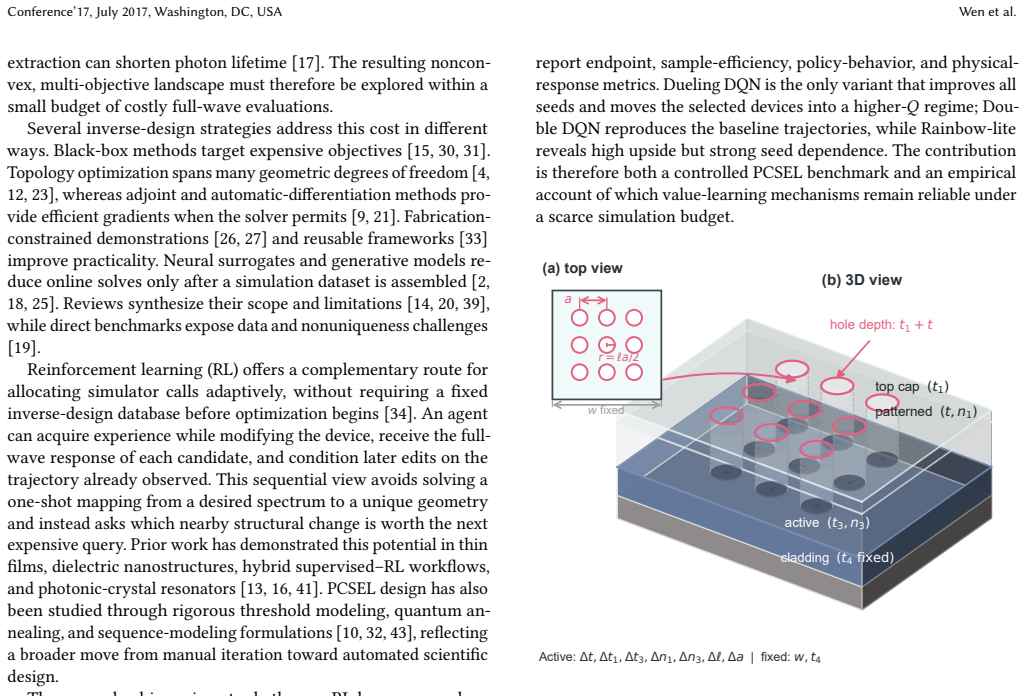
The reading
What carries the argument
Dueling value–advantage decomposition: the network splits Q(s,a) into a state-value stream V(s) that judges whether the current design neighborhood is promising and an advantage stream A(s,a) that ranks the fourteen local edits, so scarce coupled FDTD feedback can be shared across actions rather than forcing an immediate full ranking of every edit.
What would settle it
Re-run the same four matched seeds and 83-call budget with an altered objective (different component weights or unclipped physical targets) or fabricate and measure the saved dueling endpoints; if another variant then wins consistently, or measured devices reverse the simulated ranking, the reliability claim for Dueling DQN fails.
Extended reading notes
Core claim
Under a matched 83-call FDTD protocol for a seven-variable PCSEL, Dueling DQN is the only tested value-based variant that improves all four seeds and leads on endpoint score, sample efficiency, and physical responses. Relative to first-evaluated designs its selected structures raise mean quality factor by about 26×, cut wavelength error by 64%, and raise upward power by 47%; versus baseline DQN they reach roughly 2.6× higher mean Q. Double DQN copies the baseline trajectories; Rainbow-lite can score high but depends strongly on the seed.
Load-bearing premise
The fixed hand-weighted scalar score used to rank designs is assumed to track real engineering quality well enough that winning on that score, with four seeds and one local-edit template, means the method is the most reliable for actual PCSEL design.
Editorial extensions
If this is right
- Under tight full-wave budgets, prefer dueling heads before stacking distributional, prioritized-replay, or noisy extras for local-edit PCSEL search.
- Matched seeds, shared initialization blocks, and process metrics (AUC, policy-selected high scores, raw Q/λ/power) become the standard way to credit algorithmic gains in simulation-driven photonics.
- Double-style target fixes alone need not change the search path when the action space and replay are this small.
- Combined Rainbow-style agents can unlock high upside but require explicit seed-dependence checks before deployment.
- The same protocol can audit value-based RL on other costly Maxwell inverse-design tasks with discrete local edits.
Reading between the lines
- If neighborhood value is the scarce signal, simpler dueling agents may beat heavier multi-component agents whenever simulator calls number in the tens rather than thousands.
- Hand-built scalar utilities that gate Q by wavelength will systematically prefer balanced extraction over peak-Q cavities once confinement is clipped—designers should treat that ranking as a choice, not physics.
- Extending the test to fabrication tolerances or continuous actions would show whether the dueling advantage survives the jump from idealized FDTD edits to buildable devices.
- Incumbent-window local search plus replay may be doing as much work as the network variant; ablating the window schedule is a natural next control.
Editorial analysis
A structured set of objections, weighed in public.
Referee Report
Summary. The manuscript compares baseline DQN against six value-based variants (dueling, C51 distributional, PER, Noisy, Double, and a Rainbow-lite combination) for seven-variable PCSEL inverse design under a tightly controlled protocol: shared Lumerical FDTD simulator, a fixed hand-weighted physics-aware score S (Eq. 9), an 83-call budget (20 shared random-init calls + 63 learned calls in three-edit incumbent-reset windows), and four matched seeds acting as experimental blocks. The central empirical claim is that Dueling DQN is the only variant that improves all four seeds (mean best score 87.51→93.60; min 84.65→88.70), with concurrent gains in AUC, Top-5, policy-selected high-score calls, and raw physics (Q 2.19→5.63×10^6, |Δλ| 0.86→0.26 nm, P 0.078→0.089); Double DQN exactly reproduces DQN trajectories (a clean null), and Rainbow-lite shows high upside but seed-dependent bimodality. Strengths include genuinely matched protocols, re-simulation audits of saved devices (Table 3), seed-level multi-metric reporting in the spirit of Agarwal et al. [1], disclosure that the strongest seed-1 endpoint arose from epsilon-random edits, and public code. The principal weaknesses are inferential: four seeds is thin support for a 'most reliable configuration tested' claim, no equal-budget non-RL baseline (e.g., random search) is reported, and the mechanism attribution (value–advantage decomposition) is partly undercut by the authors' own stochastic-path disclosure.
Significance. If the reliability claim holds, the paper provides (i) a rare controlled, equal-budget comparison of value-based RL variants on a real photonics problem, (ii) a reproducible public codebase, and (iii) a reporting template (matched seeds, shared init blocks, raw-metric audits, re-simulation checks) that is arguably more valuable than the specific winner, since it makes algorithmic attribution auditable in simulation-budget-limited inverse design. The physical gains for the dueling-selected devices (Q 2.19→5.63×10^6, |Δλ| 0.86→0.26 nm, P 0.078→0.089) are real and independently re-simulated, so the result is not purely an artifact of the scalar score. The main limitation on significance is inferential breadth: four seeds and one objective/template constrain how far 'most reliable configuration tested' can generalize, and no equal-budget non-RL baseline anchors the practical value of the RL machinery itself.
major comments (4)
- [§3.3 / §4.1 / Table 2] The headline reliability claim rests on four paired gains: +3.50, +9.63, +1.86, +9.39. A paired t-statistic on these is ≈3.2 at df=3 — borderline uncorrected, and not significant after any multiple-comparison adjustment across the seven variants. Moreover, per Table 5 the seeds also drive NumPy/PyTorch initialization and exploration draws, so 'matched' blocks share more than starting geometry. Since each run costs only 83 FDTD calls, I ask the authors either to add seeds (e.g., 8–12 total) or to report interval estimates in line with their own cited best practice [1] (stratified bootstrap CIs, IQM/median rather than mean over 4 runs) and to temper 'only variant that improves all seeds' and 'most reliable configuration tested' accordingly.
- [§4.2] The authors honestly report that the strongest endpoint (seed 1, 97.283 at call 64) arose from two epsilon-random edits and 'cannot be attributed directly to the dueling head.' Since 'improves all four seeds' is the paper's central selling point, the claim should be decomposable into policy-driven vs. exploration-driven gains. The reported 'policy ≥83' counts (7.25 vs 3.00) gesture at this, but a per-seed policy-only endpoint (best score attained by a greedy/noisy-greedy selected call) for every algorithm is needed to show the dueling advantage survives removal of stochastic discoveries.
- [§1 / §3.3 / §4] No equal-budget non-RL comparator is reported. For an optics readership, 'accelerated photonics inverse design' invites the question of whether any RL variant beats 83 calls of random search or a simple local hill-climber under the same S, budget, and incumbent-window protocol. The 20 forced-random calls logged in all 28 runs (560 evaluations) plus the shared init protocol may support an approximate random-search baseline at negligible extra simulation cost. Without this anchor, the practical-value framing in the abstract and Conclusion is unanchored even though the internal variant ranking is unaffected.
- [§4.2 (mechanism paragraph) / §4.3 (Double null)] The mechanism claim — that separating V(s) from A(s,a) is what helps — is weakened by the adjacent finding that Double DQN's altered targets never flip a single argmax across all 28 trajectories: value-estimate changes at this budget rarely change behavior. This raises the possibility that Dueling's gains come from architecture-induced tie-breaking or initialization rather than improved value learning. A load-bearing but cheap diagnostic: quantify how often the dueling and baseline Q-rankings disagree on matched states, and whether Dueling's greedy choices track the sign of the finite-difference responses in Fig. 6(b) better than DQN's do.
minor comments (9)
- [Abstract] The '(25.8×)' improvement is relative to the first evaluated designs, which are shared across all algorithms by construction; as phrased, casual readers may attribute it to Dueling specifically. Please clarify that this describes the shared init-to-endpoint trajectory.
- [Table 3 / Fig. 9(e)] All four re-simulated devices report θ = 0.841° exactly, and Fig. 9(e) is essentially flat. Please state the far-field angular grid resolution; if c_θ is effectively constant across all visited designs, the 'multi-physics' weighting in Eq. (9) is in practice a three-term objective, which deserves one sentence.
- [Table 6 (C51 projection)] The C51 support [0,5000] spans the theoretical return bound but rewards lie in [−10, ~100]; 51 atoms give ~98-unit spacing, and the −10 terminal penalty is clipped to the support edge. This may explain the distributional variant's poor showing and should be discussed as a fairness caveat for that arm.
- [Eq. (11)] Mean-centering the advantage over all 16 outputs includes the two masked width actions. This is harmless for the masked argmax (a per-state constant), but please say so explicitly to pre-empt confusion.
- [§2.2] The weights (60, 18, 8, 4, 10) and clip/log bounds are asserted without provenance. A one-dimensional sensitivity check — e.g., re-ranking endpoints under ±50% perturbation of the two largest weights from logged data — would cost no new simulations and would address transfer of the algorithm ranking beyond this specific S.
- [Fig. 2(b) caption] 'div.*' is described as a 'stricter visualization-only scale' but the scale is never defined; please define it in the caption of Fig. 8 as well.
- [Table 2] Seed 0's DQN best occurs at call 20, i.e., during random initialization — the learned phase added nothing in that block. Worth one explicit remark in §4.1, as it bears on how much of the baseline's performance is initialization.
- [Table 7(a)] 'First ≥83' for Rainbow-lite (21.5) is conditional on only 2/4 successful seeds; please annotate conditional means in the table to avoid cross-row misreading.
- [Conclusion / refs] Conclusion: 'endpoint, process, action-log and physical-response indicate' is missing a noun (e.g., 'analyses'). Reference [43] (sequence-modeling PCSEL design) is cited but never compared; one sentence on why it is out of scope would help.
Circularity Check
No significant circularity: matched empirical RL comparison with a frozen shared objective, not a self-defining derivation.
full rationale
The paper’s load-bearing claim is an empirical ranking of DQN variants under a fixed PCSEL template, Lumerical FDTD simulator, 83-call budget, four matched seeds, and a hand-designed but frozen scalar utility S (Eq. 9) used as the RL reward. Algorithm differences are attributed to post-initialization query allocation, with Double DQN reproducing baseline trajectories as a controlled null and saved geometries re-simulated for consistency. Endpoint, AUC, policy, and raw FDTD responses (Q, λ, P, A_eff, θ) are reported separately; physical gains are not algebraically forced by the definition of S, nor fitted from the same quantities then relabeled as predictions. Self-citations to prior photonic RL work are background, not uniqueness theorems or load-bearing premises that forbid alternatives. There is no self-definitional identity, fitted-input-as-prediction loop, or renamed known law. Evaluating agents partly on the same S they optimize is standard RL practice and does not reduce the comparative result by construction. Circularity score 0.
Assumptions & free parameters
free parameters (4)
- Objective weights and normalizers in S (60, 18, 8, 4, 10; Q log clip bounds; λ Gaussian width 5 nm; P/A/θ clip scales) =
60 c_Q + 18 c_λ + 8 c_P + 4 c_A + 10 c_θ (Eq. 9)
- Simulation budget and split (83 calls; 20 random init + 63 learned; 21 three-edit windows) =
83 FDTD calls; learn from call 21
- Network/optimization hyperparameters (MLP 8–80–120–80, γ=0.98, lr=1e-4, batch 16, target every 50, ε schedule, PER α/β, =
See Appendix Tables 5–6
- Local edit step sizes (2.5 nm thicknesses/lattice; 0.005 index/hole-factor) =
2.5 nm / 0.005 as in §2.3 and Table 4
assumptions (4)
- domain assumption Classical Maxwell FDTD evaluations from Ansys Lumerical are adequate proxies for the PCSEL responses used in ranking (Q, λ, P, A_eff, θ).
- domain assumption Q-learning / DQN bootstrap targets with replay and a target network are valid learning updates for this finite-horizon local-edit MDP.
- ad hoc to paper Matched random seeds, shared init trajectories, and identical action masks make cross-algorithm score differences attributable to value-learning mechanisms rather than start geometry.
- ad hoc to paper Masking width actions and fixing t4/w isolates a representative seven-variable PCSEL search without changing the reliability conclusion’s intended scope.
invented entities (2)
-
Physics-aware scalar score S with λ-gated Q term
-
Rainbow-lite agent (Double + dueling + PER + C51 + NoisyLinear, one-step only)
Cite this review
Pith. "Pith review of When Every Simulation Counts: Value-Based Reinforcement Learning for Accelerated Photonics Inverse Design." pith.science (2026). https://pith.science/paper/IDHUQACJ
@misc{pith2026260723469,
  author       = {Pith},
  title        = {Pith review of: When Every Simulation Counts: Value-Based Reinforcement Learning for Accelerated Photonics Inverse Design},
  year         = {2026},
  howpublished = {\url{https://pith.science/paper/IDHUQACJ}},
  note         = {Machine review of arXiv:2607.23469}
}
read the original abstract
Photonic-crystal surface-emitting lasers (PCSELs) can combine high-power operation with narrow-divergence surface emission, but optimizing coupled parameters requires costly full-wave simulations. Deep Q-network (DQN) optimization can reuse simulated transitions to guide edits, yet which value-learning mechanisms remain reliable under tight simulation budgets is unknown. We address this gap by comparing baseline DQN and six value-based variants for a seven-variable PCSEL design under a shared objective, simulator, 83-call budget, and four matched initializations. Beyond endpoints, we analyze sample efficiency, policy behavior, and physical response to separate learning gains from favorable starts or exploratory jumps. Dueling DQN is the only variant to improve all four seeds. Relative to the first evaluated designs, its selected structures increase the mean quality factor () from to (), reduce wavelength error by 64%, and increase upward power by 47%; compared with baseline DQN, they achieve a higher mean under the same budget. Other variants yield no consistent improvement; Double DQN reproduces baseline trajectories, while Rainbow-lite shows high upside but strong seed dependence. These results identify Dueling DQN as the most reliable configuration tested for simulation-budget-limited PCSEL inverse design and provide a reproducible framework for attributing algorithmic gains in scientific optimization. The source code is publicly available at https://github.com/Longying-Wen/PCSEL-RL.
Figures


Figures from the paper (6 more)


Reference graph
Works this paper leans on
-
[1]
Courville, and Marc G
Rishabh Agarwal, Max Schwarzer, Pablo Samuel Castro, Aaron C. Courville, and Marc G. Bellemare. 2021. Deep Reinforcement Learning at the Edge of the Statistical Precipice. InAdvances in Neural Information Processing Systems, Vol. 34. 29304–29320
2021
-
[2]
Takashi Asano and Susumu Noda. 2019. Iterative Optimization of Photonic Crystal Nanocavity Designs by Using Deep Neural Networks.Nanophotonics8, 12 (2019), 2243–2256. doi:10.1515/nanoph-2019-0308
-
[3]
Bellemare, Will Dabney, and Remi Munos
Marc G. Bellemare, Will Dabney, and Remi Munos. 2017. A Distributional Perspec- tive on Reinforcement Learning. InProceedings of the 34th International Conference on Machine Learning (Proceedings of Machine Learning Research, Vol. 70). 449–458
2017
-
[4]
Rasmus E. Christiansen and Ole Sigmund. 2021. Inverse Design in Photonics by Topology Optimization: Tutorial.Journal of the Optical Society of America B38, 2 (2021), 496–509. doi:10.1364/JOSAB.406048
-
[5]
Meire Fortunato, Mohammad Gheshlaghi Azar, Bilal Piot, Jacob Menick, Mat- teo Hessel, Ian Osband, Alex Graves, Vlad Mnih, Remi Munos, Demis Has- sabis, Olivier Pietquin, Charles Blundell, and Shane Legg. 2018. Noisy Net- works for Exploration. InInternational Conference on Learning Representations. arXiv:1706.10295
arXiv 2018
-
[6]
Peter Henderson, Riashat Islam, Philip Bachman, Joelle Pineau, Doina Precup, and David Meger. 2018. Deep Reinforcement Learning That Matters. InProceedings of the Thirty-Second AAAI Conference on Artificial Intelligence, Vol. 32. 3207–3214. doi:10.1609/aaai.v32i1.11694
-
[7]
Matteo Hessel, Joseph Modayil, Hado van Hasselt, Tom Schaul, Georg Ostrovski, Will Dabney, Dan Horgan, Bilal Piot, Mohammad Azar, and David Silver. 2018. Rainbow: Combining Improvements in Deep Reinforcement Learning. InPro- ceedings of the Thirty-Second AAAI Conference on Artificial Intelligence, Vol. 32. 3215–3222. doi:10.1609/aaai.v32i1.11796
-
[8]
Kazuyoshi Hirose, Yong Liang, Yoshitaka Kurosaka, Akiyoshi Watanabe, Takahiro Sugiyama, and Susumu Noda. 2014. Watt-Class High-Power, High-Beam-Quality Photonic-Crystal Lasers.Nature Photonics8 (2014), 406–411. doi:10.1038/nphoton. 2014.75
doi:10.1038/nphoton 2014
Show all 45 references
-
[9]
Hughes, Momchil Minkov, Ian A
Tyler W. Hughes, Momchil Minkov, Ian A. D. Williamson, and Shanhui Fan. 2018. Adjoint Method and Inverse Design for Nonlinear Nanophotonic Devices.ACS Photonics5, 12 (2018), 4781–4787. doi:10.1021/acsphotonics.8b01522
2018 doi
-
[10]
Takuya Inoue, Yuya Seki, Shu Tanaka, Nozomu Togawa, Kenji Ishizaki, and Susumu Noda. 2022. Towards Optimization of Photonic-Crystal Surface-Emitting Lasers via Quantum Annealing.Optics Express30, 24 (2022), 43503–43512. doi:10. 1364/OE.476839
2022
-
[11]
Kenji Ishizaki, Menaka De Zoysa, and Susumu Noda. 2019. Progress in Photonic-Crystal Surface-Emitting Lasers.Photonics6, 3 (2019), 96. doi:10. 3390/photonics6030096
2019
-
[12]
Jensen and Ole Sigmund
Jakob S. Jensen and Ole Sigmund. 2011. Topology Optimization for Nano- Photonics.Laser & Photonics Reviews5, 2 (2011), 308–321. doi:10.1002/lpor. 201000014
2011 doi
-
[13]
Anqing Jiang, Yoshie Osamu, and Liangyao Chen. 2020. Multilayer Optical Thin Film Design with Deep Q Learning.Scientific Reports10 (2020), 12780. doi:10.1038/s41598-020-69754-w
2020 doi
-
[14]
Jiaqi Jiang, Mingkun Chen, and Jonathan A. Fan. 2021. Deep Neural Networks for the Evaluation and Design of Photonic Devices.Nature Reviews Materials6, 8 (2021), 679–700. doi:10.1038/s41578-020-00260-1
2021 doi
-
[15]
Jones, Matthias Schonlau, and William J
Donald R. Jones, Matthias Schonlau, and William J. Welch. 1998. Efficient Global Optimization of Expensive Black-Box Functions.Journal of Global Optimization 13 (1998), 455–492. doi:10.1023/A:1008306431147
1998 doi
-
[16]
Renjie Li, Ceyao Zhang, Wentao Xie, Yuanhao Gong, Feilong Ding, Hui Dai, Zihan Chen, Feng Yin, and Zhaoyu Zhang. 2023. Deep Reinforcement Learning Empowers Automated Inverse Design and Optimization of Photonic Crystals for Nanoscale Laser Cavities.Nanophotonics12, 2 (2023), 31...
2023
-
[17]
Yong Liang, Chao Peng, Kyosuke Sakai, Seita Iwahashi, and Susumu Noda. 2011. Three-Dimensional Coupled-Wave Model for Square-Lattice Photonic Crystal Lasers with Transverse Electric Polarization: A General Approach.Physical Review B84, 19 (2011), 195119. doi:10.1103/PhysRevB.84.195119
2011 doi
-
[18]
Rodrigues, Kyu-Tae Lee, and Wenshan Cai
Zhaocheng Liu, Dayu Zhu, Sean P. Rodrigues, Kyu-Tae Lee, and Wenshan Cai
-
[19]
Taigao Ma, Mustafa Tobah, Haozhu Wang, and L. Jay Guo. 2022. Benchmarking Deep Learning-Based Models on Nanophotonic Inverse Design Problems.Opto- Electronic Science1, 1 (2022), 210012. doi:10.29026/oes.2022.210012
2022
-
[20]
Kudyshev, Alexandra Boltasseva, Wenshan Cai, and Yongmin Liu
Wei Ma, Zhaocheng Liu, Zhaxylyk A. Kudyshev, Alexandra Boltasseva, Wenshan Cai, and Yongmin Liu. 2021. Deep Learning for the Design of Photonic Structures. Nature Photonics15 (2021), 77–90. doi:10.1038/s41566-020-0685-y
2021 doi
-
[21]
Momchil Minkov, Ian A. D. Williamson, Lucio C. Andreani, Dario Gerace, Be- icheng Lou, Alex Y. Song, Tyler W. Hughes, and Shanhui Fan. 2020. Inverse Design of Photonic Crystals through Automatic Differentiation.ACS Photonics7, 7 (2020), 1729–1741. doi:10.1021/acsphotonics.0c00327
2020 doi
-
[22]
Rusu, Joel Veness, Marc G
Volodymyr Mnih, Koray Kavukcuoglu, David Silver, Andrei A. Rusu, Joel Veness, Marc G. Bellemare, Alex Graves, Martin Riedmiller, Andreas K. Fidjeland, Georg Ostrovski, Stig Petersen, Charles Beattie, Amir Sadik, Ioannis Antonoglou, Helen King, Dharshan Kumaran, Daan Wierstra, ...
2015
-
[23]
Piggott, Weiliang Jin, Jelena Vuckovic, and Alejandro W
Sean Molesky, Zin Lin, Alexander Y. Piggott, Weiliang Jin, Jelena Vuckovic, and Alejandro W. Rodriguez. 2018. Inverse Design in Nanophotonics.Nature Photonics 12 (2018), 659–670. doi:10.1038/s41566-018-0246-9
2018 doi
-
[24]
Susumu Noda, Kyoko Kitamura, Tsuyoshi Okino, Daiki Yasuda, and Yoshinori Tanaka. 2017. Photonic-Crystal Surface-Emitting Lasers: Review and Introduction of Modulated-Photonic Crystals.IEEE Journal of Selected Topics in Quantum Electronics23, 6 (2017), 1–7. Art. no. 4900107. do...
2017
-
[25]
DeLacy, John D
John Peurifoy, Yichen Shen, Li Jing, Yi Yang, Fidel Cano-Renteria, Brendan G. DeLacy, John D. Joannopoulos, Max Tegmark, and Marin Soljacic. 2018. Nanopho- tonic Particle Simulation and Inverse Design Using Artificial Neural Networks. Science Advances4, 6 (2018), eaar4206. doi...
2018 doi
-
[26]
Piggott, Jesse Lu, Konstantinos G
Alexander Y. Piggott, Jesse Lu, Konstantinos G. Lagoudakis, Jan Petykiewicz, Thomas M. Babinec, and Jelena Vuckovic. 2015. Inverse Design and Demonstra- tion of a Compact and Broadband On-Chip Wavelength Demultiplexer.Nature Photonics9 (2015), 374–377. doi:10.1038/nphoton.2015.69
2015 doi
-
[27]
Piggott, Jan Petykiewicz, Logan Su, and Jelena Vuckovic
Alexander Y. Piggott, Jan Petykiewicz, Logan Su, and Jelena Vuckovic. 2017. Fabrication-Constrained Nanophotonic Inverse Design.Scientific Reports7 (2017),
2017
-
[28]
Tom Schaul, John Quan, Ioannis Antonoglou, and David Silver. 2016. Priori- tized Experience Replay. InInternational Conference on Learning Representations. arXiv:1511.05952
2016 arXiv
-
[29]
Philipp-Immanuel Schneider, Xavier Garcia Santiago, Victor Soltwisch, Martin Hammerschmidt, Sven Burger, and Carsten Rockstuhl. 2019. Benchmarking Five Global Optimization Approaches for Nano-Optical Shape Optimization and Parameter Reconstruction.ACS Photonics6, 11 (2019), 27...
2019
-
[30]
Adams, and Nando de Fre- itas
Bobak Shahriari, Kevin Swersky, Ziyu Wang, Ryan P. Adams, and Nando de Fre- itas. 2016. Taking the Human Out of the Loop: A Review of Bayesian Optimization. Proc. IEEE104, 1 (2016), 148–175. doi:10.1109/JPROC.2015.2494218
2016
-
[31]
Jasper Snoek, Hugo Larochelle, and Ryan P. Adams. 2012. Practical Bayesian Optimization of Machine Learning Algorithms. InAdvances in Neural Information Processing Systems, Vol. 25
2012
-
[32]
Song, Akhil Raj Kumar Kalapala, Weidong Zhou, and Shanhui Fan
Alex Y. Song, Akhil Raj Kumar Kalapala, Weidong Zhou, and Shanhui Fan. 2018. First-Principles Simulation of Photonic Crystal Surface-Emitting Lasers Using Rigorous Coupled Wave Analysis.Applied Physics Letters113, 4 (2018), 041106. doi:10.1063/1.5045486
2018 doi
-
[33]
Sapra, Jan A
Logan Su, Dries Vercruysse, Jinhie Skarda, Neil V. Sapra, Jan A. Petykiewicz, and Jelena Vuckovic. 2020. Nanophotonic Inverse Design with SPINS: Software Architecture and Practical Considerations.Applied Physics Reviews7, 1 (2020), 011407. doi:10.1063/1.5131263
2020 doi
-
[34]
Sutton and Andrew G
Richard S. Sutton and Andrew G. Barto. 2018.Reinforcement Learning: An Intro- duction(2 ed.). MIT Press
2018
-
[35]
Allen Taflove and Susan C. Hagness. 2005.Computational Electrodynamics: The Finite-Difference Time-Domain Method(3 ed.). Artech House
2005
-
[36]
Hado van Hasselt, Arthur Guez, and David Silver. 2016. Deep Reinforcement Learning with Double Q-Learning. InProceedings of the Thirtieth AAAI Conference on Artificial Intelligence, Vol. 30. 2094–2100. doi:10.1609/aaai.v30i1.10295
2016 doi
-
[37]
Ziyu Wang, Tom Schaul, Matteo Hessel, Hado van Hasselt, Marc Lanctot, and Nando de Freitas. 2016. Dueling Network Architectures for Deep Reinforcement Learning. InProceedings of the 33rd International Conference on Machine Learning (Proceedings of Machine Learning Research, Vo...
2016
-
[38]
Christopher J. C. H. Watkins and Peter Dayan. 1992. Q-Learning.Machine Learning8 (1992), 279–292. doi:10.1007/BF00992698
1992 doi
-
[39]
Wiecha, Arnaud Arbouet, Christian Girard, and Otto L
Peter R. Wiecha, Arnaud Arbouet, Christian Girard, and Otto L. Muskens. 2021. Deep Learning in Nano-Photonics: Inverse Design and Beyond.Photonics Research 9, 5 (2021), B182–B200. doi:10.1364/PRJ.415960
2021 doi
-
[40]
Kane S. Yee. 1966. Numerical Solution of Initial Boundary Value Problems In- volving Maxwell’s Equations in Isotropic Media.IEEE Transactions on Antennas and Propagation14, 3 (1966), 302–307. doi:10.1109/TAP.1966.1138693
1966
-
[41]
Fountaine, and Aaswath P
Christopher Yeung, Benjamin Pham, Zihan Zhang, Katherine T. Fountaine, and Aaswath P. Raman. 2024. Hybrid Supervised and Reinforcement Learning for Design Optimization of Nanophotonic Structures.Optics Express32, 6 (2024), 9920–9930. doi:10.1364/OE.512159
2024 doi
-
[42]
Masahiro Yoshida, Shumpei Katsuno, Takuya Inoue, John Gelleta, Koki Izumi, Menaka De Zoysa, Kenji Ishizaki, and Susumu Noda. 2023. High-Brightness Scalable Continuous-Wave Single-Mode Photonic-Crystal Laser.Nature618, 7966 (2023), 727–732. doi:10.1038/s41586-023-06059-8
2023 doi
-
[43]
Ceyao Zhang, Renjie Li, Cheng Zhang, Zhaoyu Zhang, and Feng Yin. 2024. Inverse Design of Photonic Crystal Surface Emitting Lasers is a Sequence Modeling Problem.arXiv preprint arXiv:2403.05149(2024). arXiv:2403.05149 [physics.optics] Appendix For readability, the supplementary...
2024 arXiv
-
[1786]
doi:10.1038/s41598-017-01939-2
-
[2018]
doi:10.1021/acs.nanolett.8b03171
Generative Model for the Inverse Design of Metasurfaces.Nano Letters18, 10 (2018), 6570–6576. doi:10.1021/acs.nanolett.8b03171
2018 doi
Reviewed July 30, 2026 · model on record in the stance chip above.
Discussion (0). Sign in to comment.