REVIEW 2 major objections 5 minor 300 references
Modes, states, and symmetries jointly fix which resources of quantum light can be used for information processing and precision measurement.
Reviewed by Pith at T0; open to challenge. T0 means a machine referee read the full paper against a public rubric. the ladder, T0–T4 →
T0 review · grok-4.5
2026-07-30 21:51 UTC pith:IDIUEPJW
load-bearing objection Solid unifying PhD monograph built on multiple PRL-level pieces; the modes–states–symmetries story is real and usable, with SSR as an explicit modeling choice rather than a hidden crack. the 2 major comments →
PhD thesis: Modes, States, and Symmetries in quantum Optics for quantum Information and Metrology
The pith
A machine-rendered reading of the paper's core claim, the machinery that carries it, and where it could break.
Core claim
The physical resources of photonic quantum information and metrology are determined by the joint structure of modes, states, and symmetries: time-frequency continuous variables, entanglement along collective operators (with metrological inequalities and k-entanglement), symmetry-based generalized Hong–Ou–Mandel interference with quantifiable precision, and optical superselection rules that fix accessible bosonic states/operations and unify discrete- and continuous-variable resource accounts.
What carries the argument
A modes–states–symmetries framework whose load-bearing pieces are collective-variable entanglement (spectral-space inequalities and k-entanglement), symmetry-centered generalized HOM interferometry, and superselection-rule-compliant (SSR) bosonic descriptions (Schwinger/spin tools and the CV limit of fixed-photon-number sectors).
Load-bearing premise
The claim that missing a shared global phase reference really imposes a photon-number superselection rule that correctly splits discrete and continuous pictures and decides which bosonic resources count.
What would settle it
Find an optical protocol where a genuine global phase reference is absent, yet modal entanglement from passive linear optics or CV encodings outside fixed-N sectors yields computational universality or metrological scaling that the SSR resource account forbids; or show the formal CV-as-limit-of-SSR construction fails for a standard Gaussian/non-Gaussian task.
If this is right
- Time-frequency correlations can be treated as genuine metrological resources for collective time-parameter estimation, not only technical spectrum shape.
- HOM-type precision limits and optimal inputs follow from input symmetry under the interferometer, extending beyond two single photons and ideal visibility.
- Collective time-frequency variables support GKP-like encodings and error correction tied to multimode structure.
- SSR organizes when Gaussianity, nonclassicality, modal entanglement, and particle entanglement count toward bosonic universality and metrology.
- Discrete-variable and continuous-variable optical protocols can be compared inside one fixed-photon-number-compatible resource language.
Where Pith is reading between the lines
- Labs reporting HOM metrology should quote symmetry/visibility models alongside dip depth, because the thesis ties Fisher information degradation to those quantities.
- Resource theories for linear-optical computing may need explicit phase-reference bookkeeping whenever passive elements appear to ‘create’ modal entanglement.
- Collective-variable codes suggest hybrid architectures that encode logically in sum/difference time-frequency quadratures while sensing with the same collective observables.
- If SSR limits are accepted, claims of CV advantage should state whether they survive restriction to phase-reference-free, fixed-N sectors.
Editorial analysis
A structured set of objections, weighed in public.
Referee Report
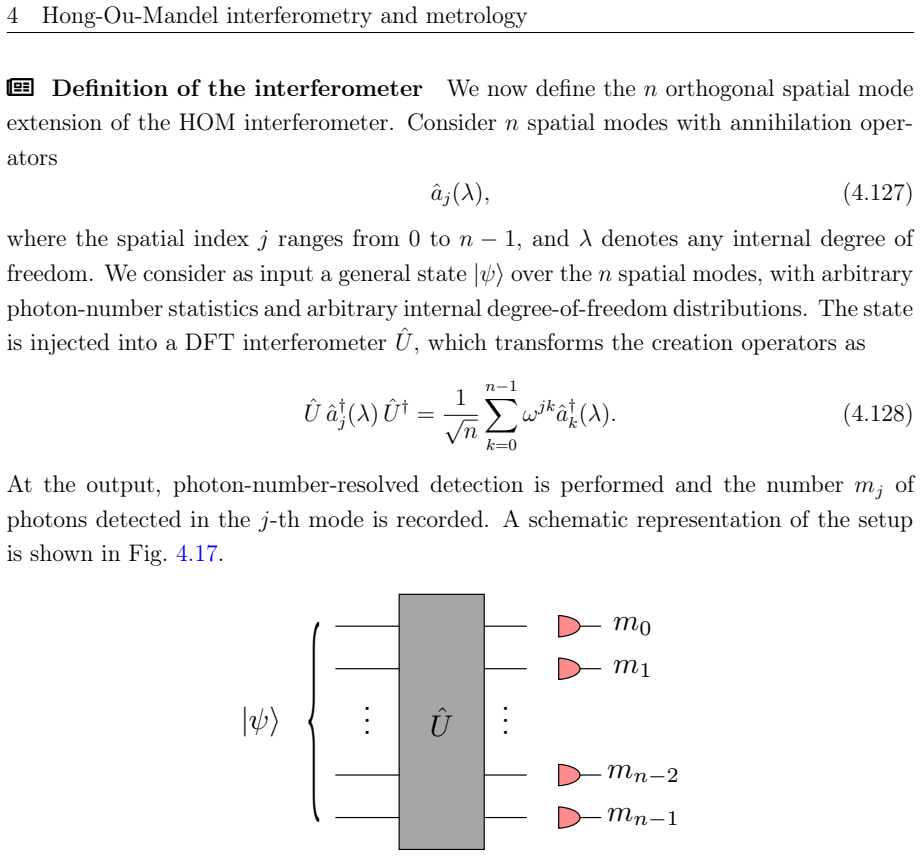
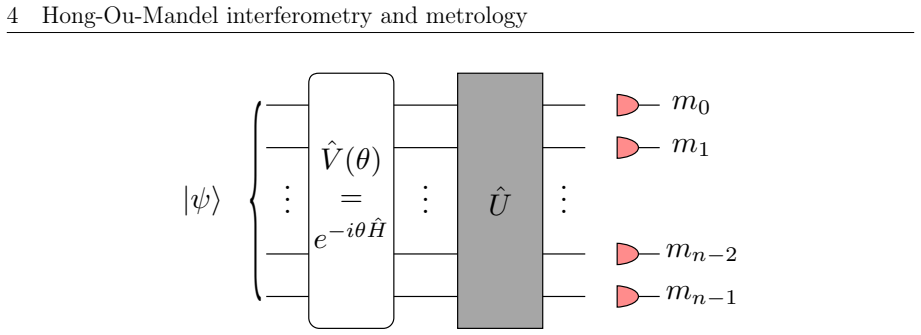
Summary. This PhD thesis develops a modes–states–symmetries framework for quantum optics in quantum information and metrology. It treats time-frequency degrees of freedom as continuous variables (Ch. 2), links multimode/time-frequency entanglement along collective operators to metrological bounds and k-entanglement, and proposes collective time-frequency GKP-type encodings (Ch. 3). It reinterprets Hong-Ou-Mandel interference via input-state symmetry, quantifies Fisher information including imperfect visibility (with experiment), and generalizes to multiphoton and multimode interferometers (Ch. 4). Finally it uses optical photon-number superselection rules (Schwinger representation, spherical phase space, controlled CV limits) to organize bosonic computational and metrological resources and to relate DV and CV encodings (Ch. 5). Core technical threads are supported by published works [1–9], appendices, and standard QFI/CRB and Fock/mode formalism.
Significance. If the synthesis holds, the thesis supplies a coherent language for when modal structure, photon statistics, and exchange/phase symmetries—not only ‘entanglement’ in the abstract—set precision and computational power in photonic platforms. Strengths that should be credited include: peer-reviewed derivations of time-frequency metrology and phase-space tools [1,2]; collective-operator entanglement measures and inequalities with explicit metrological reading [6]; symmetry-based HOM generalizations and visibility-aware precision, including experimental contact [4,7]; SSR-based resource partitions and universality discussion for bosonic encodings [5,8,9]; and extensive appendices (B.*) that make many bounds checkable. The collective-variable and HOM pillars are useful even if one rejects the strongest SSR↔CV identification. The work is significant as a unifying thesis rather than a single new theorem.
major comments (2)
- [Chapter 5, Sections 5.2–5.3] Ch. 5 / Sec. 5.2–5.3: The load-bearing unification of DV and CV resources and the universality claims rest on treating continuous-variable systems as controlled limits of fixed-N, SSR-compliant sectors (Schwinger/spin coherent states, spherical Wigner → planar phase space) and on absence of a shared global phase reference imposing photon-number SSR. This is a standard modeling choice, but the manuscript should state operational failure modes more sharply—when a local oscillator or relative-phase reference is available, which resource counts (modal vs particle entanglement, SG/SNG vs QG/QNG) and which universality statements survive unchanged. Without an explicit ‘with vs without phase reference’ map tied to the encoding-independent conditions in Sec. 5.3.5, the strongest DV/CV resource story remains partly interpretive even though the formal limit constructions are carefully set up.
- [Section 3.2] Sec. 3.2 (esp. inequalities around collective variance / Eq. (3.38) and the k-entanglement and thickness ζ discussion): The metrological inequalities and partial entanglement quantifier are central to Ch. 3’s claim that entanglement along collective operators is the relevant resource. The pure-state and spectral-support arguments are clear; the mixed-state extension and the trade-off plots (e.g. k vs ζ for fixed I) need a short statement of which measurement class saturates the bound (collective vs local) and whether k-entanglement can vanish while QFI along the collective generator remains large under experimentally natural noise. A single clarifying proposition or remark would lock the resource interpretation to the QFI expressions already used in Chs. 1–2.
minor comments (5)
- [How to use this thesis; Chapters 3–5] Front matter and Ch. 1 are appropriately pedagogical, but the icon system (established / published / unpublished) is easy to miss; a one-page ‘original vs published’ map for Chs. 3–5 would help examiners and journal readers separate [1–9] from lightbulb material.
- [Chapter 2; Section 3.1.5] Notation list is thorough; still, chrono-cyclic Wigner vs standard Wigner and collective vs local generators could be cross-referenced at first use in Ch. 2–3 to avoid dual meanings of ‘phase space’.
- [Section 4.2] HOM visibility model and experimental figures (Ch. 4, ~Figs. 4.10–4.12, Tables 4.1–4.4) are strong; ensure all plotted Fisher curves state the estimator (e.g. MLE on coincidences) and number of shots so the approach to QFI is unambiguous.
- [Throughout; List of publications] Minor language/typo cleanup: e.g. ‘fondamental’, ‘acronymes’, ‘chronocyclique/chrono-cyclique’, ‘Unied framework’ in [9], and consistent capitalization of chapter titles in the Contents.
- [Section 1.3.5; Chapter 5] Sec. 1.3.5 and Ch. 5 overlap on phase reference/SSR; a forward/back pointer stating what is standard review versus thesis contribution would reduce apparent repetition.
Circularity Check
No significant circularity: standard definitions and constructed states, with expected thesis self-citation of compiled papers [1–9] that is not load-bearing for the derivations.
full rationale
The thesis organizes modes, states, and symmetries as an analytical frame and evaluates standard resource quantities (QFI/Fisher information, collective-operator variances, HOM coincidence statistics, SSR-compliant encodings) on explicitly constructed states and interferometers. Metrological bounds follow the usual pipeline—unitary encoding → QFI = 4Δ²Ĥ (pure) or SLD form (mixed) → classical FI from POVMs/coincidences—without fitting a target observable and relabeling it as a prediction. Collective-variable inequalities, k-entanglement, symmetry-based HOM generalizations, and the SSR/CV-limit constructions are derived from stated definitions and representation theory (with technical support in the appendices), not forced by uniqueness theorems imported only from overlapping authors or by ansatz smuggled as external fact. Self-citation of [1–9] is structural for a compilation thesis and does not close a circular loop: the manuscript restates and unifies those results rather than treating an unverified self-cite as the sole warrant for the central claims. No self-definitional reduction (X defined as Y then “predicted” as Y) or fitted-input-as-prediction pattern is evidenced in the derivation chain. Score 1 reflects only the normal presence of author-overlap citations, not load-bearing circularity.
Axiom & Free-Parameter Ledger
free parameters (2)
- HOM interference visibility V (and related peak-separation / mode-overlap parameters in examples) =
State- and setup-dependent; figures show F_max(V)/F_ideal scaling versus V
- GKP lattice scale α (and finite-squeezing / finite-peak approximations)
axioms (6)
- standard math Quantum states on Hilbert/Fock space with unitary encodings and POVM measurements; classical and quantum Cramér–Rao bounds with Fisher and quantum Fisher information (incl. pure-state QFI = 4 Var(H)).
- domain assumption Electromagnetic field as bosonic modes: canonical quantization, mode transformations as passive linear optics, photons as indistinguishable bosons under exchange.
- domain assumption Time and frequency for single-photon wavepackets behave as conjugate continuous variables admitting Wigner/chrono-cyclic phase-space representation and shear/rotation optics.
- domain assumption Absent a shared optical phase reference, global U(1) phase symmetry induces a photon-number superselection rule constraining accessible states/operations (SSR-compliant optics).
- ad hoc to paper Continuous-variable bosonic systems can be obtained as controlled limits of finite-photon-number SSR-compliant systems (Schwinger/spin coherent, spherical Wigner → planar phase space).
- ad hoc to paper Metrological ‘resources’ may be counted as photon number, mode number, energy, modal entanglement, and/or particle entanglement depending on encoding and SSR sector.
invented entities (4)
-
Entanglement along collective operators and k-entanglement (partial collective entanglement quantifier)
independent evidence
-
Time-frequency / collective GKP-type encodings for single photons
independent evidence
-
Symmetry-centered generalized HOM interferometer family (multiphoton and multimode)
independent evidence
-
SSR-compliant Gaussian / non-Gaussian resource partition for bosonic QI and metrology
no independent evidence
read the original abstract
This thesis explores the role of modes, states, and symmetries in quantum optics, within the context of quantum information and quantum metrology. It proposes a unified framework to analyze how the modal structure of photonic fields, the statistical nature of states, and their symmetry properties determine the physical resources that can be exploited for quantum information processing and quantum parameter estimation. A first line of investigation develops a description of time-frequency degrees of freedom as continuous quantum variables, highlighting their richness for encoding and manipulating information. A second axis studies entanglement and collective variables, clarifying the link between physical resources and metrological gains, particularly in reaching ultimate precision limits. Interferometric scenarios of the Hong-Ou-Mandel type are then analyzed, and a general formalism centered on the notion of symmetry is developed. This framework enables the analysis of a broad range of situations and leads to several generalizations. Finally, the thesis examines the symmetries imposed by optical superselection rules and their consequences for the structure of quantum states and their operational performance, with the aim of providing a deeper understanding of the foundations of quantum optics.
Figures






Reference graph
Works this paper leans on
-
[1]
Aaronson, Scott and Arkhipov, Alex , year = 2013, journal =. The
2013
-
[2]
Physical Review A , volume =
Improved Simulation of Stabilizer Circuits , author =. Physical Review A , volume =
-
[3]
Aharonov, Yakir and Susskind, Leonard , year = 1967, journal =. Charge
1967
-
[4]
Physical Review A , volume =
Entanglement Criterion for Multipartite Systems Based on Quantum. Physical Review A , volume =
-
[5]
Physical Review A , volume =
Performance and Structure of Single-Mode Bosonic Codes , author =. Physical Review A , volume =
-
[6]
AlMasri, M. W. and Wahiddin, M. R. B. , year = 2022, journal =. Bargmann
2022
-
[7]
An examination of the extended Hong-Ou-Mandel effect and considerations for experimental detection
Alsing, Paul M. and Birrittella, Richard J. , year = 2025, number =. An Examination of the Extended. doi:10.48550/arXiv.2501.04849 , archiveprefix =. 2501.04849 , primaryclass =
work page internal anchor Pith review Pith/arXiv arXiv doi:10.48550/arxiv.2501.04849 2025
-
[8]
and Birrittella, Richard J
Alsing, Paul M. and Birrittella, Richard J. and Gerry, Christopher C. and Mimih, Jihane and Knight, Peter L. , year = 2022, journal =. Extending the
2022
-
[9]
The Hong-Ou-Mandel effect is really odd
Alsing, Paul M. and Birrittella, Richard J. and Gerry, Christopher C. and Mimih, Jihane and Knight, Peter L. , year = 2024, number =. The. doi:10.48550/arXiv.2410.11800 , archiveprefix =. 2410.11800 , publisher =
work page internal anchor Pith review Pith/arXiv arXiv doi:10.48550/arxiv.2410.11800 2024
-
[10]
Waveguide
Alushi, Uesli and Ramos, Tom. Waveguide. PRX Quantum , volume =
-
[11]
Ambainis, Andris and Leung, Debbie and Mancinska, Laura and Ozols, Maris , year = 2009, number =. Quantum. doi:10.48550/arXiv.0810.2937 , archiveprefix =. 0810.2937 , primaryclass =
-
[12]
Reviews of Modern Physics , volume =
Entanglement in Many-Body Systems , author =. Reviews of Modern Physics , volume =
-
[13]
Contracting the
Amiet, Jean-Pierre and Weigert, Stefan , year = 2000, journal =. Contracting the
2000
-
[14]
Physical Review A , volume =
Fast Simulation of Stabilizer Circuits Using a Graph-State Representation , author =. Physical Review A , volume =
-
[15]
, year = 2010, journal =
Anisimov, Petr M. , year = 2010, journal =. Quantum
2010
-
[16]
Nature Communications , volume =
Reliable Quantum Certification of Photonic State Preparations , author =. Nature Communications , volume =. doi:10.1038/ncomms9498 , copyright =
-
[17]
Flexible Entanglement-Distribution Network with an
Appas, F. Flexible Entanglement-Distribution Network with an. npj Quantum Information , volume =. doi:10.1038/s41534-021-00454-7 , copyright =
-
[18]
Nonlinear
Appas, F. Nonlinear. Journal of Lightwave Technology , volume =
-
[19]
Arecchi, F. T. and Courtens, Eric and Gilmore, Robert and Thomas, Harry , year = 1972, journal =. Atomic
1972
-
[20]
and Vinkler, Y
Arrad, G. and Vinkler, Y. and Aharonov, D. and Retzker, A. , year = 2014, journal =. Increasing
2014
-
[21]
arXiv preprint arXiv:2501.13857 , eprint =
Can Effective Descriptions of Bosonic Systems Be Considered Complete? , author =. arXiv preprint arXiv:2501.13857 , eprint =
-
[22]
Nature Communications , volume =
Effective Descriptions of Bosonic Systems Can Be Considered Complete , author =. Nature Communications , volume =. doi:10.1038/s41467-025-64872-3 , copyright =
-
[23]
Science , volume =
Generation of Time-Domain-Multiplexed Two-Dimensional Cluster State , author =. Science , volume =
-
[24]
Atia, Yosi and Aharonov, Dorit , year = 2017, journal =. Fast-Forwarding of. doi:10.1038/s41467-017-01637-7 , archiveprefix =. 1610.09619 , primaryclass =
Pith/arXiv arXiv 2017
-
[25]
and Witting, Tobias and Wyatt, Adam S
Austin, Dane R. and Witting, Tobias and Wyatt, Adam S. and Walmsley, Ian A. , year = 2010, journal =. Measuring Sub-
2010
-
[26]
Azzini, Stefano and Mazzucchi, Sonia and Moretti, Valter and Pastorello, Davide and Pavesi, Lorenzo , year = 2020, journal =. Single-. doi:10.1002/qute.202000014 , copyright =
-
[27]
Azzini, Stefano and Mazzucchi, Sonia and Moretti, Valter and Pastorello, Davide and Pavesi, Lorenzo , year = 2020, journal =. Single-
2020
-
[28]
and Ralph, Timothy C
Bachor, Hans-A. and Ralph, Timothy C. , year = 2019, publisher =. A
2019
-
[29]
Barbieri, Marco , year = 2022, journal =. Optical
2022
-
[30]
Elementary Gates for Quantum Computation , author =. Physical Review A , volume =. doi:10.1103/PhysRevA.52.3457 , archiveprefix =. quant-ph/9503016 , pages =
-
[31]
Proceedings of the Royal Society of London
A Universal Two-Bit Gate for Quantum Computation , author =. Proceedings of the Royal Society of London. Series A: Mathematical and Physical Sciences , volume =
-
[32]
Bargmann, V. , year = 1961, journal =. On a. doi:10.1002/cpa.3160140303 , copyright =
-
[33]
, year = 2022, journal =
Barreto Lemos, Gabriela and Lahiri, Mayukh and Ramelow, Sven and Lapkiewicz, Radek and Plick, William N. , year = 2022, journal =. Quantum Imaging and Metrology with Undetected Photons: Tutorial , shorttitle =
2022
-
[34]
Physical Review A , volume =
Free-Space Entangled Quantum Carpets , author =. Physical Review A , volume =
-
[35]
and Rudolph, Terry and Spekkens, Robert W
Bartlett, Stephen D. and Rudolph, Terry and Spekkens, Robert W. , year = 2006, journal =. Dialogue. doi:10.1142/S0219749906001591 , archiveprefix =. quant-ph/0507214 , pages =
Pith/arXiv arXiv 2006
-
[36]
and Sanders, Barry C
Bartlett, Stephen D. and Sanders, Barry C. and Braunstein, Samuel L. and Nemoto, Kae , year = 2002, journal =. Efficient
2002
-
[37]
Reviews of Modern Physics , volume =
Reference Frames, Superselection Rules, and Quantum Information , author =. Reviews of Modern Physics , volume =
-
[38]
Physical Review A , volume =
Quantum Cryptography Using Larger Alphabets , author =. Physical Review A , volume =
-
[39]
doi:10.1364/OE.401258 , archiveprefix =
Diagnosing Phase Correlations in the Joint Spectrum of Parametric Downconversion Using Multi-Photon Emission , author =. doi:10.1364/OE.401258 , archiveprefix =. 2007.00441 , primaryclass =
Pith/arXiv arXiv 2007
-
[40]
Bell, J. S. , year = 1964, journal =. On the
1964
-
[41]
Phase Estimation by Photon Counting Measurements in the Output of a Linear. JOSA B , volume =. doi:10.1364/JOSAB.29.002754 , copyright =
-
[42]
Sub-Shot Noise Sensitivities without Entanglement , author =. 1109.0206 , primaryclass =
-
[43]
Annals of Physics , volume =
Sub-Shot-Noise Quantum Metrology with Entangled Identical Particles , author =. Annals of Physics , volume =
-
[44]
and Brassard, Gilles , year = 2014, journal =
Bennett, Charles H. and Brassard, Gilles , year = 2014, journal =. Quantum Cryptography:
2014
-
[45]
and Brassard, Gilles and Cr
Bennett, Charles H. and Brassard, Gilles and Cr. Teleporting an Unknown Quantum State via Dual Classical and. Physical Review Letters , volume =
-
[46]
Multipartite quantum correlated bright frequency combs
Multipartite Quantum Correlated Bright Frequency Combs , author =. doi:10.48550/arXiv.2501.07252 , archiveprefix =. 2501.07252 , primaryclass =
work page internal anchor Pith review Pith/arXiv arXiv doi:10.48550/arxiv.2501.07252
-
[47]
Physical Review Research , volume =
Multipartite Quantum Correlated Bright Frequency Combs , author =. Physical Review Research , volume =
- [48]
-
[49]
Single-Photon
Bertocchi, G and Alibart, O and Ostrowsky, D B and Tanzilli, S and Baldi, P , year = 2006, journal =. Single-Photon
2006
-
[50]
Bhatia, Rajendra and Davis, Chandler , year = 2000, journal =. A
2000
-
[51]
, year = 2012, journal =
Birrittella, Richard and Mimih, Jihane and Gerry, Christopher C. , year = 2012, journal =. Multiphoton Quantum Interference at a Beam Splitter and the Approach to
2012
-
[52]
Birrittella, Richard J. and Alsing, Paul M. and Gerry, Christopher C. , year = 2021, journal =. The. doi:10.1116/5.0026148 , archiveprefix =. 2008.08658 , primaryclass =
Pith/arXiv arXiv 2021
-
[53]
Physical Review A , volume =
Single-Particle Nonlocality and Entanglement with the Vacuum , author =. Physical Review A , volume =
-
[54]
, year = 1946, journal =
Bloch, F. , year = 1946, journal =. Nuclear
1946
-
[55]
Electron Quantum Optics in Ballistic Chiral Conductors , author =. Annalen der Physik , volume =. doi:10.1002/andp.201300181 , copyright =
-
[56]
Measurement-Based Quantum Computation beyond Qubits , author =
-
[57]
Born, Max and Wolf, Emil and Bhatia, A. B. , year = 1999, publisher =. Principles of
1999
-
[58]
Borovik, Josh and Mirza, Imran M. , year = 2023, pages =. Review of. Frontiers in. doi:10.1364/FIO.2023.JTu5A.37 , copyright =
-
[59]
Bouchard, F. and de la Hoz, P. and Bj. Quantum Metrology at the Limit with Extremal. Optica , volume =. doi:10.1364/OPTICA.4.001429 , copyright =
-
[60]
Two-Photon Interference: The
Bouchard, Fr. Two-Photon Interference: The. Reports on Progress in Physics , volume =
-
[61]
Physical Review A , volume =
Toolbox for Continuous-Variable Entanglement Production and Measurement Using Spontaneous Parametric down-Conversion , author =. Physical Review A , volume =
-
[62]
Eli and Alexander, Rafael N
Bourassa, J. Eli and Alexander, Rafael N. and Vasmer, Michael and Patil, Ashlesha and Tzitrin, Ilan and Matsuura, Takaya and Su, Daiqin and Baragiola, Ben Q. and Guha, Saikat and Dauphinais, Guillaume and Sabapathy, Krishna K. and Menicucci, Nicolas C. and Dhand, Ish , year = 2021, journal =. Blueprint for a
2021
-
[63]
, year = 2008, publisher =
Boyd, Robert W. , year = 2008, publisher =. Nonlinear
2008
-
[64]
Quantum Measurement , author =
-
[65]
Physical Review A , volume =
Simultaneous Measurement of Group and Phase Delay between Two Photons , author =. Physical Review A , volume =
-
[66]
Brassard, Gilles and Broadbent, Anne and Tapp, Alain , year = 2005, journal =. Quantum. doi:10.1007/s10701-005-7353-4 , archiveprefix =. quant-ph/0407221 , pages =
Pith/arXiv arXiv 2005
-
[67]
, year = 1987, publisher =
Bratteli, Ola and Robinson, Derek W. , year = 1987, publisher =. Operator
1987
-
[68]
and Caves, Carlton M
Braunstein, Samuel L. and Caves, Carlton M. and Milburn, G. J. , year = 1996, journal =. Generalized
1996
-
[69]
Reviews of Modern Physics , volume =
Quantum Information with Continuous Variables , author =. Reviews of Modern Physics , volume =
-
[70]
Physical Review A , volume =
Squeezing as an Irreducible Resource , author =. Physical Review A , volume =
-
[71]
Physical Review Letters , volume =
Statistical Distance and the Geometry of Quantum States , author =. Physical Review Letters , volume =
-
[72]
and Kimble, H
Braunstein, Samuel L. and Kimble, H. J. , year = 1998, journal =. Teleportation of
1998
-
[73]
High-Threshold and Low-Overhead Fault-Tolerant Quantum Memory , author =. Nature , volume =. doi:10.1038/s41586-024-07107-7 , copyright =
-
[74]
Improved
Bravyi, Sergey and Gosset, David , year = 2016, journal =. Improved
2016
-
[75]
Universal Quantum Computation with Ideal
Bravyi, Sergey and Kitaev, Alexei , year = 2005, journal =. Universal Quantum Computation with Ideal
2005
-
[76]
Characterizing Entanglement in Pulsed Parametric Down-Conversion Using Chronocyclic
Brecht, Benjamin and Silberhorn, Christine , year = 2013, journal =. Characterizing Entanglement in Pulsed Parametric Down-Conversion Using Chronocyclic
2013
-
[77]
Brecht, Benjamin and Silberhorn, Christine , year = 2013, pages =. Chronocyclic. 2013. doi:10.1109/CLEOE-IQEC.2013.6801659 , isbn =
arXiv 2013
-
[78]
and Reddy, Dileep V
Brecht, B. and Reddy, Dileep V. and Silberhorn, C. and Raymer, M. G. , year = 2015, journal =. Photon
2015
-
[79]
and Gisin, N
Brendel, J. and Gisin, N. and Tittel, W. and Zbinden, H. , year = 1999, journal =. Pulsed
1999
-
[80]
Breuer, Heinz-Peter and Petruccione, Francesco , year = 2002, publisher =. The
2002
discussion (0)
Sign in with ORCID, Apple, or X to comment. Anyone can read and Pith papers without signing in.