REVIEW 4 major objections 5 minor 1 cited by
Polymorphism Crystal Structure Prediction with Adaptive Space Group Diversity Control
T0 review · 4 major / 5 minor · reviewed 2026-08-07 · deepseek-v4-flash
Pith's one-line read Adaptive space group diversity control lets one genetic algorithm recover multiple crystal polymorphs, including nearly all two-polymorph cases.
desk verdict Solid incremental advance in polymorph CSP, but the evaluation has a train/test overlap problem and missing polymorphism baselines that need addressing before the strong claims are credible. read the letter →
The pith
A machine-rendered reading of the paper's core claim, the machinery that carries it, and where it could break.
The reading
What carries the argument
The load-bearing mechanism is the adaptive space group diversity control: each candidate structure is assigned a shared space group count equal to how many other individuals in the population share its space group, and this count is minimized as a third objective in an NSGA-III/AFPO multi-objective genetic algorithm. This counteracts the natural tendency of the search to converge onto a handful of low-energy, high-symmetry space groups. Supporting components are a PyXtal-based initial population that produces physically valid, symmetry-diverse crystals; iterative shallow relaxation of all structures after each generation using a neural-network interatomic potential; and tracking the best $j$ structures per $k$ distinct space groups (here $j=3$, $k=10$) to output a polymorph set.
What would settle it
Take a two-polymorph formula where the ML potential's energy ranking of the two relaxed structures is known to contradict a DFT ranking, then run ParetoCSP2 with the ML potential as the fitness oracle; if space-group coverage stays high on such formulas, the diversity control alone compensates for misrankings, but if coverage drops, the method's polymorphism guarantees depend on the potential's accuracy. A direct test would rerun the benchmark with DFT energies substituted for ML energies at the final selection step and compare the recovered polymorph counts.
Extended reading notes
Core claim
ParetoCSP2's central claim is that polymorphism prediction becomes tractable when space-group diversity is treated as an explicit objective rather than an emergent property of the search. Each individual is assigned a shared space group count — the number of population members with the same space group — and the multi-objective optimizer minimizes that count together with energy and age. The paper reports that this adaptive space group diversity control, combined with PyXtal-based initialization and per-generation relaxation using a neural-network interatomic potential, yields an average space-group coverage of 96.67% and complete StructureMatcher coverage for formulas with two polymorphs, and improvements of 44.8%–87.04% over baselines on regular crystal structure prediction.
Load-bearing premise
The neural-network interatomic potential's energy rankings are accurate enough to guide the search toward all relevant polymorphs, especially low-symmetry structures whose energies differ by only a few meV per atom; the paper's own failure case shows the potential assigning an intermediate structure an energy below the ground truth, which would mislead any search.
Editorial extensions
If this is right
- For formulas with two known polymorphs of equal unit-cell atom count, ParetoCSP2 is claimed to recover essentially all of them (96.67% average space-group coverage, 100% structural similarity), suggesting that routine polymorph enumeration is feasible for simple systems.
- Because space-group diversity is preserved throughout the run rather than only at the end, the algorithm is claimed to find the optimal structure within 1–10 generations, which would make high-throughput polymorph screening practical with ML potentials.
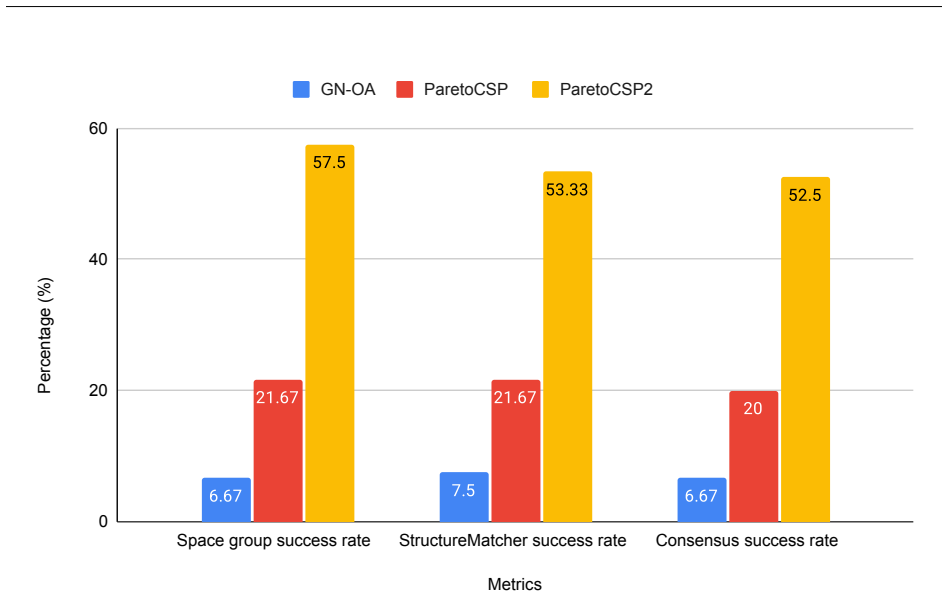
- The same diversity control improves standard crystal structure prediction, with reported gains of 44.8%–87.04% over ParetoCSP and GN-OA across energy and structural-distance metrics.
- The method handles some variable-unit-cell polymorphism, such as ZnS wurtzite and zincblende, by running separate searches per cell size, though it fails on $\alpha$-quartz in the case study.
Reading between the lines
- If the space-group crowding penalty is the true driver of the gains, then varying the penalty strength or replacing the fixed budget $j,k$ with a temperature-like schedule could tune exploration versus exploitation; the paper does not study this trade-off.
- The reliance on a single pretrained potential means the method's polymorph coverage for near-degenerate low-symmetry structures is likely bounded by the potential's energy resolution rather than by the search; substituting DFT energies for the final candidates would test this directly.
- Because the benchmark only includes same-atom-count polymorphs from the Materials Project, the method's performance on variable-cell polymorphs or on polymorphs separated by larger energy gaps remains open; the paper's silica case suggests such cases are harder.
Editorial analysis
A structured set of objections, weighed in public.
Referee Report
Summary. The manuscript proposes ParetoCSP2, an evolutionary crystal structure prediction algorithm aimed at polymorphism prediction. The key novelty is a third optimization objective, added to energy and genotypic age, that penalizes over-representation of any single space group in the NSGA-III/AFPO population, combined with PyXtal-based initialization and per-generation structural relaxation using pretrained ML interatomic potentials (M3GNet or CHGNet). The authors evaluate polymorphism recovery on 50 formulas from the Materials Project with equal unit-cell atom counts and up to 10 polymorphs, and regular CSP on 120 CSPBench structures. They report near-perfect space-group and StructureMatcher coverage for two-polymorph formulas, declining coverage for higher polymorph counts, and large improvements over ParetoCSP and GN-OA on the regular-CSP benchmark metrics.
Significance. If the results are reproducible and the evaluation is not confounded by training-data overlap, the space-group diversity objective is a simple and plausible mechanism for maintaining multiple polymorphic candidates, and the per-generation relaxation plus PyXtal initialization are practical accelerations. The paper ships source code and adopts quantitative structural metrics (ED, SD, CD, HD, FP) that make comparisons transparent. However, the polymorphism claim currently rests on a benchmark drawn from the same database that trained the surrogate potentials, no polymorphism baseline is provided, and the stochastic GA is evaluated without repeated runs or error bars. These issues must be resolved before the claimed 'excellent performance in polymorphism prediction' can be accepted.
major comments (4)
- [Benchmark dataset for polymorphism CSP; Table 2; Methods: ML IAPs] The polymorphism benchmark ground-truth structures are taken from the Materials Project, while the search and relaxation are guided by M3GNet and CHGNet, both of which were trained on Materials Project data (CHGNet on MPtrj, ~1.5 million structures). The paper nowhere states that the 50 benchmark formulas or their polymorphs were excluded from the training data. Recovering a structure that is effectively a training example is not the same as discovering it de novo, so the 96.67% space-group coverage for two-polymorph formulas in Table 2 cannot currently be attributed to the search algorithm. I ask the authors to (i) state explicitly which of the 50 formulas overlap with the M3GNet/CHGNet training sets, (ii) add a holdout evaluation or re-validate final candidates with DFT, and (iii) include a control experiment with random structure generation to estimate how much of the coverage is attributable to the surrogate's energy landscape alone.
- [Performance evaluation for polymorphism prediction; Fig. 5] ParetoCSP2 is a stochastic genetic algorithm (random initialization via PyXtal, random parent selection, mutation), but no repeated runs, random seeds, or error bars are reported for any result in Table 2 or Fig. 5. A single run of a GA can produce coverage rates that differ substantially from the expected value, particularly for the small samples in the 6-10 polymorph classes, which contain only one or two formulas each. The authors should report mean and standard deviation over at least 5-10 independent seeds for the central metrics and specify the population size, number of generations, and j/k values used for each benchmark formula.
- [Abstract; Results: Performance evaluation for regular CSP (Fig. 5)] The abstract states that ParetoCSP2 'outperforms baseline algorithms by factors of 2.46-8.62 for these accuracies,' but the 2.46-8.62 factors are the improvement in space-group and StructureMatcher success rates on the regular-CSP benchmark (Fig. 5), not on the polymorphism benchmark. For the polymorphism benchmark itself, no comparison against a baseline algorithm is provided, even though CALYPSO's symmetry-orientated divide-and-conquer method (Ref. 34) is described as the closest prior work. The claim of 'excellent performance in polymorphism prediction' therefore lacks comparative support. I suggest either adding a polymorphism-task baseline (e.g., CALYPSO or a random-sampling control) or rephrasing the abstract so the factor improvements are attributed to regular CSP only.
- [Benchmark dataset for polymorphism CSP; Fig. 3] The selection of the 50 polymorphism benchmark formulas is not transparent: the text says 'We chose a total of 50 formulas' but gives no deterministic selection rule or sampling procedure beyond the constraints of ≤20 atoms and ≤10 polymorphs, and the higher-polymorph classes contain only one or two formulas. Because the average coverage rates in Fig. 3 are the primary evidence for the polymorphism claim, the authors should (i) document the exact selection criteria, (ii) state clearly whether Supplementary Table S1 is exhaustive or a subset, and (iii) either add more samples for the 6-10 polymorph classes or refrain from drawing quantitative trends from those one- or two-sample averages.
minor comments (5)
- [Results: Performance evaluation for regular CSP] In the paragraph reporting success rates, the sentence 'Evidently, ParetoCSP outperformed ParetoCSP and GN-OA by 162.50% and 687.11%' should read 'ParetoCSP2 outperformed ParetoCSP and GN-OA...'.
- [Fig. 2 and flowchart text] The flowchart contains typos such as 'Enerrgy', 'Calcualate', and 'corrensponding'; these should be corrected.
- [Methods: ML IAPs and Discussion] The terms 'shallow relax' and 'deep relax' are used without quantitative definition; please specify the number of relaxation steps or convergence criteria for each.
- [Comparative analysis of convergence speed; Fig. 10] The claim that ParetoCSP2 converges within 1-10 generations is based on a selected sample of crystals; please clarify whether this holds across the full 120-crystal benchmark or add per-crystal convergence data.
- [Evaluation metrics] The StructureMatcher thresholds (ftol=0.2, stol=0.3, angle tolerance 5 degrees) are introduced without sensitivity analysis; a short ablation or a discussion of how the reported rates depend on these choices would strengthen the evaluation.
Circularity Check
No significant circularity: the search objectives, diversity control, and evaluation metrics are logically distinct; the Materials Project training/evaluation overlap is a data-leakage concern, not a derivation circularity.
full rationale
The claimed derivation chain is: given only a composition, PyXtal generates candidate structures; M3GNet/CHGNet energies drive a three-objective NSGA-III/AFPO search (energy, age, shared space-group count); the algorithm emits the lowest-energy structure for regular CSP or the tracked j=3 structures per k=10 distinct space groups for polymorphism CSP; these outputs are then compared to Materials Project ground-truth polymorphs by space-group and StructureMatcher coverage. No step defines the prediction target as an algorithmic input or fits a parameter to the benchmark labels. The space-group diversity objective minimizes the maximum per-space-group population count and does not encode which ground-truth space groups should be matched; coverage is an external similarity check. The ML potentials are pretrained elsewhere and are not fine-tuned or fitted in this paper, so the paper does not engage in fitted-input-called-prediction with respect to its own benchmark. The self-citations (ParetoCSP as a baseline, Wei et al. metrics and CSPBench as evaluation tools) are supporting infrastructure rather than load-bearing uniqueness claims or ansatz justifications. The Materials Project/MPtrj overlap is a real out-of-sample validity risk that should be flagged separately: the paper states it 'constructed a test set from the Materials Project database' and does not describe excluding benchmark compositions from CHGNet's MPtrj training set. The paper also candidly admits the ML IAP 'may not effectively capture fine energy differences' and can misguide the search, which weakens the reliability of the surrogate but does not make the derivation circular. Under the hard rules requiring a quoted reduction or a fitted parameter renamed as a prediction, I find no circular step.
Assumptions & free parameters
free parameters (5)
- j (structures per space group tracked) =
3
- k (distinct space groups tracked) =
10
- StructureMatcher tolerances (ftol, stol, angle) =
0.2, 0.3, 5 degrees
- Population size =
100
- Max generations G =
250 to 1000
assumptions (4)
- domain assumption M3GNet and CHGNet energies are accurate enough to rank polymorphs close in energy
- domain assumption Materials Project polymorph labels and structures are reliable ground truth
- standard math NSGA-III and AFPO behave as described in the cited literature
- domain assumption PyXtal generated structures cover the relevant space groups uniformly
Cite this review
Pith. "Pith review of Polymorphism Crystal Structure Prediction with Adaptive Space Group Diversity Control." pith.science (2026). https://pith.science/paper/IDYWBNMM
@misc{pith2026250611332,
  author       = {Pith},
  title        = {Pith review of: Polymorphism Crystal Structure Prediction with Adaptive Space Group Diversity Control},
  year         = {2026},
  howpublished = {\url{https://pith.science/paper/IDYWBNMM}},
  note         = {Machine review of arXiv:2506.11332}
}
read the original abstract
Crystalline materials can form different structural arrangements (i.e. polymorphs) with the same chemical composition, exhibiting distinct physical properties depending on how they were synthesized or the conditions under which they operate. For example, carbon can exist as graphite (soft, conductive) or diamond (hard, insulating). Computational methods that can predict these polymorphs are vital in materials science, which help understand stability relationships, guide synthesis efforts, and discover new materials with desired properties without extensive trial-and-error experimentation. However, effective crystal structure prediction (CSP) algorithms for inorganic polymorph structures remain limited. We propose ParetoCSP2, a multi-objective genetic algorithm for polymorphism CSP that incorporates an adaptive space group diversity control technique, preventing over-representation of any single space group in the population guided by a neural network interatomic potential. Using an improved population initialization method and performing iterative structure relaxation, ParetoCSP2 not only alleviates premature convergence but also achieves improved convergence speed. Our results show that ParetoCSP2 achieves excellent performance in polymorphism prediction, including a nearly perfect space group and structural similarity accuracy for formulas with two polymorphs but with the same number of unit cell atoms. Evaluated on a benchmark dataset, it outperforms baseline algorithms by factors of 2.46-8.62 for these accuracies and improves by 44.8\%-87.04\% across key performance metrics for regular CSP. Our source code is freely available at https://github.com/usccolumbia/ParetoCSP2.
Figures


Figures from the paper (9 more)




Forward citations
Cited by 1 Pith paper
-
Data-Driven Topological Analysis of Polymorphic Crystal Structures
Polymorph pairs of common space groups share recurring local polyhedral topology across different compounds, and topology-based graph embeddings cluster polymorphs across space groups.
Reference graph
Works this paper leans on
-
[1]
Buerger, M.; Bloom, M. Crystal polymorphism. Zeitschrift f \"u r Kristallographie-Crystalline Materials 1937, 96, 182--200
work page 1937
-
[2]
Brog, J.-P.; Chanez, C.-L.; Crochet, A.; Fromm, K. M. Polymorphism, what it is and how to identify it: a systematic review. Rsc Advances 2013, 3, 16905--16931
2013
-
[3]
J.; Reutzel-Edens, S
Cruz-Cabeza, A. J.; Reutzel-Edens, S. M.; Bernstein, J. Facts and fictions about polymorphism. Chemical Society Reviews 2015, 44, 8619--8635
2015
-
[4]
Polymorphism as an additional functionality of materials for technological applications at surfaces and interfaces
Gentili, D.; Gazzano, M.; Melucci, M.; Jones, D.; Cavallini, M. Polymorphism as an additional functionality of materials for technological applications at surfaces and interfaces. Chemical Society Reviews 2019, 48, 2502--2517
2019
-
[5]
G \"o tze, J.; Pan, Y.; M \"u ller, A. Mineralogy and mineral chemistry of quartz: A review. Mineralogical Magazine 2021, 85, 639--664
work page 2021
-
[6]
D.; Fladischer, K.; Yeandel, S.; Lelarge, A.; Parker, S
Eder, S. D.; Fladischer, K.; Yeandel, S.; Lelarge, A.; Parker, S. C.; S nderg rd, E.; Holst, B. A giant reconstruction of -quartz (0001) interpreted as three domains of nano dauphine twins. Scientific Reports 2015, 5, 14545
work page 2015
-
[7]
Resource, characteristic, purification and application of quartz: A review
Pan, X.; Li, S.; Li, Y.; Guo, P.; Zhao, X.; Cai, Y. Resource, characteristic, purification and application of quartz: A review. Minerals Engineering 2022, 183, 107600
work page 2022
-
[8]
Investigation of a high stable -cristobalite ceramic powder from CaO--Al2O3--SiO2 system
S an, O.; \"O zg \"u r, C. Investigation of a high stable -cristobalite ceramic powder from CaO--Al2O3--SiO2 system. Journal of the European Ceramic Society 2009, 29, 2945--2949
work page 2009
Show all 62 references
-
[9]
Cristobalite formation from the thermal treatment of amorphous silica fume recovered from the metallurgical silicon industry
Zhang, S.; Tie, S.; Zhang, F. Cristobalite formation from the thermal treatment of amorphous silica fume recovered from the metallurgical silicon industry. Micro & Nano Letters 2018, 13, 1465--1468
2018
-
[10]
Haggerty, S. E. A diamond trilogy: superplumes, supercontinents, and supernovae. Science 1999, 285, 851--860
1999
-
[11]
R.; Wang, H.; Wang, H.; Xu, Y.; Cui,
Li, Q.; Ma, Y.; Oganov, A. R.; Wang, H.; Wang, H.; Xu, Y.; Cui, . f. T.; Mao, H.-K.; Zou, G. Superhard monoclinic polymorph of carbon. Physical Review Letters 2009, 102, 175506
2009
-
[12]
Li-ion battery material under high pressure: amorphization and enhanced conductivity of Li4Ti5O12
others,, et al. Li-ion battery material under high pressure: amorphization and enhanced conductivity of Li4Ti5O12. National Science Review 2019, 6, 239--246
2019
-
[13]
Reliable crystal structure predictions from first principles
Nikhar, R.; Szalewicz, K. Reliable crystal structure predictions from first principles. Nature Communications 2022, 13, 3095
2022
-
[14]
Computational prediction of organic crystal structures and polymorphism
Price, S. Computational prediction of organic crystal structures and polymorphism. International Reviews in Physical Chemistry 2008, 27, 541--568
2008
-
[15]
Molecular aggregation: structure analysis and molecular simulation of crystals and liquids; OUP Oxford, 2007; Vol
Gavezzotti, A. Molecular aggregation: structure analysis and molecular simulation of crystals and liquids; OUP Oxford, 2007; Vol. 19
2007
-
[16]
R.; Ma, Y.; Lyakhov, A
Oganov, A. R.; Ma, Y.; Lyakhov, A. O.; Valle, M.; Gatti, C. Evolutionary crystal structure prediction as a method for the discovery of minerals and materials. Reviews in Mineralogy and Geochemistry 2010, 71, 271--298
2010
-
[17]
R.; Pickard, C
Oganov, A. R.; Pickard, C. J.; Zhu, Q.; Needs, R. J. Structure prediction drives materials discovery. Nature Reviews Materials 2019, 4, 331--348
2019
-
[18]
R.; Glass, C
Oganov, A. R.; Glass, C. W. Crystal structure prediction using ab initio evolutionary techniques: Principles and applications. The Journal of Chemical Physics 2006, 124, 244704
2006
-
[19]
W.; Oganov, A
Glass, C. W.; Oganov, A. R.; Hansen, N. USPEX—Evolutionary crystal structure prediction. Computer Physics Communications 2006, 175, 713--720
2006
-
[20]
J.; Needs, R
Pickard, C. J.; Needs, R. Ab initio random structure searching. Journal of Physics: Condensed Matter 2011, 23, 053201
2011
-
[21]
M.; Catlow, R
Woodley, S. M.; Catlow, R. Crystal structure prediction from first principles. Nature Materials 2008, 7, 937--946
2008
-
[22]
CALYPSO: A method for crystal structure prediction
Wang, Y.; Lv, J.; Zhu, L.; Ma, Y. CALYPSO: A method for crystal structure prediction. Computer Physics Communications 2012, 183, 2063--2070
2012
-
[23]
H.; Bragg, W
Bragg, W. H.; Bragg, W. L. The reflection of X-rays by crystals. Proceedings of the Royal Society of London. Series A, Containing Papers of a Mathematical and Physical Character 1913, 88, 428--438
1913
-
[24]
Bragg, W. L. The structure of some crystals as indicated by their diffraction of X-rays. Proceedings of the Royal Society of London. Series A, Containing papers of a mathematical and physical character 1913, 89, 248--277
1913
-
[25]
Chen, C.; Ye, W.; Zuo, Y.; Zheng, C.; Ong, S. P. Graph networks as a universal machine learning framework for molecules and crystals. Chemistry of Materials 2019, 31, 3564--3572
2019
-
[26]
S.; Louis, S.-Y.; Fu, N.; Wei, L.; Dey, S.; Dong, R.; Li, Q.; Hu, J
Omee, S. S.; Louis, S.-Y.; Fu, N.; Wei, L.; Dey, S.; Dong, R.; Li, Q.; Hu, J. Scalable deeper graph neural networks for high-performance materials property prediction. Patterns 2022, 3, 100491
2022
-
[27]
Chen, C.; Ong, S. P. A universal graph deep learning interatomic potential for the periodic table. Nature Computational Science 2022, 2, 718--728
2022
-
[28]
J.; Ceder, G
Deng, B.; Zhong, P.; Jun, K.; Riebesell, J.; Han, K.; Bartel, C. J.; Ceder, G. CHGNet as a pretrained universal neural network potential for charge-informed atomistic modelling. Nature Machine Intelligence 2023, 5, 1031--1041
2023
-
[29]
Crystal structure prediction by combining graph network and optimization algorithm
Cheng, G.; Gong, X.-G.; Yin, W.-J. Crystal structure prediction by combining graph network and optimization algorithm. Nature Communications 2022, 13, 1492
2022
-
[30]
S.; Wei, L.; Hu, M.; Hu, J
Omee, S. S.; Wei, L.; Hu, M.; Hu, J. Crystal structure prediction using neural network potential and age-fitness Pareto genetic algorithm. Journal of Materials Informatics 2024,
2024
-
[31]
An evolutionary many-objective optimization algorithm using reference-point-based nondominated sorting approach, part I: solving problems with box constraints
Deb, K.; Jain, H. An evolutionary many-objective optimization algorithm using reference-point-based nondominated sorting approach, part I: solving problems with box constraints. IEEE Transactions on Evolutionary Computation 2013, 18, 577--601
2013
-
[32]
D.; Lipson, H
Schmidt, M. D.; Lipson, H. Age-fitness pareto optimization. Proceedings of the 12th Annual Conference on Genetic and Evolutionary Computation. 2010; pp 543--544
2010
-
[33]
Hu, J.; Zhao, Y.; Li, Q.; Song, Y.; Dong, R.; Yang, W.; Siriwardane, E. M. Deep learning-based prediction of contact maps and crystal structures of inorganic materials. ACS Omega 2023, 8, 26170--26179
2023
-
[34]
A symmetry-orientated divide-and-conquer method for crystal structure prediction
Shao, X.; Lv, J.; Liu, P.; Shao, S.; Gao, P.; Liu, H.; Wang, Y.; Ma, Y. A symmetry-orientated divide-and-conquer method for crystal structure prediction. The Journal of Chemical Physics 2022, 156, 014105
2022
-
[35]
Polymorphism in molecular crystals ; International Union of Crystal, 2020; Vol
Bernstein, J. Polymorphism in molecular crystals ; International Union of Crystal, 2020; Vol. 30
2020
-
[36]
Crystal structure prediction of small organic molecules: a second blind test
others,, et al. Crystal structure prediction of small organic molecules: a second blind test. Acta Crystallographica 2002, 58, 647--661
2002
-
[37]
Significant progress in predicting the crystal structures of small organic molecules--a report on the fourth blind test
others,, et al. Significant progress in predicting the crystal structures of small organic molecules--a report on the fourth blind test. Acta Crystallographica Section B: Structural Science 2009, 65, 107--125
2009
-
[38]
The seventh blind test of crystal structure prediction: structure generation methods
others,, et al. The seventh blind test of crystal structure prediction: structure generation methods. Acta Crystallographica 2024, 80
2024
-
[39]
Verwer, P.; Leusen, F. J. Computer simulation to predict possible crystal polymorphs. Reviews in Computational Chemistry 1998, 327--365
1998
-
[40]
Generation of possible crystal structures from molecular structure for low-polarity organic compounds
Gavezzotti, A. Generation of possible crystal structures from molecular structure for low-polarity organic compounds. Journal of the American Chemical Society 1991, 113, 4622--4629
1991
-
[41]
R.; Du, Z.; Ammon, H
Holden, J. R.; Du, Z.; Ammon, H. L. Prediction of possible crystal structures for C-, H-, N-, O-, and F-containing organic compounds. Journal of Computational Chemistry 1993, 14, 422--437
1993
-
[42]
Ab initio molecular packing analysis
Williams, D. Ab initio molecular packing analysis. Acta Crystallographica Section A: Foundations of Crystallography 1996, 52, 326--328
1996
-
[43]
Desiraju, G. R. Crystal gazing: structure prediction and polymorphism. Science 1997, 278, 404--405
1997
-
[44]
Price, S. L. The computational prediction of pharmaceutical crystal structures and polymorphism. Advanced Drug Delivery Reviews 2004, 56, 301--319
2004
-
[45]
O.; Adutwum, L
Oliynyk, A. O.; Adutwum, L. A.; Rudyk, B. W.; Pisavadia, H.; Lotfi, S.; Hlukhyy, V.; Harynuk, J. J.; Mar, A.; Brgoch, J. Disentangling structural confusion through machine learning: structure prediction and polymorphism of equiatomic ternary phases ABC. Journal of the American...
2017
-
[46]
McDonagh, D.; Skylaris, C.-K.; Day, G. M. Machine-learned fragment-based energies for crystal structure prediction. Journal of Chemical Theory and Computation 2019, 15, 2743--2758
2019
-
[47]
C.; Gilmore, C
Collins, A.; Wilson, C. C.; Gilmore, C. J. Comparing entire crystal structures using cluster analysis and fingerprint plots. CrystEngComm 2010, 12, 801--809
2010
-
[48]
PyXtal: A Python library for crystal structure generation and symmetry analysis
Fredericks, S.; Parrish, K.; Sayre, D.; Zhu, Q. PyXtal: A Python library for crystal structure generation and symmetry analysis. Computer Physics Communications 2021, 261, 107810
2021
-
[49]
S.; Sch \"u tt, K
Hessmann, S. S.; Sch \"u tt, K. T.; Gebauer, N. W.; Gastegger, M.; Oguchi, T.; Yamashita, T. Accelerating crystal structure search through active learning with neural networks for rapid relaxations. npj Computational Materials 2025, 11, 44
2025
-
[50]
RDKit: A software suite for cheminformatics, computational chemistry, and predictive modeling
others,, et al. RDKit: A software suite for cheminformatics, computational chemistry, and predictive modeling. Greg Landrum 2013, 8, 5281
2013
-
[51]
Molecular sets (MOSES): a benchmarking platform for molecular generation models
others,, et al. Molecular sets (MOSES): a benchmarking platform for molecular generation models. Frontiers in Pharmacology 2020, 11, 565644
2020
-
[52]
M.; Bender, A.; De Graaf, C
Thomas, M.; O’Boyle, N. M.; Bender, A.; De Graaf, C. MolScore: a scoring, evaluation and benchmarking framework for generative models in de novo drug design. Journal of Cheminformatics 2024, 16, 64
2024
-
[53]
S.; Hu, J
Wei, L.; Li, Q.; Omee, S. S.; Hu, J. Towards quantitative evaluation of crystal structure prediction performance. Computational Materials Science 2024, 235, 112802
2024
-
[54]
E.; Jain, A
Zimmermann, N. E.; Jain, A. Local structure order parameters and site fingerprints for quantification of coordination environment and crystal structure similarity. RSC Advances 2020, 10, 6063--6081
2020
-
[55]
P.; Hautier, G.; Chen, W.; Richards, W
Jain, A.; Ong, S. P.; Hautier, G.; Chen, W.; Richards, W. D.; Dacek, S.; Cholia, S.; Gunter, D.; Skinner, D.; Ceder, G.; Persson, K. A. Commentary: The Materials Project: A materials genome approach to accelerating materials innovation . APL Materials 2013, 1, 011002
2013
-
[56]
Efficient crystal structure prediction based on the symmetry principle
Han, Y.; Ding, C.; Wang, J.; Gao, H.; Shi, J.; Yu, S.; Jia, Q.; Pan, S.; Sun, J. Efficient crystal structure prediction based on the symmetry principle. Nature Computational Science 2025, 1--13
2025
-
[57]
S.; Dong, R.; Fu, N.; Song, Y.; Siriwardane, E.; Xu, M.; Wolverton, C.; Hu, J
Wei, L.; Omee, S. S.; Dong, R.; Fu, N.; Song, Y.; Siriwardane, E.; Xu, M.; Wolverton, C.; Hu, J. CSPBench: a benchmark and critical evaluation of Crystal Structure Prediction. arXiv preprint arXiv:2407.00733 2024. Preprint at: https://doi.org/10.48550/arXiv.2407.00733 ,
-
[58]
VESTA: a three-dimensional visualization system for electronic and structural analysis
Momma, K.; Izumi, F. VESTA: a three-dimensional visualization system for electronic and structural analysis. Journal of Applied Crystallography 2008, 41, 653--658
2008
-
[59]
Recent advances in polymorph discovery methods of organic crystals
Yao, C.; Zhang, S.; Wang, L.; Tao, X. Recent advances in polymorph discovery methods of organic crystals. Crystal Growth & Design 2022, 23, 637--654
2022
-
[60]
J.; Feeder, N.; Davey, R
Cruz-Cabeza, A. J.; Feeder, N.; Davey, R. J. Open questions in organic crystal polymorphism. Communications Chemistry 2020, 3, 142
2020
-
[61]
M.; Barroso-Luque, L.; Levine, D
Fu, X.; Wood, B. M.; Barroso-Luque, L.; Levine, D. S.; Gao, M.; Dzamba, M.; Zitnick, C. L. Learning Smooth and Expressive Interatomic Potentials for Physical Property Prediction. arXiv preprint arXiv:2502.12147 2025. Preprint at: https://doi.org/10.48550/arXiv.2502.12147 ,
-
[62]
Commentary: The Materials Project: A materials genome approach to accelerating materials innovation
Park, Y.; Kim, J.; Hwang, S.; Han, S. Scalable parallel algorithm for graph neural network interatomic potentials in molecular dynamics simulations. Journal of Chemical Theory and Computation 2024, 20, 4857--4868 mcitethebibliography main.tex00006640000000000000000000254150150...
2024 arXiv
Reviewed August 7, 2026 · model on record in the stance chip above.
Discussion (0). Continue with ORCID to comment.