REVIEW 5 major objections 5 minor 56 references
A two-thickness fit to transmittance spectra, using a compressed homogeneous layer with state-dependent pseudo-optical constants, predicts the optical response of an untested intermediate thickness photochromic film.
Reviewed by Pith at T0; open to challenge. T0 means a machine referee read the full paper against a public rubric. the ladder, T0–T4 →
T0 review · deepseek-v4-flash
2026-08-02 22:36 UTC pith:IE2SZRKA
load-bearing objection Useful engineering study of inverse characterization for photochromic hybrid films, but the predictive claim is only supported by one held-out thickness per condition and no error bars. the 5 major comments →
Inverse Engineering of Optical Constants in Photochromic Micron-Scale Hybrid Films
The pith
A machine-rendered reading of the paper's core claim, the machinery that carries it, and where it could break.
Core claim
The central discovery is that a dual-state effective model—approximating the inhomogeneous photochromic layer as a coherent homogeneous layer of compressed thickness—captures the thickness dependence of the optical response well enough to interpolate to an untested thickness. For tungsten oxide–polyvinylpyrrolidone films, the fitted compression ratios are on the order of 10^-4, mapping micron-scale physical thicknesses to effective thicknesses of a few hundred nanometers, consistent with coherent transfer-matrix treatment. The same fitted parameters simultaneously describe the pristine and UV-irradiated states, and the difference between them yields optical modulation spectra across a contin
What carries the argument
The load-bearing object is the compressed homogeneous layer approximation: the inhomogeneous photochromic layer of physical thickness d is replaced, in each state, by a homogeneous slab of effective thickness κ d, where κ is a state-dependent compression factor in [0,1], with wavelength-dependent pseudo-refractive index ñ(λ) and pseudo-extinction coefficient k̃(λ). The transfer matrix method computes transmittance from these parameters, and a fully differentiable implementation allows simultaneous gradient-based optimization of all 702 parameters (350 wavelength points for each of ñ_P, ñ_I, k̃_P, k̃_I, plus two κ values) against a mean-squared-error loss over the measured spectra at two t
Load-bearing premise
The claim rests on the assumption that two training thicknesses are enough to pin down the 702 fitted parameters so that the model generalizes to other thicknesses—i.e., that a single scalar compression factor per state fully captures how the effective optical response scales with physical film thickness.
What would settle it
Measure transmittance of a film whose thickness lies outside the two training thicknesses (for instance, a seven-layer coating at the same spin speed) and compare the model prediction: if the deviation is large, the claimed predictive power is limited to interpolation within the trained range. Alternatively, train on single-layer and three-layer films and test on the five-layer film; failure would show the model does not extrapolate.
If this is right
- If the model's interpolation claim holds, design of photochromic films reduces to a small set of transmittance measurements: two thicknesses per fabrication condition suffice to predict the full thickness–wavelength modulation map.
- The extracted pseudo-optical constants and compression factors can serve as a compact, state-dependent description of a given fabrication process, replacing the notion of a single intrinsic n and k for inhomogeneous films.
- The framework predicts a thickness–modulation trade-off (thin films keep visible transmittance but switch weakly; thick films switch strongly but darken) that can be used to select film thickness for a target application like smart windows or near-infrared switching.
- Because the methodology only needs transmittance spectra, it transfers, in principle, to other photochromic, electrochromic, or stimuli-responsive hybrid systems without new physics assumptions.
- The differentiation-based implementation makes computation fast, so extensive parameter sweeps over thickness and wavelength become practical.
Where Pith is reading between the lines
- The success of the two-thickness fit suggests that, within the tested thickness range, the effective optical response of this film is dominated by a single thickness-scaling parameter per state; a direct test would be whether the same trained model can extrapolate to a thickness outside the trained range (e.g., a seven-layer film) or to a different spin speed.
- Because the compression factors vary systematically with spin speed and correlate with the authors' stated homogeneity trend, the fitted κ could be usable as a quantitative process metric for film quality, though the paper does not pursue this.
- The use of 702 free parameters on only two training thicknesses leaves room for overfitting; an information-theoretic check (e.g., reducing the number of wavelength nodes and observing stability of the predictions) would show whether the interpolation power comes from the physical model or from the number of degrees of freedom.
- One might connect this compressed-layer approach to standard effective-medium theories (Bruggeman, Maxwell-Garnett) at low particle loading: the extracted pseudo-constants should approach those mixing-formula predictions in the dilute limit, which would provide a physical cross-check the paper does not perform.
Editorial analysis
A structured set of objections, weighed in public.
Referee Report
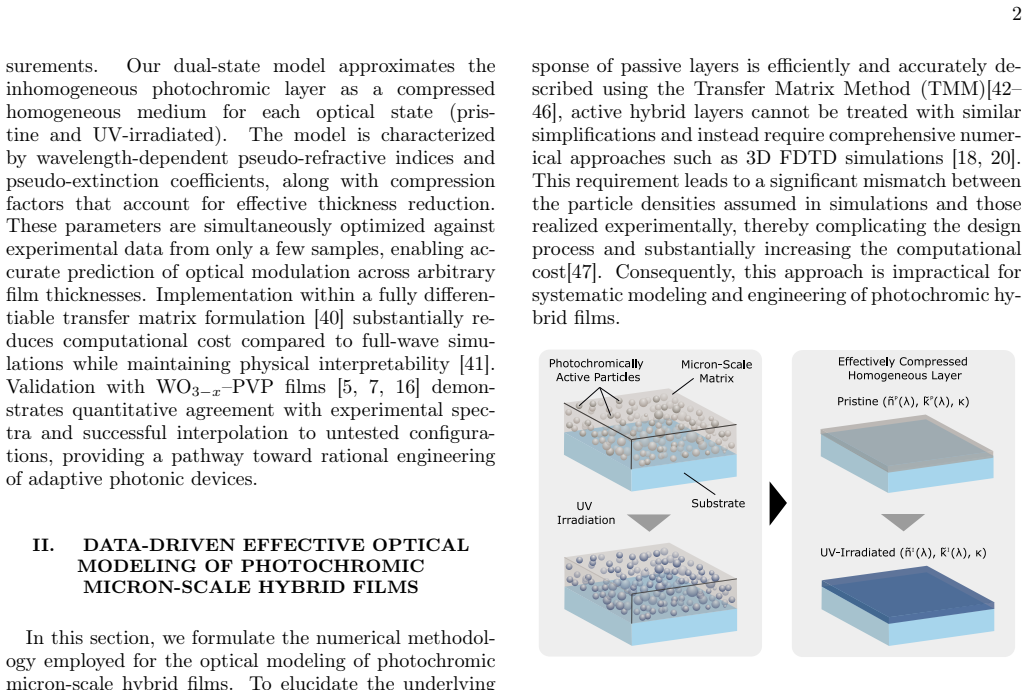
Summary. The paper proposes a data-driven, dual-state effective-medium model for inhomogeneous photochromic hybrid films. The photochromic layer is replaced, separately for the pristine and UV-irradiated states, by a homogeneous 'compressed' layer described by wavelength-dependent pseudo-refractive indices, pseudo-extinction coefficients, and a scalar compression factor. These parameters are fitted to experimental transmittance spectra of single-layer and five-layer WO3−x–PVP films at three spin-coating speeds using a fully differentiable transfer-matrix implementation. The fitted model is then used to predict the transmittance of an intermediate three-layer film at each spin speed and to generate two-dimensional optical-modulation maps over thickness and wavelength. The central claim is that this framework, trained on minimal experimental data, enables accurate interpolation of optical modulation within the tested thickness range.
Significance. If the interpolation claim is upheld, the contribution would be practically useful: it offers a computationally inexpensive, experimentally anchored way to extract effective optical constants for complex hybrid photochromic films, with potential design guidance for smart windows and adaptive optics. The paper's strengths include a fully differentiable transfer-matrix implementation, an open-source code repository, and the use of real experimental data spanning pristine and UV-irradiated states. However, the current evidence is too narrow to establish the general predictive capability: only one intermediate thickness per spin speed is tested, the model parameterization raises identifiability concerns, and no measurement uncertainties or residual statistics are reported. The scientific value is therefore conditional on additional validation and uncertainty analysis.
major comments (5)
- [Sec. IV.B, Fig. 5] The paper's central claim is that the model predicts transmittance at untested thicknesses, but the only evidence per spin speed is a single three-layer film. With two training thicknesses (single- and five-layer) and one test thickness, the agreement shown in Fig. 5c/f/i could be coincidental. To support 'accurate prediction of optical modulation within the tested thickness range,' the authors should perform leave-one-out cross-validation across multiple thicknesses or test a set of intermediate thicknesses, and report per-wavelength residuals and RMS errors for all held-out configurations.
- [Sec. II, Eq. (7); Sec. IV.A] The parameter count is unclear: the text states 702 tunable parameters, but four 350-point pseudo-constant spectra plus two compression ratios would give 1402 parameters. More substantively, for fixed κ the loss at each wavelength has exactly four training values (two thicknesses × two states) and four pseudo-constant unknowns, so the training data can be matched almost exactly for a range of κ values. The authors do not address identifiability, regularization, or optimization-trajectory dependence. Multiple initializations, a smoothness constraint, or an uncertainty estimate (e.g., posterior or bootstrap) are needed to show that the intermediate-thickness prediction is not an artifact of the chosen optimization path.
- [Sec. III and Sec. IV] The actual film thicknesses are never reported. The paper refers to single-layer, three-layer, and five-layer configurations and uses 'original thickness' in Eq. (6), but no measured thickness values are given. Without thickness measurements, the reader cannot verify that the three-layer film is indeed intermediate between the training thicknesses, nor can the reported compression factors (κ ~ 10^-4) be physically assessed. The authors should provide thickness data (e.g., profilometry or SEM cross-sections) for all samples.
- [Sec. IV.A and IV.B] No experimental uncertainty is provided for the transmittance measurements, the fitted pseudo-constants, or the prediction residuals. The statement that deviations in the 600–1100 nm range 'reflect the spectral resolution of the measurement system' is unsupported. Since only one sample per thickness and state is measured, it is impossible to distinguish model error from measurement noise. Report measurement repeatability (standard deviations or confidence bands) and include these uncertainties in the comparison between model and experiment.
- [Sec. IV.C] The optical-modulation maps in Fig. 6 are generated for thicknesses from 50 to 600 µm, but the model is trained and tested only on single-, three-, and five-layer films with unreported thicknesses. The claim that these maps enable design optimization assumes that the compressed-homogeneous-layer parametrization remains valid across the entire thickness range. This extrapolation is not validated. At minimum, test additional thicknesses inside and at the edges of the claimed range.
minor comments (5)
- [Eq. (6)] The phrase 'complex-valued n_i represents the sum of the refractive index and extinction coefficient' is incorrect. The complex refractive index is N = n + i k; please revise the wording.
- [Sec. II] The sentence 'We select 350 wavelength points for ñ and k' is ambiguous. Clarify whether each of the four pseudo-constant spectra has 350 points or whether 350 points are shared across the spectra, and reconcile this with the stated 702 tunable parameters.
- [Sec. IV.C] The text says 'from only six training measurements (two thicknesses at three spin speeds)', but each thickness configuration was measured in both pristine and UV-irradiated states, giving twelve transmittance spectra. Please correct the count.
- [Sec. IV.A] The manual bounds on n (1.3–2.4) and k (0–1.8) are said to 'yield the lowest loss values in our tests.' This tuning is not documented further. Please describe how the bounds were chosen and whether the extracted profiles and test predictions are robust to reasonable bound variations.
- [Fig. 4] The discussion of pseudo-optical constants would benefit from error bars or at least a statement about the sensitivity of the profiles to optimizer convergence. The insets show MSE but do not quantify uncertainty in the curves.
Circularity Check
No significant circularity: the held-out three-layer films provide a genuine out-of-sample check on parameters fitted only to single- and five-layer training data.
full rationale
The paper's chain is an empirical inverse-problem workflow, not a derivation that folds its conclusion into its inputs. Pseudo-optical constants and compression factors are optimized by minimizing Eq. (7) against transmittance from the two training thicknesses per spin speed (single-layer and five-layer, Fig. 5 panels a–b, d–e, g–h). The intermediate three-layer films (Fig. 5 panels c, f, i) are explicitly held out: they are not included in the loss, and no parameter is defined from or fitted to their transmittance. Comparing the model output at the held-out thickness with measured spectra is therefore a legitimate predictive test, not a circular reduction. The large number of tunable parameters (702 per spin speed) and the wavelength-separable loss structure raise genuine identifiability and overfitting concerns, but those are robustness/correctness risks rather than circularity, because the unseen-thickness comparison is an independent check. Self-citations to the authors' `katmer` software ([40], [49]) and prior film work ([14]) are implementation and material-context citations; the central transfer-matrix formalism is the independently established Abelès method, and no uniqueness theorem or ansatz is imported from the authors' prior work to force the conclusion. Thus no step reduces, by construction or self-citation, to the paper's own inputs.
Axiom & Free-Parameter Ledger
free parameters (6)
- kappa_P =
5.7e-4 to 7.1e-4 depending on spin speed
- kappa_I =
6.5e-4 to 8.8e-4 depending on spin speed
- tilde-n_P(lambda) curve =
350 wavelength points, bounds 1.3-2.4
- tilde-k_P(lambda) curve =
350 wavelength points, bounds 0-1.8
- tilde-n_I(lambda) curve =
350 wavelength points, bounds 1.3-2.4
- tilde-k_I(lambda) curve =
350 wavelength points, bounds 0-1.8
axioms (4)
- domain assumption TMM with coherent layers correctly describes the optics of the compressed pseudo-layer
- domain assumption The optical constants of air and glass layers are taken from literature and are accurate in the fitted spectral range
- ad hoc to paper A single scalar compression factor per state is sufficient to absorb all microstructural thickness effects
- ad hoc to paper Wavelength-dependent pseudo-constants do not vary rapidly, so 350 points suffice
invented entities (2)
-
Pseudo-refractive index / pseudo-extinction coefficient (tilde-n, tilde-k)
no independent evidence
-
Compression factor (kappa)
no independent evidence
read the original abstract
Photochromic materials enable dynamic optical modulation through reversible transitions between distinct absorption states, with broad potential for smart windows, adaptive optics, and reconfigurable photonic devices. Micron-scale photochromic hybrid films present a particularly attractive platform for these applications, combining straightforward preparation with substantial optical modulation and scalability for high-volume fabrication. However, rational design of such films remains fundamentally constrained by the absence of well-defined optical constants. Unlike homogeneous thin films, micron-scale hybrid photochromic materials comprise active particles dispersed non-uniformly within polymer matrices. Conventional first-principles electromagnetic simulations face substantial computational costs and discrepancies between simulated and experimental particle distributions. Here, we introduce a data-driven framework that extracts effective optical constants directly from minimal experimental transmittance measurements. Our dual-state effective model approximates the complex inhomogeneous photochromic layer as a compressed homogeneous medium characterized by pseudo-refractive indices and pseudo-extinction coefficients for both pristine and UV-irradiated states. Through systematic optimization against experimental data from tungsten oxide-polyvinylpyrrolidone hybrid films, we determine wavelength-dependent pseudo-optical constants and compression ratios that enable accurate prediction of optical modulation within the tested thickness range. Our methodology establishes a framework for engineering hybrid photochromic systems and demonstrates how data-driven modeling can overcome limitations in characterizing complex nanostructured materials.
Figures


Reference graph
Works this paper leans on
-
[1]
S. K. Deb, Philosophical Magazine27, 801 (1973)
1973
-
[2]
C. G. Granqvist, Solar Energy Materials and Solar Cells 60, 201 (2000)
2000
-
[3]
S. Wang, W. Fan, Z. Liu, A. Yu, and X. Jiang, Journal of Materials Chemistry C6, 191 (2018)
2018
-
[4]
X. Dong, Y. Lu, X. Liu, L. Zhang, and Y. Tong, Journal of Photochemistry and Photobiology C: Photochemistry Reviews53, 100555 (2022)
2022
-
[5]
Kim, J.-H
M.-S. Kim, J.-H. Yoon, H.-M. Kim, D.-J. Lee, T. Hi- rose, Y. Takeda, and J.-P. Kim, Nanomaterials14, 1121 (2024)
2024
-
[6]
Bourdin, M
M. Bourdin, M. Gaudon, F. Weill, M. Duttine, M. Gayot, Y. Messaddeq, and T. Cardinal, Nanomaterials9, 1555 (2019)
2019
-
[7]
D. A. Kozlov, A. B. Shcherbakov, T. O. Kozlova, B. An- gelov, G. P. Kopitsa, A. V. Garshev, A. E. Baranchikov, O. S. Ivanova, and V. K. Ivanov, Molecules25, 154 (2020)
2020
-
[8]
M. S. Kim, J. H. Yoon, H. K. Lee, T. Hirose, Y. Takeda, and J. P. Kim, Colloids and Surfaces A: Physicochemical and Engineering Aspects703, 135118 (2024)
2024
-
[9]
M. L. Pacheco, T. V. Pinto, C. M. Sousa, A. Guedes, G. Blanco, J. M. Pintado, P. J. Coelho, C. Freire, and C. R. Pereira, ACS Applied Optical Materials1, 1434 (2023)
2023
-
[10]
S. Cong, F. Geng, and Z. Zhao, Advanced Materials28, 10518 (2016)
2016
-
[11]
Badour, S
Y. Badour, S. Danto, M. Gonidec, C. Labrugère, M. R. Suchomel, G. Philippot, and M. Gaudon, Optical Mate- rials145, 114432 (2023)
2023
-
[12]
Bourdin, G
M. Bourdin, G. Salek, A. Fargues, S. Messaddeq, Y. Mes- saddeq, T. Cardinal, and M. Gaudon, Journal of Materi- als Chemistry C8, 9410 (2020)
2020
-
[13]
M. Chen, X. Zhang, W. Sun, Y. Xiao, H. Zhang, J. Deng, Z. Li, D. Yan, J. Zhao, and Y. Li, Nano Energy123, 109352 (2024)
2024
-
[14]
Zayim, A
E. Zayim, A. T. Mohseni, A. Galeckas, S. Sartori, U. Er- nazarov, and S. Z. Karazhanov, Materials Chemistry and Physics337, 130572 (2025)
2025
-
[15]
M. S. Kim, H. K. Lee, J. H. Yoon, H. M. Kim, Y. S. Kim, and J. P. Kim, Colloids and Surfaces A: Physicochemical and Engineering Aspects694, 134083 (2024)
2024
-
[16]
A. L. Popov, B. Han, A. M. Ermakov, I. V. Savint- seva, O. N. Ermakova, N. R. Popova, A. B. Shcherbakov, T. O. Shekunova, O. S. Ivanova, D. A. Kozlov, A. E. Baranchikov, and V. K. Ivanov, Materials Science and Engineering: C108, 110494 (2020)
2020
-
[17]
M. N. Polyanskiy, Scientific Data11, 94 (2024)
2024
-
[18]
A. F. Oskooi, D. Roundy, M. Ibanescu, P. Bermel, J. D. Joannopoulos, and S. G. Johnson, Computer Physics Communications181, 687 (2010)
2010
-
[19]
T. Xue, S. Liao, Z. Gan, C. Park, X. Xie, W. K. Liu, and J. Cao, Computer Physics Communications , 108802 (2023)
2023
-
[20]
Mahlau, F
Y. Mahlau, F. Schubert, L. Berg, and B. Rosenhahn, Journal of Open Source Software11, 8912 (2026)
2026
-
[21]
Özkan Zayim, P
E. Özkan Zayim, P. Liu, S.-H. Lee, C. E. Tracy, J. A. Turner, J. R. Pitts, and S. K. Deb, Solid State Ion- ics165, 65 (2003), fifth International Meeting on Elec- trochromism
2003
-
[22]
E. O. Zayim, Solar Energy Materials and Solar Cells87, 695 (2005), international Conference on Physics, Chem- istry and Engineering
2005
-
[23]
N. D. Baydoğan, E. Ö. Zayim, and A. B. Tuğrul, Nuclear Instruments and Methods in Physics Research Section B: Beam Interactions with Materials and Atoms264, 302 (2007). 10
2007
-
[24]
K. Lam, P. Molina-Portillo, V. Carta, T. Nishiuchi, M. Ticknor, R. C. Hayward, R. O. Al-Kaysi, T. Kubo, G. J. O. Beran, and C. J. Bardeen, Crystal Growth & Design25, 8089 (2025)
2025
-
[25]
Mahitha, S
P. Mahitha, S. Nakul, M. Kumar, N. V. Kulkarni, O. V. Kharissova, and B. I. Kharissov, inHandbook of Emerg- ing Materials for Sustainable Energy, edited by N. V. Kulkarni and B. I. Kharissov (Elsevier, 2024) pp. 237– 254
2024
-
[26]
K. F. Palmer and M. Z. Williams, Applied Optics24, 1788 (1985)
1985
-
[27]
C. H. Peng and S. B. Desu, Journal of the American Ceramic Society77, 929 (1994)
1994
-
[28]
K. F. Palmer, M. Z. Williams, and B. A. Budde, Applied Optics37, 2660 (1998)
1998
-
[29]
N. K. Sahoo, Vacuum60, 411 (2001), dAE-BRNS Work- shop on Thin Film Multilayers
2001
-
[30]
R. A. DeCrescent, S. J. Brown, R. A. Schlitz, M. L. Chabinyc, and J. A. Schuller, Optics Express24, 28842 (2016)
2016
-
[31]
Dutta, S
R. Dutta, S. I. P. Tian, Z. Liu, M. Lakshminarayanan, S. Venkataraj, Y. Cheng, D. Bash, V. Chellappan, T. Buonassisi, and S. Jayavelu, PLOS ONE17, e0276555 (2022)
2022
-
[32]
G.A.Alharshan, M.A.M.Uosif, E.S.Yousef, M.Emam- Ismail, E. R. Shaaban, and M. El-Hagary, Optical Mate- rials146, 114584 (2023)
2023
-
[33]
Bonal, J
V. Bonal, J. A. Quintana, J. M. Villalvilla, R. Muñoz- Mármol, J. C. Mira-Martínez, P. G. Boj, M. E. Cruz, Y. Castro, and M. A. Díaz-García, Polymers13, 2545 (2021)
2021
-
[34]
J. M. Bass, M. Ballester, S. M. Fernández, A. K. Kat- saggelos, E.Márquez,andF.Willomitzer,OpticsExpress 33, 29939 (2025)
2025
-
[35]
R. Unni, K. Yao, and Y. Zheng, ACS Photonics7, 2703 (2020)
2020
-
[36]
W. Chen, Y. Gao, Y. Li, Y. Yan, J.-Y. Ou, W. Ma, and J. Zhu, Advanced Science10, 2206718 (2023)
2023
-
[37]
Ballester, C
M. Ballester, C. Würsch, E. Marquez, F. Willomitzer, and A. K. Katsaggelos, inOptica Imaging Congress 2024 (3D, AOMS, COSI, ISA, pcAOP)(Optica Publishing Group, 2024) p. FD1.1
2024
-
[38]
Khaireh-Walieh, D
A. Khaireh-Walieh, D. Langevin, P. Bennet, O. Teytaud, A. Moreau, and P. R. Wiecha, Nanophotonics12, 4387 (2023)
2023
-
[39]
L. Pira, A. Antony, N. Prathap, D. Peace, and J. Romero, arXiv preprintarXiv:2505.09266, 10.48550/arXiv.2505.09266 (2025)
work page internal anchor Pith review Pith/arXiv arXiv doi:10.48550/arxiv.2505.09266 2025
-
[40]
B. S. Danis and E. Zayim, Journal of Open Source Soft- ware10, 9088 (2025)
2025
-
[41]
A. Luce, A. Mahdavi, F. Marquardt, and H. Wankerl, Journal of the Optical Society of America A39, 1007 (2022)
2022
-
[42]
Phys.12, 596 (1950)
Abelès, Florin, Ann. Phys.12, 596 (1950)
1950
-
[43]
H. A. Macleod and H. A. Macleod,Thin-film optical fil- ters(CRC press, 2010)
2010
-
[44]
C. C. Katsidis and D. I. Siapkas, Applied optics41, 3978 (2002)
2002
-
[45]
Harbecke, Applied Physics B39, 165 (1986)
B. Harbecke, Applied Physics B39, 165 (1986)
1986
-
[46]
S. J. Byrnes, Multilayer optical calculations (2020), arXiv:1603.02720 [physics.comp-ph]
Pith/arXiv arXiv 2020
-
[47]
Taflove, S
A. Taflove, S. C. Hagness, and M. Piket-May, The Elec- trical Engineering Handbook3, 15 (2005)
2005
-
[48]
C. J. Brinker and G. W. Scherer,Sol-gel science: the physics and chemistry of sol-gel processing(Gulf Profes- sional Publishing, 1990)
1990
-
[49]
B. S. Danis and E. Zayim, Katmer: Inverse design of optical thin-films & material fitting with jax and equinox, https://github.com/bahremsd/katmer(2025)
2025
-
[50]
Babuschkin, K
DeepMind, I. Babuschkin, K. Baumli, A. Bell, S. Bhu- patiraju, J. Bruce, P. Buchlovsky, D. Budden, T. Cai, A. Clark, I. Danihelka, A. Dedieu, C. Fantacci, J. God- win, C. Jones, R. Hemsley, T. Hennigan, M. Hes- sel, S. Hou, S. Kapturowski, T. Keck, I. Kemaev, M. King, M. Kunesch, L. Martens, H. Merzic, V. Miku- lik, T. Norman, G. Papamakarios, J. Quan, R....
2020
-
[51]
D. P. Kingma and J. Ba, Adam: A method for stochastic optimization (2017), arXiv:1412.6980 [cs.LG]
Pith/arXiv arXiv 2017
-
[52]
Bradbury, R
J. Bradbury, R. Frostig, P. Hawkins, M. J. Johnson, C. Leary, D. Maclaurin, G. Necula, A. Paszke, J. Van- derPlas, S. Wanderman-Milne, and Q. Zhang, JAX: com- posable transformations of Python+NumPy programs (2018)
2018
-
[53]
OpenXLATeam,XLA:AcceleratedLinearAlgebraCom- piler for Machine Learning,https://github.com/openx la/xla(2023), accessed: 2025-07-13
2023
-
[54]
Kidger and C
P. Kidger and C. Garcia, Differentiable Programming workshopatNeuralInformationProcessingSystems2021 (2021)
2021
-
[55]
E. R. Peck and K. Reeder, J. Opt. Soc. Am.62, 958 (1972)
1972
-
[56]
L. V. R. de Marcos, J. I. Larruquert, J. A. Méndez, and J. A. Aznárez, Opt. Mater. Express6, 3622 (2016)
2016
discussion (0)
Sign in with ORCID, Apple, or X to comment. Anyone can read and Pith papers without signing in.