REVIEW 4 major objections 4 minor 29 references
Rydberg atom entanglements in the weak coupling regime
T0 review · 4 major / 4 minor · reviewed 2026-08-14 · deepseek-v4-flash
Pith's one-line read Rydberg atoms can be entangled beyond the Rydberg blockade radius using a van der Waals phase in a Ramsey sequence.
desk verdict Solid experimental demonstration of weak-coupling Rydberg entanglement with a parameter-free visibility curve, but the W-state claim overreaches and finite-pulse effects are a minor caveat. read the letter →
The pith
A machine-rendered reading of the paper's core claim, the machinery that carries it, and where it could break.
The reading
What carries the argument
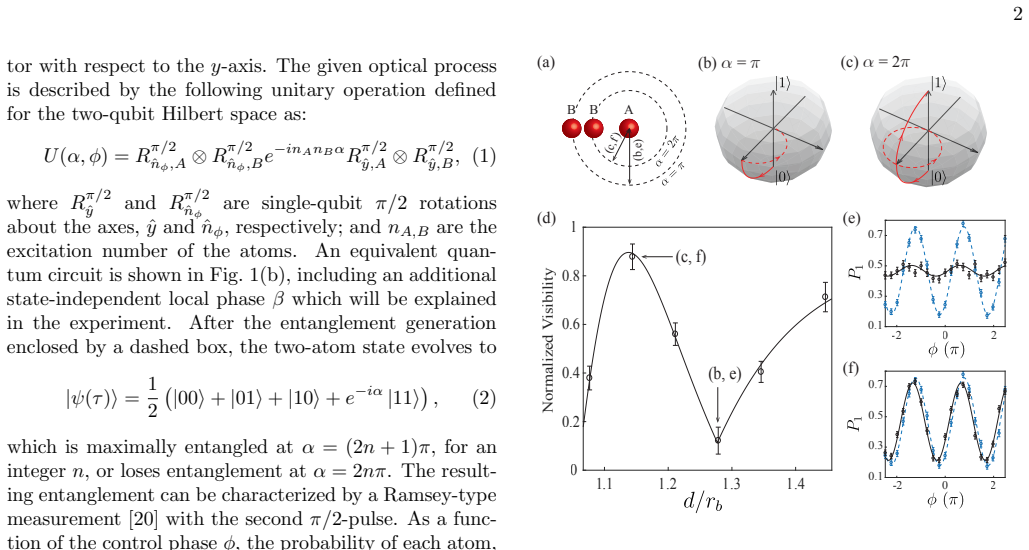
The load-bearing object is the controlled phase gate $U_p(\alpha)=e^{-i n_A n_B \alpha}$ acting during the Ramsey delay, where $n_A,n_B\in\{0,1\}$ are excitation numbers and $\alpha=\tau C_6/d^6$. This unitary is sandwiched between two single-qubit $\pi/2$ rotations, giving the full two-qubit operation $U(\alpha,\phi)=R_{\hat n_\phi}^{\pi/2}\otimes R_{\hat n_\phi}^{\pi/2}\, e^{-i n_A n_B \alpha}\, R_{\hat y}^{\pi/2}\otimes R_{\hat y}^{\pi/2}$. Setting $\alpha=\pi$ at $d_\pi=(\tau C_6/\pi)^{1/6}$ gives a controlled-$\pi$ gate, and $\alpha=2\pi$ at $d_{2\pi}=(\tau C_6/2\pi)^{1/6}$ gives the Null gate. The readout is the Ramsey fringe visibility, which reduces the entanglement to the single number $\cos(\alpha/2)$.
What would settle it
Perform full two-qubit state tomography (or a parity-oscillation measurement) on the pair at the nominal $\alpha=\pi$ and $\alpha=2\pi$ distances. The weak-coupling phase model predicts populations of roughly 1/4 on each of $|00\rangle$, $|01\rangle$, $|10\rangle$, and $|11\rangle$ with coherence 1/2 at $\alpha=\pi$; any measured population of $|11\rangle$ below 1/4 by more than the ~10% state-preparation error, or a visibility curve that deviates from $|\cos(\tau C_6/2d^6)|$ as $d$ approaches $r_b$, would falsify the claim.
Extended reading notes
Core claim
The paper's central claim is that Rydberg-atom entanglement does not require the blockade regime. In the weak-coupling regime $d>r_b$, a pair of Rydberg atoms separated by $d$ accumulates the interaction phase $\alpha=\tau C_6/d^6$ on $|11\rangle$ during a free evolution time $\tau$, and two resonant $\pi/2$ pulses before and after that evolution constitute a Ramsey sequence whose final single-atom excitation probability is $P_1 = 1/2 + (1/2)\cos(\alpha/2)\cos(\alpha/2+\beta+\phi)$. The visibility $\cos(\alpha/2)$ therefore ranges from full (atomic product state, $\alpha=2\pi$) to zero (maximally entangled state, $\alpha=\pi$), and measured visibilities follow the predicted $|\cos(\tau C_6/2d^6)|$ curve across six separations. The experiment uses this phase gate to entangle atoms A and B at $d_\pi=1.28\,r_b$ while atom C sits closer to B at the Null-gate distance $d_{2\pi}=1.14\,r_b$ and remains unentangled, and it generates a $W$-state of three partially blockaded atoms with a two-pulse sequence whose calculated fidelity exceeds 99.5%.
Load-bearing premise
The central derivation assumes the two Rydberg atoms, during the delay, only give each other a phase shift and never exchange population or lose coherence; at the closest working distance, where the interaction shift is about 46% of the Rabi frequency, this assumption is only marginally satisfied.
Editorial extensions
If this is right
- A controlled-$\pi$ phase gate between two Rydberg atoms operates at separations beyond the blockade radius, so entangling gates no longer require packing all interacting pairs inside $r_b$.
- The Ramsey fringe visibility $\cos(\alpha/2)$ provides a direct, calibration-free entanglement witness for this gate: null visibility at $\alpha=\pi$, full visibility at $\alpha=2\pi$.
- Remote pairs can be entangled while nearer neighbors are left separable, enabling selective pairwise connectivity in multi-atom arrays.
- The same phase mechanism supports multipartite entanglement: a two-pulse coherent control sequence yields a predicted $W$-state fidelity above 99.5% for three partially blockaded atoms, with measured multi-excitation error reduced relative to single-pulse excitation.
- With individual addressing, the scheme generalizes to $N$ atoms; the paper estimates $N_{\max}\approx 25$ in the current apparatus and $N_{\max}>100$ with longer dephasing time and stronger Rabi frequency.
Reading between the lines
- A natural extension the paper leaves implicit: the same controlled-$\pi$ phase gate, applied between selected pairs of a geometrically imprinted array, is exactly the entangling step needed for one-way quantum computing with Rydberg atoms, so the weak-coupling mechanism could serve as a connectivity resource rather than only a two-atom demonstration.
- Because the gate phase scales continuously as $d^{-6}$, one could tune the effective coupling strength by distance or by choosing different Rydberg states, which might be useful for quantum annealing or simulation Hamiltonians requiring a programmable two-body coupling without blockade constraints.
- The phase-only assumption would be most sharply probed by measuring the doubly excited state population after the Ramsey delay at $d_{2\pi}$; if the interaction shift of 0.38 MHz at that distance induces even a few percent of population transfer, the visibility prediction changes and the claimed Null-gate operation would degrade.
Signed reviews
Editorial analysis
A structured set of objections, weighed in public.
Referee Report
Summary. The paper proposes and experimentally demonstrates entanglement between Rydberg atoms in the weak-coupling regime, in which atoms are separated beyond the Rydberg blockade radius. The scheme is based on Ramsey-type sequences: two π/2 pulses are applied to two atoms separated by a delay τ, during which the van der Waals interaction imprints a phase α=τC6/d6 on the doubly-excited state, realizing a controlled-phase gate. The authors report two-atom entanglement, selective entanglement of a remote pair in the presence of a closer third atom, and W-state generation for partially blockaded three atoms via a two-pulse coherent-control scheme. The experimental data are Ramsey fringe visibilities and transition probabilities measured with single 87Rb atoms in optical tweezers.
Significance. If the central claims hold, the work demonstrates a distinct mechanism for Rydberg-atom entanglement that does not rely on the blockade, and it provides a route to selective long-range entanglement and to multi-partite states. A notable strength is that the visibility prediction |cos(τC6/2d6)| in Fig. 2(d) is in principle based on independent literature values of C6 and the experimental parameters, rather than fitted to the data. The proposed W-state control sequence is also an interesting extension of coherent control to partially blockaded systems. However, the strength of the conclusions is currently limited by (i) the idealized treatment of the interaction as acting only during the dark delay, (ii) the arbitrary scaling of the theoretical visibility curve, and (iii) the absence of direct entanglement verification for the W-state claim.
major comments (4)
- [§2, Eq. (1) and Fig. 2] The central unitary in Eq. (1) assumes that the van der Waals interaction acts only during the delay τ and that the π/2 rotations are instantaneous. At the working distances this assumption is not satisfied: at d2π=1.14rb, V/Ω=(rb/d)^6≈0.46, and each π/2 pulse (about 0.30 μs at Ω=2π×0.83 MHz) accumulates an interaction phase of roughly (π/2)(V/Ω)≈0.71 rad, so the total phase acquired during the two pulses is a substantial fraction of α=2π. The dynamics during the pulses is not a product of independent single-atom rotations, and therefore the predicted visibility |cos(α/2)| in Eq. (3) is not a parameter-free prediction of the actual experiment. I request a numerical simulation of the full two-atom Hamiltonian including the interaction during the pulses, together with either a corrected visibility formula or a quantitative bound on the error introduced by the idealized model.
- [Fig. 2(d)] The theoretical line in Fig. 2(d) is described as 'scaled and up-shifted for clarity.' Since Eq. (3) predicts an absolute visibility between 0 and 1 with no free parameters, this arbitrary vertical scaling and shifting prevents a quantitative test of the predicted magnitude. I ask the authors to plot the raw measured visibilities with uncertainties against the unadjusted theoretical curve, or to state explicitly what scaling was applied and justify it with an independent account of detection efficiency, state-preparation error, and decoherence.
- [§4, Fig. 4(c)] The W-state generation claim is supported only by the measured total single-excitation probability Ps and multi-excitation probability Pm. These populations are compatible with many non-W states and do not certify the coherence or entanglement content of the final state. I ask for a quantitative W-state fidelity estimate or an entanglement witness/state tomography, or alternatively a revised claim that what is demonstrated is population suppression and not, strictly, W-state entanglement.
- [§3, Fig. 3] The selective-entanglement demonstration inherits the same finite-pulse issue as the two-atom experiment. During the pulses, the B-C pair (dBC=d2π) and the A-B pair (dAB=dπ) both have V/Ω in the range 0.2–0.5, so the 'null gate' and the controlled-π gate are not exactly the ideal operations used in the circuit of Fig. 3(b). A numerical check with finite pulse durations should be added to confirm that the inferred AB entanglement and BC separability survive when the interaction during the pulses is included.
minor comments (4)
- [Fig. 3] The text refers to panels (c), (d), and (f) for atoms A, B, and C, while the caption lists (c), (d), and (e); please correct the panel labeling.
- [Eq. (3)] The phase β is introduced in Eq. (3) but is only defined later in the text as β=2π δAC τ; please define β at first use.
- [Experimental methods] The statement that 'about 200-400 times of measurements were accumulated' should be replaced by the exact number of repetitions and statistical error bars for each data point, so that the visibilities and population values can be properly evaluated.
- [§2] The term 'weak-coupling regime' is used for d>rb, but at d2π=1.14rb the interaction strength is not small compared with the Rabi frequency (V/Ω≈0.46). Please clarify the intended meaning of 'weak coupling' and discuss its validity at the working distances.
Circularity Check
No circularity: the Ramsey-visibility and W-state predictions use externally fixed C6, experimental timing/distance, and in-paper numerical optimization; self-citations are not load-bearing.
full rationale
The central derivation is self-contained. The two-atom unitary is stated in Eq. (1) with α = τC6/d^6, where C6 is taken from an external reference [23] and τ and d are experimental parameters. Eq. (3) then predicts the Ramsey fringe visibility |cos(α/2)| as a function of d, and Fig. 2(d) compares this predicted curve with measured visibilities; no interaction phase or visibility formula is fitted to the data. The parenthetical 'scaled and up-shifted for clarity' is a plotting offset, not a fitted parameter used to produce the prediction, so it does not make the comparison circular. The three-atom W-state pulse areas (2π/3 and π/3) come from numerical optimization of the stated interaction model, not from fitting the W-state data, and the measured probabilities in Fig. 4(c) are compared with that independent prediction. Self-citations [4,21,22,25] are used for apparatus, prior few-body Rydberg dynamics, and leakage-suppression methodology, but the load-bearing predictions are derived and optimized in this paper with an externally benchmarked C6; no uniqueness theorem or model choice is imported solely from the authors' own prior work. Any concern about finite-duration pulses modifying the pure-phase unitary is an approximation/correctness caveat, not an equivalence-by-construction between inputs and outputs.
Assumptions & free parameters
assumptions (4)
- domain assumption Each atom is modeled as a two-level system (ground |0> and Rydberg |1>), with the intermediate 5P3/2 state adiabatically eliminated.
- domain assumption The van der Waals interaction between two Rydberg atoms produces a pure phase shift e^{-i n_A n_B α} on the doubly excited state, with α = τ C6 / d^6.
- domain assumption No decoherence or population dynamics occur during the interaction time τ beyond the accumulated phase.
- domain assumption The three-atom dynamics in the W-state experiment are accurately described by the model used for numerical optimization (given C6, Ω, and the distances dAB=dBC=0.66 rb, dAC=1.31 rb).
Cite this review
Pith. "Pith review of Rydberg atom entanglements in the weak coupling regime." pith.science (2026). https://pith.science/paper/IG6FCMLR
@misc{pith2026190801436,
  author       = {Pith},
  title        = {Pith review of: Rydberg atom entanglements in the weak coupling regime},
  year         = {2026},
  howpublished = {\url{https://pith.science/paper/IG6FCMLR}},
  note         = {Machine review of arXiv:1908.01436}
}
abstract
We present an entanglement scheme for Rydberg atoms using the van der Waals interaction phase induced by Ramsey-type pulsed interactions. This scheme realizes not only controlled phase operations between atoms at a distance larger than Rydberg blockade distance, but also various counter-intuitive entanglement examples, including two-atom entanglement in the presence of a closer third atom and $W$-state generation for partially-blockaded three atoms. Experimental realization is conducted with single rubidium atoms loaded in an array of optical tweezer dipole traps, to demonstrate the proposed entanglement generations and measurements.
Figures


Reference graph
Works this paper leans on
-
[1]
Quantum entanglement,
R. Horodecki, P. Horodecki, M. Horodecki, and K. Horodecki, “Quantum entanglement,” Rev. Mod. Phys. 81, 865 (2009)
2009
-
[2]
Measuring entanglement entropy in a quantum many-body system,
R. Islam, R. Ma, P. M. Preiss, M. E. Tai, A. Lukin, M. Rispoli, and M. Greiner, “Measuring entanglement entropy in a quantum many-body system,” Nature 528, 77 (2015)
work page 2015
-
[3]
Probing many- body dynamics on a 51-atom quantum simulator,
H. Bernien, S. Schwartz, A. Keesling, H. Levine, A. Om- ran, H. Pichler, S. Choi, A. S. Zibrov, M. Endres, M. Greiner, V. Vuleti´ c, and M. D. Lukin, “Probing many- body dynamics on a 51-atom quantum simulator,” Na- ture 551, 579584 (2017)
work page 2017
-
[4]
De- tailed Balance of Thermalization Dynamics in Rydberg- Atom Quantum Simulators,
H. Kim, Y. J. Park, K. Kim, H.-S. Sim, and J. Ahn, “De- tailed Balance of Thermalization Dynamics in Rydberg- Atom Quantum Simulators,” Phys. Rev. Lett. 120, 180502 (2018)
work page 2018
-
[5]
M. A. Nielsen and I. L. Chuang, Quantum Computa- tion and Quantum Information , (Cambridge Univ. Press, 2010)
work page 2010
-
[6]
Quantum sensing,
C. L. Degen, F. Reinhard, and P. Cappellaro, “Quantum sensing,” Rev. Mod. Phys. 89, 035002 (2017)
2017
-
[7]
Entanglement-based quan- tum communication over 144 km,
R. Ursin, F. Tiefenbacher, T. Schmitt-manderbach, H. Weier, T. Scheidl, M. Lindenthal, B. Blauensteiner, T. Jennewein, J. Perdigues, P. Trojek, B. Omer, M. Furst, M. Meyenburg, J. Rarity, Z. Sodnik, C. Barbieri, H. We- infurter, and A. Zeilinger, “Entanglement-based quan- tum communication over 144 km,” Nat. Phys. 3, 481 (2007)
work page 2007
-
[8]
New High-Intensity Source of Polarization-Entangled Photon Pairs,
P. G. Kwiat, K. Mattle, H. Weinfurter, A. Zeilinger, A. V. Sergienko, and Y. Shih, “New High-Intensity Source of Polarization-Entangled Photon Pairs,” Phys. Rev. Lett. 75, 4337 (1995)
work page 1995
Show all 29 references
-
[9]
Entanglement of Two Individual Neutral Atoms Using Rydberg Block- ade,
T. Wilk, A. Ga¨ etan, C. Evellin, J. Wolters, Y. Mirosh- nychenko, P. Grangier, and A. Browaeys, “Entanglement of Two Individual Neutral Atoms Using Rydberg Block- ade,” Phys. Rev. Lett. 104, 010502 (2010)
2010
-
[10]
Demonstration of a Neutral Atom Controlled-NOT Quantum Gate,
L. Isenhower, E. Urban, X. L. Zhang, A. T. Gill, T. Henage, T. A. Johnson, T. G. Walker, and M. Saffman, “Demonstration of a Neutral Atom Controlled-NOT Quantum Gate,” Phys. Rev. Lett. 104, 010503 (2010)
2010
-
[11]
Entangling atomic spins with a Rydberg-dressed spin-flip blockade,
Y.-Y. Jau, A. M. Hankin, T. Keating, I. H. Deutsch, and G. W. Biedermann, “Entangling atomic spins with a Rydberg-dressed spin-flip blockade,” Nat. Phys. 12, 71 (2016)
2016
-
[12]
High-Fidelity Control and En- tanglement of Rydberg-Atom Qubits,
H. Levine, A. Keesling, A. Omran, H. Bernien, S. Schwartz, A. S. Zibrov, M. Endres, M. Greiner, V. Vuleti´ c, and M. D. Lukin, “High-Fidelity Control and En- tanglement of Rydberg-Atom Qubits,” Phys. Rev. Lett. 121, 123603 (2018)
2018
-
[13]
Deterministic Entanglement of Two Trapped Ions,
Q. A. Turchette, C. S. Wood, B. E. King, C. J. My- att, D. Leibfried, W. M. Itano, C. Monroe, and D. J. Wineland, “Deterministic Entanglement of Two Trapped Ions,” Phys. Rev. Lett. 81, 3631 (1998)
1998
-
[14]
Demonstration of controlled- NOT quantum gates on a pair of superconducting quan- tum bits,
J. H. Plantenberg, P. C. de Groot, C. J. P. M. Har- mans, and J. E. Mooij, “Demonstration of controlled- NOT quantum gates on a pair of superconducting quan- tum bits,” Nature 447, 836 (2007)
2007
-
[15]
Multipartite entanglement among single spins in diamond,
P. Neumann, N. Mizuochi, F. Rempp, P. Hemmer, H. Watanabe, S. Yamasaki, V. Jacques, T. Gaebel, F. Jelezko, and J. Wrachtrup, “Multipartite entanglement among single spins in diamond,” Science 320, 1326 (2008)
2008
-
[16]
Quantum Computations with Cold Trapped Ions,
J. I. Cirac and P. Zoller, “Quantum Computations with Cold Trapped Ions,” Phys. Rev. Lett. 74, 4091 (1995)
1995
-
[17]
Realization of the Cirac-Zoller controlled-NOT quantum gate,
F. Schmidt-Kaler, H. H¨ affner, M. Riebe, S. Gulde, G. P. T. Lancaster, T. Deuschle, C. Becher, C. F. Roos, J. Eschner, and R. Blatt, “Realization of the Cirac-Zoller controlled-NOT quantum gate,” Nature 422, 408411 (2003)
2003
-
[18]
Entangled macroscopic quantum states in two superconducting qubits,
A. J. Berkley, H. Xu, R. C. Ramos, M. A. Gubrud, F. W. Strauch, P. R. Johnson, J. R. Anderson, A. J. Dragt, C. J. Lobb, and F. C. Wellstood, “Entangled macroscopic quantum states in two superconducting qubits,” Science 300, 1548 (2003)
2003
-
[19]
Fast Quantum Gates for Neutral Atoms,
D. Jaksch, J. I. Cirac, P. Zoller, S. L. Rolston, R. Cote, and M. D. Lukin, “Fast Quantum Gates for Neutral Atoms,” Phys. Rev. Lett. 85, 2208 (2000)
2000
-
[20]
Entanglement Interferometry for Precision Measurement of Atomic Scattering Proper- ties,
A. Widera, O. Mandel, M. Greiner, S. Kreim, T. W. H¨ ansch, and I. Bloch, “Entanglement Interferometry for Precision Measurement of Atomic Scattering Proper- ties,” Phys. Rev. Lett. 92, 160406 (2004)
2004
-
[21]
In situ single-atom array synthesis using dynamic holo- graphic optical tweezers,
H. Kim, W. Lee, H. Lee, H. Jo, Y. Song, and J. Ahn, “In situ single-atom array synthesis using dynamic holo- graphic optical tweezers,” Nat. Comm. 7, 13317 (2016)
2016
-
[22]
Coherent and dissipative dynamics of entangled few-body systems of Rydberg atoms,
W. Lee, M. Kim, H. Jo, Y. Song, and J. Ahn, “Coherent and dissipative dynamics of entangled few-body systems of Rydberg atoms,” Phys. Rev. A 99, 043404 (2019)
2019
-
[23]
Tutorial: Calculation of Rydberg interaction potentials,
S. Weber, C. Tresp, H. Menke, A. Urvoy, O. Firstenberg, H. P. B¨ uchler, and S. Hofferberth, “Tutorial: Calculation of Rydberg interaction potentials,” J. Phys. B: At. Mol. Opt. Phys. 50, 133001 (2017)
2017
-
[24]
Control of quan- 5 tum phenomena: past, present and future,
C. Brif, R. Chakrabarti, and H. Rabitz, “Control of quan- 5 tum phenomena: past, present and future,” New J. Phys. 12, 075008 (2010)
2010
-
[25]
Qubit leakage suppression by ultrafast composite pulses,
H. Jo, Y. Song, and J. Ahn, “Qubit leakage suppression by ultrafast composite pulses,” Opt. Express 27, 3944 (2019)
2019
-
[26]
Single-atom ad- dressing in microtraps for quantum-state engineering us- ing Rydberg atoms,
H. Labuhn, S. Ravets, D. Barredo, L. B´ eguin, F. No- grette, T. Lahaye, and A. Browaeys, “Single-atom ad- dressing in microtraps for quantum-state engineering us- ing Rydberg atoms,” Phys. Rev. A 90, 023415 (2014)
2014
-
[27]
Coherent Addressing of Individual Neutral Atoms in a 3D Optical Lattice,
Y. Wang, X. Zhang, T. A. Corcovilos, A. Kumar, and D. S. Weiss, “Coherent Addressing of Individual Neutral Atoms in a 3D Optical Lattice,” Phys. Rev. Lett. 115, 043003 (2015)
2015
-
[28]
Cooling a single atom in an optical tweezer to its quantum ground state,
A. M. Kaufman, B. J. Lester, and C. A. Regal, “Cooling a single atom in an optical tweezer to its quantum ground state,” Phys. Rev. X 2, 041014 (2012)
2012
-
[29]
A One-Way Quantum Computer,
R. Raussendorf and H. J. Briegel, “A One-Way Quantum Computer,” Phys. Rev. Lett. 86, 5188 (2001)
2001
Reviewed August 14, 2026 · model on record in the stance chip above.
Discussion (0). Continue with ORCID to comment.