REVIEW 3 major objections 5 minor 74 references
Discrepancy-Aware Graph Mask Auto-Encoder
T0 review · 3 major / 5 minor · reviewed 2026-08-15 · deepseek-v4-flash
Pith's one-line read DGMAE, a masked graph auto-encoder that reconstructs neighbor-feature discrepancies, is reported to outperform state-of-the-art graph self-supervised methods on 16 of 17 node-classification benchmarks, with the largest gains on…
desk verdict Novel discrepancy-reconstruction pretext with strong heterophilic gains, but the paper's claimed Laplacian target doesn't match the implemented equation. read the letter →
The pith
A machine-rendered reading of the paper's core claim, the machinery that carries it, and where it could break.
The reading
What carries the argument
The load-bearing identity is $X_D = L_{\mathrm{sym}}X = (I-\tilde{A})X$ (Eq. 5), which turns neighbor-feature subtraction into multiplication by the symmetric normalized graph Laplacian and supplies the high-pass discrepancy target. The complementary mechanism is the masked/unmasked contextual discrepancy $z_i^D = z_i - \hat{z}_i$ (Eq. 11), where $z_i$ comes from an encoder on the unmasked graph and $\hat{z}_i$ from the masked branch; aligning this latent discrepancy to the raw feature discrepancy is what preserves node individuality. The adaptive discrepancy selection module converts the shared GAT attention weights into sampling probabilities $p_{ij} = \min((1-w_{ij})p_c, p_\tau)$ (Eq. 7), preferentially keeping edges whose representations are dissimilar. The two branches share one encoder and are combined as $\mathcal{L}=(1-\lambda)\mathcal{L}_f+\lambda\mathcal{L}_d$ (Eq. 13), so the feature-reconstruction and discrepancy-reconstruction objectives are optimized together.
What would settle it
Train DGMAE on a fixed heterophilic benchmark (for example Texas or Squirrel) with the exact target $X_D = L_{\mathrm{sym}}X$ from Eq. 4 and with the sampled target from Eq. 9, keeping all hyperparameters and the Bernoulli masks fixed across runs. If the two variants give nearly identical accuracy, the discrepancy-reconstruction mechanism is robust to the definitional gap; if the exact-target variant is materially better, then the implemented loss approximates the claimed signal only imperfectly and the mechanism needs revision.
Extended reading notes
Core claim
At its core, the paper claims that reconstructing discrepancy information prevents the node confusion caused by feature reconstruction. The discrepancy target is $X_D = L_{\mathrm{sym}}X = (I-\tilde{A})X$ (Eq. 5), where $\tilde{A}=D^{-1/2}AD^{-1/2}$; this is the high-pass filtered feature signal, and the paper treats it as a supervision signal rather than as an encoder input. In the embedding space, the paper measures contextual discrepancy as $z_i^D = z_i - \hat{z}_i$ (Eq. 11), the difference between the encoder's unmasked representation and the masked decoder's reconstruction, and aligns it to $x_i^D$ with a scaled cosine error. An attention-based Bernoulli sampler selects edges whose learned attention weight is low, so the discrepancy target is biased toward pairs with large feature differences. On this basis the paper reports best node-classification accuracy on 16 of 17 benchmarks, with margin examples of Texas 88.11% versus 82.70% for the best baseline and Squirrel 72.47% versus 64.81%, together with gains in node clustering and graph classification.
Load-bearing premise
The load-bearing premise is that the degree-normalized neighbor-subtraction signal $X_D=(I-\tilde{A})X$ captures the semantic discrepancy that embeddings should preserve, and that the sampled weighted-difference form in Eq. 9 faithfully reproduces that signal—which it does only when each node's weights $\sum_j 1/\sqrt{d_i d_j}$ sum to 1, a condition that fails on most real graphs.
Editorial extensions
If this is right
- On heterophilic graphs, where connected nodes tend to carry different labels, the pretext objective should include a high-pass discrepancy term alongside feature reconstruction, since feature-only reconstruction drives representations of different classes together.
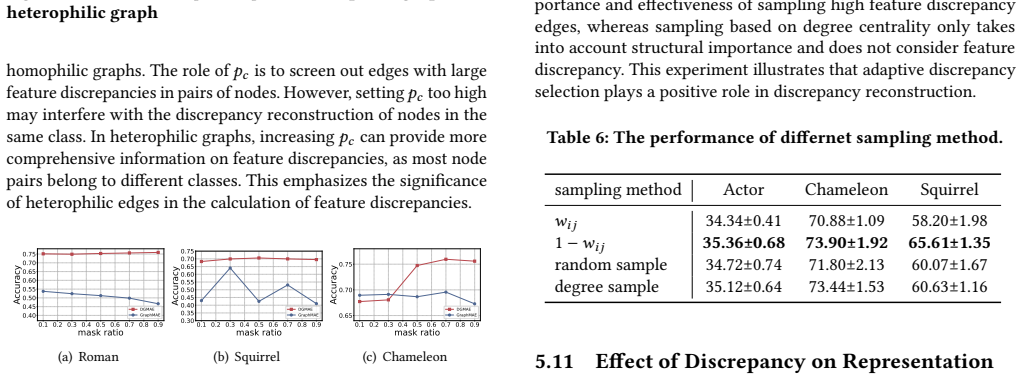
- The discrepancy signal remains informative under heavy masking: on Roman, DGMAE retains about 73.5% accuracy at an 80% mask ratio, where the feature-reconstruction baseline falls to 38.2%.
- On homophilic graphs the added branch does not hurt: DGMAE reaches 84.93% on Cora, 96.01% on Physics, and 51.56% on Flickr, matching or beating the compared self-supervised methods.
- The benefit extends to larger heterophilic graphs: DGMAE reports ROC AUC 90.72% on Minesweeper versus 81.23% for GREET and 76.69% on Penn94, suggesting the approach scales.
- Choosing which edges to include in the discrepancy target matters: sampling by reversed attention weights beats random, degree-based, and forward-attention sampling on Actor, Chameleon, and Squirrel.
Reading between the lines
- Beyond the paper, the degree normalization in Eq. 4 can be tested in isolation: comparing a variant trained on the exact $L_{\mathrm{sym}}X$ target with one trained on the sampled weighted-difference form of Eq. 9, on a fixed heterophilic dataset, would show whether the Laplacian normalization is load-bearing or incidental.
- Beyond the paper, the strong performance under high mask ratios suggests the discrepancy target could act as an auxiliary objective in other sparse-context settings, such as node classification with missing features or few-shot labels, which the paper does not evaluate.
- Beyond the paper, since the discrepancy target is feature-defined, a structural analogue (for example, differences between degree or positional encodings) could extend the idea to graphs without node attributes; the paper's own limitation section notes that featureless graphs are currently out of scope.
Signed reviews
Editorial analysis
A structured set of objections, weighed in public.
Referee Report
Summary. The paper proposes DGMAE, a self-supervised masked graph auto-encoder that augments standard feature reconstruction with a second reconstruction branch targeting node-feature discrepancies. The discrepancy target is motivated as the high-pass signal X_D = L_sym X obtained from the symmetric normalized graph Laplacian, and an adaptive edge-sampling mechanism based on shared attention weights selects node pairs with large discrepancies. The authors evaluate on 17 node-classification datasets, node clustering, graph classification, and several ablations and sensitivity analyses, reporting state-of-the-art results on most benchmarks, especially on heterophilic graphs.
Significance. The reported empirical gains are substantial and the evaluation is broad, covering many datasets, multiple downstream tasks, standard deviations, ablations, and released code. If the proposed mechanism were exactly as claimed, the paper would be a solid contribution to self-supervised learning on heterophilic graphs. However, the derivation connecting the implemented discrepancy loss to the Laplacian high-pass signal is currently incorrect on irregular graphs, and an algebraic step in the theoretical analysis is also flawed. These issues do not necessarily invalidate the empirical results, but they mean the stated mechanism is not yet supported by the equations as written.
major comments (3)
- [Section 4.3.2, Eq. (9) vs. Eq. (4)] The assertion that Eq. (4) 'can be rewritten as' Eq. (9) is not correct for irregular graphs. With m_ij = 1 for all j, Eq. (9) expands to C_i x_i - \sum_j x_j / \sqrt(d_i d_j), where C_i = \sum_j 1/\sqrt(d_i d_j), whereas Eq. (4) is x_i - \sum_j x_j / \sqrt(d_i d_j). These two expressions coincide only when C_i = 1, which fails on general graphs (e.g., for the center of a star, C_i = \sqrt(d_i)). The Bernoulli factor m_ij does not repair the mismatch, because its expectation multiplies both terms by p_ij rather than re-normalizing the self-coefficient. Since Eq. (9) is the target used in the discrepancy loss Eq. (12), the paper's claim that the model reconstructs X_D = L_sym X as defined in Eq. (5) is not established. Please either modify Eq. (9) so that it is exactly equivalent to Eq. (4) (for example by dividing by C_i or using a properly normalized self-term) or explicitly present Eq. (9) as a weighted approximation and adjust the theoretical discussion, including Appendix E, accordingly.
- [Appendix E, Eq. (16)] The algebraic manipulation used to justify the 'pull closer / push away' interpretation is incorrect. From the preceding line, maximizing <z^D_i, x^D_i> with x^D_i = \sum_{j \in N'(i)} (x_i - x_j) gives <z^D_i, x_i> - \sum_j <z^D_i, x_j>. The next line then claims this equals -1/2 ||z^D_i - x_i||^2 + \sum_j 1/2 ||z^D_i - x_j||^2. The required identity <a,b> = -1/2 ||a-b||^2 is false; the correct identity is <a,b> = 1/2(||a||^2 + ||b||^2 - ||a-b||^2). Therefore the derived decoupling interpretation does not follow from the loss as written. In addition, the definition of x^D_i used here omits the normalization factors that appear in both Eq. (4) and Eq. (9), which is a further inconsistency in the theoretical narrative.
- [Table 7, dataset statistics] The reported statistics for Cora (2,078 nodes, 5,278 edges) and Roman-empire (32,927 nodes, 5,278 edges) do not match the standard versions of these datasets (Cora: 2,708 nodes, 5,429 edges; Roman-empire: 22,662 nodes, 32,927 edges, per the cited source [38]). Because the headline results in Section 5.4 are comparisons against baselines, the exact preprocessing or data source must be clarified, and the authors should confirm that all methods were evaluated on the same graphs. If these are typographical errors, they should be corrected; if a filtered or alternative variant was used, this must be stated explicitly and its effect on comparability discussed.
minor comments (5)
- [Eq. (12)] The discrepancy loss is written as L_d = 1/|\hat{V}| \sum_{i \notin \hat{|V|}} ..., which is not well-formed; the summation set and the normalizer should be stated clearly (presumably the unmasked nodes).
- [Eqs. (6)-(9)] The attention weight w_ij is normalized over N(i), so p_ij is not symmetric. The paper should state whether the Bernoulli edge mask m_ij is drawn independently for each ordered pair or is symmetrized, since Eq. (9) sums over j \in N(i).
- [Figure 2] The axes are not labeled and the caption does not define the quantity on the vertical axis; please add axis labels and a clear description of what is plotted.
- [Abstract and Section 5] There are several grammatical errors, e.g., 'three graph analytic including tasks' in the abstract; a careful proofread is needed.
- [Eq. (3)] The inner product is defined as <z^D_i, x^D_i> = x_i^T \hat{z}_i / (||x_i^T|| ||\hat{z}_i||), but the loss expression uses <z_i, x_i>; please make the notation consistent.
Circularity Check
No significant circularity: the discrepancy target is a function of the raw features and adjacency matrix, and all headline evaluations use external labels.
full rationale
The paper's load-bearing claims are (i) that reconstructing raw-feature discrepancies produces more distinguishable representations and (ii) that DGMAE outperforms state-of-the-art self-supervised methods on node classification, clustering, and graph classification. Neither claim reduces to its own inputs. The discrepancy target X_D = L_sym X (Eq. 5) is a fixed function of the raw feature matrix and the adjacency matrix; it contains no downstream label information. The evaluation protocol freezes the learned representations and trains an external logistic-regression or k-means model on held-out or external class labels, so the main empirical results are not forced by construction. The adaptive discrepancy selection module (Eqs. 6-8) makes the sampled target depend on the model's own attention weights, so the target is not literally 'predefined' as Section 4.3.1 claims; however, this is a self-referential self-supervised pseudo-labeling design, not a circular prediction, because the predicted quantity z_D_i and the target x_D_i are distinct functions of the model and of the fixed raw features, and the reported performance is measured against external labels rather than against the training target itself. The rewrite of Eq. 4 into Eq. 9 is algebraically invalid on irregular graphs (it holds only when sum_j 1/sqrt(d_i d_j) = 1), but this is a correctness or mechanism gap, not circularity: Eq. 9 is not defined in terms of the output it is claimed to predict. Self-citations to the authors' earlier work (e.g., [25]-[28], [57]) appear only as related-work references and are not load-bearing in the discrepancy-reconstruction derivation or in the benchmark evaluation. No step in the claimed derivation chain is forced by definition, by fitted inputs renamed as predictions, or by a self-citation chain.
Assumptions & free parameters
free parameters (9)
- lambda (balance weight between feature and discrepancy loss) =
0.1 to 0.9 per dataset (Table 8)
- p_c (edge removal probability) =
0.1 to 0.5 per dataset (Table 8)
- p_tau (cut-off probability) =
0.6 to 0.9 per dataset (Table 8)
- gamma1 (SCE scaling for feature reconstruction) =
3 for all datasets (Table 8)
- gamma2 (SCE scaling for discrepancy reconstruction) =
1 to 6 per dataset (Table 8)
- weight_delay (weight decay) =
5e-7 to 1e-3 per dataset (Table 8)
- learning_rate =
1e-4 to 1e-3 per dataset (Table 8)
- mask_ratio =
0.2 to 0.9 per dataset (Table 8)
- num_layers =
1 to 2 per dataset (Table 8)
assumptions (5)
- domain assumption The normalized Laplacian high-pass signal X_D = L_sym X captures the discrepancy information that should be preserved in low-dimensional embeddings.
- domain assumption The attention coefficients w_ij from the shared GNN encoder are a reliable proxy for semantic similarity, so 1 - w_ij selects high-discrepancy edges.
- domain assumption The difference between unmasked and masked encoder outputs, z_i - \hat{z}_i, approximates the unique part of a node's representation.
- domain assumption Cosine alignment between z_D and x_D transfers raw-feature discrepancy into the embedding space.
- domain assumption The derivation in Appendix E assumes node features are normalized and drops norm terms without stating this in the main method.
Cite this review
Pith. "Pith review of Discrepancy-Aware Graph Mask Auto-Encoder." pith.science (2026). https://pith.science/paper/IHBN24G2
@misc{pith2026250619343,
  author       = {Pith},
  title        = {Pith review of: Discrepancy-Aware Graph Mask Auto-Encoder},
  year         = {2026},
  howpublished = {\url{https://pith.science/paper/IHBN24G2}},
  note         = {Machine review of arXiv:2506.19343}
}
read the original abstract
Masked Graph Auto-Encoder, a powerful graph self-supervised training paradigm, has recently shown superior performance in graph representation learning. Existing works typically rely on node contextual information to recover the masked information. However, they fail to generalize well to heterophilic graphs where connected nodes may be not similar, because they focus only on capturing the neighborhood information and ignoring the discrepancy information between different nodes, resulting in indistinguishable node representations. In this paper, to address this issue, we propose a Discrepancy-Aware Graph Mask Auto-Encoder (DGMAE). It obtains more distinguishable node representations by reconstructing the discrepancy information of neighboring nodes during the masking process. We conduct extensive experiments on 17 widely-used benchmark datasets. The results show that our DGMAE can effectively preserve the discrepancies of nodes in low-dimensional space. Moreover, DGMAE significantly outperforms state-of-the-art graph self-supervised learning methods on three graph analytic including tasks node classification, node clustering, and graph classification, demonstrating its remarkable superiority. The code of DGMAE is available at https://github.com/zhengziyu77/DGMAE.
Figures


Figures from the paper (10 more)





Reference graph
Works this paper leans on
-
[38]
Oleg Platonov, Denis Kuznedelev, Michael Diskin, Artem Babenko, and Liudmila Prokhorenkova. 2022. A critical look at the evaluation of GNNs under heterophily: Are we really making progress?. InThe Eleventh International Conference on Learning Representations
work page 2022
-
[1]
Deyu Bo, Xiao Wang, Chuan Shi, and Huawei Shen. 2021. Beyond low-frequency information in graph convolutional networks. InProceedings of the AAAI confer- ence on artificial intelligence, Vol. 35. 3950–3957
2021
-
[2]
Yuhan Chen, Yihong Luo, Jing Tang, Liang Yang, Siya Qiu, Chuan Wang, and Xiaochun Cao. 2023. LSGNN: Towards General Graph Neural Network in Node Classification by Local Similarity. InProceedings of the Thirty-Second International Joint Conference on Artificial Intelligence, IJCAI 2023, 19th-25th August 2023, Macao, SAR, China. ijcai.org, 3550–3558. doi:10...
-
[3]
Eli Chien, Jianhao Peng, Pan Li, and Olgica Milenkovic. 2020. Adaptive Universal Generalized PageRank Graph Neural Network. InInternational Conference on Learning Representations
work page 2020
-
[4]
Haoran Duan, Cheng Xie, Peng Tang, and Beibei Yu. 2024. Contextual features online prediction for self-supervised graph representation.Expert Systems with Applications238 (2024), 122075
work page 2024
-
[5]
Kaiming He, Xinlei Chen, Saining Xie, Yanghao Li, Piotr Dollár, and Ross Girshick
-
[6]
Zhenyu Hou, Yufei He, Yukuo Cen, Xiao Liu, Yuxiao Dong, Evgeny Kharlamov, and Jie Tang. 2023. Graphmae2: A decoding-enhanced masked self-supervised graph learner. InProceedings of the ACM Web Conference 2023. 737–746
work page 2023
-
[7]
Zhenyu Hou, Xiao Liu, Yukuo Cen, Yuxiao Dong, Hongxia Yang, Chunjie Wang, and Jie Tang. 2022. Graphmae: Self-supervised masked graph autoencoders. In Proceedings of the 28th ACM SIGKDD Conference on Knowledge Discovery and Data Mining. 594–604
2022
Show all 74 references
-
[8]
Ziniu Hu, Yuxiao Dong, Kuansan Wang, Kai-Wei Chang, and Yizhou Sun. 2020. Gpt-gnn: Generative pre-training of graph neural networks. InProceedings of the 26th ACM SIGKDD international conference on knowledge discovery & data mining. 1857–1867
2020
-
[9]
Thomas N Kipf and Max Welling. 2016. Semi-supervised classification with graph convolutional networks.arXiv:1609.02907(2016)
2016 arXiv
-
[10]
Thomas N Kipf and Max Welling. 2016. Variational graph auto-encoders.arXiv preprint arXiv:1611.07308(2016)
2016 arXiv
-
[11]
Soo Yong Lee, Fanchen Bu, Jaemin Yoo, and Kijung Shin. 2023. Towards deep attention in graph neural networks: Problems and remedies. InInternational Conference on Machine Learning. PMLR, 18774–18795
2023
-
[12]
Jintang Li, Ruofan Wu, Wangbin Sun, Liang Chen, Sheng Tian, Liang Zhu, Changhua Meng, Zibin Zheng, and Weiqiang Wang. 2023. What’s Behind the Mask: Understanding Masked Graph Modeling for Graph Autoencoders. InPro- ceedings of the 29th ACM SIGKDD Conference on Knowledge Discov...
2023
-
[13]
Xiang Li, Tiandi Ye, Caihua Shan, Dongsheng Li, and Ming Gao. 2023. Seegera: Self-supervised semi-implicit graph variational auto-encoders with masking. In Proceedings of the ACM web conference 2023. 143–153. KDD ’25, August 3–7, 2025, Toronto, ON, Canada Ziyu Zheng, Yaming Ya...
2023
-
[14]
Xiang Li, Renyu Zhu, Yao Cheng, Caihua Shan, Siqiang Luo, Dongsheng Li, and Weining Qian. 2022. Finding global homophily in graph neural networks when meeting heterophily. InInternational Conference on Machine Learning. PMLR, 13242–13256
2022
-
[15]
Derek Lim, Felix Hohne, Xiuyu Li, Sijia Linda Huang, Vaishnavi Gupta, Omkar Bhalerao, and Ser Nam Lim. 2021. Large scale learning on non-homophilous graphs: New benchmarks and strong simple methods.Advances in Neural Infor- mation Processing Systems34 (2021), 20887–20902
2021
-
[16]
Yang Liu, Xiang Ao, Fuli Feng, and Qing He. 2022. Ud-gnn: Uncertainty-aware debiased training on semi-homophilous graphs. InProceedings of the 28th ACM SIGKDD Conference on Knowledge Discovery and Data Mining. 1131–1140
2022
-
[17]
Yue Liu, Ke Liang, Jun Xia, Xihong Yang, Sihang Zhou, Meng Liu, Xinwang Liu, and Stan Z Li. 2023. Reinforcement Graph Clustering with Unknown Cluster Number. InProceedings of the 31st ACM International Conference on Multimedia. 3528–3537
2023
-
[18]
Yue Liu, Ke Liang, Jun Xia, Sihang Zhou, Xihong Yang, , Xinwang Liu, and Z. Stan Li. 2023. Dink-Net: Neural Clustering on Large Graphs. InProc. of ICML
2023
-
[19]
Yue Liu, Wenxuan Tu, Sihang Zhou, Xinwang Liu, Linxuan Song, Xihong Yang, and En Zhu. 2022. Deep graph clustering via dual correlation reduction. In Proceedings of the AAAI conference on artificial intelligence, Vol. 36. 7603–7611
2022
-
[20]
Yue Liu, Wenxuan Tu, Sihang Zhou, Xinwang Liu, Linxuan Song, Xihong Yang, and En Zhu. 2022. Deep Graph Clustering via Dual Correlation Reduction. In Proc. of AAAI, Vol. 36. 7603–7611
2022
-
[21]
Yue Liu, Jun Xia, Sihang Zhou, Xihong Yang, Ke Liang, Chenchen Fan, Yan Zhuang, Stan Z Li, Xinwang Liu, and Kunlun He. 2022. A Survey of Deep Graph Clustering: Taxonomy, Challenge, Application, and Open Resource.arXiv preprint arXiv:2211.12875(2022)
2022 arXiv
-
[22]
Yue Liu, Xihong Yang, Sihang Zhou, and Xinwang Liu. 2023. Simple contrastive graph clustering.IEEE Transactions on Neural Networks and Learning Systems (2023)
2023
-
[23]
Yue Liu, Xihong Yang, Sihang Zhou, Xinwang Liu, Zhen Wang, Ke Liang, Wenx- uan Tu, Liang Li, Jingcan Duan, and Cancan Chen. 2023. Hard Sample Aware Network for Contrastive Deep Graph Clustering. InProc. of AAAI
2023
-
[24]
Yixin Liu, Yizhen Zheng, Daokun Zhang, Vincent CS Lee, and Shirui Pan. 2023. Beyond smoothing: Unsupervised graph representation learning with edge het- erophily discriminating. InProceedings of the AAAI conference on artificial intelli- gence, Vol. 37. 4516–4524
2023
-
[25]
Weigang Lu, Ziyu Guan, Wei Zhao, and Yaming Yang. 2024. AdaGMLP: Ad- aBoosting GNN-to-MLP Knowledge Distillation. InProceedings of the 30th ACM SIGKDD Conference on Knowledge Discovery and Data Mining(Barcelona, Spain) (KDD ’24). Association for Computing Machinery, New York, ...
2024
-
[26]
Weigang Lu, Ziyu Guan, Wei Zhao, Yaming Yang, and Long Jin. 2024. NodeMixup: Tackling Under-Reaching for Graph Neural Networks.Proceedings of the AAAI Conference on Artificial Intelligence38, 13 (Mar. 2024), 14175–14183. doi:10.1609/ aaai.v38i13.29328
2024
-
[27]
Weigang Lu, Ziyu Guan, Wei Zhao, Yaming Yang, Yibing Zhan, Yiheng Lu, and Dapeng Tao. 2025. AGMixup: Adaptive Graph Mixup for Semi-supervised Node Classification.Proceedings of the AAAI Conference on Artificial Intelligence39, 18 (Apr. 2025), 19143–19151. doi:10.1609/aaai.v39i18.34107
2025 doi
-
[28]
Weigang Lu, Yibing Zhan, Binbin Lin, Ziyu Guan, Liu Liu, Baosheng Yu, Wei Zhao, Yaming Yang, and Dacheng Tao. 2024. SkipNode: On Alleviating Performance Degradation for Deep Graph Convolutional Networks.IEEE Transactions on Knowledge and Data Engineering36, 11 (2024), 7030–704...
2024
-
[29]
Sitao Luan, Chenqing Hua, Qincheng Lu, Jiaqi Zhu, Mingde Zhao, Shuyuan Zhang, Xiao-Wen Chang, and Doina Precup. 2022. Revisiting heterophily for graph neural networks.Advances in neural information processing systems35 (2022), 1362–1375
2022
-
[30]
Yao Ma, Xiaorui Liu, Neil Shah, and Jiliang Tang. 2021. Is Homophily a Ne- cessity for Graph Neural Networks?. InInternational Conference on Learning Representations
2021
-
[31]
Julian McAuley, Christopher Targett, Qinfeng Shi, and Anton Van Den Hengel
-
[32]
Miller McPherson, Lynn Smith-Lovin, and James M Cook. 2001. Birds of a feather: Homophily in social networks.Annual review of sociology27, 1 (2001), 415–444
2001
-
[33]
Péter Mernyei and Cătălina Cangea. 2020. Wiki-CS: A Wikipedia-Based Bench- mark for Graph Neural Networks.arXiv preprint arXiv:2007.02901(2020)
2020 arXiv
-
[34]
Shirui Pan, Ruiqi Hu, Sai-fu Fung, Guodong Long, Jing Jiang, and Chengqi Zhang
-
[35]
Shirui Pan, Ruiqi Hu, Guodong Long, Jing Jiang, Lina Yao, and Chengqi Zhang
-
[36]
Hongbin Pei, Bingzhe Wei, Kevin Chen-Chuan Chang, Yu Lei, and Bo Yang
-
[37]
Jeffrey Pennington, Richard Socher, and Christopher D Manning. 2014. Glove: Global vectors for word representation. InProceedings of the 2014 conference on empirical methods in natural language processing (EMNLP). 1532–1543
2014
-
[39]
Benedek Rozemberczki, Carl Allen, and Rik Sarkar. 2021. Multi-scale attributed node embedding.Journal of Complex Networks9, 2 (2021), cnab014
2021
-
[41]
InInternational Conference on Learning Representations
Geom-GCN: Geometric Graph Convolutional Networks. InInternational Conference on Learning Representations
-
[42]
Oleksandr Shchur, Maximilian Mumme, Aleksandar Bojchevski, and Stephan Günnemann. 2018. Pitfalls of graph neural network evaluation.arXiv preprint arXiv:1811.05868(2018)
2018 arXiv
-
[43]
Fan-Yun Sun, Jordan Hoffmann, Vikas Verma, and Jian Tang. 2019. Infograph: Un- supervised and semi-supervised graph-level representation learning via mutual information maximization.arXiv preprint arXiv:1908.01000(2019)
2019 arXiv
-
[44]
Qiaoyu Tan, Ninghao Liu, Xiao Huang, Soo-Hyun Choi, Li Li, Rui Chen, and Xia Hu. 2023. S2GAE: self-supervised graph autoencoders are generalizable learners with graph masking. InProceedings of the sixteenth ACM international conference on web search and data mining. 787–795
2023
-
[45]
Mingyue Tang, Pan Li, and Carl Yang. 2021. Graph Auto-Encoder via Neigh- borhood Wasserstein Reconstruction. InInternational Conference on Learning Representations
2021
-
[46]
Prithviraj Sen, Galileo Namata, Mustafa Bilgic, Lise Getoor, Brian Galligher, and Tina Eliassi-Rad. 2008. Collective classification in network data.AI magazine29, 3 (2008), 93–93
2008
-
[47]
Wenxuan Tu, Qing Liao, Sihang Zhou, Xin Peng, Chuan Ma, Zhe Liu, Xinwang Liu, Zhiping Cai, and Kunlun He. 2023. RARE: Robust masked graph autoencoder. IEEE Transactions on Knowledge and Data Engineering(2023)
2023
-
[48]
Petar Veličković, Guillem Cucurull, Arantxa Casanova, Adriana Romero, Pietro Lio, and Yoshua Bengio. 2017. Graph attention networks.arXiv:1710.10903(2017)
2017 arXiv
-
[49]
Petar Veličković, William Fedus, William L Hamilton, Pietro Liò, Yoshua Bengio, and R Devon Hjelm. 2018. Deep graph infomax.arXiv preprint arXiv:1809.10341 (2018)
2018 arXiv
-
[50]
Chun Wang, Shirui Pan, Ruiqi Hu, Guodong Long, Jing Jiang, and Chengqi Zhang
-
[51]
Shantanu Thakoor, Corentin Tallec, Mohammad Gheshlaghi Azar, Mehdi Azabou, Eva L Dyer, Remi Munos, Petar Veličković, and Michal Valko. 2021. Large-Scale Representation Learning on Graphs via Bootstrapping. InInternational Conference on Learning Representations
2021
-
[52]
Liang Wang, Xiang Tao, Qiang Liu, and Shu Wu. 2024. Rethinking Graph Masked Autoencoders through Alignment and Uniformity.arXiv preprint arXiv:2402.07225 (2024)
2024
-
[53]
Teng Xiao, Zhengyu Chen, Zhimeng Guo, Zeyang Zhuang, and Suhang Wang
-
[54]
Teng Xiao, Huaisheng Zhu, Zhengyu Chen, and Suhang Wang. 2024. Simple and asymmetric graph contrastive learning without augmentations.Advances in Neural Information Processing Systems36 (2024)
2024
-
[55]
Keyulu Xu, Weihua Hu, Jure Leskovec, and Stefanie Jegelka. 2018. How Powerful are Graph Neural Networks?. InInternational Conference on Learning Representa- tions
2018
-
[56]
In Proceedings of the 28th International Joint Conference on Artificial Intelligence
Attributed graph clustering: a deep attentional embedding approach. In Proceedings of the 28th International Joint Conference on Artificial Intelligence. 3670–3676
-
[57]
Haonan Wang, Jieyu Zhang, Qi Zhu, Wei Huang, Kenji Kawaguchi, and Xiaokui Xiao. 2022. Single-pass contrastive learning can work for both homophilic and heterophilic graph.arXiv preprint arXiv:2211.10890(2022)
2022 arXiv
-
[58]
Yuning You, Tianlong Chen, Yang Shen, and Zhangyang Wang. 2021. Graph contrastive learning automated. InInternational Conference on Machine Learning. PMLR, 12121–12132
2021
-
[59]
Hanqing Zeng, Hongkuan Zhou, Ajitesh Srivastava, Rajgopal Kannan, and Viktor Prasanna. 2020. GraphSAINT: Graph Sampling Based Inductive Learning Method. InInternational Conference on Learning Representations. https://openreview.net/ forum?id=BJe8pkHFwS
2020
-
[60]
Decoupled self-supervised learning for graphs.Advances in Neural Infor- mation Processing Systems35 (2022), 620–634
2022
-
[61]
Hengrui Zhang, Qitian Wu, Junchi Yan, David Wipf, and Philip S Yu. 2021. From canonical correlation analysis to self-supervised graph neural networks.Advances in Neural Information Processing Systems34 (2021), 76–89
2021
-
[62]
Qi Zhang, Yifei Wang, and Yisen Wang. 2022. How mask matters: Towards theo- retical understandings of masked autoencoders.Advances in Neural Information Processing Systems35 (2022), 27127–27139
2022
-
[63]
Keyulu Xu, Chengtao Li, Yonglong Tian, Tomohiro Sonobe, Ken-ichi Kawarabayashi, and Stefanie Jegelka. 2018. Representation learning on graphs with jumping knowledge networks. InInternational conference on machine learn- ing. PMLR, 5453–5462
2018
-
[64]
Yaming Yang, Ziyu Guan, Wei Zhao, Weigang Lu, and Bo Zong. 2022. Graph substructure assembling network with soft sequence and context attention.IEEE Transactions on Knowledge and Data Engineering35, 5 (2022), 4894–4907
2022
-
[65]
Sihang Zhou, Xinwang Liu, Miaomiao Li, En Zhu, Li Liu, Changwang Zhang, and Jianping Yin. 2019. Multiple kernel clustering with neighbor-kernel subspace segmentation.IEEE transactions on neural networks and learning systems31, 4 (2019), 1351–1362
2019
-
[66]
Jiong Zhu, Yujun Yan, Lingxiao Zhao, Mark Heimann, Leman Akoglu, and Danai Koutra. 2020. Beyond homophily in graph neural networks: Current limitations and effective designs.Advances in neural information processing systems33 (2020), 7793–7804
2020
-
[67]
Daokun Zhang, Jie Yin, and S Yu Philip. 2022. Link prediction with contextualized self-supervision.IEEE transactions on knowledge and data engineering(2022). Discrepancy-Aware Graph Mask Auto-Encoder KDD ’25, August 3–7, 2025, Toronto, ON, Canada
2022
-
[68]
out of memory
Yanqiao Zhu, Yichen Xu, Feng Yu, Qiang Liu, Shu Wu, and Liang Wang. 2021. Graph contrastive learning with adaptive augmentation. InProceedings of the Web Conference 2021. 2069–2080. KDD ’25, August 3–7, 2025, Toronto, ON, Canada Ziyu Zheng, Yaming Yang, Ziyu Guan, Wei Zhao, an...
2021
-
[70]
Xiaotong Zhang, Han Liu, Qimai Li, and Xiao-Ming Wu. 2019. Attributed graph clustering via adaptive graph convolution. InProceedings of the 28th International Joint Conference on Artificial Intelligence. 4327–4333
2019
-
[71]
Ziwen Zhao, Yuhua Li, Yixiong Zou, Jiliang Tang, and Ruixuan Li. 2024. Masked Graph Autoencoder with Non-discrete Bandwidths. InProceedings of the ACM on Web Conference 2024. 377–388
2024
-
[74]
Yanqiao Zhu, Yichen Xu, Feng Yu, Qiang Liu, Shu Wu, and Liang Wang. 2020. Deep graph contrastive representation learning.arXiv preprint arXiv:2006.04131 (2020)
2020 arXiv
-
[2015]
InProceedings of the 38th international ACM SIGIR conference on research and development in information retrieval
Image-based recommendations on styles and substitutes. InProceedings of the 38th international ACM SIGIR conference on research and development in information retrieval. 43–52
-
[2018]
In Proceedings of the 27th International Joint Conference on Artificial Intelligence
Adversarially regularized graph autoencoder for graph embedding. In Proceedings of the 27th International Joint Conference on Artificial Intelligence. 2609–2615
-
[2019]
Learning graph embedding with adversarial training methods.IEEE transactions on cybernetics50, 6 (2019), 2475–2487
2019
-
[2022]
InProceedings of the IEEE/CVF conference on computer vision and pattern recognition
Masked autoencoders are scalable vision learners. InProceedings of the IEEE/CVF conference on computer vision and pattern recognition. 16000–16009
Reviewed August 15, 2026 · model on record in the stance chip above.
Discussion (0). Continue with ORCID to comment.