REVIEW 4 major objections 7 minor 51 references
C-PATH: Conversational Patient Assistance and Triage in Healthcare System
T0 review · 4 major / 7 minor · reviewed 2026-08-07 · deepseek-v4-flash
Pith's one-line read A fine-tuned 8-billion-parameter language model can run a natural conversation with a patient and recommend the right medical department.
desk verdict A genuinely useful GPT-based data generation idea is buried under a headline claim about a system that never actually gets evaluated. read the letter →
The pith
A machine-rendered reading of the paper's core claim, the machinery that carries it, and where it could break.
The reading
What carries the argument
The machinery that carries the argument is a three-stage fine-tuning pipeline on LLaMA3-8B: (1) knowledge injection with the PubmedQA, MedQA-USMLE, and MedMCQA question-answering corpora; (2) conversation tuning on doctor-patient dialogues, using a sliding-window history manager with optional turn-level summarization and explicit speaker tags so sessions can extend beyond the context limit; and (3) summary tuning on MTS-Dialog and ACI-BENCH pairs so the model can write EHR-ready notes. The second load-bearing element is the data-augmentation framework: GPT-3.5 rewrites each DDXPlus symptom question into several patient-friendly variants, diversifies yes/no responses, and even regenerates whole conversations, producing the data_5k_GPT corpus that the authors say normalizes style and keeps token counts low. These two pieces—the dataset recipe and the staged fine-tune—are what the paper credits for C-PATH's triage accuracy and dialogue quality.
What would settle it
Run C-PATH on a set of standardized clinical vignettes with unscripted patient turns, and compare its department referral against a clinician panel or the DDXPlus ground truth; if the agreement is much lower than the 99% accuracy reported on data_5k_GPT, the proxy evaluation does not transfer to the actual conversation.
Extended reading notes
Core claim
The central claim is that C-PATH, a conversational triage system built by fine-tuning LLaMA3-8B in three stages, can conduct multi-turn patient intake in lay language and recommend the appropriate medical department with high accuracy. The paper further claims that the dataset-construction method—having GPT-3.5 rewrite DDXPlus's structured symptom and pathology data into natural, varied doctor-patient dialogues—is what makes this work: it yields the strongest GPTScore results on understandability, informativeness, and patience burden, and it enables a standard BERT model to hit 99.6% accuracy on department prediction, surpassing ClinicalBERT. The authors also claim that the same fine-tuned model can generate structured EHR-style summaries of the conversation, so the triage dialogue feeds directly into clinical documentation. The paper presents this as evidence that task-specific fine-tuning on well-structured conversational data can beat domain-specific pretraining, and that LLM-based navigators are viable as supportive, not decision-making, tools.
Load-bearing premise
The paper's results assume that scoring the static, GPT-rewritten dialogue datasets with GPTScore and measuring BERT's department-prediction accuracy on those transcripts reflects how well C-PATH itself would triage real patients in a live conversation.
Editorial extensions
If this is right
- An 8-billion-parameter open model, rather than a closed commercial API, could run triage conversations on hospital kiosks and mobile apps, keeping patient data on-premises.
- The GPT-based rewriting recipe can be reused to turn any structured medical dataset into a dialogue-training corpus, reducing the need for scarce real doctor-patient transcripts.
- The history-management strategy—pruning the window and summarizing older turns—lets multi-turn sessions run well past a model's token limit without losing the clinical thread.
- If the summarization stage holds up, each triage conversation automatically yields an EHR-style note, cutting documentation time for intake staff.
- The reported accuracy of the underlying dataset suggests that the bottleneck for such systems may be conversation data quality rather than model scale.
Reading between the lines
- The evaluation scores the rewritten datasets rather than C-PATH's own live responses, so a true test of the system would be to run real unscripted conversations and have clinicians rate the referrals.
- The near-perfect BERT accuracy on data_5k_GPT may be inflated by the stylistic uniformity of GPT-generated text; real patients typing free-form descriptions are likely to be a harder input distribution.
- The paper's conclusion that task-specific fine-tuning beats domain-specific pretraining rests on a single comparison between BERT and ClinicalBERT on one dataset family; a held-out corpus of real triage transcripts would make that claim more general.
- A practical deployment would need a fallback protocol—the system currently makes a referral but does not flag emergencies or decide whether a patient should go to the emergency room versus a clinic.
Editorial analysis
A structured set of objections, weighed in public.
Referee Report
Summary. The paper introduces C-PATH, a conversational patient assistance and triage system built on LLaMA3-8B, with three claimed contributions: a multi-stage fine-tuning pipeline (medical knowledge injection, conversation tuning, summarization tuning), a GPT-3.5-based data augmentation pipeline that rewrites structured DDXPlus cases into patient-friendly multi-turn conversations, and a dialogue history management mechanism combining sliding-window pruning with optional turn-level summarization. The authors report GPTScore evaluations on the three derived datasets (data_5k_ddxplus, data_5k_artificial, data_5k_GPT) and BERT/ClinicalBERT accuracy on a department-recommendation classification task over those datasets, plus one qualitative example interaction. The abstract and conclusions claim that C-PATH outperforms baselines in conversation quality and triage accuracy.
Significance. If the claims were substantiated, C-PATH would be a relevant contribution to patient-facing LLM triage: the open-source fine-tuning recipe, the use of DDXPlus for synthetic dialogue construction, and the history-management strategy are all useful ingredients, and the paper is explicit about limitations such as the Reversal Curse and department imbalance. The dataset construction pipeline is a potentially reproducible artifact, and the paper reports some concrete hyperparameters and a transparent multi-stage workflow. However, the significance as presented is entirely conditional: the paper never measures C-PATH itself, so the claimed system-level performance has no empirical basis. The paper's strength in dataset creation does not transfer to the conversational triage system it claims to evaluate.
major comments (4)
- [Abstract, Section IV-B, Section V] The headline claim that C-PATH 'achieves superior performance' and 'outperforms baselines' is never tested. Section III-E says the model's primary objective is department recommendation accuracy, but the quantitative experiments in Section IV-B (Tables IV and V) evaluate only the three static datasets: GPTScore is applied to the dataset text, and BERT/ClinicalBERT are trained and tested as classifiers on the dataset text. There is no row for C-PATH, no C-PATH-generated transcript scored by GPTScore, no held-out interaction in which C-PATH recommends a department, and no comparison with any conversational baseline. The single example in Figure 8 is an illustration, not a measurement. Consequently, every reported number in the evaluation section is consistent with the hypothesis that C-PATH performs arbitrarily poorly in actual triage.
- [Section IV-B, Table IV] The quality evidence for the GPT-rewritten dataset is circular in a way that is not acknowledged: GPTScore is an LLM-based judge applied to text that was generated by GPT-3.5 Turbo. Because the generator and the judge share stylistic, lexical, and formatting priors, the high understandability and informativeness scores for data_5k_GPT are plausibly inflated relative to a human or independent-metric assessment. The paper reports no human evaluation, no reliability analysis, no confidence intervals, and no repeated scoring runs, so the reported differences across datasets (e.g., SPE falling from 70.02 to 19.92, UND rising from 76.26 to 94.57) should not be treated as statistically meaningful.
- [Section IV-B, Table V] The BERT/ClinicalBERT benchmark does not measure C-PATH's triage capability in any form. It measures whether a standard classifier can predict the department from a static transcript after supervised training. This is a dataset-difficulty measurement, not a system evaluation: C-PATH's multi-turn interaction, follow-up questioning, and recommendation behavior are all absent. The inference drawn from Table V, that 'task-specific fine-tuning can often outperform domain-specific pretraining when applied to conversational healthcare data', is unsupported because the comparison is between two classifiers, not between C-PATH and a domain-specific conversational system. In addition, ClinicalBERT's extremely low F1 on data_5k_ddxplus (0.159) and its inconsistent behavior across datasets suggest a possible mismatch between the pretrained model and the conversational format; this is left unexplained.
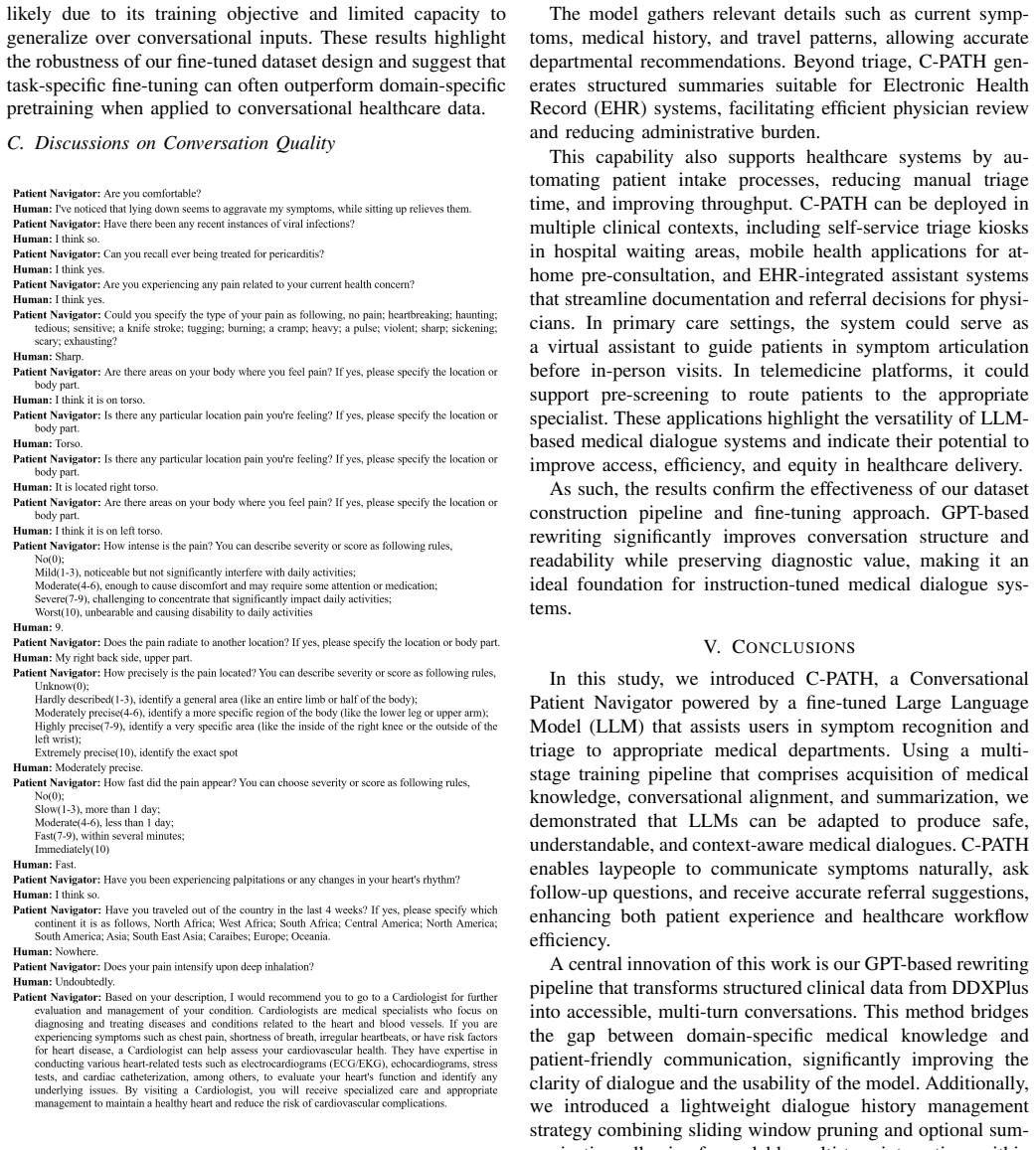
- [Section IV-C, Figure 8] The qualitative conversation example is presented as evidence that C-PATH 'engages naturally' and 'allows accurate departmental recommendations', but it does not establish that the transcript was generated by C-PATH, it is not scored, and no error analysis or comparison with other systems is provided. Because this is the only place where the actual system appears in the results, the paper's central claim rests on an anecdote rather than on data.
minor comments (7)
- [Section III-C2] The provenance of data_5k_artificial is stated inconsistently: the text first says the reformulated variants were compiled into data_5k_artificial using GPT-3.5 Turbo, then later calls this set 'manually rewritten questions and answers'. Please clarify whether this dataset is human-written, GPT-generated, or a mix, and describe the human involvement.
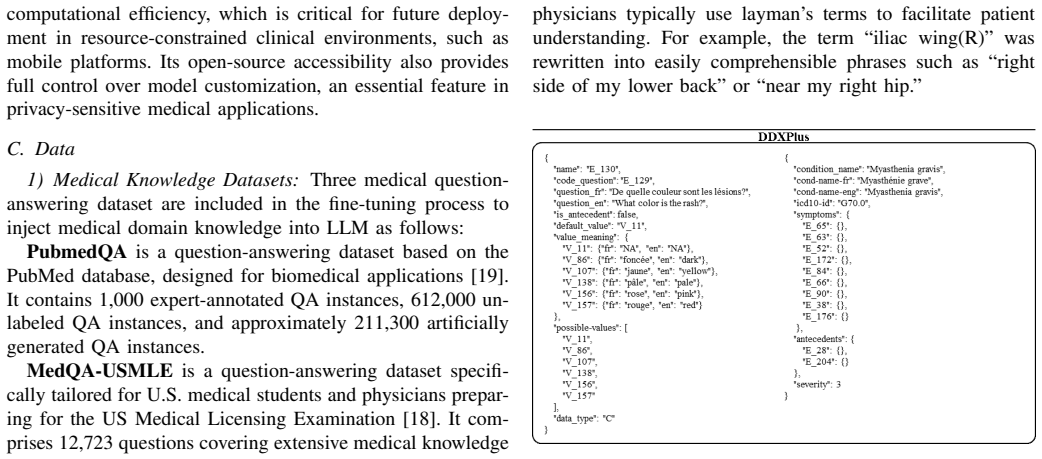
- [Section III-C2] DDXPlus is described as a dataset of patient cases with symptom hierarchies, not as a set of 'conversations'; the phrase '5000 conversations from the DDXPlus dataset' is inaccurate and should be rephrased as '5000 patient cases from which conversations were constructed'.
- [Table II] The hyperparameter table omits LoRA alpha, LoRA dropout, the learning-rate schedule, and warmup steps; including these is necessary for reproducibility of the fine-tuning pipeline.
- [Section IV-B] GPTScore is a stochastic metric, but no number of runs or variance measures are reported; the paper should state how many times the scoring was repeated and report standard deviations or confidence intervals.
- [Table IV] The PAT row values (0.10, 0.10, 0.00) are not interpretable without a statement of the scale and direction (higher = better or lower = better); the current presentation makes a perfect score of 0.00 look like a failure.
- [References] References [7] and [8] are the same work (LMFlow); one citation should be removed, and the other should cite the published NAACL 2024 version consistently throughout.
- [Section V] The conclusions repeat the unsupported claim that 'C-PATH outperforms baselines in both conversation quality and triage accuracy'; this sentence should be revised to state only what the experiments actually show, namely dataset-level classifier and GPTScore results.
Circularity Check
No circularity: the evaluation gap is an unsupported extrapolation (C-PATH never scored), not a definitional reduction.
full rationale
The paper's claimed derivation chain contains no step in which a prediction is equivalent to its input by construction. The core mismatch is that C-PATH itself is never scored: Table IV reports GPTScore on three dataset variants, and Table V reports BERT/ClinicalBERT classification accuracy on those datasets, while the abstract and conclusion attribute 'superior performance' to C-PATH. This is an unsupported extrapolation and an evaluation-validity gap, not a circularity: no fitted parameter of C-PATH is renamed as a prediction, and no dataset quality metric is defined in terms of the model's own outputs. The GPTScore evaluation of GPT-rewritten data could be biased because both generator and evaluator are GPT-based, but the paper does not define the evaluator in terms of the generator, and this concern is a confound rather than a construction. The self-citations ([10], [16], [41]) are related-work references and are not load-bearing for the central claim. Section V's stated plan for future real-world user studies confirms the absence of direct C-PATH evaluation, but that is a missing-support issue, not a circular one. Therefore no circular step can be exhibited, and the appropriate finding is no significant circularity.
Assumptions & free parameters
free parameters (4)
- learning rate =
2e-5
- block size =
128
- dialogue history window N =
unspecified
- LoRA rank =
8
assumptions (5)
- domain assumption DDXPlus condition labels map correctly to medical departments
- domain assumption GPT-3.5 rewriting preserves clinical information from DDXPlus
- domain assumption GPTScore provides a valid measure of conversation quality
- domain assumption Static dataset quality predicts interactive model performance
- domain assumption Fine-tuning on PubMedQA, MedQA-USMLE, and MedMCQA injects useful medical knowledge into LLaMA3
Cite this review
Pith. "Pith review of C-PATH: Conversational Patient Assistance and Triage in Healthcare System." pith.science (2026). https://pith.science/paper/IJ2RMJ6L
@misc{pith2026250606737,
  author       = {Pith},
  title        = {Pith review of: C-PATH: Conversational Patient Assistance and Triage in Healthcare System},
  year         = {2026},
  howpublished = {\url{https://pith.science/paper/IJ2RMJ6L}},
  note         = {Machine review of arXiv:2506.06737}
}
read the original abstract
Navigating healthcare systems can be complex and overwhelming, creating barriers for patients seeking timely and appropriate medical attention. In this paper, we introduce C-PATH (Conversational Patient Assistance and Triage in Healthcare), a novel conversational AI system powered by large language models (LLMs) designed to assist patients in recognizing symptoms and recommending appropriate medical departments through natural, multi-turn dialogues. C-PATH is fine-tuned on medical knowledge, dialogue data, and clinical summaries using a multi-stage pipeline built on the LLaMA3 architecture. A core contribution of this work is a GPT-based data augmentation framework that transforms structured clinical knowledge from DDXPlus into lay-person-friendly conversations, allowing alignment with patient communication norms. We also implement a scalable conversation history management strategy to ensure long-range coherence. Evaluation with GPTScore demonstrates strong performance across dimensions such as clarity, informativeness, and recommendation accuracy. Quantitative benchmarks show that C-PATH achieves superior performance in GPT-rewritten conversational datasets, significantly outperforming domain-specific baselines. C-PATH represents a step forward in the development of user-centric, accessible, and accurate AI tools for digital health assistance and triage.
Figures


Figures from the paper (4 more)


Reference graph
Works this paper leans on
-
[1]
Laure Abensur Vuillaume, Julien Turpinier, Lauriane Cipolat, Thomas Dumontier, Nicolas Peschanski, Yann Kieffer, Boris Barbat, Thomas Riquier, Vincent Dinot, and Joris Galland. Exploratory study: Evaluation of a symptom checker effectiveness for providing a diagnosis and evaluating the situation emergency compared to emergency physicians using simulated a...
work page 2023
-
[2]
Ayo Adedeji, Sarita Joshi, and Brendan Doohan. The sound of health- care: Improving medical transcription asr accuracy with large language models.arXiv preprint arXiv:2402.07658, 2024
arXiv 2024
-
[3]
An empirical study of clinical note generation from doctor-patient en- counters
Asma Ben Abacha, Wen-wai Yim, Yadan Fan, and Thomas Lin. An empirical study of clinical note generation from doctor-patient en- counters. InProceedings of the 17th Conference of the European Chapter of the Association for Computational Linguistics, pages 2291– 2302, Dubrovnik, Croatia, May 2023. Association for Computational Linguistics
work page 2023
-
[4]
a is b” fail to learn “b is a
Lukas Berglund, Meg Tong, Maximilian Kaufmann, Mikita Balesni, Asa Cooper Stickland, Tomasz Korbak, and Owain Evans. The reversal curse: LLMs trained on “a is b” fail to learn “b is a”. InThe Twelfth International Conference on Learning Representations, 2024
2024
-
[5]
Mika ¨el Chelli, Jules Descamps, Vincent Lavou ´e, Christophe Trojani, Michel Azar, Marcel Deckert, Jean-Luc Raynier, Gilles Clowez, Pascal Boileau, and Caroline Ruetsch-Chelli. Hallucination rates and reference accuracy of chatgpt and bard for systematic reviews: comparative analysis.Journal of medical Internet research, 26:e53164, 2024
work page 2024
-
[6]
The future landscape of large language models in medicine
Jan Clusmann, Fiona R Kolbinger, Hannah Sophie Muti, Zunamys I Car- rero, Jan-Niklas Eckardt, Narmin Ghaffari Laleh, Chiara Maria Lavinia L¨offler, Sophie-Caroline Schwarzkopf, Michaela Unger, Gregory P Veld- huizen, et al. The future landscape of large language models in medicine. Communications medicine, 3(1):141, 2023
work page 2023
-
[7]
Shizhe Diao, Rui Pan, Hanze Dong, Ka Shun Shum, Jipeng Zhang, Wei Xiong, and Tong Zhang. Lmflow: An extensible toolkit for finetuning and inference of large foundation models.arXiv preprint arXiv:2302.12420, 2023
work page Pith review arXiv 2023
-
[8]
LMFlow: An extensible toolkit for finetuning and inference of large foundation models
Shizhe Diao, Rui Pan, Hanze Dong, KaShun Shum, Jipeng Zhang, Wei Xiong, and Tong Zhang. LMFlow: An extensible toolkit for finetuning and inference of large foundation models. In Kai-Wei Chang, Annie Lee, and Nazneen Rajani, editors,Proceedings of the 2024 Conference of the North American Chapter of the Association for Computational Linguistics: Human Lang...
work page 2024
Show all 51 references
-
[9]
Navigating a path to equity in cancer care: the role of patient navigation
Niharika Dixit, Hope Rugo, and Nancy J Burke. Navigating a path to equity in cancer care: the role of patient navigation. InAmerican Society of Clinical Oncology Educational book. American Society of Clinical Oncology. Annual Meeting, volume 41, pages 1–8, 2021
2021
-
[10]
Dissecting medical referral mechanisms in health services: Role of physician professional networks.arXiv preprint arXiv:2312.02387, 2023
Regina de Brito Duarte, Qiwei Han, and Claudia Soares. Dissecting medical referral mechanisms in health services: Role of physician professional networks.arXiv preprint arXiv:2312.02387, 2023
2023 arXiv
-
[11]
Ddxplus: A new dataset for automatic medical diag- nosis.Advances in Neural Information Processing Systems, 35:31306– 31318, 2022
Arsene Fansi Tchango, Rishab Goel, Zhi Wen, Julien Martel, and Joumana Ghosn. Ddxplus: A new dataset for automatic medical diag- nosis.Advances in Neural Information Processing Systems, 35:31306– 31318, 2022
2022
-
[12]
Limitations of study on symptom checkers.JAMA internal medicine, 177(5):740–741, 2017
Hamish SF Fraser, Susan Clamp, and Carol J Wilson. Limitations of study on symptom checkers.JAMA internal medicine, 177(5):740–741, 2017
2017
-
[13]
GPTScore: Evaluate as you desire
Jinlan Fu, See-Kiong Ng, Zhengbao Jiang, and Pengfei Liu. GPTScore: Evaluate as you desire. In Kevin Duh, Helena Gomez, and Steven Bethard, editors,Proceedings of the 2024 Conference of the North American Chapter of the Association for Computational Linguistics: Human Language...
2024
-
[14]
Ai-generated clinical summaries require more than accuracy.JAMA, 331(8):637–638, 2024
Katherine E Goodman, H Yi Paul, and Daniel J Morgan. Ai-generated clinical summaries require more than accuracy.JAMA, 331(8):637–638, 2024
2024
-
[15]
Evaluating the diagnostic performance of symptom checkers: Clinical vignette study
Mohammad Hammoud, Shahd Douglas, Mohamad Darmach, Sara Alawneh, Swapnendu Sanyal, Youssef Kanbour, et al. Evaluating the diagnostic performance of symptom checkers: Clinical vignette study. JMIR AI, 3(1):e46875, 2024
2024
-
[16]
A hybrid recommender system for patient- doctor matchmaking in primary care
Qiwei Han, Mengxin Ji, Inigo Martinez De Rituerto De Troya, Manas Gaur, and Leid Zejnilovic. A hybrid recommender system for patient- doctor matchmaking in primary care. In2018 IEEE 5th International Conference on Data Science and Advanced Analytics (DSAA), pages 481–490. IEEE, 2018
2018
-
[17]
Survey of hallucination in natural language generation.ACM Computing Surveys, 55(12):1–38, 2023
Ziwei Ji, Nayeon Lee, Rita Frieske, Tiezheng Yu, Dan Su, Yan Xu, Etsuko Ishii, Ye Jin Bang, Andrea Madotto, and Pascale Fung. Survey of hallucination in natural language generation.ACM Computing Surveys, 55(12):1–38, 2023
2023
-
[18]
What disease does this patient have? a large-scale open domain question answering dataset from medical exams.Applied Sciences, 11(14):6421, 2021
Di Jin, Eileen Pan, Nassim Oufattole, Wei-Hung Weng, Hanyi Fang, and Peter Szolovits. What disease does this patient have? a large-scale open domain question answering dataset from medical exams.Applied Sciences, 11(14):6421, 2021
2021
-
[19]
Pubmedqa: A dataset for biomedical research question answering
Qiao Jin, Bhuwan Dhingra, Zhengping Liu, William Cohen, and Xinghua Lu. Pubmedqa: A dataset for biomedical research question answering. InProceedings of the 2019 Conference on Empirical Methods in Natural Language Processing and the 9th International Joint Conference on Natura...
2019
-
[20]
Artificial intelligence and clinical decision support: clinicians’ perspectives on trust, trustworthiness, and liability.Medical law review, 31(4):501–520, 2023
Caroline Jones, James Thornton, and Jeremy C Wyatt. Artificial intelligence and clinical decision support: clinicians’ perspectives on trust, trustworthiness, and liability.Medical law review, 31(4):501–520, 2023
2023
-
[21]
Medical hallucination in foundation models and their impact on healthcare.medRxiv, pages 2025–02, 2025
Yubin Kim, Hyewon Jeong, Shen Chen, Shuyue Stella Li, Mingyu Lu, Kumail Alhamoud, Jimin Mun, Cristina Grau, Minseok Jung, Rodrigo R Gameiro, et al. Medical hallucination in foundation models and their impact on healthcare.medRxiv, pages 2025–02, 2025
2025
-
[22]
Kristina M Kokorelias, Jessica E Shiers-Hanley, Jorge Rios, Amanda Knoepfli, and Sander L Hitzig. Factors influencing the implementation of patient navigation programs for adults with complex needs: a scoping re- view of the literature.Health Services Insights, 14:117863292110...
2021
-
[23]
Performance of chatgpt on usmle: potential for ai-assisted medical education using large language models.PLoS digital health, 2(2):e0000198, 2023
Tiffany H Kung, Morgan Cheatham, Arielle Medenilla, Czarina Sillos, Lorie De Leon, Camille Elepa ˜no, Maria Madriaga, Rimel Aggabao, Giezel Diaz-Candido, James Maningo, et al. Performance of chatgpt on usmle: potential for ai-assisted medical education using large language mod...
2023
-
[24]
Deep learning-based natural language processing for detecting medical symptoms and histories in emergency patient triage.The American Journal of Emergency Medicine, 77:29–38, 2024
Siryeol Lee, Juncheol Lee, Juntae Park, Jiwoo Park, Dohoon Kim, Joohyun Lee, and Jaehoon Oh. Deep learning-based natural language processing for detecting medical symptoms and histories in emergency patient triage.The American Journal of Emergency Medicine, 77:29–38, 2024
2024
-
[25]
Merging clinical knowledge into large language models for medical research and applications: A survey.arXiv preprint arXiv:2502.20988, 2025
Qiyuan Li, Haijiang Liu, Caicai Guo, Deyu Chen, Meng Wang, Feng Gao, and Jinguang Gu. Merging clinical knowledge into large language models for medical research and applications: A survey.arXiv preprint arXiv:2502.20988, 2025
2025 arXiv
-
[26]
Chatdoctor: A medical chat model fine-tuned on a large language model meta-ai (llama) using medical domain knowledge.Cureus, 15(6), 2023
Yunxiang Li, Zihan Li, Kai Zhang, Ruilong Dan, Steve Jiang, and You Zhang. Chatdoctor: A medical chat model fine-tuned on a large language model meta-ai (llama) using medical domain knowledge.Cureus, 15(6), 2023
2023
-
[27]
Patient experience and feedback after using an electronic health record–integrated covid-19 symptom checker: Survey study.JMIR Human Factors, 9(3):e40064, 2022
Andrew W Liu, Anobel Y Odisho, William Brown III, Ralph Gonzales, Aaron B Neinstein, and Timothy J Judson. Patient experience and feedback after using an electronic health record–integrated covid-19 symptom checker: Survey study.JMIR Human Factors, 9(3):e40064, 2022
2022
-
[28]
Advances and challenges in automated malaria diagnosis using digital microscopy imaging with artificial intelligence tools: A review.Frontiers in microbiology, 13:1006659, 2022
Carles Rubio Maturana, Allisson Dantas De Oliveira, Sergi Nadal, Besim Bilalli, Francesc Zarzuela Serrat, Mateu Espasa Soley, Elena Sulleiro Igual, Mercedes Bosch, Anna Veiga Lluch, Alberto Abell ´o, et al. Advances and challenges in automated malaria diagnosis using digital m...
2022
-
[29]
Patient navigators for people with chronic disease: a systematic review.PloS one, 13(2):e0191980, 2018
Kerry A McBrien, Noah Ivers, Lianne Barnieh, Jacob J Bailey, Diane L Lorenzetti, David Nicholas, Marcello Tonelli, Brenda Hemmelgarn, Richard Lewanczuk, Alun Edwards, et al. Patient navigators for people with chronic disease: a systematic review.PloS one, 13(2):e0191980, 2018
2018
-
[30]
Diagnostic accuracy of web-based covid-19 symptom checkers: com- parison study.Journal of medical Internet research, 22(10):e21299, 2020
Nicolas Munsch, Alistair Martin, Stefanie Gruarin, Jama Nateqi, Issel- mou Abdarahmane, Rafael Weingartner-Ortner, and Bernhard Knapp. Diagnostic accuracy of web-based covid-19 symptom checkers: com- parison study.Journal of medical Internet research, 22(10):e21299, 2020
2020
-
[31]
Large language models in medicine: the potentials and pitfalls: a narrative review.Annals of internal medicine, 177(2):210– 220, 2024
Jesutofunmi A Omiye, Haiwen Gui, Shawheen J Rezaei, James Zou, and Roxana Daneshjou. Large language models in medicine: the potentials and pitfalls: a narrative review.Annals of internal medicine, 177(2):210– 220, 2024
2024
-
[32]
Medmcqa: A large-scale multi-subject multi-choice dataset for medical domain question answering
Ankit Pal, Logesh Kumar Umapathi, and Malaikannan Sankarasubbu. Medmcqa: A large-scale multi-subject multi-choice dataset for medical domain question answering. In Gerardo Flores, George H Chen, Tom Pollard, Joyce C Ho, and Tristan Naumann, editors,Proceedings of the Conferenc...
2022
-
[33]
Patient navigators facilitating access to primary care: a scoping review.BMJ Open, 8(3):e019252, 2018
Annette Peart, Virginia Lewis, Ted Brown, and Grant Russell. Patient navigators facilitating access to primary care: a scoping review.BMJ Open, 8(3):e019252, 2018
2018
-
[34]
A study of generative large language model for medical research and healthcare.NPJ digital medicine, 6(1):210, 2023
Cheng Peng, Xi Yang, Aokun Chen, Kaleb E Smith, Nima PourNejatian, Anthony B Costa, Cheryl Martin, Mona G Flores, Ying Zhang, Tanja Magoc, et al. A study of generative large language model for medical research and healthcare.NPJ digital medicine, 6(1):210, 2023
2023
-
[35]
Assessment of a digital symptom checker tool’s accuracy in suggesting reproductive health conditions: clinical vignettes study.JMIR mHealth and uHealth, 11(1):e46718, 2023
Kimberly Peven, Aidan P Wickham, Octavia Wilks, Yusuf C Kaplan, Andrei Marhol, Saddif Ahmed, Ryan Bamford, Adam C Cunningham, Carley Prentice, Andr´as Meczner, et al. Assessment of a digital symptom checker tool’s accuracy in suggesting reproductive health conditions: clinical...
2023
-
[36]
Large language models encode clinical knowledge
Karan Singhal, Shekoofeh Azizi, Tao Tu, S Sara Mahdavi, Jason Wei, Hyung Won Chung, Nathan Scales, Ajay Tanwani, Heather Cole-Lewis, Stephen Pfohl, et al. Large language models encode clinical knowledge. Nature, 620(7972):172–180, 2023
2023
-
[37]
Trust by interface: How different user interfaces shape human trust in health information from large language models
Xin Sun, Yunjie Liu, Jan De Wit, Jos A Bosch, and Zhuying Li. Trust by interface: How different user interfaces shape human trust in health information from large language models. InExtended Abstracts of the CHI Conference on Human Factors in Computing Systems, pages 1–7, 2024
2024
-
[38]
Large language models in medicine.Nature medicine, 29(8):1930–1940, 2023
Arun James Thirunavukarasu, Darren Shu Jeng Ting, Kabilan Elango- van, Laura Gutierrez, Ting Fang Tan, and Daniel Shu Wei Ting. Large language models in medicine.Nature medicine, 29(8):1930–1940, 2023
1930
-
[39]
Opportunities and challenges for chatgpt and large language models in biomedicine and health.Briefings in Bioinformatics, 25(1):bbad493, 2024
Shubo Tian, Qiao Jin, Lana Yeganova, Po-Ting Lai, Qingqing Zhu, Xiuy- ing Chen, Yifan Yang, Qingyu Chen, Won Kim, Donald C Comeau, et al. Opportunities and challenges for chatgpt and large language models in biomedicine and health.Briefings in Bioinformatics, 25(1):bbad493, 2024
2024
-
[40]
Training in patient navigation: a review of the research literature.Health promotion practice, 17(3):373–381, 2016
Amy E Ustjanauskas, Marissa Bredice, Sumayah Nuhaily, Lisa Kath, and Kristen J Wells. Training in patient navigation: a review of the research literature.Health promotion practice, 17(3):373–381, 2016
2016
-
[41]
Extreme multilabel classification for specialist doctor recommendation with implicit feedback and limited patient metadata
Filipa Valdeira, Stevo Rackovi ´c, Valeria Danalachi, Qiwei Han, and Cl´audia Soares. Extreme multilabel classification for specialist doctor recommendation with implicit feedback and limited patient metadata. arXiv preprint arXiv:2308.11022, 2023
2023 arXiv
-
[42]
Adapted large language models can outperform medical experts in clinical text summarization.Nature medicine, 30(4):1134–1142, 2024
Dave Van Veen, Cara Van Uden, Louis Blankemeier, Jean-Benoit Delbrouck, Asad Aali, Christian Bluethgen, Anuj Pareek, Malgorzata Polacin, Eduardo Pontes Reis, Anna Seehofnerov ´a, et al. Adapted large language models can outperform medical experts in clinical text summarization...
2024
-
[43]
The diagnostic and triage accuracy of digital and online symptom checker tools: a systematic review.NPJ digital medicine, 5(1):118, 2022
William Wallace, Calvin Chan, Swathikan Chidambaram, Lydia Hanna, Fahad Mujtaba Iqbal, Amish Acharya, Pasha Normahani, Hutan Ashrafian, Sheraz R Markar, Viknesh Sounderajah, et al. The diagnostic and triage accuracy of digital and online symptom checker tools: a systematic rev...
2022
-
[44]
Haochun Wang, Sendong Zhao, Zewen Qiang, Zijian Li, Chi Liu, Nuwa Xi, Yanrui Du, Bing Qin, and Ting Liu. Knowledge-tuning large language models with structured medical knowledge bases for trustworthy response generation in chinese.ACM Transactions on Knowledge Discovery from D...
2025
-
[45]
Patient navigation: state of the art or is it science?Cancer, 113(8):1999– 2010, 2008
Kristen J Wells, Tracy A Battaglia, Donald J Dudley, Roland Garcia, Amanda Greene, Elizabeth Calhoun, Jeanne S Mandelblatt, Electra D Paskett, Peter C Raich, and Patient Navigation Research Program. Patient navigation: state of the art or is it science?Cancer, 113(8):1999– 2010, 2008
1999
-
[46]
Leveraging Large Language Models for Patient Engagement: The Power of Conversational AI in Digital Health
Bo Wen, Raquel Norel, Julia Liu, Thaddeus Stappenbeck, Farhana Zulkernine, and Huamin Chen. Leveraging Large Language Models for Patient Engagement: The Power of Conversational AI in Digital Health. In2024 IEEE International Conference on Digital Health (ICDH), pages 104–113. ...
2024
-
[47]
Aci-bench: a novel ambient clinical intelligence dataset for benchmarking automatic visit note generation.Scientific data, 10(1):586, 2023
Wen-wai Yim, Yujuan Fu, Asma Ben Abacha, Neal Snider, Thomas Lin, and Meliha Yetisgen. Aci-bench: a novel ambient clinical intelligence dataset for benchmarking automatic visit note generation.Scientific data, 10(1):586, 2023
2023
-
[48]
User experience of symptom checkers: a systematic review
Yue You, Renkai Ma, and Xinning Gui. User experience of symptom checkers: a systematic review. InAMIA Annual Symposium Proceedings, volume 2022, page 1198, 2023
2022
-
[49]
MedDialog: Large-scale medical dialogue datasets
Guangtao Zeng, Wenmian Yang, Zeqian Ju, Yue Yang, Sicheng Wang, Ruisi Zhang, Meng Zhou, Jiaqi Zeng, Xiangyu Dong, Ruoyu Zhang, Hongchao Fang, Penghui Zhu, Shu Chen, and Pengtao Xie. MedDialog: Large-scale medical dialogue datasets. In Bonnie Webber, Trevor Cohn, Yulan He, and ...
2020
-
[50]
Cor- relating global trends in covid-19 cases with online symptom checker self-assessments.PLoS One, 18(2):e0281709, 2023
Marc Zobel, Bernhard Knapp, Jama Nateqi, and Alistair Martin. Cor- relating global trends in covid-19 cases with online symptom checker self-assessments.PLoS One, 18(2):e0281709, 2023
2023
-
[2024]
Association for Computational Linguistics
Reviewed August 7, 2026 · model on record in the stance chip above.
Discussion (0). Sign in to comment.