REVIEW 4 major objections 4 minor 53 references
Recover and Identify: A Generative Dual Model for Cross-Resolution Person Re-Identification
T0 review · 4 major / 4 minor · reviewed 2026-08-14 · deepseek-v4-flash
Pith's one-line read One network wins cross-resolution person re-ID by 4-8%.
desk verdict Solid end-to-end cross-resolution re-ID with well-supported claims for seen scales; the unseen-resolution generalization is demonstrated only on synthetic bicubic degradation, so read that part with caution. read the letter →
The pith
A machine-rendered reading of the paper's core claim, the machinery that carries it, and where it could break.
The reading
What carries the argument
The load-bearing mechanism is the joint representation $v=[f,g]$, the concatenation of the resolution-invariant feature map $f$ from the shared encoder and the feature map $g$ from the encoder applied to the reconstructed HR image. Three loss terms act on this machinery in concert: a feature-level adversarial loss aligns $f$ across input resolutions, reconstruction and image-level adversarial losses make $g$ carry re-ID-relevant detail, and the classifier on $v$ back-propagates identity and triplet losses into both streams. This is how the paper obtains recovered images that are useful for recognition, not merely photorealistic.
What would settle it
Take a model trained exactly as in the paper and evaluate it on a real-world cross-resolution dataset where low-resolution queries were captured by a different camera with its own blur, noise, and compression rather than bicubic downsampling; if rank-1 accuracy falls to the level of non-resolution-invariant baselines, the resolution-invariance claim is falsified.
Extended reading notes
Core claim
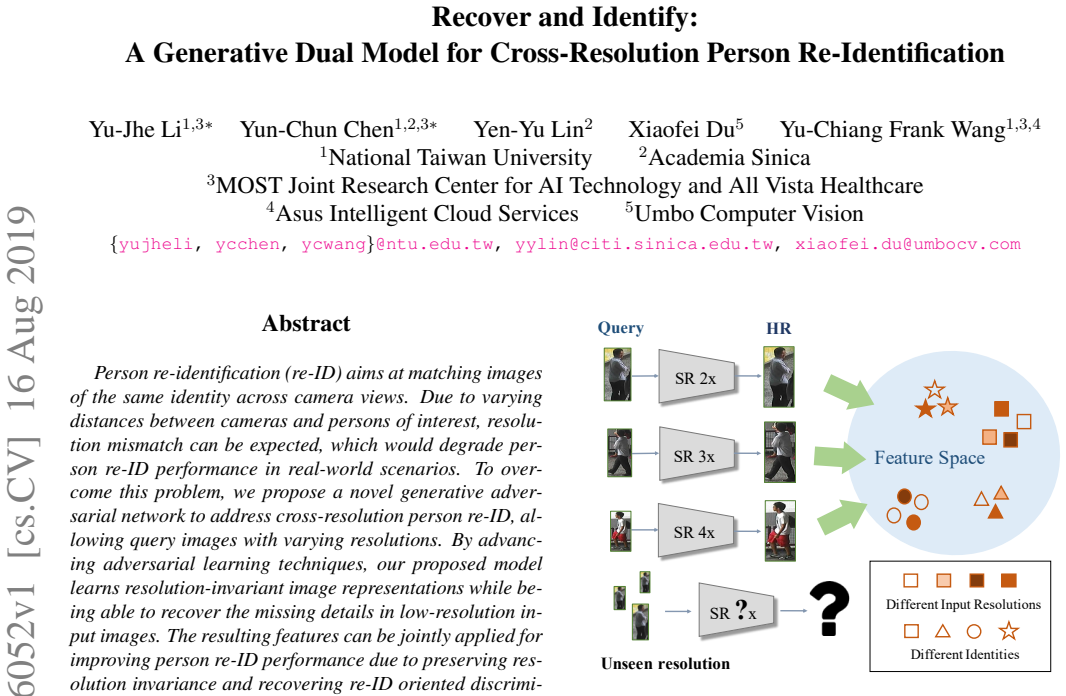
CAD-Net couples a cross-resolution GAN (CRGAN) with a cross-modal re-ID network. An encoder maps HR and LR images into the same feature space, and a feature-level discriminator tries to tell whether a given feature map came from a high- or low-resolution input; the encoder is trained to fool it, forcing the representation to be resolution-invariant. A decoder then reconstructs a high-resolution image from those features, and a second encoder extracts features from the recovered image. The two feature maps are concatenated into a joint representation and fed to a classifier trained with identity and triplet losses. The paper's central claim is that this joint design—resolution-invariant features plus re-ID-oriented HR recovery—is what lets a single model outperform specialized super-resolution-then-re-ID pipelines, including when the testing resolution is unseen.
Load-bearing premise
The claim depends on synthetic low-resolution images (made by shrinking a high-resolution image and enlarging it back) being a faithful stand-in for real low-resolution surveillance photos.
Editorial extensions
If this is right
- Cross-resolution person re-ID can be done with a single network, eliminating the need to estimate or guess the query downsampling factor before matching.
- The recovered HR images need not win on pixel-level metrics (PSNR, SSIM) to yield the best re-ID accuracy, suggesting that recognition-oriented recovery is a distinct objective from classic super-resolution.
- The model extrapolates to a downsampling factor of 8 after training only on factors 2, 3, and 4, implying the learned resolution invariance is not confined to the training scales.
- Ablations show that the feature-level adversarial loss and the reconstruction loss are each indispensable (removing either drops rank-1 by roughly 14–16 points), while the image-level adversarial loss contributes a smaller but real gain.
Reading between the lines
- If the synthetic-LR assumption holds across real camera degradation, this architecture style—an encoder with feature-space domain adversarial training plus a recognition-driven decoder—could transfer to other cross-resolution recognition tasks such as vehicle re-ID or forensic face matching.
- The paper's evidence that LPIPS aligns with re-ID performance better than PSNR/SSIM suggests a testable extension: replacing the $\ell^1$ reconstruction loss with a perceptual or identity-oriented loss could further improve both perceived image quality and rank-1 accuracy.
- Real surveillance queries will include camera-specific blur, noise, and compression that bicubic downsampling does not replicate; one can test the method's practical ceiling by fine-tuning the resolution discriminator on real LR query streams or augmenting training with realistic degradation models.
Signed reviews
Editorial analysis
A structured set of objections, weighed in public.
Referee Report
Summary. The paper proposes CAD-Net, an end-to-end generative adversarial network for cross-resolution person re-identification. The architecture comprises a Cross-Resolution GAN (CRGAN) with a resolution-invariant encoder and a high-resolution decoder, plus a Cross-Modal Re-ID network that concatenates the resolution-invariant feature with a feature extracted from the recovered HR image. The total loss combines identity, triplet, feature-level adversarial, reconstruction, and image-level adversarial terms. The authors evaluate on five datasets, including four synthetic MLR benchmarks and the real CAVIAR set, reporting rank-1 gains over SING, CSR-GAN, CamStyle, and FD-GAN, and they provide ablations and t-SNE visualizations.
Significance. If the central empirical claim holds, the paper makes a useful practical contribution: a single model that can match LR queries of varied or unseen scales to HR galleries without pre-selecting a super-resolution factor. The strengths of the paper are its breadth of evaluation (five datasets, six competing methods), the ablations showing that each loss term contributes, the quantitative HR-recovery metrics (SSIM, PSNR, LPIPS), and the visualization of resolution-invariant features. The 'unseen resolution' generalization claim, however, is only demonstrated for one unseen scale of the same synthetic degradation family, and the small real-world test does not provide statistical confidence, so the result is plausible but not fully established.
major comments (4)
- [Section 3.1, Section 4.4, Section 4.5] The load-bearing premise is that synthetic LR images, created by bicubic downsampling followed by bilinear upsampling, faithfully represent real low-resolution surveillance queries. The four synthetic MLR benchmarks and the r=8 unseen-resolution experiment all use this same degradation operator, so the claim in the abstract that the model handles 'unseen resolutions' is supported only for an unseen scale factor, not for unseen degradation types such as sensor blur, noise, or compression. The only native-resolution test, CAVIAR, has 50 identities after filtering and is split once, so it does not provide strong evidence of transfer to real surveillance degradation. Please add robustness experiments with different degradation types or explicitly limit the claim to unseen scale factors of the same degradation family.
- [Eq. (3)] Equation (3) contains the term E_{xH}[log(D_I(xH))] twice, and the third expectation should presumably be E_{xH}[log(1 - D_I(G(fH)))]. As written, the objective in the paper is not the standard adversarial loss, and the duplicated real-image term changes the gradient balance between the generator and discriminator. Please correct the equation and confirm that the implemented loss matches the corrected version.
- [Table 1, Section 4.4] The reported 4-8% rank-1 advantage over the best competitors is based on a single split and a single run on each dataset; no error bars, standard deviations, or significance tests are provided. CAVIAR is particularly small (50 identities after the SING filtering) and is split once, so the 8% gap there is not statistically secure. Please report means and standard deviations over multiple runs or bootstrap confidence intervals, and specify how many random training/test splits were used.
- [Table 1, Section 4.4] Comparisons with CamStyle and FD-GAN, which are methods for standard person re-ID, are made under a setting where they are trained on HR images only, while cross-resolution methods are trained on both HR and LR images. This asymmetry should be acknowledged when interpreting the claim that CAD-Net 'performs favorably against the state-of-the-art person re-ID approaches,' and the primary comparison should focus on SING and CSR-GAN, which are designed for the cross-resolution setting.
minor comments (4)
- [Section 1] The sentence 'This cannot not be easily applied to query images with varying or unseen resolutions' contains a doubled negation and should be corrected to 'This cannot be easily applied.'
- [Section 4.1] The resolution discriminator D_F is described only by citing Tsai et al. [41], and the HR decoder G is described by citing Miyato et al. [36]; since no code is released, the paper should provide an architecture table or a more detailed description for reproducibility.
- [Section 4.2] For CAVIAR, after stating that 22 people who appear only in the closer camera are discarded, the paper should explicitly state the final number of identities (50) and the number of images used in the training and test splits for clarity.
- [Table 3] The ablation study is reported only on MLR-CUHK03; the authors should state whether the conclusions about the importance of each loss term are expected to transfer to the other four datasets.
Circularity Check
No significant circularity: CAD-Net's results are benchmarked externally and no prediction reduces to a fitted input or self-citation chain.
full rationale
The paper's central claim, that CAD-Net outperforms state-of-the-art cross-resolution person re-ID and handles unseen resolutions, is supported by external benchmarks (MLR-CUHK03, MLR-VIPeR, CAVIAR, MLR-Market-1501, MLR-DukeMTMC-reID) compared against published baselines, not by a quantity fitted to those baselines. Hyperparameters are fixed in advance in Section 4.1 (e.g., lambda_DF_adv = lambda_rec = lambda_DI_adv = 1, margin phi = 2), and the r = 8 'unseen' resolution test in Section 4.5 uses no training images at that rate, so the headline result is not forced by construction. The only self-citation with author overlap is RAIN [6], mentioned in Related Work ('Similar to RAIN [6], our method also performs feature distribution alignment between HR and LR images'), but the paper explicitly distinguishes its end-to-end HR recovery and does not use RAIN to define its loss functions, architecture, or evaluation metrics. The synthetic LR generation in Sections 3.1 and 4.4 uses the same bicubic downsampling plus bilinear resizing operator as the external prior work SING [22]; this limits external validity for real surveillance degradation, but that is a generalization-risk concern rather than a circularity, because the reported numbers are not equivalent to the input assumptions by any equation in the paper. No equation defines a predicted quantity in terms of the benchmark outputs it is compared against.
Assumptions & free parameters
free parameters (4)
- Loss weights and triplet margin =
lambda_D^F_adv=1, lambda_rec=1, lambda_D^I_adv=1, phi=2
- Training downsampling rates =
{2,3,4}
- Input image size =
256x128x3
- Optimizer and training hyperparameters =
SGD lr 1e-3 (E,G,F,C) and 1e-4 (D_F,D_I), momentum 0.9, weight decay 5e-4, batch size 32
assumptions (4)
- domain assumption Bicubic downsampling followed by bilinear upsampling of HR images produces LR images representative of real surveillance low-resolution captures.
- domain assumption A single encoder E can map images across resolutions into a shared feature space while preserving identity information, and adversarial alignment to remove resolution information will not remove identity information.
- domain assumption The HR encoder F and classifier C trained on recovered HR images transfer to real HR gallery images captured by different cameras.
- domain assumption LPIPS with ImageNet-pretrained AlexNet is an appropriate perceptual metric for recovered HR image quality.
Cite this review
Pith. "Pith review of Recover and Identify: A Generative Dual Model for Cross-Resolution Person Re-Identification." pith.science (2026). https://pith.science/paper/IJ4JYFV6
@misc{pith2026190806052,
  author       = {Pith},
  title        = {Pith review of: Recover and Identify: A Generative Dual Model for Cross-Resolution Person Re-Identification},
  year         = {2026},
  howpublished = {\url{https://pith.science/paper/IJ4JYFV6}},
  note         = {Machine review of arXiv:1908.06052}
}
read the original abstract
Person re-identification (re-ID) aims at matching images of the same identity across camera views. Due to varying distances between cameras and persons of interest, resolution mismatch can be expected, which would degrade person re-ID performance in real-world scenarios. To overcome this problem, we propose a novel generative adversarial network to address cross-resolution person re-ID, allowing query images with varying resolutions. By advancing adversarial learning techniques, our proposed model learns resolution-invariant image representations while being able to recover the missing details in low-resolution input images. The resulting features can be jointly applied for improving person re-ID performance due to preserving resolution invariance and recovering re-ID oriented discriminative details. Our experiments on five benchmark datasets confirm the effectiveness of our approach and its superiority over the state-of-the-art methods, especially when the input resolutions are unseen during training.
Figures


Figures from the paper (1 more)

Reference graph
Works this paper leans on
-
[1]
People-tracking-by-detection and people-detection-by- tracking
Mykhaylo Andriluka, Stefan Roth, and Bernt Schiele. People-tracking-by-detection and people-detection-by- tracking. In CVPR, 2008
work page 2008
-
[2]
Multi-level factorisation net for person re-identification
Xiaobin Chang, Timothy M Hospedales, and Tao Xiang. Multi-level factorisation net for person re-identification. In CVPR, 2018
work page 2018
-
[3]
Group consistent similarity learning via deep crf for person re-identification
Dapeng Chen, Dan Xu, Hongsheng Li, Nicu Sebe, and Xi- aogang Wang. Group consistent similarity learning via deep crf for person re-identification. In CVPR, 2018
work page 2018
-
[4]
Saliency aware: Weakly supervised object localization
Yun-Chun Chen and Winston H Hsu. Saliency aware: Weakly supervised object localization. In ICASSP, 2019
work page 2019
-
[5]
Deep semantic matching with foreground detection and cycle-consistency
Yun-Chun Chen, Po-Hsiang Huang, Li-Yu Yu, Jia-Bin Huang, Ming-Hsuan Yang, and Yen-Yu Lin. Deep semantic matching with foreground detection and cycle-consistency. In ACCV, 2018
work page 2018
-
[6]
Learning resolution-invariant deep rep- resentations for person re-identification
Yun-Chun Chen, Yu-Jhe Li, Xiaofei Du, and Yu- Chiang Frank Wang. Learning resolution-invariant deep rep- resentations for person re-identification. In AAAI, 2019
work page 2019
-
[7]
Deep learning for malicious flow detection
Yun-Chun Chen, Yu-Jhe Li, Aragorn Tseng, and Tsungnan Lin. Deep learning for malicious flow detection. In PIMRC, 2017
work page 2017
-
[8]
Crdoco: Pixel-level domain transfer with cross- domain consistency
Yun-Chun Chen, Yen-Yu Lin, Ming-Hsuan Yang, and Jia- Bin Huang. Crdoco: Pixel-level domain transfer with cross- domain consistency. In CVPR, 2019
work page 2019
Show all 53 references
-
[9]
Show, match and segment: Joint learning of semantic matching and object co-segmentation.arXiv, 2019
Yun-Chun Chen, Yen-Yu Lin, Ming-Hsuan Yang, and Jia- Bin Huang. Show, match and segment: Joint learning of semantic matching and object co-segmentation.arXiv, 2019
2019
-
[10]
Person re-identification by multi-channel parts-based cnn with improved triplet loss function
De Cheng, Yihong Gong, Sanping Zhou, Jinjun Wang, and Nanning Zheng. Person re-identification by multi-channel parts-based cnn with improved triplet loss function. In CVPR, 2016
2016
-
[11]
D. S. Cheng, M. Cristani, M. Stoppa, L. Bazzani, and V . Murino. Custom pictorial structures for re-identification. In BMVC, 2011
2011
-
[12]
Pixel recursive super resolution
Ryan Dahl, Mohammad Norouzi, and Jonathon Shlens. Pixel recursive super resolution. In ICCV, 2017
2017
-
[13]
Image-image domain adaptation with preserved self-similarity and domain-dissimilarity for person reidentification
Weijian Deng, Liang Zheng, Qixiang Ye, Guoliang Kang, Yi Yang, and Jianbin Jiao. Image-image domain adaptation with preserved self-similarity and domain-dissimilarity for person reidentification. In CVPR, 2018
2018
-
[14]
Image super-resolution using deep convolutional net- works
Chao Dong, Chen Change Loy, Kaiming He, and Xiaoou Tang. Image super-resolution using deep convolutional net- works. TPAMI, 2016
2016
-
[15]
Fd-gan: Pose-guided feature distilling gan for robust person re-identification
Yixiao Ge, Zhuowan Li, Haiyu Zhao, Guojun Yin, Shuai Yi, Xiaogang Wang, and Hongsheng Li. Fd-gan: Pose-guided feature distilling gan for robust person re-identification. In NeurIPS, 2018
2018
-
[16]
Generative adversarial nets
Ian Goodfellow, Jean Pouget-Abadie, Mehdi Mirza, Bing Xu, David Warde-Farley, Sherjil Ozair, Aaron Courville, and Yoshua Bengio. Generative adversarial nets. In NeurIPS, 2014
2014
-
[17]
Viewpoint invariant pedestrian recognition with an ensemble of localized features
Douglas Gray and Hai Tao. Viewpoint invariant pedestrian recognition with an ensemble of localized features. InECCV, 2008
2008
-
[18]
Deep residual learning for image recognition
Kaiming He, Xiangyu Zhang, Shaoqing Ren, and Jian Sun. Deep residual learning for image recognition. In CVPR, 2016
2016
-
[19]
In de- fense of the triplet loss for person re-identification
Alexander Hermans, Lucas Beyer, and Bastian Leibe. In de- fense of the triplet loss for person re-identification. arXiv, 2017
2017
-
[20]
Cycada: Cycle-consistent adversarial domain adapta- tion
Judy Hoffman, Eric Tzeng, Taesung Park, Jun-Yan Zhu, Phillip Isola, Kate Saenko, Alexei A Efros, and Trevor Dar- rell. Cycada: Cycle-consistent adversarial domain adapta- tion. In ICML, 2018
2018
-
[21]
Multimodal unsupervised image-to-image translation
Xun Huang, Ming-Yu Liu, Serge Belongie, and Jan Kautz. Multimodal unsupervised image-to-image translation. In ECCV, 2018
2018
-
[22]
Deep low-resolution person re- identification
Jiening Jiao, Wei-Shi Zheng, Ancong Wu, Xiatian Zhu, and Shaogang Gong. Deep low-resolution person re- identification. In AAAI, 2018
2018
-
[23]
Super- resolution person re-identification with semi-coupled low- rank discriminant dictionary learning
Xiao-Yuan Jing, Xiaoke Zhu, Fei Wu, Xinge You, Qing- long Liu, Dong Yue, Ruimin Hu, and Baowen Xu. Super- resolution person re-identification with semi-coupled low- rank discriminant dictionary learning. In CVPR, 2015
2015
-
[24]
Human semantic parsing for person re-identification
Mahdi M Kalayeh, Emrah Basaran, Muhittin G ¨okmen, Mustafa E Kamasak, and Mubarak Shah. Human semantic parsing for person re-identification. In CVPR, 2018
2018
-
[25]
Person re- identification for real-world surveillance systems
Furqan M Khan and Franc ¸ois Br ´emond. Person re- identification for real-world surveillance systems. arXiv, 2016
2016
-
[26]
Accurate image super-resolution using very deep convolutional net- works
Jiwon Kim, Jung Kwon Lee, and Kyoung Mu Lee. Accurate image super-resolution using very deep convolutional net- works. In CVPR, 2016
2016
-
[27]
Imagenet classification with deep convolutional neural net- works
Alex Krizhevsky, Ilya Sutskever, and Geoffrey E Hinton. Imagenet classification with deep convolutional neural net- works. In NeurIPS, 2012
2012
-
[28]
Photo- realistic single image super-resolution using a generative ad- versarial network
Christian Ledig, Lucas Theis, Ferenc Husz´ar, Jose Caballero, Andrew Cunningham, Alejandro Acosta, Andrew P Aitken, Alykhan Tejani, Johannes Totz, Zehan Wang, et al. Photo- realistic single image super-resolution using a generative ad- versarial network. In CVPR, 2017
2017
-
[29]
Deep- reid: Deep filter pairing neural network for person re- identification
Wei Li, Rui Zhao, Tong Xiao, and Xiaogang Wang. Deep- reid: Deep filter pairing neural network for person re- identification. In CVPR, 2014
2014
-
[30]
Harmonious at- tention network for person re-identification
Wei Li, Xiatian Zhu, and Shaogang Gong. Harmonious at- tention network for person re-identification. In CVPR, 2018
2018
-
[31]
Multi-scale learning for low-resolution per- son re-identification
Xiang Li, Wei-Shi Zheng, Xiaojuan Wang, Tao Xiang, and Shaogang Gong. Multi-scale learning for low-resolution per- son re-identification. In ICCV, 2015
2015
-
[32]
Per- son re-identification by local maximal occurrence represen- tation and metric learning
Shengcai Liao, Yang Hu, Xiangyu Zhu, and Stan Z Li. Per- son re-identification by local maximal occurrence represen- tation and metric learning. In CVPR, 2015
2015
-
[33]
Learning volumetric segmentation for lung tumor
Jhih-Yuan Lin, Min-Sheng Wu, Yu-Cheng Chang, Yun-Chun Chen, Chao-Te Chou, Chun-Ting Wu, and Winston H Hsu. Learning volumetric segmentation for lung tumor. IEEE ICIP VIP Cup Tech. Report, 2018
2018
-
[34]
Improving person re-identification by attribute and identity learning
Yutian Lin, Liang Zheng, Zhedong Zheng, Yu Wu, and Yi Yang. Improving person re-identification by attribute and identity learning. arXiv, 2017
2017
-
[35]
Pose transferrable person re- identification
Jinxian Liu, Bingbing Ni, Yichao Yan, Peng Zhou, Shuo Cheng, and Jianguo Hu. Pose transferrable person re- identification. In CVPR, 2018
2018
-
[36]
cgans with projection discriminator
Takeru Miyato and Masanori Koyama. cgans with projection discriminator. In ICLR, 2018
2018
-
[37]
Deep group-shuffling random walk for person re-identification
Yantao Shen, Hongsheng Li, Tong Xiao, Shuai Yi, Dapeng Chen, and Xiaogang Wang. Deep group-shuffling random walk for person re-identification. In CVPR, 2018
2018
-
[38]
Person re-identification with deep similarity-guided graph neural network
Yantao Shen, Hongsheng Li, Shuai Yi, Dapeng Chen, and Xiaogang Wang. Person re-identification with deep similarity-guided graph neural network. In ECCV, 2018
2018
-
[39]
Dual attention matching network for context-aware feature sequence based person re-identification
Jianlou Si, Honggang Zhang, Chun-Guang Li, Jason Kuen, Xiangfei Kong, Alex C Kot, and Gang Wang. Dual attention matching network for context-aware feature sequence based person re-identification. In CVPR, 2018
2018
-
[40]
Mask-guided contrastive attention model for person re-identification
Chunfeng Song, Yan Huang, Wanli Ouyang, and Liang Wang. Mask-guided contrastive attention model for person re-identification. In CVPR, 2018
2018
-
[41]
Learning to adapt structured output space for semantic seg- mentation
Yi-Hsuan Tsai, Wei-Chih Hung, Samuel Schulter, Ki- hyuk Sohn, Ming-Hsuan Yang, and Manmohan Chandraker. Learning to adapt structured output space for semantic seg- mentation. In CVPR, 2018
2018
-
[42]
Peo- ple reidentification in surveillance and forensics: A survey
Roberto Vezzani, Davide Baltieri, and Rita Cucchiara. Peo- ple reidentification in surveillance and forensics: A survey. ACM Computing Surveys (CSUR), 2013
2013
-
[43]
Scale-adaptive low-resolution person re- identification via learning a discriminating surface
Zheng Wang, Ruimin Hu, Yi Yu, Junjun Jiang, Chao Liang, and Jinqiao Wang. Scale-adaptive low-resolution person re- identification via learning a discriminating surface. InIJCAI, 2016
2016
-
[44]
Cascaded sr-gan for scale-adaptive low resolution per- son re-identification
Zheng Wang, Mang Ye, Fan Yang, Xiang Bai, and Shin’ichi Satoh. Cascaded sr-gan for scale-adaptive low resolution per- son re-identification. In IJCAI, 2018
2018
-
[45]
Person transfer gan to bridge domain gap for person re- identification
Longhui Wei, Shiliang Zhang, Wen Gao, and Qi Tian. Person transfer gan to bridge domain gap for person re- identification. In CVPR, 2018
2018
-
[46]
Hallucinating very low-resolution unaligned and noisy face images by transformative discrimi- native autoencoders
Xin Yu and Fatih Porikli. Hallucinating very low-resolution unaligned and noisy face images by transformative discrimi- native autoencoders. In CVPR, 2017
2017
-
[47]
The unreasonable effectiveness of deep features as a perceptual metric
Richard Zhang, Alexei A Efros, Eli Shechtman, and Oliver Wang. The unreasonable effectiveness of deep features as a perceptual metric. In CVPR, 2018
2018
-
[48]
Scalable person re-identification: A benchmark
Liang Zheng, Liyue Shen, Lu Tian, Shengjin Wang, Jing- dong Wang, and Qi Tian. Scalable person re-identification: A benchmark. In ICCV, 2015
2015
-
[49]
Person re-identification: Past, present and future
Liang Zheng, Yi Yang, and Alexander G Hauptmann. Person re-identification: Past, present and future. arXiv, 2016
2016
-
[50]
Unlabeled sam- ples generated by gan improve the person re-identification baseline in vitro
Zhedong Zheng, Liang Zheng, and Yi Yang. Unlabeled sam- ples generated by gan improve the person re-identification baseline in vitro. In ICCV, 2017
2017
-
[51]
Camera style adaptation for person re- identification
Zhun Zhong, Liang Zheng, Zhedong Zheng, Shaozi Li, and Yi Yang. Camera style adaptation for person re- identification. In CVPR, 2018
2018
-
[52]
Unpaired image-to-image translation using cycle- consistent adversarial networks
Jun-Yan Zhu, Taesung Park, Phillip Isola, and Alexei A Efros. Unpaired image-to-image translation using cycle- consistent adversarial networks. In ICCV, 2017
2017
-
[53]
Deep cascaded bi-network for face hallucination
Shizhan Zhu, Sifei Liu, Chen Change Loy, and Xiaoou Tang. Deep cascaded bi-network for face hallucination. In ECCV, 2016
2016
Reviewed August 14, 2026 · model on record in the stance chip above.
Discussion (0). Continue with ORCID to comment.