REVIEW 3 major objections 6 minor 82 references
GeFL: Model-Agnostic Federated Learning with Generative Models
T0 review · 3 major / 6 minor · reviewed 2026-08-11 · deepseek-v4-flash
Pith's one-line read A federated generative model lets clients with different architectures train together without sharing data.
desk verdict Solid framework with thorough experiments, but the central claim about federated aggregation is not isolated from plain synthetic augmentation. read the letter →
The pith
A machine-rendered reading of the paper's core claim, the machinery that carries it, and where it could break.
The reading
What carries the argument
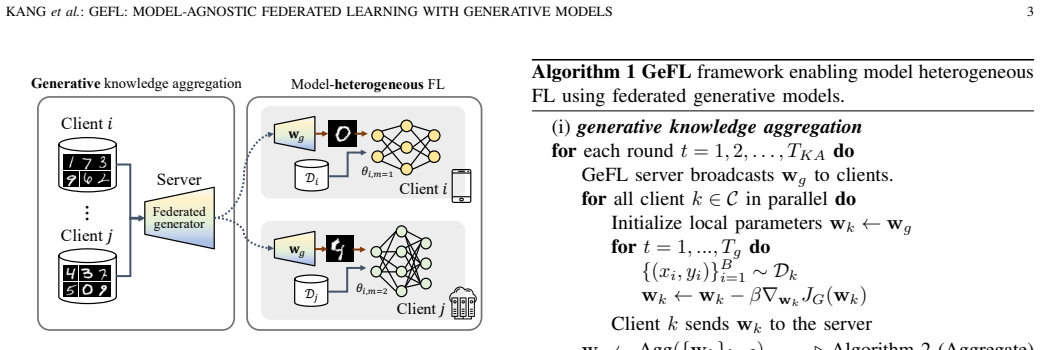
The load-bearing object is the federated generative model: a conditional GAN, VAE, or DDPM whose weights are trained by federated averaging of client updates and whose class-conditioned outputs serve as training data for every client's target network. In GeFL-F the object is the feature-generative model, a generative model trained on representations from a warmed-up common feature extractor, so the synthesized objects are low-dimensional features instead of images. This single shared generative object is what transfers knowledge across heterogeneous architectures without any client exposing raw data or another client's model parameters.
What would settle it
Train GeFL-F on a dataset with a deliberately weak or poorly warmed-up feature extractor and compare the mean-nearest-neighbor distance of reconstructed images with the image-level GeFL version; if the MND ratio rises above 1 or accuracy no longer beats grouped FedAvg, the privacy and scalability claims fail. For GeFL itself, run 100 clients with pathological label skew and check whether the federated generator collapses into low-diversity samples; collapse would falsify the claim that naive averaging of generator weights is sufficient.
Extended reading notes
Core claim
On the paper's own terms, the central discovery is that cross-client knowledge in model-heterogeneous federated learning can be carried by a generative model trained federatively. In GeFL, each client trains the same generator backbone on private local data; the server simply averages the generator parameters and returns the aggregate, and the resulting conditional generator produces class-labeled synthetic samples. Each client trains its target network on those synthetic samples and then refines on real local data, while target-network parameters are averaged only within groups sharing the same architecture. The paper states that 'the trained generative model effectively gathers global knowledge from every client, enabling the training of target networks despite the different model architectures among clients.' GeFL-F repeats the idea at the feature level: clients warm up a shared feature extractor, train a feature-generative model on its outputs, and then train heterogeneous classifier headers on the generated features, which the paper reports as more scalable, cheaper, and less prone to memorization. The model-agnosticism claim is thereby qualified, because GeFL-F clients must share the feature-extractor architecture.
Load-bearing premise
The framework depends on a shared generator, trained by simple averaging of client updates, producing synthetic samples that are at the same time high-quality, diverse, and private enough to train every client's differently built network; the feature-based variant adds the requirement that all clients use the same feature-extractor architecture.
Editorial extensions
If this is right
- Clients with entirely different CNN architectures can take part in one federated learning round and each improve its own model, removing the need for a shared global model or public data.
- GeFL-F maintains or improves accuracy as the client count grows from 10 to 100, while image-level GeFL degrades, making the feature-level variant the scalable option for large federations.
- Switching from raw-image generation to feature generation reduces total parameters, training and sampling cost, and the mean-nearest-neighbor distance ratio used to measure memorization (roughly 0.1 versus above 0.6 on MNIST), meaning the privacy risk from generative memorization is reduced.
- Synthetic samples from the federated generator can be mixed with local real data and with standard data-augmentation methods such as MixUp, CutMix, AugMix, and AutoAugment, with gains that appear additive.
- The accuracy advantage over grouped FedAvg widens as the amount of real data per client shrinks, so the method is most valuable in data-limited federated deployments.
Reading between the lines
- Beyond the paper: GeFL-F's privacy claim is measured by memorization of reconstructed images, so a stronger test would be a white-box gradient-based inversion attack on the shared feature extractor; if reconstructed images remain recognizable there, the privacy margin would shrink.
- Beyond the paper: the homogeneity-level sweep shows a peak at intermediate sharing (HL 1), which suggests the feature-extractor size is a tunable knob; one could test whether the optimal sharing level shifts with dataset difficulty or client count and use that as deployment guidance.
- Beyond the paper: the observation that five times more synthetic samples did not improve accuracy suggests a saturation effect, implying that synthetic diversity rather than synthetic volume drives the gain; varying generator guidance or truncation would test this directly.
- Beyond the paper: GeFL aggregates the generator by naive parameter averaging, so on highly skewed label distributions the 100-client regime may benefit from clustered generator aggregation or server-side model interpolation, neither of which the paper explores.
Editorial analysis
A structured set of objections, weighed in public.
Referee Report
Summary. The paper proposes GeFL and GeFL-F, two frameworks for model-heterogeneous federated learning. GeFL trains a conditional generative model in a federated manner on client data and uses its synthetic samples to augment the local training of heterogeneous target networks, without requiring shared model architectures or public data. GeFL-F extends this idea by training feature-level generative models on outputs of a shared feature extractor, claiming improved scalability, lower communication/computation cost, and reduced privacy risk. The empirical evaluation spans MNIST, Fashion-MNIST, CIFAR-10, SVHN, and CelebA with three generative model families (GAN, VAE, DDPM), reporting accuracy gains over several FL baselines, together with analyses of memorization, data scale, guidance score, and homogeneity level.
Significance. If the central claim holds, GeFL provides a practical method for knowledge sharing across clients with fully heterogeneous model architectures without public data, which is an important open problem in federated learning. The paper ships code, reports confidence intervals, and evaluates three generative families across four datasets, which is a solid empirical contribution. The paper is also honest in disclosing limitations of GeFL (memorization, scalability, resource cost) and motivates GeFL-F. However, the key attribution of the gains to federated aggregation of the generator is not experimentally isolated from the synthetic-augmentation effect, and the privacy claim for GeFL-F rests on a metric whose interpretation is questionable in the feature-reconstruction setting. These issues need to be addressed before the central claims can be accepted.
major comments (3)
- [Section III-B-b, Table II and Algorithm 1] The experimental design does not isolate federated generator aggregation from synthetic-data augmentation. In Table II, the 10-client FedAvg baseline is explicitly described as 'each client uses a unique model and trains independently without FL' (Section III-B-a), so GeFL's gains over FedAvg bundle the effect of augmentation with synthetic samples and the effect of federated aggregation of the generator. Table IV compares GeFL only against FedAvg with standard DA methods, and Table VII compares Syn vs. Real+Syn using the same federated FedDCGAN; neither includes a control where each client trains a generator only on its own local data and uses it for the same augmentation scheme. Since Algorithm 1 couples generator aggregation (lines 4-10) with target-network training on synthetic samples (lines 14-22), the central claim in Section III-A that the federated generator 'gathers global knowledge from every client' is not directly supported by the current experiments. Please add a control with locally trained generators (one per client, trained on each client's partition) and compare the resulting accuracy against GeFL; if the local-generator control matches GeFL's performance, the central contribution would need to be reframed as synthetic-augmentation rather than federated knowledge sharing.
- [Section IV-A and Algorithm 3] The abstract and introduction claim 'model-agnostic federated learning' for GeFL-F, but Algorithm 3 stage (i) requires a common feature extractor that is aggregated across all clients, and Section IV-A states that each target network consists of 'a common feature extractor and a unique heterogeneous header.' Thus GeFL-F supports heterogeneity only in the classification header, not in the full model architecture. The statement in the introduction that the framework enables 'FL with heterogeneous client models' is therefore overstated for GeFL-F. Please qualify the model-agnosticism claim for GeFL-F, and clarify in the discussion of Figure 7 that homogeneity level 0 (where no common feature extractor exists) falls outside GeFL-F's assumptions and corresponds to GeFL rather than GeFL-F.
- [Section IV-B-b, Table VI] The privacy claim for GeFL-F relies on MND ratios computed between original images and images reconstructed from generated features via model inversion, as described in Section IV-B-b and Figure 5. Because model inversion of low-dimensional features typically yields blurry or unrecognizable images, the low MND values for GeFL-F (0.101-0.120) may reflect reconstruction error rather than absence of memorization or membership-inference risk. Moreover, Eq. (1) defines MND between a training sample and sets of synthetic and validation images; applying this ratio to reconstructed images changes its meaning, and the paper does not specify how the sets S and V are constructed in the feature case. Please validate the privacy claim with a direct membership-inference attack on the feature generator or with MND computed in feature space, and state explicitly what privacy property (if any) the feature-level approach provides.
minor comments (6)
- [Section V-A] There is a typo in 'experminets' (should be 'experiments'), and the paper inconsistently uses both 'GeFL' and 'G EFL' throughout; please standardize the notation.
- [Table II] The FedALA row shows '80.03±0. 51.63±7.05', which appears to be a formatting or OCR error; the confidence interval entry is malformed and should be corrected.
- [Section III-B-a] The sentence 'the accuracy rapidly decreases thereafter due the significant heterogeneity' is missing the word 'to' after 'due'.
- [Equation (1)] The notation 'min x ∈ S' should be typeset as 'min_{x \in S}' with proper spacing, and the sets S and V should be defined immediately before the equation rather than only in the surrounding text.
- [Figure 7 caption] The caption 'GEFL-F shows the same trend across the homogeneity regardless of the number of clients' is grammatically unclear; consider rewording to 'GEFL-F exhibits the same trend across homogeneity levels for each number of clients'.
- [References] Reference [1] is given only as a URL; since it serves as the code repository, please format it as a proper code/repository entry (e.g., with an accessed date and repository name) rather than leaving it as a bare arXiv-style hyperlink.
Circularity Check
No significant circularity: the paper's claims are empirical and its generative-model mechanism is not derived from the accuracy numbers it predicts.
full rationale
This is an empirical systems paper rather than a derivation chain. The central mechanism—Algorithm 1's federated parameter averaging of the generator (w_g <- Agg({w_k})) followed by target-network training on synthetic samples—is hypothesized and tested against FedAvg, FedProx, FedALA, AvgKD, FedDF, and LG-FedAvg on MNIST, FMNIST, CIFAR10, and SVHN. The generator's parameters are not fitted to the accuracy numbers; the accuracy numbers are downstream measurements. The claim in Section III-A that 'the trained generative model effectively gathers global knowledge from every client' is a design assertion supported by experiments, not an equation that reduces to its own output. GeFL-F's stages in Algorithm 3 similarly separate warming up the common feature extractor, training a feature-generative model on the resulting features, and then training headers; no quantity in stage (iii) is defined in terms of the header accuracy it is said to predict. Self-citations appear (e.g., [3] NeFL in Section II-B, and code/repository [1]), but NeFL is cited only to distinguish submodel-based multi-model FL from the proposed approach; no uniqueness theorem or load-bearing result is imported from the authors' prior work. The missing local-only-generator control (a generator trained on one client's data) and the fact that the 10-client FedAvg baseline is 'each client uses a unique model and trains independently without FL' (Section III-B-a) are experimental gaps that could weaken the attribution of gains to federated aggregation, but they are not circular reductions: the paper's claims are empirical, and the absence of a control does not make the prediction equal to its input by construction. Overall circularity score 0.
Assumptions & free parameters
free parameters (4)
- Federated communication rounds (TKA, TTN, TFE) =
TKA=100 or 200, TTN=50 or 100, TFE=20, 50, 60, or 70
- Latent dimensions of generative models (dg, dd, l) =
(128,128) for MNIST/FMNIST, (256,64) for CIFAR10; latent size l=16 or 50
- DDPM guidance score w and number of time steps T =
w=0 and w=2; T=100 for MNIST/FMNIST and 400/500 for CIFAR10
- Data fraction used for training =
0.1 for MNIST and FMNIST, 0.5 for CIFAR10, 0.1 for SVHN
assumptions (4)
- domain assumption A single generative model trained by FedAvg-style parameter averaging can capture a coherent global data distribution from non-IID clients.
- domain assumption Synthetic samples from the federated generator improve heterogeneous target network training beyond local real data.
- domain assumption All clients in GeFL-F must share a common feature extractor architecture; only headers are heterogeneous.
- domain assumption The LPIPS-based MND ratio is a valid proxy for privacy leakage via memorization.
Cite this review
Pith. "Pith review of GeFL: Model-Agnostic Federated Learning with Generative Models." pith.science (2026). https://pith.science/paper/IJSMFV4P
@misc{pith2026241218460,
  author       = {Pith},
  title        = {Pith review of: GeFL: Model-Agnostic Federated Learning with Generative Models},
  year         = {2026},
  howpublished = {\url{https://pith.science/paper/IJSMFV4P}},
  note         = {Machine review of arXiv:2412.18460}
}
read the original abstract
Federated learning (FL) is a distributed training paradigm that enables collaborative learning across clients without sharing local data, thereby preserving privacy. However, the increasing scale and complexity of modern deep models often exceed the computational or memory capabilities of edge devices. Furthermore, clients may be constrained to use heterogeneous model architectures due to hardware variability (e.g., ASICs, FPGAs) or proprietary requirements that prevent the disclosure or modification of local model structures. These practical considerations motivate the need for model-heterogeneous FL, where clients participate using distinct model architectures. In this work, we propose Generative Model-Aided Federated Learning (GeFL), a framework that enables cross-client knowledge sharing via a generative model trained in a federated manner. This generative model captures global data semantics and facilitates local training without requiring model homogeneity across clients. While GeFL achieves strong performance, empirical analysis reveals limitations in scalability and potential privacy leakage due to generative sample memorization. To address these concerns, we propose GeFL-F, which utilizes feature-level generative modeling. This approach enhances scalability to large client populations and mitigates privacy risks. Extensive experiments across image classification tasks demonstrate that both GeFL and GeFL-F offer competitive performance in heterogeneous settings. Code is available at [1].
Figures


Figures from the paper (12 more)


Reference graph
Works this paper leans on
-
[1]
Kang and S
H. Kang and S. Cha. [Online]. Available: https://honggkang.github.io/gefl
-
[2]
McMahan, E
B. McMahan, E. Moore, D. Ramage, S. Hampson, and B. A. y. Arcas, ``Communication-efficient learning of deep networks from decentralized data,'' in International Conference on Artificial Intelligence and Statistics (AISTATS), 2017
2017
-
[3]
H. Kang, S. Cha, J. Shin, J. Lee, and J. Kang, `` NeFL : Nested federated learning for heterogeneous clients,'' arXiv preprint arXiv:2308.07761, 2023
arXiv 2023
-
[4]
A. Afonin and S. P. Karimireddy, ``Towards model agnostic federated learning using knowledge distillation,'' in International Conference on Learning Representations (ICLR), 2022
work page 2022
-
[5]
Gemini Team , ``Gemini: A family of highly capable multimodal models,'' arXiv preprint arXiv:2312.11805, 2023
arXiv 2023
-
[6]
T. Brown, B. Mann, N. Ryder, M. Subbiah, J. D. Kaplan, P. Dhariwal, A. Neelakantan, P. Shyam, G. Sastry, A. Askell, S. Agarwal, A. Herbert-Voss, G. Krueger, T. Henighan, R. Child, A. Ramesh, D. Ziegler, J. Wu, C. Winter, C. Hesse, M. Chen, E. Sigler, M. Litwin, S. Gray, B. Chess, J. Clark, C. Berner, S. McCandlish, A. Radford, I. Sutskever, and D. Amodei,...
work page 2020
-
[7]
P. Villalobos, J. Sevilla, T. Besiroglu, L. Heim, A. Ho, and M. Hobbhahn, ``Machine learning model sizes and the parameter gap,'' arXiv preprint arXiv:2207.02852, 2022
arXiv 2022
-
[8]
K. Pfeiffer, M. Rapp, R. Khalili, and J. Henkel, ``Federated learning for computationally constrained heterogeneous devices: A survey,'' ACM Computing Surveys, vol. 55, no. 14s, p. 1–27, Jul 2023
work page 2023
Show all 82 references
-
[9]
D. C. Nguyen, M. Ding, P. N. Pathirana, A. Seneviratne, J. Li, and H. Vincent Poor, ``Federated learning for internet of things: A comprehensive survey,'' IEEE Communications Surveys & Tutorials, vol. 23, no. 3, pp. 1622--1658, 2021
2021
-
[10]
T. Li, A. K. Sahu, M. Zaheer, M. Sanjabi, A. Talwalkar, and V. Smith, ``Federated optimization in heterogeneous networks,'' in Machine Learning and Systems (MLSys), 2020
2020
-
[11]
Horv\' a th, S
S. Horv\' a th, S. Laskaridis, M. Almeida, I. Leontiadis, S. Venieris, and N. Lane, `` FjORD : Fair and accurate federated learning under heterogeneous targets with ordered dropout,'' in Advances in Neural Information Processing Systems (NeurIPS), 2021
2021
-
[12]
M. Kim, S. Yu, S. Kim, and S.-M. Moon, ``Depth FL : Depthwise federated learning for heterogeneous clients,'' in International Conference on Learning Representations (ICLR), 2023
2023
-
[13]
T. Lin, L. Kong, S. U. Stich, and M. Jaggi, ``Ensemble distillation for robust model fusion in federated learning,'' in Advances in Neural Information Processing Systems (NeurIPS), 2020
2020
-
[14]
Huang, M
W. Huang, M. Ye, and B. Du, ``Learn from others and be yourself in heterogeneous federated learning,'' in IEEE/CVF Conference on Computer Vision and Pattern Recognition (CVPR), 2022
2022
-
[15]
Li and J
D. Li and J. Wang, ``Fedmd: Heterogenous federated learning via model distillation,'' arXiv preprint arXiv:1910.03581, 2019
1910 arXiv
-
[16]
L. Yi, G. Wang, X. Liu, Z. Shi, and H. Yu, `` FedGH : Heterogeneous federated learning with generalized global header,'' arXiv preprint arXiv:2303.13137, 2023
2023 arXiv
-
[17]
I. J. Goodfellow, J. Pouget-Abadie, M. Mirza, B. Xu, D. Warde-Farley, S. Ozair, A. Courville, and Y. Bengio, ``Generative adversarial networks,'' in Advances in Neural Information Processing Systems (NeurIPS), 2014
2014
-
[18]
D. P. Kingma and M. Welling, ``Auto-encoding variational bayes,'' arXiv preprint arXiv:1312.6114, 2022
2022 arXiv
-
[19]
Sohl-Dickstein, E
J. Sohl-Dickstein, E. Weiss, N. Maheswaranathan, and S. Ganguli, ``Deep unsupervised learning using nonequilibrium thermodynamics,'' in International Conference on Machine Learning (ICML), 2015
2015
-
[20]
S. P. Karimireddy, S. Kale, M. Mohri, S. Reddi, S. Stich, and A. T. Suresh, ``Scaffold: Stochastic controlled averaging for federated learning,'' in International Conference on Machine Learning (ICML), 2020
2020
-
[21]
Hinton, O
G. Hinton, O. Vinyals, and J. Dean, ``Distilling the knowledge in a neural network,'' arXiv preprint arXiv:1503.02531, 2015
2015 arXiv
-
[22]
H. Seo, J. Park, S. Oh, M. Bennis, and S.-L. Kim, ``Federated knowledge distillation,'' arXiv preprint arXiv:2011.02367, 2020
2011 arXiv
-
[23]
C. Wu, F. Wu, L. Lyu, Y. Huang, and X. Xie, ``Communication-efficient federated learning via knowledge distillation,'' Nature Communications, vol. 13, no. 1, Apr. 2022
2022
-
[24]
X. Li, B. Chen, and W. Lu, `` FedDKD : Federated learning with decentralized knowledge distillation,'' Applied Intelligence, vol. 53, no. 15, p. 18547–18563, Feb. 2023
2023
-
[25]
E. Diao, J. Ding, and V. Tarokh, ``Hetero FL : Computation and communication efficient federated learning for heterogeneous clients,'' in International Conference on Learning Representations (ICLR), 2021
2021
-
[26]
P. P. Liang, T. Liu, L. Ziyin, R. Salakhutdinov, and L.-P. Morency, ``Think locally, act globally: Federated learning with local and global representations,'' arXiv preprint arXiv:2001.01523, 2020
2001 arXiv
-
[27]
T. Shen, J. Zhang, X. Jia, F. Zhang, G. Huang, P. Zhou, K. Kuang, F. Wu, and C. Wu, ``Federated mutual learning,'' arXiv preprint arXiv:2006.16765, 2020
2006 arXiv
-
[28]
J. Wang, X. Yang, S. Cui, L. Che, L. Lyu, D. Xu, and F. Ma, ``Towards personalized federated learning via heterogeneous model reassembly,'' arXiv preprint arXiv:2308.08643, 2023
2023 arXiv
-
[29]
H. Wen, Y. Wu, J. Li, and H. Duan, ``Communication-efficient federated data augmentation on non-iid data,'' in IEEE/CVF Conference on Computer Vision and Pattern Recognition Workshops (CVPRW), 2022
2022
-
[30]
Jeong, S
E. Jeong, S. Oh, H. Kim, J. Park, M. Bennis, and S.-L. Kim, ``Communication-efficient on-device machine learning: Federated distillation and augmentation under non-iid private data,'' arxiv preprint arXiv:1811.11479, 2023
2023 arXiv
-
[31]
Y. Wu, Y. Kang, J. Luo, Y. He, and Q. Yang, `` FedCG : Leverage conditional gan for protecting privacy and maintaining competitive performance in federated learning,'' arXiv preprint arXiv:2111.08211, 2021
2021 arXiv
-
[32]
Rasouli, T
M. Rasouli, T. Sun, and R. Rajagopal, `` FedGAN : Federated generative adversarial networks for distributed data,'' arXiv preprint arXiv:2006.07228, 2020
2006 arXiv
-
[33]
Z. Zhu, J. Hong, and J. Zhou, ``Data-free knowledge distillation for heterogeneous federated learning,'' in International Conference on Machine Learning (ICML), 2021
2021
-
[34]
Zhang, L
L. Zhang, L. Shen, L. Ding, D. Tao, and L. Duan, ``Fine-tuning global model via data-free knowledge distillation for non-iid federated learning,'' in IEEE/CVF Conference on Computer Vision and Pattern Recognition (CVPR), 2022
2022
-
[35]
K. He, X. Zhang, S. Ren, and J. Sun, ``Deep residual learning for image recognition,'' in IEEE/CVF Conference on Computer Vision and Pattern Recognition (CVPR), 2016
2016
-
[36]
Tan and Q
M. Tan and Q. Le, `` EfficientNet : Rethinking model scaling for convolutional neural networks,'' in International Conference on Machine Learning (ICML), 2019
2019
-
[37]
A. G. Howard, M. Zhu, B. Chen, D. Kalenichenko, W. Wang, T. Weyand, M. Andreetto, and H. Adam, ``Mobilenets: Efficient convolutional neural networks for mobile vision applications,'' arXiv preprint arXiv:1704.04861, 2017
2017 arXiv
-
[38]
LeCun, L
Y. LeCun, L. Bottou, Y. Bengio, and P. Haffner, ``Gradient-based learning applied to document recognition,'' Proceedings of the IEEE, vol. 86, no. 11, pp. 2278--2324, 1998
1998
-
[39]
H. Xiao, K. Rasul, and R. Vollgraf, ``Fashion-mnist: a novel image dataset for benchmarking machine learning algorithms,'' arXiv preprint arXiv:1708.07747, 2017
2017 arXiv
-
[40]
Krizhevsky et al., ``Learning multiple layers of features from tiny images,'' Master's thesis, Department of Computer Science, University of Toronto, 2009
A. Krizhevsky et al., ``Learning multiple layers of features from tiny images,'' Master's thesis, Department of Computer Science, University of Toronto, 2009
2009
-
[41]
Zhang, Y
J. Zhang, Y. Hua, H. Wang, T. Song, Z. Xue, R. Ma, and H. Guan, ``Fed ALA : A daptive local aggregation for personalized federated learning,'' AAAI Conference on Artificial Intelligence (AAAI), 2023
2023
-
[42]
Radford, L
A. Radford, L. Metz, and S. Chintala, ``Unsupervised representation learning with deep convolutional generative adversarial networks,'' in International Conference on Learning Representations (ICLR), 2016
2016
-
[43]
Y. Pu, Z. Gan, R. Henao, X. Yuan, C. Li, A. Stevens, and L. Carin, ``Variational autoencoder for deep learning of images, labels and captions,'' in Advances in Neural Information Processing Systems (NeurIPS), 2016
2016
-
[44]
J. Ho, A. Jain, and P. Abbeel, ``Denoising diffusion probabilistic models,'' in Advances in Neural Information Processing Systems (NeurIPS), 2020
2020
-
[45]
Ho and T
J. Ho and T. Salimans, ``Classifier-free diffusion guidance,'' in NeurIPS 2021 Workshop on Deep Generative Models and Downstream Applications, 2021
2021
-
[46]
Heusel, H
M. Heusel, H. Ramsauer, T. Unterthiner, B. Nessler, and S. Hochreiter, ``Gans trained by a two time-scale update rule converge to a local nash equilibrium,'' in Advances in Neural Information Processing Systems (NeurIPS), 2017
2017
-
[47]
Ravuri and O
S. Ravuri and O. Vinyals, ``Classification accuracy score for conditional generative models,'' in Advances in Neural Information Processing Systems (NeurIPS), 2019
2019
-
[48]
Zhang, M
H. Zhang, M. Cisse, Y. N. Dauphin, and D. Lopez-Paz, ``mixup: Beyond empirical risk minimization,'' in International Conference on Learning Representations (ICLR), 2018
2018
-
[49]
S. Yun, D. Han, S. J. Oh, S. Chun, J. Choe, and Y. Yoo, ``Cutmix: Regularization strategy to train strong classifiers with localizable features,'' in IEEE/CVF Conference on Computer Vision and Pattern Recognition (CVPR), 2019
2019
-
[50]
Hendrycks, N
D. Hendrycks, N. Mu, E. D. Cubuk, B. Zoph, J. Gilmer, and B. Lakshminarayanan, ``Augmix: A simple data processing method to improve robustness and uncertainty,'' in International Conference on Learning Representations (ICLR), 2019
2019
-
[51]
E. D. Cubuk, B. Zoph, D. Mane, V. Vasudevan, and Q. V. Le, ``Autoaugment: Learning augmentation policies from data,'' arXiv preprint arXiv:1805.09501, 2018
2018 arXiv
-
[52]
M. D. Zeiler and R. Fergus, ``Visualizing and understanding convolutional networks,'' in European Conference on Computer Vision (ECCV), 2014
2014
-
[53]
Geiping, H
J. Geiping, H. Bauermeister, H. Dr \"o ge, and M. Moeller, ``Inverting gradients-how easy is it to break privacy in federated learning?'' Advances in Neural Information Processing Systems (NeurIPS), 2020
2020
-
[54]
van den Burg and C
G. van den Burg and C. Williams, ``On memorization in probabilistic deep generative models,'' in Advances in Neural Information Processing Systems (NeurIPS), 2021
2021
-
[55]
Somepalli, V
G. Somepalli, V. Singla, M. Goldblum, J. Geiping, and T. Goldstein, ``Diffusion art or digital forgery? investigating data replication in diffusion models,'' in IEEE/CVF Conference on Computer Vision and Pattern Recognition (CVPR), 2023
2023
-
[56]
Webster, J
R. Webster, J. Rabin, L. Simon, and F. Jurie, ``Detecting overfitting of deep generative networks via latent recovery,'' in IEEE/CVF Conference on Computer Vision and Pattern Recognition (CVPR), 2019
2019
-
[57]
X. Sun, N. Gazagnadou, V. Sharma, L. Lyu, H. Li, and L. Zheng, ``Privacy assessment on reconstructed images: Are existing evaluation metrics faithful to human perception?'' in Advances in Neural Information Processing Systems (NeurIPS), 2023
2023
-
[58]
Hilprecht, M
B. Hilprecht, M. H \"a rterich, and D. Bernau, `` Monte Carlo and reconstruction membership inference attacks against generative models,'' in Proc. on Privacy Enhancing Technologies, 2019, pp. 232--249
2019
-
[59]
Abadi, A
M. Abadi, A. Chu, I. Goodfellow, H. B. McMahan, I. Mironov, K. Talwar, and L. Zhang, ``Deep learning with differential privacy,'' in Proceedings of the 2016 ACM SIGSAC conference on computer and communications security, 2016, pp. 308--318
2016
-
[60]
L. Xie, K. Lin, S. Wang, F. Wang, and J. Zhou, ``Differentially private generative adversarial network,'' arXiv preprint arXiv:1802.06739, 2018
2018 arXiv
-
[61]
Zhang, P
R. Zhang, P. Isola, A. A. Efros, E. Shechtman, and O. Wang, ``The unreasonable effectiveness of deep features as a perceptual metric,'' in IEEE/CVF Conference on Computer Vision and Pattern Recognition (CVPR), 2018
2018
-
[62]
Y. Zhao, M. Li, L. Lai, N. Suda, D. Civin, and V. Chandra, ``Federated learning with non-iid data,'' arXiv preprint arXiv:1806.00582, 2018
2018 arXiv
-
[63]
Mahendran and A
A. Mahendran and A. Vedaldi, ``Understanding deep image representations by inverting them,'' in IEEE/CVF Conference on Computer Vision and Pattern Recognition (CVPR), 2015
2015
-
[64]
Dosovitskiy and T
A. Dosovitskiy and T. Brox, ``Inverting visual representations with convolutional networks,'' in IEEE/CVF Conference on Computer Vision and Pattern Recognition (CVPR), 2016
2016
-
[65]
Brock, J
A. Brock, J. Donahue, and K. Simonyan, ``Large scale GAN training for high fidelity natural image synthesis,'' arXiv preprint arXiv:1809.11096, 2018
2018 arXiv
-
[66]
L. A. Gatys, A. S. Ecker, and M. Bethge, ``Image style transfer using convolutional neural networks,'' in IEEE/CVF Conference on Computer Vision and Pattern Recognition (CVPR), 2016
2016
-
[67]
J. Jang, H. Ha, D. Jung, and S. Yoon, ``Fedclassavg: Local representation learning for personalized federated learning on heterogeneous neural networks,'' in Proceedings of the 51st International Conference on Parallel Processing, 2022, pp. 1--10
2022
-
[68]
J. Mori, I. Teranishi, and R. Furukawa, ``Continual horizontal federated learning for heterogeneous data,'' in 2022 International Joint Conference on Neural Networks (IJCNN), 2022, pp. 1--8
2022
-
[69]
Netzer, T
Y. Netzer, T. Wang, A. Coates, A. Bissacco, B. Wu, and A. Y. Ng, ``Reading digits in natural images with unsupervised feature learning,'' in NIPS Workshop on Deep Learning and Unsupervised Feature Learning, 2011
2011
-
[70]
Krizhevsky, V
A. Krizhevsky, V. Nair, and G. Hinton, `` CIFAR -10 ( Canadian Institute for Advanced Research ),'' http://www.cs.toronto.edu/ kriz/cifar.html
-
[71]
L. Fan, K. Chen, D. Krishnan, D. Katabi, P. Isola, and Y. Tian, ``Scaling laws of synthetic images for model training... for now,'' arXiv preprint arXiv:2312.04567, 2023
2023 arXiv
-
[72]
Y. Tian, L. Fan, P. Isola, H. Chang, and D. Krishnan, ``Stablerep: Synthetic images from text-to-image models make strong visual representation learners,'' in Advances in Neural Information Processing Systems (NeurIPS), 2023
2023
-
[73]
Azizi, S
S. Azizi, S. Kornblith, C. Saharia, M. Norouzi, and D. J. Fleet, ``Synthetic data from diffusion models improves imagenet classification,'' Transactions on Machine Learning Research, 2023
2023
-
[74]
Shmelkov, C
K. Shmelkov, C. Schmid, and K. Alahari, ``How good is my GAN ?'' in Proceedings of the European conference on computer vision (ECCV), 2018, pp. 213--229
2018
-
[75]
Yamaguchi, D
S. Yamaguchi, D. Chijiwa, S. Kanai, A. Kumagai, and H. Kashima, ``Regularizing neural networks with meta-learning generative models,'' in Thirty-seventh Conference on Neural Information Processing Systems, 2023
2023
-
[76]
J. Li, Y. Shao, K. Wei, M. Ding, C. Ma, L. Shi, Z. Han, and H. V. Poor, ``Blockchain assisted decentralized federated learning (BLADE-FL) : Performance analysis and resource allocation,'' IEEE Transactions on Parallel and Distributed Systems, vol. 33, no. 10, pp. 2401--2415, 2022
2022
-
[77]
``Pytorch models and pre-trained weights,'' 2025, https://pytorch.org/vision/stable/models.html [Accessed: (2025/5/10)]
2025
-
[78]
Ronneberger, P
O. Ronneberger, P. Fischer, and T. Brox, ``U-Net: Convolutional networks for biomedical image segmentation,'' in International Conference on on Medical Image Computing and Computer-Assisted Intervention, 2015
2015
-
[79]
Pearce, H
T. Pearce, H. H. Tan, M. Zeraatkar, and X. Zhao, [Online]. Available: https://github.com/TeaPearce/Conditional\_Diffusion\_MNIST
-
[80]
Ioffe and C
S. Ioffe and C. Szegedy, ``Batch normalization: accelerating deep network training by reducing internal covariate shift,'' in International Conference on Machine Learning (ICML), 2015
2015
-
[81]
A. F. Agarap, ``Deep learning using rectified linear units (relu),'' arXiv preprint arXiv:1803.08375, 2018
2018 arXiv
-
[82]
Meehan, K
C. Meehan, K. Chaudhuri, and S. Dasgupta, ``A non-parametric test to detect data-copying in generative models,'' in International Conference on Artificial Intelligence and Statistics (AISTATS), 2020
2020
Reviewed August 11, 2026 · model on record in the stance chip above.
Discussion (0). Continue with ORCID to comment.