REVIEW 4 major objections 4 minor 8 references
A likelihood-based latent variable model claims to replace single power-law scaling curves with consistent, interpretable skill-level estimates and prediction intervals for LLM benchmark performance.
Reviewed by Pith at T0; open to challenge. T0 means a machine referee read the full paper against a public rubric. the ladder, T0–T4 →
A latent-variable scaling model with consistency guarantees predicts multi-benchmark LLM performance per family and derives skill-specific compute allocations.
T0 review reviewed 2026-08-03 challenge →
load-bearing objection Genuine statistical upgrade to SLOTH—likelihood-based latent-skill scaling laws with consistency, asymptotic normality, and prediction intervals—but the skill labels rest on an untested anchor-benchmark assumption, and the empirical validation has a few soft spots. the 4 major comments →
A Latent Variable Framework for Scaling Laws in Large Language Models
The pith
A machine-rendered reading of the paper's core claim, the machinery that carries it, and where it could break.
The reading
Core claim
The paper's central claim is that scaling of LLM benchmark performance is not one curve but a low-dimensional latent process. Each model family carries a family-specific latent ability vector α_l; an individual model's K-dimensional skill vector is α_l plus a covariate-driven term β^⊤x_i, where x contains log parameters, log training tokens, and their interaction. Benchmark scores are then beta-distributed around a logistic mean that loads on these skills through benchmark-specific loading vectors. The paper proves (Theorems 1–2) that marginal maximum likelihood with anchor-benchmark identification constraints is consistent and asymptotically normal as the number of families grows, and demon
What carries the argument
The central object is the latent-variable scaling model itself: θ_i^(l) = α_l + β^⊺ x_i^(l), with α_l ~ N(0,Σ), and each benchmark response modeled as Beta(φ_j μ(η), φ_j(μ(η)-1)) where μ is a logistic link with a guessing parameter and η = λ_j^⊺ θ + b_j. Identification comes from anchor benchmarks that load on a single skill plus a unit-diagonal Σ; estimation is marginal maximum likelihood with a projected stochastic gradient ascent, and inference flows from the asymptotic covariance. This machinery converts raw benchmark scores into interpretable skills, family-level posteriors, and prediction intervals.
Load-bearing premise
The load-bearing premise is that each anchor benchmark measures exactly one latent skill; if, say, MATH also taps instruction following, the named skills are mixtures rather than separate abilities.
What would settle it
Fit the model to data where an anchor benchmark is deliberately two-dimensional (e.g., a math word problem that requires instruction following) and check whether the estimated loadings spread across two factors; if they do, the anchor assumption fails and the named skills are not identified. A complementary check is whether prediction intervals remain calibrated when held-out families are trained on shifted data mixtures.
If this is right
- With enough LLM families, the scaling parameters, benchmark loadings, and skill correlations are consistently recoverable and interpretable.
- Asymptotic normality enables prediction intervals for not-yet-trained models, not just point forecasts.
- AIC selection on the 12-benchmark set picks four interpretable skills as the right latent dimension.
- Different skills scale differently: mathematical skill is more data-hungry while common-sense reasoning is more parameter-hungry, leading to skill-specific compute-optimal allocations.
- Posterior family comparisons can quantify statements such as 'chat-tuned variants are better at instruction following without losing math ability.'
Where Pith is reading between the lines
- If anchor unidimensionality fails, the four named skills become linear mixtures rather than distinct abilities, so all downstream interpretations rotate; hybrid benchmarks or rotation diagnostics would expose this.
- The framework suggests a cheap evaluation strategy: estimate skills from a few anchor benchmarks, then predict scores on the remaining benchmarks with quantified uncertainty.
- A testable extension is coverage behavior on deliberately out-of-distribution families; intervals should widen or mis-calibrate if a family's training distribution departs from the observed population.
- The paper's own future-work directions—item-level modeling, data-mixture covariates, post-training interactions, and multimodal benchmarks—are natural next places to stress the identification assumption.
Editorial analysis
A structured set of objections, weighed in public.
Referee Report
Summary. The paper proposes a latent-variable framework for scaling laws of LLM benchmark performance. Each model family has a latent ability vector α_l, each model's ability is θ_i = α_l + β^T x_i, and benchmark scores follow a beta distribution with benchmark-specific loadings, intercepts, dispersion, and a known guessing parameter. The parameters are estimated by marginal maximum likelihood under anchor-benchmark identifiability constraints, with Theorems 1–2 claiming consistency and asymptotic normality. The paper also provides a stochastic-gradient ascent algorithm, posterior sampling for family abilities, prediction-interval construction, and empirical applications on Open LLM Leaderboard v1/v2 data, including skill interpretations, family comparisons, prediction intervals, and compute-optimal allocations.
Significance. If the theoretical and empirical claims hold, the framework offers a statistically principled alternative to single power-law scaling curves, with uncertainty quantification and interpretable latent skills. The formal guarantees in Theorems 1–2, the supplied proofs, and the publicly available code/data are notable strengths. However, the interpretability and compute-allocation conclusions rest on an untested anchor-benchmark unidimensionality assumption and on a model-selection decision that appears inconsistent with the paper's own AIC criterion. The prediction-interval claim is also supported only qualitatively. These issues do not undermine the estimation theory but do affect the validity of the paper's central downstream claims.
major comments (4)
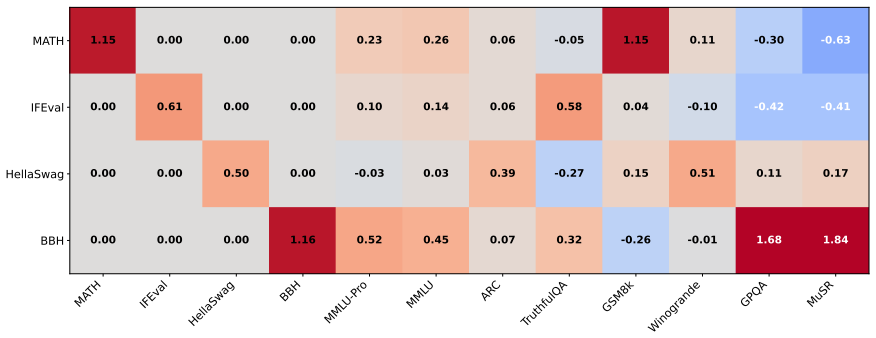
- [Section 2.2, Assumption A.1(b), Figures 1–3 and Table 2] The identification of the latent skills as 'mathematics', 'instruction following', 'common-sense reasoning', and 'logical/linguistic reasoning' depends entirely on the assumption that MATH, IFEval, HellaSwag, and BBH load only on one dimension each. The paper states this assumption (Section 2.2, 'the corresponding loading vector λ_j has a single nonzero entry') and chooses the anchors by 'domain knowledge' (Section 4.2), but provides no diagnostic checking unidimensionality. MATH, BBH, and IFEval are composite benchmarks that plausibly involve multiple skills; if any anchor has cross-loadings, the named skills are rotation artifacts and the loadings in Figure 1, the family-skill comparisons in Figure 3, and the optimal allocations in Table 2 lose their stated meaning. Since Assumption A.1(b) only identifies the model up to the anchor constraints, the consistency theorem does not validate
- [Section 2.4 and Section 4.2 / Supplement D.2] The model-selection procedure is internally inconsistent. The AIC rule in (7) selects the K minimizing AIC, and Section 2.4 states this is the rule used. Section 4.2 says AIC 'stabilizes after K=4' and chooses K=4, but Supplement D.2 states that K=6 attains the smallest AIC and that K=4 is chosen because the six-dimensional solution has highly correlated components. This is not a criticism of preferring parsimony, but the paper does not present a formal parsimony-based criterion; it presents AIC as the selection tool. The choice of K=4 is load-bearing because all subsequent interpretations of four named skills, the loadings in Figure 1, and the compute-optimal results assume the four-dimensional model. Please either report the full AIC/BIC comparison and justify the K=4 choice with a stated criterion, or show that the K=6 results do not change the qualitative conclusions.
- [Section 4.4, 'Prediction Intervals'] The central practical claim is that the model produces accurate prediction intervals, but the evidence is limited to the statement that 'nearly all intervals contain the observed scores' (Section 4.4). No numerical coverage is reported, nor interval widths per benchmark or per held-out model, nor any comparison with a non-Bayesian or plug-in baseline. Because Algorithm 2 samples ξ from an asymptotic normal approximation and α from an MCMC posterior, the finite-sample coverage could deviate substantially from the nominal 95% level even if the asymptotic theory is correct. Please provide a table of empirical coverage and average widths for the six held-out LLMs, and discuss calibration and any adjustments needed for the plug-in asymptotic covariance.
- [Section 4.5, 'Optimal Scaling of Skills', Table 2] The compute-optimal allocations are deterministic transforms of the estimated β coefficients: the objective g_ik(u) in Section 4.5 is a quadratic whose coefficients are the fitted β's, so the reported optimal parameter/token pairs in Table 2 inherit the estimation uncertainty in β. The paper has an asymptotic covariance Ψ from Theorem 2 but does not propagate it to the allocations. As a result, the table gives no indication of whether, for example, the MATH column's token-heavy recommendation is distinguishable from the HellaSwag column's parameter-heavy recommendation. Please report standard errors or confidence sets for the optimal allocations (at least for a few representative compute budgets), or a sensitivity analysis over plausible β values.
minor comments (4)
- [Eq. (3) and Eq. (3′)] The second shape parameter of the beta density is written as ϕ_j(µ(η)−1), which is negative for µ<1. The variance formula and the later Hessian derivations clearly intend Beta(ϕ_j µ(η), ϕ_j(1−µ(η))). Please correct this typo in the main text and the supplement.
- [Algorithm 1, Step 8] There is a stray double comma in the list '{Λ(t),β(t),,b(t),ϕ(t),L(t)}'.
- [Figure 1 caption] The caption says 'our K skills correspond to mathematical skills (MATH)...' — 'our K skills' should be 'our four skills' or 'the K skills' for grammar.
- [Supplement D.2 / Figure S1] The caption says 'Right: correlation of α under K=6' but the displayed matrix has rows labeled MATH, IFEval, HellaSwag, BBH, MMLU-Pro, MMLU; it would be clearer to state it is the 6×6 family-latent correlation matrix.
Circularity Check
Skill labels and compute-optimal allocations reduce to anchor constraints and fitted coefficients; core estimation and prediction intervals are self-contained.
specific steps
-
self definitional
[Section 2.2 (feasible set (5)) and Section 4.2 (Fig. 1 caption)]
"for the k-th component of the latent ability, we assume there exists a set of benchmarks S_k that measure only the k-th dimension, i.e., the corresponding loading vector λ_j has a single nonzero entry at the k-th component for j ∈ S_k. ... In the vertical axis, our K skills correspond to mathematical skills (MATH), instruction following (IFEval), common-sense reasoning (HellaSwag), and logical/linguistic reasoning (BBH)."
The latent-dimension labels are imposed, not estimated: (5) forces Λ_{j,-k}=0 for anchor benchmarks, so the anchor rows of Figure 1 are zero off-diagonal by construction. Calling the dimensions 'MATH / IFEval / HellaSwag / BBH skills' and saying the loadings 'reveal' this structure is a definitional renaming of the anchor constraints. The non-anchor loadings are data-driven, but the semantic interpretation of each skill is fixed by the chosen anchors, so the 'interpretable skills' claim cannot be validated by the fit.
-
fitted input called prediction
[Section 4.5, Table 2]
"In practice, we replace parameters (like β) by their estimates. ... Our results for our four skills (represented by MATH, IFEval, HellaSwag, and BBH) over a varying compute budget are presented in Table 2. We see that the optimal point(s) for MATH are more token-heavy..."
Table 2 is the argmax of g_ik(u) = −β̂_k2 u² + (β̂_k0 − β̂_k1 + β̂_k2 c̄)u + (α̂_l,k + β̂_k1 c̄), i.e., a deterministic transform of the just-estimated β and α. The 'optimal scaling laws' are therefore forced by the fitted model, not independent predictions or empirical discoveries. Reporting them as results ('We see that...') restates the fitted coefficients; no held-out or external check is offered, so the optimal-allocation findings reduce by construction to the estimates.
full rationale
The core statistical contribution—MLE consistency (Theorem 1), asymptotic normality (Theorem 2), and the held-out prediction intervals of Section 4.4—is self-contained: the intervals are evaluated on six LLMs withheld from fitting, with smaller variants in the training data, so coverage is a genuine out-of-sample check. The anchor-benchmark identification assumption (Assumption A.1(b)) is an untested identifiability condition; that is a validity threat rather than circularity. The two flagged steps are partial circularities in downstream interpretive applications: the semantic skill labels are definitional consequences of the anchor constraints, and the compute-optimal allocations are algebraic consequences of the fitted quadratic. Self-citations (e.g., Maia Polo et al. for covariate choice and the optimal-scaling recipe) are not load-bearing for the theorems. Overall the central derivation is not circular, but two presented 'results' reduce by construction to model inputs, warranting a moderate score.
Axiom & Free-Parameter Ledger
free parameters (6)
- Latent dimension K =
4
- Anchor benchmark sets S_k =
MATH; IFEval; HellaSwag; BBH
- Loading matrix Λ (12 benchmarks × K skills) =
Figure 1 (e.g., MATH skill loads 1.15 on MATH, 0.23 on MMLU-Pro, 1.15 on GSM8k)
- Covariate coefficient matrix β (3 covariates × K skills) =
Table 1: log(s) (0.432, 0.190, 0.840, 0.656); log(t) (0.774, 0.324, 0.384, 0.445); log(s)log(t) (0.026, 0.154, -0.039, 0
- Intercepts b_j and dispersion parameters φ_j for 12 benchmarks =
Not reported numerically in the main text
- Family latent covariance Σ (4×4, unit diagonal) =
Figure 2 correlations (e.g., BBH–MATH 0.63, BBH–HellaSwag 0.52)
axioms (6)
- domain assumption Family latent abilities α_l are i.i.d. N(0, Σ) with diag(Σ)=1.
- domain assumption Anchor benchmarks are unidimensional: for skill k there is a set S_k of benchmarks whose loading vectors have a single nonzero entry at component k.
- domain assumption Responses are conditionally independent across benchmarks, models, and families given α_l and the parameters.
- domain assumption Average benchmark scores Y_ij follow a beta distribution with mean μ(λ_j^T(α_l + β^T x_i) + b_j).
- domain assumption Scaling is linear in the covariates x = [log s, log t, log s log t]: θ_i = α_l + β^T x_i.
- standard math Standard MLE regularity conditions (Assumptions 1–2 in the supplement) hold, including identifiability, compactness, and moment conditions.
invented entities (3)
-
Family-level latent ability vector α_l
no independent evidence
-
Model-level latent skill vector θ_i = α_l + β^T x_i
no independent evidence
-
Named skill dimensions: mathematics, instruction following, common-sense reasoning, logical/linguistic reasoning
no independent evidence
Cite this review
Pith. "Pith review of A Latent Variable Framework for Scaling Laws in Large Language Models." pith.science (2026). https://pith.science/paper/IKEZCCXN
@misc{pith2026251206553,
  author       = {Pith},
  title        = {Pith review of: A Latent Variable Framework for Scaling Laws in Large Language Models},
  year         = {2026},
  howpublished = {\url{https://pith.science/paper/IKEZCCXN}},
  note         = {Machine review of arXiv:2512.06553}
}
read the original abstract
We propose a statistical framework built on latent variable modeling for scaling laws of large language models (LLMs). Our work is motivated by the rapid emergence of numerous new LLM families with distinct architectures and training strategies, evaluated on an increasing number of benchmarks. This heterogeneity makes a single global scaling curve inadequate for capturing how performance varies across families and benchmarks. To address this, we propose a latent variable modeling framework in which each LLM family is associated with a latent variable that captures the common underlying features in that family. An LLM's performance on different benchmarks is then driven by its latent skills, which are jointly determined by the latent variable and the model's own observable features. We develop an estimation procedure for this latent variable model and establish its statistical properties. We also design efficient numerical algorithms that support estimation and various downstream tasks. Empirically, we evaluate the approach on 12 widely used benchmarks from the Open LLM Leaderboard (v1/v2).
Figures


Reference graph
Works this paper leans on
-
[1]
(1998), Information theory and an extension of the maximum likelihood principle, in‘Selected papers of hirotugu akaike’, Springer, pp
Akaike, H. (1998), Information theory and an extension of the maximum likelihood principle, in‘Selected papers of hirotugu akaike’, Springer, pp. 199–213. Amemiya, T. (1985), ‘Advanced econometrics’,Harvard University Press2, 153–161. Anderson, T. W. (2003),An introduction to multivariate statistical analysis, Wiley New York. Bai, J. (2003), ‘Inferential ...
1998
-
[2]
Assumption (b) of 2 provides the condition for the central limit theorem to be applied to the score function
Assumption (a) of 2 guarantees that the asymptotic variance matrix ofˆξf is well conditioned and positive definite. Assumption (b) of 2 provides the condition for the central limit theorem to be applied to the score function. Assumption (c) of 2 ensures the uniform 30 convergence of the empirical Hessian matrix associated with(6) in a neighborhood around ...
1994
-
[4]
A Latent Variable Framework for Scaling Laws in Large Language Models
ai’,arXiv preprint arXiv:2403.04652. 28 Zellers, R., Holtzman, A., Bisk, Y., Farhadi, A. & Choi, Y. (2019), ‘HellaSwag: Can a machine really finish your sentence?’,arXiv preprint arXiv:1905.07830. Zhang, S., Chen, Y. & Liu, Y. (2020), ‘An improved stochastic em algorithm for large-scale full-information item factor analysis’,British Journal of Mathematica...
Pith/arXiv arXiv 2019
-
[6]
Conditions (ii) and (iii) are clearly satisfied by Assumption 1 and our scaling model specification
Based on Assumption 1,ξ∗ uniquely maximizes EY (l)∼fl(·|ξ∗){L(Y|ξ)} , condition (i) is satisfied. Conditions (ii) and (iii) are clearly satisfied by Assumption 1 and our scaling model specification. Condition (iv) requires the uniform law of large numbers to hold for L(Y|ξ )over ξ∈ Ξ(M). Given (a) and (b) in Assumption 1, we can apply Theorem 4.2.1 to Ame...
1985
-
[7]
Finally, under Assumption 2, the uniform law of large number holds for the quantity N−1∑N l=1∂2 logfl(Y (l)|ξ )∂ξf∂ξ ⊺ f over a small neighborhood ofξ∗ f
Hence, the Lindeberg-Feller condition holds and we have 1√ N N∑ l=1 ∂fl(Y (l)|ξ) ∂ξf ⏐⏐⏐⏐⏐ ξf =ξ∗ f d −→N{0,I(ξ ∗ f)}. Finally, under Assumption 2, the uniform law of large number holds for the quantity N−1∑N l=1∂2 logfl(Y (l)|ξ )∂ξf∂ξ ⊺ f over a small neighborhood ofξ∗ f. Given the consistency of ˆξf and the continuity of∂2 logfl(Y (l)|ξ)∂ξ f∂ξ ⊺ f, we h...
1994
-
[8]
D.1 LLMs Used The following table summarizes the LLMs used in the experiments in Section 4, including the model name, the model family, and the leaderboard on which each model appears. model family leaderboard-1 leaderboard-2 0 athena-gemma-2-2b-it athena-gemma-2-it False True 1 bio-medical-llama-3-8b bio-medical-llama-3 False True 2 bloom bloom True Fals...
2026
-
[465]
Bai, Z., Choi, K. P. & Fujikoshi, Y. (2018), ‘Consistency of AIC and BIC in estimating the number of significant components in high-dimensional principal component analysis’,The Annals of Statistics46(3), 1050–1076. Bartholomew, D. J., Knott, M. & Moustaki, I. (2011),Latent variable models and factor analysis: A unified approach, John Wiley & Sons. Beechi...
Pith/arXiv arXiv 2018
-
[2001]
Liang, P., Bommasani, R., Lee, T., Tsipras, D., Soylu, D., Yasunaga, M., Zhang, Y., Narayanan, D., Wu, Y., Kumar, A. et al. (2022), ‘Holistic evaluation of language models’, arXiv preprint arXiv:2211.09110. Lin, S., Hilton, J. & Evans, O. (2021), ‘TruthfulQA: Measuring how models mimic human falsehoods’,arXiv preprint arXiv:2109.07958. Maclaurin, D., Duve...
Pith/arXiv arXiv 2022
This paper was first reviewed by deepseek-v4-flash on August 3, 2026.
discussion (0)
Sign in with ORCID, Apple, or X to comment. Anyone can read and Pith papers without signing in.