REVIEW 2 major objections 4 minor 58 references
Superflavor symmetry, applied to the observed Tcc tetraquark, predicts that the \bar{D}^{(*)}\Xi_{cc}^{(*)} and \Xi_{cc}^{(*)}\Xi_{cc}^{(*)} systems bind into a family of hadronic molecules whose masses depend sensitively on the unknown sig
Reviewed by Pith at T0; open to challenge. T0 means a machine referee read the full paper against a public rubric. the ladder, T0–T4 →
T0 review · deepseek-v4-flash
2026-08-02 18:16 UTC pith:IKMHXYNL
load-bearing objection A competent OBEP study extending the Tcc picture to doubly charmed baryon molecules; the new predictions are worth having, but the transfer of the cutoff from Tcc is assumed, not derived, and the sigma coupling ambiguity makes the numerical results fragile. the 2 major comments →
Possible bar{D}^((*)) Xi_(cc)^((*)) and Xi_(cc)^((*))Xi_(cc)^((*)) molecules as superflavor partners of T_(cc)
The pith
A machine-rendered reading of the paper's core claim, the machinery that carries it, and where it could break.
Core claim
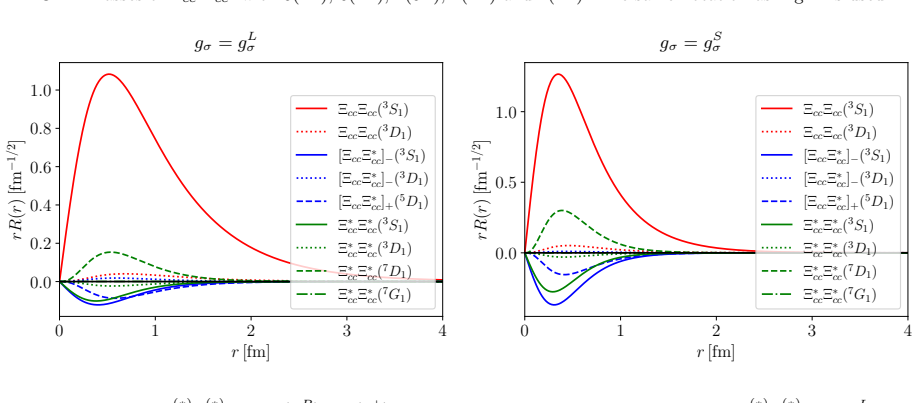
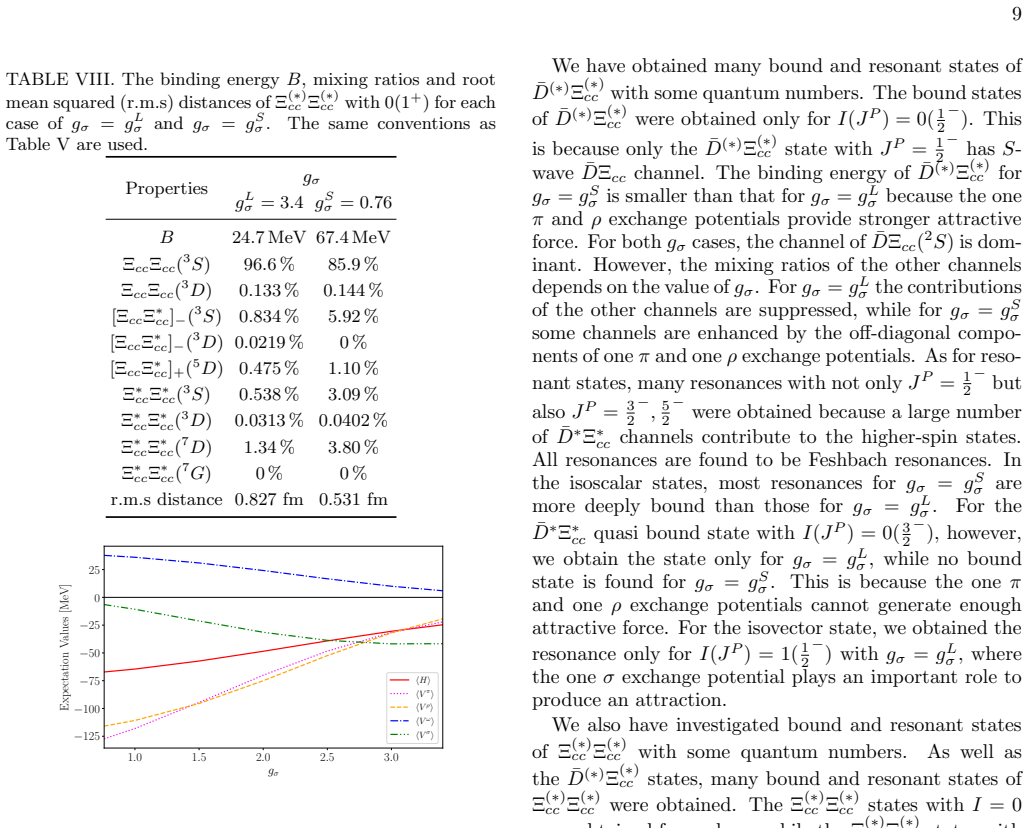
On its own terms, the paper establishes that the superflavor partner systems of Tcc contain multiple bound and resonant states when described by the same one-boson-exchange potential and the same cutoff that reproduces the 340 keV binding of Tcc. The meson–baryon system \bar{D}^{(*)}\Xi_{cc}^{(*)} has a single S-wave bound state, I(J^P)=0(1/2^-), dominated by \bar{D}\Xi_{cc}(^2S), with binding energy 7.76 MeV for the large sigma coupling and 20.4 MeV for the small one. The baryon–baryon system \Xi_{cc}^{(*)}\Xi_{cc}^{(*)} has a 0(1^+) bound state, dominated by \Xi_{cc}\Xi_{cc}(^3S), with binding energy 24.7 MeV or 67.4 MeV, plus I=1 bound states for the large sigma coupling. All the higher-s
What carries the argument
The central machinery is superflavor symmetry, which maps a heavy antiquark \bar{Q} (color \bar{3}_c) to a heavy diquark QQ (also \bar{3}_c), allowing the anti-heavy meson superfield H_a and the doubly heavy baryon superfield \psi_\mu to share the same coupling constants and cutoff. From these Lagrangians the paper derives one-boson-exchange potentials for \pi, \rho, \omega and \sigma exchange, regularized by a dipole form factor. The single free parameter \Lambda is fixed for each sigma coupling choice by reproducing the Tcc binding energy of 340 keV in a coupled-channel Schrödinger equation. Bound and resonant states are then extracted with the Gaussian expansion method and complex scaling
Load-bearing premise
The load-bearing premise is that every parameter—the cutoff \Lambda and all couplings—fixed by fitting the Tcc binding energy transfers unchanged to \Xi_{cc}-containing systems, and that the unobserved \Xi_{cc}^* mass is correctly set by the superflavor mass relation; if diquark short-range dynamics differ from antiquark dynamics, the bound-state pattern shifts or disappears.
What would settle it
A lattice QCD calculation of \bar{D}\Xi_{cc} scattering in the 0(1/2^-) channel, or of \Xi_{cc}\Xi_{cc} in 0(1^+), would settle the central claim: the paper predicts bound-state poles at approximately 7.8/20.4 MeV and 24.7/67.4 MeV below the respective thresholds, so the absence of a pole in either channel would rule out the parameter-transfer assumption. On the experimental side, a search for a narrow structure in the \bar{D}\Xi_{cc} invariant mass spectrum near threshold, or in the \Xi_{cc}\Xi_{cc} spectrum, would provide a direct test.
If this is right
- If Tcc is indeed a D D* molecule, these superflavor partners should exist; experiments can search for a \bar{D}\Xi_{cc} state just below threshold and a \Xi_{cc}\Xi_{cc} dibaryon several tens of MeV below threshold.
- Lattice QCD calculations of the \bar{D}\Xi_{cc} and \Xi_{cc}\Xi_{cc} interactions in the predicted channels would test the parameter-transfer assumption directly.
- The strong dependence of the spectra on the sigma coupling means that observing or excluding any of these states would constrain g_\sigma, which is currently uncertain.
- The predicted higher-spin resonances (J^P=3/2^-, 5/2^- for the meson–baryon system; J=0,1,2 for the baryon–baryon system) give specific line-shape targets for future amplitude analyses.
- The \Xi_{cc}^* mass enters through a superflavor relation; future observation of \Xi_{cc}^* would tighten the predictions.
Where Pith is reading between the lines
- Because the parameter transfer assumes identical short-distance dynamics for anti-charmed mesons and doubly charmed baryons, extending the calculation to the bottom sector (e.g., \bar{B}^{(*)}\Xi_{bb}^{(*)}) would reveal whether the bound-state pattern survives where heavy-quark symmetry is more accurate.
- The predicted \Xi_{cc}\Xi_{cc} state, with binding energy up to 67 MeV, would be a compact doubly charmed dibaryon; if observed, it would indicate strong diquark–diquark attraction and open a new window on charm-bearing dense matter.
- The need for a large cutoff (~1680 MeV) in the small-sigma scenario suggests that the discarded short-range contact term may matter; checking sensitivity to that term would assess how reliable the g_\sigma^S predictions are.
Editorial analysis
A structured set of objections, weighed in public.
Referee Report
Summary. The paper investigates whether the doubly charmed tetraquark T_cc, interpreted as a D(*)D(*) hadronic molecule, has superflavor partners in the systems \bar{D}^{(*)} Ξ_{cc}^{(*)} and Ξ_{cc}^{(*)} Ξ_{cc}^{(*)}. Using heavy quark spin symmetry and superflavor symmetry, the authors construct one-boson-exchange potentials (π, ρ, ω, σ) with the same couplings as for the T_cc system. The cutoff Λ is fixed to reproduce the T_cc binding energy (340 keV) for each of two choices of the σ coupling constant (g_σ^L=3.4, g_σ^S=0.76), yielding Λ_L=1074.6 MeV and Λ_S=1682.4 MeV. Solving the coupled-channel Schrödinger equation with Gaussian expansion and complex scaling, they find numerous bound states and Feshbach resonances. Examples include \bar{D}Ξ_{cc} with I(J^P)=0(1/2^-) at B=7.76 MeV (g_σ^L) or 20.4 MeV (g_σ^S), and Ξ_{cc}Ξ_{cc} with 0(1^+) at B=24.7 or 67.4 MeV. The spectra are shown to depend significantly on the uncertain σ coupling, and the results are compared with the previous study in Ref. [38].
Significance. If the superflavor transfer of parameters is valid, this work provides a rich set of concrete, experimentally testable predictions for doubly charmed molecular states beyond T_cc, thereby extending the hadronic-molecule program. The numerical implementation is careful: the coupled-channel framework is standard, the complex-scaling method is appropriate for resonances, and the agreement with Ref. [38] in the overlapping channel shows internal consistency. The paper also honestly exposes the strong dependence on the σ-coupling ambiguity. However, the predictive power is limited by the uncontrolled short-distance regulator and by the unobserved Ξ_cc^* mass, both of which are central to the claimed bound/resonant states. The contribution is a useful phenomenological exploration rather than a robust prediction.
major comments (2)
- [Sec. II, Eq. (21); Sec. III, Table VII] The Ξ_cc^* mass is not experimentally known and is set by the superflavor relation m_{Ξ_cc^*}-m_{Ξ_cc}=3/4 (m_{D^*}-m_D). This is another symmetry input subject to 1/m_c corrections. Many channels involve Ξ_cc^*, and some predicted states are extremely shallow — e.g., the I(J^P)=1(1^+) bound state in Table VII has B=0.059 MeV for g_σ^L. A modest shift in the Ξ_cc^* mass, or in the associated threshold, could eliminate this state and alter the coupled-channel dynamics for others. The authors should discuss the sensitivity of their results to the unmeasured Ξ_cc^* mass or provide a range of values.
- [Sec. III and Sec. IV, Conclusions] The paper's central claim—that many bound and resonant states exist—is strongly parameter-dependent. The abstract itself states the mass spectra depend significantly on the σ coupling. Concretely, I=1 states appear only for g_σ^L (e.g., \bar{D}^{(*)}Ξ_{cc}^{(*)} 1(1/2^-) in Table IV and Ξ_{cc}^{(*)}Ξ_{cc}^{(*)} 1(0^+),1(1^+) in Table VII), while for g_σ^S they are absent. Binding energies vary by factors of 2–3 between the two parameter sets. The paper should either find a way to constrain g_σ further, or explicitly frame the predictions as conditional on the uncertain σ coupling with a clear statement of which qualitative conclusions (if any) are robust. As written, the reader cannot tell whether the existence of any specific state is a solid prediction.
minor comments (4)
- [Sec. IV (Summary), first paragraph on \bar{D}^{(*)}Ξ_{cc}^{(*)}] The summary states that the binding energy for g_σ^S is “smaller” than for g_σ^L, contradicting Sec. III A and Table IV, where it is larger (20.4 MeV vs 7.76 MeV). This is likely a typo but is confusing for the reader.
- [Tables III and VI] The channel lists contain period marks instead of commas between entries, e.g., “4D3/2.6G3/2” in the 5/2^- row of Table III and similar in Table VI. Please correct the punctuation.
- [Eq. (16)] The expression for the potential in momentum space is garbled: “V(q) =i iMqQ i 2mi Q f 2mf” is not readable. It should presumably be V(q) = - i M / (2 m_i 2 m_f) multiplied by appropriate factors. Please rewrite.
- [Eq. (4)] The displayed Lagrangian for heavy meson–vector-meson coupling has typesetting errors (e.g., “√2βgV ¯Db ¯Da†vα ˆρa2 √2λgV ...” appears to be missing a term). Please check the equation aligns with the text description.
Circularity Check
No circularity: Tcc calibration plus superflavor parameter transfer yields genuinely new coupled-channel predictions.
full rationale
The paper's derivation chain is a calibrated-model extrapolation, not a self-fulfilling construction. In Sec. III the cutoff is explicitly fitted to an external experimental input: 'the cutoff parameter Λ is determined to reproduce the binding energy of Tcc, 340 keV, for both cases of g_L^σ and g_S^σ'. The same parameters are then transferred to the partner systems, as stated: 'we use the same set of parameters such as coupling constants and a cutoff parameter as those adopted in the Tcc analysis as dictated by the superflavor symmetry.' The partner binding energies and resonance poles (Tables IV and VII) are not the fitted Tcc binding energy by construction; they are outputs of the many-channel Schrödinger equation with different hadron masses, thresholds, spin operators, and channel content. The superflavor equality of couplings and cutoff is an explicit modeling assumption, not a conclusion smuggled in from the target predictions. Self-citations Refs. [38-40] supply the prior OBEP framework, channel sets, and Tcc fit, but the current paper restates the numerical cutoff values, solves the new channels, and openly discusses the gσ sensitivity. No equation in the paper is shown to reduce to another by construction, and no fitted parameter is renamed as a prediction of the same quantity. The significant dependence of the predicted spectra on the uncertain σ coupling is a model-uncertainty issue, not a logical circularity. Therefore no circular step is identified.
Axiom & Free-Parameter Ledger
free parameters (3)
- Cutoff Lambda_L =
1074.6 MeV
- Cutoff Lambda_S =
1682.4 MeV
- Sigma coupling constant g_sigma =
3.4 or 0.76 (two cases)
axioms (5)
- domain assumption Superflavor symmetry: a heavy antiquark and a heavy diquark in the same color representation interact identically with light mesons, so the same couplings and cutoff apply to \bar{D}^{(*)} and \Xi_{cc}^{(*)} systems.
- domain assumption Heavy quark spin symmetry: the heavy quark spin is conserved, and D, D*, Xi_cc, Xi_cc* fields combine into superfields.
- domain assumption The one-boson-exchange potential with pion, rho, omega and sigma exchanges, a dipole form factor, no contact term, and no energy transfer describes the two-body interaction.
- domain assumption Tcc is a D(*)D(*) molecule with binding energy 340 keV, used to fix the cutoff.
- domain assumption Mass of Xi_cc* is given by m_Xi*cc - m_Xicc = (3/4)(m_D* - m_D) from superflavor symmetry.
read the original abstract
The doubly charmed tetraquark $T_{cc}$ has been reported by the LHCb experiment in 2022, and a lot of theoretical studies has been conducted. The small binding energy measured from $D^{\ast + }D^0$ threshold indicates that $T_{cc}$ is a $DD^\ast$ molecule. On the other hand, the superflavor symmetry, which relates heavy antiquarks to heavy diquarks, provides a useful framework for predicting the existence of partner exotic hadrons associated with $T_{cc}$. By replacing $\bar{D}^{(*)}$ with $\Xi_{cc}^{(*)}$ within this symmetry, $\bar{D}^{(*)} \Xi_{cc}^{(*)}$ and $\Xi_{cc}^{(*)}\Xi_{cc}^{(*)}$ are expected to form partner structures of $T_{cc}$. In this paper, we investigate bound and resonant states of $\bar{D}^{(*)} \Xi_{cc}^{(*)}$ and $\Xi_{cc}^{(*)}\Xi_{cc}^{(*)}$ based on the one boson exchange potential, where $\pi$, $\rho$, $\omega$ and $\sigma$ are considered as bosons. The cutoff parameter and the coupling constants for $\bar{D}^{(*)} \Xi_{cc}^{(*)}$ and $\Xi_{cc}^{(*)}\Xi_{cc}^{(*)}$ are taken to be the same as those for $T_{cc}$ due to superflavor symmetry. We also discuss the $\sigma$ coupling constant, which is uncertain, dependence of these mass spectra. A lot of bound and resonant states with some quantum numbers are obtained for each $\sigma$ coupling constant, but these mass spectra depend on the $\sigma$ coupling constant significantly.
Figures


Reference graph
Works this paper leans on
-
[1]
The mixing ratios of ΞccΞcc(1S0) for Ξ(∗) cc Ξ(∗) cc (1(0+)) and [ΞccΞ∗ cc]+(3S1) for Ξ (∗) cc Ξ(∗) cc (1(1+)) are about 99 %
In this case, bound states of Ξ (∗) cc Ξ(∗) cc with 1(0 +) and 1(1+) are found, and their properties are discussed below. The mixing ratios of ΞccΞcc(1S0) for Ξ(∗) cc Ξ(∗) cc (1(0+)) and [ΞccΞ∗ cc]+(3S1) for Ξ (∗) cc Ξ(∗) cc (1(1+)) are about 99 %. This indicates that the oneσexchange potential provides the dominant attraction that is responsible for bind...
-
[2]
S. K. Choiet al.(Belle), Observation of a narrow charmonium-like state in exclusiveB ± →K ±π+π−J/ψ decays, Phys. Rev. Lett.91, 262001 (2003), arXiv:hep- 10 ex/0309032
arXiv 2003
-
[3]
B. Aubertet al.(BaBar), Observation of a broad struc- ture in theπ +π−J/ψmass spectrum around 4.26- GeV/c2, Phys. Rev. Lett.95, 142001 (2005), arXiv:hep- ex/0506081
arXiv 2005
-
[4]
C. Z. Yuanet al.(Belle), Measurement of e+ e- —>pi+ pi- J/psi cross-section via initial state radiation at Belle, Phys. Rev. Lett.99, 182004 (2007), arXiv:0707.2541 [hep-ex]
Pith/arXiv arXiv 2007
-
[5]
S. K. Choiet al.(Belle), Observation of a resonance- like structure in thepi ±ψ′ mass distribution in exclu- siveB→Kπ ±ψ′ decays, Phys. Rev. Lett.100, 142001 (2008), arXiv:0708.1790 [hep-ex]
Pith/arXiv arXiv 2008
-
[6]
Aubertet al.(BaBar), Search for the Z(4430)- at BABAR, Phys
B. Aubertet al.(BaBar), Search for the Z(4430)- at BABAR, Phys. Rev. D79, 112001 (2009), arXiv:0811.0564 [hep-ex]
Pith/arXiv arXiv 2009
-
[7]
R. Aaijet al.(LHCb), Observation ofJ/ψpReso- nances Consistent with Pentaquark States in Λ 0 b → J/ψK −pDecays, Phys. Rev. Lett.115, 072001 (2015), arXiv:1507.03414 [hep-ex]
Pith/arXiv arXiv 2015
-
[8]
R. Aaijet al.(LHCb), Observation of a narrow pen- taquark state,P c(4312)+, and of two-peak structure of theP c(4450)+, Phys. Rev. Lett.122, 222001 (2019), arXiv:1904.03947 [hep-ex]
Pith/arXiv arXiv 2019
-
[9]
Aaijet al.(LHCb), Observation of structure in the J/ψ-pair mass spectrum, Sci
R. Aaijet al.(LHCb), Observation of structure in the J/ψ-pair mass spectrum, Sci. Bull.65, 1983 (2020), arXiv:2006.16957 [hep-ex]
arXiv 1983
-
[10]
R. Aaijet al.(LHCb), Evidence of aJ/ψΛ structure and observation of excited Ξ − states in the Ξ − b →J/ψΛK − decay, Sci. Bull.66, 1278 (2021), arXiv:2012.10380 [hep- ex]
arXiv 2021
-
[11]
R. Aaijet al.(LHCb), Observation of an exotic narrow doubly charmed tetraquark, Nature Phys.18, 751 (2022), arXiv:2109.01038 [hep-ex]
arXiv 2022
-
[12]
R. Aaijet al.(LHCb), Study of the doubly charmed tetraquarkT + cc, Nature Commun.13, 3351 (2022), arXiv:2109.01056 [hep-ex]
arXiv 2022
-
[13]
R. Aaijet al.(LHCb), Evidence for a new structure in the J/ψpandJ/ψ¯psystems inB 0 s →J/ψp¯pdecays, Phys. Rev. Lett.128, 062001 (2022), arXiv:2108.04720 [hep- ex]
arXiv 2022
-
[14]
M. Ablikimet al.(BESIII), Observation of a Near- Threshold Structure in theK + Recoil-Mass Spectra in e+e− →K +(D− s D∗0 +D ∗− s D0), Phys. Rev. Lett.126, 102001 (2021), arXiv:2011.07855 [hep-ex]
arXiv 2021
-
[15]
N. A. Tornqvist, From the deuteron to deusons, an analy- sis of deuteron - like meson meson bound states, Z. Phys. C61, 525 (1994), arXiv:hep-ph/9310247
Pith/arXiv arXiv 1994
-
[16]
F.-K. Guo, C. Hanhart, U.-G. Meißner, Q. Wang, Q. Zhao, and B.-S. Zou, Hadronic molecules, Rev. Mod. Phys.90, 015004 (2018), [Erratum: Rev.Mod.Phys. 94, 029901 (2022)], arXiv:1705.00141 [hep-ph]
Pith/arXiv arXiv 2018
-
[17]
Machleidt, K
R. Machleidt, K. Holinde, and C. Elster, The Bonn Me- son Exchange Model for the Nucleon Nucleon Interac- tion, Phys. Rept.149, 1 (1987)
1987
-
[18]
Machleidt, The High precision, charge dependent Bonn nucleon-nucleon potential (CD-Bonn), Phys
R. Machleidt, The High precision, charge dependent Bonn nucleon-nucleon potential (CD-Bonn), Phys. Rev. C63, 024001 (2001), arXiv:nucl-th/0006014
Pith/arXiv arXiv 2001
-
[19]
Oka and K
M. Oka and K. Yazaki, Short Range Part of Baryon Baryon Interaction in a Quark Model. 1. Formulation, Prog. Theor. Phys.66, 556 (1981)
1981
-
[20]
Oka and K
M. Oka and K. Yazaki, Short Range Part of Baryon Baryon Interaction in a Quark Model. 2. Numerical Re- sults for S-Wave, Prog. Theor. Phys.66, 572 (1981)
1981
-
[21]
M. Oka, K. Shimizu, and K. Yazaki, Quark cluster model of baryon baryon interaction, Prog. Theor. Phys. Suppl. 137, 1 (2000)
2000
-
[22]
T. Sekihara and T. Hashiguchi, Reexamination of the short-range baryon-baryon potentials in the con- stituent quark model, Phys. Rev. C108, 065202 (2023), arXiv:2304.13877 [nucl-th]
Pith/arXiv arXiv 2023
-
[23]
S. Aoki, T. Hatsuda, and N. Ishii, Theoretical Foun- dation of the Nuclear Force in QCD and its applica- tions to Central and Tensor Forces in Quenched Lattice QCD Simulations, Prog. Theor. Phys.123, 89 (2010), arXiv:0909.5585 [hep-lat]
Pith/arXiv arXiv 2010
-
[24]
T. Inoue, N. Ishii, S. Aoki, T. Doi, T. Hatsuda, Y. Ikeda, K. Murano, H. Nemura, and K. Sasaki (HAL QCD), Bound H-dibaryon in Flavor SU(3) Limit of Lattice QCD, Phys. Rev. Lett.106, 162002 (2011), arXiv:1012.5928 [hep-lat]
Pith/arXiv arXiv 2011
-
[25]
N. Ishii, S. Aoki, T. Doi, T. Hatsuda, Y. Ikeda, T. In- oue, K. Murano, H. Nemura, and K. Sasaki (HAL QCD), Hadron–hadron interactions from imaginary-time Nambu–Bethe–Salpeter wave function on the lattice, Phys. Lett. B712, 437 (2012), arXiv:1203.3642 [hep-lat]
Pith/arXiv arXiv 2012
-
[26]
Y. Lyu, S. Aoki, T. Doi, T. Hatsuda, Y. Ikeda, and J. Meng, Doubly Charmed Tetraquark Tcc+ from Lattice QCD near Physical Point, Phys. Rev. Lett.131, 161901 (2023), arXiv:2302.04505 [hep-lat]
Pith/arXiv arXiv 2023
-
[27]
Neubert, Heavy quark symmetry, Phys
M. Neubert, Heavy quark symmetry, Phys. Rept.245, 259 (1994), arXiv:hep-ph/9306320
Pith/arXiv arXiv 1994
-
[28]
Grinstein, An Introduction to heavy mesons, in6th Mexican School of Particles and Fields(1995) pp
B. Grinstein, An Introduction to heavy mesons, in6th Mexican School of Particles and Fields(1995) pp. 122– 184, arXiv:hep-ph/9508227
Pith/arXiv arXiv 1995
-
[29]
R. Casalbuoni, A. Deandrea, N. Di Bartolomeo, R. Gatto, F. Feruglio, and G. Nardulli, Phenomenology of heavy meson chiral Lagrangians, Phys. Rept.281, 145 (1997), arXiv:hep-ph/9605342
Pith/arXiv arXiv 1997
-
[30]
Georgi and M
H. Georgi and M. B. Wise, Superflavor Symmetry for Heavy Particles, Phys. Lett. B243, 279 (1990)
1990
-
[31]
M. J. Savage and M. B. Wise, Spectrum of baryons with two heavy quarks, Phys. Lett. B248, 177 (1990)
1990
-
[32]
S. Fleming and T. Mehen, Doubly heavy baryons, heavy quark-diquark symmetry and NRQCD, Phys. Rev. D73, 034502 (2006), arXiv:hep-ph/0509313
Pith/arXiv arXiv 2006
-
[33]
S. Ohkoda, Y. Yamaguchi, S. Yasui, K. Sudoh, and A. Hosaka, Exotic mesons with double charm and bottom flavor, Phys. Rev. D86, 034019 (2012), arXiv:1202.0760 [hep-ph]
Pith/arXiv arXiv 2012
-
[34]
N. Li, Z.-F. Sun, X. Liu, and S.-L. Zhu, Coupled- channel analysis of the possibleD (∗)D(∗), B (∗) B (∗) and D(∗)B (∗) molecular states, Phys. Rev. D88, 114008 (2013), arXiv:1211.5007 [hep-ph]
Pith/arXiv arXiv 2013
-
[35]
H.-X. Chen, W. Chen, X. Liu, Y.-R. Liu, and S.-L. Zhu, An updated review of the new hadron states, Rept. Prog. Phys.86, 026201 (2023), arXiv:2204.02649 [hep-ph]
Pith/arXiv arXiv 2023
-
[36]
F.-L. Wang, R. Chen, and X. Liu, A new group of doubly charmed molecule with T-doublet charmed meson pair, Phys. Lett. B835, 137502 (2022), arXiv:2111.00208 [hep- ph]
Pith/arXiv arXiv 2022
-
[37]
F.-L. Wang and X. Liu, Investigating new type of dou- bly charmed molecular tetraquarks composed of charmed mesons in the H and T doublets, Phys. Rev. D104, 094030 (2021), arXiv:2108.09925 [hep-ph]
Pith/arXiv arXiv 2021
-
[38]
H. Ren, F. Wu, and R. Zhu, Hadronic Molecule Inter- pretation of Tcc+ and Its Beauty Partners, Adv. High 11 Energy Phys.2022, 9103031 (2022), arXiv:2109.02531 [hep-ph]
Pith/arXiv arXiv 2022
-
[39]
T. Asanuma, Y. Yamaguchi, and M. Harada, Analysis of DD* and D¯(*)Ξcc(*) molecule by one boson exchange model based on heavy quark symmetry, Phys. Rev. D 110, 074030 (2024), arXiv:2311.04695 [hep-ph]
Pith/arXiv arXiv 2024
-
[40]
M. Sakai and Y. Yamaguchi, Analysis of Tcc and Tbb based on the hadronic molecular model and their spin multiplets, Phys. Rev. D109, 054016 (2024), arXiv:2312.08663 [hep-ph]
Pith/arXiv arXiv 2024
-
[41]
M. Sakai and Y. Yamaguchi, Analysis of bound and res- onant states of doubly heavy tetraquarks with spin J≤2, Phys. Rev. D112, 034038 (2025), arXiv:2503.11134 [hep- ph]
arXiv 2025
-
[42]
Y. Ikeda, B. Charron, S. Aoki, T. Doi, T. Hatsuda, T. In- oue, N. Ishii, K. Murano, H. Nemura, and K. Sasaki, Charmed tetraquarksT cc andT cs from dynamical lat- tice QCD simulations, Phys. Lett. B729, 85 (2014), arXiv:1311.6214 [hep-lat]
Pith/arXiv arXiv 2014
-
[43]
M. Padmanath and S. Prelovsek, Signature of a Dou- bly Charm Tetraquark Pole in DD* Scattering on the Lattice, Phys. Rev. Lett.129, 032002 (2022), arXiv:2202.10110 [hep-lat]
Pith/arXiv arXiv 2022
-
[44]
M. Nagatsuka and S. Sasaki, Lattice study of scatter- ing phase shifts for DD* and BB* systems using twisted boundary conditions: Search for bound state formation, Phys. Rev. D112, 114510 (2025), arXiv:2507.20712 [hep- lat]
arXiv 2025
-
[45]
B. Grinstein, E. E. Jenkins, A. V. Manohar, M. J. Savage, and M. B. Wise, Chiral perturbation theory for f D(s) / f D and B B(s) / B B, Nucl. Phys. B380, 369 (1992), arXiv:hep-ph/9204207
Pith/arXiv arXiv 1992
-
[46]
Y. Yamaguchi, S. Yasui, and A. Hosaka, Open charm and bottom meson-nucleon potentials ` a la the nuclear force, Phys. Rev. D106, 094001 (2022), arXiv:2206.01921 [hep- ph]
Pith/arXiv arXiv 2022
-
[47]
Ahmedet al.(CLEO), First measurement of Gamma(D*+), Phys
S. Ahmedet al.(CLEO), First measurement of Gamma(D*+), Phys. Rev. Lett.87, 251801 (2001), arXiv:hep-ex/0108013
Pith/arXiv arXiv 2001
-
[48]
M.-Z. Liu, T.-W. Wu, M. Pavon Valderrama, J.-J. Xie, and L.-S. Geng, Heavy-quark spin and flavor symmetry partners of the X(3872) revisited: What can we learn from the one boson exchange model?, Phys. Rev. D99, 094018 (2019), arXiv:1902.03044 [hep-ph]
Pith/arXiv arXiv 2019
- [49]
-
[50]
W. A. Bardeen, E. J. Eichten, and C. T. Hill, Chiral Multiplets of Heavy - Light Mesons, Phys. Rev. D68, 054024 (2003), arXiv:hep-ph/0305049
Pith/arXiv arXiv 2003
-
[51]
X. Liu, Y.-R. Liu, W.-Z. Deng, and S.-L. Zhu, Z+(4430) as a D(1)-prime D* (D(1) D*) molecular state, Phys. Rev. D77, 094015 (2008), arXiv:0803.1295 [hep-ph]
Pith/arXiv arXiv 2008
-
[52]
J. Hu and T. Mehen, Chiral Lagrangian with heavy quark-diquark symmetry, Phys. Rev. D73, 054003 (2006), arXiv:hep-ph/0511321
Pith/arXiv arXiv 2006
-
[53]
Navaset al.(Particle Data Group), Review of particle physics, Phys
S. Navaset al.(Particle Data Group), Review of particle physics, Phys. Rev. D110, 030001 (2024)
2024
-
[54]
Hiyama, Y
E. Hiyama, Y. Kino, and M. Kamimura, Gaussian ex- pansion method for few-body systems, Prog. Part. Nucl. Phys.51, 223 (2003)
2003
-
[55]
E. Hiyama and M. Kamimura, Study of various few-body systems using Gaussian expansion method (GEM), Front. Phys. (Beijing)13, 132106 (2018), arXiv:1809.02619 [nucl-th]
Pith/arXiv arXiv 2018
-
[56]
R. Suzuki, T. Myo, and K. Kato, Level density in com- plex scaling method, AIP Conf. Proc.768, 455 (2005), arXiv:nucl-th/0502012
Pith/arXiv arXiv 2005
-
[57]
T. Myo, Y. Kikuchi, H. Masui, and K. Kat¯ o, Recent de- velopment of complex scaling method for many-body res- onances and continua in light nuclei, Prog. Part. Nucl. Phys.79, 1 (2014), arXiv:1410.4356 [nucl-th]
Pith/arXiv arXiv 2014
-
[58]
T. Myo and K. Kato, Complex scaling: Physics of un- bound light nuclei and perspective, PTEP2020, 12A101 (2020), arXiv:2007.12172 [nucl-th]
Pith/arXiv arXiv 2020
discussion (0)
Sign in with ORCID, Apple, or X to comment. Anyone can read and Pith papers without signing in.