Radial Solutions of Multi-Field de Sitter Galileons
Pith reviewed 2026-07-01 01:52 UTC · model grok-4.3
The pith
Curvature in de Sitter space can alleviate superluminality in multi-field Galileon theories for suitable matter couplings, at the cost of a finite effective theory range.
A machine-rendered reading of the paper's core claim, the machinery that carries it, and where it could break.
Core claim
Static spherically symmetric solutions in the multi-field de Sitter Galileon exhibit a screened branch controlled by quartic interactions near the source that crosses over to quadratic terms at larger radii; the solution remains viable only if this de Sitter Vainshtein crossover precedes the strong-coupling radius at which the radial equation becomes singular, and perturbations on viable backgrounds stay stable and subluminal within the domain bounded by that radius. Curvature effects can be separated from horizon effects by comparison with the Anti-de Sitter case, showing that positive curvature can ease superluminality for appropriate couplings while restricting the effective theory's rang
What carries the argument
The radial equation for the Galileon fields on a de Sitter background, which becomes singular at a finite strong-coupling radius and whose quartic-to-quadratic crossover defines the de Sitter Vainshtein radius.
If this is right
- Screened solutions exist only when the de Sitter Vainshtein crossover precedes the strong-coupling radius.
- Perturbations remain stable and subluminal inside the radial domain set by the strong-coupling point.
- Positive curvature isolates effects that differ from those in Anti-de Sitter space and can reduce superluminality for chosen matter couplings.
- The effective theory has a finite region of validity bounded by the strong-coupling radius.
Where Pith is reading between the lines
- The limited validity range implies that any cosmological application of these Galileons would require a UV completion at the strong-coupling scale.
- Specific matter-coupling choices that push the strong-coupling radius outward could be searched for to enlarge the usable domain.
- The mechanism may connect to screening in other curved-space modified-gravity models where horizon and strong-coupling scales compete.
Load-bearing premise
The de Sitter radial problem is jointly controlled by the cosmological horizon and by a possible finite strong-coupling radius that renders the effective description invalid beyond that point.
What would settle it
A concrete calculation showing a radial solution that reaches the strong-coupling singularity before the quartic-to-quadratic crossover, or a perturbation analysis that finds superluminal modes on every branch inside the allowed radial interval.
Figures
read the original abstract
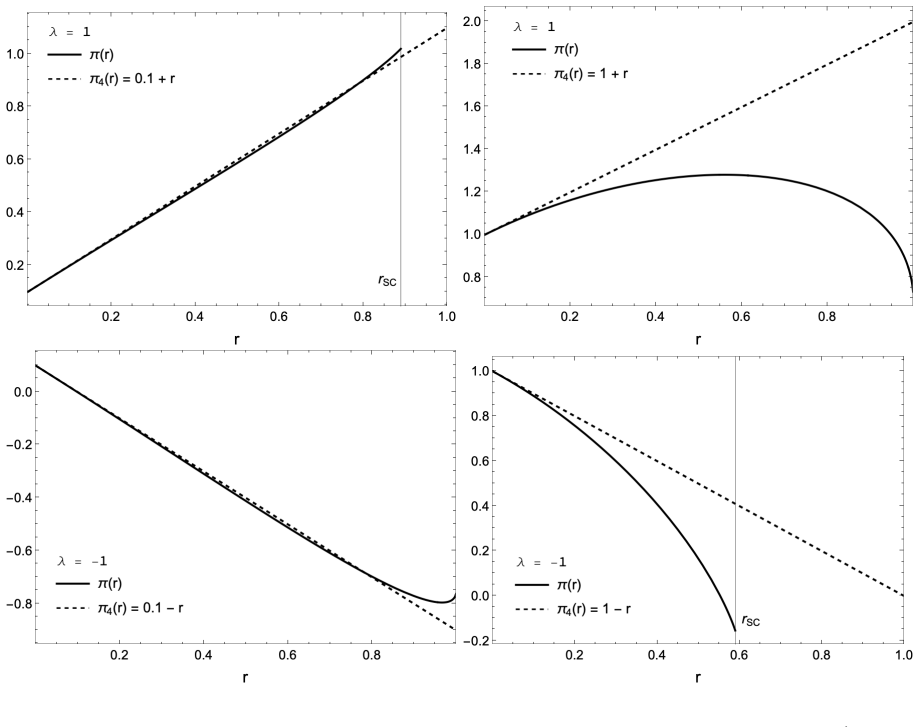
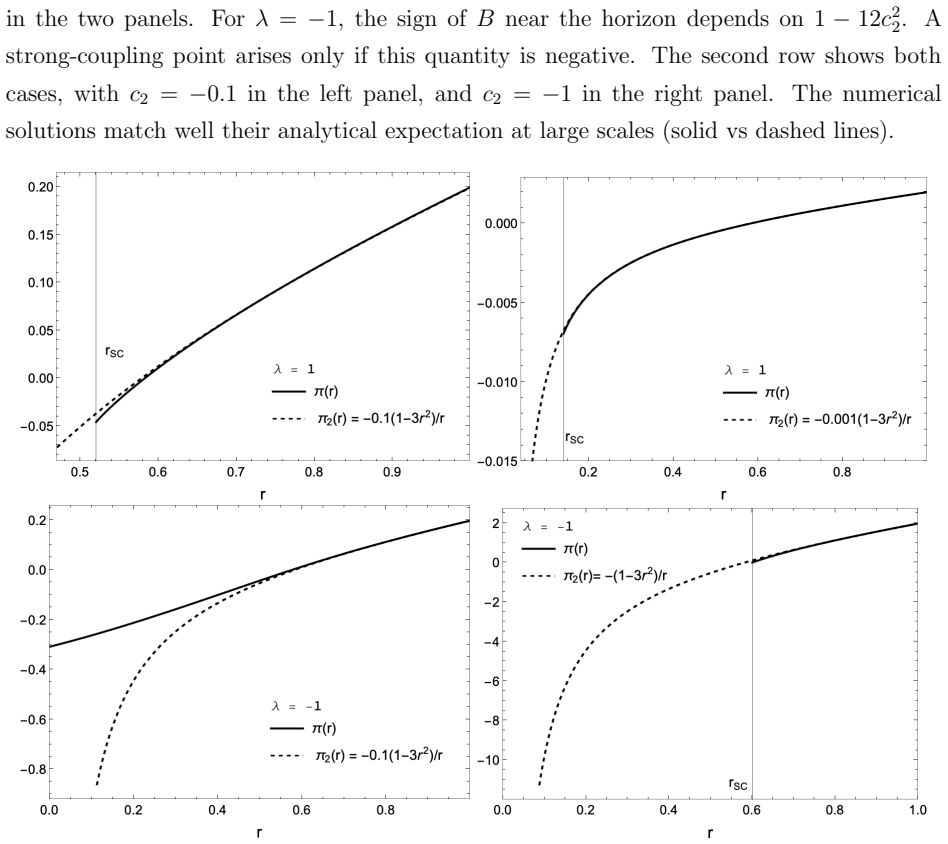
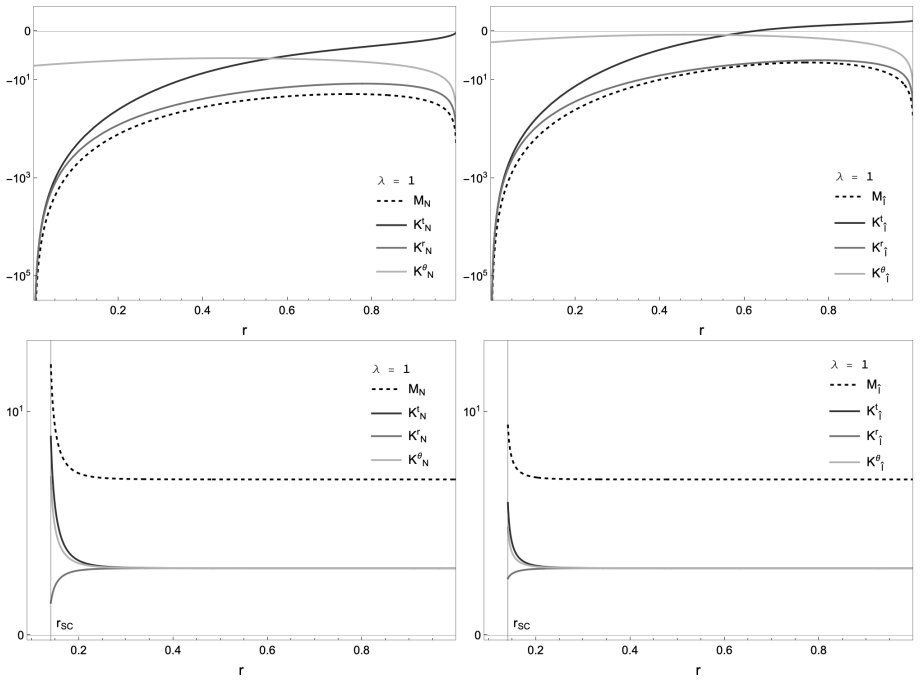
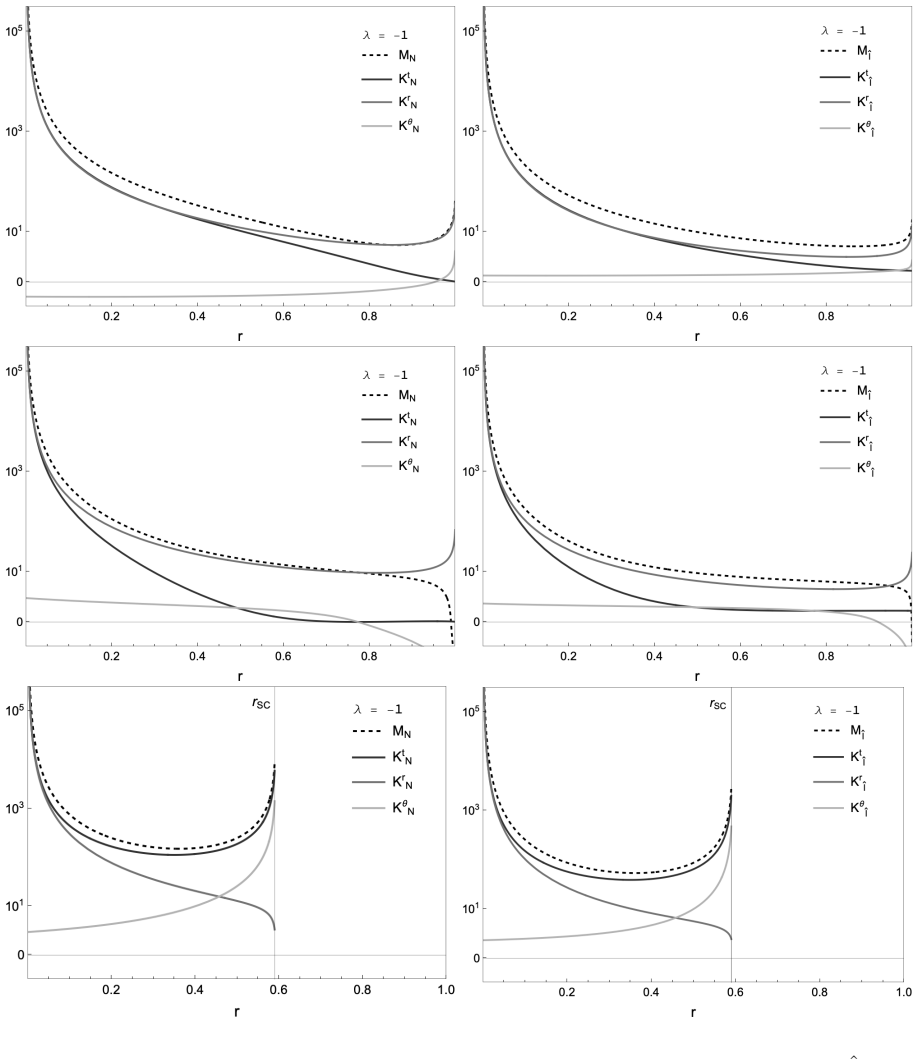
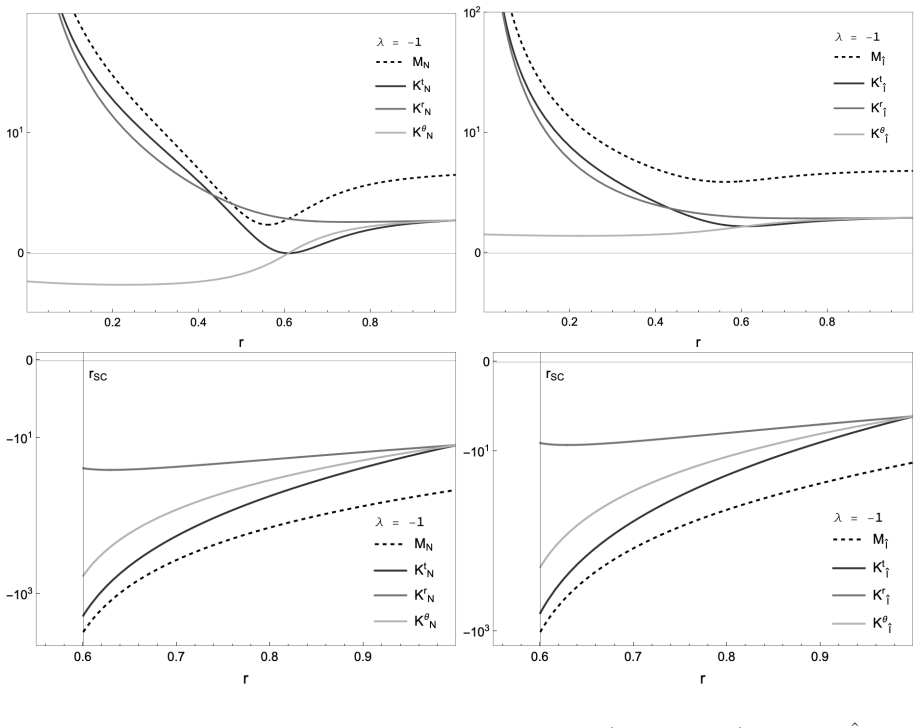
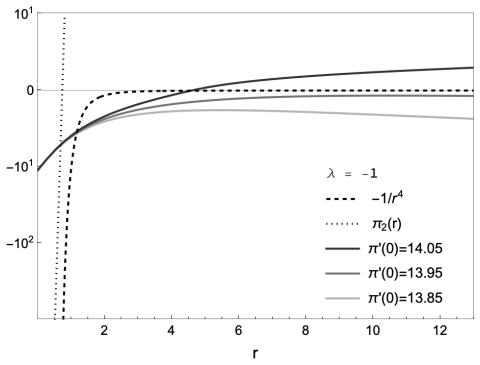
We study static, spherically symmetric screening solutions in the $\mathfrak{so}(N)$-invariant multi-field de Sitter Galileon theory, with matter couplings preserving the internal symmetry. Unlike in flat space, the de Sitter radial problem is affected both by the cosmological horizon and by the possible appearance of a finite strong-coupling radius, where the radial equation becomes singular and the effective description breaks down. Near the source, the quartic interaction governs the nonlinear screened branch, while farther away the quadratic terms dominate, defining a de Sitter analog of the Vainshtein radius at their crossover. A screened solution is viable only if this crossover occurs before the strong-coupling radius is reached. We study perturbations around the radial background and identify branches for which perturbations are stable and subluminal, within a restricted radial domain set by the strong-coupling point. Finally, we compare the de Sitter and Anti-de Sitter cases, isolating effects due to curvature from those specific to the cosmological horizon. Our results indicate that curvature can alleviate the superluminality issues that arise in Galileon theories for appropriate choices of matter couplings, though this comes at the price of a finite region of validity for the effective theory.
Editorial analysis
A structured set of objections, weighed in public.
Referee Report
Summary. The manuscript examines static, spherically symmetric screening solutions in the so(N)-invariant multi-field de Sitter Galileon theory with symmetry-preserving matter couplings. Unlike flat space, the radial problem is affected by both the cosmological horizon and a possible finite strong-coupling radius where the radial equation becomes singular. Near the source the quartic interaction governs the nonlinear screened branch while quadratic terms dominate farther out, defining a de Sitter analog of the Vainshtein radius at their crossover; a screened solution is viable only if this crossover precedes the strong-coupling radius. Perturbations around the radial background are analyzed for stability and subluminality within the restricted domain set by the strong-coupling point. The de Sitter and Anti-de Sitter cases are compared to isolate curvature effects from horizon-specific ones. The central claim is that curvature can alleviate superluminality issues for appropriate matter couplings, at the price of a finite region of validity for the effective theory.
Significance. If the explicit radial solutions, perturbation analysis, and dS/AdS comparison hold, the work supplies concrete conditions under which Galileon screening remains viable in curved space while addressing causality concerns. The explicit acknowledgment of the strong-coupling cutoff as a limiting factor, together with the symmetry-preserving coupling choices, strengthens the assessment of the effective theory's domain. The multi-field so(N) setup and direct comparison of curvature versus horizon effects are useful for cosmological applications of modified gravity.
minor comments (3)
- [Abstract] The abstract is information-dense; splitting the description of the radial branches and the perturbation analysis into separate sentences would improve readability.
- Ensure that all radial equations and perturbation equations are numbered sequentially and that every reference in the text points to the correct equation number.
- Figure captions should explicitly state the parameter values (e.g., the Galileon coefficients and the de Sitter radius) used in each panel so that the plots can be reproduced without consulting the main text.
Simulated Author's Rebuttal
We thank the referee for their positive assessment of our manuscript on radial solutions in the so(N)-invariant multi-field de Sitter Galileon theory. The recommendation for minor revision is noted, and we appreciate the recognition of the explicit radial solutions, perturbation analysis, and dS/AdS comparison as useful for cosmological applications. No specific major comments were raised in the report.
Circularity Check
No significant circularity detected
full rationale
The paper performs direct analysis of the radial equations, perturbations, and dS vs AdS comparisons in the multi-field Galileon theory. The abstract and described logic derive claims from explicit solution of the background equations and stability conditions without reducing to fitted parameters renamed as predictions, self-definitional loops, or load-bearing self-citations. The central results on screening viability, strong-coupling radius, and curvature effects on superluminality follow from the stated equations and are self-contained against external benchmarks.
Axiom & Free-Parameter Ledger
free parameters (1)
- Galileon interaction coefficients
axioms (2)
- domain assumption The multi-field theory is invariant under so(N) internal symmetry
- domain assumption Matter couplings preserve the internal symmetry
Reference graph
Works this paper leans on
-
[1]
To the problem of nonvanishing gravitation mass,
A. I. Vainshtein, “To the problem of nonvanishing gravitation mass,” Phys. Lett. B39 (1972) 393–394
1972
-
[2]
An introduction to the Vainshtein mechanism,
E. Babichev and C. Deffayet, “An introduction to the Vainshtein mechanism,” Class. Quant. Grav.30(2013) 184001,arXiv:1304.7240 [gr-qc]
Pith/arXiv arXiv 2013
-
[3]
4-D gravity on a brane in 5-D Minkowski space,
G. R. Dvali, G. Gabadadze, and M. Porrati, “4-D gravity on a brane in 5-D Minkowski space,” Phys. Lett. B485(2000) 208–214,arXiv:hep-th/0005016
Pith/arXiv arXiv 2000
-
[4]
Gravity on a brane in infinite volume extra space,
G. R. Dvali and G. Gabadadze, “Gravity on a brane in infinite volume extra space,” Phys. Rev. D63(2001) 065007,arXiv:hep-th/0008054
Pith/arXiv arXiv 2001
-
[5]
Strong interactions and stability in the DGP model,
M. A. Luty, M. Porrati, and R. Rattazzi, “Strong interactions and stability in the DGP model,” JHEP09(2003) 029,arXiv:hep-th/0303116
Pith/arXiv arXiv 2003
-
[6]
Classical and quantum consistency of the DGP model,
A. Nicolis and R. Rattazzi, “Classical and quantum consistency of the DGP model,” JHEP06(2004) 059,arXiv:hep-th/0404159
Pith/arXiv arXiv 2004
-
[7]
The Galileon as a local modification of gravity,
A. Nicolis, R. Rattazzi, and E. Trincherini, “The Galileon as a local modification of gravity,” Phys. Rev. D79(2009) 064036,arXiv:0811.2197 [hep-th]
Pith/arXiv arXiv 2009
-
[8]
C. Deffayet, G. Esposito-Farese, and A. Vikman, “Covariant Galileon,” Phys. Rev. D 79(2009) 084003,arXiv:0901.1314 [hep-th]
Pith/arXiv arXiv 2009
-
[9]
C. Deffayet, S. Deser, and G. Esposito-Farese, “Generalized Galileons: All scalar models whose curved background extensions maintain second-order field equations and stress-tensors,” Phys. Rev. D80(2009) 064015,arXiv:0906.1967 [gr-qc]
Pith/arXiv arXiv 2009
-
[10]
Energy’s and amplitudes’ positivity,
A. Nicolis, R. Rattazzi, and E. Trincherini, “Energy’s and amplitudes’ positivity,” JHEP05(2010) 095,arXiv:0912.4258 [hep-th]. [Erratum: JHEP 11, 128 (2011)]
Pith/arXiv arXiv 2010
-
[11]
N. Chow and J. Khoury, “Galileon Cosmology,” Phys. Rev. D80(2009) 024037, arXiv:0905.1325 [hep-th]
Pith/arXiv arXiv 2009
-
[12]
Self-Accelerating Universe in Galileon Cosmology,
F. P. Silva and K. Koyama, “Self-Accelerating Universe in Galileon Cosmology,” Phys. Rev. D80(2009) 121301,arXiv:0909.4538 [astro-ph.CO]. 37
Pith/arXiv arXiv 2009
-
[13]
Recovering General Relativity from massive gravity,
E. Babichev, C. Deffayet, and R. Ziour, “Recovering General Relativity from massive gravity,” Phys. Rev. Lett.103(2009) 201102,arXiv:0907.4103 [gr-qc]
Pith/arXiv arXiv 2009
-
[14]
T. Kobayashi, H. Tashiro, and D. Suzuki, “Evolution of linear cosmological perturbations and its observational implications in Galileon-type modified gravity,” Phys. Rev. D81(2010) 063513,arXiv:0912.4641 [astro-ph.CO]
Pith/arXiv arXiv 2010
-
[15]
N-Body Simulations of DGP and Degravitation Theories,
J. Khoury and M. Wyman, “N-Body Simulations of DGP and Degravitation Theories,” Phys. Rev. D80(2009) 064023,arXiv:0903.1292 [astro-ph.CO]
Pith/arXiv arXiv 2009
-
[16]
Cosmic expansion and growth histories in Galileon scalar-tensor models of dark energy,
T. Kobayashi, “Cosmic expansion and growth histories in Galileon scalar-tensor models of dark energy,” Phys. Rev. D81(2010) 103533,arXiv:1003.3281 [astro-ph.CO]
Pith/arXiv arXiv 2010
-
[17]
Enhanced Peculiar Velocities in Brane-Induced Gravity,
M. Wyman and J. Khoury, “Enhanced Peculiar Velocities in Brane-Induced Gravity,” Phys. Rev. D82(2010) 044032,arXiv:1004.2046 [astro-ph.CO]
Pith/arXiv arXiv 2010
-
[18]
Galilean Genesis: An Alternative to inflation,
P. Creminelli, A. Nicolis, and E. Trincherini, “Galilean Genesis: An Alternative to inflation,” JCAP11(2010) 021,arXiv:1007.0027 [hep-th]
Pith/arXiv arXiv 2010
-
[19]
Cosmology of a covariant Galileon field,
A. De Felice and S. Tsujikawa, “Cosmology of a covariant Galileon field,” Phys. Rev. Lett.105(2010) 111301,arXiv:1007.2700 [astro-ph.CO]
Pith/arXiv arXiv 2010
-
[20]
The Recovery of General Relativity in massive gravity via the Vainshtein mechanism,
E. Babichev, C. Deffayet, and R. Ziour, “The Recovery of General Relativity in massive gravity via the Vainshtein mechanism,” Phys. Rev. D82(2010) 104008, arXiv:1007.4506 [gr-qc]
Pith/arXiv arXiv 2010
-
[21]
Generalized Galileon cosmology,
A. De Felice and S. Tsujikawa, “Generalized Galileon cosmology,” Phys. Rev. D84 (2011) 124029,arXiv:1008.4236 [hep-th]
Pith/arXiv arXiv 2011
-
[22]
R. Kimura, T. Kobayashi, and K. Yamamoto, “Vainshtein screening in a cosmological background in the most general second-order scalar-tensor theory,” Phys. Rev. D85 (2012) 024023,arXiv:1111.6749 [astro-ph.CO]
Pith/arXiv arXiv 2012
-
[23]
Spherically Symmetric Solutions in Massive Gravity and Constraints from Galaxies,
S. Sjors and E. Mortsell, “Spherically Symmetric Solutions in Massive Gravity and Constraints from Galaxies,” JHEP02(2013) 080,arXiv:1111.5961 [gr-qc]
Pith/arXiv arXiv 2013
-
[24]
Vainshtein Mechanism In Λ 3 - Theories,
G. Chkareuli and D. Pirtskhalava, “Vainshtein Mechanism In Λ 3 - Theories,” Phys. Lett. B713(2012) 99–103,arXiv:1105.1783 [hep-th]. 38
Pith/arXiv arXiv 2012
-
[25]
Characterising Vainshtein Solutions in Massive Gravity,
F. Sbisa, G. Niz, K. Koyama, and G. Tasinato, “Characterising Vainshtein Solutions in Massive Gravity,” Phys. Rev. D86(2012) 024033,arXiv:1204.1193 [hep-th]
Pith/arXiv arXiv 2012
-
[26]
C. de Rham, “Massive Gravity,” Living Rev. Rel.17(2014) 7,arXiv:1401.4173 [hep-th]
Pith/arXiv arXiv 2014
-
[27]
Vainshtein mechanism in Generalised Massive Gravity,
A. E. Gumrukcuoglu, R. Kimura, M. Kenna-Allison, and K. Koyama, “Vainshtein mechanism in Generalised Massive Gravity,” JCAP09(2021) 023,arXiv:2107.01423 [hep-th]
arXiv 2021
-
[28]
Galileons on Cosmological Backgrounds,
G. Goon, K. Hinterbichler, and M. Trodden, “Galileons on Cosmological Backgrounds,” JCAP12(2011) 004,arXiv:1109.3450 [hep-th]
Pith/arXiv arXiv 2011
-
[29]
C. Burrage, C. de Rham, D. Seery, and A. J. Tolley, “Galileon inflation,” JCAP01 (2011) 014,arXiv:1009.2497 [hep-th]
Pith/arXiv arXiv 2011
-
[30]
Galileon forces in the Solar System,
M. Andrews, Y.-Z. Chu, and M. Trodden, “Galileon forces in the Solar System,” Phys. Rev. D88(2013) 084028,arXiv:1305.2194 [astro-ph.CO]
Pith/arXiv arXiv 2013
-
[31]
Cosmological perturbations of massive gravity coupled to DBI Galileons,
M. Andrews, K. Hinterbichler, J. Stokes, and M. Trodden, “Cosmological perturbations of massive gravity coupled to DBI Galileons,” Class. Quant. Grav.30 (2013) 184006,arXiv:1306.5743 [hep-th]
Pith/arXiv arXiv 2013
-
[32]
Cosmology with a successful Vainshtein screening in theories beyond Horndeski,
R. Kase, S. Tsujikawa, and A. De Felice, “Cosmology with a successful Vainshtein screening in theories beyond Horndeski,” Phys. Rev. D93no. 2, (2016) 024007, arXiv:1510.06853 [gr-qc]
Pith/arXiv arXiv 2016
-
[33]
Cosmology of Massive Gravity and its Extensions,
K. Hinterbichler, “Cosmology of Massive Gravity and its Extensions,” in 51st Rencontres de Moriond on Cosmology, pp. 223–232. 2016.arXiv:1701.02873 [astro-ph.CO]
Pith/arXiv arXiv 2016
-
[34]
Well-posed UV completion for simulating scalar Galileons,
M. Gerhardinger, J. T. Giblin, Jr., A. J. Tolley, and M. Trodden, “Well-posed UV completion for simulating scalar Galileons,” Phys. Rev. D106no. 4, (2022) 043522, arXiv:2205.05697 [hep-th]
arXiv 2022
-
[35]
Accurate computation of the screening of scalar fifth forces in galaxies,
C. Burrage, B. March, and A. P. Naik, “Accurate computation of the screening of scalar fifth forces in galaxies,” JCAP04(2024) 004,arXiv:2310.19955 [astro-ph.CO]. 39
arXiv 2024
-
[36]
A particle’s perspective on screening mechanisms,
S. Sevillano Mu˜ noz, “A particle’s perspective on screening mechanisms,” JCAP12 (2024) 052,arXiv:2407.08779 [hep-ph]
arXiv 2024
-
[37]
Simulating a numerical UV completion of quartic Galileons,
M. Gerhardinger, J. T. Giblin, Jr., A. J. Tolley, and M. Trodden, “Simulating a numerical UV completion of quartic Galileons,” Phys. Rev. D109no. 12, (2024) 124021,arXiv:2402.05897 [hep-th]
arXiv 2024
-
[38]
Cosmology in warped massive gravity,
S. Garcia-Saenz, Y. Wei, and X. Zhou, “Cosmology in warped massive gravity,” Phys. Rev. D113no. 4, (2026) 043545,arXiv:2509.09270 [gr-qc]
arXiv 2026
-
[39]
K. Hinterbichler, A. Nicolis, and M. Porrati, “Superluminality in DGP,” JHEP09 (2009) 089,arXiv:0905.2359 [hep-th]
Pith/arXiv arXiv 2009
-
[40]
Stability and superluminality of spherical DBI galileon solutions,
G. L. Goon, K. Hinterbichler, and M. Trodden, “Stability and superluminality of spherical DBI galileon solutions,” Phys. Rev. D83(2011) 085015,arXiv:1008.4580 [hep-th]
Pith/arXiv arXiv 2011
-
[41]
Chronology Protection in Galileon Models and Massive Gravity,
C. Burrage, C. de Rham, L. Heisenberg, and A. J. Tolley, “Chronology Protection in Galileon Models and Massive Gravity,” JCAP07(2012) 004,arXiv:1111.5549 [hep-th]
Pith/arXiv arXiv 2012
-
[42]
Superluminality, black holes and EFT,
G. Goon and K. Hinterbichler, “Superluminality, black holes and EFT,” JHEP02 (2017) 134,arXiv:1609.00723 [hep-th]
Pith/arXiv arXiv 2017
-
[43]
Causality, analyticity and an IR obstruction to UV completion,
A. Adams, N. Arkani-Hamed, S. Dubovsky, A. Nicolis, and R. Rattazzi, “Causality, analyticity and an IR obstruction to UV completion,” JHEP10(2006) 014, arXiv:hep-th/0602178
Pith/arXiv arXiv 2006
-
[44]
Positivity bounds for scalar field theories,
C. de Rham, S. Melville, A. J. Tolley, and S.-Y. Zhou, “Positivity bounds for scalar field theories,” Phys. Rev. D96no. 8, (2017) 081702,arXiv:1702.06134 [hep-th]
Pith/arXiv arXiv 2017
-
[45]
Massive Galileons and Vainshtein Screening,
C. Burrage, B. Coltman, A. Padilla, D. Saadeh, and T. Wilson, “Massive Galileons and Vainshtein Screening,” JCAP02(2021) 050,arXiv:2008.01456 [hep-th]
arXiv 2021
-
[46]
S. L. Dubovsky and V. A. Rubakov, “Brane induced gravity in more than one extra dimensions: Violation of equivalence principle and ghost,” Phys. Rev. D67(2003) 104014,arXiv:hep-th/0212222. 40
Pith/arXiv arXiv 2003
-
[47]
G. Gabadadze and M. Shifman, “Softly massive gravity,” Phys. Rev. D69(2004) 124032,arXiv:hep-th/0312289
Pith/arXiv arXiv 2004
-
[48]
Regularization of brane induced gravity,
M. Kolanovic, M. Porrati, and J.-W. Rombouts, “Regularization of brane induced gravity,” Phys. Rev. D68(2003) 064018,arXiv:hep-th/0304148
Pith/arXiv arXiv 2003
-
[49]
Cascading gravity: Extending the Dvali-Gabadadze-Porrati model to higher dimension,
C. de Rham, G. Dvali, S. Hofmann, J. Khoury, O. Pujolas, M. Redi, and A. J. Tolley, “Cascading gravity: Extending the Dvali-Gabadadze-Porrati model to higher dimension,” Phys. Rev. Lett.100(2008) 251603,arXiv:0711.2072 [hep-th]
Pith/arXiv arXiv 2008
-
[50]
Cascading Gravity and Degravitation,
C. de Rham, S. Hofmann, J. Khoury, and A. J. Tolley, “Cascading Gravity and Degravitation,” JCAP02(2008) 011,arXiv:0712.2821 [hep-th]
Pith/arXiv arXiv 2008
-
[51]
Charting the landscape of modified gravity,
N. Kaloper and D. Kiley, “Charting the landscape of modified gravity,” JHEP05 (2007) 045,arXiv:hep-th/0703190
Pith/arXiv arXiv 2007
-
[52]
Induced gravity on intersecting brane-worlds. Part I. Maximally symmetric solutions,
O. Corradini, K. Koyama, and G. Tasinato, “Induced gravity on intersecting brane-worlds. Part I. Maximally symmetric solutions,” Phys. Rev. D77(2008) 084006,arXiv:0712.0385 [hep-th]
Pith/arXiv arXiv 2008
-
[53]
Induced gravity on intersecting brane-worlds. Part II. Cosmology,
O. Corradini, K. Koyama, and G. Tasinato, “Induced gravity on intersecting brane-worlds. Part II. Cosmology,” Phys. Rev. D78(2008) 124002,arXiv:0803.1850 [hep-th]
Pith/arXiv arXiv 2008
-
[54]
Cascading Gravity is Ghost Free,
C. de Rham, J. Khoury, and A. J. Tolley, “Cascading Gravity is Ghost Free,” Phys. Rev. D81(2010) 124027,arXiv:1002.1075 [hep-th]
Pith/arXiv arXiv 2010
-
[55]
Bi-galileon theory I: Motivation and formulation,
A. Padilla, P. M. Saffin, and S.-Y. Zhou, “Bi-galileon theory I: Motivation and formulation,” JHEP12(2010) 031,arXiv:1007.5424 [hep-th]
Pith/arXiv arXiv 2010
-
[56]
C. Deffayet, S. Deser, and G. Esposito-Farese, “Arbitraryp-form Galileons,” Phys. Rev. D82(2010) 061501,arXiv:1007.5278 [gr-qc]
Pith/arXiv arXiv 2010
-
[57]
Multi-galileons, solitons and Derrick’s theorem,
A. Padilla, P. M. Saffin, and S.-Y. Zhou, “Multi-galileons, solitons and Derrick’s theorem,” Phys. Rev. D83(2011) 045009,arXiv:1008.0745 [hep-th]
Pith/arXiv arXiv 2011
-
[58]
Multi-field galileons and higher co-dimension branes,
K. Hinterbichler, M. Trodden, and D. Wesley, “Multi-field galileons and higher co-dimension branes,” Phys. Rev. D82(2010) 124018,arXiv:1008.1305 [hep-th]. 41
Pith/arXiv arXiv 2010
-
[59]
Galileons Coupled to Massive Gravity: General Analysis and Cosmological Solutions,
G. Goon, A. E. G¨ umr¨ uk¸ c¨ uo˘ glu, K. Hinterbichler, S. Mukohyama, and M. Trodden, “Galileons Coupled to Massive Gravity: General Analysis and Cosmological Solutions,” JCAP08(2014) 008,arXiv:1402.5424 [hep-th]
Pith/arXiv arXiv 2014
-
[60]
Instabilities of Spherical Solutions with Multiple Galileons and SO(N) Symmetry,
M. Andrews, K. Hinterbichler, J. Khoury, and M. Trodden, “Instabilities of Spherical Solutions with Multiple Galileons and SO(N) Symmetry,” Phys. Rev. D83(2011) 044042,arXiv:1008.4128 [hep-th]
Pith/arXiv arXiv 2011
-
[61]
Bi-galileon theory II: Phenomenology,
A. Padilla, P. M. Saffin, and S.-Y. Zhou, “Bi-galileon theory II: Phenomenology,” JHEP01(2011) 099,arXiv:1008.3312 [hep-th]
Pith/arXiv arXiv 2011
-
[62]
Superluminality in the Bi- and Multi- Galileon,
P. de Fromont, C. de Rham, L. Heisenberg, and A. Matas, “Superluminality in the Bi- and Multi- Galileon,” JHEP07(2013) 067,arXiv:1303.0274 [hep-th]
Pith/arXiv arXiv 2013
-
[63]
Multi-Galileons in curved space,
A. Garoffolo, K. Hinterbichler, and M. Trodden, “Multi-Galileons in curved space,” JHEP09(2025) 115,arXiv:2505.08865 [hep-th]
arXiv 2025
-
[64]
C. Burrage, C. de Rham, and L. Heisenberg, “de Sitter Galileon,” JCAP05(2011) 025,arXiv:1104.0155 [hep-th]
Pith/arXiv arXiv 2011
-
[65]
Symmetries for Galileons and DBI scalars on curved space,
G. Goon, K. Hinterbichler, and M. Trodden, “Symmetries for Galileons and DBI scalars on curved space,” JCAP07(2011) 017,arXiv:1103.5745 [hep-th]
Pith/arXiv arXiv 2011
-
[66]
A New Class of Effective Field Theories from Embedded Branes,
G. Goon, K. Hinterbichler, and M. Trodden, “A New Class of Effective Field Theories from Embedded Branes,” Phys. Rev. Lett.106(2011) 231102,arXiv:1103.6029 [hep-th]
Pith/arXiv arXiv 2011
-
[67]
DBI and the Galileon reunited,
C. de Rham and A. J. Tolley, “DBI and the Galileon reunited,” JCAP05(2010) 015, arXiv:1003.5917 [hep-th]
Pith/arXiv arXiv 2010
-
[68]
Shift Symmetries in (Anti) de Sitter Space,
J. Bonifacio, K. Hinterbichler, A. Joyce, and R. A. Rosen, “Shift Symmetries in (Anti) de Sitter Space,” JHEP02(2019) 178,arXiv:1812.08167 [hep-th]
Pith/arXiv arXiv 2019
-
[69]
Shift-Symmetric Spin-1 Theories,
J. Bonifacio, K. Hinterbichler, L. A. Johnson, and A. Joyce, “Shift-Symmetric Spin-1 Theories,” JHEP09(2019) 029,arXiv:1906.10692 [hep-th]
arXiv 2019
-
[70]
Exceptional scalar theories in de Sitter space,
J. Bonifacio, K. Hinterbichler, A. Joyce, and D. Roest, “Exceptional scalar theories in de Sitter space,” JHEP04(2022) 128,arXiv:2112.12151 [hep-th]. 42
arXiv 2022
-
[71]
Shift symmetries for p-forms and mixed symmetry fields on (A)dS,
K. Hinterbichler, “Shift symmetries for p-forms and mixed symmetry fields on (A)dS,” JHEP11(2022) 015,arXiv:2207.03494 [hep-th]
arXiv 2022
-
[72]
Fermionic shift symmetries in (anti) de Sitter space,
J. Bonifacio and K. Hinterbichler, “Fermionic shift symmetries in (anti) de Sitter space,” JHEP04(2024) 100,arXiv:2312.06743 [hep-th]
arXiv 2024
-
[73]
On the (A)dS Decoupling Limits of Massive Gravity,
C. De Rham, K. Hinterbichler, and L. A. Johnson, “On the (A)dS Decoupling Limits of Massive Gravity,” JHEP09(2018) 154,arXiv:1807.08754 [hep-th]
Pith/arXiv arXiv 2018
-
[74]
Galileons as Wess-Zumino Terms,
G. Goon, K. Hinterbichler, A. Joyce, and M. Trodden, “Galileons as Wess-Zumino Terms,” JHEP06(2012) 004,arXiv:1203.3191 [hep-th]
Pith/arXiv arXiv 2012
-
[75]
Beyond the Cosmological Standard Model,
A. Joyce, B. Jain, J. Khoury, and M. Trodden, “Beyond the Cosmological Standard Model,” Phys. Rept.568(2015) 1–98,arXiv:1407.0059 [astro-ph.CO]
Pith/arXiv arXiv 2015
-
[76]
Can gravitation have a finite range?,
D. G. Boulware and S. Deser, “Can gravitation have a finite range?,” Phys. Rev. D6 (1972) 3368–3382
1972
-
[77]
Cosmological perturbations of self-accelerating universe in nonlinear massive gravity,
A. E. Gumrukcuoglu, C. Lin, and S. Mukohyama, “Cosmological perturbations of self-accelerating universe in nonlinear massive gravity,” JCAP03(2012) 006, arXiv:1111.4107 [hep-th]
Pith/arXiv arXiv 2012
-
[78]
The Fate of the False Vacuum. 1. Semiclassical Theory,
S. R. Coleman, “The Fate of the False Vacuum. 1. Semiclassical Theory,” Phys. Rev. D15(1977) 2929–2936. [Erratum: Phys.Rev.D 16, 1248 (1977)]
1977
-
[79]
The Fate of the False Vacuum. 2. First Quantum Corrections,
C. G. Callan, Jr. and S. R. Coleman, “The Fate of the False Vacuum. 2. First Quantum Corrections,” Phys. Rev. D16(1977) 1762–1768. 43
1977
discussion (0)
Sign in with ORCID, Apple, or X to comment. Anyone can read and Pith papers without signing in.