REVIEW 4 major objections 6 minor 75 references
From multi-view video, DynHair builds head avatars whose hair strands deform from head velocity, acceleration, and gravity rather than a hand-tuned simulator.
Reviewed by Pith at T0; open to challenge. T0 means a machine referee read the full paper against a public rubric. the ladder, T0–T4 →
T0 review · grok-4.5
2026-07-30 14:02 UTC pith:ILGRRFGA
load-bearing objection Solid person-specific systems paper on strand-Gaussian hair driven by head kinematics; useful, not airtight on the dynamics claim. the 4 major comments →
Head Avatars with Dynamic Explicit Hair
The pith
A machine-rendered reading of the paper's core claim, the machinery that carries it, and where it could break.
Core claim
The paper shows that dynamic, person-specific hair for a Gaussian head avatar can be learned end-to-end from multi-view video by representing hair as strand-aligned Gaussians whose non-rigid motion is predicted relative to a canonical style from head-local angular velocity, acceleration, and relative gravity alone, jointly optimized with the face under photometric, geometric, and elastic supervision.
What carries the argument
The hair deformation network: an LSTM encodes a sliding window of head-local angular velocity, acceleration, and relative gravity into a motion embedding; FiLM then modulates per-point strand features, and an MLP with learnable root-to-tip attenuation predicts displacements of the canonical strands.
Load-bearing premise
A short window of the head’s own spin rate, spin-up, and gravity direction is enough to determine how that person’s hair should move, without needing the previous hair shape or explicit collisions with the body.
What would settle it
Drive the trained model with held-out head motions that include strong hair–shoulder contact or long free-swing sequences, then check whether hair velocity, silhouette IoU, and temporal LPIPS still match the multi-view ground truth better than a simulator and unstructured Gaussian baselines; clear failure under body contact or accumulating drift would refute the claim.
If this is right
- Animatable head avatars can carry controllable, strand-level hair dynamics driven only by tracked head pose history.
- Hair appearance and geometry stay editable after training (trim, recolor) while the learned dynamics still apply.
- Perceptual and temporal hair metrics improve even when pixel-aligned scores stay competitive with unstructured Gaussians.
- The same motion conditioning transfers across subjects in cross-reenactment without retuning physics parameters.
- Canonical-relative prediction avoids the long-horizon drift of frame-to-frame hair-state predictors.
Where Pith is reading between the lines
- If the head-motion-only prior is truly sufficient for many everyday hairstyles, large multi-view datasets could train a single generalist dynamics head that personalizes with few shots rather than per-subject training from scratch.
- Explicit strand Gaussians plus elastic loss may transfer to other thin deformable structures (cloth fringes, fur) where unstructured Gaussians over-smooth.
- Adding an explicit hair–body collision term on top of the learned prior is the natural next stress test once full-body multi-view data is available.
- The gap between FID/temporal metrics and PSNR/SSIM suggests evaluation suites for dynamic hair should weight motion plausibility over single-frame pixel match.
Editorial analysis
A structured set of objections, weighed in public.
Referee Report
Summary. The paper presents DynHair, a person-specific head-avatar method that disentangles hair from the face/upper body. Hair is represented as explicit polyline strands (initialized from the Im2Haircut prior) carrying strand-aligned 3D Gaussians; a temporal deformation network — an LSTM over a sliding window of head-local angular velocity, angular acceleration, and relative gravity, FiLM-modulating per-point strand features before an MLP — predicts per-frame non-rigid displacements from a canonical hairstyle. Training is end-to-end through differentiable splatting with photometric, silhouette/orientation, penetration, and elastic losses, jointly with a GHA-style face/body model. Experiments on three HHAvatar scenes and two newly captured 15-camera scenes compare against GaussianAvatars, Gaussian Head Avatar, and a hand-tuned Maya simulator (with learned colors transferred), using reconstruction metrics, a new temporal metric (tLPIPS_ex), hair-motion statistics (velocity/acceleration), physics-inspired metrics (VER, CTS, P95-Disp, AMD), an ablation study, and a 16-person user study. The claimed contributions are improved hair dynamics, temporal consistency, and cross-subject generalization, plus an animatable, editable strand-based avatar.
Significance. If the results hold, this is a meaningful step: it is, to my knowledge, the first method to learn strand-level hair dynamics end-to-end from multi-view video within a Gaussian head-avatar framework, replacing hand-tuned simulation parameters with a data-driven deformation model regularized by physically motivated losses (elastic segment preservation, root attenuation, gravity/velocity/acceleration conditioning). The explicit strand representation yields practical benefits (temporal correspondence by construction, trimming/recoloring that propagates over sequences, Sec. D). The authors commit to releasing code and data, including a new 15-camera, 72 FPS, 4K multi-view dataset with a scripted motion protocol, which is a genuine community asset. The ablations (Table 2) support the individual design choices, and the tLPIPS_ex metric is a reasonable, clearly-defined temporal measure. These strengths, however, are currently established against baselines that do not model hair dynamics at all (GHA, GA) or a hand-tuned simulator, which limits the strength of the "state-of-the-art" claim.
major comments (4)
- [Sec. 3.1, Eqs. (2)-(7); Sec. 4] Eqs. (2)-(7), Sec. 4 ('window history of 5 frames'): the deformation is a deterministic function of the canonical hairstyle plus a ~70 ms window (5 frames at 72 FPS) of head-local omega, alpha, g. Physically distinct hair states can share indistinguishable conditioning windows: after a head shake stops, omega and alpha decay to ~0 within a few frames while real hair continues swinging/settling for ~0.5-2 s. Two test frames with identical recent head kinematics -- one mid-settle, one at rest -- receive the same z_t and hence the same predicted displacement. The network can then only fit the conditional mean over such states, biasing it toward under-motion precisely in the follow-through/settling regime the Introduction highlights as the contribution. The paper itself (Sec. 2, Sec. E.4) notes HHAvatar/HADES condition on past hair states for this reason, and offers only a drift-based hypoth
- [Sec. 4 (Dataset details) and Sec. 4.1 evaluation protocol] The test split is a temporal split of the same scripted 22-action protocol (Sec. 4, 'All participants performed the same 22 actions'). With deterministic action categories repeated per subject, the model can succeed by recognizing action patterns from the conditioning window rather than inferring dynamics from physics. A concrete, inexpensive check: hold out entire action categories (e.g., train on 19, test on impulse/figure-eight) or at minimum report metrics separately for the 10 hair-dynamics actions vs. the rest. As it stands, the generalization claim ('generalization across subjects and motion patterns') is supported only for within-protocol interpolation, and cross-reenactment (Fig. 4) is qualitative only.
- [Sec. 4.2, Eq. (18) (AMD) and Table 1 (vel. column)] Eq. (18) defines AMD as deviation of total hair angular momentum from its frame-1 value, presented as 'violations of angular momentum conservation' with lower = 'more physically plausible'. But the hair is not an isolated system: it is externally forced by the head (which the measurement itself removes only partially by unposing) and subject to gravity and air drag, so its angular momentum should not be conserved; a simulator that conserves it would be wrong. The Maya reference row (AMD 7120) is then not a meaningful physical anchor. Relatedly, the Table 1 'vel.' metric has no ground-truth anchor (no GT 3D hair motion exists), so 'higher velocity = more expressive' conflates expressiveness with jitter; the justification given ('accel. measures temporal smoothness') does not resolve this. These two metrics carry part of the 'physical realism' claim of Table 2/Table 1; they need either a p
- [Sec. 4.1 (Baselines) and abstract SOTA claim] The stated motivation is that capture-based dynamic-hair methods are the relevant prior art, yet neither HHAvatar nor HADES is evaluated against -- HHAvatar is not run even though its dataset (3 of the 5 scenes) is used for training/evaluation. The physics baseline is a hand-tuned Maya simulation of 200 sparse strands (16 points, interpolated via kNN to the full hairstyle) with colors transferred from the authors' own model; this is a weak appearance baseline and its physics parameters (Sec. C.1) are admittedly not fitted. The remaining baselines (GHA, GA) do not model hair dynamics at all. Given this, 'state-of-the-art performance in terms of hair dynamics' (abstract) is stronger than the evidence supports. Either add a comparison to HHAvatar on its own data (even with a third-party reimplementation) or temper the claim to 'outperforms general head-avatar baselines and a hand-tuned simu
minor comments (6)
- [Sec. 3.1, Eq. (2)] Eq. (2) uses central differences, requiring R_{t+1}; the conditioning is therefore non-causal (the 'history' contains future information). This partially mitigates the short-window concern and should be stated explicitly, including how boundary frames and real-time inference are handled.
- [Eq. (12) (orientation loss) and tLPIPS_ex definition] The wrap-aware min over {theta, theta-1, theta+1} implies angles normalized to period 1, but the loss is multiplied by pi; please state the angle convention explicitly. Also define the clamp operator in the tLPIPS_ex mask equation and the sign convention (positive = excess variation) inline at first use rather than only in the surrounding text.
- [Table 2] All ablations are averaged over only 2 scenes and 3 motion types at 240k iterations (vs. 320k for the main model); please confirm conclusions hold at full training and report per-scene variance, since Table 2 differences (e.g., tLPIPS_ex 0.0024 vs. 0.0028 for 'w/ pose') are within plausible seed/scene noise.
- [Sec. A.2 / B.1] Hair Gaussian opacity is fixed to 1 (Sec. A.2/B.1); please comment on whether this limits wispy/semi-transparent regions, and report the ~21 FPS inference number (Sec. B.4) in the main paper alongside the 5-day training cost.
- [Table 3 and Sec. B.1] The user study (16 participants) omits GA without comment; the static loss uses lambda_pen while Eq. (10) uses lambda_penetr -- unify notation; Sec. B.1 states strands 'have 200 points' then are resampled to 40, clarify this is intentional downsampling.
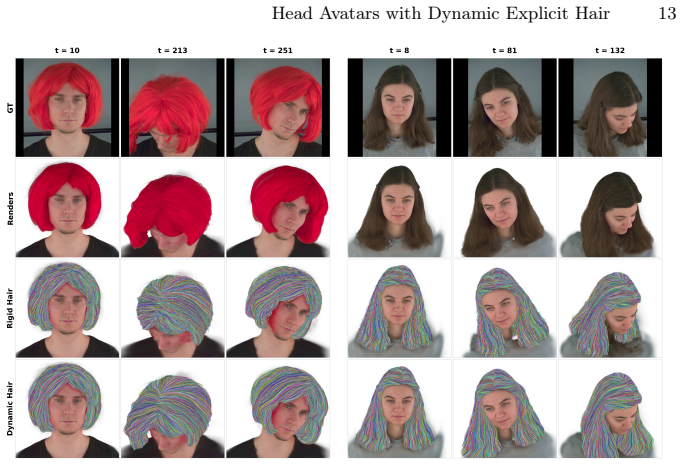
- [Figs. 3-5] Figures 3/4/9/10 would benefit from temporal strips or heatmaps of per-frame hair-region error; single frames under-support the temporal-coherence claims, which are the paper's core contribution.
Circularity Check
No significant circularity: DynHair is an empirical learned avatar model whose dynamics are fit to video and scored on held-out motions, not a first-principles derivation that collapses to its inputs.
full rationale
The paper's load-bearing chain is standard supervised/self-supervised learning, not a claimed algebraic or uniqueness derivation. Canonical strands H0 are initialized from a prior (Im2Haircut) and then jointly refined; non-rigid displacements are the free outputs of an LSTM+FiLM+MLP conditioned on measured head kinematics (Eqs. 2–7), optimized under photometric, silhouette/orientation, penetration, elastic, and color losses on multi-view training frames; evaluation is on held-out temporal splits, cross-reenactment, and external baselines (GHA, GaussianAvatars, hand-tuned Maya). Nothing in that chain defines the predicted quantity in terms of itself, renames a fitted constant as a prediction, or rests the central dynamics claim on an unverified self-citation uniqueness theorem. Self-citations (Im2Haircut, Neural Haircut, PhysHead, GHA-style body) supply initialization, related work, or the face backbone; they do not force the reported hair-dynamics result. The skeptic's 5-frame conditioning/identifiability concern is a modeling-capacity limitation, not circularity under the rubric. Score 0 with empty steps is the honest finding.
Axiom & Free-Parameter Ledger
free parameters (6)
- Loss weights (λ_rgb, λ_ssim, λ_vgg, λ_seg, λ_orient, λ_penetr, λ_elastic, color regs) =
e.g. λ_elastic=500, λ_seg=10 with decay, λ_vgg 0.1→0.6 (App. B.1)
- Motion history window T =
T=5
- Strand discretization (N strands, L points) =
L=40, ~11k strands
- Learnable root attenuation ρ_j =
linear ramp init to 1.0 at tip
- Per-axis ω/α normalization maxima from training set =
dataset-dependent max |ω|, |α|
- Maya baseline physical parameters =
stretchResistance=600, mass=2, drag=0.65, etc. (App. C.1)
axioms (6)
- domain assumption Differentiable 3D Gaussian splatting is a faithful enough image formation model for joint photometric and silhouette supervision of hair and face.
- domain assumption BFM/multi-view 3DMM tracking supplies accurate enough global head pose to derive angular velocity, acceleration, and head-local gravity.
- ad hoc to paper A short history of head-local ω, α, and g is a sufficient statistic for person-specific non-rigid hair displacement from a canonical style.
- domain assumption Im2Haircut PCA prior plus multi-view static optimization yields a usable canonical strand geometry including occluded inner structure.
- ad hoc to paper Elastic segment-length preservation and root attenuation are adequate physics proxies without full collision, friction, or material identification.
- domain assumption Pretrained hair/body segmentation and Gabor orientation maps are accurate enough geometric supervisors.
invented entities (2)
-
DynHair hair deformation network (LSTM on γ(ω,α,g) → FiLM → strand MLP with root attenuation)
no independent evidence
-
Custom temporal/physics metrics (tLPIPS_ex, VER, CTS, P95-Disp, AMD)
no independent evidence
read the original abstract
We present DynHair, a novel method for tracking and modeling dynamic hair for human head avatars. From video input, we reconstruct a dynamic head avatar with an explicit strand-based hair representation using structured 3D Gaussian Splatting. In contrast to the face region of human head avatars, which can be modeled with 3D Gaussians that are attached or generated with respect to some expressive 3D head model, hair is particularly challenging as it exhibits dynamic motion effects. Therefore, we present a novel method that models the dynamic deformations of the hair strands using a temporal network that is conditioned on angular velocity and acceleration of the head, as well as relative gravity. Specifically, an LSTM encodes the motion history and modulates per-point strand features via FiLM conditioning which further used by MLP to produce physically plausible displacements to canonical hairstyle. We jointly optimize this motion and appearance representation of the hair, with a 3DGS-based representation of the face-region, via differentiable Gaussian splatting with photometric, geometric, and physics-based supervision. As a result of our method, we retrieve hair tracking of the training video data and an animatable head avatar with controllable hair dynamics. In our experiments, we demonstrate state-of-the-art performance in terms of hair dynamics, temporal consistency, and generalization across subjects.
Figures




Reference graph
Works this paper leans on
-
[1]
Autodesk, INC. maya. Maya, accessed: 2025-10-10
2025
-
[2]
Unreal Engine, accessed: 2025-10-10
Epic Games unreal engine. Unreal Engine, accessed: 2025-10-10
2025
-
[3]
In: Proceedings of the IEEE/CVF International Conference on Computer Vision (ICCV)
Aneja, S., Sevastopolsky, A., Kirschstein, T., Thies, J., Dai, A., Nießner, M.: Gaus- sianspeech: Audio-driven personalized 3d gaussian avatars. In: Proceedings of the IEEE/CVF International Conference on Computer Vision (ICCV). pp. 13065– 13075 (October 2025)
2025
-
[4]
In: Musialski, P., Lim, I
Ben Ayed, F., Becherini, G., Thies, J., Sklyarova, V.: Vid2Haircut: 3D Strand- Based Hairstyle Reconstruction from Video. In: Musialski, P., Lim, I. (eds.) Euro- graphics 2026 - Short Papers. The Eurographics Association (2026)
2026
-
[5]
Transactions on Graphics, (Proc
Bertails, F., Audoly, B., Cani, M.P., Querleux, B., Leroy, F., Lévêque, J.L.: Super- helices for predicting the dynamics of natural hair. Transactions on Graphics, (Proc. SIGGRAPH)25(3), 1180–1187 (2006)
2006
-
[6]
In: Computer graphics forum
Blanz, V., Basso, C., Poggio, T., Vetter, T.: Reanimating faces in images and video. In: Computer graphics forum. vol. 22, pp. 641–650. Wiley Online Library (2003)
2003
-
[7]
Bouaziz, S., Wang, Y., Pauly, M.: Online modeling for realtime facial animation 32(4) (Jul 2013)
2013
-
[8]
In: International Conference on Computer Vision (ICCV) (2021)
Chen, X., Zheng, Y., Black, M.J., Hilliges, O., Geiger, A.: SNARF: Differentiable forward skinning for animating non-rigid neural implicit shapes. In: International Conference on Computer Vision (ICCV) (2021)
2021
-
[9]
In: SIGGRAPH Conference Papers (SA)
Chen, Y., Wang, L., Li, Q., Xiao, H., Zhang, S., Yao, H., Liu, Y.: Monogaussiana- vatar: Monocular gaussian point-based head avatar. In: SIGGRAPH Conference Papers (SA). pp. 1–9 (2024)
2024
-
[10]
In: The Thirty-eighthAnnualConferenceonNeuralInformationProcessingSystems(2024)
Chu, X., Harada, T.: Generalizable and animatable gaussian head avatar. In: The Thirty-eighthAnnualConferenceonNeuralInformationProcessingSystems(2024)
2024
-
[11]
Community, B.O.: Blender - a 3d modelling and rendering package (2018)
2018
-
[12]
Daněček, R., Schmitt, C., Polikovsky, S., Black, M.J.: Supervising 3D talking head avatarswithanalysis-by-audio-synthesis.In:InternationalConferenceon3DVision (3DV) (2026)
2026
-
[13]
In: SIGGRAPH Conference Papers (SA)
Daviet, G.: Interactive hair simulation on the gpu using admm. In: SIGGRAPH Conference Papers (SA). SIGGRAPH ’23, Association for Computing Machinery, New York, NY, USA (2023)
2023
-
[14]
arXiv preprint arXiv:2309.06441 (2023)
Feng, Y., Liu, W., Bolkart, T., Yang, J., Pollefeys, M., Black, M.J.: Learning dis- entangled avatars with hybrid 3d representations. arXiv preprint arXiv:2309.06441 (2023)
Pith/arXiv arXiv 2023
-
[15]
In: Conference on Computer Vision and Pattern Recognition (CVPR)
Gafni, G., Thies, J., Zollhofer, M., Nießner, M.: Dynamic neural radiance fields for monocular 4d facial avatar reconstruction. In: Conference on Computer Vision and Pattern Recognition (CVPR). pp. 8649–8658 (2021)
2021
-
[16]
ACM Transactions on Graphics (TOG)41(6), 1–12 (2022)
Gao, X., Zhong, C., Xiang, J., Hong, Y., Guo, Y., Zhang, J.: Reconstructing per- sonalized semantic facial nerf models from monocular video. ACM Transactions on Graphics (TOG)41(6), 1–12 (2022)
2022
-
[17]
In: Computer graphics forum
Garbin, S.J., Kowalski, M., Estellers, V., Szymanowicz, S., Rezaeifar, S., Shen, J., Johnson, M.A., Valentin, J.: Voltemorph: Real-time, controllable and generalizable animation of volumetric representations. In: Computer graphics forum. vol. 43, p. e15117. Wiley Online Library (2024)
2024
-
[18]
In: SIGGRAPH Asia 2024 Conference Papers
Giebenhain, S., Kirschstein, T., Rünz, M., Agapito, L., Nießner, M.: Npga: Neural parametric gaussian avatars. In: SIGGRAPH Asia 2024 Conference Papers. pp. 1–11 (2024) Head Avatars with Dynamic Explicit Hair 17
2024
-
[19]
In: Proceedings of the IEEE/CVF conference on computer vision and pattern recognition
Grassal, P.W., Prinzler, M., Leistner, T., Rother, C., Nießner, M., Thies, J.: Neu- ral head avatars from monocular rgb videos. In: Proceedings of the IEEE/CVF conference on computer vision and pattern recognition. pp. 18653–18664 (2022)
2022
-
[20]
In: SIGGRAPH Asia 2024 Real-Time Live! SA Real-Time Live! ’24 (2024)
He, C., Amador Herrera, J.A., Zhou, Y., Shu, Z., Sun, X., Feng, Y., Pirk, S., Michels, D.L., Zhang, M., Wang, T.Y., Rushmeier, H.: Digital salon: An ai and physics-driven tool for 3d hair grooming and simulation. In: SIGGRAPH Asia 2024 Real-Time Live! SA Real-Time Live! ’24 (2024)
2024
-
[21]
In: International Conference on Learning Represen- tations (ICLR) (2025)
He, C., Sun, X., Shu, Z., Luan, F., Pirk, S., Herrera, J.A.A., Michels, D.L., Wang, T.Y., Zhang, M., Rushmeier, H., Zhou, Y.: Perm: A parametric representation for multi-style 3d hair modeling. In: International Conference on Learning Represen- tations (ICLR) (2025)
2025
-
[22]
In: International Conference on Computer Vision (ICCV) (2024)
Herrera, J.A.A., Zhou, Y., Sun, X., Shu, Z., He, C., Pirk, S., Michels, D.L.: Aug- mented mass-spring model for real-time dense hair simulation. In: International Conference on Computer Vision (ICCV) (2024)
2024
-
[23]
Heusel,M.,Ramsauer,H.,Unterthiner,T.,Nessler,B.,Hochreiter,S.:Ganstrained by a two time-scale update rule converge to a local nash equilibrium (2018)
2018
-
[24]
In: Proceedings of the IEEE/CVF Conference on Com- puter Vision and Pattern Recognition
Hong, Y., Peng, B., Xiao, H., Liu, L., Zhang, J.: Headnerf: A real-time nerf-based parametric head model. In: Proceedings of the IEEE/CVF Conference on Com- puter Vision and Pattern Recognition. pp. 20374–20384 (2022)
2022
-
[25]
Computer Graphics and Interactive Techniques (PACMCGIT)6(3) (2023)
Huang, L., Yang, F., Wei, C., Chen, Y.J.E., Yuan, C., Gao, M.: Towards realtime: A hybrid physics-based method for hair animation on gpu. Computer Graphics and Interactive Techniques (PACMCGIT)6(3) (2023)
2023
-
[26]
In: SIGGRAPH
Iandola, F., Pidhorskyi, S., Santesteban, I., Gupta, D., Pahuja, A., Bartolovic, N., Yu, F., Garbin, E., Simon, T., Saito, S.: SqueezeMe: Mobile-ready distillation of gaussian full-body avatars. In: SIGGRAPH. ACM (2025)
2025
-
[27]
ACM Trans
Ichim, A.E., Bouaziz, S., Pauly, M.: Dynamic 3d avatar creation from hand-held video input. ACM Trans. Graph.34(4) (Jul 2015)
2015
-
[28]
In: Proc
Kabadayi, B., Sklyarova, V., Zielonka, W., Thies, J., Pons-Moll, G.: PhysHead: Simulation-ready gaussian head avatars. In: Proc. IEEE/CVF Conf. on Computer Vision and Pattern Recognition (CVPR) (June 2026)
2026
-
[29]
In: International Confer- ence on 3D Vision (3DV) (March 2024)
Kabadayi, B., Zielonka, W., Bhatnagar, B.L., Pons-Moll, G., Thies, J.: Gan-avatar: Controllable personalized gan-based human head avatar. In: International Confer- ence on 3D Vision (3DV) (March 2024)
2024
-
[30]
In: AAAI (2022)
Ke, Z., Sun, J., Li, K., Yan, Q., Lau, R.W.: Modnet: Real-time trimap-free portrait matting via objective decomposition. In: AAAI (2022)
2022
-
[31]
Transactions on Graphics, (Proc
Kerbl, B., Kopanas, G., Leimkühler, T., Drettakis, G.: 3d gaussian splatting for real-time radiance field rendering. Transactions on Graphics, (Proc. SIGGRAPH) 42(4), 139–1 (2023)
2023
-
[32]
ACM Transactions on Graphics (TOG)42(4), 1–14 (2023)
Kirschstein, T., Qian, S., Giebenhain, S., Walter, T., Nießner, M.: Nersemble: Multi-view radiance field reconstruction of human heads. ACM Transactions on Graphics (TOG)42(4), 1–14 (2023)
2023
-
[33]
In: Proceedings of the IEEE/CVF International Conference on Computer Vision
Kirschstein, T., Romero, J., Sevastopolsky, A., Nießner, M., Saito, S.: Avat3r: Large animatable gaussian reconstruction model for high-fidelity 3d head avatars. In: Proceedings of the IEEE/CVF International Conference on Computer Vision. pp. 12089–12100 (2025)
2025
-
[34]
Transactions on Graphics, (Proc
Li, T., Bolkart, T., Black, M.J., Li, H., Romero, J.: Learning a model of facial shape and expression from 4d scans. Transactions on Graphics, (Proc. SIGGRAPH Asia) 36(6), 194–1 (2017)
2017
-
[35]
In: Proceedings of the IEEE/CVF International Conference on Computer Vision (ICCV) (October 2025) 18 V
Liao, Z., Tu, H., Peng, C., Zhang, H., Zhou, B., Liu, Y.: Hades: Human avatar with dynamic explicit hair strands. In: Proceedings of the IEEE/CVF International Conference on Computer Vision (ICCV) (October 2025) 18 V. Sklyarova et al
2025
-
[36]
Transactions on Pattern Analysis and Machine Intelligence (TPAMI)PP(2025)
Liao, Z., Xu, Y., Li, Z., Li, Q., Zhou, B., Bai, R., Xu, D., Zhang, H., Liu, Y.: Hha- vatar: Gaussian head avatar with dynamic hairs. Transactions on Pattern Analysis and Machine Intelligence (TPAMI)PP(2025)
2025
-
[37]
In: Proceedings of the IEEE/CVF Conference on Computer Vision and Pattern Recognition (CVPR)
Liu, K., Choi, O., Wang, J., Hwang, W.: Cdgnet: Class distribution guided network for human parsing. In: Proceedings of the IEEE/CVF Conference on Computer Vision and Pattern Recognition (CVPR). pp. 4473–4482 (June 2022)
2022
-
[38]
Transactions on Graphics, (Proc
Lombardi, S., Simon, T., Schwartz, G., Zollhoefer, M., Sheikh, Y., Saragih, J.: Mixture of volumetric primitives for efficient neural rendering. Transactions on Graphics, (Proc. SIGGRAPH)40(4) (2021)
2021
-
[39]
arXiv (2024)
Luo, H., Ouyang, M., Zhao, Z., Jiang, S., Zhang, L., Zhang, Q., Yang, W., Xu, L., Yu, J.: GaussianHair: Hair modeling and rendering with light-aware gaussians. arXiv (2024)
2024
-
[40]
In: Proceedings of the IEEE/CVF conference on computer vision and pattern recognition
Mescheder, L., Oechsle, M., Niemeyer, M., Nowozin, S., Geiger, A.: Occupancy networks: Learning 3d reconstruction in function space. In: Proceedings of the IEEE/CVF conference on computer vision and pattern recognition. pp. 4460–4470 (2019)
2019
-
[41]
In: Eu- ropean Conference on Computer Vision (ECCV)
Mildenhall, B., Srinivasan, P.P., Tancik, M., Barron, J.T., Ramamoorthi, R., Ng, R.: Nerf: Representing scenes as neural radiance fields for view synthesis. In: Eu- ropean Conference on Computer Vision (ECCV). Springer (2020)
2020
-
[42]
In: DAGM German Conference on Pattern Recognition
Nehvi, J., Kabadayi, B., Valentin, J., Thies, J.: Volumetric portrait avatar. In: DAGM German Conference on Pattern Recognition. pp. 3–19. Springer (2024)
2024
-
[43]
In: Proceedings of the IEEE/CVF international conference on computer vision
Park, K., Sinha, U., Barron, J.T., Bouaziz, S., Goldman, D.B., Seitz, S.M., Martin- Brualla, R.: Nerfies: Deformable neural radiance fields. In: Proceedings of the IEEE/CVF international conference on computer vision. pp. 5865–5874 (2021)
2021
-
[44]
ACM Trans
Park,K.,Sinha,U.,Hedman,P.,Barron,J.T.,Bouaziz,S.,Goldman,D.B.,Martin- Brualla, R., Seitz, S.M.: Hypernerf: A higher-dimensional representation for topo- logically varying neural radiance fields. ACM Trans. Graph.40(6) (dec 2021)
2021
-
[45]
In: 2009 sixth IEEE interna- tional conference on advanced video and signal based surveillance
Paysan, P., Knothe, R., Amberg, B., Romdhani, S., Vetter, T.: A 3d face model for pose and illumination invariant face recognition. In: 2009 sixth IEEE interna- tional conference on advanced video and signal based surveillance. pp. 296–301. Ieee (2009)
2009
-
[46]
In: AAAI (2018)
Perez, E., Strub, F., de Vries, H., Dumoulin, V., Courville, A.C.: Film: Visual reasoning with a general conditioning layer. In: AAAI (2018)
2018
-
[47]
In: Con- ference on Computer Vision and Pattern Recognition (CVPR)
Qian, S., Kirschstein, T., Schoneveld, L., Davoli, D., Giebenhain, S., Nießner, M.: Gaussianavatars: Photorealistic head avatars with rigged 3d gaussians. In: Con- ference on Computer Vision and Pattern Recognition (CVPR). pp. 20299–20309 (2024)
2024
-
[48]
In: Conference on Computer Vision and Pattern Recognition (CVPR) (2025)
Rosu, R.A., Wu, K., Feng, Y., Zheng, Y., Black, M.J.: DiffLocks: Generating 3d hair from a single image using diffusion models. In: Conference on Computer Vision and Pattern Recognition (CVPR) (2025)
2025
-
[49]
In: Proceedings of the IEEE/CVF conference on computer vision and pattern recognition
Saito, S., Schwartz, G., Simon, T., Li, J., Nam, G.: Relightable gaussian codec avatars. In: Proceedings of the IEEE/CVF conference on computer vision and pattern recognition. pp. 130–141 (2024)
2024
-
[50]
In: Conference on Computer Vision and Pattern Recognition (CVPR)
Shao, Z., Wang, Z., Li, Z., Wang, D., Lin, X., Zhang, Y., Fan, M., Wang, Z.: Splattingavatar: Realistic real-time human avatars with mesh-embedded gaussian splatting. In: Conference on Computer Vision and Pattern Recognition (CVPR). pp. 1606–1616 (2024)
2024
-
[51]
19705–19716 (2023) Head Avatars with Dynamic Explicit Hair 19
Sklyarova, V., Chelishev, J., Dogaru, A., Medvedev, I., Lempitsky, V., Zakharov, E.:Neuralhaircut:Prior-guidedstrand-basedhairreconstruction.2023IEEE/CVF International Conference on Computer Vision (ICCV) pp. 19705–19716 (2023) Head Avatars with Dynamic Explicit Hair 19
2023
-
[52]
In: International Conference on Computer Vision (ICCV) (2025)
Sklyarova, V., Zakharov, E., Prinzler, M., Becherini, G., Black, M., Thies, J.: Im2haircut: Single-view strand-based hair reconstruction for human avatars. In: International Conference on Computer Vision (ICCV) (2025)
2025
-
[53]
In: Conference on Com- puter Vision and Pattern Recognition (CVPR) (2024)
Stuyck, T., Lin, G.W.C., Larionov, E., Chen, H.y., Bozic, A., Sarafianos, N., Roble, D.: Quaffure: Real-time quasi-static neural hair simulation. In: Conference on Com- puter Vision and Pattern Recognition (CVPR) (2024)
2024
-
[54]
In: Proceedings of the SIGGRAPH Asia 2025 Conference Papers
Teotia, K., Rhodin, H., Mendiratta, M., Kim, H., Habermann, M., Theobalt, C.: Audio driven universal gaussian head avatars. In: Proceedings of the SIGGRAPH Asia 2025 Conference Papers. SA Conference Papers ’25, Association for Comput- ing Machinery, New York, NY, USA (2025)
2025
-
[55]
In: International Conference on 3D Vision 2025 (2025)
Thambiraja, B., Prinzler, M., Aliakbarian, S., Cosker, D., Thies, J.: 3diFACE: Synthesizing and editing holistic 3d facial animation. In: International Conference on 3D Vision 2025 (2025)
2025
-
[56]
In: Proceedings of the IEEE/CVF Conference on Computer Vision and Pattern Recognition (CVPR)
Wang, C., Kang, D., Sun, H., Qian, S., Wang, Z., Bao, L., Zhang, S.H.: Mega: Hybrid mesh-gaussian head avatar for high-fidelity rendering and head editing. In: Proceedings of the IEEE/CVF Conference on Computer Vision and Pattern Recognition (CVPR). pp. 26274–26284 (June 2025)
2025
-
[57]
IEEE Transactions on Visualization and Computer Graphics (2025)
Wang, J., Xie, J.C., Li, X., Xu, F., Pun, C.M., Gao, H.: Gaussianhead: High- fidelity head avatars with learnable gaussian derivation. IEEE Transactions on Visualization and Computer Graphics (2025)
2025
-
[58]
In: Advances in Neural Information Processing Systems (NeurIPS) (2025)
Wang,J.,Xu,Y.,Tretschk,E.,Wang,Z.,Ianina,A.,Bozic,A.,Neumann,U.,Tung, T.: Dgh: Dynamic gaussian hair. In: Advances in Neural Information Processing Systems (NeurIPS) (2025)
2025
-
[59]
In: Conference on Computer Vision and Pattern Recognition (CVPR) (2023)
Wang, Z., Nam, G., Stuyck, T., Lombardi, S., Cao, C., Saragih, J., Zollhoefer, M., Hodgins, J., Lassner, C.: Neuwigs: A neural dynamic model for volumetric hair cap- ture and animation. In: Conference on Computer Vision and Pattern Recognition (CVPR) (2023)
2023
-
[60]
In: Conference on Computer Vision and Pattern Recognition (CVPR) (2022)
Wang, Z., Nam, G., Stuyck, T., Lombardi, S., Zollhoefer, M., Hodgins, J., Lassner, C.: Hvh: Learning a hybrid neural volumetric representation for dynamic hair performance capture. In: Conference on Computer Vision and Pattern Recognition (CVPR) (2022)
2022
-
[61]
ACM transactions on graphics (TOG)30(4), 1–10 (2011)
Weise, T., Bouaziz, S., Li, H., Pauly, M.: Realtime performance-based facial ani- mation. ACM transactions on graphics (TOG)30(4), 1–10 (2011)
2011
-
[62]
In: Conference on Computer Vision and Pattern Recognition (CVPR) (2024)
Wu, K., Yang, L., Kuang, Z., Feng, Y., Han, X., Shen, Y., Fu, H., Zhou, K., Zheng, Y.: Monohair: High-fidelity hair modeling from a monocular video. In: Conference on Computer Vision and Pattern Recognition (CVPR) (2024)
2024
-
[63]
In: Conference on Computer Vision and Pattern Recognition (CVPR)
Xiang, J., Gao, X., Guo, Y., Zhang, J.: Flashavatar: High-fidelity head avatar with efficient gaussian embedding. In: Conference on Computer Vision and Pattern Recognition (CVPR). pp. 1802–1812 (2024)
2024
-
[64]
In: Conference on Computer Vision and Pattern Recognition (CVPR)
Xu, Y., Chen, B., Li, Z., Zhang, H., Wang, L., Zheng, Z., Liu, Y.: Gaussian head avatar: Ultra high-fidelity head avatar via dynamic gaussians. In: Conference on Computer Vision and Pattern Recognition (CVPR). pp. 1931–1941 (2024)
1931
-
[65]
Transactions on Graphics, (Proc
Yang, L., Shi, Z., Zheng, Y., Zhou, K.: Dynamic hair modeling from monocular videos using deep neural networks. Transactions on Graphics, (Proc. SIGGRAPH) 38(6) (2019)
2019
-
[66]
In: Thirty-Fifth Conference on Neural Information Processing Systems (2021)
Yariv, L., Gu, J., Kasten, Y., Lipman, Y.: Volume rendering of neural implicit surfaces. In: Thirty-Fifth Conference on Neural Information Processing Systems (2021)
2021
-
[67]
In: European Conference of Computer Vision (ECCV) (2024) 20 V
Zakharov, E., Sklyarova, V., Black, M.J., Nam, G., Thies, J., Hilliges, O.: Human hair reconstruction with strand-aligned 3d gaussians. In: European Conference of Computer Vision (ECCV) (2024) 20 V. Sklyarova et al
2024
-
[68]
In: Proceedings of the IEEE conference on computer vision and pattern recognition
Zhang, R., Isola, P., Efros, A.A., Shechtman, E., Wang, O.: The unreasonable effectiveness of deep features as a perceptual metric. In: Proceedings of the IEEE conference on computer vision and pattern recognition. pp. 586–595 (2018)
2018
-
[69]
In: Conference on Computer Vision and Pattern Recognition (CVPR)
Zheng, Y., Abrevaya, V.F., Bühler, M.C., Chen, X., Black, M.J., Hilliges, O.: Im avatar: Implicit morphable head avatars from videos. In: Conference on Computer Vision and Pattern Recognition (CVPR). pp. 13545–13555 (2022)
2022
-
[70]
Transactions on Graphics, (Proc
Zhou, Y., Chai, M., Pepe, A., Gross, M., Beeler, T.: Groomgen: A high-quality generative hair model using hierarchical latent representations. Transactions on Graphics, (Proc. SIGGRAPH) (2023)
2023
-
[71]
Transactions on Graph- ics, (Proc
Zhou, Y., Chai, M., Wang, D., Winberg, S., Wood, E., Sarkar, K., Gross, M., Beeler, T.: Groomcap: High-fidelity prior-free hair capture. Transactions on Graph- ics, (Proc. SIGGRAPH) (2024)
2024
-
[72]
In: CVPR (June 2025)
Zielonka, W., Bolkart, T., Beeler, T., Thies, J.: Gaussian eigen models for human heads. In: CVPR (June 2025)
2025
-
[73]
In: Proceed- ings of the IEEE/CVF conference on computer vision and pattern recognition
Zielonka, W., Bolkart, T., Thies, J.: Instant volumetric head avatars. In: Proceed- ings of the IEEE/CVF conference on computer vision and pattern recognition. pp. 4574–4584 (2023)
2023
-
[74]
In: Pro- ceedings of the IEEE/CVF Conference on Computer Vision and Pattern Recogni- tion (CVPR) (June 2025)
Zielonka, W., Garbin, S.J., Lattas, A., Kopanas, G., Gotardo, P., Beeler, T., Thies, J., Bolkart, T.: Synthetic prior for few-shot drivable head avatar inversion. In: Pro- ceedings of the IEEE/CVF Conference on Computer Vision and Pattern Recogni- tion (CVPR) (June 2025)
2025
-
[75]
Which rendering looks more realistic, especially in the hair region?
Zielonka, W., Kirschstein, T., Bolkart, T., Giebenhain, S., Sklyarova, V., Deng, X., Xiang, D., Saito, S., Liu, Y., Nießner, M., Thies, J.: How to build digital humans? from priors to photorealistic avatars. Computer Graphics Forum (Eurographics State-of-the-Art Report)45(2) (2026) Head Avatars with Dynamic Explicit Hair 21 A Background A.1 Dynamic Head A...
2026
discussion (0)
Sign in with ORCID, Apple, or X to comment. Anyone can read and Pith papers without signing in.