REVIEW 2 major objections 1 minor 1 cited by
Sample-efficient Low-level Motion Planning for Robotic Manipulation Tasks via Zero-shot Transfer Learning
T0 review · 2 major / 1 minor · reviewed 2026-06-28 · grok-4.3
Pith's one-line read Transferring iCEM parameters from simple to complex tasks improves robotic manipulation success rates by up to 23%.
desk verdict This applies transfer learning to iCEM parameters for harder manipulation tasks plus reward redesign, with a real Franka test, but the evidence for the 23% gains is too thin to evaluate properly. read the letter →
The pith
A machine-rendered reading of the paper's core claim, the machinery that carries it, and where it could break.
The reading
What carries the argument
iCEM+TL framework that transfers key parameters of the Sample-efficient Cross-Entropy Method from upstream to downstream tasks.
What would settle it
Running the complex tasks with transferred parameters and finding success rates equal to or lower than the standard iCEM without transfer.
Extended reading notes
Core claim
The iCEM+TL framework explicitly leverages transfer learning where key iCEM parameters are transferred from simpler upstream tasks to guide more complex downstream tasks, combined with reward redesign through task decomposition, resulting in success rate improvements of up to 23% in simulation and practical feasibility on a real Franka Emika robot.
Load-bearing premise
Key iCEM parameters from simpler tasks will transfer reliably to improve performance on complex tasks without negative effects or need for much extra tuning.
Editorial extensions
If this is right
- Success rates in complex tasks like stacking, sliding, and shelf placement increase by up to 23% in simulation.
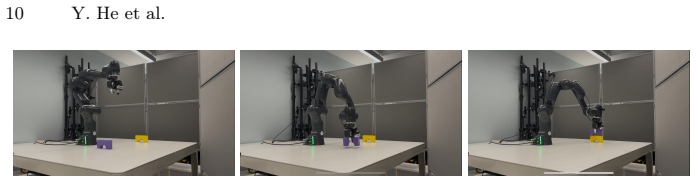
- The approach demonstrates real-world applicability by succeeding in a stacking task on a physical Franka Emika robot.
- Training times decrease through reuse of parameters across tasks.
- Low-level real-time planning becomes more effective in sophisticated robotic systems.
Reading between the lines
- Similar transfer strategies might apply to other planning algorithms beyond iCEM.
- Task decomposition for reward redesign could extend to additional manipulation scenarios.
- Zero-shot transfer may scale to even more complex multi-step robotic operations if parameter selection is refined.
Editorial analysis
A structured set of objections, weighed in public.
Referee Report
Summary. The manuscript proposes the iCEM+TL framework, which augments the Sample-efficient Cross-Entropy Method (iCEM) with zero-shot transfer learning by moving key parameters from simpler upstream tasks to more complex downstream robotic manipulation tasks (stacking, sliding, shelf placement). It further incorporates reward redesign (RR) via task decomposition for stacking and shelf placement. Simulation experiments are reported to yield success-rate gains of up to 23 percent; the approach is additionally validated on a physical Franka Emika robot performing a stacking task.
Significance. If the reported gains can be shown to arise specifically from the transferred iCEM parameters rather than from reward redesign, environment differences, or hyper-parameter tuning, the work would offer a practical route to sample-efficient low-level planning that reduces the need for task-specific retraining. The real-robot demonstration, if statistically supported, would strengthen the case for deployability.
major comments (2)
- [Abstract] Abstract: the central claim of 'success rate improvements of up to 23%' is presented without any baseline (plain iCEM, other planners), number of trials, variance, error bars, or statistical test, rendering the magnitude and attribution of the gain impossible to evaluate.
- [Results] Results / Experiments: the transfer-learning assumption—that iCEM parameters learned on simpler tasks transfer reliably to stacking/sliding/shelf tasks without negative transfer or further adaptation—is load-bearing yet unsupported by ablations that isolate TL from RR or that quantify transfer success versus failure cases.
minor comments (1)
- [Abstract] Abstract: the expansion of iCEM is given as 'Sample-efficient Cross-Entropy Method' but the original iCEM reference is not cited, leaving readers without the source of the base algorithm.
Simulated Author's Rebuttal
We thank the referee for the detailed and constructive review. We address each major comment below and outline the revisions we will make to strengthen the manuscript.
read point-by-point responses
-
Referee: [Abstract] Abstract: the central claim of 'success rate improvements of up to 23%' is presented without any baseline (plain iCEM, other planners), number of trials, variance, error bars, or statistical test, rendering the magnitude and attribution of the gain impossible to evaluate.
Authors: We agree that the abstract is insufficiently detailed for evaluating the reported gains. In the revised version we will expand the abstract to explicitly name the plain iCEM baseline, state the number of trials, and report variance (or error bars) together with any statistical tests used. The results section already contains these quantities; the abstract will be updated to match. revision: yes
-
Referee: [Results] Results / Experiments: the transfer-learning assumption—that iCEM parameters learned on simpler tasks transfer reliably to stacking/sliding/shelf tasks without negative transfer or further adaptation—is load-bearing yet unsupported by ablations that isolate TL from RR or that quantify transfer success versus failure cases.
Authors: We acknowledge that isolating the contribution of transferred iCEM parameters from reward redesign (RR) is necessary to substantiate the transfer-learning claim. The current experiments evaluate the combined iCEM+TL+RR pipeline; we will add explicit ablation studies in the revised manuscript that separately apply TL without RR and RR without TL, and that report transfer success versus failure rates across the downstream tasks. revision: yes
Circularity Check
No circularity: purely empirical framework with no derivations or self-referential predictions
full rationale
The paper presents an empirical framework (iCEM+TL with reward redesign) whose central claims are measured success-rate gains (up to 23%) on simulation tasks and a real-robot stacking validation. No equations, parameter-free derivations, or uniqueness theorems appear; the load-bearing steps are the reported experimental outcomes rather than any algebraic reduction to fitted inputs or self-citations. The transfer assumption is stated as an empirical hypothesis, not derived by construction from the same data. Consequently the argument remains externally falsifiable and contains no self-definitional, fitted-prediction, or self-citation-load-bearing circularity.
Assumptions & free parameters
Cite this review
Pith. "Pith review of Sample-efficient Low-level Motion Planning for Robotic Manipulation Tasks via Zero-shot Transfer Learning." pith.science (2026). https://pith.science/paper/ILVQSM4P
@misc{pith2026260606041,
  author       = {Pith},
  title        = {Pith review of: Sample-efficient Low-level Motion Planning for Robotic Manipulation Tasks via Zero-shot Transfer Learning},
  year         = {2026},
  howpublished = {\url{https://pith.science/paper/ILVQSM4P}},
  note         = {Machine review of arXiv:2606.06041}
}
read the original abstract
As robotic systems become more sophisticated, the growing complexity of their motion planning models and the longer training times pose substantial challenges. Evolutionary algorithms such as the Sample-efficient Cross-Entropy Method (iCEM) have recently demonstrated promising potential for low-level real-time planning by leveraging efficient knowledge reuse strategies to improve performance. Although effective in many control tasks, iCEM's performance can be constrained in more complex scenarios, particularly those requiring stacking, sliding, and shelf placement. In this work, we propose a novel iCEM+TL framework that explicitly leverages Transfer Learning (TL), where key iCEM parameters are transferred from simpler upstream tasks to guide more complex downstream tasks. Additionally, we applied Reward Redesign (RR) through task decomposition for stacking objects and shelf placement to optimize task-specific performance. Results from the simulation show that our framework achieves success rate improvements of up to 23%. The framework is further validated on a real Franka Emika robot in a stacking task, demonstrating its practical feasibility for real-world deployment.
Figures


Figures from the paper (3 more)


Forward citations
Cited by 1 Pith paper
-
Detector Confidence Signals Presence Rather Than Occlusion in Cluttered Manipulation
Open-vocabulary detector confidence stays high when a queried object is occluded because it fires on same-category distractors, so it reports category presence rather than target visibility.
Reference graph
Works this paper leans on
-
[1]
Artificial intelligence, machine learning and deep learning in advanced robotics, a review.Cognitive Robotics, 3:54–70, 2023
Mohsen Soori, Behrooz Arezoo, and Roza Dastres. Artificial intelligence, machine learning and deep learning in advanced robotics, a review.Cognitive Robotics, 3:54–70, 2023. 12 Y. He et al
2023
-
[2]
An open-source multi-goal rein- forcement learning environment for robotic manipulation with pybullet
Xintong Yang, Ze Ji, Jing Wu, and Yu-Kun Lai. An open-source multi-goal rein- forcement learning environment for robotic manipulation with pybullet. InAnnual Conference Towards Autonomous Robotic Systems, pages 14–24. Springer, 2021
2021
-
[3]
Curious exploration via structured world models yields zero-shot object manipulation.Advances in Neural Information Processing Systems, 35:24170–24183, 2022
Cansu Sancaktar, Sebastian Blaes, and Georg Martius. Curious exploration via structured world models yields zero-shot object manipulation.Advances in Neural Information Processing Systems, 35:24170–24183, 2022
2022
-
[4]
Transfer learning in robotics: An upcoming breakthrough? a review of promises and challenges.The International Journal of Robotics Research, 44(3):465–485, 2025
Noémie Jaquier, Michael C Welle, Andrej Gams, Kunpeng Yao, Bernardo Fichera, Aude Billard, Aleš Ude, Tamim Asfour, and Danica Kragic. Transfer learning in robotics: An upcoming breakthrough? a review of promises and challenges.The International Journal of Robotics Research, 44(3):465–485, 2025
2025
-
[5]
Transfer learning in deep reinforcement learning: A survey.IEEE Transactions on Pattern Analysis and Machine Intelligence, 45(11):13344–13362, 2023
Zhuangdi Zhu, Kaixiang Lin, Anil K Jain, and Jiayu Zhou. Transfer learning in deep reinforcement learning: A survey.IEEE Transactions on Pattern Analysis and Machine Intelligence, 45(11):13344–13362, 2023
2023
-
[6]
Few-shot transfer learning for deep reinforcement learning on robotic manipulation tasks
Yuanzhi He, Christopher D Wallbridge, Juan D Hernndez, and Gualtiero B Colombo. Few-shot transfer learning for deep reinforcement learning on robotic manipulation tasks. InAnnual Conference Towards Autonomous Robotic Systems, pages 85–92. Springer, 2024
2024
-
[7]
Curious: intrinsically motivated modular multi-goal reinforce- ment learning
Cédric Colas, Pierre Fournier, Mohamed Chetouani, Olivier Sigaud, and Pierre- Yves Oudeyer. Curious: intrinsically motivated modular multi-goal reinforce- ment learning. InInternational conference on machine learning, pages 1331–1340. PMLR, 2019
2019
-
[8]
Soft actor- critic: Off-policy maximum entropy deep reinforcement learning with a stochastic actor
Tuomas Haarnoja, Aurick Zhou, Pieter Abbeel, and Sergey Levine. Soft actor- critic: Off-policy maximum entropy deep reinforcement learning with a stochastic actor. InInternational conference on machine learning, pages 1861–1870. Pmlr, 2018
2018
Show all 16 references
-
[9]
Con- trolling overestimation bias with truncated mixture of continuous distributional quantile critics
Arsenii Kuznetsov, Pavel Shvechikov, Alexander Grishin, and Dmitry Vetrov. Con- trolling overestimation bias with truncated mixture of continuous distributional quantile critics. InInternational conference on machine learning, pages 5556–5566. PMLR, 2020
2020
-
[10]
Hindsight experience replay.Advances in neural information processing systems, 30, 2017
Marcin Andrychowicz, Filip Wolski, Alex Ray, Jonas Schneider, Rachel Fong, Pe- ter Welinder, Bob McGrew, Josh Tobin, OpenAI Pieter Abbeel, and Wojciech Zaremba. Hindsight experience replay.Advances in neural information processing systems, 30, 2017
2017
-
[11]
First return, then explore.Nature, 590(7847):580–586, 2021
Adrien Ecoffet, Joost Huizinga, Joel Lehman, Kenneth O Stanley, and Jeff Clune. First return, then explore.Nature, 590(7847):580–586, 2021
2021
-
[12]
Evolu- tion strategies as a scalable alternative to reinforcement learning.arXiv preprint arXiv:1703.03864, 2017
Tim Salimans, Jonathan Ho, Xi Chen, Szymon Sidor, and Ilya Sutskever. Evolu- tion strategies as a scalable alternative to reinforcement learning.arXiv preprint arXiv:1703.03864, 2017
2017 arXiv
-
[13]
Sample-efficient cross-entropy method for real-time planning
Cristina Pinneri, Shambhuraj Sawant, Sebastian Blaes, Jan Achterhold, Joerg Stueckler, Michal Rolinek, and Georg Martius. Sample-efficient cross-entropy method for real-time planning. InConference on Robot Learning, pages 1049–
-
[14]
Learning robotic manipulation policies from point clouds with conditional flow matching.Conference on Robot Learning (CoRL), 2024
Eugenio Chisari, Nick Heppert, Max Argus, Tim Welschehold, Thomas Brox, and Abhinav Valada. Learning robotic manipulation policies from point clouds with conditional flow matching.Conference on Robot Learning (CoRL), 2024
2024
-
[15]
Neural mp: A generalist neural motion planner.arXiv preprint arXiv:2409.05864, 2024
Murtaza Dalal, Jiahui Yang, Russell Mendonca, Youssef Khaky, Ruslan Salakhut- dinov, and Deepak Pathak. Neural mp: A generalist neural motion planner.arXiv preprint arXiv:2409.05864, 2024
2024
-
[16]
Openai gym.arXiv preprint arXiv:1606.01540, 2016
Greg Brockman, Vicki Cheung, Ludwig Pettersson, Jonas Schneider, John Schulman, Jie Tang, and Wojciech Zaremba. Openai gym.arXiv preprint arXiv:1606.01540, 2016
2016 arXiv
Reviewed June 28, 2026 · model on record in the stance chip above.
Discussion (0). Sign in to comment.