REVIEW 3 major objections 6 minor 4 cited by
DMRG and exact-diagonalization results on up to 72 sites indicate a gapped zero-field ground state for the easy-axis triangular-lattice Heisenberg model with α≲0.3–0.5, and a crossover/transition to gapless behavior at larger α.
Reviewed by Pith at T0; open to challenge. T0 means a machine referee read the full paper against a public rubric. the ladder, T0–T4 →
T0 review · deepseek-v4-flash
2026-08-04 09:52 UTC pith:IMXQ3XOV
load-bearing objection A careful but not decisive numerical case for a gapped ground state in the easy-axis triangular lattice; the effective-model comparison is the cleanest part, the extrapolations are the weak link. the 3 major comments →
The anisotropic Heisenberg model close to the Ising limit: triangular lattice vs. effective models
The pith
A machine-rendered reading of the paper's core claim, the machinery that carries it, and where it could break.
The authors study the spin-1/2 Heisenberg model with anisotropy α = J⊥/Jz < 1. Using density-matrix renormalization group (DMRG) on clusters up to N=72 sites and exact diagonalization on smaller clusters, they extract the magnetization m(h) near zero field. A nonzero intercept h* from the N→∞ extrapolation would mean a magnon gap—zero magnetization until the field exceeds h*. They also compute the spin stiffness ρs, which should vanish for a gapped state. Both probes point to a gap for α below roughly 0.3–0.5, and the inferred h* scales approximately like ζ α J. They emphasize that linear spin-wave theory, which predicts gapless modes and a finite transverse component, fails in this regime because magnons repel each other strongly, similar to electrons forming a Mott insulator.
In parallel, they freeze one-third of the triangular-lattice spins and arrive at effective honeycomb- and square-lattice models. These reproduce the triangular-lattice magnetization and transverse component for partially polarized states, but at the point meant to represent the triangular zero-field case they remain gapless with finite m⊥. So the simpler lattices are useful analogues, yet they miss the very gap the triangular lattice develops. The paper leaves open whether the gapped-to-gapless change at α* is a true transition or a smooth crossover.
Core claim
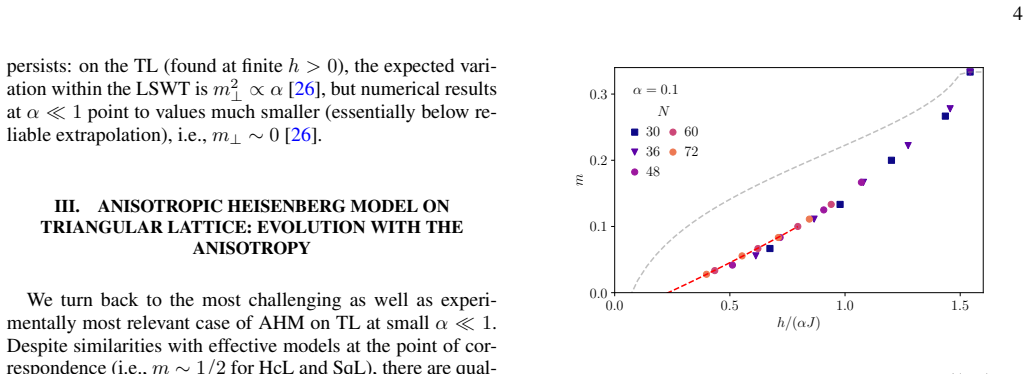
At zero field and α≪1, the triangular-lattice AHM has a gapped ground state with m⊥=0: 'the extrapolated results would be consistent with quite different marginal fields (effective magnon gaps) h*=Δ1=ζαJ' and 'extrapolated ρs/(αJ)→0 in the regime α<α*∼0.3'. The phase diagram (Fig. 7) therefore contains a 'gapped spin solid' for h<h*(α), with a crossover/transition to gapless supersolid at α*≲0.5.
Load-bearing premise
The deduced gap rests on N→∞ extrapolations of small-cluster quantities. h* is read off quadratic fits to ED/DMRG m(h) data for N≤72 (Fig. 4, Appendix A), and ρs is extrapolated by 1/N from N≤36 ED plus N=48 DMRG (Fig. 6). If the true thermodynamic limit has h*→0 or ρs>0 with a different scaling (the data are strongly size-dependent and the two probes give different α*≈0.5 vs 0.3), the gapped-solid claim collapses. The authors concede 'it seems beyond present numerical capabilities to clarify whether we are dealing with a transition or a crossover'.
Editorial analysis
A structured set of objections, weighed in public.
Referee Report
Summary. The paper studies the spin-1/2 easy-axis (XXZ) Heisenberg model on the triangular lattice (TL), with exchange anisotropy α = J⊥/Jz < 1 and a longitudinal field h, motivated by experiments on K2Co(SeO3)2 (α ≈ 0.07). It first compares the full TL model with effective models on honeycomb and square lattices obtained by freezing one third of the spins; at the correspondence point (m = 1/2 on the bipartite lattices, which corresponds to h = 0 on the TL), these effective models remain gapless with finite transverse magnetization m⊥. The central and more conjectural claim is that the TL model itself has a gapped ground state at h = 0 for α ≪ 1, with h* = Δ1 = ζαJ, and a transition/crossover to a gapless supersolid at α* ≲ 0.5. Evidence is drawn from (i) the zero-crossing of polynomial fits to magnetization curves m(h) from ED/DMRG on N = 30–72 (Sec. III A, Appendix A), and (ii) the 1/N-extrapolated spin stiffness ρs/(αJ), which vanishes for α ≲ 0.3 (Sec. III B). LSWT is shown to fail at h ∼ 0, with the failure attributed to effective magnon repulsion. The resulting phase diagram (Fig. 7) contains a gapped spin solid for h < h*(α). The authors explicitly concede that a transition vs a crossover at α* cannot be distinguished with present numerics.
Significance. Should the gapped-solid scenario survive, the paper would help settle an active controversy: the easy-axis TL model at α ≪ 1 would not be a supersolid at h = 0, directly affecting the interpretation of KCSO neutron-scattering and thermodynamic experiments, and it identifies a qualitative failure mechanism for LSWT (magnon repulsion / Mott-like gap). The numerical work is substantial: systematic ED/DMRG magnetization curves up to N = 72, a spin-stiffness analysis including a DMRG point at N = 48, and finite-size scaling of m⊥ on the effective honeycomb model. The multi-probe design (m(h), ρs, m⊥) and the explicit α > 0 vs α < 0 comparison are strengths, as is the falsifiable prediction h* = ζαJ with ζ extracted from data. The weaknesses are that both gap diagnostics are extrapolations with untested asymptotic forms and no error bars, and the two probes give inconsistent α* values (≈0.5 vs ≈0.3). The central claim is therefore plausible but not established by the present data; the stress-test concern about the unvalidated finite-size extrapolation lands.
major comments (3)
- [Sec. III A / Figs. 4,5; Appendix A] The gapped-solid claim rests on the marginal field h* extracted as the zero-crossing of a polynomial fit to m(h) for N = 30–72 (Fig. 4; Appendix A), not on a direct measurement of the one-magnon gap Δ1 = E(S_z = 1) − E0. For a gapless system with downward curvature in m(h), a polynomial fit can produce a spurious positive zero-crossing; the good data collapse does not fix the intercept. At α = 0.1 the extrapolated h* ≈ ζαJ ≈ 0.01–0.02 J (Fig. 5) is comparable to or smaller than the finite-size gap scale expected for a gapless system on the N = 72 cluster (∝ αJ/L, of order 0.07 J), so h* is not yet separated from finite-size effects. Fig. 5 has no error bars and the fit form/window are not specified. I recommend adding a direct one-magnon-gap analysis: extrapolate Δ1(N) = E(S_z = 1) − E0, already available in the DMRG runs restricted to S_z^tot ≤ 4, and test the sensitivity of h* to the f
- [Sec. III B / Fig. 6] The spin stiffness is extrapolated to N → ∞ with a bare 1/N ansatz using only four points (N = 18, 30, 36 by ED; N = 48 by DMRG), a fixed twist θ = 0.1 with no convergence check in θ, and no error bars. The conclusion that ρs/(αJ) → 0 for α ≲ 0.3 is fragile; alternative scalings (e.g., 1/N^2, exponential convergence, or an added curvature term) should be tested and shown not to change the zero crossing. In addition, the two probes are quantitatively inconsistent — α* ≈ 0.5 from h*(α) in Sec. III A vs α* ≈ 0.3 from ρs in Sec. III B — which under-determines the boundary drawn in Fig. 7. This discrepancy should be reconciled or presented as an explicit uncertainty range for α*.
- [Sec. V / Fig. 7] The authors state that it is 'beyond present numerical capabilities to clarify whether we are dealing with a transition or a crossover at a particular α*.' This ambiguity is load-bearing: the abstract and the phase diagram assert a gapped GS phase for h < h*(α), but a genuine thermodynamic phase requires h*(∞) > 0. Given the strong size dependence in Figs. 4 and 6 and the mismatch between the two probes, the abstract's wording ('confirm the existence of the gap', 'indicate a transition/crossover') overstates what the data establish. Unless the direct-gap extrapolation requested above is supplied, the central claim should be presented as 'consistent with a gapped solid'.
minor comments (6)
- [Fig. 5 (Sec. III A)] The procedure producing h* is not fully described: specify the polynomial degree, the h/(αJ) fitting window, and whether the fit is applied to the pooled finite-N data or to an extrapolated m(h). Add error estimates (e.g., bootstrap over N or over the fit range).
- [Eq. (3), Sec. III B] The stiffness formula appears as 'ρs = (1/N)∂²E0/∂²θ', which should read ∂²E0/∂θ² evaluated at θ = 0. Also, the fixed value θ = 0.1 is used without a convergence check; a brief test of θ-dependence would strengthen the DMRG points in Fig. 6.
- [Eq. (8), Sec. IV] In HJ,BC the two hopping terms are printed identically (a_i a†_j appears twice); presumably the second should be a†_i a_j. Please correct and verify the subsequent algebra.
- [Fig. 2 caption] The caption says 'DSSP' in two places; the text defines DSSF (dynamical spin structure factor). Unify the acronym.
- [Fig. 6 legend] The legend 'N 18, 30, 36, ∞, 48' is confusing: ∞ sits between cluster sizes, and the DMRG N = 48 points are listed last although the text introduces them as crosses. Reorder and explain the symbols in the caption.
- [Abstract / Sec. I] The abstract says 'several additional numerical studies ... confirm the existence of the gap at α ≪ 1.' The cited literature is divided (Refs. 13–15 and 27 report gapless/supersolid behavior in parts of this regime). 'Confirm' overstates the current state of evidence; consider 'support' or 'are consistent with'.
Circularity Check
No significant circularity: the gapped-solid claim rests on fresh ED/DMRG extrapolations; minor self-citations are contextual, not load-bearing.
full rationale
The central gapped-solid conclusion is not an input to the calculation. h* is read from polynomial extrapolations of m(h) computed with ED/DMRG for N=30...72 (Sec. III A, Fig. 4, Appendix A), and rho_s is obtained from a twist second derivative (Eq. 3) with 1/N extrapolation (Sec. III B, Fig. 6). Neither observable is defined to produce the claimed phase; the m(h) threshold and vanishing rho_s are the empirical evidence. The equality h* = Delta_1 is an operational identity for a gapped phase, not a construction that forces the result. Self-citations [25,26] supply context, methods, and previous smaller-N evidence, but the present N=72 data and stiffness extrapolations stand independently; no central claim reduces to a self-citation. The acknowledged unresolved transition-vs-crossover ambiguity and the alpha* discrepancy are limitations on certainty, not circularity.
Axiom & Free-Parameter Ledger
free parameters (3)
- marginal field h* (scaled gap ζ = h*/(αJ)) =
α-dependent; e.g., for α=0.1 a small ζ≲0.2 implied by Fig. 5; ζ decreases toward 0 at α*≈0.5
- spin stiffness extrapolation ρs(N→∞) =
≈0 for α<~0.3; ≈0.05J at α=1 (from 1/N fits)
- α* (gap-closing anisotropy) =
≲0.5 from h* data; ~0.3 from ρs data
axioms (5)
- domain assumption Finite-size ED/DMRG spectra with PBC (N≤72, S_z^tot≤4 near h=0) represent the thermodynamic-limit low-energy manifold.
- domain assumption The 1/N (or quadratic in N) scaling ansatz for h* and ρs is valid.
- domain assumption Freezing one third of the triangular-lattice spins and mapping to HcL/SqL at m=1/2 corresponds to the TL at h=0.
- domain assumption ρs=0 is a reliable signature of a gapped ground state.
- domain assumption LSWT with quadratic bosonization is valid near the saturation/plateau; discarded quartic magnon repulsion terms dominate at low m.
read the original abstract
Stimulated by recent experiments on materials representing the realization of the anisotropic Heisenberg spin-$1/2$ model on the triangular lattice, we explore further properties of such a model in the easy-axis regime $\alpha = J_\perp/J_z < 1$, as well as effective models that also capture such physics. We show that anisotropic Heisenberg models on the honeycomb lattice and even on the square lattice reveal similarities to the full triangular lattice in the magnetization curve as well as in the transverse magnetization (superfluid) order parameter $m_\perp$ at finite fields. Still, at $\alpha \ll 1$, results reveal gapless excitations and small but finite $m_\perp >0 $ at effective fields corresponding to the triangular case without the field. In contrast, several additional numerical studies of the full model on the triangular lattice confirm the existence of the gap at $\alpha \ll 1$. In particular, the magnetization curve $m(h)$ as well as the spin stiffness $\rho_s$ indicate (at zero field) a transition/crossover from gapped to gapless regime at $\alpha \sim \alpha^*$ with $\alpha^* \lesssim 0.5$. We also show that deviations from the linear spin-wave theory and the emergence of the gap can be traced back to the strong effective repulsion between magnon excitations, having similarity to strongly correlated systems.
Figures




Forward citations
Cited by 4 Pith papers
-
Melting upon cooling in a quantum magnet
In the Ising-like triangular antiferromagnet Er7TaO12, long-range magnetic order forms on cooling then melts into short-range correlations at lower temperature, realizing a spin analog of the Pomeranchuk effect.
-
A microscopic design rule for spin supersolids in triangular-lattice magnets
Exchange anisotropy Δ in X₂YCo(PO₄)₂ and X₂Co(SeO₃)₂ families is determined by the ratio of trigonal crystal field to spin-orbit coupling, providing a microscopic design rule for spin supersolids.
-
Emergent Spin Supersolids in Frustrated Quantum Materials
Spin supersolids featuring coexisting longitudinal spin order breaking lattice symmetry and transverse order breaking spin U(1) symmetry have been established in frustrated quantum magnets through consistent experimen...
-
Emergent Spin Supersolids in Frustrated Quantum Materials
A review consolidating experimental and numerical evidence for spin supersolid phases in frustrated triangular-lattice quantum magnets, and discussing their cooling and spintronic prospects.
Reference graph
Works this paper leans on
-
[1]
P. W. Anderson, Resonating valence bonds: a new kind of insu- lator?, Mat. Res. Bull.8, 153 (1973)
1973
-
[2]
Bernu, P
B. Bernu, P. Lecheminant, C. Lhuillier, and L. Pierre, Exact spectra, spin susceptibilities, and order parameter of the quan- tum Heisenberg antiferromagnet on the triangular lattice, Phys. Rev. B50, 10048 (1994)
1994
-
[3]
A. L. Chernyshev and M. E. Zhitomirsky, Spin waves in a tri- angular lattice antiferromagnet: Decays, spectrum renormaliza- tion, and singularities, Phys. Rev. B79, 144416 (2009)
2009
-
[4]
Capriotti, A
L. Capriotti, A. E. Trumper, and S. Sorella, Long-range N ´eel order in the triangular Heisenberg model, Phys. Rev. Lett.82, 3899 (1999)
1999
-
[5]
S. R. White and A. L. Chernyshev, Neel order in square and tri- angular lattice Heisenberg models, Phys. Rev. Lett.99, 127004 (2007)
2007
-
[6]
G. H. Wannier, Antiferromagnetism: The triangular Ising net, Phys. Rev.79, 357 (1950)
1950
-
[7]
Miyashita and H
S. Miyashita and H. Kawamura, Phase transitions of anisotropic Heisenberg antiferromagnets on the triangular lattice, J. Phys. Soc. Jpn.54, 3385 (1985)
1985
-
[8]
Boninsegni and N
M. Boninsegni and N. V . Prokof’ev, Colloquium: Supersolids: What and where are they?, Rev. Mod. Phys.84, 759 (2012)
2012
-
[9]
Heidarian and K
D. Heidarian and K. Damle, Persistent supersolid phase of hard-core bosons on the triangular lattice, Phys. Rev. Lett.95, 127206 (2005)
2005
-
[10]
Boninsegni and N
M. Boninsegni and N. Prokof’ev, Supersolid phase of hard- core bosons on a triangular lattice, Phys. Rev. Lett.95, 237204 (2005)
2005
-
[11]
Wessel and M
S. Wessel and M. Troyer, Supersolid hard-core bosons on the triangular lattice, Phys. Rev. Lett.95, 127205 (2005)
2005
-
[12]
F. Wang, F. Pollmann, and A. Vishwanath, Extended super- solid phase of frustrated hard-core bosons on a triangular lat- tice, Phys. Rev. Lett.102, 017203 (2009)
2009
-
[13]
H. C. Jiang, M. Q. Weng, Z. Y . Weng, D. N. Sheng, and L. Ba- lents, Supersolid order of frustrated hard-core bosons in a trian- gular lattice system, Phys. Rev. B79, 020409 (2009)
2009
-
[14]
Yamamoto, G
D. Yamamoto, G. Marmorini, and I. Danshita, Quantum phase diagram of the triangular-latticeXXZmodel in a magnetic field, Phys. Rev. Lett.112, 127203 (2014)
2014
-
[15]
Sellmann, X.-F
D. Sellmann, X.-F. Zhang, and S. Eggert, Phase diagram of the antiferromagneticXXZmodel on the triangular lattice, Phys. Rev. B91, 081104 (2015)
2015
-
[16]
N. Li, Q. Huang, X. Y . Yue, W. J. Chu, Q. Chen, E. S. Choi, X. Zhao, H. D. Zhou, and X. F. Sun, Possible itinerant excita- tions and quantum spin state transitions in the effective spin- 1/2 triangular-lattice antiferromagnet Na 2BaCo(PO4)2, Nat. Comm.11, 1 (2020)
2020
-
[17]
Y . Gao, Y . C. Fan, H. Li, F. Yang, X. T. Zeng, X. L. Sheng, R. Zhong, Y . Qi, Y . Wan, and W. Li, Spin supersolidity in nearly ideal easy-axis triangular quantum antiferromagnet Na2BaCo(PO4)2, npj Quantum Materials7, 89 (2022)
2022
-
[18]
Xiang, C
J. Xiang, C. Zhang, Y . Gao, W. Schmidt, K. Schmalzl, C. W. Wang, B. Li, N. Xi, X. Y . Liu, H. Jin, G. Li, J. Shen, Z. Chen, Y . Qi, Y . Wan, W. Jin, W. Li, P. Sun, and G. Su, Giant magne- tocaloric effect in spin supersolid candidate Na 2BaCo(PO4)2, Nature625, 270 (2024)
2024
-
[19]
Y . Gao, C. Zhang, J. Xiang, D. Yu, X. Lu, P. Sun, W. Jin, G. Su, and W. Li, Double magnon-roton excitations in the triangular- lattice spin supersolid, Phy. Rev. B110, 1 (2024)
2024
-
[20]
T. Arh, B. Sana, M. Pregelj, P. Khuntia, Z. Jagli ˇci´c, M. D. Le, P. K. Biswas, P. Manuel, L. Mangin-Thro, A. Ozarowski, and A. Zorko, The Ising triangular-lattice antiferromagnet neodymium heptatantalate as a quantum spin liquid candidate, Nat. Mater.21, 416 (2022)
2022
-
[21]
Zhong, S
R. Zhong, S. Guo, and R. J. Cava, Frustrated magnetism in the layered triangular lattice materials K 2Co(SeO3)2 and Rb2Co(SeO3)2 , Phys. Rev. Materials4, 084406 (2020)
2020
-
[22]
M. Zhu, V . Romerio, N. Steiger, S. D. Nabi, N. Murai, S. Ohira- Kawamura, K. Y . Povarov, Y . Skourski, R. Sibille, L. Keller, Z. Yan, S. Gvasaliya, and A. Zheludev, Continuum excitations in a spin-supersolid on a triangular lattice, Phys. Rev. Lett.133, 186704 (2024)
2024
-
[23]
T. Chen, A. Ghasemi, J. Zhang, L. Shi, Z. Tagay, L. Chen, E.-S. Choi, M. Jaime, M. Lee, Y . Hao, H. Cao, B. Winn, R. Zhong, X. Xu, N. P. Armitage, R. Cava, and C. Broholm, Phase di- agram and spectroscopic evidence of supersolids in quantum Ising magnet K2Co(SeO3)2, arXiv:2402.15869
-
[24]
M. Zhu, L. M. Chinellato, V . Romerio, N. Murai, Z. Yan, S. Gvasaliya, Y . Kato, C. D. Batista, and A. Zheludev, Wan- 8 0.0 0.1 0.2 0.3 m α = −0.2 α = 0.1 N 30 36 48 60 72 α = 0.3 α = 0.7 0.0 0.5 1.0 1.5 h/(αJ ) 0.0 0.1 0.2 0.3 m α = −0.1 0.0 0.5 1.0 1.5 h/(αJ ) α = 0.2 0.0 0.5 1.0 1.5 h/(αJ ) α = 0.5 0.0 0.5 1.0 1.5 h/(αJ ) α = 1.0 Figure 8. Magnetizatio...
-
[25]
Ulaga, J
M. Ulaga, J. Kokalj, A. Wietek, A. Zorko, and P. Prelov ˇsek, Finite-temperature properties of the easy-axis Heisenberg model on frustrated lattices, Phys. Rev. B109, 035110 (2024)
2024
-
[26]
Ulaga, J
M. Ulaga, J. Kokalj, T. Tohyama, and P. Prelov ˇsek, Easy-axis Heisenberg model on the triangular lattice: From a supersolid to a gapped solid, Phys. Rev. B111, 174442 (2025)
2025
-
[27]
C. A. Gallegos, S. Jiang, S. R. White, and A. L. Chernyshev, Phase diagram of the easy-axis triangular-latticeJ 1-J2 Model, Phy. Rev. Lett.134, 196702 (2025)
2025
-
[28]
Y . Xu, J. Hasik, B. Ponsioen, and A. H. Nevidomskyy, Sim- ulating spin dynamics of supersolid states in a quantum Ising magnet, Phy. Rev. B111, L060402 (2025)
2025
-
[29]
R. Flores-Calder ´on, R. Moessner, and F. Pollmann, Uncon- ventional Spin Dynamics and Supersolid Excitations in the Triangular-Lattice XXZ Model, arXiv:2506.15516
-
[30]
R. G. Melko, A. Paramekanti, A. A. Burkov, A. Vishwanath, D. N. Sheng, and L. Balents, Supersolid order from disorder: Hard-core bosons on the triangular lattice, Phy. Rev. Lett.95, 127207 (2005)
2005
-
[31]
Toth and B
S. Toth and B. Lake, Linear spin wave theory for single-q in- commensurate magnetic structures, J. Phys. Condens. Matter 27, 166002 (2015)
2015
-
[32]
Holtschneider, S
M. Holtschneider, S. Wessel, and W. Selke, Classical and quan- tum two-dimensional anisotropic Heisenberg antiferromagnets, Phys. Rev. B75, 0703135 (2007)
2007
-
[33]
Honecker, A comparative study of the magnetization process of two-dimensional antiferromagnets, J
A. Honecker, A comparative study of the magnetization process of two-dimensional antiferromagnets, J. Phys. Condens. Matter 11, 4697 (1999)
1999
-
[34]
Honecker, J
A. Honecker, J. Schulenburg, and J. Richter, Magnetization plateaus in frustrated antiferromagnetic quantum spin models, J. Phys. Condens. Matter16, S749 (2004)
2004
-
[35]
Prelov ˇsek and J
P. Prelov ˇsek and J. Bon ˇca, Ground state and finite temperature Lanczos methods, in Strongly Correlated Systems - Numerical Methods, edited by A. Avella and F. Mancini (Springer, Berlin, 2013)
2013
-
[36]
Manousakis, The spin-½ Heisenberg antiferromagnet on a square lattice and its application to the cuprous oxides, Rev
E. Manousakis, The spin-½ Heisenberg antiferromagnet on a square lattice and its application to the cuprous oxides, Rev. Mod. Phys.63, 1 (1991)
1991
-
[37]
Bon ˇca, J
J. Bon ˇca, J. P. Rodriguez, J. Ferrer, and K. S. Bedell, Direct cal- culation of spin stiffness for spin-1/2 Heisenberg models, Phys. Rev. B50, 3415 (1994)
1994
-
[38]
Lecheminant, B
P. Lecheminant, B. Bernu, C. Lhuillier, and L. Pierre, Spin stiff- nesses of the quantum Heisenberg antiferromagnet on a trian- gular lattice, Phy. Rev. B52, 9162 (1995)
1995
-
[39]
S. E. Kr ¨uger, R. Darradi, J. Richter, and D. J. J. Farnell, Direct calculation of the spin stiffness of the spin- 1 2 Heisenberg anti- ferromagnet on square, triangular, and cubic lattices using the coupled-cluster method, Phys. Rev. B73, 094404 (2006)
2006
-
[40]
Kohn, Theory of the insulating state, Phys
W. Kohn, Theory of the insulating state, Phys. Rev.133, A171 (1964)
1964
-
[41]
D. J. Scalapino, S. R. White, and S. Zhang, Insulator, metal, or superconductor: The criteria, Phy. Rev. B47, 7995 (1993)
1993
-
[42]
M. E. Zhitomirsky and T. Nikuni, Magnetization curve of a square-lattice Heisenberg antiferromagnet, Phys. Rev. B57, 5013 (1998)
1998
-
[43]
D. A. Huse, Ground-state staggered magnetization of two- dimensional quantum Heisenberg antiferromagnets, Phys. Rev. B37, 2380 (1988)
1988
discussion (0)
Sign in with ORCID, Apple, or X to comment. Anyone can read and Pith papers without signing in.