REVIEW 3 major objections 5 minor 58 references
Optimal Control for the Quantum Simulation of Nuclear Dynamics
T0 review · 3 major / 5 minor · reviewed 2026-08-14 · deepseek-v4-flash
Pith's one-line read A single optimized microwave gate on a 3D transmon can simulate the spin dynamics of two interacting neutrons, and with realistic noise the surviving oscillation signal yields the interaction's complete energy spectrum without quantum…
desk verdict A coherent fixed-separation spin-dynamics emulation with a real eigenvalue-extraction trick, wrapped in a title and abstract that overstate the scope to full nuclear dynamics. read the letter →
The pith
A machine-rendered reading of the paper's core claim, the machinery that carries it, and where it could break.
The reading
What carries the argument
The load-bearing object is a single dense multi-level gate: a 100 ns microwave drive, optimized by gradient ascent pulse engineering (GRAPE), whose time-ordered evolution under the transmon-plus-drive Hamiltonian reproduces the target unitary $\exp(-i\hat{V}_{\mathrm{SD}}\Delta t/\hbar)$ to an infidelity below $10^{-4}$. The gate works by mapping the four uncoupled two-neutron spin states onto the lowest four Fock levels of the transmon and by driving the device's own transition frequencies, so no population leaks out of the computational manifold. On the analysis side, the argument is carried by the identity $|\langle \xi_i | \Psi(t) \rangle|^2 = \sum_{j,k} c_j b^i_j c_k^* b^{i*}_k e^{-i\Delta\lambda_{jk} t/\hbar}$, which turns the discrete Fourier transform of the measured occupation probabilities into a direct readout of every pairwise eigenenergy difference $\Delta\lambda_{jk}$ of $\hat{V}_{\mathrm{SD}}$. A generalized least-squares fit with a time-correlated Gaussian covariance model locates the spectral peaks between Fourier grid points, and a second propagation with $\hat{V}_{\mathrm{SD}}^3$ supplies the nonlinear pair $\lambda_3 - \lambda_0 = \alpha$, $\lambda_3^3 - \lambda_0^3 = \beta$ whose solution, combined with the Hamiltonian trace, fixes the absolute eigenvalues without quantum phase estimation.
What would settle it
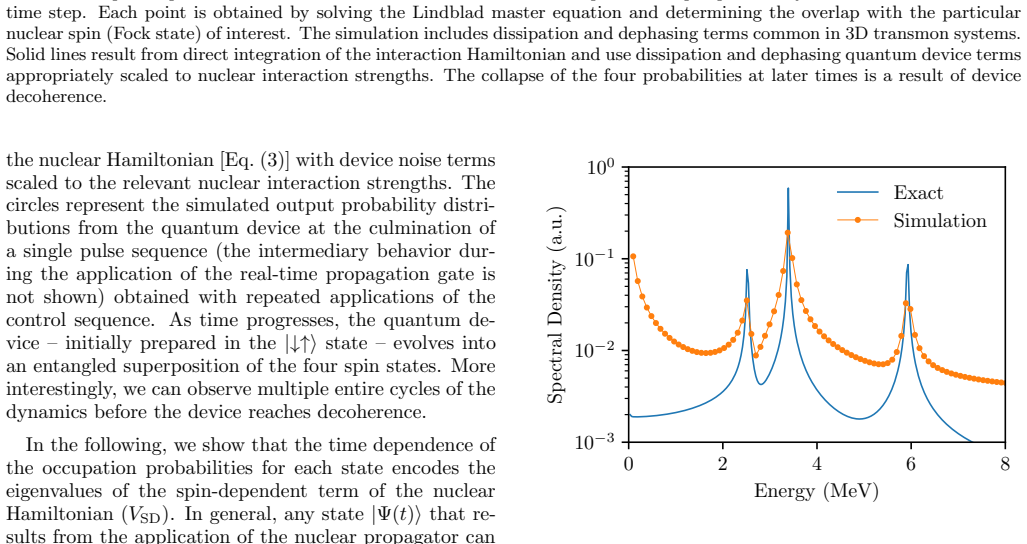
On real hardware, prepare a 3D transmon in the $|\downarrow\uparrow\rangle$ state, apply the 100 ns optimized pulse repeatedly, and take the discrete Fourier transform of the four occupation probabilities: the central claim fails if the three dominant peaks do not appear at the time-converted values 2.5254, 3.3951, and 5.9205 MeV under the stated $T_1 = 30\,\mu\mathrm{s}$, $T_\phi = 50\,\mu\mathrm{s}$ noise, or if the signal decays before completing one full oscillation cycle. A direct check of the encoding step is quantum process tomography of the implemented gate against $\exp(-i\hat{V}_{\mathrm{SD}}\Delta t/\hbar)$, which should show infidelity below the claimed $10^{-4}$ threshold.
Extended reading notes
Core claim
The paper establishes that the short-time spin propagator $\exp(-i\hat{V}_{\mathrm{SD}}\Delta t/\hbar)$ of the neutron–neutron interaction at leading order of chiral EFT can be embedded as a single dense gate on the lowest four levels of a 3D transmon, with the four uncoupled spin states $|\downarrow\downarrow\rangle$, $|\downarrow\uparrow\rangle$, $|\uparrow\downarrow\rangle$, $|\uparrow\uparrow\rangle$ mapped onto the Fock states $|0\rangle$ through $|3\rangle$. The gate is a 100 ns drive pulse found by gradient ascent pulse engineering, optimized to an infidelity below $10^{-4}$, and it acts by driving the device's own transition frequencies so that none of the population leaves the computational manifold. Lindblad master-equation simulations at $T_1 = 30\,\mu\mathrm{s}$ and $T_\phi = 50\,\mu\mathrm{s}$ show the occupation probabilities undergoing multiple full oscillation cycles, and the discrete Fourier transform of the $|\downarrow\uparrow\rangle$ probability resolves all three distinct pairwise eigenenergy differences of $\hat{V}_{\mathrm{SD}}$ — 2.5254, 3.3951, and 5.9205 MeV — to within roughly 0.01–0.03 MeV. Propagating $\hat{V}_{\mathrm{SD}}^3$ in a second simulation, and solving the two-equation pair relating the largest eigenvalue difference $\alpha$ and the largest cubed difference $\beta$, yields the absolute eigenvalues ($-2.3(2)$, $0.9(6)$, $3.6(2)$ MeV versus exact $-2.329$, $1.066$, $3.592$ MeV) without quantum phase estimation.
Load-bearing premise
The scheme rests on treating the two neutrons as frozen at one fixed internuclear separation, so that the single gate simulates only the spin propagator of the interaction: kinetic energy and the spin-independent potential are set aside for a classical co-processor that the paper neither implements nor tests. If that separation of spin and spatial dynamics is not valid for the physics being simulated, the gate does not implement the full nuclear dynamics promised by the paper's title.
Editorial extensions
If this is right
- Energy-difference spectroscopy becomes available on near-term quantum hardware: the eigenenergies of a simulated nuclear interaction can be read from the Fourier transform of a short time signal, as long as the propagator survives a few oscillation periods.
- The qudit encoding sidesteps the compilation overhead of breaking a nuclear propagator into many elementary one- and two-qubit gates, because the multi-level structure of the device itself carries the computation.
- The scheme enables a classical–quantum co-processing protocol in which the quantum processor advances the spin wavefunction while a classical computer handles the spatial propagation, potentially bypassing the exponential growth of spin configurations that limits quantum Monte Carlo methods.
- Because the pulse is derived from the device's own Hamiltonian, the single-gate recipe transfers to any short-time propagator expressible in the lowest levels of a multilevel superconducting circuit, reaching beyond nuclear physics.
Reading between the lines
- My inference: the cubed-interaction trick is a general spectroscopic lever — propagating a low-degree polynomial of the interaction and matching extremal eigenvalue differences between the polynomial and the linear operator would let other few-level simulations convert eigenvalue differences into absolute eigenvalues without quantum phase estimation.
- My inference: scaling beyond two neutrons is the open question the paper leaves unanswered; the GRAPE search and the single-device encoding both grow with the number of spin configurations, and whether the method remains practical for three or more nucleons requires a dedicated study.
- My inference: a direct hardware test on a real transmon at the stated T1 and Tφ values, comparing measured Fourier linewidths with the master-equation prediction, would show whether Markovian relaxation and dephasing capture the dominant noise in this regime.
- My inference: the frozen-separation approximation could be lifted in a concrete hybrid algorithm by discretizing the internuclear separation, running one optimized gate per grid point, and interleaving classical updates of the spatial wavefunction between time steps.
Signed reviews
Editorial analysis
A structured set of objections, weighed in public.
Referee Report
Summary. The manuscript proposes a single-gate, single-qudit implementation of the short-time propagator exp(-i V_SD(r0)Δt/ħ) for the spin-dependent part of the two-neutron interaction at leading order of chiral EFT. The authors fix the internuclear separation r=3.5 fm and encode the four neutron spin states in the lowest four transmon levels. A GRAPE-optimized pulse is computed in QuTIP, and repeated application of the pulse is modeled with a Lindblad master equation including T1=30 μs and Tφ=50 μs. From the time-dependent occupation probabilities they extract all pairwise eigenenergy differences of V_SD (Table I), and by a second propagation driven by V_SD^3 they infer absolute eigenvalues (Table II). The appendices provide the analytic spin-eigenvalue decomposition and the Fourier-peak fitting procedure.
Significance. If read as a proof-of-principle for encoding the fixed-r spin part of the chiral-EFT NN interaction in a multi-level transmon and for noise-robust spectroscopy of the resulting four-level system, the work is a solid and useful contribution. The numerical experiments are internally consistent: the GRAPE optimization is run to an infidelity threshold below 10^-4; the Lindblad simulations show several oscillation cycles; and the extracted peak locations agree with the analytic eigenvalues within the quoted uncertainties. The main weakness is that the title and abstract advertise 'nuclear dynamics' of two interacting neutrons, whereas the simulated object is only the 4x4 spin propagator at one fixed separation, with the spatial part of H_LO not implemented. With an appropriate reframing, the paper would be a meaningful step toward qudit-based simulation of spin-isospin nuclear interactions.
major comments (3)
- [Sec. II, Eq. (4); Sec. IV, Eq. (9); Sec. VI] The central simulation is not the two-nucleon Hamiltonian of Eq. (1). Equation (4) shows that the full Trotterized propagator requires applying exp[-i V_SD(x)Δt/ħ] separately for each spatial point x while the spin state is entangled with the spatial wavefunction. The implemented pulse realizes one fixed unitary (Eq. (9)) for a single value r0=3.5 fm; a single fixed pulse cannot implement the x-dependent family of unitaries required by Eq. (4). The classical-quantum co-processing paragraph in Sec. VI is only a 'possibility' and does not provide a concrete mechanism (such as a position-controlled gate or a sum over r-bins that preserves spin-position entanglement) that would realize Eq. (4). The title, abstract, and several introductory statements therefore overstate the scope of the demonstration. Please either reframe the claims to the frozen-spin spin-propagator proof-of-principle, or provide and validate a concrete mechanism for the full H_LO dynamics.
- [Sec. V, Eqs. (13)-(14) and the trace paragraph] The extraction of absolute eigenvalues uses the trace of V_SD, but the text says that because this matrix is traceless, a constant diagonal matrix is added to induce a nonzero trace. Adding c times the identity shifts every eigenvalue by c and changes no observable probabilities. The manuscript does not specify the value of c or how the reported eigenvalues in Table II are obtained from the shifted ones. Without this relation, the trace condition is underdetermined and the absolute calibration is not established. Please state the shift explicitly and show how the eigenvalues in Table II follow from it.
- [Sec. V, Eq. (10) and Fig. 4] The relationship between the plotted nuclear evolution time (in MeV^-1), the Trotter step Δt=0.30 MeV^-1, and the physical duration of each 100 ns GRAPE pulse is not given. This conversion determines how many pulses are applied and hence the total physical time over which T1 and Tφ act; without it the reader cannot check whether the observed attenuation is consistent with the stated coherence times. Please state the mapping between device-time and nuclear-time units and the total physical duration represented by the plots.
minor comments (5)
- [Sec. II and Sec. V] There are typos: 'seperation' in Sec. II and 'Linblad' in Sec. V should be 'separation' and 'Lindblad', respectively.
- [Sec. V] The phrase 'trace trace' is duplicated in the paragraph on absolute eigenvalue extraction; please correct.
- [Fig. 4 caption] The numeric labels '45 95 144 156 324' in the figure are unexplained; please clarify what these numbers denote.
- [References] References [30] and [49] are the same paper (Paik et al.), as are [43] and [50] (Rigetti et al.); please consolidate or cite once.
- [Fig. 3(b)] The axis label 'Detuned Frequency from QPU Ground State (GHz)' is unclear for a Fourier transform of the drive amplitudes; please clarify what is displayed.
Circularity Check
No significant circularity: the paper validates a GRAPE-optimized gate by comparing extracted spectra to the same Hamiltonian used to define the target unitary, which is a benchmark rather than a derivation.
full rationale
The paper's central numerical chain is self-contained and non-circular. The target unitary in Eq. (9) is exp(-i V_SD Delta t / hbar), built from the known LO chiral-EFT spin-dependent potential; a GRAPE optimizer finds a transmon drive approximating this unitary. The subsequent Lindblad master-equation simulation (Eq. (10)) with T1 and Tphi is an independent dynamical calculation, and the Fourier analysis of the resulting occupation probabilities yields frequency peaks that are then compared with the exact eigenvalue differences in Table I. This is a validation benchmark, not a derivation of new nuclear physics from the device output: the spectrum is an input to the target unitary, and the paper explicitly frames the comparison as 'a validation of the encoding of the nuclear Hamiltonian' (Sec. V) and as 'validation' in the abstract. No free parameter is fitted to the exact eigenvalues to produce the reported peak positions; the frequencies are extracted from the simulated noisy signal, with priors only from the initial DFT estimates (Appendix B). The self-citations (e.g., Ref. [56]) appear in a list of standard Lindblad/cQED references and are not load-bearing. The limitation that the demonstration is at fixed internuclear separation (Sec. VI) is a scope restriction, not a circularity.
Assumptions & free parameters
free parameters (6)
- internuclear separation r =
3.5 fm
- relative orientation parameters x and phi =
x=0.382, phi=2.71 degrees
- time step Delta t =
0.30 MeV^-1
- device parameters T1, T_phi, anharmonicity alpha_T =
T1=30 us, T_phi=50 us, alpha_T=200 MHz
- control pulse duration and maximum drive =
tau=100 ns, max drive 20 MHz
- chiral low-energy constants (e.g., C1, C2, g_A, f_pi, m_pi) =
not stated in the text; taken from Ref. [38]
assumptions (5)
- domain assumption The two-neutron problem is approximated by freezing the spatial wavefunction and propagating only spin degrees of freedom with V_SD at fixed separation.
- domain assumption The spin-dependent interaction V_SD(r) at LO chiral EFT is correctly given by Eqs. (3), (A1), and (A2) with the LECs from Ref. [38].
- domain assumption The 3D transmon is well described by the fourth-order expanded Hamiltonian H_d^(4) plus control H_c, with six levels in the optimization and the lowest four as the computational space with no leakage.
- domain assumption The Lindblad master equation with T1 and T_phi dissipation, together with the covariance model in Appendix B, captures the dominant device noise.
- domain assumption The GRAPE optimization reaches the target unitary with infidelity below 10^-4 and is insensitive to the initial guess.
Cite this review
Pith. "Pith review of Optimal Control for the Quantum Simulation of Nuclear Dynamics." pith.science (2026). https://pith.science/paper/INS4NUEO
@misc{pith2026190808222,
  author       = {Pith},
  title        = {Pith review of: Optimal Control for the Quantum Simulation of Nuclear Dynamics},
  year         = {2026},
  howpublished = {\url{https://pith.science/paper/INS4NUEO}},
  note         = {Machine review of arXiv:1908.08222}
}
read the original abstract
We propose a method for enacting the unitary time propagation of two interacting neutrons at leading order of chiral effective field theory by efficiently encoding the nuclear dynamics into a single multi-level quantum device. The emulated output of the quantum simulation shows that, by applying a single gate that draws on the underlying characteristics of the device, it is possible to observe multiple cycles of the nucleons' dynamics before the onset of decoherence. Owing to the signal's longevity, we can then extract spectroscopic properties of the simulated nuclear system. This allows us to validate the encoding of the nuclear Hamiltonian and the robustness of the simulation in the presence of quantum-hardware noise by comparing the extracted spectroscopic information to exact calculations. This work paves the way for transformative calculations of dynamical properties of nuclei on near-term quantum devices.
Figures


Figures from the paper (1 more)
Reference graph
Works this paper leans on
-
[1]
R. P. Feynman, International journal of theoretical physics 21, 467 (1982)
1982
- [2]
-
[3]
R. Barends, L. Lamata, J. Kelly, L. Garc´ ıa- ´Alvarez, A. Fowler, A. Megrant, E. Jeffrey, T. White, D. Sank, J. Mutus, et al. , Nat. Commun. 6, 7654 (2015)
work page 2015
-
[4]
Y. Chen, P. Roushan, D. Sank, C. Neill, E. Lucero, M. Mariantoni, R. Barends, B. Chiaro, J. Kelly, A. Megrant, et al. , Nat. Commun. 5, 5184 (2014)
work page 2014
-
[5]
J.D, X.W. and E.H. acknowledge partial support by the DOE ASCR quantum testbed pathfinder program. Appendix A Following the notation of Ref. [38], the explicit form of the functions A(1)(⃗ r) and A(2) α,β(⃗ r) appearing in the expression of the SD neutron-neutron interaction at LO of chiral EFT in coordinate space [see Eq. (3)] are given by A(1)(⃗ r) =C1δR...
-
[6]
U. Las Heras, A. Mezzacapo, L. Lamata, S. Filipp, A. Wallraff, and E. Solano, Phys. Rev. Lett. 112, 200501 (2014)
work page 2014
-
[7]
A. Mezzacapo, U. Las Heras, J. S. Pedernales, L. Di- Carlo, E. Solano, and L. Lamata, Scientific reports 4, 7482 (2014)
work page 2014
-
[8]
P. Roushan, C. Neill, Y. Chen, M. Kolodrubetz, C. Quin- tana, N. Leung, M. Fang, R. Barends, B. Campbell, Z. Chen, et al. , Nature 515, 241 (2014). 9
work page 2014
Show all 58 references
-
[9]
M. R. Geller, J. M. Martinis, A. T. Sornborger, P. C. Stancil, E. J. Pritchett, H. You, and A. Galiautdinov, Phys. Rev. A 91, 062309 (2015)
2015
-
[10]
Chiesa, P
A. Chiesa, P. Santini, D. Gerace, J. Raftery, A. A. Houck, and S. Carretta, Scientific reports 5, 16036 (2015)
2015
-
[11]
P. J. O’Malley, R. Babbush, I. D. Kivlichan, J. Romero, J. R. McClean, R. Barends, J. Kelly, P. Roushan, A. Tranter, N. Ding, et al. , Phys. Rev. X 6, 031007 (2016)
2016
-
[12]
Salath´ e, M
Y. Salath´ e, M. Mondal, M. Oppliger, J. Heinsoo, P. Kurpiers, A. Potoˇ cnik, A. Mezzacapo, U. Las Heras, L. Lamata, E. Solano, et al. , Phys. Rev. X 5, 021027 (2015)
2015
-
[13]
Neill, P
C. Neill, P. Roushan, M. Fang, Y. Chen, M. Kolodru- betz, Z. Chen, A. Megrant, R. Barends, B. Campbell, B. Chiaro, et al. , Nat. Phys. 12, 1037 (2016)
2016
-
[14]
Roushan, C
P. Roushan, C. Neill, A. Megrant, Y. Chen, R. Bab- bush, R. Barends, B. Campbell, Z. Chen, B. Chiaro, A. Dunsworth, et al. , Nat. Phys. 13, 146 (2017)
2017
-
[15]
Roushan, C
P. Roushan, C. Neill, J. Tangpanitanon, V. Bastidas, A. Megrant, R. Barends, Y. Chen, Z. Chen, B. Chiaro, A. Dunsworth, et al. , Science 358, 1175 (2017)
2017
-
[16]
Kandala, A
A. Kandala, A. Mezzacapo, K. Temme, M. Takita, M. Brink, J. M. Chow, and J. M. Gambetta, Nature 549, 242 (2017)
2017
-
[17]
N. K. Langford, R. Sagastizabal, M. Kounalakis, C. Dickel, A. Bruno, F. Luthi, D. J. Thoen, A. Endo, and L. DiCarlo, Nat. Commun. 8, 1715 (2017)
2017
-
[18]
Sameti, A
M. Sameti, A. Potoˇ cnik, D. E. Browne, A. Wallraff, and M. J. Hartmann, Phys. Rev. A 95, 042330 (2017)
2017
-
[19]
E. F. Dumitrescu, A. J. McCaskey, G. Hagen, G. R. Jansen, T. D. Morris, T. Papenbrock, R. C. Pooser, D. J. Dean, and P. Lougovski, Phys. Rev. Lett. 120, 210501 (2018)
2018
-
[20]
Potoˇ cnik, A
A. Potoˇ cnik, A. Bargerbos, F. A. Schr¨ oder, S. A. Khan, M. C. Collodo, S. Gasparinetti, Y. Salath´ e, C. Creatore, C. Eichler, H. E. T¨ ureci, et al. , Nat. Commun. 9, 904 (2018)
2018
-
[21]
Viyuela, A
O. Viyuela, A. Rivas, S. Gasparinetti, A. Wallraff, S. Fil- ipp, and M. A. Martin-Delgado, npj Quantum Informa- tion 4, 10 (2018)
2018
-
[22]
Kandala, K
A. Kandala, K. Temme, A. D. C´ orcoles, A. Mezzacapo, J. M. Chow, and J. M. Gambetta, Nature 567, 491 (2019)
2019
-
[23]
N. Klco, E. F. Dumitrescu, A. J. McCaskey, T. D. Morris, R. C. Pooser, M. Sanz, E. Solano, P. Lougovski, and M. J. Savage, Phys. Rev. A 98, 032331 (2018)
2018
-
[24]
Peruzzo, J
A. Peruzzo, J. McClean, P. Shadbolt, M.-H. Yung, X.-Q. Zhou, P. J. Love, A. Aspuru-Guzik, and J. L. O’brien, Nat. Commun. 5, 4213 (2014)
2014
-
[25]
J. M. Chow, L. DiCarlo, J. M. Gambetta, F. Motzoi, L. Frunzio, S. M. Girvin, and R. J. Schoelkopf, Phys. Rev. A 82, 040305 (2010)
2010
-
[26]
N. Ofek, A. Petrenko, R. Heeres, P. Reinhold, Z. Leghtas, B. Vlastakis, Y. Liu, L. Frunzio, S. Girvin, L. Jiang, et al. , Nature 536, 441 (2016)
2016
-
[27]
R. W. Heeres, P. Reinhold, N. Ofek, L. Frunzio, L. Jiang, M. H. Devoret, and R. J. Schoelkopf, Nat. Commun. 8, 94 (2017)
2017
-
[28]
L. Hu, Y. Ma, W. Cai, X. Mu, Y. Xu, W. Wang, Y. Wu, H. Wang, Y. Song, C.-L. Zou,et al., Nat. Phys. , 1 (2019)
2019
-
[29]
Epelbaum, H.-W
E. Epelbaum, H.-W. Hammer, and U.-G. Meißner, Rev. Mod. Phys. 81, 1773 (2009), arXiv:0811.1338 [nucl-th]
2009 arXiv
-
[30]
Machleidt and D
R. Machleidt and D. R. Entem, Phys. Rept. 503, 1 (2011), arXiv:1105.2919 [nucl-th]
2011 arXiv
-
[31]
H. Paik, D. I. Schuster, L. S. Bishop, G. Kirchmair, G. Catelani, A. P. Sears, B. R. Johnson, M. J. Reagor, L. Frunzio, L. I. Glazman, et al. , Phys. Rev. Lett. 107, 240501 (2011)
2011
-
[32]
Khaneja, T
N. Khaneja, T. Reiss, C. Kehlet, T. Schulte-Herbr¨ uggen, and S. J. Glaser, J. Magn. Reson. 172, 296 (2005)
2005
-
[33]
Johansson, P
J. Johansson, P. Nation, and F. Nori, Comput. Phys. Commun. 184, 1234 (2013)
2013
-
[34]
C. D. Goodman, C. A. Goulding, M. B. Greenfield, J. Ra- paport, D. E. Bainum, C. C. Foster, W. G. Love, and F. Petrovich, Phys. Rev. Lett. 44, 1755 (1980)
1980
-
[35]
W. G. Love and M. A. Franey, Phys. Rev. C 24, 1073 (1981)
1981
-
[36]
Franey and W
M. Franey and W. Love, Phys. Rev. C 31, 488 (1985)
1985
-
[37]
Weinberg, Physics Letters B 251, 288 (1990)
S. Weinberg, Physics Letters B 251, 288 (1990)
1990
-
[38]
Gezerlis, I
A. Gezerlis, I. Tews, E. Epelbaum, M. Freunek, S. Gan- dolfi, K. Hebeler, A. Nogga, and A. Schwenk, Phys. Rev. C 90, 054323 (2014)
2014
-
[39]
I. Tews, S. Gandolfi, A. Gezerlis, and A. Schwenk, Phys. Rev. C 93, 024305 (2016)
2016
-
[40]
Blais, R.-S
A. Blais, R.-S. Huang, A. Wallraff, S. M. Girvin, and R. J. Schoelkopf, Phys. Rev. A 69, 062320 (2004)
2004
-
[41]
J. Koch, M. Y. Terri, J. Gambetta, A. A. Houck, D. I. Schuster, J. Majer, A. Blais, M. H. Devoret, S. M. Girvin, and R. J. Schoelkopf, Phys. Rev. A 76, 042319 (2007)
2007
-
[42]
J. A. Schreier, A. A. Houck, J. Koch, D. I. Schuster, B. R. Johnson, J. M. Chow, J. M. Gambetta, J. Majer, L. Frunzio, M. H. Devoret,et al., Phys. Rev. B77, 180502 (2008)
2008
-
[43]
Wallraff, D
A. Wallraff, D. I. Schuster, A. Blais, L. Frunzio, R.-S. Huang, J. Majer, S. Kumar, S. M. Girvin, and R. J. Schoelkopf, Nature 431, 162 (2004)
2004
-
[44]
Rigetti, J
C. Rigetti, J. M. Gambetta, S. Poletto, B. Plourde, J. M. Chow, A. C´ orcoles, J. A. Smolin, S. T. Merkel, J. Rozen, G. A. Keefe, et al. , Phys. Rev. B 86, 100506 (2012)
2012
-
[45]
S. E. Nigg, H. Paik, B. Vlastakis, G. Kirchmair, S. Shankar, L. Frunzio, M. H. Devoret, R. J. Schoelkopf, and S. M. Girvin, Phys. Rev. Lett. 108, 240502 (2012)
2012
-
[46]
Macklin, K
C. Macklin, K. O’Brien, D. Hover, M. Schwartz, V. Bolkhovsky, X. Zhang, W. Oliver, and I. Siddiqi, Science 350, 307 (2015)
2015
-
[47]
N. Ofek, Y. Liu, M. Hatridge, S. Shankar, M. H. Devoret, and R. J. Schoelkopf, in APS Meeting Abstracts (2014)
2014
-
[48]
Moler and C
C. Moler and C. Van Loan, SIAM review 45, 3 (2003)
2003
-
[49]
Raftery, A
J. Raftery, A. Vrajitoarea, G. Zhang, Z. Leng, S. J. Srinivasan, and A. A. Houck, arXiv preprint arXiv:1703.00942 (2017)
2017 arXiv
-
[50]
H. Paik, D. I. Schuster, L. S. Bishop, G. Kirchmair, G. Catelani, A. P. Sears, B. R. Johnson, M. J. Reagor, L. Frunzio, L. I. Glazman, S. M. Girvin, M. H. De- voret, and R. J. Schoelkopf, Phys. Rev. Lett.107, 240501 (2011)
2011
-
[51]
Rigetti, J
C. Rigetti, J. M. Gambetta, S. Poletto, B. L. T. Plourde, J. M. Chow, A. D. C´ orcoles, J. A. Smolin, S. T. Merkel, J. R. Rozen, G. A. Keefe, M. B. Rothwell, M. B. Ketchen, and M. Steffen, Phys. Rev. B 86, 100506 (2012)
2012
-
[52]
Y. Chen, C. Neill, P. Roushan, N. Leung, M. Fang, R. Barends, J. Kelly, B. Campbell, Z. Chen, B. Chiaro, A. Dunsworth, E. Jeffrey, A. Megrant, J. Y. Mu- tus, P. J. J. O’Malley, C. M. Quintana, D. Sank, A. Vainsencher, J. Wenner, T. C. White, M. R. Geller, A. N. Cleland, and J. ...
2014
-
[53]
Leung, M
N. Leung, M. Abdelhafez, J. Koch, and D. Schuster, Phys. Rev. A 95, 042318 (2017)
2017
-
[54]
K. W. Murch, U. Vool, D. Zhou, S. J. Weber, S. M. Girvin, and I. Siddiqi, Phys. Rev. Lett. 109, 183602 (2012)
2012
-
[55]
Geerlings, Z
K. Geerlings, Z. Leghtas, I. M. Pop, S. Shankar, L. Frun- zio, R. J. Schoelkopf, M. Mirrahimi, and M. H. Devoret, Phys. Rev. Lett. 110, 120501 (2013)
2013
-
[56]
Leghtas, U
Z. Leghtas, U. Vool, S. Shankar, M. Hatridge, S. M. Girvin, M. H. Devoret, and M. Mirrahimi, Phys. Rev. A 88, 023849 (2013)
2013
-
[57]
E. T. Holland, B. Vlastakis, R. W. Heeres, M. J. Reagor, U. Vool, Z. Leghtas, L. Frunzio, G. Kirchmair, M. H. De- voret, M. Mirrahimi, et al., Phys. Rev. Lett. 115, 180501 (2015)
2015
-
[58]
Leghtas, S
Z. Leghtas, S. Touzard, I. M. Pop, A. Kou, B. Vlas- takis, A. Petrenko, K. M. Sliwa, A. Narla, S. Shankar, M. J. Hatridge, M. Reagor, L. Frunzio, R. J. Schoelkopf, M. Mirrahimi, and M. H. Devoret, Science 347, 853 (2015)
2015
Reviewed August 14, 2026 · model on record in the stance chip above.
Discussion (0). Continue with ORCID to comment.