REVIEW 3 major objections 5 minor 55 references
A two-stage training framework, EAG-RL, uses an expert model's attention as a reward to lift LLM accuracy on structured EHR prediction tasks by 14.62% on average.
Reviewed by Pith at T0; open to challenge. T0 means a machine referee read the full paper against a public rubric. the ladder, T0–T4 →
EAG-RL improves LLM performance on EHR mortality and readmission prediction by training on expert-generated reasoning traces and an attention-alignment RL reward.
T0 review reviewed 2026-08-05 challenge →
load-bearing objection A credible RL pipeline for EHR reasoning with an over-claimed attention mechanism; worth a referee but the headline and mechanism need a rewrite. the 3 major comments →
Toward Better EHR Reasoning in LLMs: Reinforcement Learning with Expert Attention Guidance
The pith
A machine-rendered reading of the paper's core claim, the machinery that carries it, and where it could break.
The reading
Core claim
On its own terms, the paper's central claim is that an LLM's EHR reasoning can be intrinsically improved by treating a task-specific expert model as a policy supervisor. EAG-RL works in two stages: first, expert-guided MCTS builds stepwise subquestion-answer reasoning trajectories, and trajectory-level supervised fine-tuning initializes the policy; second, group-relative policy optimization maximizes a composite reward that combines a classification reward with an attention-alignment reward, defined as the Jaccard similarity between the features the LLM writes in <Important Features> and the attention-salient features of the expert EHR model, plus an entropy-aware adaptive upper clipping bou
What carries the argument
The load-bearing mechanism is an attention-alignment reward: the Jaccard overlap $R_{\text{att}} = |C \cap C_{\text{exp}}| / |C \cup C_{\text{exp}}|$ between the LLM's self-reported important features $C$ and the expert model's attention-highlighted features $C_{\text{exp}}$, combined with the classification reward $R_{\text{cls}}$ and an entropy-aware adaptive up-clipping bound that scales policy-update strength by token-level entropy. This reward is what converts a black-box expert model into fine-grained policy supervision for the LLM, and it works together with expert-guided Monte Carlo Tree Search, which supplies the high-quality starting trajectories that make the RL stage sample-effic
Load-bearing premise
The reward assumes the feature names the LLM emits in its 'important features' output are a faithful proxy for the information the model actually attends to while reasoning, so aligning those names with the expert's attention features improves reasoning rather than just teaching the model to echo the right labels.
What would settle it
Train EAG-RL with the expert feature lists randomly shuffled or replaced by a fixed random set while keeping the classification reward intact: if AUROC and AUPRC gains over the no-attention baseline persist, the attention-alignment reward is not the source of the improvement. Alternatively, use internal attention probes or logit-level interventions to check whether the model that names the expert's features actually computes with them.
If this is right
- EHR prediction no longer needs a hybrid LLM-plus-DL stack; the LLM itself becomes the predictor and can be deployed where feature order and availability vary across institutions.
- Because the attention reward is computed on the text output rather than internal attention, the method is cheap enough to run at RL sampling time and could be transferred to other high-dimensional tabular tasks.
- Removing either stage (trajectory distillation or attention-aligned RL) or the attention reward lowers AUROC and AUPRC, so the authors' account predicts that each component is necessary, not decorative.
- Robustness under full feature permutation suggests the trained model relies on semantic content rather than position, which matters for heterogeneous EHR systems.
- The same recipe could be scaled to larger backbones and multiple expert models; the authors state this as future work.
Where Pith is reading between the lines
- The reward only inspects the text the model writes in its important-features tag, not the model's internal attention; a testable extension is to probe attention heads or use intervention-based evidence to verify that the alignment signal changes actual computation, not just output formatting.
- The Jaccard reward is all-or-nothing per feature and ignores clinical severity or trends; a graded or weighted overlap could carry more signal and is a natural next experiment.
- If the mechanism generalizes, it should work for other structured clinical targets such as length of stay or sepsis onset, and for non-clinical tabular benchmarks with an attention-equipped expert model.
- An adversarial check on the attention reward—training with expert features shuffled or fixed to random subsets—would tell whether the gains are due to feature alignment or just the classification reward; the paper's current ablations remove the reward but do not corrupt it. The authors' own stated limits are two datasets, models up to 8B parameters, and a single expert model.
Editorial analysis
A structured set of objections, weighed in public.
Referee Report
Summary. The paper proposes EAG-RL, a two-stage framework for improving LLMs on structured EHR prediction tasks (mortality and readmission). Stage 1 uses expert-guided Monte Carlo Tree Search to construct stepwise clinical reasoning trajectories, which are used for supervised fine-tuning. Stage 2 applies GRPO-style reinforcement learning with a composite reward: a classification reward plus an attention-alignment reward that measures Jaccard similarity between the features the LLM declares in <Important Features> and the features highlighted by a pretrained expert EHR model (Concare). An entropy-aware adaptive clipping mechanism is introduced to adjust the policy-update clipping bound per trajectory. Experiments on MIMIC-IV and TJH report AUROC/AUPRC improvements over prompt-based baselines, an ablation study, a robustness test under feature-order perturbation, and a cross-dataset generalization test.
Significance. If the central claim holds, the paper demonstrates a practical way to use expert EHR model attention as policy supervision, and it provides evidence that LLMs can become competitive on structured clinical prediction tasks where conventional deep learning models have been dominant. The paper ships code, conducts ablations that isolate components, and evaluates on multiple backbones and datasets. However, the evidence for the specific mechanism named in the title—expert attention guidance—is weaker than the evidence for the overall performance gains, and the headline improvement is computed against prompt-based baselines rather than the strongest RL competitors.
major comments (3)
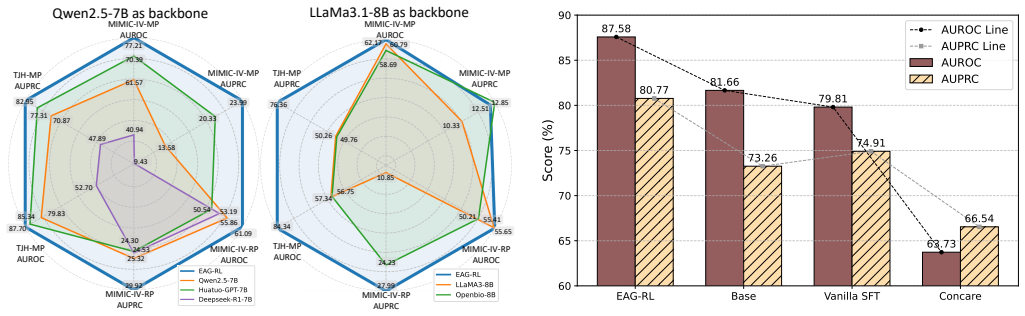
- [§3.3, Eq. (6), Table 2] The central mechanism claim that EAG-RL improves 'intrinsic EHR reasoning' via expert attention is underdetermined. The attention-alignment reward Ratt is computed from the set C emitted in <Important Features>, not from any internal attention; the policy is directly rewarded for emitting names that match Cexp, so the model can inflate Ratt by echoing expert feature lists without changing its latent reasoning. The case study in Table 4 shows overlap increasing, but this is a direct effect of the reward. More importantly, the ablation in Table 2 shows that removing the entropy-adaptive up-clipping (w/o ε(τ)) causes a larger performance drop than removing Ratt on most metrics (e.g., MIMIC-IV mortality AUROC: 77.21→66.24 vs 77.21→75.58; TJH AUPRC: 82.95→72.71 vs 82.95→76.64). Thus the reported gains cannot be attributed primarily to expert attention guidance. I would need a direct measureme
- [§4.2 and abstract] The headline 14.62% average improvement is computed against prompt-based methods only, not against the best RL baselines. Against GRPO and DAPO with the same Stage-1 initialization, the advantage is inconsistent. For example, Table 1 (LLaMA3.1-8B) MIMIC-IV mortality AUPRC: EAG-RL 12.51±3.00 vs GRPO 15.64±5.80 and DAPO 13.82±4.08; on readmission AUROC, EAG-RL 55.65±4.28 is within noise of DAPO 55.12±3.99. Since the abstract claims improvement in 'intrinsic EHR reasoning ability', the baseline choice should include the strongest available RL competitors. Please report relative improvements over the best baseline, or explicitly qualify 14.62% as a comparison against prompt-based prompting strategies.
- [§3.2, Eq. (6), Algorithm 1] The expert feature set Cexp is never formally defined. The text and Figure 2 say 'Extract Attention' and 'Important Clinic Features', but there is no specification of how Concare's attention matrices are converted into the set Cexp: which heads/layers are used, whether features are aggregated, how top-k or thresholding is performed. Since Eq. (6) and the MCTS reward in Algorithm 1 (line 30) depend on Cexp, this is a reproducibility gap that affects the core training signal. Please provide the exact extraction procedure.
minor comments (5)
- [Appendix D] The readmission prediction prompt repeatedly says 'within two weeks' (both in the Reasoning Format and in the Final subquestion), while the task definition in §2 and the example output say 30 days. This inconsistency should be fixed.
- [Appendix F] Typo: 'valuation prompt' should be 'evaluation prompt'.
- [Abstract and §1] Grammar issues: 'Our code have been available' and 'to to encourage' in the contributions list.
- [References] One reference entry is incomplete: 'Wang, S.; Zhao... ???? ChatCAD...' has no year.
- [Table 1] In the Qwen2.5-7B block, the MIMIC-IV Readmission AUPRC for EAG-RL is 29.92±0.46, with a bootstrap standard deviation far smaller than all other entries in that column (typically 3.5–5.3). This is suspicious and should be verified.
Circularity Check
Attention-overlap evidence in the case study is the optimized reward restated, but the main benchmark results are independent.
specific steps
-
self definitional
[Appendix G (Case Study), compared with Section 3.3 Eq. (6)]
"This is evidenced by a significant increase in the overlap between the features identified as important by our model and those highlighted by the expert model."
The overlap cited as evidence of steering attention is exactly the reward term Ratt in Eq. (6), defined as the Jaccard similarity between the LLM's output feature set C and the expert's attention set Cexp. Since the RL objective in Eqs. (7) and (12) is optimized to maximize this overlap, an increase after training is a direct consequence of the training objective. Presenting that increase as evidence that the model's attention was aligned and that this caused the accuracy improvement is circular: the observation is the metric being optimized, not an independent measurement of internal attention or of causal efficacy. The held-out AUROC/AUPRC results remain independent of this step.
full rationale
The central derivation chain is not circular. EAG-RL trains the LLM with a composite reward combining a label-based classification reward (Eq. 4) and an attention-alignment reward (Eq. 6), plus entropy-adaptive clipping; all benchmark numbers (Tables 1-2, Figures 3-5) are computed on held-out labels, so the reported improvements are not forced by construction. The expert model Concare is an external, peer-reviewed system, and the cited prior results on attention saliency are not load-bearing self-citations. The single circular element is localized to Appendix G: the case study uses an increase in the Jaccard overlap between LLM-declared features and expert features as evidence of attention steering, but that overlap is precisely the reward being optimized. This makes the qualitative mechanism claim self-confirming, but it does not undermine the independent quantitative evaluation. Hence a low score of 2.
Axiom & Free-Parameter Ledger
free parameters (8)
- lambda_2 (Rcls vs Ratt reward weight) =
0.6
- GRPO lower clip bound epsilon =
0.2
- Entropy clipping bounds epsilon_min and epsilon_max =
0.2 to 0.4
- UCT exploration weight lambda_1 =
1.0
- Candidate subquestions d =
3
- top-k trajectories for SFT =
2
- Rollout and sampling count N =
8
- LoRA rank/scaling and learning rate =
64 / 32, 3e-6
axioms (4)
- domain assumption Clinical reasoning can be modeled as stepwise subquestioning and evidence integration (hypothetico-deductive process).
- domain assumption Concare's attention identifies clinically salient features.
- ad hoc to paper Jaccard similarity between LLM-declared important features and expert features is a valid reward signal.
- domain assumption The final output score 0.XX from the LLM can be used as a calibrated probability for AUROC/AUPRC.
Cite this review
Pith. "Pith review of Toward Better EHR Reasoning in LLMs: Reinforcement Learning with Expert Attention Guidance." pith.science (2026). https://pith.science/paper/INTFOTLW
@misc{pith2026250813579,
  author       = {Pith},
  title        = {Pith review of: Toward Better EHR Reasoning in LLMs: Reinforcement Learning with Expert Attention Guidance},
  year         = {2026},
  howpublished = {\url{https://pith.science/paper/INTFOTLW}},
  note         = {Machine review of arXiv:2508.13579}
}
read the original abstract
Improving large language models (LLMs) for electronic health record (EHR) reasoning is essential for enabling accurate and generalizable clinical predictions. While LLMs excel at medical text understanding, they underperform on EHR-based prediction tasks due to challenges in modeling temporally structured, high-dimensional data. Existing approaches often rely on hybrid paradigms, where LLMs serve merely as frozen prior retrievers while downstream deep learning (DL) models handle prediction, failing to improve the LLM's intrinsic reasoning capacity and inheriting the generalization limitations of DL models. To this end, we propose EAG-RL, a novel two-stage training framework designed to intrinsically enhance LLMs' EHR reasoning ability through expert attention guidance, where expert EHR models refer to task-specific DL models trained on EHR data. Concretely, EAG-RL first constructs high-quality, stepwise reasoning trajectories using expert-guided Monte Carlo Tree Search to effectively initialize the LLM's policy. Then, EAG-RL further optimizes the policy via reinforcement learning by aligning the LLM's attention with clinically salient features identified by expert EHR models. Extensive experiments on two real-world EHR datasets show that EAG-RL improves the intrinsic EHR reasoning ability of LLMs by an average of 14.62%, while also enhancing robustness to feature perturbations and generalization to unseen clinical domains. These results demonstrate the practical potential of EAG-RL for real-world deployment in clinical prediction tasks. Our code have been available at https://github.com/devilran6/EAG-RL.
Figures



Reference graph
Works this paper leans on
-
[1]
, " * write output.state after.block = add.period write newline
ENTRY address archivePrefix author booktitle chapter edition editor eid eprint howpublished institution isbn journal key month note number organization pages publisher school series title type volume year label extra.label sort.label short.list INTEGERS output.state before.all mid.sentence after.sentence after.block FUNCTION init.state.consts #0 'before.a...
-
[2]
write newline
" write newline "" before.all 'output.state := FUNCTION n.dashify 't := "" t empty not t #1 #1 substring "-" = t #1 #2 substring "--" = not "--" * t #2 global.max substring 't := t #1 #1 substring "-" = "-" * t #2 global.max substring 't := while if t #1 #1 substring * t #2 global.max substring 't := if while FUNCTION word.in bbl.in capitalize " " * FUNCT...
-
[3]
E.; Yan, C.; Li, Z.; Zhang, X.; Collins, B
Brown, K. E.; Yan, C.; Li, Z.; Zhang, X.; Collins, B. X.; Chen, Y.; Clayton, E. W.; Kantarcioglu, M.; Vorobeychik, Y.; and Malin, B. A. 2024. Not the models you are looking for: Traditional ML outperforms LLMs in clinical prediction tasks. medRxiv
work page 2024
-
[4]
Chen, C.; Yu, J.; Chen, S.; Liu, C.; Wan, Z.; Bitterman, D.; Wang, F.; and Shu, K. 2024 a . ClinicalBench: Can LLMs Beat Traditional ML Models in Clinical Prediction? arXiv preprint arXiv:2411.06469
Pith/arXiv arXiv 2024
-
[5]
Chen, J.; Cai, Z.; Ji, K.; Wang, X.; Liu, W.; Wang, R.; Hou, J.; and Wang, B. 2024 b . Huatuogpt-o1, towards medical complex reasoning with llms. arXiv preprint arXiv:2412.18925
Pith/arXiv arXiv 2024
-
[6]
Chen, Q.; Du, J.; Hu, Y.; Kuttichi Keloth, V.; Peng, X.; Raja, K.; Zhang, R.; Lu, Z.; and Xu, H. 2023. Large language models in biomedical natural language processing: benchmarks, baselines, and recommendations. arXiv e-prints, arXiv--2305
work page 2023
-
[7]
Chen, Y.; Gao, J.; and Wu, J. 2025. Towards Revealing the Effectiveness of Small-Scale Fine-tuning in R1-style Reinforcement Learning. arXiv preprint arXiv:2505.17988
work page internal anchor Pith review Pith/arXiv arXiv 2025
-
[8]
Chu, T.; Zhai, Y.; Yang, J.; Tong, S.; Xie, S.; Schuurmans, D.; Le, Q. V.; Levine, S.; and Ma, Y. 2025. Sft memorizes, rl generalizes: A comparative study of foundation model post-training. arXiv preprint arXiv:2501.17161
Pith/arXiv arXiv 2025
-
[9]
Coulom, R. 2006. Efficient selectivity and backup operators in Monte-Carlo tree search. In International conference on computers and games, 72--83. Springer
work page 2006
-
[10]
Dao, T.; Fu, D.; Ermon, S.; Rudra, A.; and R \'e , C. 2022. Flashattention: Fast and memory-efficient exact attention with io-awareness. Advances in neural information processing systems, 35: 16344--16359
2022
- [11]
-
[12]
Dubey, A.; Jauhri, A.; Pandey, A.; Kadian, A.; Al-Dahle, A.; Letman, A.; Mathur, A.; Schelten, A.; Yang, A.; Fan, A.; et al. 2024. The llama 3 herd of models. arXiv e-prints, arXiv--2407
2024
-
[13]
Gao, J.; Zhu, Y.; Wang, W.; Wang, Z.; Dong, G.; Tang, W.; Wang, H.; Wang, Y.; Harrison, E. M.; and Ma, L. 2024. A comprehensive benchmark for COVID-19 predictive modeling using electronic health records in intensive care. Patterns, 5(4)
work page 2024
-
[15]
Guo, D.; Yang, D.; Zhang, H.; Song, J.; Zhang, R.; Xu, R.; Zhu, Q.; Ma, S.; Wang, P.; Bi, X.; et al. 2025 b . Deepseek-r1: Incentivizing reasoning capability in llms via reinforcement learning. arXiv preprint arXiv:2501.12948
Pith/arXiv arXiv 2025
-
[16]
Hao, S.; Gu, Y.; Ma, H.; Hong, J. J.; Wang, Z.; Wang, D. Z.; and Hu, Z. 2023 a . Reasoning with language model is planning with world model. arXiv preprint arXiv:2305.14992
Pith/arXiv arXiv 2023
-
[17]
Hao, Z.; Guo, J.; Han, K.; Tang, Y.; Hu, H.; Wang, Y.; and Xu, C. 2023 b . One-for-all: Bridge the gap between heterogeneous architectures in knowledge distillation. Advances in Neural Information Processing Systems, 36: 79570--79582
work page 2023
-
[18]
Jahan, I.; Laskar, M. T. R.; Peng, C.; and Huang, J. X. 2024. A comprehensive evaluation of large language models on benchmark biomedical text processing tasks. Computers in biology and medicine, 171: 108189
work page 2024
-
[19]
Jiang, P.; Xiao, C.; Cross, A.; and Sun, J. 2023 a . Graphcare: Enhancing healthcare predictions with personalized knowledge graphs. arXiv preprint arXiv:2305.12788
Pith/arXiv arXiv 2023
-
[20]
Jiang, X.; Zhang, R.; Xu, Y.; Qiu, R.; Fang, Y.; Wang, Z.; Tang, J.; Ding, H.; Chu, X.; Zhao, J.; and Wang, Y. 2023 b . Think and Retrieval: A Hypothesis Knowledge Graph Enhanced Medical Large Language Models
work page 2023
-
[21]
E.; Bulgarelli, L.; Shen, L.; Gayles, A.; Shammout, A.; Horng, S.; Pollard, T
Johnson, A. E.; Bulgarelli, L.; Shen, L.; Gayles, A.; Shammout, A.; Horng, S.; Pollard, T. J.; Hao, S.; Moody, B.; Gow, B.; et al. 2023. MIMIC-IV, a freely accessible electronic health record dataset. Scientific data, 10(1): 1
2023
-
[22]
Kaelbling, L. P.; Littman, M. L.; and Moore, A. W. 1996. Reinforcement learning: A survey. Journal of artificial intelligence research, 4: 237--285
work page 1996
-
[23]
Kaufmann, T.; Weng, P.; Bengs, V.; and H \"u llermeier, E. 2024. A survey of reinforcement learning from human feedback
work page 2024
-
[24]
Kocsis, L.; and Szepesv \'a ri, C. 2006. Bandit based monte-carlo planning. In European conference on machine learning, 282--293. Springer
work page 2006
-
[25]
Liu, Q.; Wu, X.; Zhao, X.; Zhu, Y.; Zhang, Z.; Tian, F.; and Zheng, Y. 2024. Large Language Model Distilling Medication Recommendation Model. arXiv:2402.02803
Pith/arXiv arXiv 2024
-
[26]
Ma, L.; Zhang, C.; Wang, Y.; Ruan, W.; Wang, J.; Tang, W.; Ma, X.; Gao, X.; and Gao, J. 2020. Concare: Personalized clinical feature embedding via capturing the healthcare context. In Proceedings of the AAAI conference on artificial intelligence, volume 34, 833--840
work page 2020
-
[27]
Meng, Y.; Xia, M.; and Chen, D. 2024. Simpo: Simple preference optimization with a reference-free reward. Advances in Neural Information Processing Systems, 37: 124198--124235
work page 2024
-
[28]
Nguyen, T. D.; Huynh, T. T.; Phan, M. H.; Nguyen, Q. V. H.; and Le Nguyen, P. 2024. CARER-ClinicAl Reasoning-Enhanced Representation for Temporal Health Risk Prediction. In Proceedings of the 2024 Conference on Empirical Methods in Natural Language Processing, 10392--10407
work page 2024
-
[29]
Norman, G. R.; and Eva, K. W. 2010. Diagnostic error and clinical reasoning. Medical education, 44(1): 94--100
work page 2010
-
[30]
OpenAI. 2025. OpenAI-o1. Accessed: 2025-05-16
work page 2025
-
[31]
Pal, M. S. A.; and Sankarasubbu, M. 2024. Openbiollms: Advancing open-source large language models for healthcare and life sciences
work page 2024
-
[32]
D.; Ermon, S.; and Finn, C
Rafailov, R.; Sharma, A.; Mitchell, E.; Manning, C. D.; Ermon, S.; and Finn, C. 2023. Direct preference optimization: Your language model is secretly a reward model. Advances in neural information processing systems, 36: 53728--53741
2023
-
[33]
Shao, Z.; Wang, P.; Zhu, Q.; Xu, R.; Song, J.; Bi, X.; Zhang, H.; Zhang, M.; Li, Y.; Wu, Y.; et al. 2024. Deepseekmath: Pushing the limits of mathematical reasoning in open language models. arXiv preprint arXiv:2402.03300
Pith/arXiv arXiv 2024
-
[34]
Sheng, G.; Zhang, C.; Ye, Z.; Wu, X.; Zhang, W.; Zhang, R.; Peng, Y.; Lin, H.; and Wu, C. 2025. Hybridflow: A flexible and efficient rlhf framework. In Proceedings of the Twentieth European Conference on Computer Systems, 1279--1297
work page 2025
-
[35]
Sutton, R. S.; Barto, A. G.; et al. 1999. Reinforcement learning. Journal of Cognitive Neuroscience, 11(1): 126--134
work page 1999
-
[36]
Wang, S.; Yu, L.; Gao, C.; Zheng, C.; Liu, S.; Lu, R.; Dang, K.; Chen, X.; Yang, J.; Zhang, Z.; et al. 2025. Beyond the 80/20 rule: High-entropy minority tokens drive effective reinforcement learning for llm reasoning. arXiv preprint arXiv:2506.01939
Pith/arXiv arXiv 2025
-
[37]
???? ChatCAD: Interactive Computer-Aided Diagnosis on Medical Image using Large Language Models
Wang, S.; Zhao, Z.; Ouyang, X.; Wang, Q.; Shen, D.; and Segmentor, L. ???? ChatCAD: Interactive Computer-Aided Diagnosis on Medical Image using Large Language Models
-
[38]
Wang, Z.; Li, R.; Dong, B.; Wang, J.; Li, X.; Liu, N.; Mao, C.; Zhang, W.; Dong, L.; Gao, J.; et al. 2023. Can LLMs like GPT-4 outperform traditional AI tools in dementia diagnosis? Maybe, but not today. arXiv preprint arXiv:2306.01499
Pith/arXiv arXiv 2023
-
[39]
Wells, B. J.; Chagin, K. M.; Nowacki, A. S.; and Kattan, M. W. 2013. Strategies for handling missing data in electronic health record derived data. Egems, 1(3): 1035
work page 2013
-
[40]
???? Small Models are Valuable Plug-ins for Large Language Models
Xu, C.; Xu, Y.; Wang, S.; Liu, Y.; Zhu, C.; Mcauley, J.; and Diego, D. ???? Small Models are Valuable Plug-ins for Large Language Models
-
[41]
Xu, H.; Zhu, Q.; Deng, H.; Li, J.; Hou, L.; Wang, Y.; Shang, L.; Xu, R.; and Mi, F. 2025 a . KDRL: Post-Training Reasoning LLMs via Unified Knowledge Distillation and Reinforcement Learning. arXiv preprint arXiv:2506.02208
Pith/arXiv arXiv 2025
-
[42]
Xu, R.; Shi, W.; Yu, Y.; Zhuang, Y.; Jin, B.; Wang, M. D.; Ho, J. C.; and Yang, C. 2024. Ram-ehr: Retrieval augmentation meets clinical predictions on electronic health records. arXiv preprint arXiv:2403.00815
Pith/arXiv arXiv 2024
-
[43]
Xu, Y.; Chu, X.; Yang, K.; Wang, Z.; Zou, P.; Ding, H.; Zhao, J.; Wang, Y.; and Xie, B. 2023 a . Seqcare: Sequential training with external medical knowledge graph for diagnosis prediction in healthcare data. In Proceedings of the ACM Web Conference 2023, 2819--2830
work page 2023
-
[44]
Xu, Y.; Jiang, X.; Chu, X.; Qiu, R.; Feng, Y.; Ding, H.; Zhao, J.; Wang, Y.; and Xie, B. 2025 b . DearLLM: Enhancing Personalized Healthcare via Large Language Models-Deduced Feature Correlations. In Proceedings of the AAAI Conference on Artificial Intelligence, volume 39, 941--949
work page 2025
-
[45]
Xu, Y.; Yang, K.; Zhang, C.; Zou, P.; Wang, Z.; Ding, H.; Zhao, J.; Wang, Y.; and Xie, B. 2023 b . VecoCare: Visit Sequences-Clinical Notes Joint Learning for Diagnosis Prediction in Healthcare Data. In IJCAI, volume 23, 4921--4929
work page 2023
-
[46]
Yan, L.; Zhang, H.-T.; Goncalves, J.; Xiao, Y.; Wang, M.; Guo, Y.; Sun, C.; Tang, X.; Jing, L.; Zhang, M.; et al. 2020. An interpretable mortality prediction model for COVID-19 patients. Nature machine intelligence, 2(5): 283--288
work page 2020
-
[47]
Yang, A.; Li, A.; Yang, B.; Zhang, B.; Hui, B.; Zheng, B.; Yu, B.; Gao, C.; Huang, C.; Lv, C.; et al. 2025. Qwen3 technical report. arXiv preprint arXiv:2505.09388
Pith/arXiv arXiv 2025
-
[48]
Yang, A.; Yang, B.; Zhang, B.; Hui, B.; Zheng, B.; Yu, B.; Li, C.; Liu, D.; Huang, F.; Wei, H.; et al. 2024. Qwen2. 5 technical report. arXiv preprint arXiv:2412.15115
Pith/arXiv arXiv 2024
-
[49]
Yang, G.; Yu, S.; Sheng, Y.; and Yang, H. 2023. Attention and feature transfer based knowledge distillation. Scientific Reports, 13(1): 18369
work page 2023
-
[50]
Yu, Q.; Zhang, Z.; Zhu, R.; Yuan, Y.; Zuo, X.; Yue, Y.; Dai, W.; Fan, T.; Liu, G.; Liu, L.; et al. 2025. Dapo: An open-source llm reinforcement learning system at scale. arXiv preprint arXiv:2503.14476
Pith/arXiv arXiv 2025
-
[51]
Zelikman, E.; Wu, Y.; Mu, J.; and Goodman, N. 2022. Star: Bootstrapping reasoning with reasoning. Advances in Neural Information Processing Systems, 35: 15476--15488
2022
-
[52]
Zhang, H.; Chen, J.; Jiang, F.; Yu, F.; Chen, Z.; Li, J.; Chen, G.; Wu, X.; Zhang, Z.; Xiao, Q.; et al. 2023. Huatuogpt, towards taming language model to be a doctor. arXiv preprint arXiv:2305.15075
Pith/arXiv arXiv 2023
-
[53]
Zhou, H.; Liu, F.; Gu, B.; Zou, X.; Huang, J.; Wu, J.; Li, Y.; Chen, S. S.; Zhou, P.; Liu, J.; et al. 2023. A survey of large language models in medicine: Progress, application, and challenge. arXiv preprint arXiv:2311.05112
Pith/arXiv arXiv 2023
-
[54]
O.; Wang, Y.; Yu, L.; Pan, C.; et al
Zhu, Y.; Gao, J.; Wang, Z.; Liao, W.; Zheng, X.; Liang, L.; Bernabeu, M. O.; Wang, Y.; Yu, L.; Pan, C.; et al. 2024 a . ClinicRealm: Re-evaluating Large Language Models with Conventional Machine Learning for Non-Generative Clinical Prediction Tasks. arXiv preprint arXiv:2407.18525
arXiv 2024
-
[55]
Zhu, Y.; Ren, C.; Wang, Z.; Zheng, X.; Xie, S.; Feng, J.; Zhu, X.; Li, Z.; Ma, L.; and Pan, C. 2024 b . Emerge: Integrating rag for improved multimodal ehr predictive modeling. arXiv preprint arXiv:2406.00036
work page internal anchor Pith review Pith/arXiv arXiv 2024
-
[56]
Zhu, Y.; Wang, W.; Gao, J.; and Ma, L. 2024 c . Pyehr: A predictive modeling toolkit for electronic health records
work page 2024
This paper was first reviewed by deepseek-v4-flash on August 5, 2026.
discussion (0)
Sign in with ORCID, Apple, or X to comment. Anyone can read and Pith papers without signing in.