Mapping the Infrared Phase Space of Gravity to Finite Subregions
Pith reviewed 2026-06-27 09:05 UTC · model grok-4.3
The pith
The phase space on any null cut in Minkowski space is symplectomorphic to the infrared phase space of asymptotically flat gravity.
A machine-rendered reading of the paper's core claim, the machinery that carries it, and where it could break.
Core claim
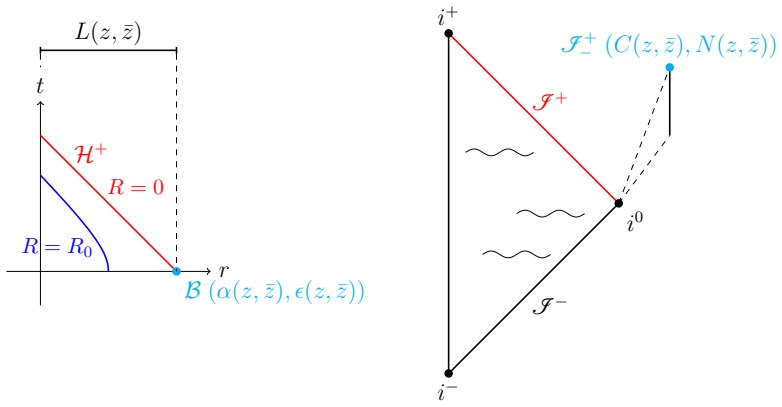
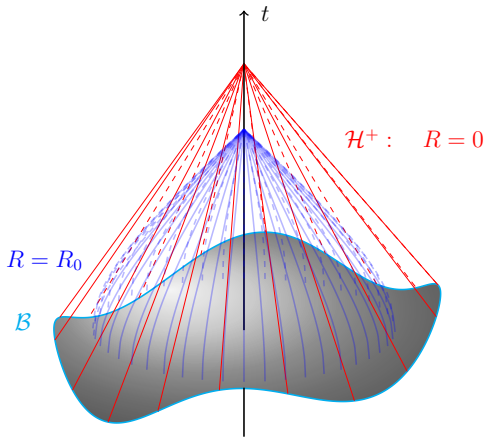
We construct the phase space for an arbitrary cut of a null hypersurface in Minkowski spacetime and demonstrate that it is symplectomorphic to the infrared phase space of asymptotically flat gravity. Fluctuations of the cut are mapped to the leading soft graviton mode. Furthermore, the supertranslation Goldstone mode is mapped to the product of the size of the cut with its symplectic partner, the null time offset.
What carries the argument
The symplectomorphism equating the phase space of a finite null cut to the infrared phase space, with cut fluctuations mapped to soft graviton modes.
If this is right
- Fluctuations of the null cut correspond directly to the leading soft graviton mode.
- The supertranslation Goldstone mode is realized as the product of the cut size and the null time offset.
- Asymptotic infrared structure can be recovered from phase space data localized on a finite null surface.
- The mapping holds for arbitrary cuts of the null hypersurface.
Where Pith is reading between the lines
- The equivalence suggests that soft-graviton theorems might be recoverable from calculations restricted to local flat-space subregions.
- It opens the possibility of studying asymptotic symmetries using only finite-region data, potentially simplifying certain holographic calculations.
- Similar mappings could be tested in more general spacetimes to see whether the infrared structure remains tied to null cuts.
Load-bearing premise
The infrared phase space of asymptotically flat gravity is independently well-defined so that a symplectomorphism to the finite null cut phase space can be established without further global boundary conditions.
What would settle it
An explicit computation of the symplectic form on the phase space of a chosen null cut in Minkowski spacetime that fails to match the known infrared symplectic form of asymptotically flat gravity would falsify the claimed equivalence.
Figures
read the original abstract
We construct the phase space for an arbitrary cut of a null hypersurface in Minkowski spacetime and demonstrate that it is symplectomorphic to the infrared phase space of asymptotically flat gravity. Fluctuations of the cut are mapped to the leading soft graviton mode. Furthermore, the supertranslation Goldstone mode is mapped to the product of the size of the cut with its symplectic partner, the null time offset.
Editorial analysis
A structured set of objections, weighed in public.
Referee Report
Summary. The paper constructs the phase space for an arbitrary cut of a null hypersurface in Minkowski spacetime and demonstrates that it is symplectomorphic to the infrared phase space of asymptotically flat gravity. Fluctuations of the cut are mapped to the leading soft graviton mode, and the supertranslation Goldstone mode is mapped to the product of the cut size with its null time offset.
Significance. If the claimed symplectomorphism holds with explicit verification, the result would furnish a finite-subregion realization of the IR phase space of gravity. This could clarify the physical interpretation of soft modes and memory effects by relating them directly to local data on null cuts, without relying solely on asymptotic boundary conditions.
major comments (1)
- [Demonstration of symplectomorphism] The central claim is the explicit demonstration that the symplectic form on the cut phase space equals the pullback of the IR symplectic form under the stated map (cut fluctuations to leading soft graviton; Goldstone to size × null-time offset). No derivation of either symplectic form, no computation of the pullback, and no check that edge boundary terms vanish are supplied, rendering the equivalence unverified. This is load-bearing for the result.
minor comments (1)
- [Abstract] The abstract states the mapping but does not indicate the coordinate system or fall-off conditions used to define the cut phase space; adding one sentence on these would improve readability.
Simulated Author's Rebuttal
We thank the referee for the detailed report and for identifying the central claim requiring explicit verification. We agree that the symplectomorphism must be demonstrated with full derivations rather than asserted. Below we respond to the single major comment and commit to a revision that supplies the missing calculations.
read point-by-point responses
-
Referee: [Demonstration of symplectomorphism] The central claim is the explicit demonstration that the symplectic form on the cut phase space equals the pullback of the IR symplectic form under the stated map (cut fluctuations to leading soft graviton; Goldstone to size × null-time offset). No derivation of either symplectic form, no computation of the pullback, and no check that edge boundary terms vanish are supplied, rendering the equivalence unverified. This is load-bearing for the result.
Authors: We accept the referee's assessment. The submitted manuscript states the symplectomorphism but does not provide the explicit derivations of the two symplectic forms, the pullback computation under the given map, or the verification that edge boundary terms cancel. In the revised version we will add a new section (or subsection) that: (i) derives the symplectic form on the phase space of an arbitrary null cut in Minkowski space from the covariant phase space formalism; (ii) recalls the standard IR symplectic form on the asymptotic phase space; (iii) defines the map (cut fluctuations ↔ leading soft graviton, Goldstone mode ↔ cut size × null-time offset) with all coordinate conventions; (iv) computes the pullback explicitly; and (v) confirms that all boundary terms at the cut edges vanish or cancel. This will make the equivalence fully verifiable. revision: yes
Circularity Check
No significant circularity; mapping between independently constructed phase spaces
full rationale
The paper constructs the phase space on an arbitrary null cut in Minkowski spacetime separately and then demonstrates a symplectomorphism to the infrared phase space of asymptotically flat gravity, which is treated as a pre-existing object from the literature. The abstract and reader's summary give no indication that the cut phase space is defined in terms of the IR one or that the symplectomorphism is tautological. No load-bearing self-citation, fitted prediction, or self-definitional step is exhibited in the provided text. This is the normal case of a paper whose central claim has independent content.
Axiom & Free-Parameter Ledger
Reference graph
Works this paper leans on
-
[1]
Observational signatures of quantum gravity in interferometers,
E. P. Verlinde and K. M. Zurek, “Observational signatures of quantum gravity in interferometers,”Phys. Lett. B822(2021) 136663,arXiv:1902.08207 [gr-qc]
arXiv 2021
-
[2]
Spacetime Fluctuations in AdS/CFT,
E. Verlinde and K. M. Zurek, “Spacetime Fluctuations in AdS/CFT,”JHEP04 (2020) 209,arXiv:1911.02018 [hep-th]
arXiv 2020
-
[3]
Quantum Area Fluctuations from Gravitational Phase Space,
L. Ciambelli, T. He, and K. M. Zurek, “Quantum Area Fluctuations from Gravitational Phase Space,”arXiv:2504.12282 [hep-th]
-
[4]
Quantum Mechanics of a Spherically Symmetric Causal Diamond in Minkowski Spacetime,
M. W. Bub, T. He, P. Mitra, Y. Zhang, and K. M. Zurek, “Quantum Mechanics of a Spherically Symmetric Causal Diamond in Minkowski Spacetime,”Phys. Rev. Lett. 134no. 12, (2025) 121501,arXiv:2408.11094 [hep-th]
arXiv 2025
-
[5]
An effective density matrix for vacua in asymptotically flat gravity,
T. He, P. Mitra, and K. M. Zurek, “An effective density matrix for vacua in asymptotically flat gravity,”arXiv:2509.13401 [hep-th]
-
[6]
From Asymptotically Flat Gravity to Finite Causal Diamonds,
L. Ciambelli, T. He, and K. M. Zurek, “From Asymptotically Flat Gravity to Finite Causal Diamonds,”arXiv:2512.09018 [hep-th]
-
[7]
Crossed products, extended phase spaces and the resolution of entanglement singularities,
M. S. Klinger and R. G. Leigh, “Crossed products, extended phase spaces and the resolution of entanglement singularities,”Nucl. Phys. B999(2024) 116453, arXiv:2306.09314 [hep-th]
arXiv 2024
-
[8]
The problem of time and its quantum resolution,
M. S. Klinger and R. G. Leigh, “The problem of time and its quantum resolution,” Int. J. Mod. Phys. D34no. 16, (2025) 2544022,arXiv:2504.00152 [hep-th]. 32
arXiv 2025
-
[9]
Geometric noise spectrum in interferometers,
L. Freidel and R. Oberfrank, “Geometric noise spectrum in interferometers,” arXiv:2601.17849 [hep-th]
-
[10]
Quantum Geometry from Area Fluctuations,
J. Kowalski-Glikman and L. Varrin, “Quantum Geometry from Area Fluctuations,” arXiv:2606.06372 [hep-th]
-
[11]
Local subsystems in gauge theory and gravity,
W. Donnelly and L. Freidel, “Local subsystems in gauge theory and gravity,”JHEP 09(2016) 102,arXiv:1601.04744 [hep-th]
Pith/arXiv arXiv 2016
-
[12]
Local phase space and edge modes for diffeomorphism-invariant theories,
A. J. Speranza, “Local phase space and edge modes for diffeomorphism-invariant theories,”JHEP02(2018) 021,arXiv:1706.05061 [hep-th]
Pith/arXiv arXiv 2018
-
[13]
Extended actions, dynamics of edge modes, and entanglement entropy,
M. Geiller and P. Jai-akson, “Extended actions, dynamics of edge modes, and entanglement entropy,”JHEP09(2020) 134,arXiv:1912.06025 [hep-th]
arXiv 2020
-
[14]
On-shell derivation of the soft effective action in Abelian gauge theories,
T. He, P. Mitra, A. Sivaramakrishnan, and K. M. Zurek, “On-shell derivation of the soft effective action in Abelian gauge theories,”Phys. Rev. D109no. 12, (2024) 125016,arXiv:2403.14502 [hep-th]
arXiv 2024
-
[15]
Dynamical edge modes and entanglement in Maxwell theory,
A. Ball, Y. T. A. Law, and G. Wong, “Dynamical edge modes and entanglement in Maxwell theory,”JHEP09(2024) 032,arXiv:2403.14542 [hep-th]
arXiv 2024
-
[16]
Dynamical edge modes in p-form gauge theories,
A. Ball and Y. T. A. Law, “Dynamical edge modes in p-form gauge theories,”JHEP 02(2025) 182,arXiv:2411.02555 [hep-th]
arXiv 2025
-
[17]
Dynamical Edge Modes in Yang-Mills Theory,
A. Ball and L. Ciambelli, “Dynamical Edge Modes in Yang-Mills Theory,” arXiv:2412.06672 [hep-th]
-
[18]
A Diamond of Infrared Equivalences in Abelian Gauge Theories,
T. He, P. Mitra, and K. M. Zurek, “A Diamond of Infrared Equivalences in Abelian Gauge Theories,”arXiv:2405.12303 [hep-th]
-
[19]
Soft edges: the many links between soft and edge modes,
G. Araujo-Regado, P. A. Hoehn, F. Sartini, and B. Tomova, “Soft edges: the many links between soft and edge modes,”JHEP07(2025) 180,arXiv:2412.14548 [hep-th]
arXiv 2025
-
[20]
Edge modes as dynamical frames: charges from post-selection in generally covariant theories,
S. Carrozza, S. Eccles, and P. A. Hoehn, “Edge modes as dynamical frames: charges from post-selection in generally covariant theories,”SciPost Phys.17no. 2, (2024) 048,arXiv:2205.00913 [hep-th]
arXiv 2024
-
[21]
Embeddings and Integrable Charges for Extended Corner Symmetry,
L. Ciambelli, R. G. Leigh, and P.-C. Pai, “Embeddings and Integrable Charges for Extended Corner Symmetry,”Phys. Rev. Lett.128(2022) ,arXiv:2111.13181 [hep-th]. 33
arXiv 2022
-
[22]
From Asymptotic Symmetries to the Corner Proposal,
L. Ciambelli, “From Asymptotic Symmetries to the Corner Proposal,”PoS Modave2022(2023) 002,arXiv:2212.13644 [hep-th]
arXiv 2023
-
[23]
Extended phase space in general gauge theories,
M. S. Klinger, R. G. Leigh, and P.-C. Pai, “Extended phase space in general gauge theories,”Nucl. Phys. B998(2024) 116404,arXiv:2303.06786 [hep-th]
arXiv 2024
-
[24]
Generalized Entropy is von Neumann Entropy II: The complete symmetry group and edge modes,
M. S. Klinger, J. Kudler-Flam, and G. Satishchandran, “Generalized Entropy is von Neumann Entropy II: The complete symmetry group and edge modes,” arXiv:2601.07910 [hep-th]
-
[25]
BMS supertranslations and Weinberg’s soft graviton theorem,
T. He, V. Lysov, P. Mitra, and A. Strominger, “BMS supertranslations and Weinberg’s soft graviton theorem,”JHEP05(2015) 151,arXiv:1401.7026 [hep-th]
Pith/arXiv arXiv 2015
-
[26]
From shockwaves to the gravitational memory effect,
T. He, A.-M. Raclariu, and K. M. Zurek, “From shockwaves to the gravitational memory effect,”JHEP01(2024) 006,arXiv:2305.14411 [hep-th]
arXiv 2024
-
[27]
T. He, A.-M. Raclariu, and K. M. Zurek, “An infrared on-shell action and its implications for soft charge fluctuations in asymptotically flat spacetimes,”J. Phys. A 58no. 16, (2025) 165402,arXiv:2408.01485 [hep-th]
arXiv 2025
-
[28]
An algebra of proper observables at null infinity: Dirac brackets, Memory and Goldstone probes,
R. Andrade e Silva and S. Speziale, “An algebra of proper observables at null infinity: Dirac brackets, Memory and Goldstone probes,”arXiv:2605.13804 [hep-th]
-
[29]
On BMS Invariance of Gravitational Scattering,
A. Strominger, “On BMS Invariance of Gravitational Scattering,”JHEP07(2014) 152,arXiv:1312.2229 [hep-th]
Pith/arXiv arXiv 2014
-
[30]
Area, Entanglement Entropy and Supertranslations at Null Infinity,
D. Kapec, A.-M. Raclariu, and A. Strominger, “Area, Entanglement Entropy and Supertranslations at Null Infinity,”Class. Quant. Grav.34no. 16, (2017) 165007, arXiv:1603.07706 [hep-th]
Pith/arXiv arXiv 2017
-
[31]
Interferometer response to geontropic fluctuations,
D. Li, V. S. H. Lee, Y. Chen, and K. M. Zurek, “Interferometer response to geontropic fluctuations,”Phys. Rev. D107no. 2, (2023) 024002,arXiv:2209.07543 [gr-qc]
arXiv 2023
-
[32]
Photon-Counting Interferometry to Detect Geontropic Space-Time Fluctuations with GQuEST,
S. M. Vermeulenet al., “Photon-Counting Interferometry to Detect Geontropic Space-Time Fluctuations with GQuEST,”Phys. Rev. X15no. 1, (2025) 011034, arXiv:2404.07524 [gr-qc]
arXiv 2025
-
[33]
Lectures on the Infrared Structure of Gravity and Gauge Theory,
A. Strominger, “Lectures on the Infrared Structure of Gravity and Gauge Theory,” arXiv:1703.05448 [hep-th]
-
[34]
Null Conservation Laws for Gravity,
F. Hopfm¨ uller and L. Freidel, “Null Conservation Laws for Gravity,”Phys. Rev. D97 no. 12, (2018) 124029,arXiv:1802.06135 [gr-qc]. 34
Pith/arXiv arXiv 2018
-
[35]
Modular fluctuations from shockwave geometries,
E. Verlinde and K. M. Zurek, “Modular fluctuations from shockwave geometries,” Phys. Rev. D106no. 10, (2022) 106011,arXiv:2208.01059 [hep-th]
arXiv 2022
-
[36]
Snowmass 2021 White Paper: Observational Signatures of Quantum Gravity,
K. M. Zurek, “Snowmass 2021 White Paper: Observational Signatures of Quantum Gravity,”arXiv:2205.01799 [gr-qc]
arXiv 2021
-
[37]
Gravitational Memory, BMS Supertranslations and Soft Theorems,
A. Strominger and A. Zhiboedov, “Gravitational Memory, BMS Supertranslations and Soft Theorems,”JHEP01(2016) 086,arXiv:1411.5745 [hep-th]
Pith/arXiv arXiv 2016
-
[38]
Foundations of Carrollian Geometry,
L. Ciambelli and P. Jai-akson, “Foundations of Carrollian Geometry,” arXiv:2510.21651 [hep-th]
-
[39]
Asymptotic Limit of Null Hypersurfaces,
L. Ciambelli, “Asymptotic Limit of Null Hypersurfaces,”arXiv:2501.17357 [hep-th]
-
[40]
Rindler fluids from gravitational shockwaves,
S.-E. Bak, C. Keeler, Y. Zhang, and K. M. Zurek, “Rindler fluids from gravitational shockwaves,”JHEP05(2024) 331,arXiv:2403.18013 [hep-th]
arXiv 2024
-
[41]
Carrollian Physics at the Black Hole Horizon,
L. Donnay and C. Marteau, “Carrollian Physics at the Black Hole Horizon,”Class. Quant. Grav.36no. 16, (2019) 165002,arXiv:1903.09654 [hep-th]
arXiv 2019
-
[42]
S. M. Carroll,Spacetime and Geometry: An Introduction to General Relativity. Cambridge University Press, 7, 2019
2019
-
[43]
Quantum null geometry and gravity,
L. Ciambelli, L. Freidel, and R. G. Leigh, “Quantum null geometry and gravity,” JHEP12(2024) 028,arXiv:2407.11132 [hep-th]
arXiv 2024
-
[44]
Symmetries and charges of general relativity at null boundaries,
V. Chandrasekaran, E. E. Flanagan, and K. Prabhu, “Symmetries and charges of general relativity at null boundaries,”JHEP11(2018) 125,arXiv:1807.11499 [hep-th]. [Erratum: JHEP 07, 224 (2023)]
arXiv 2018
-
[45]
Horizon phase spaces in general relativity,
V. Chandrasekaran and E. E. Flanagan, “Horizon phase spaces in general relativity,” JHEP07(2024) 017,arXiv:2309.03871 [hep-th]
arXiv 2024
-
[46]
General gravitational charges on null hypersurfaces,
G. Odak, A. Rignon-Bret, and S. Speziale, “General gravitational charges on null hypersurfaces,”JHEP12(2023) 038,arXiv:2309.03854 [gr-qc]
arXiv 2023
-
[47]
Null Raychaudhuri: canonical structure and the dressing time,
L. Ciambelli, L. Freidel, and R. G. Leigh, “Null Raychaudhuri: canonical structure and the dressing time,”JHEP01(2024) 166,arXiv:2309.03932 [hep-th]
arXiv 2024
-
[48]
A Theory of Backgrounds and Background Independence,
M. Klinger, “A Theory of Backgrounds and Background Independence,” arXiv:2512.05043 [hep-th]. 35
-
[49]
Analytical Calculations of Gravitational Radiation,
T. Damour, “Analytical Calculations of Gravitational Radiation,” in4th Marcel Grossmann Meeting on the Recent Developments of General Relativity. 6, 1985
1985
-
[50]
Thermodynamics of a Spherically Symmetric Causal Diamond in Minkowski Spacetime,
K. Fransen, T. He, and K. M. Zurek, “Thermodynamics of a Spherically Symmetric Causal Diamond in Minkowski Spacetime,”arXiv:2507.22977 [hep-th]
-
[51]
Field-dependent diffeomorphisms and the transformation of surface charges between gauges,
L. Ciambelli and M. Geiller, “Field-dependent diffeomorphisms and the transformation of surface charges between gauges,”JHEP05(2025) 022, arXiv:2412.14992 [hep-th]
arXiv 2025
-
[52]
Gravitational waves in general relativity. 7. Waves from axisymmetric isolated systems,
H. Bondi, M. G. J. van der Burg, and A. W. K. Metzner, “Gravitational waves in general relativity. 7. Waves from axisymmetric isolated systems,”Proc. Roy. Soc. Lond. A269(1962) 21–52
1962
-
[53]
Asymptotic symmetries in gravitational theory,
R. Sachs, “Asymptotic symmetries in gravitational theory,”Phys. Rev.128(1962) 2851–2864
1962
-
[54]
Symplectic Geometry of Radiative Modes and Conserved Quantities at Null Infinity,
A. Ashtekar and M. Streubel, “Symplectic Geometry of Radiative Modes and Conserved Quantities at Null Infinity,”Proc. Roy. Soc. Lond. A376(1981) 585–607
1981
-
[55]
Infrared finite scattering theory in quantum field theory and quantum gravity,
K. Prabhu, G. Satishchandran, and R. M. Wald, “Infrared finite scattering theory in quantum field theory and quantum gravity,”Phys. Rev. D106no. 6, (2022) 066005, arXiv:2203.14334 [hep-th]
arXiv 2022
-
[56]
Emergent geometry from quantum probability,
S. Ali Ahmad and M. S. Klinger, “Emergent geometry from quantum probability,” Phys. Rev. D111no. 10, (2025) 105015,arXiv:2411.07288 [hep-th]
arXiv 2025
-
[57]
S. Ali Ahmad and M. S. Klinger, “Extensions from within,”arXiv:2503.02944 [hep-th]
-
[58]
Horizons and Soft Quantum Information,
D. L. Danielson and G. Satishchandran, “Horizons and Soft Quantum Information,” arXiv:2512.20754 [hep-th]
-
[59]
Stochastic Description of Near-Horizon Fluctuations in Rindler-AdS,
Y. Zhang and K. M. Zurek, “Stochastic Description of Near-Horizon Fluctuations in Rindler-AdS,”arXiv:2304.12349 [hep-th]
-
[60]
Geometry of general hypersurfaces in space-time: Junction conditions,
M. Mars and J. M. M. Senovilla, “Geometry of general hypersurfaces in space-time: Junction conditions,”Class. Quant. Grav.10(1993) 1865–1897, arXiv:gr-qc/0201054
Pith/arXiv arXiv 1993
-
[61]
Carrollian hydrodynamics and symplectic structure on stretched horizons,
L. Freidel and P. Jai-akson, “Carrollian hydrodynamics and symplectic structure on stretched horizons,”JHEP05(2024) 135,arXiv:2211.06415 [gr-qc]. 36
arXiv 2024
discussion (0)
Sign in with ORCID, Apple, or X to comment. Anyone can read and Pith papers without signing in.