REVIEW 6 major objections 5 minor 1 cited by
Ten Challenging Problems in Federated Foundation Models
T0 review · 6 major / 5 minor · reviewed 2026-08-07 · deepseek-v4-flash
Pith's one-line read A single weighted-loss equation unifies the ten hard problems of federated foundation models, the paper argues.
desk verdict Useful FedFM taxonomy undermined by a unified equation that misrepresents its own per-problem formulations. read the letter →
The pith
A machine-rendered reading of the paper's core claim, the machinery that carries it, and where it could break.
The reading
What carries the argument
The unifying object is Eq. (17), a five-term weighted objective with a no-free-lunch constraint. Each term is a loss evaluated on the server model, client models, client actions, aggregation mechanism, contribution evaluation mechanism, the sequence of tasks, and graph data; the five weights are nonnegative and sum to 1. The machinery works by coefficient selection: setting one weight to 1 collapses the general objective into the specific formulation of one of the ten problems, so the same equation serves both as a common framework and as a generator of individual problem statements.
What would settle it
Train two FedFM systems to identical final model weights using different numbers of communication rounds or different aggregation randomness, then measure membership-inference or gradient-inversion leakage on the same target client. If leakage differs while the model weights and local data are the same, privacy loss is not a function of weights and data alone, and the unified objective cannot faithfully represent the privacy constraints it claims to encode.
Extended reading notes
Core claim
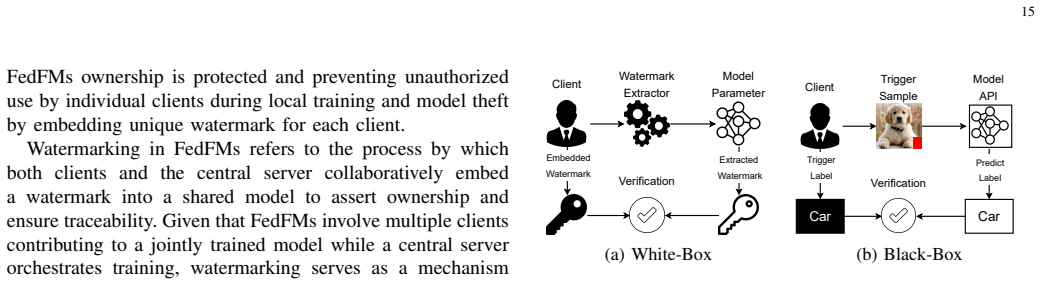
The paper's central claim is Eq. (17): minimize, over the server model, client models, client actions, aggregation mechanism, and contribution evaluation mechanism, a weighted sum of five loss terms — utility loss, efficiency loss, watermark loss, contribution loss, and privacy loss — subject to the constraint that the sum of utility, privacy, and efficiency losses is strictly positive. By setting one weight to 1 and the others to 0, the equation is claimed to recover the individual problems: utility-only covers private data utilization, continual learning, Non-IID and graph data, bidirectional knowledge transfer, and game mechanisms; efficiency-only covers Problem 10; watermark-only covers Problem 9; contribution-only covers Problem 7; privacy-only covers unlearning; and the constraint encodes the foundational-theory trade-off of Problem 1. The paper presents this as the first unified mathematical formulation of the key problems of FedFMs.
Load-bearing premise
The unified objective treats privacy loss as a fixed function of the model weights and the local dataset, but in real federated systems privacy leakage also depends on the training algorithm, the number of communication rounds, the adversary's prior knowledge, and randomness — none of which appear as variables in Eq. (17).
Editorial extensions
If this is right
- If Eq. (17) is accepted, FedFM research can be organized as a single multi-objective optimization, with each of the ten problems a special case obtained by choosing weights.
- The no-free-lunch constraint makes explicit that utility, privacy, and efficiency cannot all be minimized simultaneously, so every FedFM design must state which trade-off it accepts.
- Problems 2, 3, 5, 6, and 8 are claimed to share the utility-loss term, meaning methods for private-data utilization, continual learning, Non-IID and graph learning, bidirectional transfer, and game mechanisms can be evaluated within one utility objective.
- The framework folds incentive design (contribution loss) and security (watermark and privacy losses) into the training objective itself, making fairness and protection part of optimization rather than post-hoc add-ons.
- The per-problem formulations in Eqs. (1) through (16) give concrete objective functions that future FedFM algorithms can instantiate, compare, and test against.
Reading between the lines
- If the unification is taken literally, an immediate test is whether real FedFM systems admit a single set of weights that reproduces observed trade-offs; the paper does not propose how to choose those weights, so weight selection becomes a key open design problem.
- A consequence the authors leave implicit is that the same equation could serve as a benchmark generator: each problem's objective can be turned into a synthetic task suite where methods are scored by how much they reduce the corresponding term without inflating the others.
- Because the privacy term is written as a function of weights and local data alone, the framework will likely need an extended version that conditions privacy loss on communication rounds, randomness, and adversary knowledge — a natural next step beyond the paper.
- The five-loss structure connects naturally to multi-objective federated learning formalizations, and the no-free-lunch constraint could be sharpened into concrete information-theoretic bounds if privacy loss were replaced by a mutual-information or differential-privacy based quantity.
Editorial analysis
A structured set of objections, weighed in public.
Referee Report
Summary. This manuscript is a survey/position paper on federated foundation models (FedFMs). It identifies ten problems—foundational theory, private data utilization, continual learning, unlearning, Non-IID/graph data, bidirectional knowledge transfer, incentive and contribution evaluation, game mechanisms, model watermarking, and efficiency—and organizes them under five themes. For each problem it gives a short optimization formulation (Eqs. (1)–(16)), reviews representative methods, and lists challenges and potential solutions. Section XII then proposes Eq. (17) as a single weighted objective over utility, efficiency, watermark, contribution, and privacy losses, and claims that this is the first mathematical perspective unifying all ten problems. The per-problem formulations and the survey material are the paper's main content.
Significance. The survey is timely and useful as a map of a rapidly growing area: it assembles a large reference set, compares against existing reviews in Table II, and attempts to give each of the ten challenges a crisp mathematical statement. If Eq. (17) were a faithful unification, it would provide a valuable common formalism for reasoning about trade-offs across privacy, utility, efficiency, watermarking, and contribution. However, the central unification claim is not supported by the equations as written: several per-problem formulations are informal or inconsistent, and Eq. (17) drops the privacy thresholds and mislabels Problem 4. The value of the manuscript lies mainly in its taxonomy and literature coverage; the mathematical contributions need substantial revision before they can serve as a foundation.
major comments (6)
- [Section XII, Eq. (17)] The unified equation does not subsume the privacy-constrained problems it claims to cover. In Eqs. (4), (9), and (16), privacy appears as a hard constraint ℓ_{p,k}(w) < δ_k, while Eq. (17) contains no δ_k and places ℓ_{p,k} only in the weighted objective. A weighted objective term cannot enforce a hard constraint without an explicit constraint set, so the reductions α1=1 and α5=1 do not reproduce Problems 2, 5, or 10. The additional claim that α5=1 'optimizes the privacy loss (i.e., problem 4)' is also incorrect: Problem 4 is defined in Eq. (7) as minimizing dist(w_un, w_re), with no ℓ_p term in the objective. The mapping from Eq. (17) to Problem 8 is likewise unexplained, since Eq. (12) is a utility maximization rather than a utility-loss minimization. Until these reductions are actually carried out, the 'first mathematical perspective' claim in Section XII is unsupported.
- [Section XII, Eq. (17)] Eq. (17) is not a well-defined optimization program. The minimization is over wg, {a_k}, F, and C, where F is an aggregation mechanism and C a contribution evaluation mechanism; these are function-valued objects, and no function space, feasible set, or regularity condition is given for them. The notation F_{k∈[K],t∈[T]} appearing before the objective is undefined, and the loss terms are written with arguments (ws, wk, ak, C, {D_t^k}, G) even though C is simultaneously an optimization variable and an argument of the losses. A reader cannot evaluate, solve, or instantiate Eq. (17) for any of the ten problems.
- [Section II-A, Eq. (1)] The 'no free lunch' constraint ℓu(w)+ℓp(w)+ℓe(w)>0 is trivial for any nonnegative loss functions and therefore does not express the privacy-utility-efficiency trade-off the text describes. A trade-off requires either a lower bound relating the three losses, as in Eq. (2), or a Pareto-front characterization. The same trivial inequality is reused as the constraint in Eq. (17), so the foundational-theory Problem 1 is not captured by the unified equation.
- [Section VIII-A, Eq. (11)] The contribution-evaluation objective depends on an Oracle that knows the true contribution C*_k for each client. Such ground-truth contributions are unobservable in any real federated system, and the manuscript does not define C*_k or explain how existing schemes (Shapley value, leave-one-out, least core) relate to it. As written, Eq. (11) turns contribution evaluation into supervised regression against an unknown target, which cannot be computed or verified. The formulation needs either an operational definition of C*_k or a restatement in terms of the fairness properties that contribution evaluation is meant to satisfy.
- [Section IX-A, Eqs. (12)–(14)] The game-mechanism formulation is internally inconsistent. The text writes that attackers minimize their utility Uatt, but in a defense game an attacker should be maximizing its own utility subject to costs; the equilibrium condition in Eq. (13) is the standard Nash condition U_k(a*_k,a*_-k) ≥ U_k(a_k,a*_-k), which presupposes maximization. The subsequently 'unified' objective in Eq. (14), max Σ_k U_k & min Σ_k Cost_k, also leaves the trade-off between utility and cost unspecified, and it does not follow from the two preceding displayed objectives. Problem 8 therefore lacks a coherent mathematical statement, and Eq. (17) cannot inherit one from it.
- [Throughout, Eqs. (1), (4), (9), (16), (17)] Privacy loss is treated throughout as a deterministic function ℓ_{p,k}(w, D_k) of the model and local data. In real federated systems, privacy leakage depends on the training algorithm, the number of communication rounds, the adversary's prior knowledge, and the randomness of the mechanism. Because Eq. (17) and the per-problem formulations do not include these variables, the unified framework cannot faithfully represent privacy guarantees such as differential privacy or membership-inference risk. A formal treatment should either define ℓ_{p,k} through a specific privacy mechanism or state explicitly that the formulation abstracts away from mechanism-dependent leakage.
minor comments (5)
- [Section X-A, Eq. (15)] The notation min_w F_{k=0,1,...,K} αℓu,k(ws)+... is ambiguous: F appears both as an aggregation mechanism and as part of the minimization expression, and the relationship between the outer weight α and the stated constraint α+β+γ=1 is unclear. Please rewrite with explicit aggregation and separate index notation.
- [Section VIII-A, Eq. (11)] In Eq. (11), k is used both for the client on the left-hand side and as the summation index on the right-hand side; the sum should run over a different index (e.g., Σ_{j=1}^K ||C(ws,D_j)-C*_j||²). The current notation also defines ℓc,k as a global sum rather than a per-client loss, which conflicts with the surrounding text.
- [Section IV-A, Eq. (5)] In Eq. (5), the old-task arguments are written as {D^t_k}_{t=1}^T inside ℓu,k(wg, {D^t_k}_{t=1}^T), but the aggregation F then takes a comma-separated list of old-task and new-task losses. The syntax suggests two different function types and should be made uniform.
- [Section VII-A, Settings 2 and 3] The server-side loss is written as ℓu,s(ws|wk,Dp) in one line and as ℓu,k(ws|wk,Dp) in the adjacent displays; the subscripts should be standardized to avoid confusion between the server and client indices.
- [Throughout] There are numerous typos and inconsistent terms: 'mechanishm' in Eqs. (6), (8), and (9), 'receptively' in Eq. (15), 'Tand' in Section IV-A, 'How to to improve' in the Problem 10 heading, and 'foundation theory' versus 'foundational theory' are used interchangeably. A careful copy-edit is needed.
Circularity Check
No significant circularity: Section XII's Eq. (17) is a stated synthesis of the paper's own per-problem formulations, not an independent derivation, and the internal inconsistencies flagged by the skeptic are correctness concerns rather than circular reductions.
full rationale
This is a survey/position paper rather than a derivation of new empirical predictions. Each of the ten problems is formulated independently in Sections II-XI and grounded in the cited literature (e.g., FedAvg [112], the no-free-lunch trade-off [108], FedIPR [92], FedMKT [64]). Section XII then writes Eq. (17) as a weighted sum of the same loss symbols (ell_u, ell_e, ell_m, ell_c, ell_p) and asserts that setting one alpha_i to 1 reduces the equation to one of the earlier problems. That assertion is a synthesis claim, not a fitted parameter or a theorem derived from external constraints. The skeptical objection that Eq. (17) drops the delta_k privacy constraints and mislabels Problem 4 (unlearning, Eq. (7)) as "privacy loss" is an internal-consistency/correctness problem with the claimed unification; it does not make the unification circular, because Eq. (17) is not being used to predict or derive the per-problem results. The self-citations to [108], [64], [92], [111], etc. are used as literature grounding, not as a load-bearing uniqueness argument, and the no-free-lunch constraint in Eqs. (1) and (17) is attributed to an external peer-reviewed theorem rather than assumed into existence by this paper. Accordingly, no step satisfies the standard of "Eq. X = Eq. Y by construction" or "fitted parameter renamed as prediction." The strongest claim of being the "first" mathematical perspective is a novelty assertion that may be contestable on scope or correctness, but it is not circular.
Assumptions & free parameters
free parameters (2)
- weights α, β, γ and α1..α5
- privacy thresholds δ_k
assumptions (3)
- standard math The 'no free lunch' trade-off: ℓu + ℓp + ℓe > 0, borrowed from Zhang et al. [108].
- ad hoc to paper All ten challenges are representable as minimization of additive loss terms over model weights through an aggregation mechanism F.
- domain assumption Privacy loss ℓ_{p,k}(w, Dk) is a deterministic function of the model and data.
invented entities (1)
-
Oracle true contribution C*_k
Cite this review
Pith. "Pith review of Ten Challenging Problems in Federated Foundation Models." pith.science (2026). https://pith.science/paper/IPTAIWPG
@misc{pith2026250212176,
  author       = {Pith},
  title        = {Pith review of: Ten Challenging Problems in Federated Foundation Models},
  year         = {2026},
  howpublished = {\url{https://pith.science/paper/IPTAIWPG}},
  note         = {Machine review of arXiv:2502.12176}
}
read the original abstract
Federated Foundation Models (FedFMs) represent a distributed learning paradigm that fuses general competences of foundation models as well as privacy-preserving capabilities of federated learning. This combination allows the large foundation models and the small local domain models at the remote clients to learn from each other in a teacher-student learning setting. This paper provides a comprehensive summary of the ten challenging problems inherent in FedFMs, encompassing foundational theory, utilization of private data, continual learning, unlearning, Non-IID and graph data, bidirectional knowledge transfer, incentive mechanism design, game mechanism design, model watermarking, and efficiency. The ten challenging problems manifest in five pivotal aspects: ``Foundational Theory," which aims to establish a coherent and unifying theoretical framework for FedFMs. ``Data," addressing the difficulties in leveraging domain-specific knowledge from private data while maintaining privacy; ``Heterogeneity," examining variations in data, model, and computational resources across clients; ``Security and Privacy," focusing on defenses against malicious attacks and model theft; and ``Efficiency," highlighting the need for improvements in training, communication, and parameter efficiency. For each problem, we offer a clear mathematical definition on the objective function, analyze existing methods, and discuss the key challenges and potential solutions. This in-depth exploration aims to advance the theoretical foundations of FedFMs, guide practical implementations, and inspire future research to overcome these obstacles, thereby enabling the robust, efficient, and privacy-preserving FedFMs in various real-world applications.
Figures


Figures from the paper (8 more)



Forward citations
Cited by 1 Pith paper
-
Handling Spatial-Temporal Data Heterogeneity for Federated Continual Learning via Tail Anchor
FedTA freezes a pre-trained ViT and trains small tail anchors to keep class features in place, reducing forgetting in federated continual learning.
Reference graph
Works this paper leans on
-
[1]
A comprehensive survey on pretrained founda- tion models: A history from bert to chatgpt,
C. Zhou, Q. Li et al., “A comprehensive survey on pretrained founda- tion models: A history from bert to chatgpt,” IJMLC, 2024
2024
-
[2]
Fate-llm: A industrial grade federated learning framework for llms,
T. Fan, Y . Kang et al., “Fate-llm: A industrial grade federated learning framework for llms,” arXiv preprint, 2023
2023
-
[3]
Grounding foundation models through federated transfer learning: A general framework,
Y . Kang, T. Fanet al., “Grounding foundation models through federated transfer learning: A general framework,” arXiv preprint, 2023
2023
-
[4]
Advances and open challenges in federated learning with foundation models,
C. Ren, H. Yu et al. , “Advances and open challenges in federated learning with foundation models,” arXiv preprint, 2024
2024
-
[5]
Federated machine learning: Concept and applications,
Q. Yang, Y . Liu et al. , “Federated machine learning: Concept and applications,” TIST, 2019
2019
-
[6]
No free lunch theorem for privacy-preserving llm inference,
X. Zhang, Y . Fei et al., “No free lunch theorem for privacy-preserving llm inference,” Artificial Intelligence, 2025
2025
-
[7]
Tunable soft prompts are messengers in federated learning,
C. Dong, Y . Xie et al. , “Tunable soft prompts are messengers in federated learning,” in EMNLP, 2023
2023
-
[8]
Privately customizing prefinetuning to better match user data in federated learning,
C. Hou, H. Zhan et al., “Privately customizing prefinetuning to better match user data in federated learning,” ICLR Workshop, 2023
2023
Show all 219 references
-
[9]
Federatedscope-llm: A comprehensive package for fine-tuning llms in federated learning,
W. Kuang et al. , “Federatedscope-llm: A comprehensive package for fine-tuning llms in federated learning,” in SIGKDD, 2024
2024
-
[10]
Fedbiot: Llm local fine-tuning in federated learning without full model,
F. Wu, Z. Li et al., “Fedbiot: Llm local fine-tuning in federated learning without full model,” in SIGKDD, 2024
2024
-
[11]
Towards building the federated gpt: Federated instruction tuning,
J. Zhang, S. Vahidian et al. , “Towards building the federated gpt: Federated instruction tuning,” in ICASSP, 2023
2023
-
[12]
Flora: Federated fine-tuning llms with heterogeneous low-rank adaptations,
Z. Wang, Z. Shen et al. , “Flora: Federated fine-tuning llms with heterogeneous low-rank adaptations,” arXiv preprint, 2024. 18
2024
-
[13]
Pfedprompt: Learning personalized prompt for vision-language models in federated learning,
T. Guo, S. Guo et al., “Pfedprompt: Learning personalized prompt for vision-language models in federated learning,” in WWW, 2023
2023
-
[14]
Efficient model personalization in federated learning via client-specific prompt generation,
F.-E. Yang, C.-Y . Wang et al. , “Efficient model personalization in federated learning via client-specific prompt generation,” in ICCV, 2023
2023
-
[15]
Synthetic data aided federated learning using foundation models,
F. Abacha, S. G. Teo et al. , “Synthetic data aided federated learning using foundation models,” 2024
2024
-
[16]
Federated full-parameter tuning of billion-sized language models with communication cost,
Z. Qin et al., “Federated full-parameter tuning of billion-sized language models with communication cost,” ICML, 2023
2023
-
[17]
FEDKIM: Adaptive federated knowledge injection into medical foundation models,
X. Wang et al. , “FEDKIM: Adaptive federated knowledge injection into medical foundation models,” in EMNLP, 2024
2024
-
[18]
Demo: Fedcampus: A real-world privacy- preserving mobile application for smart campus via federated learn- ing& analytics,
J. Geng, B. Tang et al. , “Demo: Fedcampus: A real-world privacy- preserving mobile application for smart campus via federated learn- ing& analytics,” in MobiHoc, 2024
2024
-
[19]
Fedpit: Towards privacy-preserving and few-shot federated instruction tuning,
Z. Zhang, J. Zhang et al. , “Fedpit: Towards privacy-preserving and few-shot federated instruction tuning,” arXiv preprint, 2024
2024
-
[20]
Openfedllm: Training llms on decentralized private data via federated learning,
R. Ye, W. Wang et al. , “Openfedllm: Training llms on decentralized private data via federated learning,” in SIGKDD, 2024
2024
-
[21]
Fedbone: Towards large-scale federated multi-task learning,
Y . Chen, T. Zhang et al. , “Fedbone: Towards large-scale federated multi-task learning,” JCST, 2024
2024
-
[22]
Enhancing storage and computational efficiency in federated multimodal learning for large-scale models,
Z. Zhang, F. Qi et al., “Enhancing storage and computational efficiency in federated multimodal learning for large-scale models,” in ICML, 2024
2024
-
[23]
Towards efficient replay in federated incremental learning,
Y . Li, Q. Li et al., “Towards efficient replay in federated incremental learning,” in CVPR, 2024
2024
-
[24]
Sr-fdil: Synergistic replay for federated domain- incremental learning,
Y . Li, W. Xu et al., “Sr-fdil: Synergistic replay for federated domain- incremental learning,” TPDS, 2024
2024
-
[25]
Overcoming spatial-temporal catastrophic forgetting for federated class-incremental learning,
H. Yu, X. Yang et al. , “Overcoming spatial-temporal catastrophic forgetting for federated class-incremental learning,” in MM, 2024
2024
-
[26]
Diffusion-driven data replay: A novel approach to combat forgetting in federated class cl,
J. Liang et al. , “Diffusion-driven data replay: A novel approach to combat forgetting in federated class cl,” in ECCV, 2025
2025
-
[27]
Federated continual learning with weighted inter-client transfer,
J. Yoon, W. Jeong et al., “Federated continual learning with weighted inter-client transfer,” in ICML, 2021
2021
-
[28]
Federated class-incremental learning,
J. Dong, L. Wang et al. , “Federated class-incremental learning,” in CVPR, 2022
2022
-
[29]
Continual federated learning based on knowledge distillation
Y . Ma, Z. Xie et al., “Continual federated learning based on knowledge distillation.” in IJCAI, 2022
2022
-
[30]
Knowledge lock: Overcoming catastrophic forget- ting in federated learning,
G. Wei and X. Li, “Knowledge lock: Overcoming catastrophic forget- ting in federated learning,” in PAKDD, 2022
2022
-
[31]
Federated continual learning via prompt-based dual knowledge transfer,
H. Piao, Y . Wu et al., “Federated continual learning via prompt-based dual knowledge transfer,” in ICML, 2024
2024
-
[32]
Personalized federated continual learning via multi-granularity prompt,
H. Yu, X. Yang et al. , “Personalized federated continual learning via multi-granularity prompt,” in SIGKDD, 2024
2024
-
[33]
Federated unlearning via class-discriminative pruning,
J. Wang, S. Guo et al., “Federated unlearning via class-discriminative pruning,” in WWW, 2022
2022
-
[34]
Unlearning via sparse representations,
V . Shah, F. Tr ¨auble et al. , “Unlearning via sparse representations,” arXiv preprint, 2023
2023
-
[35]
A few-shot label unlearning in vertical federated learning,
H. Gu, H. X. Tae et al. , “A few-shot label unlearning in vertical federated learning,” arXiv preprint, 2024
2024
-
[36]
Ferrari: Federated feature unlearning via optimizing feature sensitivity,
H. Gu, W. K. Ong et al. , “Ferrari: Federated feature unlearning via optimizing feature sensitivity,” NeurIPS, 2024
2024
-
[37]
Unlearning during learning: An efficient federated machine unlearning method,
H. Gu et al. , “Unlearning during learning: An efficient federated machine unlearning method,” in IJCAI, 2024
2024
-
[38]
The right to be forgotten in federated learning: An efficient realization with rapid retraining,
Y . Liu, L. Xu et al., “The right to be forgotten in federated learning: An efficient realization with rapid retraining,” in INFOCOM, 2022
2022
-
[39]
Asynchronous federated unlearning,
N. Su and B. Li, “Asynchronous federated unlearning,” in INFOCOM, 2023
2023
-
[40]
Sifu: Sequential informed federated unlearning for efficient and provable client unlearning in federated optimization,
Y . Fraboni, M. Van Waerebeke et al. , “Sifu: Sequential informed federated unlearning for efficient and provable client unlearning in federated optimization,” in AISTATS, 2024
2024
-
[41]
Federated unlearning: How to efficiently erase a client in federated learning?
A. Halimi, S. Kadhe et al., “Federated unlearning: How to efficiently erase a client in federated learning?” in ICML, 2022
2022
-
[42]
Federated unlearning: Guarantee the right of clients to forget,
L. Wu, S. Guo et al. , “Federated unlearning: Guarantee the right of clients to forget,” IEEE Network, 2022
2022
-
[43]
Verifi: Towards verifiable federated unlearning,
X. Gao, X. Ma et al., “Verifi: Towards verifiable federated unlearning,” TDSC, 2024
2024
-
[44]
Fedrecover: Recovering from poisoning attacks in federated learning using historical information,
X. Cao, J. Jia et al., “Fedrecover: Recovering from poisoning attacks in federated learning using historical information,” in IEEE SP, 2023
2023
-
[45]
Fedrecovery: Differentially private machine unlearning for federated learning frameworks,
L. Zhang, T. Zhu et al. , “Fedrecovery: Differentially private machine unlearning for federated learning frameworks,” TIFS, 2023
2023
-
[46]
Federated unlearning: a perspective of stability and fairness,
J. Shao, T. Lin et al., “Federated unlearning: a perspective of stability and fairness,” arXiv preprint, 2024
2024
-
[47]
Fedbaf: Federated learning aggregation biased by a foundation model,
J.-I. Park, S. Pranav et al. , “Fedbaf: Federated learning aggregation biased by a foundation model,” arXiv preprint, 2024
2024
-
[48]
Tripleplay: Enhancing federated learning with clip for non-iid data and resource efficiency,
A. Imteaj, M. Z. Hossain et al. , “Tripleplay: Enhancing federated learning with clip for non-iid data and resource efficiency,” arXiv preprint, 2024
2024
-
[49]
Dual-personalizing adapter for federated foundation models,
yiyuan yang, G. Long et al., “Dual-personalizing adapter for federated foundation models,” in NeurIPS, 2024
2024
-
[50]
Fedgta: Topology-aware averaging for federated graph learning,
X. Li, Z. Wu et al., “Fedgta: Topology-aware averaging for federated graph learning,” 2024
2024
-
[51]
Beyond the federation: Topology-aware federated learning for generalization to unseen clients,
M. Ma, T. Li et al., “Beyond the federation: Topology-aware federated learning for generalization to unseen clients,” in ICML, 2024
2024
-
[52]
Accelerating federated edge learning via topology optimization,
S. Huang, Z. Zhang et al. , “Accelerating federated edge learning via topology optimization,” IoT-J, 2022
2022
-
[53]
Privfusion: Privacy-preserving model fusion via decentralized federated graph matching,
Q. Chen, Y . Chen et al., “Privfusion: Privacy-preserving model fusion via decentralized federated graph matching,” TKDE, 2024
2024
-
[54]
Model trip: Enhancing privacy and fairness in model fusion across multi-federations for trustworthy global healthcare,
Q. Chen et al., “Model trip: Enhancing privacy and fairness in model fusion across multi-federations for trustworthy global healthcare,” in ICDE, 2024
2024
-
[55]
Distilling step-by-step! outperforming larger language models with less training data and smaller model sizes,
C.-Y . Hsieh, C.-L. Li et al. , “Distilling step-by-step! outperforming larger language models with less training data and smaller model sizes,” ACL, 2023
2023
-
[56]
Explanations from llms make small reasoners better,
S. Li, J. Chen et al. , “Explanations from llms make small reasoners better,” Sustainable AI Workshop, 2022
2022
-
[57]
Lion: Adversarial distillation of proprietary llms,
Y . Jiang, C. Chan et al., “Lion: Adversarial distillation of proprietary llms,” in EMNLP, 2023
2023
-
[58]
Pdss: A privacy-preserving framework for step-by-step distillation of llms,
T. Fan, Y . Kang et al. , “Pdss: A privacy-preserving framework for step-by-step distillation of llms,” arXiv preprint, 2024
2024
-
[59]
Federated domain-specific knowledge transfer on llms using synthetic data,
H. Li, X. Zhao et al. , “Federated domain-specific knowledge transfer on llms using synthetic data,” arXiv preprint, 2024
2024
-
[60]
A split-and-privatize framework for large language model fine-tuning,
X. Shen, Y . Liu et al. , “A split-and-privatize framework for large language model fine-tuning,” arXiv preprint, 2023
2023
-
[61]
Model inversion attacks against collaborative inference,
Z. He, T. Zhang et al., “Model inversion attacks against collaborative inference,” in ACSAC, 2019
2019
-
[62]
Minillm: Knowledge distillation of llms,
Y . Gu, L. Dong et al. , “Minillm: Knowledge distillation of llms,” in ICLR, 2024
2024
-
[63]
Multimodal federated learning via contrastive representation ensemble,
Q. Yu, Y . Liu et al. , “Multimodal federated learning via contrastive representation ensemble,” ICLR, 2023
2023
-
[64]
FedMKT: Federated mutual knowledge transfer for large and small language models,
T. Fan, G. Ma et al., “FedMKT: Federated mutual knowledge transfer for large and small language models,” in COLING, 2025
2025
-
[65]
Gpt-fl: Generative pre-trained model-assisted federated learning,
T. Zhang, T. Feng et al., “Gpt-fl: Generative pre-trained model-assisted federated learning,” arXiv preprint, 2023
2023
-
[66]
Offsite-tuning: Transfer learning without full model,
G. Xiao, J. Lin et al. , “Offsite-tuning: Transfer learning without full model,” arXiv preprint, 2023
2023
-
[67]
Fedcollm: A parameter-efficient federated co- tuning framework for large and small language models,
T. Fan, Y . Kang et al., “Fedcollm: A parameter-efficient federated co- tuning framework for large and small language models,”arXiv preprint, 2024
2024
-
[68]
Mutual enhancement of large and small language models with cross-silo knowledge transfer,
Y . Deng et al. , “Mutual enhancement of large and small language models with cross-silo knowledge transfer,” arXiv preprint, 2023
2023
-
[69]
Incentive mechanism for reliable federated learning: A joint optimization approach to combining reputation and contract theory,
J. Kang et al. , “Incentive mechanism for reliable federated learning: A joint optimization approach to combining reputation and contract theory,” IoT-J, 2019
2019
-
[70]
Algorithmic stability and sanity-check bounds for leave-one-out cross-validation,
M. Kearns and D. Ron, “Algorithmic stability and sanity-check bounds for leave-one-out cross-validation,” Neural Comput., 1999
1999
-
[71]
Fedccea: A practical approach of client contribution evaluation for federated learning,
S. K. Shyn, D. Kim et al. , “Fedccea: A practical approach of client contribution evaluation for federated learning,” arXiv preprint, 2021
2021
-
[72]
Efficient participant contribution evaluation for horizontal and vertical federated learning,
J. Wang, L. Zhang et al., “Efficient participant contribution evaluation for horizontal and vertical federated learning,” in ICDE, Conference Proceedings
-
[73]
Profit allocation for federated learning,
T. Song, Y . Tong et al. , “Profit allocation for federated learning,” in IEEE BigData, 2019
2019
-
[74]
Efficient and fair data valuation for horizontal federated learning,
S. Wei, Y . Tong et al., “Efficient and fair data valuation for horizontal federated learning,” Federated Learning: Privacy and Incentive , 2020
2020
-
[75]
Improving fairness for data valuation in horizontal federated learning,
Z. Fan, H. Fang et al. , “Improving fairness for data valuation in horizontal federated learning,” in ICDE, 2022
2022
-
[76]
If you like shapley then you’ll love the core,
T. Yan and A. D. Procaccia, “If you like shapley then you’ll love the core,” in AAAI, 2021
2021
-
[77]
Motivating workers in federated learning: A stackelberg game perspective,
Y . Sarikaya and O. Ercetin, “Motivating workers in federated learning: A stackelberg game perspective,” IEEE Networking Letters , 2019
2019
-
[78]
A crowdsourcing framework for on- device federated learning,
S. R. Pandey, N. H. Tran et al., “A crowdsourcing framework for on- device federated learning,” TWC, 2020
2020
-
[79]
Federated learning for edge networks: Resource optimization and incentive mechanism,
L. U. Khan et al. , “Federated learning for edge networks: Resource optimization and incentive mechanism,” IEEE Communications Mag- azine, 2020
2020
-
[80]
Incentive mechanism design for unbiased federated learning with randomized client participation,
B. Luo, Y . Feng et al. , “Incentive mechanism design for unbiased federated learning with randomized client participation,” in ICDCS, 2023
2023
-
[81]
Trading data for learning: Incentive mechanism for on-device federated learning,
R. Hu and Y . Gong, “Trading data for learning: Incentive mechanism for on-device federated learning,” in GLOBECOM, 2020
2020
-
[82]
Market analysis of distributed learning resource manage- ment for internet of things: a game-theoretic approach,
J. Lee et al., “Market analysis of distributed learning resource manage- ment for internet of things: a game-theoretic approach,” IoT-J, 2020
2020
-
[83]
Regulating workers in federated learning by yardstick competition,
Y . Sarikaya and O. Ercetin, “Regulating workers in federated learning by yardstick competition,” in EAI Valuetools, 2020. 19
2020
-
[84]
Privacy-preserving model training architecture for intelligent edge computing,
X. Qu, Q. Hu et al. , “Privacy-preserving model training architecture for intelligent edge computing,” Computer Communications, 2020
2020
-
[85]
Utility-maximizing bidding strategy for data consumers in auction-based federated learning,
X. Tang and h. Yu, “Utility-maximizing bidding strategy for data consumers in auction-based federated learning,” in ICME, 2023
2023
-
[86]
Competitive-cooperative multi-agent reinforce- ment learning for auction-based federated learning
X. Tang and H. Yu, “Competitive-cooperative multi-agent reinforce- ment learning for auction-based federated learning.” in IJCAI, 2023
2023
-
[87]
A bias-free revenue-maximizing bidding strategy for data consumers in auction-based federated learning,
X. Tang, H. Yu et al., “A bias-free revenue-maximizing bidding strategy for data consumers in auction-based federated learning,” in IJCAI, 2024
2024
-
[88]
Multi-session budget optimization for forward auction-based federated learning,
X. ”Tang and H. Yu, “Multi-session budget optimization for forward auction-based federated learning,” arXiv preprint, 2023
2023
-
[89]
A cost-aware utility-maximizing bidding strategy for auction-based federated learning,
X. Tang and H. Yu, “A cost-aware utility-maximizing bidding strategy for auction-based federated learning,” TNNLS, 2024
2024
-
[90]
Intelligent agents for auction-based federated learning: A survey,
X. Tang, H. Yu et al. , “Intelligent agents for auction-based federated learning: A survey,” in IJCAI, 2024
2024
-
[91]
Stakeholder-oriented decision support for auction-based federated learning,
X. Tang, “Stakeholder-oriented decision support for auction-based federated learning,” in IJCAI, 2024
2024
-
[92]
Fedipr: Ownership verification for federated deep neural network models,
B. Li, L. Fan et al., “Fedipr: Ownership verification for federated deep neural network models,” TPAMI, 2022
2022
-
[93]
Fedsov: Federated model secure ownership verification with unforgeable signature,
W. Yang, G. Zhu et al. , “Fedsov: Federated model secure ownership verification with unforgeable signature,” arXiv preprint, 2023
2023
-
[94]
Fedtracker: Furnishing ownership verification and traceability for federated learning model,
S. Shao, W. Yang et al., “Fedtracker: Furnishing ownership verification and traceability for federated learning model,” TDSC, 2024
2024
-
[95]
Fedcip: Federated client intellectual property protection with traitor tracking,
J. Liang and R. Wang, “Fedcip: Federated client intellectual property protection with traitor tracking,” arXiv preprint, 2023
2023
-
[96]
Waffle: Watermarking in federated learning,
B. G. Atli, Y . Xia et al., “Waffle: Watermarking in federated learning,” arXiv preprint, 2021
2021
-
[97]
Secure federated learning model verification: A client-side backdoor triggered watermarking scheme,
X. Liu, S. Shao et al. , “Secure federated learning model verification: A client-side backdoor triggered watermarking scheme,” in 2021 IEEE International Conference on Systems, Man, and Cybernetics (SMC) , 2021
2021
-
[98]
Watermarking in secure federated learning: A verification framework based on client-side backdooring,
W. Yang, S. Shao et al., “Watermarking in secure federated learning: A verification framework based on client-side backdooring,” ACM Transactions on Intelligent Systems and Technology , 2023
2023
-
[99]
Dynamic black-box model watermarking for heterogeneous federated learning,
Y . Liao, R. Jiang et al., “Dynamic black-box model watermarking for heterogeneous federated learning,” Electronics, 2024
2024
-
[100]
Federated data-efficient instruction tuning for llms,
Z. Qin, Z. Wu et al. , “Federated data-efficient instruction tuning for llms,” arXiv preprint, 2024
2024
-
[101]
Two-layer accumulated quantized compression for communication-efficient federated learning: Tlaqc,
Y . Ren, Y . Cao et al., “Two-layer accumulated quantized compression for communication-efficient federated learning: Tlaqc,” Sci Rep, 2023
2023
-
[102]
Data-free adaptive structured pruning for federated learning,
W. Fan, K. Yang et al. , “Data-free adaptive structured pruning for federated learning,” The Journal of Supercomputing , 2024
2024
-
[103]
Fedmd: Heterogenous federated learning via model distillation,
D. Li and J. Wang, “Fedmd: Heterogenous federated learning via model distillation,” arXiv preprint, 2019
2019
-
[104]
Dynabert: Dynamic bert with adaptive width and depth,
L. Hou, Z. Huang et al., “Dynabert: Dynamic bert with adaptive width and depth,” NeurIPS, 2020
2020
-
[105]
Smartmem: Layout transformation elimination and adaptation for efficient dnn execution on mobile,
W. Niu, M. M. R. Sanim et al. , “Smartmem: Layout transformation elimination and adaptation for efficient dnn execution on mobile,” in ASPLOS, 2024
2024
-
[106]
Resource-efficient federated learning with hierarchical aggregation in edge computing,
Z. Wang, H. Xu et al. , “Resource-efficient federated learning with hierarchical aggregation in edge computing,” in INFOCOM, 2021
2021
-
[107]
Mhat: An efficient model-heterogenous aggre- gation training scheme for federated learning,
L. Hu, H. Yan et al. , “Mhat: An efficient model-heterogenous aggre- gation training scheme for federated learning,” Information Sciences , 2021
2021
-
[108]
No free lunch theorem for security and utility in federated learning,
X. Zhang, H. Gu et al., “No free lunch theorem for security and utility in federated learning,” TIST, 2022
2022
-
[109]
Federated continual learning via knowledge fusion: A survey,
X. Yang, H. Yu et al. , “Federated continual learning via knowledge fusion: A survey,” TKDE, 2024
2024
-
[110]
A survey on federated unlearning: Challenges, methods, and future directions,
Z. Liu, Y . Jiang et al., “A survey on federated unlearning: Challenges, methods, and future directions,” ACM Computing Surveys , 2024
2024
-
[111]
A game-theoretic framework for privacy- preserving federated learning,
X. Zhang, L. Fan et al. , “A game-theoretic framework for privacy- preserving federated learning,” TIST, 2024
2024
-
[112]
Communication-efficient learning of deep networks from decentralized data,
B. McMahan, E. Moore et al. , “Communication-efficient learning of deep networks from decentralized data,” in AISTATS, 2017
2017
-
[113]
Federated large language model: A position paper,
C. Chen, X. Feng et al., “Federated large language model: A position paper,” arXiv preprint, 2023
2023
-
[114]
Position paper: Assessing robustness, privacy, and fairness in federated learning integrated with foundation models,
X. Li and J. Wang, “Position paper: Assessing robustness, privacy, and fairness in federated learning integrated with foundation models,” arXiv preprint, 2024
2024
-
[115]
When foundation model meets feder- ated learning: Motivations, challenges, and future directions,
W. Zhuang, C. Chen et al. , “When foundation model meets feder- ated learning: Motivations, challenges, and future directions,” arXiv preprint, 2023
2023
-
[116]
Federated foundation models: Privacy-preserving and collaborative learning for large models,
S. Yu et al. , “Federated foundation models: Privacy-preserving and collaborative learning for large models,” in COLING, 2023
2023
-
[117]
A survey on efficient federated learning methods for foundation model training,
H. Woisetschl ¨ager, A. Isenko et al. , “A survey on efficient federated learning methods for foundation model training,” in IJCAI, 2024
2024
-
[118]
Synergizing foundation models and federated learning: A survey,
S. Li, F. Ye et al. , “Synergizing foundation models and federated learning: A survey,” arXiv preprint, 2024
2024
-
[119]
Optimizing privacy, utility and efficiency in constrained multi-objective federated learning,
Y . Kang, H. Gu et al. , “Optimizing privacy, utility and efficiency in constrained multi-objective federated learning,” TIST, 2023
2023
-
[120]
Safely learning with private data: A federated learning framework for large language model,
J. Zheng, H. Zhang et al. , “Safely learning with private data: A federated learning framework for large language model,” 2024
2024
-
[121]
Can public llms help private cross-device federated learning?
B. Wang, Y . J. Zhang et al., “Can public llms help private cross-device federated learning?” Findings of NAACL 2024 , 2024
2024
-
[122]
Titanic: Towards production federated learning with llms,
N. Su, C. Hu et al. , “Titanic: Towards production federated learning with llms,” in INFOCOM, 2024
2024
-
[123]
Fedjudge: Federated legal large language model,
L. Yue, Q. Liu et al., “Fedjudge: Federated legal large language model,” DASFAA, 2024
2024
-
[124]
Gpt-4 technical report,
OpenAI, “Gpt-4 technical report,” ArXiv, 2023
2023
-
[125]
Llama: Open and efficient foundation language models,
H. Touvron, T. Lavril et al. , “Llama: Open and efficient foundation language models,” arXiv preprint, 2023
2023
-
[126]
Federated optimization in heterogeneous networks,
T. Li, A. K. Sahu et al. , “Federated optimization in heterogeneous networks,” Proceedings of Machine learning and systems , 2020
2020
-
[127]
Diprompt: Disentangled prompt tuning for multiple latent domain generalization in federated learning,
S. Bai, J. Zhang et al. , “Diprompt: Disentangled prompt tuning for multiple latent domain generalization in federated learning,” in CVPR, 2024
2024
-
[128]
pfedes: Model heterogeneous personalized feder- ated learning with feature extractor sharing,
L. Yi, H. Yu et al., “pfedes: Model heterogeneous personalized feder- ated learning with feature extractor sharing,” arXiv preprint, 2023
2023
-
[129]
Towards federated foundation models: Scalable dataset pipelines for group-structured learning,
Z. Charles et al. , “Towards federated foundation models: Scalable dataset pipelines for group-structured learning,” in NeurIPS, 2023
2023
-
[130]
Enhancing data quality in federated fine-tuning of foundation models,
W. Zhao, Y . Du et al., “Enhancing data quality in federated fine-tuning of foundation models,” CoRR, 2024
2024
-
[131]
FedBPT: Efficient federated black-box prompt tuning for llms,
J. Sun, Z. Xu et al. , “FedBPT: Efficient federated black-box prompt tuning for llms,” in ICML, 2024
2024
-
[132]
Roseagg: Robust defense against targeted collusion attacks in federated learning,
H. Yang, W. Xi et al. , “Roseagg: Robust defense against targeted collusion attacks in federated learning,” TIFS, 2024
2024
-
[133]
Fedfms: Exploring federated foundation models for med- ical image segmentation,
Y . Liu et al., “Fedfms: Exploring federated foundation models for med- ical image segmentation,” in MICCAI, 2024
2024
-
[134]
Fedkit: Enabling cross-platform federated learning for android and ios,
S. He, B. Tang et al. , “Fedkit: Enabling cross-platform federated learning for android and ios,” in INFOCOM Workshops, 2024
2024
-
[135]
Federated learning for healthcare informatics,
J. Xu, B. S. Glicksberg et al. , “Federated learning for healthcare informatics,” Journal of Healthcare Informatics Research , 2021
2021
-
[136]
Zoopfl: Exploring black-box foundation models for personalized federated learning,
W. Lu, H. Yu et al., “Zoopfl: Exploring black-box foundation models for personalized federated learning,” arXiv preprint, 2023
2023
-
[137]
Overcoming catastrophic forgetting in neural networks,
J. Kirkpatrick, R. Pascanu et al., “Overcoming catastrophic forgetting in neural networks,” PNAS, 2017
2017
-
[138]
Learning without forgetting,
Z. Li and D. Hoiem, “Learning without forgetting,” TPAMI, 2017
2017
-
[139]
Class-incremental learning: A survey,
D.-W. Zhou, Q.-W. Wang et al., “Class-incremental learning: A survey,” TPAMI, 2024
2024
-
[140]
Federated continual learning for edge-ai: A comprehensive survey,
Z. Wang, F. Wu et al. , “Federated continual learning for edge-ai: A comprehensive survey,” ACM Comput. Surv , 2024
2024
-
[141]
Distilling the knowledge in a neural network,
G. Hinton, “Distilling the knowledge in a neural network,” arXiv preprint, 2015
2015
-
[142]
An image is worth 16x16 words: Transformers for image recognition at scale,
A. Dosovitskiy, L. Beyer et al. , “An image is worth 16x16 words: Transformers for image recognition at scale,” in ICLR, 2020
2020
-
[143]
Right to be forgotten in the age of machine learning,
Q.-V . Dang, “Right to be forgotten in the age of machine learning,” in Advances in Digital Science: ICADS 2021 , 2021
2021
-
[144]
Grnn: generative regression neural network—a data leakage attack for federated learning,
H. Ren, J. Deng et al., “Grnn: generative regression neural network—a data leakage attack for federated learning,” TIST, 2022
2022
-
[145]
Quantifying memorization across neural language models,
N. Carlini, D. Ippolito et al., “Quantifying memorization across neural language models,” in ICLR, 2023
2023
-
[146]
R ´enyi divergence and kullback-leibler divergence,
T. Van Erven and P. Harremos, “R ´enyi divergence and kullback-leibler divergence,” IEEE Transactions on Information Theory , 2014
2014
-
[147]
Transfer learning via dimensionality reduction
S. J. Pan, J. T. Kwok et al. , “Transfer learning via dimensionality reduction.” in AAAI, 2008
2008
-
[148]
Learn to forget: Machine unlearning via neuron masking,
Z. Ma, Y . Liu et al., “Learn to forget: Machine unlearning via neuron masking,” TDSC, 2022
2022
-
[149]
Markov chain monte carlo-based machine unlearning: Unlearning what needs to be forgotten,
Q. P. Nguyen et al. , “Markov chain monte carlo-based machine unlearning: Unlearning what needs to be forgotten,” in AsiaCCS, 2022
2022
-
[150]
On the power of curriculum learning in training deep networks,
G. Hacohen and D. Weinshall, “On the power of curriculum learning in training deep networks,” in ICML, 2019
2019
-
[151]
Semi-hfederated learning: semi-supervised federated learning for heterogeneous devices,
Z. Zhong, J. Wang et al., “Semi-hfederated learning: semi-supervised federated learning for heterogeneous devices,” Complex & Intelligent Systems, 2023
2023
-
[152]
Q. Yang, Y . Zhang et al. , Transfer Learning. Cambridge University Press, 2020
2020
-
[153]
Federated graph learning–a position paper,
H. Zhang, T. Shen et al., “Federated graph learning–a position paper,” arXiv preprint, 2021
2021
-
[154]
Federated graph machine learning: A survey of concepts, techniques, and applications,
X. Fu, B. Zhang et al., “Federated graph machine learning: A survey of concepts, techniques, and applications,” SIGKDD, 2022
2022
-
[155]
Personalized subgraph federated learning,
J. Baek, W. Jeong et al. , “Personalized subgraph federated learning,” in ICML, 2023
2023
-
[156]
Graphfm: A scalable framework for multi- graph pretraining,
D. Lachi, M. Azabou et al., “Graphfm: A scalable framework for multi- graph pretraining,” arXiv preprint, 2024. 20
2024
-
[157]
Netsafe: Exploring the topological safety of multi-agent networks,
M. Yu, S. Wang et al. , “Netsafe: Exploring the topological safety of multi-agent networks,” arXiv preprint, 2024
2024
-
[158]
Graphrouter: A graph-based router for llm selections,
T. Feng, Y . Shen et al. , “Graphrouter: A graph-based router for llm selections,” 2024
2024
-
[159]
Selective pre-training for private fine-tuning,
D. Yu, S. Gopi et al. , “Selective pre-training for private fine-tuning,” arXiv preprint, 2023
2023
-
[160]
Differential privacy,
C. Dwork, “Differential privacy,” in ICALP, 2006
2006
-
[161]
Fully homomorphic encryption using ideal lattices,
C. Gentry, “Fully homomorphic encryption using ideal lattices,” in STOC, 2009
2009
-
[162]
How to generate and exchange secrets,
A. C.-C. Yao, “How to generate and exchange secrets,” in FOCS, 1986
1986
-
[163]
L. S. Shapley, in A Value for n-person Games , 1988
1988
-
[164]
The nucleolus of a characteristic function game,
D. Schmeidler, “The nucleolus of a characteristic function game,” J. Math. Econ., 1969
1969
-
[165]
Incentive allocation in vertical federated learning based on bankruptcy problem,
A. Khan, M. t. Thij et al. , “Incentive allocation in vertical federated learning based on bankruptcy problem,” arXiv preprint, 2023
2023
-
[166]
Dealing with label quality disparity in federated learning,
Y . Chen, X. Yang et al. , “Dealing with label quality disparity in federated learning,” Federated Learning: Privacy and Incentive , 2020
2020
-
[167]
Understanding black-box predictions via influence functions,
P. W. Koh and P. Liang, “Understanding black-box predictions via influence functions,” in ICML, 2017
2017
-
[168]
Rewarding high-quality data via influence functions,
A. Richardson, A. Filos-Ratsikas et al., “Rewarding high-quality data via influence functions,” CoRR, 2019
2019
-
[169]
Joint service pricing and cooperative relay communication for federated learning,
S. Feng, D. Niyato et al., “Joint service pricing and cooperative relay communication for federated learning,” in IOT, 2019
2019
-
[170]
Decomposition results for gram matrix determinants,
T. Banica and S. Curran, “Decomposition results for gram matrix determinants,” Journal of mathematical physics , 2010
2010
-
[171]
When crowdsensing meets federated learning: Privacy-preserving mobile crowdsensing system,
B. Zhao, X. Liu et al., “When crowdsensing meets federated learning: Privacy-preserving mobile crowdsensing system,”arXiv preprint, 2021
2021
-
[172]
Deep leakage from gradients,
L. Zhu, Z. Liu et al., “Deep leakage from gradients,” in NeurIPS, 2019
2019
-
[173]
Inverting gradients-how easy is it to break privacy in federated learning?
J. Geiping, H. Bauermeister et al., “Inverting gradients-how easy is it to break privacy in federated learning?” NeurIPS, 2020
2020
-
[174]
Beyond inferring class representatives: User- level privacy leakage from federated learning,
Z. Wang, M. Song et al., “Beyond inferring class representatives: User- level privacy leakage from federated learning,” in INFOCOM, 2019
2019
-
[175]
Data poisoning attacks against federated learning systems,
V . Tolpegin, S. Truex et al., “Data poisoning attacks against federated learning systems,” in Computer security–ESORICs, 2020
2020
-
[176]
Backdoor attacks and countermeasures on deep learning: A comprehensive review,
Y . Gao, B. G. Doan et al., “Backdoor attacks and countermeasures on deep learning: A comprehensive review,” arXiv preprint, 2020
2020
-
[177]
Backdoor learning: A survey,
Y . Li, Y . Jiang et al., “Backdoor learning: A survey,” TNNLS, 2022
2022
-
[178]
A learning-based incentive mechanism for federated learning,
Y . Zhan, P. Li et al. , “A learning-based incentive mechanism for federated learning,” IoT-J, 2020
2020
-
[179]
Optimal mechanism design for heterogeneous client sampling in federated learning,
G. Liao et al. , “Optimal mechanism design for heterogeneous client sampling in federated learning,” IEEE Trans. Mob. Comput. , 2024
2024
-
[180]
A privacy-preserving game model for local differential privacy by using information-theoretic approach,
N. Wu et al., “A privacy-preserving game model for local differential privacy by using information-theoretic approach,” IEEE Access, 2020
2020
-
[181]
Game theory based correlated privacy preserving analysis in big data,
X. Wu, T. Wu et al., “Game theory based correlated privacy preserving analysis in big data,” IEEE Trans. Big Data , 2017
2017
-
[182]
Generative ai for game theory-based mobile networking,
L. He, G. Sun et al. , “Generative ai for game theory-based mobile networking,” WC, 2024
2024
-
[183]
More than privacy: Adopting differential privacy in game-theoretic mechanism design,
L. Zhang, T. Zhu et al. , “More than privacy: Adopting differential privacy in game-theoretic mechanism design,” ACM CSUR, 2021
2021
-
[184]
A sustainable incentive scheme for federated learning,
H. Yu, Z. Liu et al. , “A sustainable incentive scheme for federated learning,” IEEE Intelligent Systems , 2020
2020
-
[185]
Towards trustworthy AI-empowered real-time bidding for online advertisement auctioning,
X. Tang and H. Yu, “Towards trustworthy AI-empowered real-time bidding for online advertisement auctioning,”ACM Computing Surveys, 2024
2024
-
[186]
Deep reinforcement learning assisted federated learning algorithm for data management of iiot,
P. Zhang, C. Wang et al. , “Deep reinforcement learning assisted federated learning algorithm for data management of iiot,” TII, 2021
2021
-
[187]
Resource aware clustering for tackling the heterogeneity of participants in federated learning,
R. Mishra, H. P. Gupta et al., “Resource aware clustering for tackling the heterogeneity of participants in federated learning,” TPDS, 2024
2024
-
[188]
Towards a conceptual framework for ai- driven anomaly detection in smart city iot networks for enhanced cybersecurity,
H. Zeng, M. Yunis et al. , “Towards a conceptual framework for ai- driven anomaly detection in smart city iot networks for enhanced cybersecurity,” Journal of Innovation & Knowledge , 2024
2024
-
[189]
Embedding watermarks into deep neural networks,
Y . Uchida, Y . Nagai et al. , “Embedding watermarks into deep neural networks,” in ICMR, 2017
2017
-
[190]
Deepmarks: A digital fingerprinting framework for deep neural networks,
H. Chen, B. D. Rohani et al. , “Deepmarks: A digital fingerprinting framework for deep neural networks,” arXiv preprint, 2018
2018
-
[191]
Deepsigns: An end-to-end watermarking framework for ownership protection of deep neural networks,
B. Darvish Rouhani, H. Chen et al. , “Deepsigns: An end-to-end watermarking framework for ownership protection of deep neural networks,” in ASPLOS, 2019
2019
-
[192]
Rethinking deep neural network owner- ship verification: Embedding passports to defeat ambiguity attacks,
L. Fan, K. W. Ng et al. , “Rethinking deep neural network owner- ship verification: Embedding passports to defeat ambiguity attacks,” NeurIPS, 2019
2019
-
[193]
Deepipr: Deep neural network ownership verification with passports,
L. Fan et al. , “Deepipr: Deep neural network ownership verification with passports,” TPAMI, 2021
2021
-
[194]
Turning your weakness into a strength: Watermarking deep neural networks by backdooring,
Y . Adi, C. Baum et al. , “Turning your weakness into a strength: Watermarking deep neural networks by backdooring,” in USENIX Security, 2018
2018
-
[195]
Protecting intellectual property of deep neural networks with watermarking,
J. Zhang, Z. Gu et al., “Protecting intellectual property of deep neural networks with watermarking,” in ASIA-CCS, 2018
2018
-
[196]
Who leaked the model? tracking ip infringers in accountable federated learning,
S. Yu, J. Hong et al. , “Who leaked the model? tracking ip infringers in accountable federated learning,” in NeurIPS Workshop
-
[197]
Model pruning enables efficient federated learning on edge devices,
Y . Jiang, S. Wang et al. , “Model pruning enables efficient federated learning on edge devices,” TNNLS, 2022
2022
-
[198]
Federated pruning: Improving neural network efficiency with federated learning,
R. Lin, Y . Xiao et al., “Federated pruning: Improving neural network efficiency with federated learning,” arXiv preprint, 2022
2022
-
[199]
Coded dnn watermark: Robustness against pruning models using constant weight code,
T. Yasui, T. Tanaka et al., “Coded dnn watermark: Robustness against pruning models using constant weight code,” Journal of Imaging, 2022
2022
-
[200]
Watermarking vision-language pre-trained models for multi-modal embedding as a service,
Y . Tang, J. Yuet al., “Watermarking vision-language pre-trained models for multi-modal embedding as a service,” arXiv preprint, 2023
2023
-
[201]
Federated llms: Current progress and future directions,
Y . Yao, J. Zhang et al. , “Federated llms: Current progress and future directions,” arXiv preprint, 2024
2024
-
[202]
Communication-efficient federated learning,
M. Chen, N. Shlezinger et al. , “Communication-efficient federated learning,” Proceedings of the National Academy of Sciences , 2021
2021
-
[203]
Nlp from scratch without large-scale pre- training: A simple and efficient framework,
X. Yao, Y . Zheng et al. , “Nlp from scratch without large-scale pre- training: A simple and efficient framework,” in ICML, 2022
2022
-
[204]
Improving multimodal reasoning in llms via federated example selection,
B. Fawcett, F. Ashworth et al. , “Improving multimodal reasoning in llms via federated example selection,” 2024
2024
-
[205]
Federated learning of llms with parameter- efficient prompt tuning and adaptive optimization,
T. Che, J. Liu et al. , “Federated learning of llms with parameter- efficient prompt tuning and adaptive optimization,” in EMNLP, 2023
2023
-
[206]
Learning to compress prompts with gist tokens,
J. Mu, X. Li et al., “Learning to compress prompts with gist tokens,” in NeurIPS, 2024
2024
-
[207]
Fedmq: Multi-grained quantization for heterogeneous federated learning,
M. Cao, T. Zhang et al. , “Fedmq: Multi-grained quantization for heterogeneous federated learning,” in WASA, 2024
2024
-
[208]
Communication-efficient federated learning with adaptive quantization,
Y . Mao, Z. Zhao et al. , “Communication-efficient federated learning with adaptive quantization,” TIST, 2022
2022
-
[209]
Fedmef: Towards memory-efficient federated dynamic pruning,
H. Huang, W. Zhuang et al. , “Fedmef: Towards memory-efficient federated dynamic pruning,” in CVPR, 2024
2024
-
[210]
Low-rank approximation for sparse attention in multi-modal llms,
L. Song, Y . Chen et al., “Low-rank approximation for sparse attention in multi-modal llms,” in CVPR, 2024
2024
-
[211]
Melting point: Mobile evaluation of language transformers,
S. Laskaridis, K. Katevas et al., “Melting point: Mobile evaluation of language transformers,” MobiCom, 2024
2024
-
[212]
Cost-effective federated learning design,
B. Luo, X. Li et al. , “Cost-effective federated learning design,” in INFOCOM, 2021
2021
-
[213]
Tackling system and statistical heterogeneity for federated learning with adaptive client sampling,
B. Luo et al. , “Tackling system and statistical heterogeneity for federated learning with adaptive client sampling,” in INFOCOM, 2022
2022
-
[214]
Efficient memory management for large language model serving with pagedattention,
W. Kwon, Z. Li et al. , “Efficient memory management for large language model serving with pagedattention,” in SOSP, 2023
2023
-
[215]
Aggregation service for federated learning: An efficient, secure, and more resilient realization,
Y . Zheng, S. Lai et al. , “Aggregation service for federated learning: An efficient, secure, and more resilient realization,” TDSC, 2022
2022
-
[216]
Decentralized aggregation for energy-efficient federated learning via d2d communications,
M. S. Al-Abiad et al., “Decentralized aggregation for energy-efficient federated learning via d2d communications,” IEEE Trans. Commun. , 2023
2023
-
[217]
Layer-wise adaptive model aggregation for scalable federated learning,
S. Lee, T. Zhang et al. , “Layer-wise adaptive model aggregation for scalable federated learning,” in AAAI, 2023
2023
-
[218]
BatchCrypt: Efficient homomorphic encryption for Cross-Silo federated learning,
C. Zhang, S. Li et al., “BatchCrypt: Efficient homomorphic encryption for Cross-Silo federated learning,” in USENIX ATC, 2020
2020
-
[219]
Dependent task offloading for edge computing based on deep reinforcement learning,
J. Wang, J. Hu et al., “Dependent task offloading for edge computing based on deep reinforcement learning,” TC, 2021
2021
Reviewed August 7, 2026 · model on record in the stance chip above.
Discussion (0). Continue with ORCID to comment.