REVIEW 4 major objections 5 minor 68 references
Dark-ISP: Enhancing RAW Image Processing for Low-Light Object Detection
T0 review · 4 major / 5 minor · reviewed 2026-08-04 · deepseek-v4-flash
Pith's one-line read A lightweight, task-driven ISP that processes Bayer RAW images end-to-end outperforms state-of-the-art low-light detectors.
desk verdict Dark-ISP is a genuinely lightweight and well-ablated RAW-to-RGB module, but the SOTA claim is unsupported by the chosen baseline set. read the letter →
The pith
A machine-rendered reading of the paper's core claim, the machinery that carries it, and where it could break.
The reading
What carries the argument
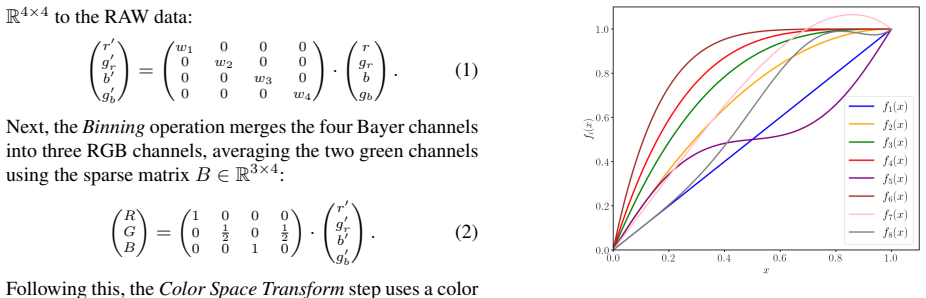
The load-bearing machinery is a three-part structure. (1) An adaptive linear transformation P' = (Pl + Pg + P), where P is the fixed 3x4 camera matrix from white balance, binning, and color-space conversion; Pl and Pg are pixel-level and image-level corrections produced by local and global attention over features of the RAW input. (2) A nonlinear component in which a small network predicts pixel-wise coefficient maps C_k, combined with eight non-convex polynomial bases f_k (each of order k, passing through (0,0) and (1,1)) to form an image-adaptive tone-mapping curve F(x). (3) A Self-Boost loss that computes an approximate inverse matrix P̃ = U·I^T (I·I^T)^{-1} from the nonlinear output U an
What would settle it
During training, extract the learned linear matrix P' and compute the pseudo-target P̃ = U·I^T·(I·I^T)^{-1} at each batch. If, after convergence, the mean row-wise cosine similarity between P' and P̃ is low (e.g., below 0.5) while object-detection mAP still exceeds the no-Self-Boost baseline, then the directional-alignment mechanism described by the Self-Boost loss is not the actual cause of the improvement.
Extended reading notes
Core claim
Dark-ISP's central claim is that the conventional ISP need not be treated as a fixed preprocessing step or a black-box neural network: it can be decomposed into a learnable linear matrix (absorbing white balance, binning, and color transform) and a learnable nonlinear tone mapping built from eight non-convex polynomial bases. Both are trained jointly with the detection loss, so the RAW-to-RGB mapping adapts to the task, and the Self-Boost regularization aligns the two stages. Evidence is the reported detection performance: 70.4 mAP on LOD with ResNet-50 versus 67.9 for the best cited baseline (LIS); higher mAP, mAP50, and mAP75 than all baselines on both cameras of NOD; and 23.1 mAP on SynCO
Load-bearing premise
The Self-Boost loss assumes that the nonlinear module's own output U is a trustworthy stand-in for the ideal sRGB image when guiding the linear module; the mathematical justification for this substitution only works for an independent oracle target, and the paper defers the verification of this proxy's validity to an appendix that was not included.
Editorial extensions
If this is right
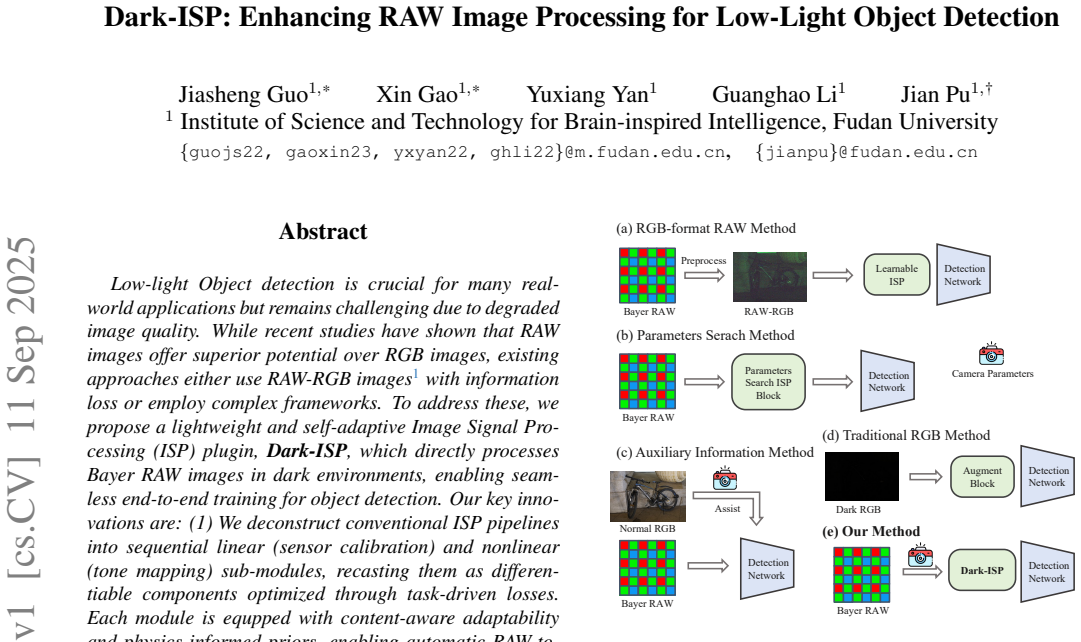
- Direct use of unquantized Bayer RAW avoids the bit-depth and information loss that RGB and RAW-RGB methods suffer, so detection networks pretrained on RGB can be fed sensor data without a fixed ISP.
- A task-driven ISP can be trained without paired RAW–normal-RGB data; the Self-Boost pseudo-target removes the need for an oracle sRGB image.
- The entire extra parameter footprint is about 0.5 MB (0.345 MB linear + 0.136 MB nonlinear), making the plugin practical for deployment on resource-constrained devices.
- The method generalizes across cameras (Canon, Sony, Nikon) and to synthetic RAW data, indicating that the learned modules automatically adapt to different sensor characteristics.
- The authors expect the same RAW-to-RGB design to benefit other perceptual tasks such as segmentation and tracking.
Reading between the lines
- The Self-Boost idea is a general principle for cascaded differentiable systems: any stage's output can serve as a pseudo-target for an earlier stage, so the same regularizer could be applied to, say, denoising followed by classification, or restoration before segmentation.
- The explicit non-convex polynomial bases provide a compact, physically interpretable prior for tone mapping; a natural extension is to test these bases in other low-light enhancement networks that currently use unconstrained curve estimation or lookup tables.
- Because the linear module is content-aware via attention, the method may be sensitive to sensor gain and noise level; a stress test with extreme ISO values or heavy synthetic noise would reveal whether the learned scaling adapts or saturates.
- A direct comparison between the eight-order polynomial bases and an equal-capacity multi-layer perceptron (the paper compares to ResMLP but not to an MLP of matched parameter count) would isolate the value of the physics-informed basis.
Editorial analysis
A structured set of objections, weighed in public.
Referee Report
Summary. The paper proposes Dark-ISP, a lightweight learnable ISP module that maps Bayer RAW images to RGB for end-to-end low-light object detection. The ISP is decomposed into a dynamic linear component (white balance, binning, color space transform) with local-global attention, and a nonlinear component that combines pixel-wise coefficient maps with a set of non-convex polynomial bases. A Self-Boost regularization loss aligns the linear mapping with a pseudo-target derived from the nonlinear module's output. Experiments on LOD, NOD, and SynCOCO with RetinaNet/ResNet backbones report improvements over several baselines, e.g., 70.4 versus 67.9 mAP on LOD with ResNet-50.
Significance. If validated, the contribution is practically useful: it demonstrates that a compact, physically structured ISP can replace both hand-crafted pipelines and heavier learned alternatives, and it highlights the value of Bayer RAW input for detection. The explicit use of non-convex polynomial bases, the low parameter counts (0.345 MB for the linear component, 0.136 MB for the nonlinear component), and the evaluation on three datasets are strengths. However, the central claim of beating state-of-the-art RAW-based detection methods is not adequately supported because several directly relevant methods are absent from the comparison, and the Self-Boost mechanism has neither a rigorous derivation nor the promised empirical verification.
major comments (4)
- [Sec. 4.1, Tables 1-3] The claim that Dark-ISP 'outperforms state-of-the-art RGB- and RAW-based detection approaches' is supported only by comparisons against default ISP, demosaic, LIS, SID, FeatEnHancer, and RAW-Adapter. The related work in Sec. 2.2 names AdaptiveISP [52], DynamicISP [60], ISP-Teacher [66], and GenISP [41] as the most closely related methods that process Bayer RAW with trainable ISPs for detection; GenISP also introduced the NOD dataset used in Table 2. None of these appears in the evaluation. The reported margins (e.g., 70.4 vs 67.9 mAP on LOD) may not hold against these baselines. The authors should add these comparisons or substantially soften the state-of-the-art claim.
- [Sec. 3.3, Eq. (10)-(11)] The Self-Boost pseudo-target is self-referential: P~ = U I^T (I I^T)^-1, where U = F(P'·I) is itself a function of P'. The paper acknowledges that the closed-form solution in Eq. (9) no longer holds and writes 'We verify the validity of these properties in the appendix,' but the appendix is not present in the reviewed manuscript. This is a load-bearing gap: without evidence that the self-referential alignment does not collapse or oscillate, the claimed benefit of Lsb is unsupported. Please provide the promised verification, along with at least an ablation varying lambda, training curves, and the cosine similarity between P' and P~ during optimization.
- [Sec. 3.1 and Sec. 3.3, Eqs. (5)-(6) vs (11)] The definition of P' is inconsistent between the linear mapping and the regularization. In Eq. (5)-(6), P' = Pl + Pg + P is a pixel-wise tensor in R^{3x4xHxW} that multiplies I per pixel to produce I' in R^{3xHxW}. However, in Eq. (11), P' is treated as a single 3x4 matrix with row vectors p'_i, and the cosine distance is computed against the global P~. It is unclear whether the loss is averaged over all spatial positions or applied to a global average. The authors should specify the exact tensor contraction used in the implementation; otherwise the method is not reproducible.
- [Sec. 4.1, Table 2] The blanket 'outperforms' is not true for every metric and dataset. On the NOD Nikon camera, FeatEnHancer achieves mAP75 30.8 while Dark-ISP reports 30.7, and on the Sony camera the mAP margin over FeatEnHancer is only 1.2 points. The paper does not report variance or statistical significance. Please report repeated runs or error bars, or qualify the conclusion to say that Dark-ISP improves overall mAP on these datasets.
minor comments (5)
- [Abstract and throughout] Typos: 'equpped' should be 'equipped' in the Abstract; 'orignal' in Sec. 1; inconsistent spacing in 'RA W' throughout. Please proofread.
- [Sec. 3.3] The notation 'L sb' in Eq. (12) and the surrounding text is typeset inconsistently. Use one form consistently.
- [Sec. 4, Datasets] The SynCOCO generation is described only as 'Following the pipeline from LIS [10]'. Please provide details on the inverse ISP parameters, noise model values, and any split used, so the synthetic benchmark is reproducible.
- [Fig. 2] The caption and the figure labels use 'Lsb' and 'L_sb' interchangeably. Also, the arrows around the Self-Boost path could be clarified to show which tensors are detached (if any) during backpropagation.
- [References] Some references are duplicated or inconsistent: [41] GenISP appears as both a method name and a dataset source; [52] AdaptiveISP is listed with two different year entries. Please clean up the bibliography.
Circularity Check
Self-Boost's pseudo-target is defined from the model's own output, making its supervision self-referential; central detection claims still rest on external benchmarks, so circularity is partial.
-
self definitional
[Sec. 3.3, Eqs. (9)-(11)]
"As a relaxation, we propose a self-supervised approximation by substituting the oracle U ∗ with the nonlinear module's own output, U. ... Critically, because U is a function of P ′, the closed-form solution in Eq. (9) is no longer holds ... We therefore treat U as a pseudo-target and define an approximate linear mapping ˜P := U·I T ·(I·I T )−1. (10)"
Equation (10) defines the supervision target \tilde P as a function of U, and U is the nonlinear component's output computed from I′ = P′·I (Sec. 3.2). Hence \tilde P depends on P′, the very matrix that Eq. (11) aligns to \tilde P. The oracle target P* of Eq. (9) is replaced by the model's own output, so the loss is a self-consistency condition P′ ≈ g(P′) rather than an externally grounded target. The paper concedes the closed-form solution 'no longer holds' and defers verification of the claimed benefits to an appendix that is absent from the reviewed version, leaving the mechanism's stated advantage unverified. The detection loss supplies external supervision, so the circularity is partial and affects the Self-Boost contribution (68.7→70.4 mAP in Tab. 4), not the full SOTA claim.
full rationale
Dark-ISP's headline results (e.g., 70.4 mAP on LOD) are established by external benchmarks and ablations showing the full model outperforms both baselines and its own sub-modules, so the central SOTA claim does not reduce to the debatable regularizer. The only identifiable circular element is the Self-Boost loss: Eq. (10) builds \tilde P from U, and U is the nonlinear module's output on I′=P′I, so \tilde P depends on P′, the matrix that Eq. (11) aligns to it. The paper openly acknowledges that the oracle closed-form no longer holds and says 'We verify the validity of these properties in the appendix,' but the reviewed copy contains no appendix; this makes the regularizer a transparent self-consistency constraint rather than an independent target. Because the primary supervision is the external detection loss, the circularity is partial and does not invalidate the overall empirical comparison. The omission of closely related RAW-to-detection baselines (AdaptiveISP, DynamicISP, GenISP, ISP-Teacher) from Tables 1–3 is a completeness concern about the 'state-of-the-art' wording, not a circularity, and was not scored as such.
Assumptions & free parameters
free parameters (4)
- polynomial order n =
8
- self-boost weight lambda =
1e-2
- warmup epochs N_warmup =
not specified
- polynomial basis functions =
not specified
assumptions (5)
- domain assumption ISP can be decomposed into a linear matrix transform followed by a nonlinear tone mapping
- domain assumption Polynomial bases of order n can approximate the required tone mapping function sufficiently for detection
- ad hoc to paper The nonlinear module's output U is a valid pseudo-target for the linear module
- domain assumption The feature hierarchy hypothesis (deeper layers produce task-closer representations)
- standard math Invertibility of I I^T for the least-squares solution
Cite this review
Pith. "Pith review of Dark-ISP: Enhancing RAW Image Processing for Low-Light Object Detection." pith.science (2026). https://pith.science/paper/IQSLNQUJ
@misc{pith2026250909183,
  author       = {Pith},
  title        = {Pith review of: Dark-ISP: Enhancing RAW Image Processing for Low-Light Object Detection},
  year         = {2026},
  howpublished = {\url{https://pith.science/paper/IQSLNQUJ}},
  note         = {Machine review of arXiv:2509.09183}
}
read the original abstract
Low-light Object detection is crucial for many real-world applications but remains challenging due to degraded image quality. While recent studies have shown that RAW images offer superior potential over RGB images, existing approaches either use RAW-RGB images with information loss or employ complex frameworks. To address these, we propose a lightweight and self-adaptive Image Signal Processing (ISP) plugin, Dark-ISP, which directly processes Bayer RAW images in dark environments, enabling seamless end-to-end training for object detection. Our key innovations are: (1) We deconstruct conventional ISP pipelines into sequential linear (sensor calibration) and nonlinear (tone mapping) sub-modules, recasting them as differentiable components optimized through task-driven losses. Each module is equipped with content-aware adaptability and physics-informed priors, enabling automatic RAW-to-RGB conversion aligned with detection objectives. (2) By exploiting the ISP pipeline's intrinsic cascade structure, we devise a Self-Boost mechanism that facilitates cooperation between sub-modules. Through extensive experiments on three RAW image datasets, we demonstrate that our method outperforms state-of-the-art RGB- and RAW-based detection approaches, achieving superior results with minimal parameters in challenging low-light environments.
Figures

Figures from the paper (3 more)


Reference graph
Works this paper leans on
-
[52]
Adaptiveisp: Learning an adaptive image signal pro- cessor for object detection.Advances in Neural Information Processing Systems, 37:112598–112623, 2025
Yujin Wang, Tianyi Xu, Zhang Fan, Tianfan Xue, and Jinwei Gu. Adaptiveisp: Learning an adaptive image signal pro- cessor for object detection.Advances in Neural Information Processing Systems, 37:112598–112623, 2025. 2
2025
-
[60]
Dynamicisp: dynamically controlled image signal processor for image recognition
Masakazu Yoshimura, Junji Otsuka, Atsushi Irie, and Takeshi Ohashi. Dynamicisp: dynamically controlled image signal processor for image recognition. InICCV. 2
-
[66]
Isp-teacher: image signal pro- cess with disentanglement regularization for unsupervised domain adaptive dark object detection
Yin Zhang, Yongqiang Zhang, Zian Zhang, Man Zhang, Rui Tian, and Mingli Ding. Isp-teacher: image signal pro- cess with disentanglement regularization for unsupervised domain adaptive dark object detection. InProceedings of the AAAI Conference on Artificial Intelligence, pages 7387– 7395, 2024. 2
2024
-
[41]
Genisp: Neural isp for low-light machine cognition
Igor Morawski, Yu-An Chen, Yu-Sheng Lin, Shusil Dangi, Kai He, and Winston H Hsu. Genisp: Neural isp for low-light machine cognition. InProceedings of the IEEE/CVF Con- ference on Computer Vision and Pattern Recognition, pages 630–639, 2022. 2, 5
2022
-
[1]
Learning generalized medical image segmentation from decoupled feature queries
Qi Bi, Jingjun Yi, Hao Zheng, Wei Ji, Yawen Huang, Yuex- iang Li, and Yefeng Zheng. Learning generalized medical image segmentation from decoupled feature queries. InPro- ceedings of the AAAI Conference on Artificial Intelligence, pages 810–818, 2024. 5
2024
-
[2]
Unprocessing images for learned raw denoising
Tim Brooks, Ben Mildenhall, Tianfan Xue, Jiawen Chen, Dillon Sharlet, and Jonathan T Barron. Unprocessing images for learned raw denoising. InProceedings of the IEEE/CVF conference on computer vision and pattern recognition, pages 11036–11045, 2019. 2
2019
-
[3]
Cascade r-cnn: Delving into high quality object detection
Zhaowei Cai and Nuno Vasconcelos. Cascade r-cnn: Delving into high quality object detection. In2018 IEEE/CVF Con- ference on Computer Vision and Pattern Recognition, 2018. 4
2018
-
[4]
Physics-guided iso-dependent sensor noise modeling for extreme low-light photography
Yue Cao, Ming Liu, Shuai Liu, Xiaotao Wang, Lei Lei, and Wangmeng Zuo. Physics-guided iso-dependent sensor noise modeling for extreme low-light photography. InProceed- ings of the IEEE/CVF Conference on Computer Vision and Pattern Recognition, pages 5744–5753, 2023. 3
2023
Show all 68 references
-
[5]
End-to- end object detection with transformers
Nicolas Carion, Francisco Massa, Gabriel Synnaeve, Nicolas Usunier, Alexander Kirillov, and Sergey Zagoruyko. End-to- end object detection with transformers. InEuropean confer- ence on computer vision, pages 213–229. Springer, 2020. 1
2020
-
[6]
Learning to see in the dark
Chen Chen, Qifeng Chen, Jia Xu, and Vladlen Koltun. Learning to see in the dark. InProceedings of the IEEE con- ference on computer vision and pattern recognition, pages 3291–3300, 2018. 3, 6
2018
-
[7]
Seeing motion in the dark
Chen Chen, Qifeng Chen, Minh N Do, and Vladlen Koltun. Seeing motion in the dark. InProceedings of the IEEE/CVF International conference on computer vision, pages 3185– 3194, 2019. 3
2019
-
[8]
Masked image training for generalizable deep image denois- ing
Haoyu Chen, Jinjin Gu, Yihao Liu, Salma Abdel Magid, Chao Dong, Qiong Wang, Hanspeter Pfister, and Lei Zhu. Masked image training for generalizable deep image denois- ing. InProceedings of the IEEE/CVF Conference on Com- puter Vision and Pattern Recognition, pages 1692–1703,
-
[9]
Mmdetection: Open mmlab detection tool- box and benchmark.arXiv preprint arXiv:1906.07155, 2019
Kai Chen, Jiaqi Wang, Jiangmiao Pang, Yuhang Cao, Yu Xiong, Xiaoxiao Li, Shuyang Sun, Wansen Feng, Ziwei Liu, Jiarui Xu, et al. Mmdetection: Open mmlab detection tool- box and benchmark.arXiv preprint arXiv:1906.07155, 2019. 5
1906 arXiv
-
[10]
Instance segmentation in the dark.International Journal of Computer Vision, 131(8):2198–2218, 2023
Linwei Chen, Ying Fu, Kaixuan Wei, Dezhi Zheng, and Fe- lix Heide. Instance segmentation in the dark.International Journal of Computer Vision, 131(8):2198–2218, 2023. 1, 2, 6
2023
-
[11]
Tsdn: Two-stage raw denoising in the dark.IEEE Transactions on Image Processing, 32:3679– 3689, 2023
Wenshu Chen, Yujie Huang, Mingyu Wang, Xiaolin Wu, and Xiaoyang Zeng. Tsdn: Two-stage raw denoising in the dark.IEEE Transactions on Image Processing, 32:3679– 3689, 2023. 3
2023
-
[12]
Retinex-rawmamba: Bridging demosaicing and denoising for low-light raw image enhancement.arXiv preprint arXiv:2409.07040, 2024
Xianmin Chen, Peiliang Huang, Xiaoxu Feng, Dingwen Zhang, Longfei Han, and Junwei Han. Retinex-rawmamba: Bridging demosaicing and denoising for low-light raw image enhancement.arXiv preprint arXiv:2409.07040, 2024. 3
2024 arXiv
-
[13]
Nilut: Conditional neural implicit 3d lookup tables for image enhancement
Marcos V Conde, Javier Vazquez-Corral, Michael S Brown, and Radu Timofte. Nilut: Conditional neural implicit 3d lookup tables for image enhancement. InProceedings of the AAAI Conference on Artificial Intelligence, pages 1371– 1379, 2024. 2
2024
-
[14]
Trash to treasure: Low-light object detec- tion via decomposition-and-aggregation
Xiaohan Cui, Long Ma, Tengyu Ma, Jinyuan Liu, Xin Fan, and Risheng Liu. Trash to treasure: Low-light object detec- tion via decomposition-and-aggregation. InProceedings of the AAAI Conference on Artificial Intelligence, pages 1417– 1425, 2024. 2
2024
-
[15]
Raw-adapter: Adapting pre- trained visual model to camera raw images
Ziteng Cui and Tatsuya Harada. Raw-adapter: Adapting pre- trained visual model to camera raw images. InEuropean Conference on Computer Vision, pages 37–56. Springer,
-
[16]
Multitask aet with orthogonal tangent regularity for dark object detection
Ziteng Cui, Guo-Jun Qi, Lin Gu, Shaodi You, Zenghui Zhang, and Tatsuya Harada. Multitask aet with orthogonal tangent regularity for dark object detection. InProceedings of the IEEE/CVF international conference on computer vi- sion, pages 2553–2562, 2021. 2
2021
-
[17]
Diffuseraw: End-to-end generative raw image processing for low-light images.arXiv preprint arXiv:2402.18575, 2023
Rishit Dagli. Diffuseraw: End-to-end generative raw image processing for low-light images.arXiv preprint arXiv:2402.18575, 2023. 3
2023 arXiv
-
[18]
Mobile computational photography: A tour.Annual review of vision science, 7(1):571–604, 2021
Mauricio Delbracio, Damien Kelly, Michael S Brown, and Peyman Milanfar. Mobile computational photography: A tour.Annual review of vision science, 7(1):571–604, 2021. 2, 3, 4
2021
-
[19]
Dirty pixels: Towards end-to-end image processing and percep- tion.ACM Transactions on Graphics (TOG), 40(3):1–15,
Steven Diamond, Vincent Sitzmann, Frank Julca-Aguilar, Stephen Boyd, Gordon Wetzstein, and Felix Heide. Dirty pixels: Towards end-to-end image processing and percep- tion.ACM Transactions on Graphics (TOG), 40(3):1–15,
-
[20]
Abandoning the bayer-filter to see in the dark
Xingbo Dong, Wanyan Xu, Zhihui Miao, Lan Ma, Chao Zhang, Jiewen Yang, Zhe Jin, Andrew Beng Jin Teoh, and Jiajun Shen. Abandoning the bayer-filter to see in the dark. InProceedings of the ieee/cvf conference on computer vision and pattern recognition, pages 17431–17440, 2022. 3
2022
-
[21]
Boosting object detection with zero-shot day-night domain adaptation
Zhipeng Du, Miaojing Shi, and Jiankang Deng. Boosting object detection with zero-shot day-night domain adaptation. InProceedings of the IEEE/CVF Conference on Computer Vision and Pattern Recognition, pages 12666–12676, 2024. 2
2024
-
[22]
Real- time noise-aware tone mapping.ACM Transactions on Graphics (TOG), 34(6):1–15, 2015
Gabriel Eilertsen, Rafał K Mantiuk, and Jonas Unger. Real- time noise-aware tone mapping.ACM Transactions on Graphics (TOG), 34(6):1–15, 2015. 2
2015
-
[23]
Learnability enhancement for low-light raw denoising: Where paired real data meets noise modeling
Hansen Feng, Lizhi Wang, Yuzhi Wang, and Hua Huang. Learnability enhancement for low-light raw denoising: Where paired real data meets noise modeling. InProceed- ings of the 30th ACM International Conference on Multime- dia, pages 1436–1444, 2022. 3
2022
-
[24]
Fast r-cnn
Ross Girshick. Fast r-cnn. InProceedings of the IEEE inter- national conference on computer vision, pages 1440–1448,
-
[25]
Zero-reference deep curve estimation for low-light image enhancement
Chunle Guo, Chongyi Li, Jichang Guo, Chen Change Loy, Junhui Hou, Sam Kwong, and Runmin Cong. Zero-reference deep curve estimation for low-light image enhancement. In Proceedings of the IEEE/CVF conference on computer vi- sion and pattern recognition, pages 1780–1789, 2020. 2, 5, 8
2020
-
[26]
Dynamic low-light image enhancement for object detection via end-to-end train- ing
Haifeng Guo, Tong Lu, and Yirui Wu. Dynamic low-light image enhancement for object detection via end-to-end train- ing. In2020 25th International Conference on Pattern Recognition (ICPR), pages 5611–5618. IEEE, 2021. 2
2021
-
[27]
Learn- ing degradation-independent representations for camera isp pipelines
Yanhui Guo, Fangzhou Luo, and Xiaolin Wu. Learn- ing degradation-independent representations for camera isp pipelines. InProceedings of the IEEE/CVF Conference on Computer Vision and Pattern Recognition, pages 25774– 25783, 2024. 2
2024
-
[28]
Featenhancer: En- hancing hierarchical features for object detection and beyond under low-light vision
Khurram Azeem Hashmi, Goutham Kallempudi, Didier Stricker, and Muhammad Zeshan Afzal. Featenhancer: En- hancing hierarchical features for object detection and beyond under low-light vision. InProceedings of the IEEE/CVF International Conference on Computer Vision, pages 6725– ...
2023
-
[29]
Deep residual learning for image recognition
Kaiming He, Xiangyu Zhang, Shaoqing Ren, and Jian Sun. Deep residual learning for image recognition. InProceed- ings of the IEEE conference on computer vision and pattern recognition, pages 770–778, 2016. 5
2016
-
[30]
Craft- ing object detection in very low light
Yang Hong, Kaixuan Wei, Linwei Chen, and Ying Fu. Craft- ing object detection in very low light. InBMVC, page 3,
-
[31]
Dnf: Decouple and feedback network for seeing in the dark
Xin Jin, Ling-Hao Han, Zhen Li, Chun-Le Guo, Zhi Chai, and Chongyi Li. Dnf: Decouple and feedback network for seeing in the dark. InProceedings of the IEEE/CVF con- ference on computer vision and pattern recognition, pages 18135–18144, 2023. 3
2023
-
[32]
Lighting every darkness in two pairs: A calibration-free pipeline for raw denoising
Xin Jin, Jia-Wen Xiao, Ling-Hao Han, Chunle Guo, Ruixun Zhang, Xialei Liu, and Chongyi Li. Lighting every darkness in two pairs: A calibration-free pipeline for raw denoising. InICCV, 2023. 3, 6
2023
-
[33]
Paramisp: learned forward and inverse isps using camera parameters.arXiv preprint arXiv:2312.13313, 2023
Woohyeok Kim, Geonu Kim, Junyong Lee, Seungyong Lee, Seung-Hwan Baek, and Sunghyun Cho. Paramisp: learned forward and inverse isps using camera parameters.arXiv preprint arXiv:2312.13313, 2023. 2
2023 arXiv
-
[34]
Local tone mapping using the k-means algorithm and automatic gamma setting.IEEE Transactions on Consumer Electron- ics, 57(1):209–217, 2011
Ji Won Lee, Rae-Hong Park, and Soonkeun Chang. Local tone mapping using the k-means algorithm and automatic gamma setting.IEEE Transactions on Consumer Electron- ics, 57(1):209–217, 2011. 2
2011
-
[35]
Dualdn: Dual-domain denoising via differ- entiable isp
Ruikang Li, Yujin Wang, Shiqi Chen, Fan Zhang, Jinwei Gu, and Tianfan Xue. Dualdn: Dual-domain denoising via differ- entiable isp. InEuropean Conference on Computer Vision, pages 160–177. Springer, 2024. 2
2024
-
[36]
A dark transformation-equivariant al- gorithm for dark object detection
Tongxu Lin, Junyu Lin, Jingchao Wang, Zhengnan Deng, and Guoheng Huang. A dark transformation-equivariant al- gorithm for dark object detection. InProceedings of the 2023 4th International Conference on Computing, Networks and Internet of Things, pages 731–735, 2023. 1, 2
2023
-
[37]
Microsoft coco: Common objects in context
Tsung-Yi Lin, Michael Maire, Serge Belongie, James Hays, Pietro Perona, Deva Ramanan, Piotr Doll´ar, and C Lawrence Zitnick. Microsoft coco: Common objects in context. In Computer vision–ECCV 2014: 13th European conference, zurich, Switzerland, September 6-12, 2014, proceeding...
2014
-
[38]
Focal loss for dense object detection
Tsung-Yi Lin, Priya Goyal, Ross Girshick, Kaiming He, and Piotr Doll´ar. Focal loss for dense object detection. InPro- ceedings of the IEEE international conference on computer vision, pages 2980–2988, 2017. 1, 5
2017
-
[39]
Un- supervised image denoising in real-world scenarios via self- collaboration parallel generative adversarial branches
Xin Lin, Chao Ren, Xiao Liu, Jie Huang, and Yinjie Lei. Un- supervised image denoising in real-world scenarios via self- collaboration parallel generative adversarial branches. In Proceedings of the IEEE/CVF International Conference on Computer Vision, pages 12642–12652, 2023. 3
2023
-
[40]
Raw or cooked? object detection on raw images
William Ljungbergh, Joakim Johnander, Christoffer Peters- son, and Michael Felsberg. Raw or cooked? object detection on raw images. InScandinavian Conference on Image Anal- ysis, pages 374–385. Springer, 2023. 2, 8
2023
-
[42]
Hardware-in- the-loop end-to-end optimization of camera image process- ing pipelines
Ali Mosleh, Avinash Sharma, Emmanuel Onzon, Fahim Mannan, Nicolas Robidoux, and Felix Heide. Hardware-in- the-loop end-to-end optimization of camera image process- ing pipelines. InProceedings of the IEEE/CVF Conference on Computer Vision and Pattern Recognition, pages 7529– 7...
2020
-
[43]
A novel low light object detection method based on the yolov5 fusion feature enhancement.Scientific reports, 14(1):4486, 2024
Daxin Peng, Wei Ding, and Tong Zhen. A novel low light object detection method based on the yolov5 fusion feature enhancement.Scientific reports, 14(1):4486, 2024. 2
2024
-
[44]
Attention-aware learning for hyperparameter prediction in image processing pipelines
Haina Qin, Longfei Han, Juan Wang, Congxuan Zhang, Yan- wei Li, Bing Li, and Weiming Hu. Attention-aware learning for hyperparameter prediction in image processing pipelines. InEuropean Conference on Computer Vision, pages 271–
-
[45]
You only look once: Unified, real-time object de- tection
Joseph Redmon, Santosh Divvala, Ross Girshick, and Ali Farhadi. You only look once: Unified, real-time object de- tection. InProceedings of the IEEE conference on computer vision and pattern recognition, pages 779–788, 2016. 1
2016
-
[46]
Embeddedpigdet—fast and accurate pig detection for embedded board implementations
Jihyun Seo, Hanse Ahn, Daewon Kim, Sungju Lee, Yong- wha Chung, and Daihee Park. Embeddedpigdet—fast and accurate pig detection for embedded board implementations. Applied Sciences, 10(8):2878, 2020. 1
2020
-
[47]
Sparse r-cnn: End-to-end ob- ject detection with learnable proposals
Peize Sun, Rufeng Zhang, Yi Jiang, Tao Kong, Chen- feng Xu, Wei Zhan, Masayoshi Tomizuka, Lei Li, Zehuan Yuan, Changhu Wang, et al. Sparse r-cnn: End-to-end ob- ject detection with learnable proposals. InProceedings of the IEEE/CVF conference on computer vision and pattern rec...
2021
-
[48]
Attention is all you need.Advances in neural information processing systems, 30, 2017
Ashish Vaswani, Noam Shazeer, Niki Parmar, Jakob Uszko- reit, Llion Jones, Aidan N Gomez, Łukasz Kaiser, and Illia Polosukhin. Attention is all you need.Advances in neural information processing systems, 30, 2017. 4
2017
-
[49]
Real-time image en- hancer via learnable spatial-aware 3d lookup tables
Tao Wang, Yong Li, Jingyang Peng, Yipeng Ma, Xian Wang, Fenglong Song, and Youliang Yan. Real-time image en- hancer via learnable spatial-aware 3d lookup tables. In Proceedings of the IEEE/CVF International Conference on Computer Vision, pages 2471–2480, 2021. 2
2021
-
[50]
Exposurediffusion: Learning to expose for low-light image enhancement
Yufei Wang, Yi Yu, Wenhan Yang, Lanqing Guo, Lap-Pui Chau, Alex C Kot, and Bihan Wen. Exposurediffusion: Learning to expose for low-light image enhancement. In Proceedings of the IEEE/CVF International Conference on Computer Vision, pages 12438–12448, 2023. 3
2023
-
[51]
Adaptiveisp: Learning an adaptive image signal pro- cessor for object detection.Advances in Neural Information Processing Systems, 37:112598–112623, 2024
Yujin Wang, Tianyi Xu, Zhang Fan, Tianfan Xue, and Jinwei Gu. Adaptiveisp: Learning an adaptive image signal pro- cessor for object detection.Advances in Neural Information Processing Systems, 37:112598–112623, 2024. 2
2024
-
[53]
A physics-based noise formation model for extreme low-light raw denoising
Kaixuan Wei, Ying Fu, Jiaolong Yang, and Hua Huang. A physics-based noise formation model for extreme low-light raw denoising. InProceedings of the IEEE/CVF Conference on Computer Vision and Pattern Recognition, pages 2758– 2767, 2020. 1, 3, 6
2020
-
[54]
Physics-based noise modeling for extreme low-light photog- raphy.IEEE Transactions on Pattern Analysis and Machine Intelligence, page 1–1, 2021
Kaixuan Wei, Ying Fu, Yinqiang Zheng, and Jiaolong Yang. Physics-based noise modeling for extreme low-light photog- raphy.IEEE Transactions on Pattern Analysis and Machine Intelligence, page 1–1, 2021. 1, 6
2021
-
[55]
Invertible im- age signal processing
Yazhou Xing, Zian Qian, and Qifeng Chen. Invertible im- age signal processing. InProceedings of the IEEE/CVF con- ference on computer vision and pattern recognition, pages 6287–6296, 2021. 2
2021
-
[56]
Rawformer: An efficient vision transformer for low-light raw image enhancement.IEEE Signal Process- ing Letters, 29:2677–2681, 2022
Wanyan Xu, Xingbo Dong, Lan Ma, Andrew Beng Jin Teoh, and Zhixian Lin. Rawformer: An efficient vision transformer for low-light raw image enhancement.IEEE Signal Process- ing Letters, 29:2677–2681, 2022. 3
2022
-
[57]
Exploring image enhancement for salient object detection in low light images.ACM transactions on multime- dia computing, communications, and applications (TOMM), 17(1s):1–19, 2021
Xin Xu, Shiqin Wang, Zheng Wang, Xiaolong Zhang, and Ruimin Hu. Exploring image enhancement for salient object detection in low light images.ACM transactions on multime- dia computing, communications, and applications (TOMM), 17(1s):1–19, 2021. 1, 2
2021
-
[58]
Best of both worlds: See and understand clearly in the dark
Xinwei Xue, Jia He, Long Ma, Yi Wang, Xin Fan, and Risheng Liu. Best of both worlds: See and understand clearly in the dark. InProceedings of the 30th ACM Interna- tional Conference on Multimedia, pages 2154–2162, 2022. 1, 2
2022
-
[59]
Seplut: Separable image-adaptive lookup tables for real-time image enhancement
Canqian Yang, Meiguang Jin, Yi Xu, Rui Zhang, Ying Chen, and Huaida Liu. Seplut: Separable image-adaptive lookup tables for real-time image enhancement. InEuropean Con- ference on Computer Vision, pages 201–217. Springer, 2022. 2
2022
-
[61]
Cycleisp: Real image restoration via improved data synthesis
Syed Waqas Zamir, Aditya Arora, Salman Khan, Munawar Hayat, Fahad Shahbaz Khan, Ming-Hsuan Yang, and Ling Shao. Cycleisp: Real image restoration via improved data synthesis. InProceedings of the IEEE/CVF conference on computer vision and pattern recognition, pages 2696–2705,
-
[62]
Learning image-adaptive 3d lookup tables for high perfor- mance photo enhancement in real-time.IEEE Transactions on Pattern Analysis and Machine Intelligence, 44(4), 2020
Hui Zeng, Jianrui Cai, Lida Li, Zisheng Cao, and Lei Zhang. Learning image-adaptive 3d lookup tables for high perfor- mance photo enhancement in real-time.IEEE Transactions on Pattern Analysis and Machine Intelligence, 44(4), 2020. 2, 8
2020
-
[63]
Towards general low- light raw noise synthesis and modeling
Feng Zhang, Bin Xu, Zhiqiang Li, Xinran Liu, Qingbo Lu, Changxin Gao, and Nong Sang. Towards general low- light raw noise synthesis and modeling. InProceedings of the IEEE/CVF international conference on computer vision, pages 10820–10830, 2023. 3
2023
-
[64]
Featurized query r-cnn
Wenqiang Zhang, Tianheng Cheng, Xinggang Wang, Shaoyu Chen, Qian Zhang, and Wenyu Liu. Featurized query r-cnn. arXiv preprint arXiv:2206.06258, 2022. 4
2022 arXiv
-
[65]
Rethinking noise synthesis and modeling in raw denois- ing
Yi Zhang, Hongwei Qin, Xiaogang Wang, and Hongsheng Li. Rethinking noise synthesis and modeling in raw denois- ing. InProceedings of the IEEE/CVF International Confer- ence on Computer Vision, pages 4593–4601, 2021. 3
2021
-
[67]
Restoration for weakly blurred and strongly noisy images
Xiang Zhu and Peyman Milanfar. Restoration for weakly blurred and strongly noisy images. In2011 IEEE Workshop on Applications of Computer Vision (WACV), pages 103–
-
[68]
Deformable detr: Deformable transform- ers for end-to-end object detection.arXiv: Computer Vision and Pattern Recognition,arXiv: Computer Vision and Pat- tern Recognition, 2020
Xizhou Zhu, Weijie Su, Lewei Lu, Bin Li, Xiaogang Wang, and Jifeng Dai. Deformable detr: Deformable transform- ers for end-to-end object detection.arXiv: Computer Vision and Pattern Recognition,arXiv: Computer Vision and Pat- tern Recognition, 2020. 4
2020
Reviewed August 4, 2026 · model on record in the stance chip above.
Discussion (0). Sign in to comment.