REVIEW 4 major objections 5 minor 39 references
Exploiting Boosting in Hyperdimensional Computing for Enhanced Reliability in Healthcare
T0 review · 4 major / 5 minor · reviewed 2026-08-12 · deepseek-v4-flash
Pith's one-line read BoostHD splits the hyperdimensional space into boosted weak learners and beats single-model HDC on wearable stress data.
desk verdict BoostHD has a genuinely new subspace-ensembling idea and strong WESAD accuracy, but the published algorithm does not actually implement boosting and the theory is invalid, so it needs major revision and code before the claims are credible. read the letter →
The pith
A machine-rendered reading of the paper's core claim, the machinery that carries it, and where it could break.
The reading
What carries the argument
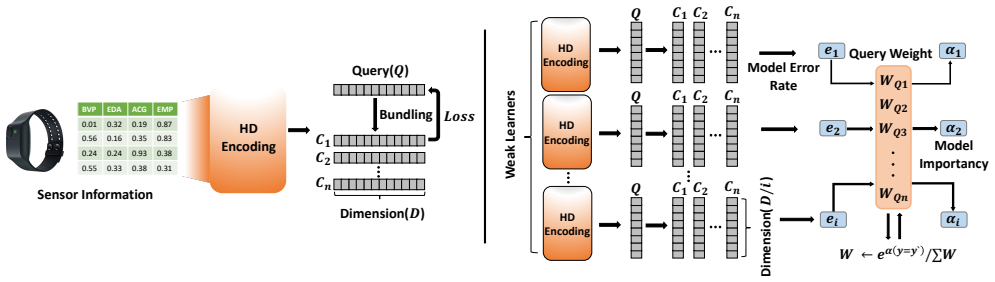
The mechanism is a partitioned ensemble: the $D$-dimensional encoding is split into $n$ disjoint segments, each the working space of one OnlineHD-style weak learner trained on the same data; boosting reweights misclassified samples between learners, and inference sums the learners' predictions weighted by their error-derived $\alpha_i$. The theoretical support is Marchenko-Pastur analysis of the Gaussian kernel's singular values (Eqs. 2-3): mean $\mu_\lambda$ grows with $D$ while variance $\sigma^2_\lambda$ plateaus, so the kernel ellipse becomes nearly circular, and span utilization $SP = \text{rank}(K)/D$ attenuated by factors $\pi_i$ is used to argue that many small spaces are used more fully than one large space. The baseline-dimensionality condition keeps each segment informative: when $D_{total}/N_L$ falls below a threshold, accuracy collapses (shown for $N_L=100$, $D_{total}=1$K).
What would settle it
Fix $D_{total}=4000$ and $N_L=10$ and run BoostHD and OnlineHD on a dataset where classes are numerous or input features are highly correlated; if accuracy crosses below OnlineHD while each segment is at the same per-learner dimensionality as the single model's best setting, the partition benefit is not general. More directly, compute rank($K$)/$D$ for both on the same data: if BoostHD's span utilization is not higher, the theory's core quantity is contradicted.
Extended reading notes
Core claim
BoostHD's central claim is that partitioning the hyperdimensional space into boosted weak learners improves both performance and reliability relative to using the same total dimensionality as one strong learner. Each weak learner receives a $D/n$ segment and is trained sequentially; sample weights are updated by each learner's error, and inference weights predictions by model importance. The paper supports this with a random-matrix analysis: as $D$ grows, the singular-value mean of the HDC kernel increases while its variance stabilizes, so the kernel's ellipse becomes more circular, and it argues that the practical span utilization --- rank of the classifier matrix divided by $D$, discounted by cosine-similarity factors --- is higher in BoostHD. Empirically, BoostHD reaches 98.37% ± 0.32% on WESAD, 61.52% ± 0.07% on Nurse Stress, and 68.10% ± 0.09% on Stress-Predict, improving over OnlineHD, and it keeps higher accuracy under class imbalance, bitflip noise, and person-specific splits.
Load-bearing premise
The load-bearing premise is that splitting $D$ into $n$ segments keeps each weak learner above a 'baseline dimensionality' that preserves enough discriminative information; the paper demonstrates degradation when this fails but never defines the threshold or shows how it scales with dataset size.
Editorial extensions
If this is right
- If the central claim is right, hyperdimensional computing reaches 98.37% on WESAD, beating Random Forest, XGBoost, and OnlineHD while keeping inference near $10^{-4}$ seconds.
- The roughly threefold lower run-to-run standard deviation and the bounded bitflip loss make BoostHD a candidate for noisy wearable hardware where single-model HDC and DNNs degrade more.
- Segment independence permits parallel inference; reported per-sample inference times of $1.1\times10^{-4}$ s on WESAD and $1.2\times10^{-4}$ s on Nurse Stress point to on-device deployment.
- Accuracy holds as the imbalance ratio $r$ increases while OnlineHD drops, suggesting boosting reweighting offsets the overfitting HDC shows on skewed classes.
- Average person-specific accuracy of 96.19% across hand preference, gender, age, and height subgroups indicates the ensemble narrows demographic accuracy gaps relative to other models.
Reading between the lines
- A natural extension is to derive the baseline-dimensionality threshold from dataset size and class structure; the paper leaves it empirical, so a formula would let $N_L$ and $D_{total}$ be set automatically per dataset.
- The span-utilization reasoning is a general claim about HDC geometry, not just stress detection; testing BoostHD on image or text benchmarks would show whether subspace ensembles beat a single hypervector outside healthcare.
- Since the reweighting rule is standard AdaBoost, initializing sample weights with class-balanced or cost-sensitive values could push the imbalance results further; the paper does not test this variant.
- The bitflip robustness may mix ensemble averaging with boosting effects; logging per-segment errors under noise would separate the two mechanisms.
Editorial analysis
A structured set of objections, weighed in public.
Referee Report
Summary. The paper proposes BoostHD, a hyperdimensional computing (HDC) ensemble method that splits a D-dimensional hypervector space into n disjoint segments, treats each segment as a weak learner, and allegedly combines the learners through sequential boosting with sample reweighting. The authors report accuracy gains over OnlineHD, Random Forest, XGBoost, SVM, and DNN on three healthcare datasets (WESAD, Nurse Stress, Stress-Predict), with the headline WESAD accuracy of 98.37% ± 0.32% versus 96.37% ± 0.40% for OnlineHD. Additional experiments address stability as a function of dimensionality, robustness to bit-flip noise, behavior under induced class imbalance, and person-specific subgroup performance. A theoretical discussion based on the Marchenko-Pastur distribution and an invented 'span utilization' metric is used to motivate why subspace partitioning improves reliability.
Significance. If the method were correctly specified and reproducible, the central empirical finding would be practically meaningful for low-power wearable stress detection, and the external-baseline comparisons in Table I are a genuine strength because they are not circular. The WESAD accuracy improvement over OnlineHD is internally consistent and the inference-efficiency results in Table II are useful. However, the paper has a load-bearing specification problem: the pseudocode in Algorithm 1 does not describe a working boosting procedure. In addition, the theoretical derivation that motivates the method is internally inconsistent. These issues must be resolved before the claims 'integrates boosting with HDC' and 'enhances performance and reliability' can be assessed.
major comments (4)
- [Section III, Algorithm 1] The training procedure as written is not a boosting algorithm. Line 4, 'Train fθi with X and y', never uses the sample-weight vector Ws, so the reweighting update in line 8 cannot influence any subsequent learner. Line 7, 'αi = Ws · eθi', mixes a vector of sample weights with a scalar error rate and is not the AdaBoost confidence α = 0.5 ln((1−e)/e). Inference line 3 sums ŷs · α even though ŷs is not defined as a class-score vector, and the argmax is therefore undefined. Because the paper's novelty is the integration of boosting with HDC, the reported gains cannot currently be attributed to boosting; the authors must either correct the pseudocode to an executable boosting loop or release the implementation.
- [Section III, Eqs. (2)–(7)] The Marchenko-Pastur analysis is internally inconsistent. The text defines q = Nc/Nr = Nc/D and states that q has an inverse relationship with D, yet Eqs. (4)–(6) take limits q→∞, which is the opposite scaling regime for large D. Moreover, the support bounds are written as (1+√q)^4 and (q−√q)^4, whereas the standard Marchenko-Pastur support for eigenvalues is (1±√q)^2; the eigenvalue-versus-singular-value convention is never fixed. Since the conclusion that σ²λ stays constant and the kernel becomes 'circular' relies on these limits, the theoretical justification in Section III is unsupported as written and should be corrected or removed.
- [Section III and Figure 3] The 'baseline dimensionality' is load-bearing for the stability claim but is never defined. The text states that failure to preserve this baseline causes substantial degradation (e.g., NL = 100 with Dtotal = 1K in Figure 3b), but no formula or scaling law is given to determine when a segment of size D/n is viable, and no connection to sample size or class structure is established. Without such a condition, the recommended operating region for D and NL is uncontrolled, and the claimed stability advantage of BoostHD cannot be generalized beyond the reported grid.
- [Section IV-C, Eq. (8)] The overfitting experiment is not interpretable as written. Equation 8 writes D = (x, if y = Ctarget; x × r, if y ≠ Ctarget), but the notation x × r is not defined for a data sample x and a scalar r. The text does not state whether the induced imbalance comes from replicating samples, discarding samples, or scaling feature values. Because Figure 7 is the sole support for the overfitting-resistance claim, this experimental description must be clarified or corrected before the result can be evaluated.
minor comments (5)
- [Section III] The 'span utilization' (SP) metric is defined informally: 'rank(K)/D divided by the product of π1, π2, ..., πn' does not specify what πi are or how they are computed. As an explanatory metric it should be formalized if it is retained.
- [Figure 8] The horizontal axis labels are confusing: the left panel shows pb values from 20 to 100 while the caption text refers to 10^-6 and 10^-5. The intended axis ranges and any log-scale transformations should be stated explicitly.
- [Table III] The text says BoostHD ranked second in two person-specific categories, but in the printed table it appears second only in the Height ≥ 185 row; please reconcile this statement with the table.
- [References] References [18] and [39] are incomplete (missing full author lists and, for [18], the publication venue details).
- [General] The manuscript does not mention a code or data release. Given the ambiguities in Algorithm 1, providing the implementation as supplementary material would be essential for verifying the reported results.
Circularity Check
No significant circularity: BoostHD's reported accuracy gains are benchmarked against external baselines, and the SP and Marchenko-Pastur analyses are explanatory constructs rather than fitted inputs.
full rationale
I examined the claimed derivation chain for reductions to the paper's own inputs. The headline empirical claim (98.37% vs OnlineHD's 96.37% on WESAD) is measured against external baselines (RF, XGBoost, SVM, DNN, OnlineHD), so it does not reduce to the paper's definitions. The 'span utilization' (SP) metric is defined from rank(K)/D and cosine-similarity products, not from the accuracy figures it is later used to rationalize; thus SP is a post-hoc explanatory construct rather than a self-definitional prediction. The Marchenko-Pastur discussion (Eqs. 2-7) invokes an external theorem, and even if the application is mathematically questionable, that is a soundness issue rather than circularity. The only notable self-citation, OnlineHD [18], is used as the base encoder and as a baseline; the boosting claim does not rest on a disputed result from that paper, so the self-citation is not load-bearing. I also note that Algorithm 1 does not actually pass sample weights into weak-learner training (line 4 trains f_theta_i on X and y only), so the 'boosting' mechanism is under-specified; this is a reproducibility and correctness defect, not a circular reduction, because the reported accuracies are not constructed from those weights. No fitted parameter is renamed as a prediction, and no uniqueness theorem is imported to forbid alternatives. The 'baseline dimensionality' condition is asserted without derivation, but an unproven assumption is not a circular equivalence. Verdict: no significant circularity.
Assumptions & free parameters
free parameters (3)
- D_total (total hyperdimensional dimensionality) =
not stated for Table I; scanned from 10 to 10,000
- NL (number of weak learners) =
10
- Moving-average filter window size =
30
assumptions (3)
- domain assumption Random Gaussian HDC feature matrices follow the Marchenko-Pastur law with q=Nc/Nr, and the conclusions in Equations 2-7 describe the HDC kernel's eigenvalue geometry.
- domain assumption Splitting D into n disjoint segments preserves each weak learner's accuracy provided a baseline dimensionality is maintained.
- ad hoc to paper Higher span utilization SP of class hypervectors implies higher classification accuracy.
invented entities (1)
-
Span Utilization (SP)
Cite this review
Pith. "Pith review of Exploiting Boosting in Hyperdimensional Computing for Enhanced Reliability in Healthcare." pith.science (2026). https://pith.science/paper/IQXFNQFO
@misc{pith2026241114612,
  author       = {Pith},
  title        = {Pith review of: Exploiting Boosting in Hyperdimensional Computing for Enhanced Reliability in Healthcare},
  year         = {2026},
  howpublished = {\url{https://pith.science/paper/IQXFNQFO}},
  note         = {Machine review of arXiv:2411.14612}
}
read the original abstract
Hyperdimensional computing (HDC) enables efficient data encoding and processing in high-dimensional space, benefiting machine learning and data analysis. However, underutilization of these spaces can lead to overfitting and reduced model reliability, especially in data-limited systems a critical issue in sectors like healthcare that demand robustness and consistent performance. We introduce BoostHD, an approach that applies boosting algorithms to partition the hyperdimensional space into subspaces, creating an ensemble of weak learners. By integrating boosting with HDC, BoostHD enhances performance and reliability beyond existing HDC methods. Our analysis highlights the importance of efficient utilization of hyperdimensional spaces for improved model performance. Experiments on healthcare datasets show that BoostHD outperforms state-of-the-art methods. On the WESAD dataset, it achieved an accuracy of 98.37%, surpassing Random Forest, XGBoost, and OnlineHD. BoostHD also demonstrated superior inference efficiency and stability, maintaining high accuracy under data imbalance and noise. In person-specific evaluations, it achieved an average accuracy of 96.19%, outperforming other models. By addressing the limitations of both boosting and HDC, BoostHD expands the applicability of HDC in critical domains where reliability and precision are paramount.
Figures


Figures from the paper (3 more)


Reference graph
Works this paper leans on
-
[1]
Heal: Brain-inspired hyperdimensional efficient active learning,
Y . Ni, Z. Zou, W. Huang, H. Chen, W. Y . Chung, S. Cho, R. Krishnan, P. Mercati, and M. Imani, “Heal: Brain-inspired hyperdimensional efficient active learning,” arXiv preprint arXiv:2402.11223 , 2024
arXiv 2024
-
[2]
A framework for collaborative learning in secure high- dimensional space,
M. Imani, Y . Kim, S. Riazi, J. Messerly, P. Liu, F. Koushanfar, and T. Rosing, “A framework for collaborative learning in secure high- dimensional space,” in 2019 IEEE 12th International Conference on Cloud Computing (CLOUD) . IEEE, 2019, pp. 435–446
work page 2019
-
[3]
Biohd: an efficient genome sequence search platform using hyperdimensional memorization,
Z. Zou, H. Chen, P. Poduval, Y . Kim, M. Imani, E. Sadredini, R. Cam- marota, and M. Imani, “Biohd: an efficient genome sequence search platform using hyperdimensional memorization,” in Proceedings of the 49th Annual International Symposium on Computer Architecture , 2022, pp. 656–669
work page 2022
-
[4]
Hdpg: Hyperdimensional policy-based reinforcement learning for continuous control,
Y . Ni, M. Issa, D. Abraham, M. Imani, X. Yin, and M. Imani, “Hdpg: Hyperdimensional policy-based reinforcement learning for continuous control,” in Proceedings of the 59th ACM/IEEE Design Automation Conference, 2022, pp. 1141–1146
work page 2022
-
[5]
Y . Ni, Y . Kim, T. Rosing, and M. Imani, “Algorithm-hardware co-design for efficient brain-inspired hyperdimensional learning on edge. in 2022 design, automation & test in europe conference & exhibition (date),” IEEE, 292 ´s297, 2022
work page 2022
-
[6]
Hdreason: Algorithm-hardware codesign for hyperdimensional knowledge graph reasoning,
H. Chen, Y . Ni, A. Zakeri, Z. Zou, S. Yun, F. Wen, B. Khaleghi, N. Srinivasa, H. Latapie, and M. Imani, “Hdreason: Algorithm-hardware codesign for hyperdimensional knowledge graph reasoning,” arXiv preprint arXiv:2403.05763, 2024
arXiv 2024
-
[7]
H. Chen, Y . Ni, W. Huang, and M. Imani, “Scalable and interpretable brain-inspired hyper-dimensional computing intelligence with hardware- software co-design,” in 2024 IEEE Custom Integrated Circuits Confer- ence (CICC). IEEE, 2024, pp. 1–8
work page 2024
-
[9]
Hyperdimensional computing for robust and efficient unsupervised learning,
S. Yun, H. E. Barkam, P. R. Genssler, H. Latapie, H. Amrouch, and M. Imani, “Hyperdimensional computing for robust and efficient unsupervised learning,” in 2023 57th Asilomar Conference on Signals, Systems, and Computers . IEEE, 2023, pp. 281–288
work page 2023
Show all 39 references
-
[10]
Spatial-aware image re- trieval: A hyperdimensional computing approach for efficient similarity hashing,
S. Yun, R. Masukawa, S. Jeong, and M. Imani, “Spatial-aware image re- trieval: A hyperdimensional computing approach for efficient similarity hashing,” arXiv preprint arXiv:2404.11025 , 2024
2024 arXiv
-
[11]
Neurally-inspired hyper- dimensional classification for efficient and robust biosignal processing,
Y . Ni, N. Lesica, F.-G. Zeng, and M. Imani, “Neurally-inspired hyper- dimensional classification for efficient and robust biosignal processing,” in Proceedings of the 41st IEEE/ACM International Conference on Computer-Aided Design, 2022, pp. 1–9
2022
-
[12]
Darl: Distributed reconfigurable accelerator for hyperdimensional reinforcement learning,
H. Chen, M. Issa, Y . Ni, and M. Imani, “Darl: Distributed reconfigurable accelerator for hyperdimensional reinforcement learning,” in Proceed- ings of the 41st IEEE/ACM International Conference on Computer-Aided Design, 2022, pp. 1–9
2022
-
[13]
Brain-inspired computing for in-process melt pool characterization in additive manufacturing,
R. Chen, M. Sodhi, M. Imani, M. Khanzadeh, A. Yadollahi, and F. Imani, “Brain-inspired computing for in-process melt pool characterization in additive manufacturing,” CIRP Journal of Manufacturing Science and Technology, vol. 41, pp. 380–390, 2023
2023
-
[14]
Real-time and robust hyperdimensional classification,
A. Hern ´andez-Cano, C. Zhuo, X. Yin, and M. Imani, “Real-time and robust hyperdimensional classification,” in Proceedings of the 2021 on Great Lakes Symposium on VLSI , 2021, pp. 397–402
2021
-
[15]
Efficient exploration in edge-friendly hyperdimensional reinforcement learning,
Y . Ni, W. Y . Chung, S. Cho, Z. Zou, and M. Imani, “Efficient exploration in edge-friendly hyperdimensional reinforcement learning,” in Proceed- ings of the Great Lakes Symposium on VLSI 2024 , 2024, pp. 111–118
2024
-
[16]
Density-aware parallel hyperdimensional genome sequence matching,
H. Chen and M. Imani, “Density-aware parallel hyperdimensional genome sequence matching,” in 2022 IEEE 30th Annual Interna- tional Symposium on Field-Programmable Custom Computing Machines (FCCM). IEEE, 2022, pp. 1–4
2022
-
[17]
Brain-inspired trustworthy hyperdimensional computing with efficient uncertainty quantification,
Y . Ni, H. Chen, P. Poduval, Z. Zou, P. Mercati, and M. Imani, “Brain-inspired trustworthy hyperdimensional computing with efficient uncertainty quantification,” in 2023 IEEE/ACM International Conference on Computer Aided Design (ICCAD) . IEEE, 2023, pp. 01–09
2023
-
[18]
Onlinehd: Robust, efficient, and single-pass online learning using hyperdimensional system,
A. Hernandez-Cane et al., “Onlinehd: Robust, efficient, and single-pass online learning using hyperdimensional system,” in DATE, 2021
2021
-
[19]
An overview of overfitting and its solutions,
X. Ying, “An overview of overfitting and its solutions,” in Journal of physics: Conference series, vol. 1168. IOP Publishing, 2019, p. 022022
2019
-
[20]
Stop explaining black box machine learning models for high stakes decisions and use interpretable models instead,
C. Rudin, “Stop explaining black box machine learning models for high stakes decisions and use interpretable models instead,” Nature machine intelligence, vol. 1, no. 5, pp. 206–215, 2019
2019
-
[21]
Artificial intelligence in disease diagnosis: a systematic literature review, synthesizing frame- work and future research agenda,
Y . Kumar, A. Koul, R. Singla, and M. F. Ijaz, “Artificial intelligence in disease diagnosis: a systematic literature review, synthesizing frame- work and future research agenda,” Journal of ambient intelligence and humanized computing, pp. 1–28, 2022
2022
-
[22]
Explaining adaboost,
R. E. Schapire, “Explaining adaboost,” in Empirical Inference: Festschrift in Honor of Vladimir N. Vapnik. Springer, 2013, pp. 37–52
2013
-
[23]
A survey on hyperdimensional computing aka vector symbolic architectures, part ii: Applications, cognitive models, and challenges,
D. Kleyko, D. Rachkovskij, E. Osipov, and A. Rahimi, “A survey on hyperdimensional computing aka vector symbolic architectures, part ii: Applications, cognitive models, and challenges,” ACM Computing Surveys, vol. 55, no. 9, pp. 1–52, 2023
2023
-
[24]
A theoretical perspective on hyperdimensional computing,
A. Thomas, S. Dasgupta, and T. Rosing, “A theoretical perspective on hyperdimensional computing,” Journal of Artificial Intelligence Research, vol. 72, pp. 215–249, oct 2021. [Online]. Available: https://doi.org/10.1613%2Fjair.1.12664
2021
-
[25]
Greedy function approximation: a gradient boosting machine,
J. H. Friedman, “Greedy function approximation: a gradient boosting machine,” Annals of statistics , pp. 1189–1232, 2001
2001
-
[26]
Lightgbm: A highly efficient gradient boosting decision tree,
G. Ke, Q. Meng, T. Finley, T. Wang, W. Chen, W. Ma, Q. Ye, and T.- Y . Liu, “Lightgbm: A highly efficient gradient boosting decision tree,” Advances in neural information processing systems , vol. 30, 2017
2017
-
[27]
Xgboost: extreme gradient boosting,
T. Chen, T. He, M. Benesty, V . Khotilovich, Y . Tang, H. Cho, K. Chen, R. Mitchell, I. Cano, T. Zhou et al. , “Xgboost: extreme gradient boosting,” R package version 0.4-2 , vol. 1, no. 4, pp. 1–4, 2015
2015
-
[28]
Introducing wesad, a multimodal dataset for wearable stress and affect detection,
P. Schmidt, A. Reiss, R. Duerichen, C. Marberger, and K. Van Laer- hoven, “Introducing wesad, a multimodal dataset for wearable stress and affect detection,” in Proceedings of the 20th ACM international conference on multimodal interaction , 2018, pp. 400–408
2018
-
[29]
Deep PPG: Large-Scale heart rate estimation with convolutional neural networks,
A. Reiss, I. Indlekofer, P. Schmidt, and K. Van Laerhoven, “Deep PPG: Large-Scale heart rate estimation with convolutional neural networks,” Sensors (Basel), vol. 19, no. 14, Jul. 2019
2019
-
[30]
Hyperdimensional computing for resilient edge learning,
H. E. Barkam, S. E. Jeon, S. Yun, C. Yeung, Z. Zou, X. Jiao, N. Srini- vasa, and M. Imani, “Hyperdimensional computing for resilient edge learning,” in 2023 IEEE/ACM International Conference on Computer Aided Design (ICCAD) . IEEE, 2023, pp. 1–8
2023
-
[31]
Reliable hyperdimensional reasoning on unreliable emerging technologies,
H. E. Barkam, S. Yun, H. Chen, P. Gensler, A. Mema, A. Ding, G. Mich- elogiannakis, H. Amrouch, and M. Imani, “Reliable hyperdimensional reasoning on unreliable emerging technologies,” in 2023 IEEE/ACM International Conference on Computer Aided Design (ICCAD) . IEEE, 2023, pp. 1–9
2023
-
[32]
Comprehensive analysis of hyperdimensional computing against gra- dient based attacks,
H. E. Barkam, S. E. Jeon, C. Yeung, Z. Zou, X. Jiao, and M. Imani, “Comprehensive analysis of hyperdimensional computing against gra- dient based attacks,” in 2023 Design, Automation & Test in Europe Conference & Exhibition (DATE) . IEEE, 2023, pp. 1–2
2023
-
[33]
Hyper- graf: Hyperdimensional graph-based reasoning acceleration on fpga,
H. Chen, A. Zakeri, F. Wen, H. E. Barkam, and M. Imani, “Hyper- graf: Hyperdimensional graph-based reasoning acceleration on fpga,” in 2023 33rd International Conference on Field-Programmable Logic and Applications (FPL). IEEE, 2023, pp. 34–41
2023
-
[34]
V oicehd: Hyperdi- mensional computing for efficient speech recognition,
M. Imani, D. Kong, A. Rahimi, and T. Rosing, “V oicehd: Hyperdi- mensional computing for efficient speech recognition,” in 2017 IEEE international conference on rebooting computing (ICRC) . IEEE, 2017, pp. 1–8
2017
-
[35]
Hyperdimensional hybrid learning on end- edge-cloud networks,
M. Issa, S. Shahhosseini, Y . Ni, T. Hu, D. Abraham, A. M. Rahmani, N. Dutt, and M. Imani, “Hyperdimensional hybrid learning on end- edge-cloud networks,” in 2022 IEEE 40th International Conference on Computer Design (ICCD) . IEEE, 2022, pp. 652–655
2022
-
[36]
Robust in-memory computing with hyperdimensional stochastic repre- sentation. in 2021 ieee,
P. Poduval, M. Issa, F. Imani, C. Zhuo, X. Yin, H. Najafi, and M. Imani, “Robust in-memory computing with hyperdimensional stochastic repre- sentation. in 2021 ieee,” in ACM International Symposium on Nanoscale Architectures (NANOARCH), pp. 1–6
2021
-
[37]
Stochd: Stochastic hyperdimensional system for efficient and robust learning from raw data,
P. Poduval, Z. Zou, H. Najafi, H. Homayoun, and M. Imani, “Stochd: Stochastic hyperdimensional system for efficient and robust learning from raw data,” in 2021 58th ACM/IEEE Design Automation Conference (DAC). IEEE, 2021, pp. 1195–1200
2021
-
[38]
Rate of convergence in probability to the marchenko-pastur law,
F. G ¨otze and A. Tikhomirov, “Rate of convergence in probability to the marchenko-pastur law,” Bernoulli, vol. 10, no. 3, pp. 503–548, 2004
2004
-
[39]
A multimodal sensor dataset for continuous stress detection of nurses in a hospital,
S. Hosseini, R. Gottumukkala, S. Katragadda, R. T. Bhupatiraju, Z. Ashkar, C. W. Borst, and K. Cochran, “A multimodal sensor dataset for continuous stress detection of nurses in a hospital,” Scientific Data, vol. 9, no. 1, p. 255, 2022
2022
-
[40]
Stress monitoring using wearable sensors: A pilot study and stress-predict dataset,
T. Iqbal, A. J. Simpkin, D. Roshan, N. Glynn, J. Killilea, J. Walsh, G. Molloy, S. Ganly, H. Ryman, E. Coen et al., “Stress monitoring using wearable sensors: A pilot study and stress-predict dataset,” Sensors, vol. 22, no. 21, p. 8135, 2022
2022
Reviewed August 12, 2026 · model on record in the stance chip above.
Discussion (0). Continue with ORCID to comment.