REVIEW 4 major objections 6 minor 36 references
Instance Enhancement Batch Normalization: an Adaptive Regulator of Batch Noise
T0 review · 4 major / 6 minor · reviewed 2026-08-14 · deepseek-v4-flash
Pith's one-line read This paper argues that a per-channel, per-instance sigmoid gate on batch norm's scale parameter regulates batch noise and consistently improves image-classification accuracy over plain batch norm.
desk verdict IEBN is a simple, plausibly useful BN variant with consistent gains, but the experimental protocol leaves the mechanism claim under-supported. read the letter →
The pith
A machine-rendered reading of the paper's core claim, the machinery that carries it, and where it could break.
The reading
What carries the argument
The load-bearing object is the per-channel instance gate $\delta_{bc}=\operatorname{sigmoid}(\hat\gamma_c\,\operatorname{AVG}(X_{bc})+\hat\beta_c)$, a single sigmoid neuron per channel with only two added parameters, placed multiplicatively on batch norm's scale $\gamma_c$. Its work is to convert a coarse instance statistic—the channel's average activation for that image—into a correction factor that scales the whole reparameterization: when written out, $\delta_{bc}$ enters both the coefficient of $X_{bc}$ and the subtracted batch-statistics term, so it can shrink or amplify the influence of the batch mean and variance for each instance individually. The paper's conceptual machinery is the decomposition of noise into estimation noise (batch statistics estimating dataset statistics) and batch noise (batch information disturbing each instance's gradient); the gate is the proposed adaptive regulator for the second kind.
What would settle it
Train the same architectures with BN and IEBN under matched hyperparameter search, and also run IEBN with its gate frozen at the initial value $\delta\approx 0.269$; if the best tuned BN matches IEBN, or if the frozen gate performs as well as the adaptive gate, then the reported gains are not evidence of adaptive noise regulation.
Extended reading notes
Core claim
The paper's central contention is that batch normalization's batch statistics are a double-edged sword: they provide useful stochastic regularization, but when they misrepresent the true data distribution—because of a small batch, a noisy batch, or a batch mixed from different datasets—they degrade training and generalization. IEBN is designed to let each instance correct its own normalization. For channel $c$ and instance $b$, it computes the channel mean $m_{bc}=\operatorname{AVG}(X_{bc})$, forms a gate $\delta_{bc}=\operatorname{sigmoid}(\hat\gamma_c m_{bc}+\hat\beta_c)$ with $\hat\gamma_c$ initialized to $0$ and $\hat\beta_c$ to $-1$, and replaces the standard scale in batch norm: $Y_{bc}=\hat X_{bc}(\gamma_c\delta_{bc})+\beta_c$. Because the gate multiplies the scale parameter, the expanded form shows it rescales both the normalized feature and the batch mean/variance terms, pushing the operation toward instance normalization. The paper claims this "instance enhancement" adaptively regulates batch noise and demonstrates the claim with accuracy gains on benchmark image classification and with two targeted noise-attack experiments.
Load-bearing premise
The load-bearing premise is that comparing BN and IEBN under identical, untuned hyperparameters is a fair test, even though IEBN's gate initialization and activation were selected on CIFAR100; if BN would recover the same margin under matching tuning, the central empirical claim loses its footing.
Editorial extensions
If this is right
- Replacing all batch norm layers with IEBN raises top-1 accuracy over BN in all reported settings, e.g., 77.09% versus 74.29% for ResNet164 on CIFAR100 and 79.17% versus 77.58% for ResNet152 on ImageNet, at a cost of two scalars per channel.
- Under constant noise injected into the batch-normalized step, IEBN keeps test accuracy near 75–77% with standard deviations below 0.3, where BN collapses to accuracies in the 35–46% range with deviations above 30 in several configurations.
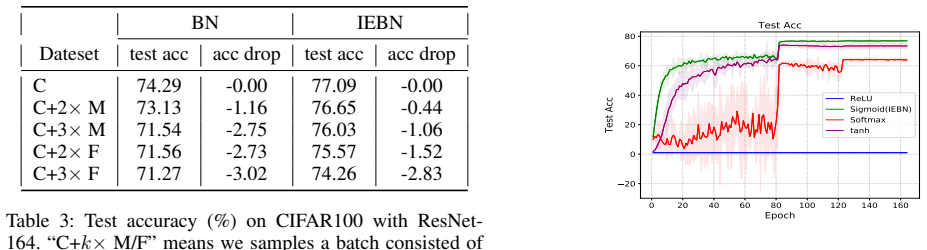
- When training batches mix CIFAR100 with MNIST or FashionMNIST, IEBN's accuracy drop is smaller than BN's across the reported mixing ratios, indicating more tolerance to corrupted batch statistics.
- Ablations identify the operative recipe: gate the scale $\gamma$ but not the bias $\beta$, use a per-channel linear transformation followed by sigmoid, and initialize $\hat\gamma=0$, $\hat\beta=-1$; alternative activations or applying the gate to $\beta$ perform worse.
Reading between the lines
- The same gate could be transplanted onto group or layer normalization; the paper only tests it on batch norm, but the noise-regulation logic would predict similar benefits wherever statistics mix across a batch.
- The paper's account predicts the largest gains when batch statistics are least representative, so a batch-size or domain-shift sweep should show IEBN's margin widening as batches shrink or become contaminated; the paper did not run that sweep.
- The chosen initialization makes the gate start as a constant attenuation near $\delta\approx 0.269$; decoupling that initial scaling from the adaptive update would isolate whether adaptivity or a lucky scale produces the gains.
Signed reviews
Editorial analysis
A structured set of objections, weighed in public.
Referee Report
Summary. The paper proposes Instance Enhancement Batch Normalization (IEBN), a modification of Batch Normalization that adds a per-channel, per-instance multiplicative gate to the reparameterization step. The gate is computed by applying a sigmoid to a linearly transformed channel average, with two additional learnable parameters per channel (initialized to 0 and -1). The authors claim that this instance-specific gating acts as an adaptive regulator of batch noise, stabilizing training and improving generalization, and they report accuracy gains over BN on CIFAR-10/100 and ImageNet across several architectures. They also present noise-attack experiments (constant noise and mixed-dataset batches) and ablations of the gate operator, excitation position, initialization, and activation function. The paper's central empirical claim is that replacing all BN layers by IEBN improves test accuracy with only a light parameter increment.
Significance. If the empirical gains are validated, the proposal is a simple and practically useful drop-in replacement for BN, with negligible parameter overhead and no architectural changes required. The paper's strength is the simplicity of the idea and the wide range of architectures and datasets tested. However, the reported improvements are not yet rigorously established: the main comparison lacks statistical significance, the gate hyperparameters are selected on the same CIFAR-100 benchmark used for the headline claim, and no control experiment isolates the proposed adaptive-instance-gating mechanism from a fixed constant scaling. The mechanism claim (adaptive regulation of batch noise) is therefore not supported by the current evidence. The work is more incremental than transformative, but it could become a solid empirical contribution after additional controlled experiments.
major comments (4)
- [Table 1 (Image Classification)] The central comparison of IEBN against BN reports single accuracies with no error bars or multiple seeds. Several of the claimed improvements are small relative to typical seed variance in these settings: e.g., PreResNet164 on CIFAR-10 (95.01 vs 95.09), ResNet34 on ImageNet (73.91 vs 74.38), and ResNeXt50 on ImageNet (77.19 vs 77.99). Without repeated runs or a statement of the number of seeds, the claim that IEBN consistently outperforms BN is not statistically supported, particularly for the smaller-margin cases.
- [Ablation Study, Table 5 and Figure 4] The gate initialization (Table 5), activation function (Figure 4), and gate operator (Table 4, left) are selected on CIFAR-100 with ResNet164, and the same architecture and dataset then appear as the headline result in Table 1 (77.09 vs 74.29). This is a selection-on-the-test-set bias. Moreover, the BN baseline uses a standard recipe (Appendix Tables 6-7) that is not tuned; the reported ResNet164 CIFAR-100 accuracy of 74.29 is below commonly reported values for this configuration, suggesting the baseline may be under-trained. A fair comparison would require tuning BN under the same search budget or using a separate validation set for both methods.
- [Ablation Study, Table 4 (Left), 'Identity'] The paper does not include a control that isolates the proposed instance-dependent gate from a fixed constant scaling. With the chosen initialization, sigmoid(0*mbc - 1) = 0.269 for every instance and channel, so IEBN begins as BN with the learnable scale gamma effectively multiplied by 0.269. The 'Identity' ablation removes the trainable parameters entirely (delta_bc = sigmoid(mbc)), which changes the functional form and gives 67.53, but it does not control for the constant-scale effect of the initial gate. A control with delta_bc fixed to sigmoid(-1) (i.e., no learning of gamma_hat and beta_hat) would be needed to determine whether the gains come from the adaptive instance-dependent gating or simply from a better effective initialization of the BN scale. This is load-bearing for the paper's mechanism claim.
- [Analysis, Tables 2 and 3] The noise-attack experiments do not directly measure the claimed 'regulation of batch noise' in standard training. The constant-noise attack inserts fixed constants into the normalization step, and the mix-dataset attack alters the data distribution; both are rather artificial stress tests. The fact that IEBN is more robust to these attacks is consistent with a regularization effect, but it does not demonstrate that IEBN reduces the batch noise that arises in normal training. The argument in Eqns. (12)-(14) is also heuristic: delta_bc depends on the instance, while Na and Nb are constants, so the claimed compensation of the noise is not established. A direct analysis of the variance of gradients or activations during standard training would be needed to support the mechanism claim.
minor comments (6)
- [Algorithm 1] The pseudocode does not specify how delta_bc is computed at test time, i.e., whether the instance-specific channel average is used in inference or whether running statistics are substituted. The paper should state this explicitly, since it affects both reproducibility and the interpretation of the module.
- [Table 3] The text and table use 'MINIST' for MNIST; this should be corrected.
- [Abstract and Section 1] The paper calls IEBN a 'self-attention' mechanism, but the gate operates independently on each channel with no cross-channel or cross-spatial interaction. Consider using more precise terminology such as 'channel-wise instance gating' or 'attention-like recalibration'.
- [Figure 4] The training curves for the different activation functions are hard to read in the printed figure; please provide numerical final accuracies or a table.
- [Experiments, Dataset and Model] There is a typo: 'CIAFR10' should be 'CIFAR10'.
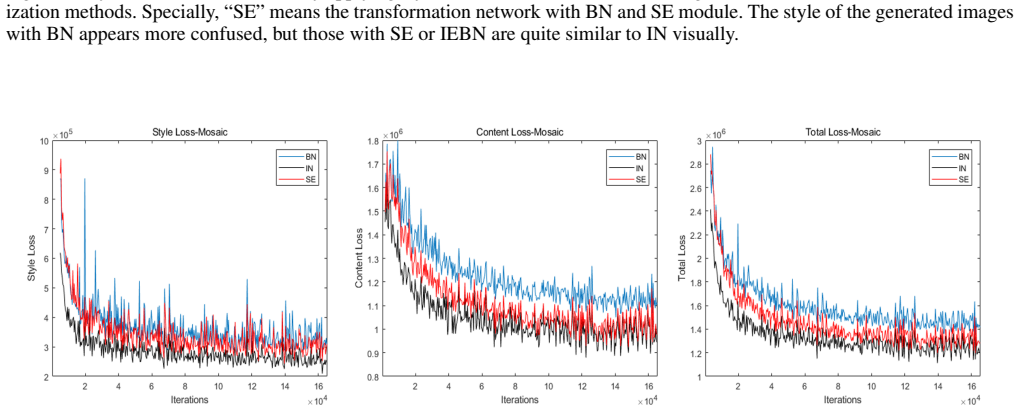
- [Auxiliary experiments] The style-transfer experiments that motivate the paper are purely qualitative. If they are meant to support the claim that self-attention reduces batch noise, quantitative metrics (e.g., style/content loss curves with multiple seeds) would strengthen the argument.
Circularity Check
Central claim is empirical and not forced by construction; hyperparameter selection on CIFAR100 is a selection/fairness issue, not circularity.
full rationale
The paper's central claim is an empirical comparison, not a derivation. IEBN is defined by Eq. (8)–(9) as BN's reparameterization scaled by sigmoid(hat_gamma_c * m_bc + hat_beta_c), with hat_gamma and hat_beta learned during training; no equation forces IEBN's accuracy to exceed BN. The reported gains are measured on external benchmarks (CIFAR10/100, ImageNet) and include BN and SE controls. The only same-author citation (Huang et al. 2019, Dianet) appears in a related-work enumeration and is not load-bearing. The ablation study does select the gate initialization (0,-1), the Linear operator, and Sigmoid activation using CIFAR100 test accuracy, and Table 1 reports the same ResNet164/CIFAR100 configuration; the paper even states that 'the theoretical nature behind the best initialization configuration will be our future work.' That is a test-set hyperparameter selection and baseline-fairness concern, not a by-construction equivalence: the selected configuration is then applied to CIFAR10 and ImageNet, and those gains are independent of the selection. No self-definitional, fitted-as-prediction, or imported-uniqueness step is present.
Assumptions & free parameters
free parameters (3)
- Per-channel instance-gate parameters (gamma_hat_c, beta_hat_c) =
learned per channel during training; initialized at 0 and -1
- Gate initialization (gamma_hat=0, beta_hat=-1) =
0 and -1
- Gate activation function =
sigmoid
assumptions (3)
- domain assumption Batch training noise can be decomposed into estimation noise and batch noise, with batch noise being the primary harmful component at moderate batch sizes.
- ad hoc to paper Visual similarity between SE/IEBN style-transfer outputs and IN outputs indicates that self-attention reduces batch noise.
- ad hoc to paper IEBN can be trained with the same hyperparameters as BN without additional tuning for each architecture.
Cite this review
Pith. "Pith review of Instance Enhancement Batch Normalization: an Adaptive Regulator of Batch Noise." pith.science (2026). https://pith.science/paper/IR6MIOQT
@misc{pith2026190804008,
  author       = {Pith},
  title        = {Pith review of: Instance Enhancement Batch Normalization: an Adaptive Regulator of Batch Noise},
  year         = {2026},
  howpublished = {\url{https://pith.science/paper/IR6MIOQT}},
  note         = {Machine review of arXiv:1908.04008}
}
read the original abstract
Batch Normalization (BN)(Ioffe and Szegedy 2015) normalizes the features of an input image via statistics of a batch of images and hence BN will bring the noise to the gradient of the training loss. Previous works indicate that the noise is important for the optimization and generalization of deep neural networks, but too much noise will harm the performance of networks. In our paper, we offer a new point of view that self-attention mechanism can help to regulate the noise by enhancing instance-specific information to obtain a better regularization effect. Therefore, we propose an attention-based BN called Instance Enhancement Batch Normalization (IEBN) that recalibrates the information of each channel by a simple linear transformation. IEBN has a good capacity of regulating noise and stabilizing network training to improve generalization even in the presence of two kinds of noise attacks during training. Finally, IEBN outperforms BN with only a light parameter increment in image classification tasks for different network structures and benchmark datasets.
Figures


Figures from the paper (3 more)


Reference graph
Works this paper leans on
-
[1]
write newline
" write newline "" before.all 'output.state := FUNCTION fin.entry add.period write newline FUNCTION new.block output.state before.all = 'skip after.block 'output.state := if FUNCTION new.sentence output.state after.block = 'skip output.state before.all = 'skip after.sentence 'output.state := if if FUNCTION not #0 #1 if FUNCTION and 'skip pop #0 if FUNCTIO...
-
[2]
The computational work for this article was partially performed on resources of the National Supercomputing Centre, Singapore (https://www.nscc.sg)
-
[3]
P.; Selman, B.; and Weinberger, K
Bjorck, N.; Gomes, C. P.; Selman, B.; and Weinberger, K. Q. 2018. Understanding batch normalization. In NeurIPS , 7705--7716
work page 2018
-
[4]
Cai, Y.; Li, Q.; and Shen, Z. 2019. A quantitative analysis of the effect of batch normalization on gradient descent. In ICML , 882--890
work page 2019
-
[5]
de Vries, H.; Strub, F.; Mary, J.; Larochelle, H.; Pietquin, O.; and Courville, A. C. 2017. Modulating early visual processing by language. In NIPS , 6597--6607
work page 2017
-
[6]
Dumoulin, V.; Shlens, J.; and Kudlur, M. 2016. A learned representation for artistic style. arXiv preprint arXiv:1610.07629
arXiv 2016
-
[7]
Gatys, L. A.; Ecker, A. S.; and Bethge, M. 2016. Image style transfer using convolutional neural networks. In Proceedings of the IEEE conference on computer vision and pattern recognition , 2414--2423
work page 2016
-
[8]
Ge, R.; Huang, F.; Jin, C.; and Yuan, Y. 2015. Escaping from saddle pointsonline stochastic gradient for tensor decomposition. In Conference on Learning Theory , 797--842
work page 2015
Show all 36 references
-
[9]
He, K.; Zhang, X.; Ren, S.; and Sun, J. 2016. Deep residual learning for image recognition. In Computer Vision and Pattern Recognition
2016
-
[10]
Hu, J.; Shen, L.; and Sun, G. 2018. Squeeze-and-excitation networks. In Proceedings of the IEEE conference on computer vision and pattern recognition , 7132--7141
2018
-
[11]
Huang, X., and Belongie, S. 2017. Arbitrary style transfer in real-time with adaptive instance normalization. In Proceedings of the IEEE International Conference on Computer Vision , 1501--1510
2017
-
[12]
Huang, Z.; Liang, S.; Liang, M.; and Yang, H. 2019. Dianet: Dense-and-implicit attention network. CoRR abs/1905.10671
2019 arXiv
-
[13]
Ioffe, S., and Szegedy, C. 2015. Batch normalization: Accelerating deep network training by reducing internal covariate shift. In Proceedings of the 32Nd International Conference on International Conference on Machine Learning - Volume 37 , ICML'15, 448--456. JMLR.org
2015
-
[14]
Ioffe, S. 2017. Batch renormalization: Towards reducing minibatch dependence in batch-normalized models. In NIPS , 1942--1950
2017
-
[15]
Jia, S.; Chen, D.-J.; and Chen, H.-T. 2019. Instance-level meta normalization. In The IEEE Conference on Computer Vision and Pattern Recognition (CVPR)
2019
-
[16]
M.; and Jordan, M
Jin, C.; Ge, R.; Netrapalli, P.; Kakade, S. M.; and Jordan, M. I. 2017. How to escape saddle points efficiently. In Proceedings of the 34th International Conference on Machine Learning-Volume 70 , 1724--1732. JMLR. org
2017
-
[17]
Johnson, J.; Alahi, A.; and Fei-Fei, L. 2016a. Perceptual losses for real-time style transfer and super-resolution. In ECCV (2) , 694--711
-
[18]
Johnson, J.; Alahi, A.; and Fei-Fei, L. 2016b. Perceptual losses for real-time style transfer and super-resolution. In European conference on computer vision , 694--711. Springer
-
[19]
S.; Mudigere, D.; Nocedal, J.; Smelyanskiy, M.; and Tang, P
Keskar, N. S.; Mudigere, D.; Nocedal, J.; Smelyanskiy, M.; and Tang, P. T. P. 2016. On large-batch training for deep learning: Generalization gap and sharp minima
2016
-
[20]
Krizhevsky, A., and Hinton, G. 2009. Learning multiple layers of features from tiny images. Technical report, Citeseer
2009
-
[21]
LeCun, Y., and Cortes, C. 2010. MNIST handwritten digit database
2010
-
[22]
Li, Y.; Wang, N.; Shi, J.; Hou, X.; and Liu, J. 2018. Adaptive batch normalization for practical domain adaptation. Pattern Recognition 80:109--117
2018
-
[23]
Li, X.; Wang, W.; Hu, X.; and Yang, J. 2019. Selective kernel networks
2019
-
[24]
Li, X.; Hu, X.; and Yang, J. 2019. Spatial group-wise enhance: Improving semantic feature learning in convolutional networks. CoRR abs/1905.09646
2019 arXiv
-
[25]
Luo, P.; Wang, X.; Shao, W.; and Peng, Z. 2019. Towards understanding regularization in batch normalization. In International Conference on Learning Representations
2019
-
[26]
Luo, P.; Ren, J.; and Peng, Z. 2018. Differentiable learning-to-normalize via switchable normalization. arXiv preprint arXiv:1806.10779
2018 arXiv
-
[27]
Luo, L.; Xiong, Y.; and Liu, Y. 2019. Adaptive gradient methods with dynamic bound of learning rate. In International Conference on Learning Representations
2019
-
[28]
C.; and Fei-Fei, L
Russakovsky, O.; Deng, J.; Su, H.; Krause, J.; Satheesh, S.; Ma, S.; Huang, Z.; Karpathy, A.; Khosla, A.; Bernstein, M.; Berg, A. C.; and Fei-Fei, L. 2015. ImageNet Large Scale Visual Recognition Challenge . International Journal of Computer Vision (IJCV) 115(3):211--252
2015
-
[29]
Salimans, T., and Kingma, D. P. 2016. Weight normalization: A simple reparameterization to accelerate training of deep neural networks. In Advances in Neural Information Processing Systems , 901--909
2016
-
[30]
Santurkar, S.; Tsipras, D.; Ilyas, A.; and Madry, A. 2018. How does batch normalization help optimization? In NeurIPS , 2488--2498
2018
-
[31]
Ulyanov, D.; Vedaldi, A.; and Lempitsky, V. 2017. Improved texture networks: Maximizing quality and diversity in feed-forward stylization and texture synthesis. In Proceedings of the IEEE Conference on Computer Vision and Pattern Recognition , 6924--6932
2017
-
[32]
Wang, X.; Girshick, R.; Gupta, A.; and He, K. 2018. Non-local neural networks. In CVPR , 7794--7803
2018
-
[33]
Wu, Y., and He, K. 2018. Group normalization. In ECCV (13) , 3--19
2018
-
[34]
Xiao, H.; Rasul, K.; and Vollgraf, R. 2017. Fashion-mnist: a novel image dataset for benchmarking machine learning algorithms
2017
-
[35]
Xie, S.; Girshick, R.; Doll \'a r, P.; Tu, Z.; and He, K. 2017. Aggregated residual transformations for deep neural networks. In Computer Vision and Pattern Recognition
2017
-
[36]
Zhu, J.-Y.; Park, T.; Isola, P.; and Efros, A. A. 2017. Unpaired image-to-image translation using cycle-consistent adversarial networks. In ICCV , 2242--2251
2017
Reviewed August 14, 2026 · model on record in the stance chip above.
Discussion (0). Continue with ORCID to comment.