REVIEW 4 major objections 5 minor 44 references
Towards Adversarial Robustness of Model-Level Mixture-of-Experts Architectures for Semantic Segmentation
T0 review · 4 major / 5 minor · reviewed 2026-08-11 · deepseek-v4-flash
Pith's one-line read Model-level mixtures of experts—pretrained segmentation specialists combined by a learned gate—are, in most tested settings, more robust to adversarial attacks than fixed ensembles, with a classwise gate plus an extra convolution strongest.
desk verdict First robustness study of model-level MoEs for segmentation, but the headline claim is undercut by a missing control and inconsistent results across attack settings. read the letter →
The pith
A machine-rendered reading of the paper's core claim, the machinery that carries it, and where it could break.
The reading
What carries the argument
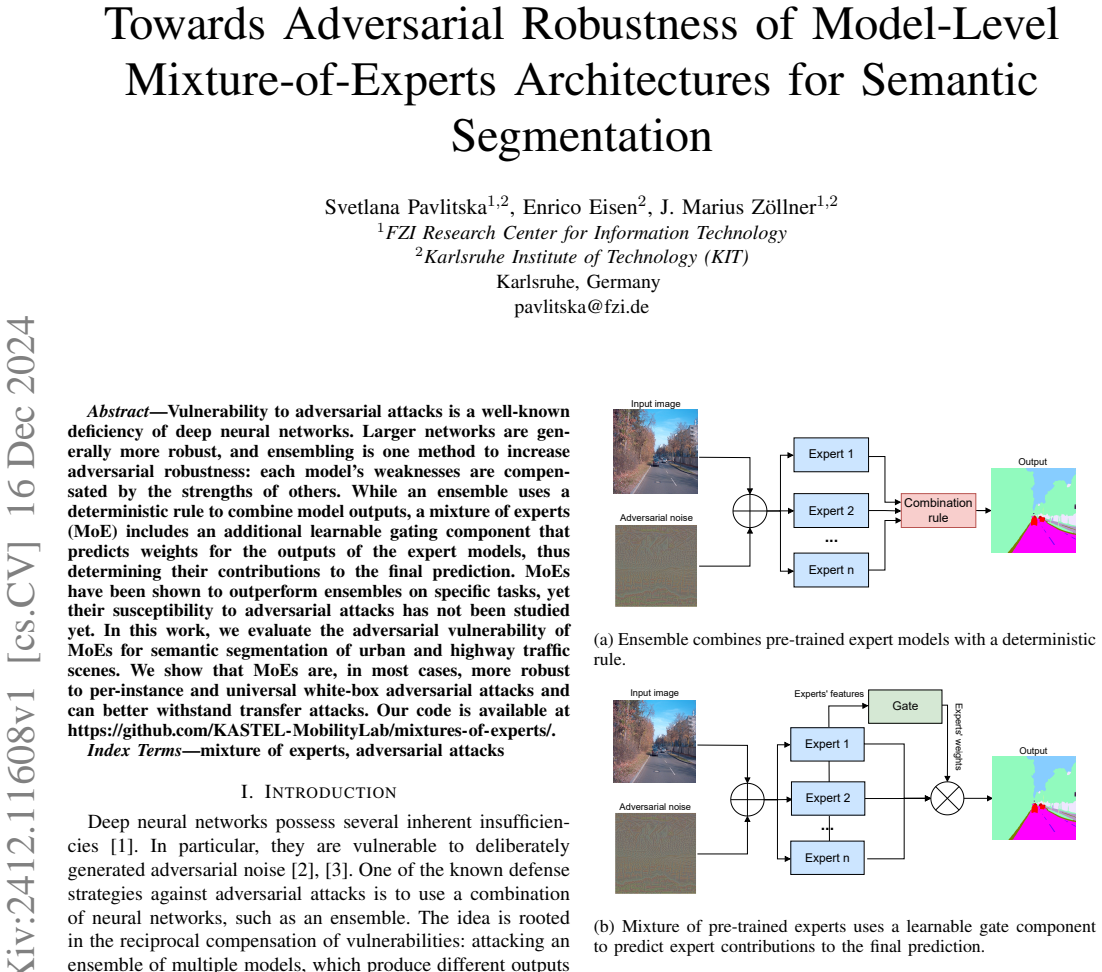
The object that carries the argument is the gate: a small convolutional-plus-two-fully-connected network that takes the concatenated features of both experts and outputs softmax weights. In the simple-gate variant it emits one weight per expert; in the classwise variant it emits one weight per class per expert, so each class can be assigned to the more reliable specialist. The second design variable is an optional convolutional layer placed after the weighted sum of expert predictions and before the final softmax. These two choices define the four MoE architectures, and the paper attributes the robustness differences to them: the classwise gate and the extra convolution are the configurations that keep attacked accuracy highest most often.
What would settle it
Run the same comparison under a 100-step iterative attack and with five random training seeds per model; if the classwise-gate-plus-conv MoE no longer beats the mean and max ensembles in retained segmentation accuracy, the central claim is overturned.
Extended reading notes
Core claim
The central claim is that adding a learned gate to an ensemble does not merely preserve ensembling's robustness—it can improve on it. Concretely, the authors take two segmentation experts, one trained on urban and one on highway images, and compare a fixed mean/max ensemble against four MoE variants under the fast gradient sign method at epsilon up to 0.10, a ten-step projected-gradient-descent attack at epsilon 0.05, and a universal PGD pattern trained on a whole dataset. In most comparisons the MoEs show a smaller accuracy drop; for DeepLabv3+-based models, the classwise-gate-plus-conv variant reaches 13.01 mIoU under FGSM at epsilon 0.05 versus 8.27 for the single baseline and 7.36 for the mean ensemble, and it is also the best under PGD-10 in that family. The paper thus argues that the input-dependent weighting learned by the gate, together with the post-combination convolution, is a robustness-relevant design choice, not just a performance one.
Load-bearing premise
The load-bearing premise is that the chosen attack strengths—one-step noise up to 0.10, ten-step iterative noise at 0.05, and one dataset-wide noise pattern—are a representative and hard enough test of adversarial robustness, and that a single training run per model is stable enough that differences of a few tenths of a percent in the segmentation score are real.
Editorial extensions
If this is right
- Model-level MoEs can be added to existing segmentation pipelines without retraining the experts; only the gate and optional convolutional layer need to be trained, and the attacked-accuracy gain appears mostly at larger perturbation sizes.
- The classwise gate with an extra convolutional layer is the configuration to choose for per-instance robustness on DeepLabv3+-based models; it retains the highest mIoU at epsilon 0.05 under FGSM and PGD-10 in the paper's table.
- Attacks computed on one model transfer less well to MoEs than to ensembles, so a MoE target is harder to attack by reusing a noise pattern from a similar model.
- Universal-pattern attacks remain a weaker point for MoEs; the paper's table shows the best ensemble sometimes keeps more accuracy under the universal PGD pattern, so universal robustness should not be assumed.
Reading between the lines
- A plausible reason the extra convolutional layer helps is that it smooths the weighted expert outputs before the final softmax, acting as a learned denoiser; this could be tested by freezing the gate at uniform weights and re-running the attacks.
- The gate itself may be a distinct attack surface: an adversary could target the gating weights directly, for example by maximizing the probability mass assigned to a vulnerable expert rather than maximizing the segmentation loss, and the paper does not evaluate such gate-targeted attacks.
- The robustness ordering may depend on the number of experts and on how distinct the subdomains are; with more than two experts or less separated domains, gate training could behave differently, so the results are a first baseline rather than a general law.
- Extending the same setup to other domain splits, such as day/night, city/country, or weather conditions, would show whether the gate's learned weighting, rather than the specific highway-urban expert pair, is what carries the robustness.
Editorial analysis
A structured set of objections, weighed in public.
Referee Report
Summary. The paper presents an empirical study of adversarial robustness for model-level mixtures of experts (MoEs) in semantic segmentation. Using two-segmenter architectures (FRRN-based and DeepLabv3+-based) trained on an A2D2 highway/urban split, the authors compare single experts, a baseline, fixed mean/max ensembles, and four MoE variants (simple/classwise gates, with or without an additional convolutional layer) under FGSM, PGD-10, universal PGD, and transfer attacks. The central claim is that MoEs are, in most cases, more robust than fixed ensembles, especially the classwise-gate-plus-conv variant, and that MoEs better withstand transfer attacks. Results are reported in Table I and Figures 3-4.
Significance. If the central claim is supported, this would be one of the first evaluations of adversarial robustness specifically for model-level MoEs in semantic segmentation, a relevant and understudied setting. The paper uses established attack protocols, compares two base architectures, reports clean and attacked mIoU, and releases code. The main value is as a first empirical mapping of MoE robustness for segmentation; however, the causal attribution to the MoE gating mechanism is not cleanly identified, and several headline claims are not uniformly supported by the reported numbers.
major comments (4)
- [Section III-A and Table I] The two MoE configurations that drive the positive per-instance result, 'simple gate and conv' and 'classwise gate and conv', differ from the ensemble baselines not only by the trainable gate but also by an additional convolutional layer after the weighted combination, and by higher clean mIoU. For DeepLabv3+ under FGSM, classwise gate with conv reaches 13.01 mIoU versus 8.26 for ensemble max, while classwise gate without conv reaches 9.38; under PGD-10 the corresponding values are 2.78 versus 0.83 and 1.32. Without an ensemble-plus-conv baseline or a fixed learned fusion baseline that isolates the effect of input-dependent gating from the extra parameters, the abstract's attribution of robustness to MoE gating is not identifiable. This is load-bearing because the non-conv MoE variants are much closer to the ensembles and sometimes worse.
- [Table I, Universal PGD-10 columns] The universal attack results contradict the abstract's claim that MoEs better withstand universal attacks. For FRRN, every MoE variant has lower attacked mIoU than the max ensemble (best MoE 3.39-4.46 versus 6.08 for ensemble max). For DeepLabv3+, the mean ensemble (1.20) is essentially tied with the best MoE (1.10) and most MoE variants are worse (e.g., 3.40 for simple gate with conv, 3.30 for simple gate). The paper should either narrow the 'universal attack' claim to specific configurations, or analyze why universal perturbations degrade MoE gating, rather than stating the opposite in the abstract and conclusion.
- [Section IV-A and Table I] All results appear to come from a single training run per configuration, with no repeated seeds, confidence intervals, or significance tests. This matters because several comparisons in Table I are within a few tenths of mIoU, e.g., DeepLabv3+ PGD-10 ensemble mean 1.28 versus MoE classwise gate 1.20, FRRN FGSM ensemble max 5.86 versus MoE classwise 6.17, and DeepLabv3+ universal ensemble mean 1.20 versus MoE classwise gate with conv 1.10. The headline 'in most cases' cannot be adjudicated from point estimates of this size; multiple runs or error bars are needed, or the claims should be scoped to the observed runs.
- [Section IV-B, Attack Settings] The white-box evaluation is limited to FGSM and PGD-10 at epsilon 0.05 for PGD; PGD-10 is a relatively weak iterative attack. There is no PGD with more iterations, no adaptive attack, and no discussion of whether the robustness ordering is stable under stronger attacks. This matters because robust-accuracy comparisons can reverse as attack strength increases, and the paper's central claim is framed generally rather than as a statement about these specific attack configurations. Adding PGD-20/50 results, or explicitly justifying PGD-10 as a sufficient adversarial budget for this setting, would substantially strengthen the conclusions.
minor comments (5)
- [Equation (1)] Equation (1) has an unmatched parenthesis: it reads "sign(∇xL(Θ, x, y)," instead of "sign(∇xL(Θ, x, y))".
- [Table I caption] The caption says the best-performing and most robust models are 'marked', but no visible markers are present in the table; please add bold or a symbol and explain it in the caption.
- [Section IV-C and Figure 4] Figure 4 does not explain what the numbers inside the matrix represent, how the source-model attack pattern is generated, or what the diagonal/off-diagonal entries correspond to; the reader cannot reconstruct the transfer-attack protocol from the text.
- [Section II-C] The reference to MNIST is cited as [23], but [23] is Metzen et al. on universal adversarial perturbations for segmentation; the MNIST dataset citation is missing or misplaced.
- [Section V and Section IV-A] The conclusion refers to 'FRRN+' while Section IV-A introduces 'FRRN-A' and Section III calls it 'FRRN-based models'; please use consistent terminology and define FRRN-A.
Circularity Check
No significant circularity: the robustness claims rest on fresh empirical comparisons against external baselines, not on fitted predictions or self-citation chains.
full rationale
The paper draws its MoE architecture and the A2D2 train/validation split from the authors' prior work [13], [14], but those are experimental inputs, not conclusions derived from the present robustness evaluation. The central claim that MoEs are more robust than ensembles is supported by directly measured mIoU under FGSM, PGD-10, and universal PGD attacks, compared against single experts and fixed mean/max ensembles as external baselines. No parameter is fitted to the attacked data and then renamed a prediction; no uniqueness theorem is invoked; and no result is defined in terms of the quantity it purports to predict. The strongest residual concern is a possible confound: the best-performing MoE variants include an extra convolutional layer that the ensemble baselines lack, so the observed advantage may partly stem from that layer rather than from gating. That is a question of experimental control and causal attribution, not a circularity, because the comparison itself is not equivalent to its inputs by construction. Self-citations appear only as sources for the architecture and data split, and they are not load-bearing for the robustness conclusion, which is evaluated empirically against independent baselines. Therefore no circular step can be exhibited, and the appropriate score is 0.
Assumptions & free parameters
free parameters (2)
- epsilon (attack magnitude) =
0.05 (main table), 0.0-0.10 in Fig. 3
- PGD iterations and step size =
10 steps, alpha=0.01, Adam optimizer
assumptions (3)
- domain assumption mIoU under FGSM, PGD-10(Adam), and universal PGD is a valid measure of adversarial robustness for the claim.
- domain assumption The A2D2 highway/urban split and ImageNet-pretrained backbones produce experts with genuine specialization.
- ad hoc to paper A single training run for each model is representative.
Cite this review
Pith. "Pith review of Towards Adversarial Robustness of Model-Level Mixture-of-Experts Architectures for Semantic Segmentation." pith.science (2026). https://pith.science/paper/IRFSX2YI
@misc{pith2026241211608,
  author       = {Pith},
  title        = {Pith review of: Towards Adversarial Robustness of Model-Level Mixture-of-Experts Architectures for Semantic Segmentation},
  year         = {2026},
  howpublished = {\url{https://pith.science/paper/IRFSX2YI}},
  note         = {Machine review of arXiv:2412.11608}
}
read the original abstract
Vulnerability to adversarial attacks is a well-known deficiency of deep neural networks. Larger networks are generally more robust, and ensembling is one method to increase adversarial robustness: each model's weaknesses are compensated by the strengths of others. While an ensemble uses a deterministic rule to combine model outputs, a mixture of experts (MoE) includes an additional learnable gating component that predicts weights for the outputs of the expert models, thus determining their contributions to the final prediction. MoEs have been shown to outperform ensembles on specific tasks, yet their susceptibility to adversarial attacks has not been studied yet. In this work, we evaluate the adversarial vulnerability of MoEs for semantic segmentation of urban and highway traffic scenes. We show that MoEs are, in most cases, more robust to per-instance and universal white-box adversarial attacks and can better withstand transfer attacks. Our code is available at \url{https://github.com/KASTEL-MobilityLab/mixtures-of-experts/}.
Figures


Figures from the paper (1 more)

Reference graph
Works this paper leans on
-
[1]
Inspect, understand, overcome: A survey of practical methods for ai safety,
S. Houben, S. Abrecht, M. Akila, A. B ¨ar, F. Brockherde, P. Feifel, T. Fingscheidt, S. S. Gannamaneni, S. E. Ghobadi, A. Hammam et al., “Inspect, understand, overcome: A survey of practical methods for ai safety,” in Deep Neural Networks and Data for Automated Driving: Robustness, Uncertainty Quantification, and Insights Towards Safety . Springer, 2022
work page 2022
-
[2]
Intriguing properties of neural networks,
C. Szegedy, W. Zaremba, I. Sutskever, J. Bruna, D. Erhan, I. J. Goodfellow, and R. Fergus, “Intriguing properties of neural networks,” in International Conference on Learning Representations (ICLR) , 2014
work page 2014
-
[3]
Explaining and Harnessing Adversarial Examples,
I. J. Goodfellow, J. Shlens, and C. Szegedy, “Explaining and Harnessing Adversarial Examples,” in International Conference on Learning Rep- resentations (ICLR), 2015
work page 2015
-
[4]
Robustness to adversarial examples through an ensemble of specialists,
M. Abbasi and C. Gagn ´e, “Robustness to adversarial examples through an ensemble of specialists,” in International Conference on Learning Representations (ICLR) - Workshops , 2017
work page 2017
-
[5]
Improving adversarial robustness of ensembles with diversity training,
S. Kariyappa and M. K. Qureshi, “Improving adversarial robustness of ensembles with diversity training,” CoRR, vol. abs/1901.09981, 2019
arXiv 1901
-
[6]
Improving adversarial ro- bustness via promoting ensemble diversity,
T. Pang, K. Xu, C. Du, N. Chen, and J. Zhu, “Improving adversarial ro- bustness via promoting ensemble diversity,” in International Conference on Machine Learning (ICML) , 2019
work page 2019
-
[7]
Adaptive mixtures of local experts,
R. A. Jacobs, M. I. Jordan, S. J. Nowlan, and G. E. Hinton, “Adaptive mixtures of local experts,” Neural computation, 1991
work page 1991
-
[8]
Outrageously large neural networks: The sparsely- gated mixture-of-experts layer,
N. Shazeer, A. Mirhoseini, K. Maziarz, A. Davis, Q. V . Le, G. E. Hinton, and J. Dean, “Outrageously large neural networks: The sparsely- gated mixture-of-experts layer,” inInternational Conference on Learning Representations (ICLR), 2017
work page 2017
Show all 44 references
-
[9]
Sparsely- gated mixture-of-expert layers for cnn interpretability,
S. Pavlitska, C. Hubschneider, L. Struppek, and J. M. Z ¨ollner, “Sparsely- gated mixture-of-expert layers for cnn interpretability,” in International Joint Conference on Neural Networks (IJCNN) , 2023
2023
-
[10]
Deep mixture of experts via shallow embedding,
X. Wang, F. Yu, L. Dunlap, Y . Ma, R. Wang, A. Mirhoseini, T. Darrell, and J. E. Gonzalez, “Deep mixture of experts via shallow embedding,” in Conference on Uncertainty in Artificial Intelligence, UAI , 2019
2019
-
[11]
On the adversarial robustness of mixture of experts,
J. Puigcerver, R. Jenatton, C. Riquelme, P. Awasthi, and S. Bhojanapalli, “On the adversarial robustness of mixture of experts,” in Advances in Neural Information Processing Systems (NIPS) , 2022
2022
-
[12]
Robust mixture-of-expert training for convolu- tional neural networks,
Y . Zhang, R. Cai, T. Chen, G. Zhang, H. Zhang, P.-Y . Chen, S. Chang, Z. Wang, and S. Liu, “Robust mixture-of-expert training for convolu- tional neural networks,” in International Conference on Computer Vision (ICCV), 2023
2023
-
[13]
Using mixture of expert models to gain insights into semantic segmentation,
S. Pavlitskaya, C. Hubschneider, M. Weber, R. Moritz, F. H ¨uger, P. Schlicht, and J. M. Z ¨ollner, “Using mixture of expert models to gain insights into semantic segmentation,” in Conference on Computer Vision and Pattern Recognition (CVPR) - Workshops , 2020
2020
-
[14]
Evaluating mixture-of- experts architectures for network aggregation,
S. Pavlitskaya, C. Hubschneider, and M. Weber, “Evaluating mixture-of- experts architectures for network aggregation,” in Deep Neural Networks and Data for Automated Driving: Robustness, Uncertainty Quantifica- tion, and Insights Towards Safety . Springer, 2022
2022
-
[15]
Switch transformers: Scaling to trillion parameter models with simple and efficient sparsity,
W. Fedus, B. Zoph, and N. Shazeer, “Switch transformers: Scaling to trillion parameter models with simple and efficient sparsity,”The Journal of Machine Learning Research , 2022
2022
-
[16]
Deepspeed-moe: Advancing mixture-of- experts inference and training to power next-generation AI scale,
S. Rajbhandari, C. Li, Z. Yao, M. Zhang, R. Y . Aminabadi, A. A. Awan, J. Rasley, and Y . He, “Deepspeed-moe: Advancing mixture-of- experts inference and training to power next-generation AI scale,” in International Conference on Machine Learning (ICML) , 2022
2022
-
[17]
Network of experts for large-scale image categorization,
K. Ahmed, M. H. Baig, and L. Torresani, “Network of experts for large-scale image categorization,” in European Conference on Computer Vision (ECCV) - Workshops . Springer, 2016
2016
-
[18]
Adversarial examples for semantic image segmentation,
V . Fischer, M. C. Kumar, J. H. Metzen, and T. Brox, “Adversarial examples for semantic image segmentation,” inInternational Conference on Learning Representations (ICLR) - Workshops , 2017
2017
-
[19]
Adversarial examples in the physical world,
A. Kurakin, I. J. Goodfellow, and S. Bengio, “Adversarial examples in the physical world,” in International Conference on Learning Represen- tations (ICLR) - Workshops , 2017
2017
-
[20]
On the robustness of semantic segmentation models to adversarial attacks,
A. Arnab, O. Miksik, and P. H. S. Torr, “On the robustness of semantic segmentation models to adversarial attacks,” in Conference on Computer Vision and Pattern Recognition (CVPR) , 2018
2018
-
[21]
The pascal visual object classes (VOC) challenge,
M. Everingham, L. V . Gool, C. K. I. Williams, J. M. Winn, and A. Zisserman, “The pascal visual object classes (VOC) challenge,” International Journal of Computer Vision , 2010
2010
-
[22]
The cityscapes dataset for semantic urban scene understanding,
M. Cordts, M. Omran, S. Ramos, T. Rehfeld, M. Enzweiler, R. Be- nenson, U. Franke, S. Roth, and B. Schiele, “The cityscapes dataset for semantic urban scene understanding,” in Conference on Computer Vision and Pattern Recognition (CVPR) , 2016
2016
-
[23]
Universal adversar- ial perturbations against semantic image segmentation,
J. H. Metzen, M. C. Kumar, T. Brox, and V . Fischer, “Universal adversar- ial perturbations against semantic image segmentation,” in International Conference on Computer Vision (ICCV) , 2017
2017
-
[24]
Adversarial examples on seg- mentation models can be easy to transfer,
J. Gu, H. Zhao, V . Tresp, and P. H. S. Torr, “Adversarial examples on seg- mentation models can be easy to transfer,” CoRR, vol. abs/2111.11368, 2021
2021 arXiv
-
[25]
Pyramid scene parsing network,
H. Zhao, J. Shi, X. Qi, X. Wang, and J. Jia, “Pyramid scene parsing network,” in Conference on Computer Vision and Pattern Recognition (CVPR), 2017
2017
-
[26]
Rethinking atrous convolution for semantic image segmentation,
L. Chen, G. Papandreou, F. Schroff, and H. Adam, “Rethinking atrous convolution for semantic image segmentation,” CoRR, vol. abs/1706.05587, 2017
2017 arXiv
-
[27]
Learning multiple layers of features from tiny images,
A. Krizhevsky, G. Hinton et al. , “Learning multiple layers of features from tiny images,” 2009
2009
-
[28]
Deepfool: A simple and accurate method to fool deep neural networks,
S. Moosavi-Dezfooli, A. Fawzi, and P. Frossard, “Deepfool: A simple and accurate method to fool deep neural networks,” in Conference on Computer Vision and Pattern Recognition (CVPR) , 2016
2016
-
[29]
Ensemble methods as a defense to adversarial perturbations against deep neural networks,
T. Strauss, M. Hanselmann, A. Junginger, and H. Ulmer, “Ensemble methods as a defense to adversarial perturbations against deep neural networks,” CoRR, vol. abs/1709.03423, 2017
2017 arXiv
-
[30]
Ensemble methods in machine learning,
T. G. Dietterich, “Ensemble methods in machine learning,” in Interna- tional workshop on multiple classifier systems . Springer, 2000
2000
-
[31]
Improving robustness and calibration in ensembles with diversity regularization,
H. A. Mehrtens, C. Gonz ´alez, and A. Mukhopadhyay, “Improving robustness and calibration in ensembles with diversity regularization,” in German Conference on Pattern Recognition (GCPR) , 2022
2022
-
[32]
Measuring ensemble diversity and its effects on model robustness,
L. Heidemann, A. Schwaiger, and K. Roscher, “Measuring ensemble diversity and its effects on model robustness,” in International Joint Conference on Artificial Intelligence (IJCAI) - Workshops , 2021
2021
-
[33]
Mixture of robust experts (more): A robust denoising method towards multiple perturbations,
K. Xu, C. Wang, H. Cheng, B. Kailkhura, X. Lin, and R. Goldhahn, “Mixture of robust experts (more): A robust denoising method towards multiple perturbations,” CoRR, vol. abs/2104.10586, 2021
2021 arXiv
-
[34]
Synergy-of-experts: Collaborate to improve adversarial robustness,
S. Cui, J. Zhang, J. Liang, B. Han, M. Sugiyama, and C. Zhang, “Synergy-of-experts: Collaborate to improve adversarial robustness,” in Advances in Neural Information Processing Systems (NIPS) , 2022
2022
-
[35]
Enhancing the
Q. Han, Y . Huang, X. Guo, Y . Zhai, Y . Qin, and Y . Yang, “Enhancing the ”immunity” of mixture-of-experts networks for adversarial defense,” CoRR, vol. abs/2402.18787, 2024
2024 arXiv
-
[36]
Towards deep learning models resistant to adversarial attacks,
A. Madry, A. Makelov, L. Schmidt, D. Tsipras, and A. Vladu, “Towards deep learning models resistant to adversarial attacks,” in International Conference on Learning Representations (ICLR) , 2018
2018
-
[37]
Adversarial risk and the dangers of evaluating against weak attacks,
J. Uesato, B. O’Donoghue, P. Kohli, and A. van den Oord, “Adversarial risk and the dangers of evaluating against weak attacks,” in International Conference on Machine Learning (ICML) , 2018
2018
-
[38]
Towards evaluating the robustness of neural networks,
N. Carlini and D. Wagner, “Towards evaluating the robustness of neural networks,” in IEEE Symposium on Security and Privacy , 2017
2017
-
[39]
Adam: A method for stochastic optimization,
D. P. Kingma and J. Ba, “Adam: A method for stochastic optimization,” in International Conference on Learning Representations (ICLR) , 2015
2015
-
[40]
Univer- sal Adversarial Perturbations,
S.-M. Moosavi-Dezfooli, A. Fawzi, O. Fawzi, and P. Frossard, “Univer- sal Adversarial Perturbations,” in Conference on Computer Vision and Pattern Recognition (CVPR). IEEE, 2017
2017
-
[41]
Full-Resolution Residual Networks for Semantic Segmentation in Street Scenes,
T. Pohlen, A. Hermans, M. Mathias, and B. Leibe, “Full-Resolution Residual Networks for Semantic Segmentation in Street Scenes,” in Conference on Computer Vision and Pattern Recognition (CVPR), 2017
2017
-
[42]
Encoder- decoder with atrous separable convolution for semantic image segmenta- tion,
L. Chen, Y . Zhu, G. Papandreou, F. Schroff, and H. Adam, “Encoder- decoder with atrous separable convolution for semantic image segmenta- tion,” in European Conference on Computer Vision (ECCV) - Workshops, 2018
2018
-
[43]
Deep residual learning for image recognition,
K. He, X. Zhang, S. Ren, and J. Sun, “Deep residual learning for image recognition,” in Conference on Computer Vision and Pattern Recognition (CVPR), 2016
2016
-
[44]
A2D2: audi autonomous driving dataset,
J. Geyer, Y . Kassahun, M. Mahmudi, X. Ricou, R. Durgesh, A. S. Chung, L. Hauswald, V . H. Pham, M. M ¨uhlegg, S. Dorn, T. Fernandez, M. J ¨anicke, S. Mirashi, C. Savani, M. Sturm, O. V orobiov, M. Oelker, S. Garreis, and P. Schuberth, “A2D2: audi autonomous driving dataset,” ...
2004 arXiv
Reviewed August 11, 2026 · model on record in the stance chip above.
Discussion (0). Continue with ORCID to comment.