REVIEW 4 major objections 7 minor 90 references
DeepFeature claims LLMs can automatically produce task-specific biosignal features that outperform handcrafted and automated baselines across eight healthcare tasks.
Reviewed by Pith at T0; open to challenge. T0 means a machine referee read the full paper against a public rubric. the ladder, T0–T4 →
T0 review · deepseek-v4-flash
2026-08-03 17:40 UTC pith:IRLRFM4L
load-bearing objection Novel system, shaky headline evidence: the subject-level claim in the abstract never appears in the body, and without code or semantic verification the AUROC numbers are not yet a basis for believing the 4-10% gains. the 4 major comments →
DeepFeature: LLM-Empowered Context-aware Feature Generation for Wearable Biosignals
The pith
A machine-rendered reading of the paper's core claim, the machinery that carries it, and where it could break.
Core claim
The paper's central claim is that context-aware, iterative feature generation is the bottleneck, not the model: with the right context and feedback, a general-purpose LLM can discover feature sets that outperform both expert-validated features and broad automated extraction libraries. DeepFeature generates candidates from three sources—the LLM's own knowledge, a knowledge base built by crawling task-relevant literature, and mathematical combinations of already-computed features—then converts descriptions to code through a four-filter pipeline and feeds model performance and confusion-matrix details back into the LLM for refinement. Across eight tasks on EEG, PPG, and multimodal wrist/chest b
What carries the argument
The load-bearing mechanism is the full DeepFeature pipeline: multi-source feature generation that combines the LLM's own knowledge with task context from crawled literature and operator-composed features; an iterative loop in which feature assessment (validation AUROC, confusion matrix, per-class accuracy) is converted into feedback for the next generation round; and a feature-to-code translator guarded by four static filters (syntactic validity, name/parameter alignment with sensor modalities, rejection of placeholder bodies, rejection of constant or empty returns) plus an output-dimension consistency check during execution. The filters and verification are what make automated code executio
Load-bearing premise
The load-bearing premise is that the four-layer code filter (Section 3.3.1) ensures the generated functions correctly implement the feature semantics described in the JSON prompt; it actually verifies only syntactic validity, non-empty bodies, parameter alignment with sensor names, and non-constant returns, so functions that silently compute the wrong quantity would pass every check and invalidate the reported AUROC improvements and feature analyses.
What would settle it
Take a random sample of feature functions generated for the eight tasks, run them on the raw biosignals, and compare their outputs against independent reference implementations (e.g., standard HRV/GSR feature libraries) or against known physiological ground-truth values. If a meaningful fraction of functions produce mismatching values, DeepFeature's performance gains are not attributable to the intended features; the average AUROC could still be high if the downstream model happens to exploit whatever the code actually computes.
If this is right
- Feature engineering for new wearable-health tasks can be fully automated from raw sensor data, removing the need for manual feature lists.
- Adding mathematical operator combinations to LLM-generated features is a substantial contributor: removing it lowers AUROC by 6.75% on the evaluated PPG tasks.
- Removing the iterative feedback loop lowers AUROC by 5.58%, so refinement driven by model performance is part of the claimed gain.
- Removing the context-guided source lowers AUROC by 3.53% on average, indicating that literature-derived task context carries part of the advantage.
- The framework works across different underlying LLMs and downstream classifier types, suggesting the approach is not tied to one model.
Where Pith is reading between the lines
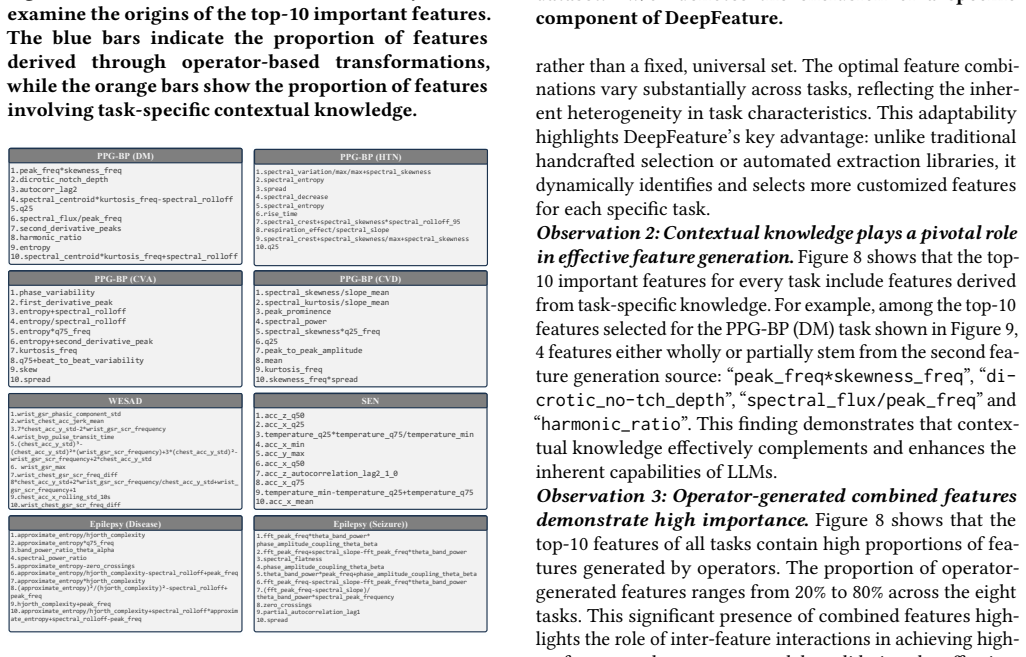
- Because the code filters check only syntax, non-empty bodies, parameter alignment, and non-constant returns (Section 3.3.1), they do not verify that a generated function computes the quantity described in the JSON prompt. If silent semantic bugs exist, the reported AUROC gains and top-feature analysis would not be trustworthy; a hand-audit or reference-implementation comparison of a sample of func
- The ablations remove components only from DeepFeature; they do not add the same iterative feedback or operator expansion to the baselines. A stronger test of the claim would give strong baselines equal access to those mechanisms.
- If the semantic gap is closed, the same pattern—context injection, iterative feedback, guarded code generation—could plausibly transfer to other time-series domains such as predictive maintenance or speech analytics, where raw signals similarly need task-specific features.
Editorial analysis
A structured set of objections, weighed in public.
Referee Report
Summary. The paper presents DeepFeature, a framework that uses LLMs to generate context-aware features from wearable biosignals. It integrates three feature sources: direct LLM generation, task-context-guided generation using a knowledge base assembled from online literature, and operator-based combinations of existing features. Generated feature descriptions are translated into code through a multi-layer filter and verification pipeline, and an iterative feedback loop refines the feature set based on validation performance. Experiments on eight tasks from four datasets report an average AUROC of 81.22%, with gains of 4.21–9.67% over baselines; the abstract additionally claims gains under both sample-level and subject-level settings. The paper also includes ablations, sensitivity analyses, and system overhead measurements.
Significance. If validated, DeepFeature addresses a practical need: automated, task-specific feature engineering for wearable biosignals, reducing manual effort and enabling lightweight deployment. The multi-source generation and code-filtering pipeline are sensible components, and the paper offers a broad comparative evaluation against established feature-engineering baselines. However, the current evidence does not support the headline claim of subject-level generalization, because the experimental protocol uses only a random sample-level split and no subject-level evaluation. The code-semantics verification gap further weakens the reliability and interpretability of the generated features. These issues are fixable with additional experiments and analyses, and the paper could become a useful contribution after major revision.
major comments (4)
- [Abstract / Sec. 4.1.2 / Sec. 3.4.1] The abstract claims DeepFeature achieves the highest average AUROC under both sample-level and subject-level settings, with gains of 4.56% and 4.61%. However, the body defines only a 75/25 random sample-level split (Sec. 4.1.2) and a 20% random sample-level validation split (Sec. 3.4.1); no subject-level evaluation, table, or definition appears. For wearable biosignals, sample-level splits can inflate AUROC because highly autocorrelated segments from the same subject may appear in both training and test sets. This is load-bearing for the central claim. Please add a subject-level (grouped) evaluation and report those results, and reconcile the absolute gain numbers in the abstract (4.56%/4.61%) with the body (4.21–9.67%).
- [Sec. 3.3.1 / Sec. 3.3.2] The multi-layer filter checks syntactic validity, parameter alignment, non-constant returns, and output dimension consistency, but it does not verify that the executed code computes the feature semantics described in the JSON prompt. If a function silently computes a different quantity, it is still retained and used in training, and the qualitative top-feature analysis (Figs. 8–9) would be misleading. Since DeepFeature's contribution is context-aware, semantically meaningful feature generation, this gap is a correctness risk. Please add semantic verification (e.g., unit tests on synthetic signals with known values, or a human audit of a sample of generated functions) and report the mismatch rate.
- [Sec. 4.3] The ablation study removes entire components, changing both feature composition and dimensionality. For example, removing operator-based composition removes all combined features, so the reported AUROC drop of 6.75% may reflect fewer features rather than the operator mechanism per se. Without controlling for the number of features (e.g., adding an equal number of random or LLM-generated features in the ablated condition), the attribution of gains to each component is not established. Please add a feature-budget or control-condition analysis.
- [Sec. 4.2.1] For the AutoIoT baseline, the paper states that 'we manually selected only the correctly functioning feature extraction functions' to enable a fair comparison. This manual selection is not reproducible and is not part of AutoIoT's automatic pipeline, introducing an uncontrolled human factor. Please specify how 'correctly functioning' was determined, or better, run AutoIoT's original automatic pipeline with its debugging mechanism and report the resulting AUROC and the failure rate. If manual selection is necessary, provide explicit selection criteria and ideally release the selected functions.
minor comments (7)
- [Abstract / Sec. 4.2.1] The reported gain numbers are inconsistent: the abstract states 4.56%/4.61%, while the body says 4.21–9.67%. Please clarify how these are computed and whether the range is per-task best or average AUROC improvement.
- [Figure 10 caption] The caption says 'FeatMiner' but the paper describes 'DeepFeature'. Please correct the name.
- [Figure 4 caption] The caption references '§4.1' for multi-source feature generation, but the correct section is 3.2.
- [Sec. 3.3.1] Typo: 'JOSN' should be 'JSON'.
- [Sec. 3.5 / Algorithm 1] The condition in line 5, `(S_best != ∅ or i != 0)`, is confusing. It likely intends `i > 0` or a clearer initial-state check.
- [Sec. 4.4.5] The text says 'four different types of machine learning models' but lists only three: Random Forest, XGBoost, and SVM. Please correct the count or add the missing model.
- [General] The paper does not release code, data, prompts, or generated feature functions. Given the stochastic LLM pipeline and manual baseline adjustments, releasing these artifacts would greatly improve reproducibility.
Circularity Check
No circularity found; the empirical framework is self-contained and the subject-level reporting gap is a validity concern, not a circular reduction.
full rationale
DeepFeature is an empirical feature-generation and model-selection pipeline, not a derivation whose outputs are equivalent to its inputs by construction. Features are generated by LLMs, translated to code, executed on raw biosignals, assessed on a validation split (20% of the training data), and the best model is selected by validation AUROC; the reported results are then measured on a held-out 25% test split (Sec. 4.1.2, Sec. 3.4.1). No fitted parameter is renamed as a prediction: the validation feedback loop is conventional model selection, and the test AUROC is not used to fit the framework. The paper's self-citations (e.g., [14], [18], [34], [48], [62], [77]) are contextual references to prior healthcare-sensing systems and are not load-bearing evidence for DeepFeature's central claims. The abstract's claim of subject-level evaluation is not supported by the body, which describes only a random 75/25 split, and the code filters (Sec. 3.3.1) verify syntax and structural properties rather than semantic correctness; these are correctness/evidence concerns, not circular reductions. Accordingly, the circularity score is 0.
Axiom & Free-Parameter Ledger
free parameters (6)
- feature_generation_stride m =
20 (main results), 5 (ablation)
- iteration count N_iter =
10 in sensitivity experiments; not specified for main results
- top-k features for operator combination =
not specified
- RFE target feature count =
not specified
- validation split proportion =
20% of training set
- LLM choice =
DeepSeek-V3 by default
axioms (4)
- domain assumption LLM-generated code that passes the four syntactic filters computes the feature semantics described in the JSON prompt.
- domain assumption Validation AUROC is a reliable proxy for test performance and selects a model that generalizes.
- domain assumption The knowledge base retrieved by keyword search and embeddings provides task-relevant features that would not be found otherwise.
- domain assumption The public datasets, as preprocessed by NormWear, are correctly aligned and labeled for the eight tasks.
read the original abstract
Biosignals collected from wearable devices are widely utilized in healthcare applications. Machine learning models used in these applications often rely on features extracted from biosignals due to their effectiveness, lower data dimensionality, and wide compatibility across various model architectures. However, existing feature extraction methods often lack task-specific contextual knowledge, struggle to identify optimal features in high-dimensional combinatorial feature space, and are prone to automated code generation and execution errors. In this paper, we propose DeepFeature, the first LLM-empowered, context-aware feature generation framework for wearable biosignals. DeepFeature introduces a multi-source feature generation mechanism that integrates the inherent ability of LLMs, expert knowledge and inter-feature interactions. It also employs an iterative feature refinement process that uses feature assessment-based feedback for feature re-selection. Additionally, DeepFeature utilizes a robust multi-layer filtering and verification approach for feature description-to-code translation to ensure that the feature extraction functions run without crashing. Experimental evaluation results show that DeepFeature achieves the highest average AUROC across eight tasks under both sample-level and subject-level settings, outperforming the best baselines by 4.56% and 4.61%, respectively. DeepFeature achieves the most pronounced gains on the PPG-BP tasks, while remaining competitive with the best-performing baselines on Epilepsy, WESAD, and our self-collected SEN dataset.
Figures




Reference graph
Works this paper leans on
-
[1]
Victor Abiola Adepoju, Safayet Jamil, Mohammad Shahangir Biswas, and ABM Alauddin Chowdhury. 2024. Wearable Technology in the Management of Chronic Diseases: A Growing Concern.Chronic Diseases and Translational Medicine(2024)
2024
-
[2]
Ferdous Ahmed, ASM Hossain Bari, and Marina L Gavrilova. 2019. Emotion recognition from body movement.IEEE Access8 (2019), 11761–11781
2019
-
[3]
Ralph G Andrzejak, Klaus Lehnertz, Florian Mormann, Christoph Rieke, Peter David, and Christian E Elger. 2001. Indications of nonlinear deterministic and finite-dimensional structures in time series of brain electrical activity: Dependence on recording region and brain state. Physical Review E64, 6 (2001), 061907
2001
-
[4]
Association for Computing Machinery. 2025. ACM Digital Library. https://dl.acm.org/. Accessed: 2025-04-08
2025
-
[5]
Dimitra Azariadi, Vasileios Tsoutsouras, Sotirios Xydis, and Dimitrios Soudris. 2016. ECG signal analysis and arrhythmia detection on IoT wearable medical devices. In2016 5th International conference on modern circuits and systems technologies (MOCAST). IEEE, 1–4
2016
-
[6]
Anandhi Bagirathan, Jerritta Selvaraj, Anusuya Gurusamy, and Hi- mangshu Das. 2021. Recognition of positive and negative valence states in children with autism spectrum disorder (ASD) using discrete wavelet transform (DWT) analysis of electrocardiogram signals (ECG).Journal of ambient intelligence and humanized computing12 (2021), 405–416
2021
-
[7]
Maroua Bahri, Flavia Salutari, Andrian Putina, and Mauro Sozio. 2022. AutoML: state of the art with a focus on anomaly detection, challenges, and research directions.International Journal of Data Science and Analytics14, 2 (2022), 113–126
2022
-
[8]
Marília Barandas, Duarte Folgado, Letícia Fernandes, Sara Santos, Mariana Abreu, Patrícia Bota, Hui Liu, Tanja Schultz, and Hugo Gamboa. 2020. TSFEL: Time series feature extraction library.SoftwareX 11 (2020), 100456
2020
-
[9]
Nuno Bento, Joana Rebelo, Marília Barandas, André V Carreiro, Andrea Campagner, Federico Cabitza, and Hugo Gamboa. 2022. Comparing handcrafted features and deep neural representations for domain generalization in human activity recognition.Sensors22, 19 (2022), 7324
2022
-
[10]
Larbi Boubchir, Boubaker Daachi, and Vinod Pangracious. 2017. A review of feature extraction for EEG epileptic seizure detection and clas- sification. In2017 40th International Conference on Telecommunications and Signal Processing (TSP). 456–460
2017
-
[11]
Leo Breiman. 2001. Random forests.Machine learning45 (2001), 5–32
2001
-
[12]
2024.Doubao Pro: 256k Context Window LLM
ByteDance. 2024.Doubao Pro: 256k Context Window LLM. https://console.volcengine.com/ark/region:ark+cn-beijing/model/ detail?Id=doubao-pro-256k
2024
-
[13]
Sandra Cano, Claudio Cubillos, Rodrigo Alfaro, Andrés Romo, Matías García, and Fernando Moreira. 2024. Wearable Solutions Using Physiological Signals for Stress Monitoring on Individuals with Autism Spectrum Disorder (ASD): A Systematic Literature Review.Sensors 24, 24 (2024), 8137
2024
-
[14]
Hongkai Chen, Nicola Paoletti, Scott A Smolka, and Shan Lin. 2019. Committed moving horizon estimation for meal detection and estimation in type 1 diabetes. In2019 american control conference (acc). IEEE, 4765–4772
2019
-
[15]
Tianqi Chen and Carlos Guestrin. 2016. Xgboost: A scalable tree boosting system. InProceedings of the 22nd acm sigkdd international conference on knowledge discovery and data mining. 785–794
2016
-
[16]
Xiangning Chen, Qingwei Lin, Chuan Luo, Xudong Li, Hongyu Zhang, Yong Xu, Yingnong Dang, Kaixin Sui, Xu Zhang, Bo Qiao, et al. 2019. Neural feature search: A neural architecture for automated feature engineering. In2019 IEEE International Conference on Data Mining 13 (ICDM). IEEE, 71–80
2019
-
[17]
Kristy Choi, Chris Cundy, Sanjari Srivastava, and Stefano Ermon. 2022. LMPriors: Pre-Trained Language Models as Task-Specific Priors. In NeurIPS 2022 Foundation Models for Decision Making Workshop
2022
-
[18]
Kushan Choksi, Hongkai Chen, Karan Joshi, Sukrutha Jade, Shahriar Nirjon, and Shan Lin. 2024. SensEmo: Enabling affective learning through real-time emotion recognition with smartwatches. In2024 IEEE 21st International Conference on Mobile Ad-Hoc and Smart Systems (MASS). IEEE, 453–459
2024
-
[19]
Maximilian Christ, Nils Braun, Julius Neuffer, and Andreas W Kempa- Liehr. 2018. Time series feature extraction on basis of scalable hypothesis tests (tsfresh–a python package).Neurocomputing307 (2018), 72–77
2018
-
[20]
Cohere. 2025. Cohere: The World’s Leading AI Platform for Enterprise. https://cohere.com/. Accessed: 2025-04-08
2025
-
[21]
Cornell University. 2025. arXiv.org e-Print archive. https://arxiv.org/. Accessed: 2025-04-08
2025
-
[22]
Ulysse Côté-Allard, Evan Campbell, Angkoon Phinyomark, François Laviolette, Benoit Gosselin, and Erik Scheme. 2020. Interpreting deep learning features for myoelectric control: A comparison with handcrafted features.Frontiers in bioengineering and biotechnology8 (2020), 158
2020
-
[23]
Ramón Díaz-Uriarte and Sara Alvarez de Andrés. 2006. Gene selection and classification of microarray data using random forest.BMC bioinformatics7 (2006), 1–13
2006
-
[24]
Empatica. 2025. E4 wristband | Real-time physiological sig- nals | Wearable PPG, EDA, Temperature, Motion sensors. https://www.empatica.com/en-int/research/e4/ Accessed: [2025]
2025
-
[25]
2023.Doubao-Lite-128K Model Documen- tation
Volcano Engine. 2023.Doubao-Lite-128K Model Documen- tation. https://console.volcengine.com/ark/region:ark+cn- beijing/model/detail?Id=doubao-lite-128k
2023
-
[26]
2021.Kats: One stop shop for time series analysis in Python
Facebook Infrastructure Data Science team. 2021.Kats: One stop shop for time series analysis in Python. https://facebookresearch.github.io/Kats/
2021
-
[27]
Ronald Aylmer Fisher. 1970. Statistical methods for research workers. InBreakthroughs in statistics: Methodology and distribution. Springer, 66–70
1970
-
[28]
Zoltan Galaz, Peter Drotar, Jiri Mekyska, Matej Gazda, Jan Mucha, Vojtech Zvoncak, Zdenek Smekal, Marcos Faundez-Zanuy, Reinel Castrillon, Juan Rafael Orozco-Arroyave, et al. 2022. Comparison of CNN-learned vs. handcrafted features for detection of Parkinson’s dis- ease dysgraphia in a multilingual dataset.Frontiers in Neuroinformatics 16 (2022), 877139
2022
-
[29]
Jeferson David Gallo-Aristizabal, Daniel Escobar-Grisales, Cris- tian David Ríos-Urrego, Jesús Francisco Vargas-Bonilla, Adolfo M García, and Juan Rafael Orozco-Arroyave. 2025. Towards Parkin- son’s disease detection through analysis of everyday handwriting. Diagnostics15, 3 (2025), 381
2025
-
[30]
Theodoros Georgiou, Sebastian Schmitt, Thomas Bäck, Nan Pu, Wei Chen, and Michael Lew. 2021. Comparison of deep learning and hand crafted features for mining simulation data. In2020 25th International Conference on Pattern Recognition (ICPR). IEEE, 1–8
2021
-
[31]
Nanxu Gong, Chandan K Reddy, Wangyang Ying, Haifeng Chen, and Yanjie Fu. 2025. Evolutionary large language model for automated feature transformation. InProceedings of the AAAI Conference on Artificial Intelligence, Vol. 39. 16844–16852
2025
-
[32]
Isabelle Guyon, Jason Weston, Stephen Barnhill, and Vladimir Vapnik
-
[33]
Sungwon Han, Jinsung Yoon, Sercan Ö Arik, and Tomas Pfister
-
[34]
Jinglin He, Yunqi Guo, Lai Kwan Lam, Waikei Leung, Lixing He, Yuanan Jiang, Chi Chiu Wang, Guoliang Xing, and Hongkai Chen. 2025. OpenTCM: a GraphRAG-empowered LLM-based system for traditional Chinese medicine knowledge retrieval and diagnosis.arXiv preprint arXiv:2504.20118(2025)
Pith/arXiv arXiv 2025
-
[35]
Jennifer A Healey and Rosalind W Picard. 2005. Detecting stress during real-world driving tasks using physiological sensors.IEEE Transactions on intelligent transportation systems6, 2 (2005), 156–166
2005
-
[36]
Hearst, Susan T Dumais, Edgar Osuna, John Platt, and Bernhard Scholkopf
Marti A. Hearst, Susan T Dumais, Edgar Osuna, John Platt, and Bernhard Scholkopf. 1998. Support vector machines.IEEE Intelligent Systems and their applications13, 4 (1998), 18–28
1998
-
[37]
Noah Hollmann, Samuel Müller, and Frank Hutter. 2024. Large language models for automated data science: Introducing caafe for context-aware automated feature engineering.Advances in Neural Information Processing Systems36 (2024)
2024
-
[38]
Franziska Horn, Robert Pack, and Michael Rieger. 2019. The autofeat python library for automated feature engineering and selection. InJoint European Conference on Machine Learning and Knowledge Discovery in Databases. Springer, 111–120
2019
-
[39]
Iqram Hussain and Se Jin Park. 2021. Big-ECG: Cardiographic predictive cyber-physical system for stroke management.IEEe Access 9 (2021), 123146–123164
2021
-
[40]
Daniel P Jeong, Zachary C Lipton, and Pradeep Ravikumar. 2024. Llm-select: Feature selection with large language models.arXiv preprint arXiv:2407.02694(2024)
Pith/arXiv arXiv 2024
-
[41]
James Max Kanter and Kalyan Veeramachaneni. 2015. Deep feature synthesis: Towards automating data science endeavors. In2015 IEEE international conference on data science and advanced analytics (DSAA). IEEE, 1–10
2015
-
[42]
Gilad Katz, Eui Chul Richard Shin, and Dawn Song. 2016. Explorekit: Automatic feature generation and selection. In2016 IEEE 16th international conference on data mining (ICDM). IEEE, 979–984
2016
-
[43]
Udayan Khurana, Horst Samulowitz, and Deepak Turaga. 2018. Feature engineering for predictive modeling using reinforcement learning. In Proceedings of the AAAI Conference on Artificial Intelligence, Vol. 32
2018
-
[44]
Udayan Khurana, Deepak Turaga, Horst Samulowitz, and Srinivasan Parthasrathy. 2016. Cognito: Automated feature engineering for supervised learning. In2016 IEEE 16th international conference on data mining workshops (ICDMW). IEEE, 1304–1307
2016
-
[45]
David D Lewis. 1992. Feature selection and feature extraction for text categorization. InSpeech and Natural Language: Proceedings of a Workshop Held at Harriman, New York, February 23-26, 1992
1992
-
[46]
Chenqi Li, Timothy Denison, and Tingting Zhu. 2024. A survey of few-shot learning for biomedical time series.IEEE Reviews in Biomedical Engineering(2024)
2024
-
[47]
Dawei Li, Zhen Tan, and Huan Liu. 2025. Exploring large language models for feature selection: A data-centric perspective.ACM SIGKDD Explorations Newsletter26, 2 (2025), 44–53
2025
-
[48]
Yang Li, Doris Sau Fung Yu, Shuangzhou Chen, Guoliang Xing, and Hongkai Chen. 2024. EmoMarker: A privacy-preserving, multi-modal sensing system for dyadic digital biomarkers of expressed emotions for patients with dementia. InProceedings of the 22nd Annual International Conference on Mobile Systems, Applications and Services. 614–615
2024
-
[49]
Yongbo Liang, Zhencheng Chen, Guiyong Liu, and Mohamed Elgendi
-
[50]
Wenyi Lin, Kyle Hasenstab, Guilherme Moura Cunha, and Armin Schwartzman. 2020. Comparison of handcrafted features and con- volutional neural networks for liver MR image adequacy assessment. Scientific Reports10, 1 (2020), 20336
2020
-
[51]
Yin Lin, Bolin Ding, HV Jagadish, and Jingren Zhou. 2023. SmartFeat: efficient feature construction through feature-level foundation model interactions.arXiv preprint arXiv:2309.07856(2023). 14
Pith/arXiv arXiv 2023
-
[52]
Aixin Liu, Bei Feng, Bing Xue, Bingxuan Wang, Bochao Wu, Chengda Lu, Chenggang Zhao, Chengqi Deng, Chenyu Zhang, Chong Ruan, et al
-
[53]
Changchun Liu, Karla Conn, Nilanjan Sarkar, and Wendy Stone
-
[54]
Carl H Lubba, Sarab S Sethi, Philip Knaute, Simon R Schultz, Ben D Fulcher, and Nick S Jones. 2019. catch22: CAnonical Time-series CHaracteristics: Selected through highly comparative time-series analysis.Data mining and knowledge discovery33, 6 (2019), 1821–1852
2019
-
[55]
Yunfei Luo, Yuliang Chen, Asif Salekin, and Tauhidur Rahman. 2024. NormWear: A Foundation Model for Multivariate Wearable Sensing of Physiological Signals. https://github.com/Mobile-Sensing-and- UbiComp-Laboratory/NormWear. GitHub repository
2024
-
[56]
Deepseek-v3 technical report.arXiv preprint arXiv:2412.19437 (2024)
Pith/arXiv arXiv 2024
-
[57]
Microsoft. 2024. Azure OpenAI Service. https://azure.microsoft.com/en- us/products/ai-services/openai-service
2024
-
[58]
Jaehyun Nam, Kyuyoung Kim, Seunghyuk Oh, Jihoon Tack, Jaehyung Kim, and Jinwoo Shin. 2024. Optimized Feature Generation for Tabular Data via LLMs with Decision Tree Reasoning.arXiv preprint arXiv:2406.08527(2024)
Pith/arXiv arXiv 2024
-
[59]
National Center for Biotechnology Information. 2025. PubMed. https://pubmed.ncbi.nlm.nih.gov/. Accessed: 2025-04-08
2025
-
[60]
OpenAI. 2024. ChatGPT - OpenAI GPT-3.5
2024
-
[61]
Yunfei Luo, Yuliang Chen, Asif Salekin, and Tauhidur Rahman. 2024. Toward Foundation Model for Multivariate Wearable Sensing of Physiological Signals.arXiv preprint arXiv:2412.09758(2024)
Pith/arXiv arXiv 2024
-
[62]
Nicola Paoletti, Kin Sum Liu, Hongkai Chen, Scott A Smolka, and Shan Lin. 2019. Data-driven robust control for a closed-loop artificial pancreas.IEEE/ACM transactions on computational biology and bioinformatics17, 6 (2019), 1981–1993
2019
-
[63]
Eunji Park, Duri Lee, Yunjo Han, James Diefendorff, and Uichin Lee. 2024. Hide-and-seek: Detecting Workers’ Emotional Workload in Emotional Labor Contexts Using Multimodal Sensing.Proceedings of the ACM on In- teractive, Mobile, Wearable and Ubiquitous Technologies8, 3 (2024), 1–28
2024
-
[64]
Wenhao Qi, Xiaohong Zhu, Bin Wang, Yankai Shi, Chaoqun Dong, Shiying Shen, Jiaqi Li, Kun Zhang, Yunfan He, Mengjiao Zhao, et al. 2025. Alzheimer’s disease digital biomarkers multidimensional landscape and AI model scoping review.npj Digital Medicine8, 1 (2025), 366
2025
-
[65]
Grand View Research. 2024. China Wearable Medical Devices Market Size, Share & Trends Analysis Report. https://www.grandviewresearch. com/industry-analysis/china-wearable-medical-devices-market- report Report ID: GVR-4-68040-246-1, 80 pages
2024
-
[66]
Sivamani Palanisamy and Harikumar Rajaguru. 2023. Machine Learning Techniques for the Performance Enhancement of Multiple Classifiers in the Detection of Cardiovascular Disease from PPG Signals. Bioengineering10, 6 (2023)
2023
-
[67]
Philip Schmidt, Attila Reiss, Robert Duerichen, Claus Marberger, and Kristof Van Laerhoven. 2018. Introducing wesad, a multimodal dataset for wearable stress and affect detection. InProceedings of the 20th ACM international conference on multimodal interaction. 400–408
2018
-
[68]
Leming Shen, Qiang Yang, Yuanqing Zheng, and Mo Li. 2025. Autoiot: Llm-driven automated natural language programming for aiot applications. InProceedings of the 31st Annual International Conference on Mobile Computing and Networking. 468–482
2025
-
[69]
Afshin Shoeibi, Navid Ghassemi, Roohallah Alizadehsani, Modjtaba Rouhani, Hossein Hosseini-Nejad, Abbas Khosravi, Maryam Panahi- azar, and Saeid Nahavandi. 2021. A comprehensive comparison of handcrafted features and convolutional autoencoders for epileptic seizures detection in EEG signals.Expert Systems with Applications 163 (2021), 113788
2021
-
[70]
Nagesh Shukla, José M Merigó, Thorsten Lammers, and Luis Miranda
-
[71]
RespiBAN. 2025. RespiBAN Professional. https://www.pluxbiosignals. com/collections/wearables/products/respiban-ble Accessed: [2025]
2025
-
[72]
Spotify. 2024. Approximate Nearest Neighbors Oh Yeah. https://github.com/spotify/annoy
2024
-
[73]
Kimi Team, Yifan Bai, Yiping Bao, Guanduo Chen, Jiahao Chen, Ningxin Chen, Ruijue Chen, Yanru Chen, Yuankun Chen, Yutian Chen, et al. 2025. Kimi k2: Open agentic intelligence.arXiv preprint arXiv:2507.20534(2025)
Pith/arXiv arXiv 2025
-
[74]
Qwen Team. 2024. Qwen2 technical report.arXiv preprint arXiv:2407.10671(2024)
Pith/arXiv arXiv 2024
-
[75]
2024.VolcEngine Official Website
VolcEngine. 2024.VolcEngine Official Website. https: //www.volcengine.com ByteDance’s cloud computing platform offering AI services including the Doubao large language model
2024
-
[76]
Dakuo Wang, Josh Andres, Justin D Weisz, Erick Oduor, and Casey Dugan. 2021. Autods: Towards human-centered automation of data science. InProceedings of the 2021 CHI conference on human factors in computing systems. 1–12
2021
-
[77]
Elena Smets, Emmanuel Rios Velazquez, Giuseppina Schiavone, Imen Chakroun, Ellie D’Hondt, Walter De Raedt, Jan Cornelis, Olivier Janssens, Sofie Van Hoecke, Stephan Claes, et al. 2018. Large-scale wearable data reveal digital phenotypes for daily-life stress detection. NPJ digital medicine1, 1 (2018), 67
2018
-
[78]
Wangyang Ying, Dongjie Wang, Kunpeng Liu, Leilei Sun, and Yanjie Fu. 2023. Self-optimizing feature generation via categorical hashing representation and hierarchical reinforcement crossing. In2023 IEEE International Conference on Data Mining (ICDM). IEEE, 748–757
2023
-
[79]
Jingwen Zhang, Dingwen Li, Ruixuan Dai, Heidy Cos, Gregory A Williams, Lacey Raper, Chet W Hammill, and Chenyang Lu. 2022. Pre- dicting post-operative complications with wearables: a case study with patients undergoing pancreatic surgery.Proceedings of the ACM on In- teractive, Mobile, Wearable and Ubiquitous Technologies6, 2 (2022), 1–27
2022
-
[80]
Tianping Zhang, Zheyu Aqa Zhang, Zhiyuan Fan, Haoyan Luo, Fengyuan Liu, Qian Liu, Wei Cao, and Li Jian. 2023. Openfe: Automated feature generation with expert-level performance. InInternational Conference on Machine Learning. PMLR, 41880–41901
2023
discussion (0)
Sign in with ORCID, Apple, or X to comment. Anyone can read and Pith papers without signing in.