REVIEW 4 major objections 5 minor 1 cited by
RISKTAGGER: Evidence-Guided LLM Agent for Post-Incident Forensic Analysis of Money Laundering in Web3
T0 review · 4 major / 5 minor · reviewed 2026-08-04 · deepseek-v4-flash
Pith's one-line read RiskTagger claims that an LLM-driven agent can automate the annotation of Web3 money laundering behaviors from public on-chain evidence, reporting 100% clue extraction, 84.1% expert agreement, and 90% report coverage on the largest known cr
desk verdict RiskTagger addresses a real bottleneck in Web3 AML data labeling, but the body's single-case self-referential evaluation doesn't back the abstract's multi-incident recall/precision claims — fix that gap and it becomes worth citing. read the letter →
The pith
A machine-rendered reading of the paper's core claim, the machinery that carries it, and where it could break.
The reading
What carries the argument
The load-bearing mechanism is the fetch–reason–reflect loop: a multichain fetcher retrieves intra-chain and cross-chain transactions around candidate addresses; a translator compresses them into a structured, LLM-readable digest of statistics and representative edges; a chain-of-thought reasoner scores each address against regulatory red-flag indicators across four risk dimensions and triggers self-reflection when evidence conflicts; and a filter prunes the next-hop frontier by recency, value salience, and red-flag consistency. A two-stage key-clue extractor (per-chunk summarization then global consolidation) turns unstructured reports into machine-readable clues, and a data explainer compil
What would settle it
Run RiskTagger on a fresh incident whose laundering addresses have been independently compiled by a third-party security firm, and compare the system's high-risk flags to that external list; if agreement on the held-out incident falls well below the reported 84.1%, the claim of generalizable automatic annotation fails.
Extended reading notes
Core claim
On its own terms, the paper's central discovery is that an LLM can serve as a reliable evidence-constrained reasoner for blockchain forensics if it is not handed raw transaction flows directly. RiskTagger's laundering tracer alternates between fetching structured transaction subgraphs, translating them into a compact JSON digest, and asking the LLM to assign risk ratings through chain-of-thought reasoning with a self-reflection step; a filter prevents the search frontier from exploding. Evaluated on the largest recorded cryptocurrency theft, the system identifies all key entities from public reports (100% accuracy), agrees with expert risk ratings on 84.1% of a stratified sample of 113 accou
Load-bearing premise
The evaluation assumes the expert annotations and the Extractor's own checklist are accurate, independent ground truth, but both come from the system's developers or the system itself, so the reported agreement and coverage may overstate how the tool performs on genuinely new cases.
Editorial extensions
If this is right
- Manual AML dataset construction could be replaced or augmented by an automatic pipeline that covers more incidents and chains in less time.
- Auditors get a transparent, evidence-linked trail from incident report to suspicious address and laundering path, making verdicts easier to verify.
- The system's convergence at 20 layers and the observation that 29% of laundering accounts appear at Layer 9 expose the depth structure of laundering networks, a signal that could sharpen detection models.
- Cross-case results isolate distinct laundering mechanisms — short-cycle fragmentation, long-range paths, interwoven DeFi services, deterministic denomination splitting — which could each seed targeted detection rules.
- Because all evidence is public on-chain data, the resulting annotated datasets are reproducible and independently verifiable.
Reading between the lines
- The most decisive test would be a blind run against a ground-truth set compiled by an independent external team; the current gold standard is partly self-referential, since the expert labels come from the paper's own authors and the RQ3 denominator is the Extractor's own checklist.
- The same loop could be repurposed for real-time monitoring of emerging laundering patterns, not just post-incident annotation.
- The framework is tied to EVM-compatible chains and public APIs, so its reported recall and precision are upper bounds for the populations the fetchers can see; laundering through non-EVM ledgers or private channels would be missed.
- The five false negatives on small-value transactions suggest the system under-weights micro-transfer laundering; folding in external label databases (e.g., exchange wallets) would likely close that gap but adds a new dependency.
Editorial analysis
A structured set of objections, weighed in public.
Referee Report
Summary. The paper proposes RiskTagger, a modular LLM agent for post-incident Web3 anti-money-laundering annotation. It consists of a key-clue extractor (two-stage LLM summarization of unstructured reports), a laundering tracer (transaction fetcher, translator, CoT reasoner with reflection, and a filter), and a data explainer that produces auditor-oriented reports. The body evaluates the system on the Bybit hack and reports 100% extraction accuracy on seven fields, 84.1% agreement with expert risk labels on a 113-account stratified sample, and 90% information coverage in generated reports. The header/arXiv abstract additionally claims evaluation on five incidents with 95.24–100.00% address recall and 91.27–100.00% expert-reviewed precision, as well as cross-case generalization, baseline comparison, component ablation, and LLM-backend analysis; the body does not contain these experiments. The code and data are stated to be open-sourced.
Significance. If the headline results were independently validated, RiskTagger would address a real bottleneck in crypto AML research: the high manual cost of constructing labeled laundering datasets with traceable evidence. The framework is modular, the prompts are documented, and the use of public on-chain data is a strength for reproducibility. The open-source release of code and data is also a positive feature. However, the current evaluation does not support the claimed numbers. The RQ2 agreement metric is computed on a sample drawn from RiskTagger's own candidate set and labeled by the paper's authors; the RQ3 coverage denominator is the system's own extractor output; and the multi-incident recall/precision claims in the header abstract are absent from the body. As it stands, the contribution is a single-case feasibility demonstration with internal consistency metrics, not a validated forensic tool.
major comments (4)
- [Header abstract vs. §5 (Experimental Setup)] The header/arXiv abstract claims a five-incident evaluation with 97.33% address recall and 98.69% expert-reviewed precision, plus cross-case generalization, baseline comparison, component ablation, and LLM-backend analysis. The body's abstract, §5.1, and §5.4 report only a single Bybit Hack case and compute only extraction accuracy (100%), expert agreement (84.1%), and report coverage (90%). No address-recall or precision metric is defined or computed anywhere in §5, and no baseline/ablation/backend analysis appears. This is a load-bearing inconsistency: the contribution changes from a validated multi-incident forensic tool to a single-case feasibility study. The authors should align the abstract with the experiments actually reported, or supply the missing evaluations.
- [§5.3, RQ2 (sampling strategy, Table 3)] The 84.1% agreement is computed on 113 accounts sampled from RiskTagger's own 2,246 labeled accounts (step 1). The metric is therefore conditional on the Tracer's candidate generation: laundering addresses the Tracer never discovered are absent from the sample, so the confusion matrix cannot estimate recall of address discovery; it only measures risk-tier agreement among accounts already in the system's candidate set. In addition, the gold-standard labels were produced by two of the paper's authors, with Etherscan 'Bybit Hack' tags used to assign High Risk; this is not an independent ground truth for Medium/Low/None. The 84.1% figure thus does not substantiate 'alignment with human experts' as a claim about detecting laundering accounts.
- [§5.4, RQ3 (R_coverage definition)] The coverage metric defines E_All as 'the set generated by the Extractor as a comprehensive checklist for all essential entities.' This makes the 90% coverage a self-consistency check between two modules of the same system: if the Extractor omits an entity, the report can still achieve high coverage because the omitted entity is not in the denominator. The paper itself notes contract_address is omitted from the generated report; under the current metric this omission is invisible unless the Extractor also included it in E_All. Compute the metric against an externally defined entity checklist (e.g., entities in the source incident reports) and report per-entity recall/precision.
- [§5 (overall evaluation design)] The body contains no baseline comparison, no component ablation, and no LLM-backend analysis, despite the header abstract promising them. RQ1–RQ3 present absolute numbers only. Because the central design choice is to embed an LLM in a controlled tracing loop, the reader cannot tell whether the reported behavior comes from the CoT/reflection mechanism, the filtering thresholds, the underlying crawler (BlockchainSpider/Connector), or the LLM itself. Add at least one non-LLM/heuristic baseline and an ablation (e.g., without reflection, without CoT, or with a different LLM) to support the framework-level contribution.
minor comments (5)
- [§5.1] Hyperparameters (search depth D, translator context size k, filtering thresholds/weights, coverage weights) are not reported; only LLM temperature = 0.3 is given. The convergence at '20 layers' in §5.3 should be tied to D. Please provide the exact settings for reproducibility.
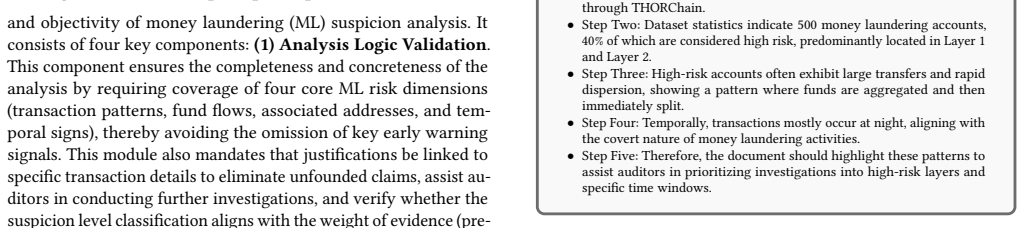
- [§A.5, Figure 9] The 'Example of Thought Process' in the Explainer prompt mentions '500 money laundering accounts' and '40% high risk', but the actual dataset has 1,246 suspected accounts and 17.7% high risk (Table 2). Replace the placeholder numbers.
- [Figure 6 and cross-references] Figure 6's caption reads 'Example JSON prompt template used in the Explainer module' but the figure shows Reasoner output. Also, 'Figure 11 in Section 11' should be 'Appendix A.6 / Figure 11'.
- [Table 1, RQ1] The '100% accuracy' claim should be scoped as 'on the seven fields of the single Bybit report'; no partial-credit scoring method is defined for extraction.
- [Naming consistency] The terms 'Data Explainer' and 'Dataset Explainer' are used inconsistently across §4.1, §4.4, and Figure 2. Please unify.
Circularity Check
Evaluation is self-referential: RQ2 samples from RiskTagger's own labeled population and RQ3 measures coverage against the Extractor's own checklist; the abstract's multi-case address-recall/precision claims are absent from the experimental section.
-
self definitional
[Section 5.3, RQ2, '(1) Sampling strategy']
"Using RiskTagger’s four risk categories {High, Medium, Low, None} as strata, we randomly sampled 5% of accounts from the total set (1,246 suspected laundering accounts and 1,000 normal accounts, totaling 2,246 accounts), resulting in 113 accounts for evaluation."
The 2,246-account population is RiskTagger's own Tracer output (Section 5.3: 'RiskTagger labels 1,246 suspected laundering accounts ... while 1,000 accounts are identified as normal controls'). The expert-agreement evaluation is therefore restricted to accounts the system itself already discovered and labeled. Any laundering address the Tracer failed to surface is outside the sampling frame, so the 84.1% agreement cannot validate discovery recall; it is an agreement rate conditional on the system's own candidate generation. The evaluation population is defined by the system's output, making the central annotation claim self-referential by construction.
-
self definitional
[Section 5.4, RQ3, Information Coverage Rate formula]
"we assess the quality of explanation by calculating the Information Coverage Rate as R_coverage = |E_full| + 0.5 * |E_part| / |E_All|, where E_All is the set generated by the Extractor as a comprehensive checklist for all essential entities"
The denominator of the coverage metric is the Extractor's own output—the first module of the same RiskTagger pipeline whose later output (the Explainer's report) is being scored. Thus the reported 90% coverage measures the report against the system's own earlier output, not against an independent ground-truth set of essential entities. If the Extractor omitted an entity, the metric cannot see the omission, so the coverage number is partly guaranteed by the pipeline's own completeness assumptions. This is a definitional reduction of the quality claim to the system's own input/output.
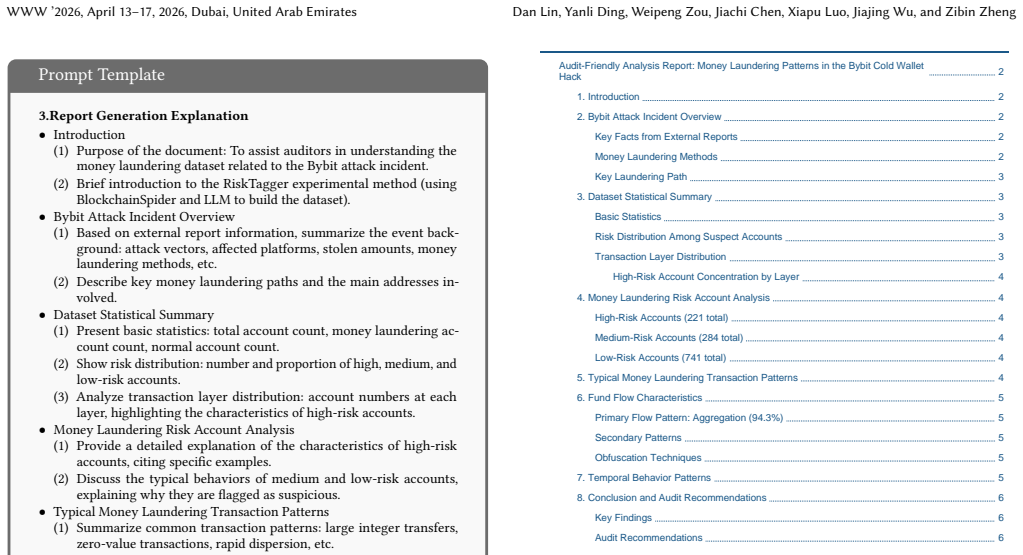
full rationale
The strongest circularity is in the evaluation design rather than in the LLM derivation itself. RQ3's coverage formula has E_All explicitly 'generated by the Extractor,' so the Explainer's 90% coverage is scored against the system's own checklist—this is self-referential by construction. RQ2's 84.1% agreement is computed on a 5% sample drawn from the 2,246 accounts RiskTagger itself labeled, so the test set cannot contain laundering addresses the system failed to discover; the metric is conditional on the system's candidate generation and does not estimate discovery recall. RQ1's extraction accuracy is anchored to external incident reports and author verification, which is independent content, and the methodology's citations to Forge, BlockchainSpider, and Connector are tool/inspiration citations, not uniqueness theorems. Separately, the abstract's claim of 97.33% address recall and 98.69% expert-reviewed precision across five incidents is not computed in the experimental section, which reports only single-case Bybit metrics (100% extraction, 84.1% agreement, 90% coverage); that is a missing-support problem rather than a circular step. Overall, two of the three headline evaluation metrics reduce at least in part to the system's own outputs, so the central claim is partially circular: score 6.
Assumptions & free parameters
free parameters (6)
- search depth D =
20
- translator context size k =
not specified
- filtering thresholds and priority weights =
not specified
- LLM temperature =
0.3
- coverage metric weights =
1.0 (full) / 0.5 (partial)
- sampling fraction for expert evaluation =
5%
assumptions (6)
- domain assumption FATF red-flag indicators are a valid and sufficient signal set for laundering behavior
- domain assumption Etherscan 'Bybit Exploit' tags and the authors' manual tracing constitute a reliable gold standard
- domain assumption BlockchainSpider and Connector return complete and correct multi-chain transaction data
- domain assumption The Rekt.news report and the authors' factual summary of the Bybit incident are accurate
- domain assumption LLM zero-shot CoT with self-reflection can produce consistent risk classifications without task-specific fine-tuning
- domain assumption The Bybit case is representative of Web3 money laundering generally
Cite this review
Pith. "Pith review of RISKTAGGER: Evidence-Guided LLM Agent for Post-Incident Forensic Analysis of Money Laundering in Web3." pith.science (2026). https://pith.science/paper/IRROIFYJ
@misc{pith2026251017848,
  author       = {Pith},
  title        = {Pith review of: RISKTAGGER: Evidence-Guided LLM Agent for Post-Incident Forensic Analysis of Money Laundering in Web3},
  year         = {2026},
  howpublished = {\url{https://pith.science/paper/IRROIFYJ}},
  note         = {Machine review of arXiv:2510.17848}
}
read the original abstract
Cryptocurrency money-laundering forensic analysis after Web3 incidents faces challenges such as fragmented evidence, expanding transaction paths, and cross-chain discontinuity. Existing Web3 AML methods largely rely on manual clues and heuristic or graph-search-based tracing, with outputs limited to lists of suspicious addresses and lacking path-level evidence and verifiable explanations. Directly applying general-purpose large language models to raw transaction flows also struggles to ensure evidence constraints and result verifiability. To address these limitations, this paper presents RISKTAGGER, an LLM-guided agent for forensic tracing of Web3 cryptocurrency money laundering. RISKTAGGER embeds the LLM as an evidence-constrained decision component within a controlled tracing loop. It extracts case clues from public incident materials, recursively expands a risk-labeled fund-flow graph over on-chain evidence, and generates evidence-organized reports for analyst review. We evaluate it on five real-world incidents spanning multiple years and covering heterogeneous attack patterns and laundering path structures. We further conduct cross-case generalization analysis, baseline comparison, component ablation, and LLM backend analysis. In the main Bybit case, the system achieves a 97.33% address recall and a 98.69% expert-reviewed sampled address precision. Across the other four incidents, it achieves 95.24-100.00% address recall and 91.27-100.00% expert-reviewed address precision. The cross-case results further show that the complexity of Web3 money laundering arises from heterogeneous mechanisms, including short-cycle fund fragmentation, long-range laundering paths, interwoven DeFi services, and deterministic denomination splitting. RISKTAGGER can recover case-related fund paths, identify high-priority risk accounts, and organize public evidence into verifiable forensic reports.
Figures


Figures from the paper (8 more)



Forward citations
Cited by 1 Pith paper
-
UniDetect: LLM-Driven Universal Fraud Detection across Heterogeneous Blockchains
UniDetect is an LLM-based system that generates universal transaction summary texts and uses two-stage multimodal training on text plus graphs to detect fraudulent accounts across heterogeneous blockchains, outperform...
Reference graph
Works this paper leans on
-
[1]
Ismail Alarab, Simant Prakoonwit, and Mohamed Ikbal Nacer. 2020. Comparative analysis using supervised learning methods for anti-money laundering in Bitcoin. InProceedings of the International Conference on Machine Learning Technologies. 11–17
2020
-
[2]
Hugo Almeida, Pedro Pinto, and Ana Fernández Vilas. 2023. A review on cryptocurrency transaction methods for money laundering.arXiv preprint arXiv:2311.17203(2023)
arXiv 2023
-
[3]
Alhanouf Abdulrahman Saleh Alsuwailem and Abdul Khader Jilani Saudagar
-
[4]
Grundy, Zhenzhe Shao, Yanlin Wang, Jiashui Wang, Ting Chen, and Zibin Zheng
Jiachi Chen, Yiming Shen, Jiashuo Zhang, Zihao Li, John C. Grundy, Zhenzhe Shao, Yanlin Wang, Jiashui Wang, Ting Chen, and Zibin Zheng. 2025. FORGE: An LLM-driven framework for large-scale smart contract vulnerability dataset construction.arXiv preprint arXiv:2506.18795(2025)
arXiv 2025
-
[5]
Daniel Dupuis and Kimberly Gleason. 2020. Money laundering with cryptocur- rency: open doors and the regulatory dialectic.Journal of Financial Crime28, 1 (08 2020), 60–74
2020
-
[6]
Youssef Elmougy and Ling Liu. 2023. Demystifying fraudulent transactions and illicit nodes in the bitcoin network for financial forensics. InProceedings of the 29th ACM SIGKDD conference on knowledge discovery and data mining. 3979–3990
2023
-
[7]
Yu Chun Gai, Liyi Zhou, Kaihua Qin, Dawn Xiaodong Song, and Arthur Gervais
-
[8]
Paul Gilmour. 2023. Reexamining the anti-money laundering framework: A legal critique and new approach to combating money laundering.Journal of Financial Crime30 (01 2023), 35–47
2023
Show all 62 references
-
[9]
Sihao Hu, Zhen Zhang, Bingqiao Luo, Shengliang Lu, Bingsheng He, and Ling Liu. 2023. BERT4ETH: A pre-trained transformer for Ethereum fraud detection. InProceedings of the ACM Web Conference. 2189–2197
2023
-
[10]
Palita Humranan and Siriporn Supratid. 2023. A Study on GCN using Focal Loss on Class-Imbalanced Bitcoin Transaction for Anti-Money Laundering Detection. 2023 International Electrical Engineering Congress (iEECON)(2023), 101–104
2023
-
[11]
Ziwei Ji, Tiezheng Yu, Yan Xu, Nayeon Lee, Etsuko Ishii, and Pascale Fung
-
[12]
Kose John, Maureen O'Hara, and Fahad Saleh. 2022. Bitcoin and Beyond. Annual Review of Financial Economics14, Volume 14, 2022 (2022), 95–115
2022
-
[13]
Dan Lin, Jiajing Wu, Qishuang Fu, Yunmei Yu, Kaixin Lin, Zibin Zheng, and Shuo Yang. 2023. Towards Understanding Crypto Money Laundering in Web3 Through the Lenses of Ethereum Heists.arXiv preprint arXiv:2305.14748(2023)
2023 arXiv
-
[14]
InFindings of the Association for Computational Linguistics: EMNLP 2023
Towards mitigating LLM hallucination via self reflection. InFindings of the Association for Computational Linguistics: EMNLP 2023. 1827–1843
2023
-
[15]
Dan Lin, Jiajing Wu, Yunmei Yu, Qishuang Fu, Zibin Zheng, and Changlin Yang
-
[16]
Lu Liu, Lili Wei, Wuqi Zhang, Ming Wen, Yepang Liu, and Shing-Chi Cheung. 2021. Characterizing transaction-reverting statements in Ethereum smart contracts. InProceedings of the IEEE/ACM International Conference on Automated Software Engineering. 630–641
2021
-
[17]
Dan Lin, Jiajing Wu, Yuxin Su, Ziye Zheng, Yuhong Nan, Qinnan Zhang, Bowen Song, and Zibin Zheng. 2025. Connector: Enhancing the traceability of decen- tralized bridge applications via automatic cross-Chain transaction association. IEEE Transactions on Information Forensics an...
2025
-
[18]
Ye Liu, Yue Xue, Daoyuan Wu, Yuqiang Sun, Yi Li, Miaolei Shi, and Yang Liu
-
[19]
Joana Lorenz, Maria Inês Silva, David Aparício, João Tiago Ascensão, and Pedro Bizarro. 2021. Machine learning methods to detect money laundering in the bitcoin blockchain in the presence of label scarcity. InProceedings of the First ACM International Conference on AI in Finan...
2021
-
[20]
Yu Luo, Weifeng Xu, Karl Andersson, Mohammad Shahadat Hossain, and Dianxi- ang Xu. 2024. Fellmvp: An ensemble llm framework for classifying smart contract vulnerabilities. In2024 IEEE International Conference on Blockchain (Blockchain). IEEE, 89–96
2024
-
[21]
Weikang Liu, Bin Cao, and Mugen Peng. 2024. Web3 Technologies: Challenges and Opportunities.IEEE Network38, 3 (2024), 187–193
2024
-
[22]
Makiko Mita, Kensuke Ito, Shohei Ohsawa, and Hideyuki Tanaka. 2019. What is stablecoin?: A survey on price stabilization mechanisms for decentralized payment systems. InInternational Congress on Advanced Applied Informatics. IEEE, 60–66
2019
-
[23]
Propertygpt: Llm-driven formal verification of smart contracts through retrieval-augmented property generation.arXiv preprint arXiv:2405.02580(2024)
2024 arXiv
-
[24]
Nankpan Moses Nanyun and Alireza Nasiri. 2020. Role of FATF on financial systems of countries: successes and challenges.Journal of Money Laundering Control24, 2 (08 2020), 234–245
2020
-
[25]
Jack Nicholls, Aditya Kuppa, and Nhien-An Le-Khac. 2023. Fraudlens: Graph structural learning for bitcoin illicit activity identification. InProceedings of the 39th Annual Computer Security Applications Conference. 324–336
2023
-
[26]
Semyon Malamud and Marzena Rostek. 2017. Decentralized Exchange.American Economic Review107, 11 (November 2017), 3320–62
2017
-
[27]
Yelena Patashkova, Shakizada Niyazbekova, Seyit Kerimkhulle, Madina Serikova, and Marija Troyanskaya. 2021. Dynamics of Bitcoin trading on the Binance cryptocurrency exchange.Economic Annals-XXI/Ekonomìčnij Časopis-XXI187 (2021)
2021
-
[28]
Debasis Mohanty, Divya Anand, Hani Moaiteq Aljahdali, and Santos Gracia Villar. 2022. Blockchain Interoperability: Towards a Sustainable Payment System. Sustainability14, 2 (2022). WWW ’2026, April 13–17, 2026, Dubai, United Arab Emirates Dan Lin, Yanli Ding, Weipeng Zou, Jiac...
2022
-
[29]
Zhuocheng Shen. 2024. LLM With Tools: A Survey. arXiv:2409.18807 [cs.AI]
2024 arXiv
-
[30]
Zayne Sprague, Fangcong Yin, Juan Diego Rodriguez, Dongwei Jiang, Manya Wadhwa, Prasann Singhal, Xinyu Zhao, Xi Ye, Kyle Mahowald, and Greg Durrett
-
[31]
Wei Ou, Shiying Huang, Jingjing Zheng, Qionglu Zhang, Guang Zeng, and Wen- bao Han. 2022. An overview on cross-chain: Mechanism, platforms, challenges and advances.Computer Networks218 (2022), 109378
2022
-
[32]
Pascal Tippe and Christoph Deckers. 2025. Unmixing the mix: Patterns and challenges in Bitcoin mixer investigations.Forensic Science International: Digital Investigation52 (2025), 301876. DFRWS EU 2025 - Selected Papers from the 12th Annual Digital Forensics Research Conference Europe
2025
-
[33]
Farimah Poursafaei, Reihaneh Rabbany, and Zeljko Zilic. 2021. Sigtran: signature vectors for detecting illicit activities in blockchain transaction networks. In Pacific-Asia Conference on Knowledge Discovery and Data Mining. 27–39
2021
-
[34]
Sai Wang, Siqi Zeng, Yu Wu, and Yi Yang. 2024. A survey on LLM-based multi- agent systems: workflow, infrastructure, and challenges.Vicinagearth1 (10 2024)
2024
-
[35]
Mark Weber, Giacomo Domeniconi, Jie Chen, Daniel Karl I Weidele, Claudio Bellei, Tom Robinson, and Charles E Leiserson. 2019. Anti-money laundering in bitcoin: Experimenting with graph convolutional networks for financial forensics. arXiv preprint arXiv:1908.02591(2019)
2019 arXiv
-
[36]
Jiajing Wu, Dan Lin, Qishuang Fu, Shuo Yang, Ting Chen, Zibin Zheng, and Bowen Song. 2023. Toward understanding asset flows in crypto money laundering through the lenses of Ethereum heists.IEEE Transactions on Information Forensics and Security19 (2023), 1994–2009
2023
-
[37]
2023.Blockchain programming smart contract on polygon
Ariesto Hadi Sutopo. 2023.Blockchain programming smart contract on polygon. Topazart
2023
-
[38]
Zhiying Wu, Jieli Liu, Jiajing Wu, Zibin Zheng, Xiapu Luo, and Ting Chen
-
[39]
Algimantas Venčkauskas, Šar¯unas Grigali¯unas, Linas Pocius, Rasa Br¯uzgien˙e, and Andrejs Romanovs. 2025. Machine Learning in Money Laundering Detection Over Blockchain Technology.IEEE Access13 (2025), 7555–7573
2025
-
[40]
An Yang, Anfeng Li, Baosong Yang, Beichen Zhang, and et al. 2025. Qwen3 Technical Report. arXiv:2505.09388 https://arxiv.org/abs/2505.09388
2025 arXiv
-
[41]
Shuo Yang, Jiachi Chen, and Zibin Zheng. 2023. Definition and Detection of Defects in NFT Smart Contracts. InProceedings of the 32nd ACM SIGSOFT Inter- national Symposium on Software Testing and Analysis (ISSTA 2023). Association for Computing Machinery, 373–384
2023
-
[42]
Jiahao Yu, Xian Wu, Hao Liu, Wenbo Guo, and Xinyu Xing. 2024. BlockFound: Customized blockchain foundation model for anomaly detection.arXiv preprint arXiv:2410.04039(2024)
2024
-
[43]
Jiajing Wu, Kaixin Lin, Dan Lin, Bozhao Zhang, Zhiying Wu, and Jianzhong Su
-
[44]
InProceedings of the ACM on Web Conference
Safeguarding blockchain ecosystem: Understanding and detecting attack transactions on cross-chain bridges. InProceedings of the ACM on Web Conference
-
[46]
InProceedings of the ACM Web Conference
Know your transactions: Real-time and generic transaction semantic representation on blockchain & Web3 ecosystem. InProceedings of the ACM Web Conference. 1918–1927
1918
-
[47]
Yuexin Xiang, Yuchen Lei, Ding Bao, Tiantian Li, Qin Yang, Wenmao Liu, Wei Ren, and Kim-Kwang Raymond Choo. 2022. BABD: A Bitcoin Address Behavior Dataset for Pattern Analysis.IEEE Transactions on Information Forensics and Security19 (2022), 2171–2185
2022
-
[51]
Abdullah A Zarir, Gustavo A Oliva, Zhen M Jiang, and Ahmed E Hassan. 2021. Developing cost-effective blockchain-powered applications: A case study of the gas usage of smart contract transactions in the ethereum blockchain platform. ACM Transactions on Software Engineering and ...
2021
-
[52]
Owner accounts
Zibin Zheng, Shaoan Xie, Hong-Ning Dai, Weili Chen, Xiangping Chen, Jian Weng, and Muhammad Imran. 2020. An overview on smart contracts: Challenges, advances and platforms.Future Generation Computer Systems105 (2020), 475–491. A Appendix A.1 Bybit Hack Summary According to the...
2020
-
[53]
high-frequency transfers
Analysis Logic Validation • Verify if the initial analysis covered all risk dimensions in the original framework (transaction patterns, fund flows, associated addresses, tem- poral signs). If any dimension was omitted, explain the potential impact. • Check if the justification...
-
[54]
Evidence Quality Review •Identify conflicting evidence that was not addressed
-
[55]
Bias and Blind Spot Detection • Reflect on potential confirmation bias: Did the analysis overemphasize evidence supporting the initial suspicion while downplaying mitigating factors (e.g., regulatory compliance documents for the address)? •Identify assumptions that lack validation
-
[56]
high- risk
Reflection Output • Critical Issues Identified: Detailedly list significant flaws in the initial analysis. If no flaw, answer "No flaw" and explain. Figure 8: Reflection prompt template of Reasoner. and objectivity of money laundering (ML) suspicion analysis. It consists of fo...
2026
-
[57]
Bybit Attack Incident Overview Key Facts from External Reports Money Laundering Methods Key Laundering Path
-
[58]
Dataset Statistical Summary Basic Statistics Risk Distribution Among Suspect Accounts Transaction Layer Distribution High-Risk Account Concentration by Layer
-
[59]
Money Laundering Risk Account Analysis High-Risk Accounts (221 total) Medium-Risk Accounts (284 total) Low-Risk Accounts (741 total)
-
[60]
Typical Money Laundering Transaction Patterns
-
[61]
Fund Flow Characteristics Primary Flow Pattern: Aggregation (94.3%) Secondary Patterns Obfuscation Techniques
-
[62]
Temporal Behavior Patterns
-
[63]
Part II specifies the detailed report out- line, including sections such as incident overview, dataset summary, risk account analysis, and audit recommendations
Conclusion and Audit Recommendations Key Findings Audit Recommendations 2 5 5 6 5 4 4 4 2 6 3 3 3 4 2 2 5 5 3 6 4 2 4 3 Figure 11: Explanation Report of Bybit Hack dataset statistics, and identify laundering patterns through a Chain- of-Thought (CoT) process. Part II specifies...
-
[2020]
Anti-money laundering systems: a systematic literature review.Journal of Money Laundering Control23, 4 (06 2020), 833–848
2020
-
[2023]
Blockchain Large Language Models.ArXivabs/2304.12749 (2023)
2023 arXiv
-
[2024]
InProceedings of the ACM Web Conference 2024
DenseFlow: Spotting cryptocurrency money laundering in ethereum trans- action graphs. InProceedings of the ACM Web Conference 2024. 4429–4438
2024
Reviewed August 4, 2026 · model on record in the stance chip above.
Discussion (0). Sign in to comment.