REVIEW 2 major objections 4 minor 58 references
Low-temperature-compatible iron garnet films grown by liquid phase epitaxy
T0 review · 2 major / 4 minor · reviewed 2026-08-04 · deepseek-v4-flash
Pith's one-line read Replacing the standard paramagnetic GGG substrate with commercially available diamagnetic YSGG lets liquid-phase-epitaxy yttrium iron garnet films keep ferromagnetic resonance linewidths below 1 mT down to 3 K, removing the main obstacle to
desk verdict First LPE growth of strained YIG on diamagnetic YSGG delivers cryogenic FMR linewidths below 1 mT at 3 K; a solid, honest experimental paper that deserves peer review, with a missing composition depth profile as the main (non-fatal) gap. read the letter →
The pith
A machine-rendered reading of the paper's core claim, the machinery that carries it, and where it could break.
The reading
What carries the argument
The central object is the YSGG substrate (yttrium scandium gallium garnet), a commercial diamagnetic garnet whose lattice parameter sits about 0.7 percent below YIG's, close enough to support fully strained pseudomorphic YIG films up to roughly 100 nm thick. Its job is to eliminate the paramagnetic Gd3+ moments that, in the standard GGG case, couple to the film and broaden the resonance at cryogenic temperatures. The argument's quantitative engine is a two-part model: a mean-field Brillouin-function description of GGG's magnetization, and a computed stray-field distribution (using demagnetizing factors and field-profile statistics) that yields the extra linewidth contribution subtracted from
What would settle it
A secondary-ion mass spectrometry or EDX depth profile across the YIG/YSGG interface: measurable scandium or gallium in the YIG layer beyond the first nanometre, or at levels above roughly 0.01 per formula unit, would mean the 3 K linewidth carries extrinsic impurity losses beyond those the paper assigns to strain. Alternatively, growing the same film on a strain-compensated or lattice-matched diamagnetic substrate and seeing the 3 K linewidth drop below 0.7 mT would confirm that strain, not something intrinsic to YSGG, sets the current floor.
Extended reading notes
Core claim
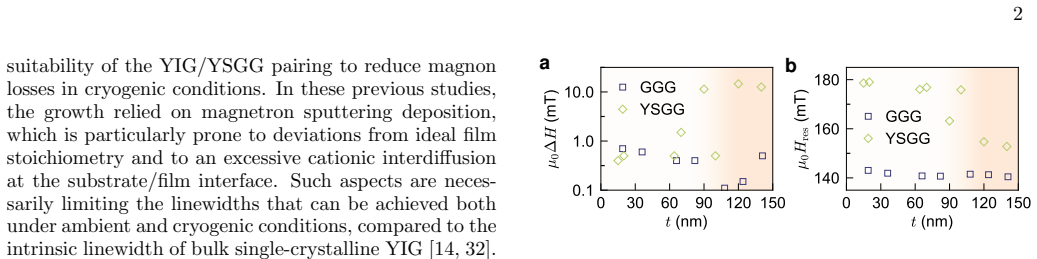
On its own terms: growing YIG by liquid phase epitaxy on a diamagnetic YSGG substrate removes the dominant low-temperature loss channel in thin-film magnonics. The paper reports a ferromagnetic resonance linewidth of 0.7 mT at 3 K and 46 GHz (below 1 mT across the range), a Gilbert damping upper bound of 2 × 10^-4, and a linewidth that barely moves between 3 and 100 K, in both in-plane and out-of-plane field geometries. For comparison, YIG/GGG films measured in the same setup show a strong low-temperature linewidth increase, which the authors trace, via a shape-dependent stray-field model, to the paramagnetic GGG substrate's magnetization rather than to the YIG film itself. The residual temp
Load-bearing premise
The central claim assumes that the YIG/YSGG interface is as chemically inert as the YIG/GGG interface — that scandium and gallium from the substrate do not diffuse into the film during growth — yet the paper supports this only with X-ray structural data and no direct composition depth profile.
Editorial extensions
If this is right
- Cryogenic magnonic devices can use unpatterned LPE YIG films on commercial YSGG directly, with no need to lift the film off its growth substrate.
- The FMR linewidth stays nearly flat from 300 K down to 3 K, so the paramagnetic-substrate degradation that dominates YIG/GGG below about 50 K is avoided in both in-plane and out-of-plane geometries.
- The fully strained thickness window (below roughly 100 nm) defines the usable range for YIG-on-YSGG films; above it, strain relaxation sharply degrades the linewidth.
- The measured upper bound on intrinsic Gilbert damping (below 2 × 10^-4 at 3 K) is low enough to support coherent magnonic and hybrid-superconducting-qubit experiments at cryogenic temperatures.
- Residual inhomogeneous broadening is tied to strain and substrate quality, pointing to strain mitigation as the next improvement step for these films.
Reading between the lines
- If strain is the dominant residual loss source, lattice-matched diamagnetic substrates or strain-compensating buffer layers should push 3 K linewidths toward the bulk-YIG limit, possibly extending usefulness toward millikelvin temperatures.
- The stray-field correction model implies that some previously reported low-temperature damping values for YIG/GGG were substrate artifacts; re-analyzing such data with comparable corrections would revise the apparent temperature dependence of the Gilbert damping.
- Patterning these films into microstructures should remove most inhomogeneous broadening, potentially revealing an intrinsic damping below 1 × 10^-4 at 3 K and enabling a direct comparison with bulk YIG spheres.
- The same LPE growth on YSGG should transfer to substituted iron garnets, allowing strain-tuned anisotropy and magnetization while keeping cryogenic compatibility.
Signed reviews
Editorial analysis
A structured set of objections, weighed in public.
Referee Report
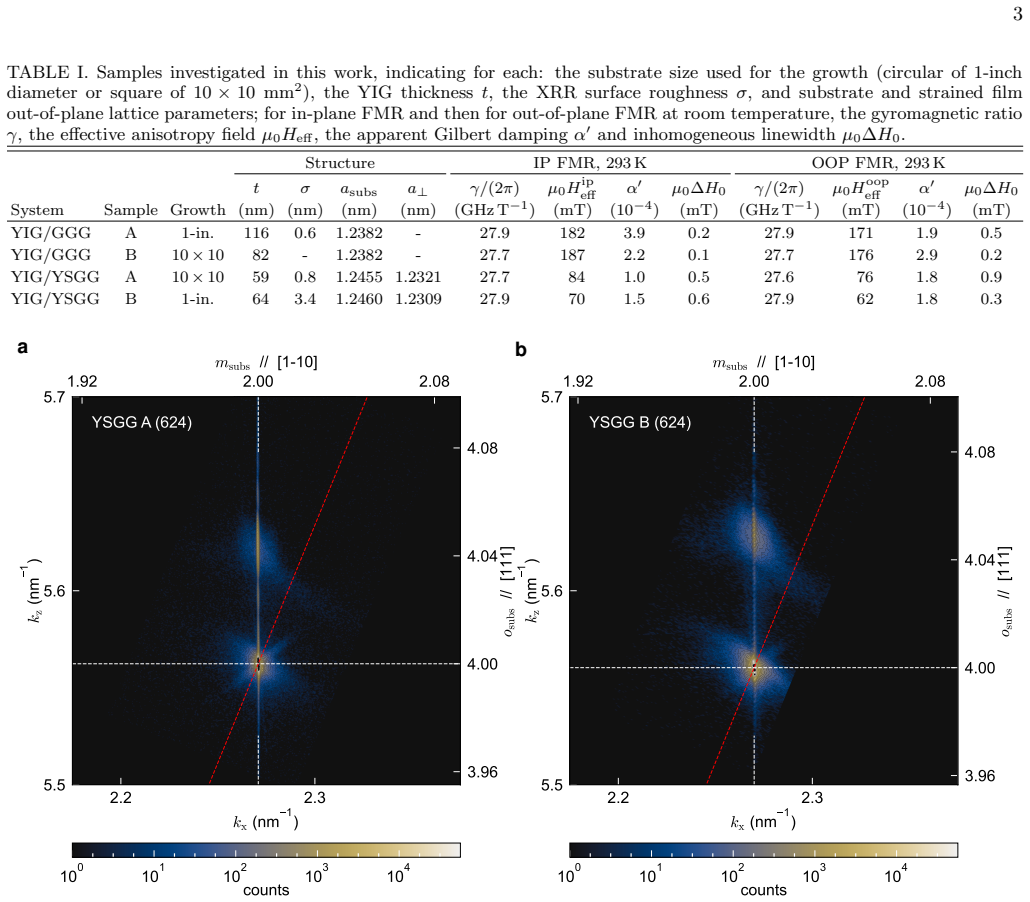
Summary. The manuscript reports liquid-phase-epitaxial growth of sub-100-nm YIG films on (111)-oriented yttrium scandium gallium garnet (YSGG) substrates, with X-ray reflectivity, diffraction, and reciprocal-space-map evidence for fully strained, pseudomorphic growth below roughly 90–110 nm. Broadband FMR measurements from 293 K down to 3 K compare YIG/YSGG with YIG/GGG. On YSGG, the FMR linewidth remains nearly flat down to 3 K; the best OOP value is 0.7 mT at 46 GHz, with a conservative upper bound α<2×10⁻⁴. The large low-temperature linewidth increase of YIG/GGG is attributed primarily to inhomogeneous stray fields from the paramagnetic GGG substrate, modeled in Appendix C. The authors conclude that LPE YIG on commercial YSGG removes the substrate-paramagnetism bottleneck for cryogenic magnonics.
Significance. If substantiated, the result is significant: it provides a straightforward LPE route to low-loss iron-garnet films on a diamagnetic substrate for cryogenic magnonics and hybrid quantum devices. The strengths are real: linewidths are directly measured with documented broadband FMR and field-differential analysis; apparent Gilbert damping is separated from inhomogeneous broadening; the GGG stray-field contribution is modeled quantitatively with an explicit procedure; and the claims are qualified as applying to unpatterned films and as upper bounds. The principal gap is chemical characterization of the film and of the film/substrate interface, which is important for attributing the measured low linewidth to intrinsic YIG rather than to a fortuitous substituted-garnet composition.
major comments (2)
- [Section II, Table I and Fig. 2] The central attribution of the low-temperature linewidth to intrinsic YIG on a diamagnetic substrate rests on the assumption that the LPE film is stoichiometric YIG with negligible Sc/Ga interdiffusion at the YIG/YSGG interface. The X-ray RSM and Laue-oscillation data establish structural coherence and full strain but cannot detect dilute cation substitution. Refs. [23,24] document minimal interdiffusion only for LPE YIG/GGG; YSGG has a different lattice mismatch, composition, and growth chemistry. If Sc or Ga enters the film, the magnetization, anisotropy, and low-temperature relaxation would be modified, so the measured linewidth would not exclusively reflect intrinsic YIG properties. Please provide a composition depth profile (SIMS, EDX, or TEM) or explicitly qualify the conclusions as applying to the actual film composition rather than to intrinsic YIG.
- [Table I and Figs. 5, 7, 9] The quantitative claims—linewidth below 1 mT at 3 K, α<2×10⁻⁴, and the weak temperature dependence—are reported without uncertainties or error bars. The fits to μ0ΔH(f) are shown, but the fit parameters in Table I and Figs. 5, 7, and 9 have no confidence intervals. Since the comparison between YSGG A and B and the threshold 'below 1 mT' are central to the paper, representative uncertainty estimates (at least for the headline values and one full temperature sweep) are needed to support those claims.
minor comments (4)
- [Fig. 1 caption; Appendix C] Several figure captions and Appendix C equations contain garbled placeholder text (e.g., '/uni...' sequences). The final version should render all symbols cleanly.
- [Fig. 5] The label 'no subs.' in Figs. 5(c) and 5(d) is not defined in the caption. Please define it as 'after subtracting the substrate stray-field contribution ΔB_stray'.
- [Throughout] The notation for the stray-field broadening is inconsistent: 'ΔB_stray', 'ΔBstray', and 'ΔB stray' are used. Please unify.
- [Section II, FMR analysis] The text states that fits exclude low-frequency data points below 6 GHz, but the exact cutoff used for each sample and temperature is not given. Please state the cutoff, since Table I parameters depend on it.
Circularity Check
No significant circularity: the central YIG/YSGG low-temperature linewidth is a directly measured FMR result, not a derived or fitted prediction.
full rationale
The paper's central claim is experimental: LPE-grown YIG/YSGG films exhibit μ0ΔH ≈ 0.7 mT at 3 K and 46 GHz, with weak temperature and frequency dependence. This is a direct FMR measurement (Figs. 4, 6, 8, 10), not the output of a model or a fitted parameter. The Gilbert-form fits are standard linear decompositions of measured linewidth versus frequency, and the reported α < 2×10⁻⁴ is an upper bound computed from the measured 0.7 mT point, not a prediction obtained from an input. The only self-citations are (i) Ref. [23], used together with independent external Ref. [24] to support minimal LPE interdiffusion, and (ii) Ref. [38], the quadratic stray-field formula in Appendix C used to model the GGG paramagnetic contribution for the comparison sample. Neither is load-bearing for the YSGG result: the YSGG low-temperature linewidth is read directly from FMR, and the GGG stray-field correction is an interpretive analysis of the reference sample. The absence of a SIMS/EDX composition depth profile is a real experimental limitation that bears on robustness, but it is not a circularity, because no fitted constant or self-cited result is being used to generate the claimed linewidth. The derivation chain therefore does not reduce to its own inputs.
Assumptions & free parameters
free parameters (3)
- apparent Gilbert damping alpha' =
e.g., about 2e-4 for YSGG A at 3 K, IP (Fig. 5c)
- inhomogeneous linewidth mu0 Delta H0 =
e.g., about 0.6-0.8 mT for YSGG A at 3-40 K (Fig. 5d)
- linear-fit low-frequency cutoff =
6 GHz
assumptions (5)
- standard math Kittel equation and Gilbert linewidth model describe the FMR of the films.
- domain assumption The GGG substrate magnetization is described by a mean-field Brillouin model with literature parameters, including lambda = -1.3 and M_sat = 813 kA/m.
- domain assumption YSGG is diamagnetic and produces no magnetic stray field in the FMR measurement.
- domain assumption LPE growth on YSGG yields minimal cation interdiffusion, by analogy with LPE on GGG.
- domain assumption Linear superposition of Lorentzian (Gilbert) and Gaussian (inhomogeneous) broadening is a sufficient model when their widths differ.
Cite this review
Pith. "Pith review of Low-temperature-compatible iron garnet films grown by liquid phase epitaxy." pith.science (2026). https://pith.science/paper/ITMUGWU3
@misc{pith2026250906242,
  author       = {Pith},
  title        = {Pith review of: Low-temperature-compatible iron garnet films grown by liquid phase epitaxy},
  year         = {2026},
  howpublished = {\url{https://pith.science/paper/ITMUGWU3}},
  note         = {Machine review of arXiv:2509.06242}
}
read the original abstract
Single-crystalline yttrium iron garnet (YIG) thin films (< 100 nm) form the backbone of magnonics, owing to the record-low losses affecting their magnetization dynamics. However, thin epitaxial YIG has mostly been investigated under ambient temperatures, limited by the paramagnetic losses occurring at low temperatures due to the gadolinium gallium garnet (GGG) substrates required for epitaxial growth. Driven by a growing interest in magnonic devices that can operate in cryogenic conditions and address quantum information applications, there is a strong need for iron garnet epitaxial films grown on diamagnetic substrates that can maintain low losses at low temperatures. In this work, we use liquid phase epitaxy (LPE) to grow ultrathin films of strained YIG on a commercial diamagnetic substrate, yttrium scandium gallium garnet (YSGG). We investigate their magnetization dynamics in the 3-300 K temperature range, and compare them to equivalent films grown on paramagnetic GGG. We demonstrate for LPE YIG on YSGG substrates a ferromagnetic resonance linewidth below 1 mT at 3 K, together with a very weak temperature and frequency dependence of the losses. The growth of YIG/YSGG by LPE provides a straightforward approach to producing iron garnet thin films for use in low-temperature investigations.
Figures

Figures from the paper (13 more)


Reference graph
Works this paper leans on
-
[1]
Y. Tabuchi, S. Ishino, A. Noguchi, T. Ishikawa, R. Ya- mazaki, K. Usami, and Y. Nakamura, Quantum magnon- ics: The magnon meets the superconducting qubit, C. R. Phys.17, 729 (2016)
work page 2016
-
[2]
H. Y. Yuan, Y. Cao, A. Kamra, R. A. Duine, and P. Yan, Quantum magnonics: When magnon spintronics meets quantum information science, Phys. Rep.965, 1 (2022)
2022
- [3]
- [4]
-
[5]
H. Y. Yuan and R. A. Duine, Magnon antibunching in a nanomagnet, Phys. Rev. B102, 100402 (2020)
work page 2020
- [6]
- [7]
- [8]
Show all 58 references
-
[9]
Tabuchi, S
Y. Tabuchi, S. Ishino, A. Noguchi, T. Ishikawa, R. Ya- mazaki, K. Usami, and Y. Nakamura, Coherent coupling between a ferromagnetic magnon and a superconducting qubit, Science349, 405 (2015)
2015
-
[10]
Lachance-Quirion, S
D. Lachance-Quirion, S. P. Wolski, Y. Tabuchi, S. Kono, K. Usami, and Y. Nakamura, Entanglement-based single- shot detection of a single magnon with a superconducting qubit, Science367, 425 (2020)
2020
-
[11]
S. P. Wolski, D. Lachance-Quirion, Y. Tabuchi, S. Kono, A. Noguchi, K. Usami, and Y. Nakamura, Dissipation- Based Quantum Sensing of Magnons with a Supercon- ducting Qubit, Phys. Rev. Lett.125, 117701 (2020)
2020
-
[12]
Xu, X.-K
D. Xu, X.-K. Gu, H.-K. Li, Y.-C. Weng, Y.-P. Wang, J. Li, H. Wang, S.-Y. Zhu, and J. Q. You, Quantum Con- trol of a Single Magnon in a Macroscopic Spin System, Phys. Rev. Lett.130, 193603 (2023)
2023
-
[13]
S. Rani, X. Cao, A. E. Baptista, A. Hoffmann, and W. Pfaff, High-dynamic-range quantum sensing of magnons and their dynamics using a superconducting qubit, Phys. Rev. Appl.23, 064032 (2025)
2025
-
[14]
E. G. Spencer, R. C. LeCraw, and A. M. Clogston, Low-Temperature Line-Width Maximum in Yttrium Iron Garnet, Phys. Rev. Lett.3, 32 (1959)
1959
-
[15]
R. O. Serha, K. H. McAllister, F. Majcen, S. Knauer, T. Reimann, C. Dubs, G. A. Melkov, A. A. Serga, V. S. Tyberkevych, A. V. Chumak, and D. A. Bozhko, Ultra- long-living magnons in the quantum limit, arXiv (2025), http://arxiv.org/abs/2505.22773v1
2025 arXiv
-
[16]
Fukami, D
M. Fukami, D. R. Candido, D. D. Awschalom, and M. E. Flatt´ e, Opportunities for Long-Range Magnon-Mediated Entanglement of Spin Qubits via On- and Off-Resonant Coupling, PRX Quantum2, 040314 (2021)
2021
-
[17]
Y. Li, V. G. Yefremenko, M. Lisovenko, C. Trevillian, T. Polakovic, T. W. Cecil, P. S. Barry, J. Pearson, R. Di- van, V. Tyberkevych, C. L. Chang, U. Welp, W.-K. Kwok, and V. Novosad, Coherent Coupling of Two Re- mote Magnonic Resonators Mediated by Superconduct- ing Circuits,...
2022
-
[18]
C. L. Jermain, S. V. Aradhya, N. D. Reynolds, R. A. Buhrman, J. T. Brangham, M. R. Page, P. C. Hammel, F. Y. Yang, and D. C. Ralph, Increased low-temperature damping in yttrium iron garnet thin films, Phys. Rev. B 95, 174411 (2017)
2017
-
[19]
Kosen, A
S. Kosen, A. F. van Loo, D. A. Bozhko, L. Mihalceanu, and A. D. Karenowska, Microwave magnon damping in YIG films at millikelvin temperatures, APL Mater.7, 101120 (2019)
2019
-
[20]
Knauer, K
S. Knauer, K. Dav ´ ıdkov´ a, D. Schmoll, R. O. Serha, A. Voronov, Q. Wang, R. Verba, O. V. Dobrovolskiy, M. Lindner, T. Reimann, C. Dubs, M. Urb´ anek, and A. V. Chumak, Propagating spin-wave spectroscopy in a liquid-phase epitaxial nanometer-thick YIG film at mil- likelvin t...
2023
-
[21]
R. O. Serha, A. A. Voronov, D. Schmoll, R. Verba, K. O. Levchenko, S. Koraltan, K. Dav ´ ıdkov´ a, B. Budinsk´ a, Q. Wang, O. V. Dobrovolskiy, M. Urb´ anek, M. Lindner, T. Reimann, C. Dubs, C. Gonzalez-Ballestero, C. Abert, D. Suess, D. A. Bozhko, S. Knauer, and A. V. Chumak, ...
2024
-
[22]
Schmoll, A
D. Schmoll, A. A. Voronov, R. O. Serha, D. Slobodia- niuk, K. O. Levchenko, C. Abert, S. Knauer, D. Suess, R. Verba, and A. V. Chumak, Wavenumber-dependent magnetic losses in yttrium iron garnet–gadolinium gal- lium garnet heterostructures at millikelvin temperatures, Phys. Re...
2025
-
[23]
Beaulieu, N
N. Beaulieu, N. Kervarec, N. Thiery, O. Klein, V. Nale- 11 tov, H. Hurdequint, G. de Loubens, J. Ben Youssef, and N. Vukadinovic, Temperature Dependence of Mag- netic Properties of a Ultrathin Yttrium-Iron Garnet Film Grown by Liquid Phase Epitaxy: Effect of a Pt Over- layer, ...
2018
-
[24]
A. R. Will-Cole, J. L. Hart, V. Lauter, A. Grutter, C. Dubs, M. Lindner, T. Reimann, N. R. Valdez, C. J. Pearce, T. C. Monson, J. J. Cha, D. Heiman, and N. X. Sun, Negligible magnetic losses at low temperatures in liquid phase epitaxy grown Y 3Fe5O12 films, Phys. Rev. Mater.7,...
2023
-
[25]
F. J. Rachford, M. Levy, R. M. Osgood, A. Kumar, and H. Bakhru, Magnetization and FMR studies of crystal- ion-sliced narrow linewidth gallium-doped yttrium iron garnet, J. Appl. Phys.87, 6253 (2000)
2000
-
[26]
P. G. Baity, D. A. Bozhko, R. Macˆ edo, W. Smith, R. C. Holland, S. Danilin, V. Seferai, J. Barbosa, R. R. Peroor, S. Goldman, U. Nasti, J. Paul, R. H. Hadfield, S. McVi- tie, and M. Weides, Strong magnon–photon coupling with chip-integrated YIG in the zero-temperature limit, ...
2021
-
[27]
J. Xu, C. Horn, Y. Jiang, A. Pishehvar, X. Li, D. Rosen- mann, X. Han, M. Levy, S. Guha, and X. Zhang, Cryo- genic hybrid magnonic circuits based on spalled YIG thin films, J. Appl. Phys.137, 023901 (2025)
2025
-
[28]
C. D. Brandle and R. L. Barns, Crystal stoichiometry and growth of rare-earth garnets containing scandium, J. Cryst. Growth20, 1 (1973)
1973
-
[29]
S. Guo, B. McCullian, P. C. Hammel, and F. Yang, Low damping at few-K temperatures in Y 3Fe5O12 epitaxial films isolated from Gd 3Ga5O12 substrate using a dia- magnetic Y3Sc2.5Al2.5O12 spacer, J. Magn. Magn. Mater. 562, 169795 (2022)
2022
-
[30]
S. Guo, D. Russell, J. Lanier, H. Da, P. C. Hammel, and F. Yang, Strong on-Chip Microwave Photon–Magnon Coupling Using Ultralow-Damping Epitaxial Y 3Fe5O12 Films at 2 K, Nano Lett.23, 5055 (2023)
2023
-
[31]
Legrand, Y
W. Legrand, Y. Kemna, S. Sch¨ aren, H. Wang, D. Pet- rosyan, L. Holder, R. Schlitz, M. H. Aguirre, M. Lammel, and P. Gambardella, Lattice-Tunable Substituted Iron Garnets for Low-Temperature Magnonics, Adv. Funct. Mater. , 2503644 (2025)
2025
-
[32]
Maier-Flaig, S
H. Maier-Flaig, S. Klingler, C. Dubs, O. Surzhenko, R. Gross, M. Weiler, H. Huebl, and S. T. B. Goen- nenwein, Temperature-dependent magnetic damping of yttrium iron garnet spheres, Phys. Rev. B95, 214423 (2017)
2017
-
[33]
S. L. Blank and J. W. Nielsen, The growth of magnetic garnets by liquid phase epitaxy, J. Cryst. Growth17, 302 (1972)
1972
-
[34]
C. Dubs, O. Surzhenko, R. Linke, A. Danilewsky, U. Br¨ uckner, and J. Dellith, Sub-micrometer yttrium iron garnet LPE films with low ferromagnetic resonance losses, J. Phys. D: Appl. Phys.50, 204005 (2017)
2017
-
[35]
C. Dubs, O. Surzhenko, R. Thomas, J. Osten, T. Schnei- der, K. Lenz, J. Grenzer, R. H¨ ubner, and E. Wendler, Low damping and microstructural perfection of sub- 40nm-thin yttrium iron garnet films grown by liquid phase epitaxy, Phys. Rev. Mater.4, 024416 (2020)
2020
-
[36]
G¨ uckelhorn, T
J. G¨ uckelhorn, T. Wimmer, M. M¨ uller, S. Gepr¨ ags, H. Huebl, R. Gross, and M. Althammer, Magnon trans- port in Y 3Fe5O12/Pt nanostructures with reduced effec- tive magnetization, Phys. Rev. B104, L180410 (2021)
2021
-
[37]
R. O. Serha, A. A. Voronov, D. Schmoll, R. Kling- beil, S. Knauer, S. Koraltan, E. Pribytova, M. Lindner, T. Reimann, C. Dubs, C. Abert, R. Verba, M. Urb´ anek, D. Suess, and A. V. Chumak, Damping enhancement in YIG at millikelvin temperatures due to GGG substrate, Materials T...
2025
-
[38]
Legrand, D
W. Legrand, D. Petrosyan, H. Wang, P. Helbingk, R. Schlitz, M. Lammel, J. Ben Youssef, and P. Gam- bardella, Implementation of field-differential phase- resolved microwave magnetic spectroscopy, Rev. Sci. In- strum.96, 034708 (2025)
2025
-
[39]
M. J. Roos, P. Quarterman, J. Ding, M. Wu, B. J. Kirby, and B. L. Zink, Magnetization and antiferromagnetic coupling of the interface between a 20 nm Y 3Fe5O12 film and Gd3Ga5O12 substrate, Phys. Rev. Mater.6, 034401 (2022)
2022
-
[40]
J. F. Dillon and J. W. Nielsen, Effects of Rare Earth Impurities on Ferrimagnetic Resonance in Yttrium Iron Garnet, Phys. Rev. Lett.3, 30 (1959)
1959
-
[41]
J. F. Dillon, Ferrimagnetic Resonance in Rare-Earth- Doped Yttrium Iron Garnet. III. Linewidth, Phys. Rev. 127, 1495 (1962)
1962
-
[42]
P. E. Seiden, Ferrimagnetic Resonance Relaxation in Rare-Earth Iron Garnets, Phys. Rev.133, A728 (1964)
1964
-
[43]
Arias and D
R. Arias and D. L. Mills, Extrinsic contributions to the ferromagnetic resonance response of ultrathin films, Phys. Rev. B60, 7395 (1999)
1999
-
[44]
K. Lenz, H. Wende, W. Kuch, K. Baberschke, K. Nagy, and A. J´ anossy, Two-magnon scattering and viscous Gilbert damping in ultrathin ferromagnets, Phys. Rev. B73, 144424 (2006)
2006
-
[45]
C. L. Jermain, H. Paik, S. V. Aradhya, R. A. Buhrman, D. G. Schlom, and D. C. Ralph, Low-damping sub-10-nm thin films of lutetium iron garnet grown by molecular- beam epitaxy, Appl. Phys. Lett.109, 192408 (2016)
2016
-
[46]
J. F. Dillon, Ferrimagnetic Resonance in Yttrium Iron Garnet at Liquid Helium Temperatures, Phys. Rev.111, 1476 (1958)
1958
-
[47]
E. G. Spencer, J. P. Remeika, and P. V. Lenzo, Ferromag- netic Resonance Losses in Indium-substituted Yttrium Iron Garnet, Appl. Phys. Lett.4, 171 (1964)
1964
-
[48]
T. S. Hartwick and J. Smit, Ferromagnetic Resonance in Si-Doped YIG, J. Appl. Phys.40, 3995 (1969)
1969
-
[49]
R. D. McMichael, A mean-field model of extrinsic line broadening in ferromagnetic resonance, J. Appl. Phys. 103, 07B114 (2008)
2008
-
[50]
E. G. Spencer, R. C. LeCraw, and R. C. Linares, Low- Temperature Ferromagnetic Relaxation in Yttrium Iron Garnet, Phys. Rev.123, 1937 (1961)
1937
-
[51]
Guguschev, C
C. Guguschev, C. Dubs, R. Blukis, O. Surzhenko, M. Br¨ utzam, R. Koc, C. Rhode, K. Berger, C. Richter, C. Berryman, R. O. Serha, and A. V. Chumak, Novel diamagnetic garnet-type substrate single crys- tals for ultralow-damping yttrium iron garnet Y 3Fe5O12 films at cryogenic te...
2025 arXiv
-
[52]
R. O. Serha, C. Dubs, C. Guguschev, B. Aich- ner, D. Schmoll, J. Panda, M. Weiler, P. Pirro, M. Urb´ anek, and A. V. Chumak, YSGAG: The Ideal Substrate for YIG in Quantum Magnonics, arXiv (2025), http://arxiv.org/abs/2508.19044v1
2025 arXiv
-
[53]
Kriegner, E
D. Kriegner, E. Wintersberger, and J. Stangl, xrayutil- ities: a versatile tool for reciprocal space conversion of scattering data recorded with linear and area detectors, J. Appl. Crystallogr.46, 1162 (2013). 12
2013
-
[54]
Maier-Flaig, S
H. Maier-Flaig, S. T. B. Goennenwein, R. Ohshima, M. Shiraishi, R. Gross, H. Huebl, and M. Weiler, Note: Derivative divide, a method for the analysis of broadband ferromagnetic resonance in the frequency domain, Rev. Sci. Instrum.89, 076101 (2018)
2018
-
[55]
V. V. Danilov, D. L. Lyfar’, Y. V. Lyubon’ko, A. Y. Nechiporuk, and S. M. Ryabchenko, Low-temperature ferromagnetic resonance in epitaxial garnet films on para- magnetic substrates, Sov. Phys. J.32, 276 (1989)
1989
-
[56]
Mihalceanu, V
L. Mihalceanu, V. I. Vasyuchka, D. A. Bozhko, T. Langner, A. Y. Nechiporuk, V. F. Romanyuk, B. Hille- brands, and A. A. Serga, Temperature-dependent relax- ation of dipole-exchange magnons in yttrium iron garnet films, Phys. Rev. B97, 214405 (2018)
2018
-
[57]
Aharoni, Demagnetizing factors for rectangular ferro- magnetic prisms, J
A. Aharoni, Demagnetizing factors for rectangular ferro- magnetic prisms, J. Appl. Phys.83, 3432 (1998)
1998
-
[58]
Ortner and L
M. Ortner and L. G. Coliado Bandeira, Magpylib: A free Python package for magnetic field computation, Soft- wareX11, 100466 (2020). 13 /uni00000013/uni00000014/uni00000015/uni00000016/uni00000017/uni00000018 2θ/uni00000003/uni0000000b/uni00000047/uni00000048/uni0000004a/uni000...
2020
Reviewed August 4, 2026 · model on record in the stance chip above.
Discussion (0). Continue with ORCID to comment.