REVIEW 4 major objections 4 minor 18 references
Abduction Without a Body? Representational Grounding and the Abduction Loop for Scientific Hypothesis Generation
T0 review · 4 major / 4 minor · reviewed 2026-08-04 · deepseek-v4-flash
Pith's one-line read Continuous embodiment is not necessary for every scientific abduction: identity abduction can be grounded in representations, and a documented episode in which a multimodal model identified the gravitational-memory complex with the spherica
desk verdict A carefully scoped, candid proposal with a genuinely new convention-space idea, but the single motivating episode is too contaminated to carry the counterexample—worth refereeing for the benchmark, not yet worth citing as evidence. read the letter →
The pith
A machine-rendered reading of the paper's core claim, the machinery that carries it, and where it could break.
The reading
What carries the argument
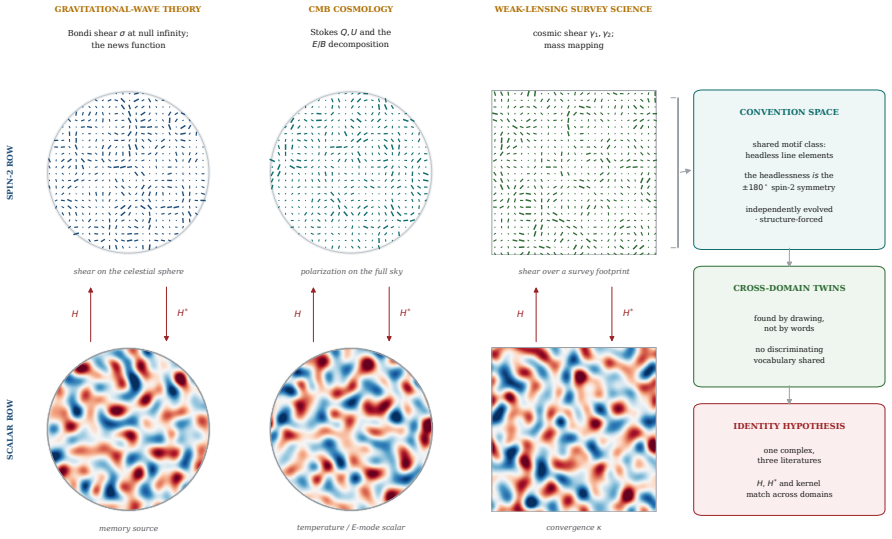
The central object is convention space: the space of motif classes produced by independently evolved scientific drawing conventions that preserve structural invariants across domains. It acts as a pre-computed canonical form, allowing a system to retrieve mathematically related work when two fields share no discriminating vocabulary. The Abduction Loop—representation generation, motif extraction, convention-space canonicalization, cross-domain retrieval, identity-hypothesis generation, adversarial verification, and abstention as the designed default—operationalizes representational grounding. DAB-30 is the evaluation instrument that turns the proposal's claims into falsifiable predictions.
What would settle it
Run the DAB-30 seeded-positive arm under strict blinding: if systems cannot retrieve the withheld correspondences, or accept adversarial decoys, when figures contain no embedded text and no hints are given, the claim that representation alone grounds identity abduction fails; successful blinded replications would support it.
Extended reading notes
Core claim
The paper's central claim is that the Embodiment Necessity Thesis—the proposition that continuous online sensorimotor embodiment is necessary for scientific abduction—is false for at least one subclass of abductive inference. The subclass is identity abduction: proposing that two apparently distinct mathematical or physical structures are the same object under an explicit correspondence. The mechanism is representational grounding: a representation that preserves the structural invariants needed for an inference and makes them computationally accessible is sufficient for that inference, so embodiment is one route to grounding but not the only one. The paper's exhibit is a July 10, 2026 episo
Load-bearing premise
The load-bearing premise is that the July 10, 2026 episode is genuine—the model proposed the memory–lensing equivalence from drawing-convention cues, not from text in the figure, prior conversation, or human hints; without that, the counterexample to the Embodiment Necessity Thesis collapses.
Editorial extensions
If this is right
- The Embodiment Necessity Thesis falls: if the episode is accepted as a genuine abductive act, no version of the thesis that requires a body for every scientific abduction survives.
- Cross-domain scientific search can be built on drawing conventions: retrieval in convention space should outperform lexical or generic-embedding retrieval for structurally related work, with a stated empirical test.
- Verified identity equivalences import mathematics: a match at the level of complex, kernel, and spectrum lets techniques transfer between fields even when their literatures share no vocabulary.
- A benchmark with seeded positives, adversarial decoys, and open-world cases can separate genuine abduction from retrieval-and-guessing, making the dispute measurable.
- The architecture predicts its own failure conditions: decorative figures, stylization drift, convention collisions, pedagogical layout, and dimensional overflow should degrade precision, and the correct response is abstention.
Reading between the lines
- If convention space works as described, the curation of scientific figures becomes a form of infrastructure: communities that maintain structure-forced diagrams are unknowingly building a cross-domain retrieval index for future discoveries.
- The same grounding mechanism should generalize beyond diagrams to algebraic normal forms, tensor notation, and other structure-exposing substrates, a direction the paper leaves open but does not test.
- Because the motivating episode's verification used the same workflow that generated the hypothesis, the first decisive test is independent reproduction under blind conditions; until that happens, the counterexample's force is conditional.
- A sharper prediction follows from the paper's failure regimes: precision should fall on dynamical-systems figures relative to contour and tree figures, with the loss concentrated in projection mismatch—measurable before the full benchmark is built.
Editorial analysis
A structured set of objections, weighed in public.
Referee Report
Summary. The paper argues, against the Embodiment Necessity Thesis (ENT), that online sensorimotor embodiment is not necessary for every abductive scientific act. It focuses on identity abduction—the inference that two independently developed structures are the same object under an explicit correspondence—and proposes representational grounding as an alternative mechanism: transformations into representations that expose latent invariants can supply inferential affordances without bodily interaction. The paper formalizes this in the Abduction Loop architecture (representation generation, motif extraction, convention-space canonicalization, cross-domain retrieval, identity-hypothesis generation, adversarial verification, with abstention as default) and proposes the DAB-30 benchmark for controlled evaluation. The central evidence is a single documented episode (July 10, 2026) in which a multimodal model, shown a figure of the CMT-4D memory complex, allegedly generated and verified the equivalence of that complex with the spherical Kaiser-Squires mass-mapping complex of weak-lensing cosmology. The paper is careful to scope its claims: it presents the episode as a possibility witness, not evidence of general capability, and its limitations section is unusually candid about contamination channels and lack of independent replication.
Significance. If the motivating episode is accepted as genuinely abductive, the paper provides a concrete counterexample to a strong universal claim in the philosophy of AI and cognitive science, and it offers a mechanistic alternative—representational grounding via convention space—that is testable. The paper's strengths are its explicit operationalization of identity abduction (Definition 2), its detailed falsifiable evaluation protocol (Appendix B), its stated failure conditions for convention-space retrieval (Section 4.2), and its refusal to overclaim prevalence or autonomy. The DAB-30 benchmark, although not yet executed, is a serious and well-designed instrument that could turn the philosophical dispute into an empirical one. The central weakness is evidential: the sole counterexample is retrospectively impossible to authenticate, as the paper itself concedes. The mathematical equivalence reported in Section 5 is self-contained but not independently replicated, and the architecture is abstracted from the same episode that is then used as its possibility witness, creating a circularity in the argument's evidentiary base.
major comments (4)
- [Section 5, Section 7, Appendix A, Definition 2] The load-bearing premise is that the July 10, 2026 episode satisfies condition (i) of Definition 2: the correspondence was not supplied by the prompt or surrounding context. Appendix A concedes that the input figure contains labels and equations (caveat b), the session occurred within an ongoing research program with the same model and retroactive exclusion of contamination is impossible (caveat a), the search meta-strategy was human-supplied (caveat c), and the retrieved image layer is not byte-stable (caveat d). The complete transcript is deferred to a companion paper. Consequently, the episode does not currently establish the counterexample to ENT; it only illustrates what a counterexample would look like if the authenticity and independence conditions were met. The paper frames the case as a 'possibility witness' and asks reviewers to hold it to that scope, but Section 7 still assert
- [Section 5, spectral and kernel argument] The mathematical equivalence is stated with explicit formulas for the spectrum, kernel, and normalization, which is commendable. However, the paper itself notes in Section 5 that the initial checks were performed within the same research workflow that generated the hypothesis and do not satisfy the independence criterion adopted later in Section 6. The claim that the hypothesis survived deduction is therefore not yet a verified equivalence under the paper's own standards. Since the episode's status as a successful abduction requires the equivalence to be correct, the lack of independent replication is load-bearing. At minimum, provide a computer-algebra or independent numerical verification of the claimed unitary equivalence, or explicitly present the episode as a hypothesized correspondence that has not yet been verified.
- [Section 5, Section 7, Section 10] The evidentiary structure is circular in a specific sense: Section 5 presents the episode as the motivating case, Section 6 abstracts the Abduction Loop from it, and Section 7 then uses the episode as evidence for the mechanism's possibility. The paper acknowledges this indirectly by excluding the motivating case from the benchmark's seeded-positive arm, but that exclusion does not remove the circularity from the central argument. Since the episode is the only direct evidence for the possibility claim, and the architecture is derived from that same episode, the possibility claim is not independently supported by the architecture. This does not invalidate the theoretical proposal, but it means the paper's contribution is a plausible hypothesis and a test design, not a demonstrated counterexample.
- [Section 4, Hypothesis 1] The convention-space retrieval hypothesis is clearly empirical and testable, and its ablation conditions in Appendix B are well designed. However, the paper's argument that convention space partially canonicalizes across domains rests on a selection-pressure analogy that is asserted rather than evidenced. The claim that diagrams persist because they are structure-forced is plausible for several well-known examples (commutative diagrams, Feynman diagrams, Dynkin diagrams), but the generalization to all scientific graphics is broad. This is not fatal, because the DAB-30 ablations can test it; nevertheless, Section 4 should be framed more explicitly as motivating the hypothesis rather than as an established empirical regularity.
minor comments (4)
- [Section 5, notation] The displayed memory complex uses arrow notation that is difficult to parse. Please use a cleaner long right arrow and define the two operators before first use, with the target space written more legibly.
- [Figure 1 caption] The caption says the headlessness is the ±180-degree spin-2 symmetry. Since a spin-2 line element is invariant under 180-degree rotation, consider rewording to 'invariance under 180-degree rotation' to avoid the redundant sign.
- [Section 6, Stage 3] The term convention space is defined abstractly, but the operational embedding is not specified. This is intentional, but a brief example of how a motif would be represented in a candidate convention space would aid comprehension.
- [Appendix A, Appendix B] The reference to 'S1-S4 scoring' in Appendix A is not defined in Appendix B. Please align the notation with the scoring section of the protocol.
Circularity Check
No significant circularity: the paper's central argument is an explicitly conditional possibility claim supported by an external episode; the architecture is abstracted from that episode, not used to validate it.
full rationale
The derivation chain is: define ENT, define representational grounding and identity abduction, introduce convention space, present the July 10, 2026 episode, abstract the Abduction Loop from it, and propose DAB-30 as the falsification program. The load-bearing step is the episode itself, and the paper is unusually explicit that the episode is a conditional possibility witness, not evidence of general capability: "serves as a motivating possibility witness from which the architecture is abstracted, not as evidence of general capability." The architecture is not used to prove that the episode occurred or that it qualifies as identity abduction; the paper instead invites the ENT defender to contest the classification under an explicit operational definition. The mathematical equivalence in Section 5 is stated with explicit conventions, normalizations, spectra, and kernels, and is presented as "algebraically supported at the level reported here" but "not received independent replication"—again a caution, not a circular reduction. Appendix A concedes contamination channels candidly, but that is evidential underdetermination of the single case, not a logical circle. There is no fitted parameter renamed as a prediction, no load-bearing self-citation (the author's prior 'v0.x' record and Paper 2 are forward references to unpublished material, not citations used to justify the central claim), no imported uniqueness theorem, and no ansatz smuggled in via the author's prior work. The main risk to the paper is the authenticity and purity of the motivating episode, which the paper itself flags; that risk weakens the empirical force of the counterexample but does not make the argument circular.
Assumptions & free parameters
assumptions (4)
- ad hoc to paper Representational sufficiency: if a representation preserves the invariants needed for an inference and makes them computationally accessible, online embodiment is not necessary for that inference.
- domain assumption Scientific drawing conventions are structure-forced: independent communities converge on the same motifs because mathematics constrains the representation.
- ad hoc to paper The July 10, 2026 episode occurred as reported, with the model's recognition being genuinely abductive (correspondence not supplied, verification downstream).
- ad hoc to paper The memory complex and spherical Kaiser–Squires complex are equivalent at spectrum, kernel, and normalization level.
invented entities (2)
-
Convention space
independent evidence
-
Representational grounding
independent evidence
Cite this review
Pith. "Pith review of Abduction Without a Body? Representational Grounding and the Abduction Loop for Scientific Hypothesis Generation." pith.science (2026). https://pith.science/paper/IWGOE2KB
@misc{pith2026260802505,
  author       = {Pith},
  title        = {Pith review of: Abduction Without a Body? Representational Grounding and the Abduction Loop for Scientific Hypothesis Generation},
  year         = {2026},
  howpublished = {\url{https://pith.science/paper/IWGOE2KB}},
  note         = {Machine review of arXiv:2608.02505}
}
read the original abstract
Can scientific abduction occur without continuous sensorimotor embodiment? Recent arguments in AI and philosophy of science hold that genuine hypothesis generation requires an agent continuously coupled to the physical world. We defend a narrower claim: online embodiment is not necessary for every abductive scientific act. Our focus is identity abduction: the inference that two independently developed structures are one object under an explicit correspondence, reached through representational grounding rather than bodily interaction. An agent may acquire new inferential affordances not through physical interaction but through transformations into representations that expose latent invariants. Scientific diagrams are a practical substrate because they embody independently evolved conventions that partially canonicalize symmetry, topology, and operator structure across disciplines - a property we develop as convention space, which answers a hard retrieval problem: finding mathematically related work when two fields share no discriminating vocabulary. We operationalize the mechanism as an architecture, the Abduction Loop: representation generation, motif extraction, convention-space canonicalization, cross-domain retrieval, identity-hypothesis generation, and adversarial verification, with abstention as the designed default. A documented episode, in which a multimodal model given a figure of a gravitational-memory transport model generated and then verified the hypothesis that its central differential complex is equivalent to the spherical Kaiser-Squires mass-mapping complex of weak-lensing cosmology, serves as a motivating possibility witness from which the architecture is abstracted, not as evidence of general capability. We close with a falsifiable evaluation program, the DAB-30 benchmark. The contribution is a mechanistic proposal, an architecture, and a test program.
Figures


Figures from the paper (1 more)

Reference graph
Works this paper leans on
-
[1]
T. Zahavy. Position: LLMs can’t jump. InProceedings of the 43rd International Conference on Machine Learning (ICML), Position Paper Track, 2026. Poster presentation, 9 July 2026. https:// icml.cc/virtual/2026/poster/67091. Preprint: PhilSci-Archive 28024, January 2026; OpenReview klU4737opt
2026
-
[2]
C. S. Peirce.Collected Papers. Harvard University Press, 1934
1934
-
[3]
Magnani.Abductive Cognition
L. Magnani.Abductive Cognition. Springer, 2009
2009
-
[4]
S. Harnad. The symbol grounding problem.Physica D, 42:335–346, 1990
1990
-
[5]
Y. LeCun. A path towards autonomous machine intelligence.Open Review, 2022
2022
-
[6]
J. Bruce et al. Genie: Generative interactive environments. arXiv:2402.15391, 2024
arXiv 2024
-
[7]
Varela, E
F. Varela, E. Thompson, and E. Rosch.The Embodied Mind. MIT Press, 1991
1991
-
[8]
J. J. Gibson.The Ecological Approach to Visual Perception. Houghton Mifflin, 1979
1979
Show all 18 references
-
[9]
A. Clark. Whatever next? Predictive brains, situated agents, and the future of cognitive science. Behavioral and Brain Sciences, 36:181–204, 2013
2013
-
[10]
N. J. Nersessian.Creating Scientific Concepts. MIT Press, 2008
2008
-
[11]
J. H. Larkin and H. A. Simon. Why a diagram is (sometimes) worth ten thousand words.Cognitive Science, 11:65–100, 1987
1987
-
[12]
Kirsh and P
D. Kirsh and P. Maglio. On distinguishing epistemic from pragmatic action.Cognitive Science, 18:513–549, 1994
1994
-
[13]
Hutchins.Cognition in the Wild
E. Hutchins.Cognition in the Wild. MIT Press, 1995
1995
-
[14]
Zhang and D
J. Zhang and D. A. Norman. Representations in distributed cognitive tasks.Cognitive Science, 18:87– 122, 1994. 19
1994
-
[15]
J. Zhou, Y. Zhou, and Y. Xu. Analogy search engine. arXiv:1812.06974, 2018
2018 arXiv
-
[16]
Kang et al
H. Kang et al. Augmenting scientific creativity with retrieval across knowledge domains. arXiv:2206.01328, 2022
2022 arXiv
-
[17]
Kaiser and G
N. Kaiser and G. Squires. Mapping the dark matter with weak gravitational lensing.Astrophysical Journal, 404:441–450, 1993
1993
-
[18]
C. G. R. Wallis, M. A. Price, J. D. McEwen, T. D. Kitching, B. Leistedt, and A. Plouviez. Mapping dark matter on the celestial sphere with weak gravitational lensing.MNRAS, 509(3):4480–4497, 2021. doi:10.1093/mnras/stab3235. 20
2021 doi
Reviewed August 4, 2026 · model on record in the stance chip above.
Discussion (0). Sign in to comment.