REVIEW 4 major objections 5 minor 37 references
A random walk around a black hole escapes capture more often than in flat space, and time dilation flattens the low-frequency X-ray flicker, matching Cygnus X-1-like sources.
Reviewed by Pith at T0; open to challenge. T0 means a machine referee read the full paper against a public rubric. the ladder, T0–T4 →
T0 review · deepseek-v4-flash
2026-08-02 01:33 UTC pith:IWKADXRT
load-bearing objection A clean mathematical exercise with a genuine geometric insight, but the astrophysical PSD claim rests on an unvalidated step-time mapping that likely drives the effect. the 4 major comments →
Random walks around black holes and low-frequency X-ray variability
The pith
A machine-rendered reading of the paper's core claim, the machinery that carries it, and where it could break.
Core claim
The central claim is that curvature changes the statistics of stochastic accretion. On the Schwarzschild-de Sitter spatial slice, the probability P_H(r) that a walker starting at radius r is captured by the horizon is lower than in flat space for every r, because the weight u^{-2} f(u)^{-1/2} in the capture integral piles up near the horizon; the black hole is therefore a weaker attractor for a diffusing grain than for a geodesic. When many grains are launched from a thin-disc density profile n(r) ∝ r^{-3/2}, the horizon-hitting rate in coordinate time has a power spectrum with a nearly flat low-frequency branch (slope ≈ −0.2), transitioning through ≈ −1.5 to ≈ −3, while the flat-space walk
What carries the argument
The engine is the diffusion equation ∂_t P = ½ ∇_μ(σ² ∇^μ P) on the Riemannian slice with metric dΣ² = f(r)^{-1} dr² + r² dΩ², where ∇ is the Laplace-Beltrami operator and σ the diffusivity. For constant σ the capture probability is a harmonic function; integrating it with absorbing boundaries at the event and cosmological horizons yields P_H(r) with the weight [u²√f(u)]^{-1}. The geometric drift responsible for the higher escape probability comes from the Christoffel terms in the stochastic differential equation. The coordinate-time conversion dτ = √f(r) dt then turns proper-time step counts into observer-time arrival series, and the growth of 1/√f(r) near the horizon stretches arrival time
Load-bearing premise
The load-bearing premise is that the coordinate-time series of walkers crossing an artificial absorbing boundary just outside the horizon, with the conversion dt = dτ/√f(r), is a faithful proxy for the observed X-ray light curve; since real X-rays are emitted outside the horizon and the conversion diverges there, the claimed low-frequency flattening is regulated by where that boundary is placed.
What would settle it
Repeat the large-N walk with the inner absorbing boundary at r_in = r_H + εΔr for ε = 1/2, 1, 2, and 3 (as in Appendix B) and measure the low-frequency PSD slope; if the ≈ −0.2 branch appears only for ε ≲ 1 and reverts toward ≈ −1 for larger ε, or if a radiative-transfer model that emits photons from r > r_H erases the flattening, then the geometric effect is a numerical boundary artefact rather than a property of the spacetime.
If this is right
- A black hole is a weaker sink for a randomly walking grain than for a geodesic particle; the capture probability falls as the mass rises for a fixed starting radius.
- The horizon-flux power spectrum inherits a nearly flat low-frequency branch (slope ≈ −0.2) and a steeper high-frequency branch (≈ −3), instead of the flat-space ≈ −1.4 to ≈ −2; geometry acts as a low-pass filter on accretion noise.
- For steady-state injection of walkers at the disc edge, fractional variability is about 4% (peaks near 10%), systematically lower than in flat space, broadly consistent with soft-state X-ray binaries such as GRO J1655–40.
- The qualitative PSD shape — flat at low frequencies, steepening to a noisy floor — matches hard-state observations of sources like Cygnus X-1 and GX 339–4 better than a flat-space random walk does.
- Time dilation is the primary driver of the low-frequency flattening; without the dτ = √f(r) dt conversion the curvature-weighted and flat-space walks have similar spectral slopes.
Where Pith is reading between the lines
- If the geometric flattening is real, some of the shallow low-frequency power in black-hole binaries may be a projection effect of the spacetime rather than a property of the turbulent engine; comparing sources with different black-hole spin would test this, since rotation adds an advective term that should bias escape and further lengthen timescales.
- The same curvature-weighting logic extends to any stochastic observable that is converted to observer time through a redshift factor, e.g., magnetospheric fluctuations above neutron stars; the shape of the resulting PSD could be a probe of the compact object's redshift profile.
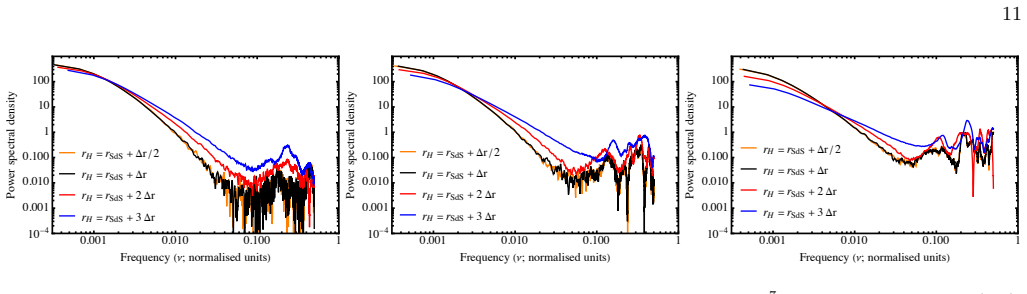
- The paper's own boundary-dependence tests show that the lowest Fourier frequency shifts by a factor ~4 when the absorbing inner radius moves from εΔr/2 to 3εΔr; a cleaner formulation would place the inner boundary at the photon ring or combine the walk with a radiative-transfer model for emission outside the horizon, which could either sharpen or dissolve the claimed match.
- Because the diffusionless limit of the walk recovers only 3D geodesics unless energy is artificially conserved (the Jacobi-metric route), a future extension that lets the walker diffuse in energy as well as position might connect stochastic accretion to orbital dynamics and remove the need for an absorbing boundary.
Editorial analysis
A structured set of objections, weighed in public.
Referee Report
Summary. The paper formulates random walks on the spatial slice of a static, spherically symmetric spacetime, using Schwarzschild-de Sitter as the concrete example. It derives a Fokker-Planck equation for the walker density, computes capture probabilities and expected capture times via quadrature, and then simulates many walkers distributed in a thin-disc-like profile to produce synthetic particle-flux time series through an artificial inner boundary near the horizon. The central claims are that (i) the escape probability is higher in curved space than in flat space because the radial volume element is stretched near the horizon, and (ii) the power spectral density of the horizon flux is shallower at low frequencies and steeper at high frequencies relative to flat space, which the paper says 'broadly matches' low-frequency X-ray variability from sources like Cygnus X-1. The mathematical derivations in Sections III A and III B are clean, but the astrophysical comparison rests on a heuristic coordinate-time assignment to random-walk steps and a horizon-flux proxy that is not validated.
Significance. If the central claim were established, it would be a novel and interesting result: pure spacetime curvature, through the induced spatial metric and time dilation, would change the noise statistics of accreting matter without any additional microphysical mechanism. The Fokker-Planck treatment of diffusion on curved spatial slices is a useful contribution, and the escape-probability analysis is concrete and falsifiable within the model. However, the paper's own caveats and the sensitivity of the PSD to the artificial boundary placement mean that the astrophysical significance is currently not demonstrated. The strength of the paper is its clean mathematical core and the explicit convergence tests; the weakness is the unvalidated step-to-coordinate-time mapping and the loose observational comparison.
major comments (4)
- [§IV, Eqs. (16)–(17)] The coordinate-time assignment for each random-walk step neglects the spatial contribution to the worldline interval. For a radial worldline, dτ² = f dt² − f^{-1} dr², so dτ = √f dt is valid only when dr=0. With the parameters used (σ=1, Δr=0.5M, f≈1 near the ISCO), dr/dτ = σ² f/Δr ≈ 2, so the steps are far from static; the exact dt is larger than dτ/√f by a factor √5 for f≈1. Near the horizon the qualitative divergence of dt exists, but the detailed scaling that produces the low-frequency flattening in Fig. 5 is derived from an unphysical map. The paper offers no physical justification for this map, and it is load-bearing for the PSD claim. Please either derive the time series from a proper timelike random walk (using the full worldline interval) or clearly state that the PSD applies to a fictitious coordinate time and cannot be compared to observed light curves.
- [§IV A and Appendix B] The low-frequency slope and the lowest Fourier frequency are regulated by the artificial inner boundary r_in = r_H + εΔr. Appendix B shows that f_min shifts by a factor ~4 as ε goes from 1/2 to 3. The paper argues convergence for ε≤1, but the near-horizon time dilation diverges as ε→0; any finite ε cuts off the divergence. With ε=1 and Δr=0.5M, the boundary is at r_out ≈ 2.5M where f≈0.2, so the accumulated time dilation is only a factor of a few, not the large factor implied by the horizon divergence. The claimed very flat slope (≈ −0.2) may therefore be an artifact of the chosen boundary placement rather than a robust geometric effect. A proper convergence study should take ε→0 with Δr→0 simultaneously and show that the relevant frequency range where the flattening occurs is independent of the regulator.
- [§IV A and §V] The observational comparison is not quantified. The SdS PSD has a low-frequency slope of about −0.2, while the quoted Cygnus X-1 hard-state index is α=−0.93±0.05 (Reig et al. 2002). The paper says the curvature-weighted walk 'broadly matches' observations, but no mapping between the normalized simulation frequencies and physical frequencies for any source is provided, and the radiative efficiency/corona filter mentioned in the caveat is not included. The abstract and discussion make a stronger claim than the analysis supports. Please either remove the observational claim or provide a concrete, falsifiable prediction (e.g., the break frequency and PSD normalization for a given black-hole mass and accretion rate), or explicitly restrict the claim to a qualitative demonstration of how geometric drifts can flatten low-frequency PSDs.
- [§III C and §IV A (simulation algorithm)] The simulation algorithm is not specified in enough detail to reproduce the results. The paper states that Euler–Maruyama is used with a fixed radial step Δr, but does not describe how angular directions are drawn on the curved 2-sphere, how the step length in the full 3D spatial metric is reconciled with the radial coordinate step, how crossing events are binned into a time series (the time-bin width), or how the PSD is estimated (windowing, segmentation, normalization). These details are necessary to judge whether the reported PSD slopes are robust or depend on numerical choices.
minor comments (5)
- [Throughout] The name 'Weiner' should be 'Wiener' (e.g., 'Weiner kicks' and 'Wiener processes' appear interchangeably). Also 'Itô's lemma' should have the accent.
- [§IV A, after Eq. (18)] The statement that 'H/r is constant – as is standard in thin-disc modelling' cites Ref. [20], which is a self-citation. A standard reference such as Shakura & Sunyaev or a textbook would be more appropriate.
- [§IV A, Fig. 4 caption and text] The horizontal axis label 'Normalised time (∝ 1/σ)' is undefined. It should specify the exact normalization procedure (e.g., time in units of M with σ set to 1).
- [§IV A, text near Fig. 5] The sentence 'coordinate time scales like f(r)^{-3/2} (equations 16 and 17)' is used to explain the PSD flattening, but the connection between a per-step time scaling and the global PSD shape is not derived. Consider providing a more explicit argument or simulation evidence.
- [Appendix A] The point-particle limit (σ→0) recovers spatial geodesics on the slice, not full 4D geodesics; the paper correctly discusses the Jacobi-metric obstruction. This limitation should be mentioned earlier in the main text because it affects the physical interpretation of the random walk.
Circularity Check
No significant circularity: the PSD and escape-probability results follow from the stated metric and stochastic map, with no fitted observational target.
full rationale
The derivation chain is self-contained: the spatial SDE (Eq. 2) is built from the metric's frame fields, the Fokker-Planck equation (Eq. 6) follows from the generator, the capture probability (Eq. 9) and mean capture time (Eqs. 12-13) are solved from the stated diffusion operator with absorbing boundaries, and the flux time series are produced via the explicit coordinate-time map (Eqs. 14-17). All inputs (f(r), sigma, Lambda, M, Delta r, and boundary placement) are stated, and none are adjusted to force agreement with Cygnus X-1 or any observed PSD. The observational comparison is qualitative, and the paper itself flags the limitation: 'we caution the reader however that we cannot directly compare to the observed X-ray variability...' and 'provided the horizon flux provides a reasonable proxy for the accretion rate.' These are model-validity caveats, not circular reductions. The only self-citation, [20], is used for the standard thin-disc assumption H/r = constant in Eq. (18); it affects the initial shell weighting but is not needed for the central curvature-versus-flat PSD comparison, so it is not load-bearing. Appendix B reports the sensitivity to the artificial inner boundary rather than concealing it; the epsilon-dependence is the expected time-dilation cutoff and is not a hidden fit. The questionable step-time map in Eq. (17) is a possible physical-validity concern, but the PSD flattening is still a derived consequence of the assumed metric and stated mapping, not a conclusion equivalent to its input by construction. No circular step can therefore be exhibited under any of the seven categories.
Axiom & Free-Parameter Ledger
free parameters (5)
- Cosmological constant Λ =
1e-4 (arbitrary units)
- Diffusion coefficient σ =
1 (arbitrary units)
- Radial step Δr =
0.5M (convergence tests with 0.4M, 0.6M)
- Injection interval Δt =
2 (σ=1 units)
- Disc scale-height ratio H/r =
constant (value not specified)
axioms (6)
- domain assumption The grain's stochastic motion can be represented by a spatial random walk on a spacelike hyperslice of a static spacetime, with no diffusion in time.
- standard math Wiener kicks in the local frame are standard Brownian increments in R^3 with dW^a dW^b = δ^{ab} dτ, lifted via frame fields.
- domain assumption The event horizon and cosmological horizon/OSCO act as perfectly absorbing boundaries.
- domain assumption The Shakura-Sunyaev thin-disc density profile with constant H/r gives n(r)∝r^{-3/2}.
- domain assumption The horizon-crossing particle flux, converted to coordinate time via dτ=√f dt, is a valid proxy for the observed X-ray luminosity.
- domain assumption Self-gravity and backreaction of the grains are negligible.
read the original abstract
The stochastic dynamics of a grain embedded within a turbulent fluid subject to strong gravitational fields can be formulated as a random walk on a Riemannian manifold. Such curvature-weighted walks provide a framework to model the intrinsic variability of accretion onto compact objects. By solving the relevant Fokker-Planck equation on a black hole background, we find the counterintuitive result that the escape probability of a grain is actually higher compared to flat space. This is a consequence of the stretching of radial cells near the event horizon: there is a greater spatial volume for the particle to wander through before being captured. By simulating a large number of grain trajectories, initially distributed on concentric shells with a density profile set by the thin-disc structure equations, we also study particle fluxes through the horizon. Shallower spectral indices emerge at low frequencies relative to flat space, primarily due to time dilation, and steeper ones at high frequencies. We find that Schwarzschild-weighted spectra broadly match observations of low-frequency X-ray variability from systems like Cygnus X-1 in their hard state, suggesting that geometric drifts may be important in describing stochastic accretion processes.
Figures



Reference graph
Works this paper leans on
-
[1]
P. J. Ioannou and A. Kakouris, ApJ550, 931 (2001)
2001
-
[2]
Grigor’yan, Applicable Analysis71, 63 (1998)
A. Grigor’yan, Applicable Analysis71, 63 (1998)
1998
-
[3]
E. P. Hsu,Stochastic analysis on manifolds, 38 (American Mathematical Soc., 2002)
2002
-
[4]
W. S. Kendall, Acta Applicandae Mathematica9, 29 (1987)
1987
-
[5]
B. C. Kelly, M. Sobolewska, and A. Siemiginowska, ApJ 730, 52 (2011), arXiv:1009.6011 [astro-ph.HE]
Pith/arXiv arXiv 2011
-
[6]
J.-M. Wang, C. Hu, Y.-R. Li, Y.-M. Chen, A. R. King, A. Marconi, L. C. Ho, C.-S. Yan, R. Staubert, and S. Zhang, ApJL697, L141 (2009), arXiv:0904.1896 [astro-ph.GA]
Pith/arXiv arXiv 2009
-
[7]
C. L. MacLeod, ˇZ. Ivezi´ c, C. S. Kochanek, S. Koz lowski, B. Kelly, E. Bullock, A. Kimball, B. Sesar, D. Westman, K. Brooks, R. Gibson, A. C. Becker, and W. H. de Vries, ApJ721, 1014 (2010), arXiv:1004.0276 [astro-ph.CO]
Pith/arXiv arXiv 2010
-
[8]
van der Klis, inTiming Neutron Stars, NATO Ad- vanced Study Institute (ASI) Series C, Vol
M. van der Klis, inTiming Neutron Stars, NATO Ad- vanced Study Institute (ASI) Series C, Vol. 262, edited by H. ¨Ogelman and E. P. J. van den Heuvel (1989) p. 27
1989
-
[9]
Edelson, R
R. Edelson, R. Warwick, and P. Uttley, Monthly Notices of the Royal Astronomical Society345, 1271 (2003)
2003
-
[10]
W. Yu, G. T. Richards, M. S. Vogeley, J. Moreno, and M. J. Graham, ApJ936, 132 (2022), arXiv:2201.08943 [astro-ph.GA]
Pith/arXiv arXiv 2022
-
[11]
Y.-X. Chen and D. N. C. Lin, MNRAS522, 319 (2023), arXiv:2303.17097 [astro-ph.HE]
Pith/arXiv arXiv 2023
-
[12]
J. Fagin, J. W. Park, H. Best, J. H. H. Chan, K. E. S. Ford, M. J. Graham, V. A. Villar, S. Ho, and M. O’Dowd, ApJ965, 104 (2024), arXiv:2304.04277 [astro-ph.GA]
Pith/arXiv arXiv 2024
-
[13]
P. Reig, I. Papadakis, and N. Kylafis, Astronomy & Astrophysics383, 202 (2002)
2002
-
[14]
Mannella and P
R. Mannella and P. V. McClintock, Fluctuation and Noise Letters11, 1240010 (2012)
2012
-
[15]
stumbling drunk
model we can estimateσ 2/2≈αc sH/Sc where Sc is the Schmidt number,c s is the speed of sound,His the disc thickness, andαis the dimensionless viscosity coeffi- cient. In the astrophysical cases of interest, the Schmidt number is likely of order unity [16] so thatσcould be estimated directly from the disc structure equations. III. STUMBLING AROUND A BLACK ...
2000
-
[16]
N. I. Shakura and R. A. Sunyaev, A&A24, 337 (1973)
1973
-
[17]
A. N. Youdin and Y. Lithwick, Icarus192, 588 (2007), arXiv:0707.2975 [astro-ph]
Pith/arXiv arXiv 2007
-
[18]
Planck Collaboration, A&A571, A16 (2014), arXiv:1303.5076 [astro-ph.CO]
Pith/arXiv arXiv 2014
-
[19]
Durrett,Probability: theory and examples, Vol
R. Durrett,Probability: theory and examples, Vol. 49 (Cambridge university press, 2019)
2019
-
[20]
Cabr´ e, Discrete and Continuous Dynamical Systems 20, 425 (2007)
X. Cabr´ e, Discrete and Continuous Dynamical Systems 20, 425 (2007)
2007
-
[21]
K. Glampedakis and A. G. Suvorov, MNRAS508, 2399 (2021), arXiv:2109.07657 [astro-ph.HE]
Pith/arXiv arXiv 2021
-
[22]
Stuchlik, Bulletin of the Astronomical Institutes of Czechoslovakia34, 129 (1983)
Z. Stuchlik, Bulletin of the Astronomical Institutes of Czechoslovakia34, 129 (1983)
1983
-
[23]
Stuchl ´ ık, M
Z. Stuchl ´ ık, M. Koloˇ s, J. Kov´ aˇ r, P. Slan´ y, and A. Tur- sunov, Universe6, 26 (2020)
2020
-
[24]
Y. E. Lyubarskii, MNRAS292, 679 (1997)
1997
-
[25]
van der Klis, inCompact stellar X-ray sources, Vol
M. van der Klis, inCompact stellar X-ray sources, Vol. 39, edited by W. H. G. Lewin and M. van der Klis (Cambridge University Press, 2006) pp. 39–112
2006
-
[26]
M. A. Nowak, MNRAS318, 361 (2000), arXiv:astro- ph/0005232 [astro-ph]
arXiv 2000
-
[27]
R. A. Remillard, E. H. Morgan, J. E. McClintock, C. D. Bailyn, and J. A. Orosz, ApJ522, 397 (1999)
1999
-
[28]
Jiang, Galaxies12, 80 (2024), arXiv:2411.12507 [astro- ph.HE]
J. Jiang, Galaxies12, 80 (2024), arXiv:2411.12507 [astro- ph.HE]
Pith/arXiv arXiv 2024
-
[29]
M. Axelsson and C. Done, MNRAS480, 751 (2018), arXiv:1803.01991 [astro-ph.HE]
Pith/arXiv arXiv 2018
-
[30]
P. Uttley and M. Klein-Wolt, MNRAS451, 475 (2015), arXiv:1504.08313 [astro-ph.HE]
Pith/arXiv arXiv 2015
-
[31]
A. G. Suvorov and G. Pappas, Physical Review D113, 044018 (2026), arXiv:2511.22405 [gr-qc]
arXiv 2026
-
[32]
Scott, Plasma Physics and Controlled Fusion39, 1635 (1997)
B. Scott, Plasma Physics and Controlled Fusion39, 1635 (1997)
1997
- [33]
-
[34]
O. C. Pin, Advances in Mathematics15, 269 (1975)
1975
-
[35]
G. W. Gibbons, Classical and Quantum Gravity33, 025004 (2016), arXiv:1508.06755 [gr-qc]
Pith/arXiv arXiv 2016
-
[36]
M. P. L´ evy, American Journal of Mathematics62, 487 (1940)
1940
-
[37]
Jacobi-metric
R. M. Wald,General Relativity(Chicago Univ. Pr., Chicago, USA, 1984). 10 Appendix A: The point-particle limit We rewrite the probability density,P, in terms of a new variable,S, that represents the mean of a Gaussian, P(x, t) = exp − S(x, t) σ2 .(A1) This form is chosen so that intuitively, asσ→0, the probability “cloud”P(x, t) obeying equation (6) col- l...
1984
discussion (0)
Sign in with ORCID, Apple, or X to comment. Anyone can read and Pith papers without signing in.