REVIEW 4 major objections 6 minor 56 references
V-FIND: Revealing the Intrinsic Forgery Knowledge Encoded in Video Forgery Detectors
T0 review · 4 major / 6 minor · reviewed 2026-08-08 · deepseek-v4-flash
Pith's one-line read A video forgery detector's real-versus-fake knowledge lives in a sparse set of neurons, and a frozen backbone plus a 211-neuron linear readout can match or beat full retraining.
desk verdict Sparse frozen-neuron forensic subspace is a real, well-controlled finding, but the headline Magic numbers are selected on the test set and need a clean re-run. read the letter →
The pith
A machine-rendered reading of the paper's core claim, the machinery that carries it, and where it could break.
The reading
What carries the argument
The load-bearing object is the latent anchor neuron (LAN): an individual latent unit in a critical layer, scored by the product of its activation magnitude and its linear-probe weight, $r_n(x)=|a_n(x)|\,|w_n|$, and selected when its real–fake separation effect size $d_n = |\mu_{\mathrm{fake}}-\mu_{\mathrm{real}}|/(\sigma_{\mathrm{pool}}+\epsilon)$ exceeds a threshold. Layer localization precedes this using the intersection $L^* = L_{\mathrm{sep}} \cap L_{\mathrm{shift}}$ of a directional-separation signal and a normalized centroid-shift signal, which narrows the search from all 32 layers to a few late layers. The selected LAN activations are concatenated into a compact forensic subspace $h_S(x) = [a_n(x)]_{n\in S}$, and a linear classifier trained on this subspace performs the detection while the backbone stays frozen. This construction is what lets the paper attribute performance to specific internal neurons rather than to feature dimensionality.
What would settle it
Zero out the 211 reported LAN activations in the frozen detector (or swap them with activations from real videos) and measure the shift in the detector's real–fake logits: the paper reports large directional shifts and label-flip rates for these neurons, so a replication that finds no larger effect than random same-budget neurons would refute the functional-specialization claim.
Extended reading notes
Core claim
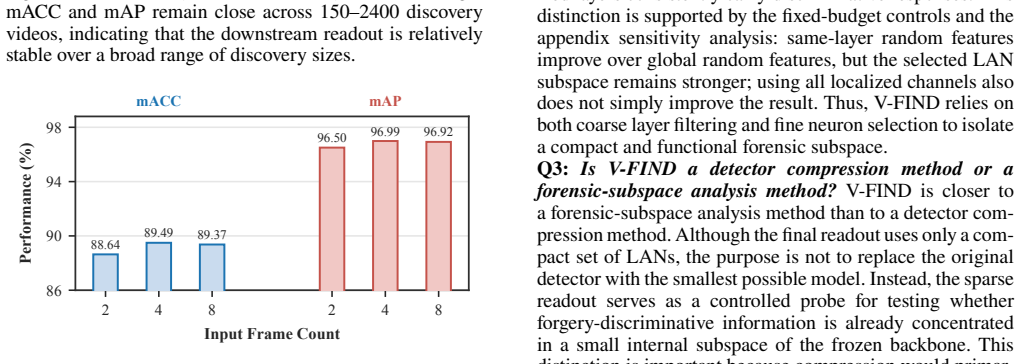
The paper's central claim is that forgery-discriminative knowledge inside a video forgery detector is localized: a sparse set of latent units, not the full representation space, carries the real-versus-fake signal. V-FIND operationalizes this by computing two layer-wise discrepancy measures (directional separation of class centroids and variance-normalized centroid shift), intersecting the layers they flag, then training a linear probe inside those layers and ranking neurons by an effect size that compares the mean response gap between real and fake videos to pooled within-class variation. Retaining the 211 neurons with the largest effect sizes in layers 28–30 of a frozen Qwen2.5-ViT detector and fitting only a linear readout yields 89.37 mean accuracy and 96.92 mean average precision on Magic Videos, 96.85 accuracy and 99.31 average precision on MovieGen, and 98.2 AUC on DVF, competitive with or better than full-model baselines quoted from prior work. Activation-swap interventions on the selected neurons move the detector's decisions far more than same-budget random neurons, which the paper takes as direct evidence that these neurons are functionally specialized for forgery detection.
Load-bearing premise
The central claim stands on the assumption that the neurons selected by the probe-based effect-size score genuinely carry forgery-discriminative signal and that the quoted baseline numbers were produced under the same evaluation protocol; if either fails, the reported gains could be artifacts rather than evidence of a sparse forensic subspace.
Editorial extensions
If this is right
- A released detector can be adapted to a new video generator by discovering and reading out its sparse forensic neurons, without touching the backbone's weights.
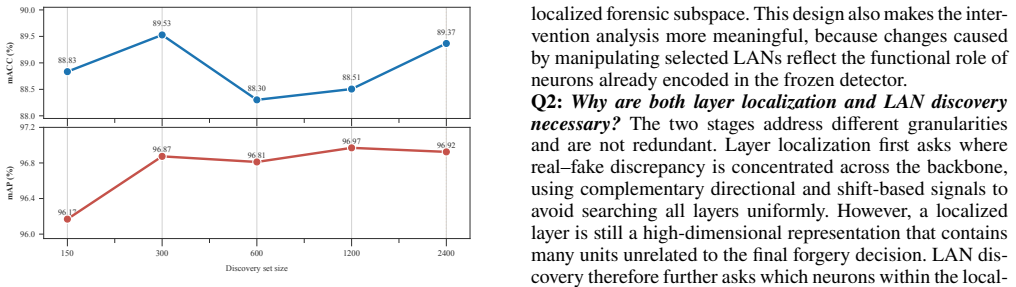
- Detection with 211 activations needs very little training data: performance is already strong with a few hundred discovery videos and stabilizes around 2,400 samples.
- Because only a few neurons drive the decision, the detector's reasoning becomes inspectable: response maps show the neurons firing on textures, boundaries, and repeated structures in fake videos.
- The discovery procedure transfers across architectures, improving mean accuracy on VINA and X-CLIP backbones by 7.6 to 14.9 points, so sparse forensic knowledge is not unique to one model family.
Reading between the lines
- A natural extension the paper leaves open: if LAN locations are stable across training runs and checkpoints, one could build a reusable neuron atlas so that new detectors inherit known forensic neurons instead of rediscovering them, but the paper explicitly notes intra-family consistency is not yet established.
- The same neuron-scoring machinery could be pointed at finer questions than real-versus-fake, such as which generator produced a video; nothing in the method restricts it to binary classes.
- Because the readout is linear, the detection boundary can be inspected coordinate-by-coordinate, which could support auditability requirements for AI-content detectors in deployment.
- A testable extension: run V-FIND on a detector trained only on face-manipulation deepfakes and compare the localized layers to those found here; overlap would suggest a common forensic substrate across manipulation types, while disjoint layers would imply separate mechanisms.
Editorial analysis
A structured set of objections, weighed in public.
Referee Report
Summary. The paper proposes V-FIND, a framework that claims to uncover sparse, functionally specialized "latent anchor neurons" (LANs) within a frozen video forgery detector (Qwen2.5-ViT), localizing critical layers via two complementary discrepancy signals, selecting neurons via a probe-based effect-size threshold, and training only a linear classifier on the selected LAN activations. The main empirical claims are that this sparse readout achieves 89.37 mACC / 96.92 mAP on Magic Videos, 96.85 ACC / 99.31 AP on MovieGen, and 98.2 AUC on DVF, matching or exceeding full retrained detectors, and that neuron intervention experiments demonstrate functional specificity. The manuscript includes layer/neuron ablations, fixed-budget controls, cross-architecture validation, and an appendix with formal definitions and a theoretical interpretation.
Significance. If the central claim holds, the paper would make a useful contribution by showing that video forgery detectors contain sparse, extractable, and reusable discriminative knowledge, which challenges the uniform-distribution assumption and offers a lightweight, interpretable alternative to full-model retraining. The manuscript's strengths include cross-architecture consistency (Table 3), controlled comparisons against random and PCA baselines at a fixed budget (Figure 7), and causal intervention evidence (Figure 9), all of which are appropriate and well-conceived experimental designs. The theoretical analysis in Appendix C is explicitly framed as an explanatory approximation rather than a formal proof, which is honest. However, the headline quantitative demonstration is weakened by the selection of the key hyperparameter tau_d and the LAN budget on the Magic benchmark itself, and the baseline comparisons are quoted rather than reproduced under a matched protocol, so the magnitude of the reported gains should be treated with caution.
major comments (4)
- [Sec. 4.1, Sec. 4.3, Fig. 6, Fig. 10, Appendix A] The claim in Sec. 4.1 and Appendix A that "No external benchmark is involved in layer localization, neuron discovery, threshold choice, or checkpoint selection" is contradicted by the presented evidence. Section 4.3 shows tau_d = 1.5 was selected by a coarse-to-fine sweep whose displayed values are Magic Videos mACC/mAP (Fig. 6), and Fig. 10 similarly shows the 211-neuron LAN budget as the peak of a Magic-based curve (89.37 mACC / 96.92 mAP). Since tau_d determines which neurons enter the forensic subspace, the headline Magic numbers are a selected maximum on the test set rather than an unbiased held-out evaluation. The fixed-budget controls in Fig. 7 also inherit the Magic-selected budget. I would like to see the threshold and budget selection moved to the internal validation split (or justified by a stability argument over discovery splits), with Magic numbers re-reported afterward; the current figures cannot both display the Magic evaluation curve and support a strict separation claim.
- [Tables 1 and 2 vs. Sec. 4.1] The comparison against baselines is protocol-sensitive but the protocol is only specified for V-FIND. V-FIND uses 2 FPS decoding, 8 center-aligned frames, and dynamic resolution 224–720p (Sec. 4.1), while the quoted baselines from Li et al. (2026b) have no stated preprocessing in this manuscript. If the baselines used different frame counts, resolutions, or cropping, the reported gains (e.g., +6.17 mACC over Qwen2.5-ViT on Magic, +13.8 AUC on DVF's VideoCrafter1 row in Table 2) could reflect protocol mismatch rather than the forensic subspace. Please state the exact evaluation protocol for every quoted baseline, or re-run the strongest baselines under the V-FIND protocol.
- [Sec. 3.2, Eq. (12)] The per-sample response r_n(x_i) = |a_n(x_i)| · |w_n| and the effect size d_n are computed using probe weights w_n trained on the same discovery split that is then used to rank and select neurons. This supervised selection makes it partly guaranteed by construction that selected neurons separate real and fake in the discovery distribution; the paper's own fixed-budget and intervention controls (Figs. 7, 9) mitigate this concern but do not eliminate it. Please add an explicit analysis of selection bias, e.g., by reporting the drop in discriminative effect sizes or in readout performance when LANs are selected on discovery split A and evaluated by training the final readout on a disjoint split B, or by comparing against neurons selected by unsupervised variance or random projection at the same budget.
- [Appendix C, Eqs. (30)–(31)] The margin-based argument in Eqs. (30)–(31) is conditional on unverified quantities: the omitted-coordinate norm ||w*_Sbar||_2 · ||z_Sbar(x)||_2 and the reference separator f* are not measured, so the bound is not shown to hold for the actual Qwen2.5-ViT representations. The authors do label the analysis as an explanatory approximation, which is commendable, but the sentence "the sparse projection preserves the sign of the reference decision" is stronger than what is demonstrated. Please either soften this to a conditional statement or add a direct empirical check of the margin condition on the real representations.
minor comments (6)
- [Sec. 3.1, Eqs. (6), (8), Appendix B] Tau_sep and tau_shift are defined as mean + std of the layer-wise score distributions on the discovery split, but it is not stated whether this produced L* = {28, 29, 30} deterministically or how stable the intersection is across discovery splits; please report the actual threshold values and the resulting layer sets.
- [Sec. 4.3, Fig. 7] The PCA baseline in Fig. 7 is described only by name; please specify whether PCA was fit on the discovery split, which layers were concatenated, and the number of components (presumably 211).
- [Sec. 4.4, Fig. 9] The label "Original LAN size / flip rate" in Fig. 9 is ambiguous; the text reports flip rates of 6.8%, 19.7%, 1.2%, and 1.8%, so please clarify which numbers correspond to flip rates and which to logit shifts in the figure.
- [Sec. 4.2, Tables 1–2] The tables state that best results are bold and second-best underlined, but no bolding or underlining appears in the provided text version; please ensure the final PDF formatting matches the stated convention.
- [Appendix D, Fig. 10] The claim that the 211 budget is a stable region is not strongly supported by the apparent non-monotonicity around the selected budget (e.g., 200 vs. 211 vs. 500); please add error bars or variance across multiple discovery/training seeds, or discuss the observed fluctuations.
- [General] Several references appear to be future-dated (e.g., Li et al. 2026a, 2026b; Cao et al. 2026) and the paper is dated August 2026; please verify all citations and ensure the arXiv identifier and version are correctly stated, since this affects reproducibility.
Circularity Check
Headline Magic Videos results are partly a test-set-selected maximum: τd and the 211-neuron budget are chosen by sweeping Magic Videos, then reported as out-of-sample performance.
-
fitted input called prediction
[Section 4.3 'Threshold Sensitivity', Figure 6; cf. Section 4.2 Magic Videos results and Appendix A]
"To verify whether the threshold for identifying LANs can be selected in a systematic and stable manner rather than being heuristically fixed, we conduct a coarse-to-fine sweep over τd. The results identify a relatively stable and consistently high-performing region around τd ≈1.5, as shown in Figure 6. Specifically, the coarse-to-fine search procedure first narrows the candidate range, and the subsequent fine-grained search shows that τd = 1.5 achieves the best trade-off, reaching the highest mACC and mAP simultaneously. ..."
The threshold τd determines which 211 neurons form the forensic subspace, and it is selected by sweeping the Magic Videos benchmark and picking the value with the highest mACC/mAP on that benchmark. The same Magic numbers (89.37 mACC, 96.92 mAP) are then reported as the headline out-of-sample result in Table 1 and Section 4.2. This directly contradicts Appendix A's claim that 'No external benchmark is involved in layer localization, neuron discovery, threshold choice, or checkpoint selection.' The reported Magic performance is therefore a selected maximum over the threshold sweep, not an unbiased evaluation of the sparse readout, so the claim that the sparse subspace matches or exceeds full detectors on Magic is partly forced by the selection rule.
-
fitted input called prediction
[Appendix D 'Sensitivity to the Number of Selected LANs', Figure 10; cf. Section 4.1 'yielding 211 LANs' and Figure 7 controls]
"Sensitivity to the Number of Selected LANs. We first vary the number of selected LANs while keeping the rest of the evaluation protocol unchanged. Figure 10 shows that performance improves rapidly from very small subsets to moderate-size subsets, reaches its strongest region near the main setting, and then becomes comparatively stable."
The 211-neuron budget is selected using Magic Videos, since Figure 10 reports Magic mACC/mAP and the main setting uses 211 LANs. The same budget is then used for the headline Magic results and for the fixed-budget controls in Figure 7 that compare LANs against random and PCA baselines. Because the budget was chosen at the peak of the Magic curve, the comparison on Magic is not a blind test of neuron informativeness: the selected subspace is measured on the same benchmark used to choose its size. This inflates the apparent advantage of LANs over the matched-budget controls on Magic, making part of the central empirical demonstration a consequence of test-set hyperparameter selection.
full rationale
V-FIND's layer localization and LAN scoring are internal to the discovery split, and the DVF and MovieGen transfer results, together with the random-neuron and intervention controls, provide independent support for the qualitative claim that sparse forensic neurons exist. However, the headline Magic Videos numbers are not clean out-of-sample results: both the τd threshold and the 211-neuron budget are selected by sweeping Magic Videos (Figures 6 and 10), and the same Magic numbers are then reported as the outcome. Appendix A's explicit statement that no external benchmark is involved in threshold choice or checkpoint selection is contradicted by Figure 6, whose values are Magic mACC/mAP and whose selected threshold maximizes those values. This makes the Magic comparison a selected maximum rather than an unbiased held-out evaluation. The central qualitative finding may survive a clean re-run, but the quantitative evidence for the central claim on Magic is overstated and partly forced by construction. Score 6 reflects partial circularity: one set of headline numbers reduces to test-set hyperparameter selection, while other external benchmarks and controls retain independent content.
Assumptions & free parameters
free parameters (2)
- tau_d (LAN effect-size threshold) =
1.5
- Layer-localization threshold rule (tau_sep, tau_shift) =
mean(D) + std(D)
assumptions (4)
- domain assumption Spatiotemporal average pooling (Eq. 3) preserves forgery-discriminative information.
- ad hoc to paper Within-class activation covariance is approximately isotropic per layer (Appendix C).
- ad hoc to paper A reference linear separator on the localized representation approximates the nonlinear detector's behavior (Eqs. 30-31).
- domain assumption Internal splits from the source distribution are representative for transfer to external benchmarks.
Cite this review
Pith. "Pith review of V-FIND: Revealing the Intrinsic Forgery Knowledge Encoded in Video Forgery Detectors." pith.science (2026). https://pith.science/paper/IWNY6AOM
@misc{pith2026260803008,
  author       = {Pith},
  title        = {Pith review of: V-FIND: Revealing the Intrinsic Forgery Knowledge Encoded in Video Forgery Detectors},
  year         = {2026},
  howpublished = {\url{https://pith.science/paper/IWNY6AOM}},
  note         = {Machine review of arXiv:2608.03008}
}
read the original abstract
As generated videos become increasingly realistic, reliable video forgery detection is increasingly important. Existing studies typically optimize and use video forgery detectors as black boxes, while the latent forgery-discriminative knowledge inside them remains largely unexplored. Instead of continuing to rely on resource-intensive full-model retraining to steadily improve detection performance, we ask whether video forgery detection can also be achieved by uncovering and activating sparse forensic knowledge within the detector. We find that forgery-discriminative knowledge is not uniformly distributed across the full representation space, but is concentrated in a sparse set of functionally specialized neurons. Based on this insight, we propose a video forgery-intrinsic neuron discovery (V-FIND) framework. V-FIND first localizes critical layers that exhibit pronounced discrepancies between real and forged videos, and then identifies latent anchor neurons that consistently carry forgery-discriminative signals, organizing them into a compact forensic subspace. With the original backbone frozen and only a lightweight linear classifier trained, this subspace still delivers strong detection performance across multiple external benchmarks for generated videos. Further neuron intervention experiments provide direct evidence for the functional specificity of the discovered neurons. Overall, these results suggest that video forgery detectors contain sparse, extractable, and reusable forgery-discriminative knowledge, offering a new perspective on understanding and exploiting their intrinsic forensic capability.
Figures


Figures from the paper (7 more)


Reference graph
Works this paper leans on
-
[1]
Preserving Forgery Artifacts: AI-Generated Video Detection at Native Scale
Preserving Forgery Artifacts: AI-Generated Video Detection at Native Scale , author=. arXiv preprint arXiv:2604.04634 , year=
-
[2]
arXiv preprint arXiv:2410.13720 , year=
Movie gen: A cast of media foundation models , author=. arXiv preprint arXiv:2410.13720 , year=
-
[3]
ACM Computing Surveys , volume=
Security and privacy on generative data in aigc: A survey , author=. ACM Computing Surveys , volume=. 2024 , publisher=
work page 2024
-
[4]
Proceedings of the IEEE/CVF conference on computer vision and pattern recognition , pages=
High-resolution image synthesis with latent diffusion models , author=. Proceedings of the IEEE/CVF conference on computer vision and pattern recognition , pages=
-
[5]
Proceedings of the IEEE/CVF international conference on computer vision , pages=
Scalable diffusion models with transformers , author=. Proceedings of the IEEE/CVF international conference on computer vision , pages=
-
[6]
OpenAI Blog , volume=
Video generation models as world simulators , author=. OpenAI Blog , volume=
-
[7]
Kling AI: Next-generation AI creative studio , author=. https://app. klingai. com/ , year=
-
[8]
European conference on computer vision , pages=
Thinking in frequency: Face forgery detection by mining frequency-aware clues , author=. European conference on computer vision , pages=. 2020 , organization=
2020
Show all 56 references
-
[9]
for now , author=
CNN-generated images are surprisingly easy to spot... for now , author=. Proceedings of the IEEE/CVF conference on computer vision and pattern recognition , pages=
-
[10]
Proceedings of the IEEE/CVF International Conference on Computer Vision , pages=
Dire for diffusion-generated image detection , author=. Proceedings of the IEEE/CVF International Conference on Computer Vision , pages=
-
[11]
arXiv preprint arXiv:2307.01426 , year=
Deepfakebench: A comprehensive benchmark of deepfake detection , author=. arXiv preprint arXiv:2307.01426 , year=
-
[12]
Proceedings of the IEEE/CVF international conference on computer vision , pages=
Tall: Thumbnail layout for deepfake video detection , author=. Proceedings of the IEEE/CVF international conference on computer vision , pages=
-
[13]
Icml , volume=
Is space-time attention all you need for video understanding? , author=. Icml , volume=
-
[14]
International conference on machine learning , pages=
Learning transferable visual models from natural language supervision , author=. International conference on machine learning , pages=. 2021 , organization=
2021
-
[15]
European conference on computer vision , pages=
Expanding language-image pretrained models for general video recognition , author=. European conference on computer vision , pages=. 2022 , organization=
2022
-
[16]
arXiv preprint arXiv , volume=
Decof: Generated video detection via frame consistency , author=. arXiv preprint arXiv , volume=
-
[17]
2025 , journal=
Genvidbench: A challenging benchmark for detecting ai-generated video , author=. 2025 , journal=
2025
-
[18]
arXiv preprint arXiv:2405.15343 , year=
Distinguish any fake videos: Unleashing the power of large-scale data and motion features , author=. arXiv preprint arXiv:2405.15343 , year=
-
[19]
Advances in Neural Information Processing Systems , volume=
On learning multi-modal forgery representation for diffusion generated video detection , author=. Advances in Neural Information Processing Systems , volume=
-
[20]
Proceedings of the IEEE/CVF conference on computer vision and pattern recognition , pages=
Rethinking the up-sampling operations in cnn-based generative network for generalizable deepfake detection , author=. Proceedings of the IEEE/CVF conference on computer vision and pattern recognition , pages=
-
[21]
European Conference on computer vision , pages=
Leveraging representations from intermediate encoder-blocks for synthetic image detection , author=. European Conference on computer vision , pages=. 2024 , organization=
2024
-
[22]
Proceedings of the IEEE/CVF Conference on Computer Vision and Pattern Recognition , pages=
Forgery-aware adaptive transformer for generalizable synthetic image detection , author=. Proceedings of the IEEE/CVF Conference on Computer Vision and Pattern Recognition , pages=
-
[23]
arXiv preprint arXiv:2412.17671 , year=
A bias-free training paradigm for more general ai-generated image detection , author=. arXiv preprint arXiv:2412.17671 , year=
-
[24]
arXiv preprint arXiv:2411.15633 , year=
Orthogonal subspace decomposition for generalizable ai-generated image detection , author=. arXiv preprint arXiv:2411.15633 , year=
-
[25]
arXiv preprint arXiv:2405.19707 , year=
Demamba: Ai-generated video detection on million-scale genvideo benchmark , author=. arXiv preprint arXiv:2405.19707 , year=
-
[26]
arXiv preprint arXiv:2506.16802 , year=
Seeing What Matters: Generalizable AI-generated Video Detection with Forensic-Oriented Augmentation , author=. arXiv preprint arXiv:2506.16802 , year=
-
[27]
Proceedings of the Computer Vision and Pattern Recognition Conference , pages=
Towards a universal synthetic video detector: From face or background manipulations to fully ai-generated content , author=. Proceedings of the Computer Vision and Pattern Recognition Conference , pages=
-
[28]
arXiv preprint arXiv:2605.21977 , year=
Video as Natural Augmentation: Towards Unified AI-Generated Image and Video Detection , author=. arXiv preprint arXiv:2605.21977 , year=
-
[29]
arXiv preprint arXiv:2504.07491 , year=
Kimi-vl technical report , author=. arXiv preprint arXiv:2504.07491 , year=
-
[30]
Proceedings of the IEEE/CVF International Conference on Computer Vision , pages=
Multimodal neurons in pretrained text-only transformers , author=. Proceedings of the IEEE/CVF International Conference on Computer Vision , pages=
-
[31]
Proceedings of the 63rd Annual Meeting of the Association for Computational Linguistics (Volume 1: Long Papers) , pages=
From Neurons to Semantics: Evaluating Cross-Linguistic Alignment Capabilities of Large Language Models via Neurons Alignment , author=. Proceedings of the 63rd Annual Meeting of the Association for Computational Linguistics (Volume 1: Long Papers) , pages=
-
[32]
Proceedings of the 2024 Conference on Empirical Methods in Natural Language Processing , pages=
Mmneuron: Discovering neuron-level domain-specific interpretation in multimodal large language model , author=. Proceedings of the 2024 Conference on Empirical Methods in Natural Language Processing , pages=
2024
-
[33]
Proceedings of the 62nd Annual Meeting of the Association for Computational Linguistics (Volume 1: Long Papers) , pages=
Language-specific neurons: The key to multilingual capabilities in large language models , author=. Proceedings of the 62nd Annual Meeting of the Association for Computational Linguistics (Volume 1: Long Papers) , pages=
-
[34]
arXiv preprint arXiv:2502.20578 , year=
Interpreting CLIP with hierarchical sparse autoencoders , author=. arXiv preprint arXiv:2502.20578 , year=
-
[35]
Proceedings of the AAAI Conference on Artificial Intelligence , volume=
Tide: Temporal-aware sparse autoencoders for interpretable diffusion transformers in image generation , author=. Proceedings of the AAAI Conference on Artificial Intelligence , volume=
-
[36]
arXiv preprint arXiv:2412.05276 , year=
Sparse autoencoders reveal selective remapping of visual concepts during adaptation , author=. arXiv preprint arXiv:2412.05276 , year=
-
[37]
Proceedings of the IEEE/CVF international conference on computer vision , pages=
Ablating concepts in text-to-image diffusion models , author=. Proceedings of the IEEE/CVF international conference on computer vision , pages=
-
[38]
arXiv preprint arXiv:2509.21008 , year=
A single neuron works: Precise concept erasure in text-to-image diffusion models , author=. arXiv preprint arXiv:2509.21008 , year=
-
[39]
Proceedings of the IEEE/CVF International Conference on Computer Vision , pages=
Granular Concept Circuits: Toward a Fine-Grained Circuit Discovery for Concept Representations , author=. Proceedings of the IEEE/CVF International Conference on Computer Vision , pages=
-
[40]
Importance-based neuron allocation for multilingual neural machine translation , author=. Proceedings of the 59th Annual Meeting of the Association for Computational Linguistics and the 11th International Joint Conference on Natural Language Processing (Volume 1: Long Papers) , pages=
-
[41]
Proceedings of the IEEE/CVF international conference on computer vision , pages=
Exploring temporal coherence for more general video face forgery detection , author=. Proceedings of the IEEE/CVF international conference on computer vision , pages=
-
[42]
Proceedings of the Computer Vision and Pattern Recognition Conference , pages=
Face forgery video detection via temporal forgery cue unraveling , author=. Proceedings of the Computer Vision and Pattern Recognition Conference , pages=
-
[43]
Proceedings of the 2025 Conference on Empirical Methods in Natural Language Processing , pages=
Multimodal Language Models See Better When They Look Shallower , author=. Proceedings of the 2025 Conference on Empirical Methods in Natural Language Processing , pages=
2025
-
[44]
Proceedings of the AAAI Conference on Artificial Intelligence , volume=
Causality matters: How temporal information emerges in video language models , author=. Proceedings of the AAAI Conference on Artificial Intelligence , volume=
-
[45]
ICLR workshop on deep generative models for highly structured data , year=
Video diffusion models , author=. ICLR workshop on deep generative models for highly structured data , year=
-
[46]
arXiv preprint arXiv:2209.14792 , year=
Make-a-video: Text-to-video generation without text-video data , author=. arXiv preprint arXiv:2209.14792 , year=
-
[47]
Proceedings of the IEEE/CVF conference on computer vision and pattern recognition , pages=
Align your latents: High-resolution video synthesis with latent diffusion models , author=. Proceedings of the IEEE/CVF conference on computer vision and pattern recognition , pages=
-
[48]
Proceedings of the IEEE conference on computer vision and pattern recognition , pages=
Network dissection: Quantifying interpretability of deep visual representations , author=. Proceedings of the IEEE conference on computer vision and pattern recognition , pages=
-
[49]
International conference on machine learning , pages=
Interpretability beyond feature attribution: Quantitative testing with concept activation vectors (tcav) , author=. International conference on machine learning , pages=. 2018 , organization=
2018
-
[50]
Distill , volume=
Feature visualization , author=. Distill , volume=
-
[51]
arXiv preprint arXiv:1610.01644 , year=
Understanding intermediate layers using linear classifier probes , author=. arXiv preprint arXiv:1610.01644 , year=
-
[52]
Distill , volume=
Zoom in: An introduction to circuits , author=. Distill , volume=
-
[53]
Proceedings of the National Academy of Sciences , volume=
Understanding the role of individual units in a deep neural network , author=. Proceedings of the National Academy of Sciences , volume=. 2020 , publisher=
2020
-
[54]
Controllable Generation With Text-to-Image Diffusion Models: A Survey , year=
Cao, Pu and Zhou, Feng and Song, Qing and Yang, Lu , journal=. Controllable Generation With Text-to-Image Diffusion Models: A Survey , year=
-
[55]
and He, Yuxiong and Tao, Dacheng and Song, Shuaiwen Leon , journal=
Bie, Fengxiang and Yang, Yibo and Zhou, Zhongzhu and Ghanem, Adam and Zhang, Minjia and Yao, Zhewei and Wu, Xiaoxia and Holmes, Connor and Golnari, Pareesa and Clifton, David A. and He, Yuxiong and Tao, Dacheng and Song, Shuaiwen Leon , journal=. RenAIssance: A Survey Into AI ...
-
[56]
Proceedings of the IEEE/CVF Conference on Computer Vision and Pattern Recognition , pages=
Where culture fades: revealing the cultural gap in text-to-image generation , author=. Proceedings of the IEEE/CVF Conference on Computer Vision and Pattern Recognition , pages=
Reviewed August 8, 2026 · model on record in the stance chip above.
Discussion (0). Continue with ORCID to comment.