REVIEW 2 major objections 4 minor 1 cited by
emg2pose: A Large and Diverse Benchmark for Surface Electromyographic Hand Pose Estimation
T0 review · 2 major / 4 minor · reviewed 2026-08-11 · deepseek-v4-flash
Pith's one-line read emg2pose releases a 193-user, 370-hour paired wrist-sEMG and hand-pose dataset, with held-out benchmarks showing generalization improves as user and behavior diversity grow.
desk verdict A genuinely large sEMG pose dataset with a novel held-out-stage benchmark; the label-validation gap and double-counted headline numbers are real but fixable. read the letter →
The pith
A machine-rendered reading of the paper's core claim, the machinery that carries it, and where it could break.
The reading
What carries the argument
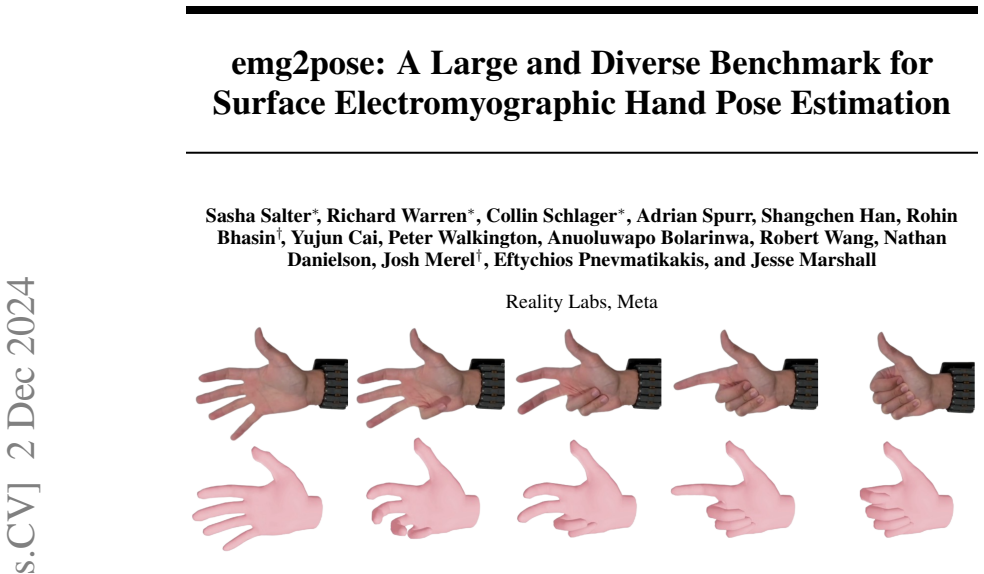
The load-bearing mechanism is the paired recording pipeline: a 16-channel, 2 kHz wrist sEMG band worn simultaneously with 19 reflective markers per hand tracked by 26 cameras, whose 3D positions are converted by an inverse-kinematics solver with a personalized hand model into 20 joint-angle degrees of freedom, then filtered and resampled to 2 kHz. On the modelling side, vemg2pose carries the baseline results: a causal strided convolutional featurizer built from time-depth separable convolutions turns sEMG into features at 50 Hz, and an autoregressive LSTM predicts joint angular velocities that are integrated into angles; for tracking the ground-truth initial pose seeds the integrator, while for regression the first 250 ms of angles are also predicted. The velocity representation is what lets one model handle both tasks and keeps predictions smooth.
What would settle it
Take a random sample of several hundred frames from occlusion-heavy and fist-clench stages, have annotators independently label joint angles using a different capture method, and compare them with the dataset's inverse-kinematics angles; if the median per-joint difference approaches the 7 to 15 degree errors reported for the models, the benchmark's headline numbers mostly measure label noise.
Extended reading notes
Core claim
The central claim is that a dataset large and diverse enough to span user anatomy, sensor placement, and hand kinematics makes it possible to learn continuous hand pose from wrist muscle signals for people and movement types never seen in training. The paper reports 193 users, 370 hours, 29 stages, and 80 million labelled frames, with 16-channel 2 kHz sEMG synchronized to 26-camera motion-capture labels within 10 ms; it calls this the largest open sEMG pose dataset and comparable in scale to large vision hand datasets. On held-out users, stages, and user-stage combinations, the velocity-based vemg2pose baseline achieves mean joint-angle errors of about 12.2, 15.2, and 15.8 degrees in regression and 7.7, 11.2, and 11.0 degrees in tracking, beating reimplementations of prior sEMG pose networks. Scale experiments show held-out error decreasing as training users or stages are added, which the authors present as evidence that breadth across these axes, not just dataset size, drives generalization.
Load-bearing premise
The motion-capture pipeline that turns marker positions into joint angles is accurate enough to serve as ground truth for all 193 users, even though the solver failed on 12.7 percent of frames and its angle estimates were never checked against an independent gold standard.
Editorial extensions
If this is right
- On emg2pose's held-out splits, sEMG alone supports continuous hand-pose estimation for unseen users at roughly 12.2 degrees mean joint-angle error in regression and 7.7 degrees in tracking, with the velocity model outperforming both reimplemented prior architectures.
- The three test sets let researchers measure generalization to new anatomy, new kinematics, and both at once; the user-plus-stage condition is the paper's proposed proxy for real-world deployment.
- Dataset scale is shown to be causally linked to generalization: subsampling training users or stages degrades held-out performance, so further scaling along these axes should keep reducing error.
- Stages designed to confound vision systems, including occlusion and hand-hand or hand-object interaction, do not degrade sEMG tracking, indicating the modality covers cases where cameras fail.
- The open benchmark and baselines give the community a shared platform for exploring sequence models, probabilistic decoding, and personalization for biosignal interfaces.
Reading between the lines
- If the inverse-kinematics labels contain noise of the same order as the reported errors, and the solver failed on 12.7 percent of frames without an independent gold-standard check, then part of the measured error is label error; an independent label audit on a few hundred frames would separate the two.
- The velocity-integration design hints that other derivative-sensing wearables, such as inertial, ultrasound, or impedance sensors, could borrow the same architecture whenever the measurement responds to movement rather than to static pose.
- The user-plus-stage held-out split could be adopted as a general time-series domain-generalization benchmark beyond sEMG, because it cleanly separates shift in the signal source from shift in the output behavior.
- The paper's own limitation notes imply that adding real-world signal aggressors such as sweat, electrode contact changes, and muscle fatigue, as well as wrist tracking, will be needed before the benchmark reflects in-the-wild performance; those are testable extensions rather than demonstrated results.
Editorial analysis
A structured set of objections, weighed in public.
Referee Report
Summary. The paper introduces emg2pose, a large benchmark dataset of wrist surface electromyography (sEMG) and hand pose labels obtained from a 26-camera motion capture rig. The dataset is reported to span 193 users, 370 hours, 29 kinematic stages, and 80M labeled frames, with pose labels given as joint angles. The authors provide three baselines (NeuroPose, SensingDynamics, and a new velocity-based vemg2pose model), define regression and tracking tasks, and evaluate generalization to held-out users, held-out stages, and held-out user-stage combinations. The paper also includes a datasheet, discussion of limitations, and links to code and data.
Significance. If the dataset and labels are as described, this is a valuable contribution to sEMG-based hand pose estimation and to benchmark research more broadly. The strongest assets are the scale relative to prior open sEMG datasets, the explicit three-axis generalization evaluation (users, stages, and user-stage combinations), the release of code and baseline models, and the unusually detailed documentation of collection, consent, preprocessing, and limitations. The paper is transparent about several weaknesses, including occlusion-induced label degradation, the default hand model used for landmark metrics, and the absence of seed variation in reported results. However, two issues need attention: the accuracy of the IK-derived pose labels is not validated against an independent gold standard, and the headline scale figures double-count the two hands. These issues affect the central claims and should be addressed before publication.
major comments (2)
- [Section 3.2, Appendix A, Appendix B.4] The central claim that emg2pose provides "high-quality hand pose labels" is not yet supported because the motion-capture inverse kinematics labels are never validated against an independent gold standard. Appendix A reports a 0.32 degree difference between filtered and unfiltered signals, which quantifies smoothing, not IK accuracy. Section 3.2 states that the IK solver failed on 12.7% of frames, typically due to simultaneously occluded markers, and Section 3.5 says those time-points are skipped during training and evaluation. Since Appendix B.4 concedes that occlusion "hinders label quality for gestures such as fist clenching," the skipped frames are plausibly concentrated in the hardest kinematic conditions; if so, the reported held-out errors are optimistic and the effective kinematic diversity is reduced. I request an independent validation study on a subset (e.g., manual marker annotation, a second sensing modality, or synthetic marker-dropout analysis), a per-stage report of failure rates, and an evaluation of how results change when failed frames are handled differently.
- [Section 1, Table 2, Section 3.2] The headline scale figures double-count the two hands. Section 3.2 notes that hours count left- and right-hand data separately, and Table 2 lists both "per hand" and "across hands" frame counts, but the abstract and introduction use the per-hand number (370 hours, 80M frames) without qualification. Unique hours are roughly 185 and unique frames roughly 40M. The largest-sEMG-dataset claim probably survives (Atzori et al. [2014] reports 37 hours), but the comparison with CV datasets such as Sener et al. [2022] (111M frames) is misleading if 80M is used. Please state unique-count figures in the abstract and introduction, or explicitly define 370 hours and 80M frames as per-hand totals.
minor comments (4)
- [Section 3.5] There are typos: "sEMG meaures" and "between between predicted and ground truth fingertip locations."
- [Appendix A, Section 3.2, Appendix B.2.1] The stated stage duration is inconsistent: Section 3.2 says 45–120 s, Appendix A says 30–120 s, and Appendix B.2.1 says 45–60 s (freeform 60–120 s). Please reconcile.
- [Section 3.5 and Table 7] The name "emg2pose" is used both for the dataset and for the positional (non-velocity) baseline model in Table 7, which is confusing next to "vemg2pose."
- [Table 4 and Checklist 3(c)] The paper states that seed variance is negligible but does not report the underlying numbers; adding a sentence with the observed spread across seeds would strengthen reproducibility.
Circularity Check
No significant circularity: the benchmark's empirical claims are self-contained and its held-out splits are independent of baseline fitting.
full rationale
The paper's central contribution is an empirical dataset and benchmark rather than a derivation chain, so there is no predicted quantity that reduces to its own input by construction. The strongest claims are scale statistics (193 users, 370 hours, 80M frames) and held-out generalization errors, all of which are computed from the collected data and fixed train/val/test splits. The self-citations to CTRL-labs at Reality Labs et al. [2024] supply hardware context for the sEMG-RD wristband, and the citation to Han et al. [2018] supplies the marker-based inverse kinematics labeling method; neither citation determines the reported test errors or the dataset scale, and the labeling method is an external, independently developed pipeline rather than a uniqueness theorem or ansatz imposed by this paper. The baselines are trained on the training split and evaluated on fixed held-out users, stages, and user-stage combinations, with no parameter fitted to the test error and renamed as a prediction. The velocity-integration design of vemg2pose is an architectural choice, not a self-defined metric. The acknowledged 12.7% IK failure frames being skipped during training and evaluation, and the default-hand-model bias in landmark distance, are validation and correctness concerns rather than circular reductions. No equation in the paper defines a reported result in terms of itself or of a fitted parameter masquerading as a prediction, so the appropriate finding is no significant circularity.
Assumptions & free parameters
free parameters (5)
- Fingertip loss weight =
0.01
- vemg2pose output scale =
0.01
- Regression initial-state window P =
250 ms
- Joint angle low-pass filter cutoff =
15 Hz
- Evaluation trajectory length =
5 s
assumptions (4)
- domain assumption sEMG from the sEMG-RD wristband contains sufficient information about muscle activity to infer hand pose given enough data.
- domain assumption The motion-capture inverse kinematics pipeline produces accurate ground-truth joint angles; failed frames (12.7%) are skipped without biasing the data.
- domain assumption Software timestamp alignment keeps sEMG and motion capture streams within 10 ms relative latency, approximately the Nyquist limit of the 60 Hz mocap.
- domain assumption The default hand model used to convert joint angles to landmark positions is an adequate approximation for all users.
Cite this review
Pith. "Pith review of emg2pose: A Large and Diverse Benchmark for Surface Electromyographic Hand Pose Estimation." pith.science (2026). https://pith.science/paper/IWV4ZJVB
@misc{pith2026241202725,
  author       = {Pith},
  title        = {Pith review of: emg2pose: A Large and Diverse Benchmark for Surface Electromyographic Hand Pose Estimation},
  year         = {2026},
  howpublished = {\url{https://pith.science/paper/IWV4ZJVB}},
  note         = {Machine review of arXiv:2412.02725}
}
read the original abstract
Hands are the primary means through which humans interact with the world. Reliable and always-available hand pose inference could yield new and intuitive control schemes for human-computer interactions, particularly in virtual and augmented reality. Computer vision is effective but requires one or multiple cameras and can struggle with occlusions, limited field of view, and poor lighting. Wearable wrist-based surface electromyography (sEMG) presents a promising alternative as an always-available modality sensing muscle activities that drive hand motion. However, sEMG signals are strongly dependent on user anatomy and sensor placement, and existing sEMG models have required hundreds of users and device placements to effectively generalize. To facilitate progress on sEMG pose inference, we introduce the emg2pose benchmark, the largest publicly available dataset of high-quality hand pose labels and wrist sEMG recordings. emg2pose contains 2kHz, 16 channel sEMG and pose labels from a 26-camera motion capture rig for 193 users, 370 hours, and 29 stages with diverse gestures - a scale comparable to vision-based hand pose datasets. We provide competitive baselines and challenging tasks evaluating real-world generalization scenarios: held-out users, sensor placements, and stages. emg2pose provides the machine learning community a platform for exploring complex generalization problems, holding potential to significantly enhance the development of sEMG-based human-computer interactions.
Figures


Figures from the paper (12 more)


Forward citations
Cited by 1 Pith paper
-
Sensor-Placement-Agnostic Sonomyography: Toward Continuous High-Dimensional Control by Users with Tetraplegia
A three-pose-calibrated optical-flow sonomyography algorithm gives continuous 1-DOF cursor control from arbitrary sensor locations, plus a first pilot of continuous 2-DOF control.
Reference graph
Works this paper leans on
-
[1]
P. Achenbach, S. Laux, D. Purdack, P. N. M \"u ller, and S. G \"o bel. Give me a sign: Using data gloves for static hand-shape recognition. Sensors, 23 0 (24): 0 9847, 2023
work page 2023
- [2]
-
[3]
C. Amma, T. Krings, J. B \"o er, and T. Schultz. Advancing muscle-computer interfaces with high-density electromyography. In Proceedings of the 33rd Annual ACM Conference on Human Factors in Computing Systems, pages 929--938, 2015
work page 2015
- [4]
- [5]
-
[6]
A. Boukhayma, R. d. Bem, and P. H. Torr. 3d hand shape and pose from images in the wild. In Proceedings of the IEEE/CVF Conference on Computer Vision and Pattern Recognition, pages 10843--10852, 2019
work page 2019
-
[7]
S. Brahmbhatt, C. Tang, C. D. Twigg, C. C. Kemp, and J. Hays. Contactpose: A dataset of grasps with object contact and hand pose. In Computer Vision--ECCV 2020: 16th European Conference, Glasgow, UK, August 23--28, 2020, Proceedings, Part XIII 16, pages 361--378. Springer, 2020
work page 2020
-
[8]
A. Brunetti, D. Buongiorno, G. F. Trotta, and V. Bevilacqua. Computer vision and deep learning techniques for pedestrian detection and tracking: A survey. Neurocomputing, 300: 0 17--33, 2018
work page 2018
Show all 78 references
-
[9]
Caggiano, H
V. Caggiano, H. Wang, G. Durandau, M. Sartori, and V. Kumar. Myosuite--a contact-rich simulation suite for musculoskeletal motor control. arXiv preprint arXiv:2205.13600, 2022
2022 arXiv
-
[10]
Y. Cai, L. Ge, J. Cai, and J. Yuan. Weakly-supervised 3d hand pose estimation from monocular rgb images. In Proceedings of the European conference on computer vision (ECCV), pages 666--682, 2018
2018
-
[11]
Sussillo, P
CTRL - labs at Reality Labs , D. Sussillo, P. Kaifosh, and T. Reardon. A generic noninvasive neuromotor interface for human-computer interaction. bioRxiv, 2024. doi:10.1101/2024.02.23.581779. URL https://www.biorxiv.org/content/early/2024/02/28/2024.02.23.581779
2024 doi
-
[12]
Danelljan, L
M. Danelljan, L. V. Gool, and R. Timofte. Probabilistic regression for visual tracking. In Proceedings of the IEEE/CVF conference on computer vision and pattern recognition, pages 7183--7192, 2020
2020
-
[13]
Darvish, L
K. Darvish, L. Penco, J. Ramos, R. Cisneros, J. Pratt, E. Yoshida, S. Ivaldi, and D. Pucci. Teleoperation of humanoid robots: A survey. IEEE Transactions on Robotics, 39 0 (3): 0 1706--1727, 2023
2023
-
[14]
Y. Du, W. Jin, W. Wei, Y. Hu, and W. Geng. Surface emg-based inter-session gesture recognition enhanced by deep domain adaptation. Sensors, 17 0 (3): 0 458, 2017
2017
-
[15]
Dunion, T
M. Dunion, T. McInroe, K. S. Luck, J. Hanna, and S. Albrecht. Conditional mutual information for disentangled representations in reinforcement learning. Advances in Neural Information Processing Systems, 36, 2024
2024
-
[16]
Z. Fan, O. Taheri, D. Tzionas, M. Kocabas, M. Kaufmann, M. J. Black, and O. Hilliges. Arctic: A dataset for dexterous bimanual hand-object manipulation. In Proceedings of the IEEE/CVF Conference on Computer Vision and Pattern Recognition, pages 12943--12954, 2023
2023
-
[17]
I. T. Gatt, T. Allen, and J. Wheat. Accuracy and repeatability of wrist joint angles in boxing using an electromagnetic tracking system. Sports Engineering, 23: 0 1--10, 2020
2020
-
[18]
L. Ge, H. Liang, J. Yuan, and D. Thalmann. Robust 3d hand pose estimation in single depth images: from single-view cnn to multi-view cnns. In Proceedings of the IEEE conference on computer vision and pattern recognition, pages 3593--3601, 2016
2016
-
[19]
Gebru, J
T. Gebru, J. Morgenstern, B. Vecchione, J. W. Vaughan, H. Wallach, H. D. Iii, and K. Crawford. Datasheets for datasets. Communications of the ACM, 64 0 (12): 0 86--92, 2021
2021
-
[20]
A. Gu, K. Goel, and C. R \'e . Efficiently modeling long sequences with structured state spaces. arXiv preprint arXiv:2111.00396, 2021
2021 arXiv
-
[21]
Hampali, M
S. Hampali, M. Rad, M. Oberweger, and V. Lepetit. Honnotate: A method for 3d annotation of hand and object poses. In Proceedings of the IEEE/CVF conference on computer vision and pattern recognition, pages 3196--3206, 2020
2020
-
[22]
S. Han, B. Liu, R. Wang, Y. Ye, C. D. Twigg, and K. Kin. Online optical marker-based hand tracking with deep labels. Acm transactions on graphics (tog), 37 0 (4): 0 1--10, 2018
2018
-
[23]
S. Han, B. Liu, R. Cabezas, C. D. Twigg, P. Zhang, J. Petkau, T.-H. Yu, C.-J. Tai, M. Akbay, Z. Wang, et al. Megatrack: monochrome egocentric articulated hand-tracking for virtual reality. ACM Transactions on Graphics (ToG), 39 0 (4): 0 87--1, 2020
2020
-
[24]
S. Han, P. Wu, Y. Zhang, B. Liu, L. Zhang, Z. Wang, W. Si, P. Zhang, Y. Cai, T. Hodan, R. Cabezas, L. Tran, M. Akbay, T. Yu, C. Keskin, and R. Wang. Umetrack: Unified multi-view end-to-end hand tracking for VR . In SIGGRAPH Asia 2022 Conference Papers, SA 2022, Daegu, Republic...
2022
-
[25]
Hannun, A
A. Hannun, A. Lee, Q. Xu, and R. Collobert. Sequence-to-sequence speech recognition with time-depth separable convolutions. arXiv preprint arXiv:1904.02619, 2019
1904 arXiv
-
[26]
J. N. Ingram, K. P. K \"o rding, I. S. Howard, and D. M. Wolpert. The statistics of natural hand movements. Experimental brain research, 188: 0 223--236, 2008
2008
-
[27]
E. Jang, A. Irpan, M. Khansari, D. Kappler, F. Ebert, C. Lynch, S. Levine, and C. Finn. Bc-z: Zero-shot task generalization with robotic imitation learning. In Conference on Robot Learning, pages 991--1002. PMLR, 2022
2022
-
[28]
Jiang, X
X. Jiang, X. Liu, J. Fan, X. Ye, C. Dai, E. A. Clancy, M. Akay, and W. Chen. Open access dataset, toolbox and benchmark processing results of high-density surface electromyogram recordings. IEEE Transactions on Neural Systems and Rehabilitation Engineering, 29: 0 1035--1046, 2021
2021
-
[29]
J. D. M.-W. C. Kenton and L. K. Toutanova. Bert: Pre-training of deep bidirectional transformers for language understanding. In Proceedings of naacL-HLT, volume 1, page 2. Minneapolis, Minnesota, 2019
2019
-
[30]
Kirillov, E
A. Kirillov, E. Mintun, N. Ravi, H. Mao, C. Rolland, L. Gustafson, T. Xiao, S. Whitehead, A. C. Berg, W.-Y. Lo, et al. Segment anything. In Proceedings of the IEEE/CVF International Conference on Computer Vision, pages 4015--4026, 2023
2023
-
[31]
Kojima, S
T. Kojima, S. S. Gu, M. Reid, Y. Matsuo, and Y. Iwasawa. Large language models are zero-shot reasoners. Advances in neural information processing systems, 35: 0 22199--22213, 2022
2022
-
[32]
Krasoulis, I
A. Krasoulis, I. Kyranou, M. S. Erden, K. Nazarpour, and S. Vijayakumar. Improved prosthetic hand control with concurrent use of myoelectric and inertial measurements. Journal of neuroengineering and rehabilitation, 14: 0 1--14, 2017
2017
-
[33]
Laput and C
G. Laput and C. Harrison. Sensing fine-grained hand activity with smartwatches. In Proceedings of the 2019 CHI Conference on Human Factors in Computing Systems, pages 1--13, 2019
2019
-
[34]
Laput, R
G. Laput, R. Xiao, and C. Harrison. Viband: High-fidelity bio-acoustic sensing using commodity smartwatch accelerometers. In Proceedings of the 29th Annual Symposium on User Interface Software and Technology, UIST '16, page 321–333, New York, NY, USA, 2016. Association for Com...
2016
-
[35]
Lauri, D
M. Lauri, D. Hsu, and J. Pajarinen. Partially observable markov decision processes in robotics: A survey. IEEE Transactions on Robotics, 39 0 (1): 0 21--40, 2022
2022
-
[36]
Y. Liu, S. Zhang, and M. Gowda. Neuropose: 3d hand pose tracking using emg wearables. In Proceedings of the Web Conference 2021, pages 1471--1482, 2021
2021
-
[37]
Y. Liu, Y. Liu, C. Jiang, K. Lyu, W. Wan, H. Shen, B. Liang, Z. Fu, H. Wang, and L. Yi. Hoi4d: A 4d egocentric dataset for category-level human-object interaction. In Proceedings of the IEEE/CVF Conference on Computer Vision and Pattern Recognition, pages 21013--21022, 2022
2022
-
[38]
Y. Luo, Y. Li, P. Sharma, W. Shou, K. Wu, M. Foshey, B. Li, T. Palacios, A. Torralba, and W. Matusik. Learning human--environment interactions using conformal tactile textiles. Nature Electronics, 4 0 (3): 0 193--201, 2021
2021
-
[39]
McIntosh, A
J. McIntosh, A. Marzo, M. Fraser, and C. Phillips. Echoflex: Hand gesture recognition using ultrasound imaging. In Proceedings of the 2017 CHI Conference on Human Factors in Computing Systems, pages 1923--1934, 2017
2017
-
[40]
Merletti and D
R. Merletti and D. Farina. Surface electromyography: physiology, engineering, and applications. John Wiley & Sons, 2016
2016
-
[41]
Moon, S.-I
G. Moon, S.-I. Yu, H. Wen, T. Shiratori, and K. M. Lee. Interhand2. 6m: A dataset and baseline for 3d interacting hand pose estimation from a single rgb image. In Computer Vision--ECCV 2020: 16th European Conference, Glasgow, UK, August 23--28, 2020, Proceedings, Part XX 16, p...
2020
-
[42]
G. Moon, S. Saito, W. Xu, R. Joshi, J. Buffalini, H. Bellan, N. Rosen, J. Richardson, M. Mize, P. De Bree, et al. A dataset of relighted 3d interacting hands. Advances in Neural Information Processing Systems, 36, 2024
2024
-
[43]
Mueller, D
F. Mueller, D. Mehta, O. Sotnychenko, S. Sridhar, D. Casas, and C. Theobalt. Real-time hand tracking under occlusion from an egocentric rgb-d sensor. In Proceedings of the IEEE International Conference on Computer Vision, pages 1154--1163, 2017
2017
-
[44]
Mueller, F
F. Mueller, F. Bernard, O. Sotnychenko, D. Mehta, S. Sridhar, D. Casas, and C. Theobalt. Ganerated hands for real-time 3d hand tracking from monocular rgb. In Proceedings of the IEEE conference on computer vision and pattern recognition, pages 49--59, 2018
2018
-
[45]
Palermo, M
F. Palermo, M. Cognolato, A. Gijsberts, H. M \"u ller, B. Caputo, and M. Atzori. Repeatability of grasp recognition for robotic hand prosthesis control based on semg data. In 2017 International Conference on Rehabilitation Robotics (ICORR), pages 1154--1159. IEEE, 2017
2017
-
[46]
X. Pan, P. Luo, J. Shi, and X. Tang. Two at once: Enhancing learning and generalization capacities via ibn-net. In Proceedings of the european conference on computer vision (ECCV), pages 464--479, 2018
2018
-
[47]
F. S. Parizi, E. Whitmire, and S. Patel. Auraring: Precise electromagnetic finger tracking. Proceedings of the ACM on Interactive, Mobile, Wearable and Ubiquitous Technologies, 3 0 (4): 0 1--28, 2019
2019
-
[48]
Park, T.-K
G. Park, T.-K. Kim, and W. Woo. 3d hand pose estimation with a single infrared camera via domain transfer learning. In 2020 IEEE International Symposium on Mixed and Augmented Reality (ISMAR), pages 588--599. IEEE, 2020
2020
-
[49]
Collaborative data science, 2015
Plotly Technologies Inc. Collaborative data science, 2015. URL https://plot.ly
2015
-
[50]
Quivira, T
F. Quivira, T. Koike-Akino, Y. Wang, and D. Erdogmus. Translating semg signals to continuous hand poses using recurrent neural networks. In 2018 IEEE EMBS International Conference on Biomedical & Health Informatics (BHI), pages 166--169. IEEE, 2018
2018
-
[51]
Rawat, S
S. Rawat, S. Vats, and P. Kumar. Evaluating and exploring the myo armband. In 2016 International Conference System Modeling & Advancement in Research Trends (SMART), pages 115--120. IEEE, 2016
2016
-
[52]
Roda-Sales, J
A. Roda-Sales, J. L. Sancho-Bru, M. Vergara, V. Gracia-Ib \'a \ n ez, and N. J. Jarque-Bou. Effect on manual skills of wearing instrumented gloves during manipulation. Journal of biomechanics, 98: 0 109512, 2020
2020
-
[53]
Samarth, T
B. Samarth, T. Chengcheng, D. T. Christopher, C. K. Charles, and H. James. Contactpose: A dataset of grasps with object contact and hand pose. In European Conference on Computer Vision (ECCV), 2020
2020
-
[54]
Santos Carreras
L. Santos Carreras. Increasing haptic fidelity and ergonomics in teleoperated surgery. Technical report, EPFL, 2012
2012
-
[55]
Scheggi, L
S. Scheggi, L. Meli, C. Pacchierotti, and D. Prattichizzo. Touch the virtual reality: using the leap motion controller for hand tracking and wearable tactile devices for immersive haptic rendering. In ACM SIGGRAPH 2015 Posters, pages 1--1. 2015
2015
-
[56]
Sener, D
F. Sener, D. Chatterjee, D. Shelepov, K. He, D. Singhania, R. Wang, and A. Yao. Assembly101: A large-scale multi-view video dataset for understanding procedural activities. In Proceedings of the IEEE/CVF Conference on Computer Vision and Pattern Recognition, pages 21096--21106, 2022
2022
-
[57]
Z. Shen, J. Yi, X. Li, M. H. P. Lo, M. Z. Chen, Y. Hu, and Z. Wang. A soft stretchable bending sensor and data glove applications. Robotics and biomimetics, 3 0 (1): 0 22, 2016
2016
-
[58]
Shrestha, C
S. Shrestha, C. Ferm \"u ller, T. Huang, P. T. Win, A. Zukerman, C. M. Parameshwara, and Y. Aloimonos. Aimusicguru: Music assisted human pose correction. arXiv preprint arXiv:2203.12829, 2022
2022 arXiv
-
[59]
R. C. S \^ mpetru, A. Arkudas, D. I. Braun, M. Osswald, D. S. de Oliveira, B. Eskofier, T. M. Kinfe, and A. Del Vecchio. Sensing the full dynamics of the human hand with a neural interface and deep learning. bioRxiv, pages 2022--07, 2022 a
2022
-
[60]
R. C. S \^ mpetru, M. Osswald, D. I. Braun, D. S. Oliveira, A. L. Cakici, and A. Del Vecchio. Accurate continuous prediction of 14 degrees of freedom of the hand from myoelectrical signals through convolutive deep learning. In 2022 44th Annual International Conference of the I...
2022
-
[61]
Sosin, D
I. Sosin, D. Kudenko, and A. Shpilman. Continuous gesture recognition from semg sensor data with recurrent neural networks and adversarial domain adaptation. In 2018 15Th international conference on control, automation, robotics and vision (ICARCV), pages 1436--1441. IEEE, 2018
2018
-
[62]
M. T. Spaan. Partially observable markov decision processes. In Reinforcement learning: State-of-the-art, pages 387--414. Springer, 2012
2012
-
[63]
Spurr, J
A. Spurr, J. Song, S. Park, and O. Hilliges. Cross-modal deep variational hand pose estimation. In Proceedings of the IEEE conference on computer vision and pattern recognition, pages 89--98, 2018
2018
-
[64]
Spurr, U
A. Spurr, U. Iqbal, P. Molchanov, O. Hilliges, and J. Kautz. Weakly supervised 3d hand pose estimation via biomechanical constraints. In European conference on computer vision, pages 211--228. Springer, 2020
2020
-
[65]
Spurr, A
A. Spurr, A. Dahiya, X. Wang, X. Zhang, and O. Hilliges. Self-supervised 3d hand pose estimation from monocular rgb via contrastive learning. In Proceedings of the IEEE/CVF international conference on computer vision, pages 11230--11239, 2021
2021
-
[66]
D. Stashuk. Emg signal decomposition: how can it be accomplished and used? Journal of Electromyography and Kinesiology, 11 0 (3): 0 151--173, 2001
2001
-
[67]
J. S. Supan c i c , G. Rogez, Y. Yang, J. Shotton, and D. Ramanan. Depth-based hand pose estimation: methods, data, and challenges. International Journal of Computer Vision, 126: 0 1180--1198, 2018
2018
-
[68]
Tashakori, Z
A. Tashakori, Z. Jiang, A. Servati, S. Soltanian, H. Narayana, K. Le, C. Nakayama, C.-l. Yang, Z. J. Wang, J. J. Eng, et al. Capturing complex hand movements and object interactions using machine learning-powered stretchable smart textile gloves. Nature Machine Intelligence, 6...
2024
-
[69]
Truong, S
H. Truong, S. Zhang, U. Muncuk, P. Nguyen, N. Bui, A. Nguyen, Q. Lv, K. Chowdhury, T. Dinh, and T. Vu. Capband: Battery-free successive capacitance sensing wristband for hand gesture recognition. In Proceedings of the 16th ACM Conference on Embedded Networked Sensor Systems, p...
2018
-
[70]
C. Wan, T. Probst, L. V. Gool, and A. Yao. Self-supervised 3d hand pose estimation through training by fitting. In Proceedings of the IEEE/CVF conference on computer vision and pattern recognition, pages 10853--10862, 2019
2019
-
[71]
J. Wang, F. Mueller, F. Bernard, S. Sorli, O. Sotnychenko, N. Qian, M. A. Otaduy, D. Casas, and C. Theobalt. Rgb2hands: real-time tracking of 3d hand interactions from monocular rgb video. ACM Transactions on Graphics (ToG), 39 0 (6): 0 1--16, 2020
2020
-
[72]
Z. Yang, S. Yan, B.-J. F. van Beijnum, B. Li, and P. H. Veltink. Hand-finger pose estimation using inertial sensors, magnetic sensors and a magnet. IEEE sensors journal, 21 0 (16): 0 18115--18122, 2021
2021
-
[73]
Z. Yu, J. S. Yoon, I. K. Lee, P. Venkatesh, J. Park, J. Yu, and H. S. Park. Humbi: A large multiview dataset of human body expressions. In Proceedings of the IEEE/CVF Conference on Computer Vision and Pattern Recognition, pages 2990--3000, 2020
2020
-
[74]
S. Yuan, Q. Ye, B. Stenger, S. Jain, and T.-K. Kim. Bighand2. 2m benchmark: Hand pose dataset and state of the art analysis. In Proceedings of the IEEE conference on computer vision and pattern recognition, pages 4866--4874, 2017
2017
-
[75]
Y. Yuan, J. Song, U. Iqbal, A. Vahdat, and J. Kautz. Physdiff: Physics-guided human motion diffusion model. In Proceedings of the IEEE/CVF International Conference on Computer Vision, pages 16010--16021, 2023
2023
-
[76]
Zhang and C
Y. Zhang and C. Harrison. Tomo: Wearable, low-cost electrical impedance tomography for hand gesture recognition. In Proceedings of the 28th Annual ACM Symposium on User Interface Software & Technology, pages 167--173, 2015
2015
-
[77]
Zimmermann and T
C. Zimmermann and T. Brox. Learning to estimate 3d hand pose from single rgb images. In Proceedings of the IEEE international conference on computer vision, pages 4903--4911, 2017
2017
-
[78]
Zimmermann, D
C. Zimmermann, D. Ceylan, J. Yang, B. Russell, M. Argus, and T. Brox. Freihand: A dataset for markerless capture of hand pose and shape from single rgb images. In Proceedings of the IEEE/CVF International Conference on Computer Vision, pages 813--822, 2019
2019
Reviewed August 11, 2026 · model on record in the stance chip above.
Discussion (0). Continue with ORCID to comment.