Probing globular clusters parameters through gravitational wave lensing with stellar-mass black hole binaries
Pith reviewed 2026-07-01 04:00 UTC · model grok-4.3
The pith
Lensed gravitational waves from stellar-mass black hole binaries can recover the central velocity dispersion of globular clusters modeled as singular isothermal spheres.
A machine-rendered reading of the paper's core claim, the machinery that carries it, and where it could break.
Core claim
By modeling globular clusters as singular isothermal spheres, the effective lensing mass imprinted on gravitational wave signals in the wave-optics regime can be recovered through Bayesian inference on joint source-lens parameters, and this mass, together with sky localization, permits estimation of the cluster central velocity dispersion for well-aligned sources.
What carries the argument
Wave-optics lensing signatures from singular isothermal sphere models of globular clusters, embedded in gravitational waveform templates for joint Bayesian estimation of source and lens parameters.
If this is right
- The effective lensing mass is recoverable from the frequency-dependent signatures in the lensed gravitational wave signal.
- Combining the recovered lensing mass with sky localization information and globular cluster catalogs yields an estimate of the cluster's central velocity dispersion.
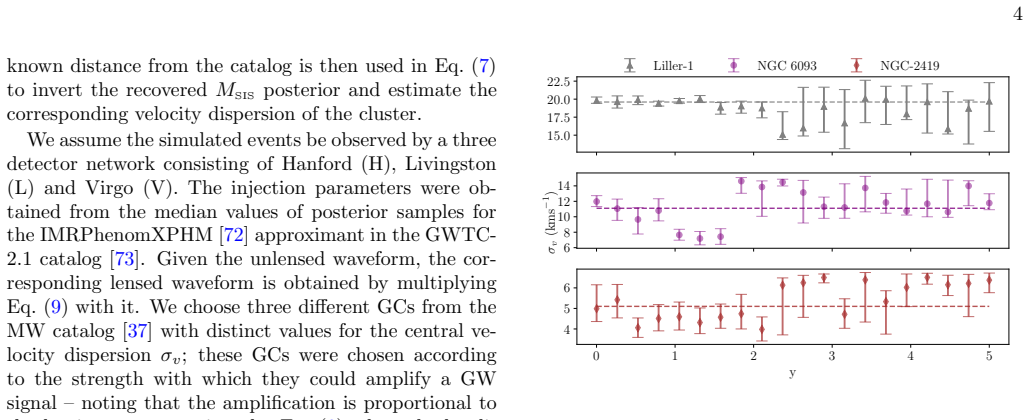
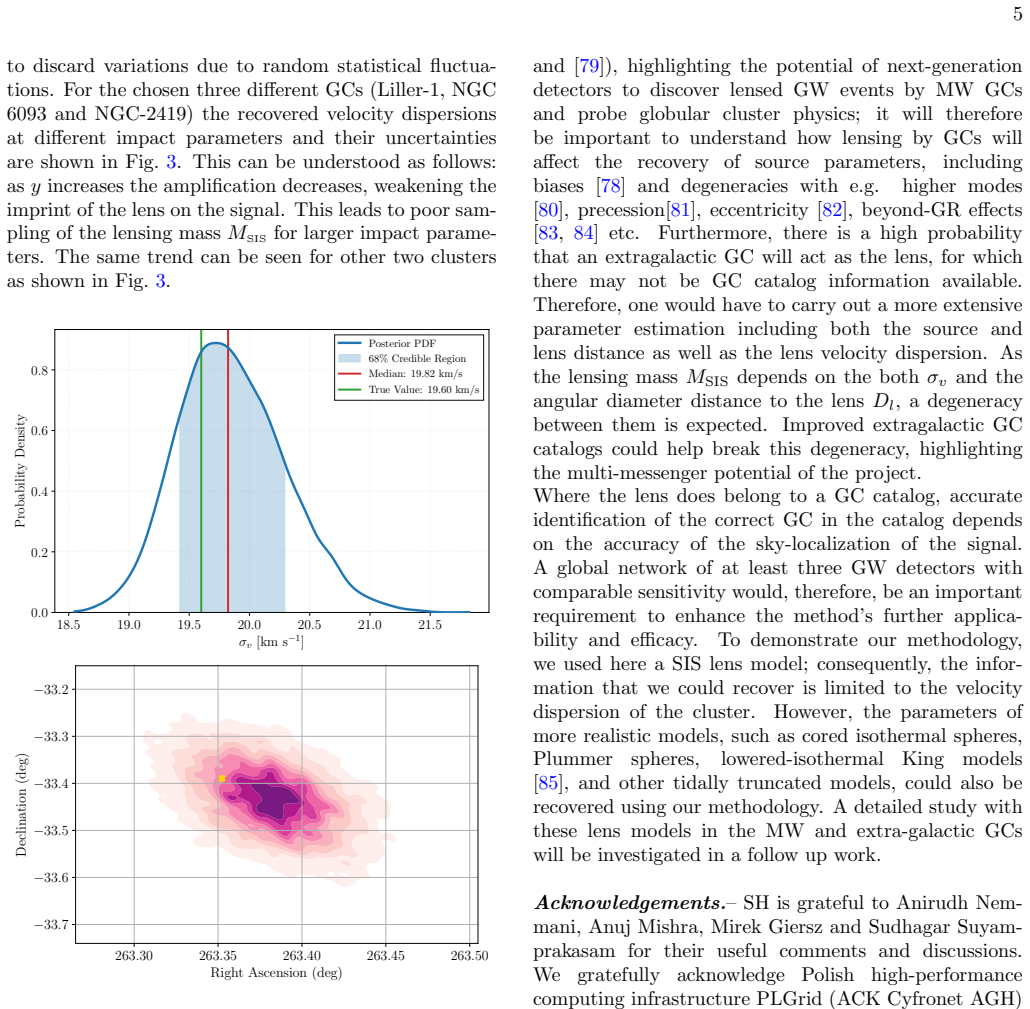
- For favorable source-lens alignments the injected velocity dispersion values are recovered within credible intervals.
- This approach provides a complementary probe of globular cluster dynamics alongside traditional methods.
Where Pith is reading between the lines
- Future gravitational wave detectors with better sky localization could increase the number of identifiable lensed events from globular clusters.
- Applying this to real data would require careful accounting for uncertainties in globular cluster catalogs and positions.
- More detailed modeling of globular cluster density profiles beyond the singular isothermal sphere could test the robustness of the velocity dispersion recovery.
Load-bearing premise
That globular clusters are adequately described by singular isothermal sphere models for calculating wave-optics lensing effects and that sky localization allows unambiguous association of the lensing mass with a particular cluster.
What would settle it
Detection of a gravitational wave signal showing wave-optics lensing features where the inferred velocity dispersion from the effective lensing mass disagrees with independent optical measurements of the associated globular cluster.
Figures
read the original abstract
Globular clusters (GCs) can act as gravitational lenses for gravitational waves(GWs) in the wave-optics regime, imprinting frequency-dependent signatures on the observed signal. We investigate whether such lensing effects can be used to probe intrinsic properties of GCs, in particular their central velocity dispersion. Modeling GCs as singular isothermal spheres, we simulate lensed GW150914-like signals and perform Bayesian parameter estimation using waveform templates that include both source and lens parameters. We show that the effective lensing mass can be recovered and, when combined with GW sky localization information and GC catalogs, allows for an estimate of the cluster velocity dispersion. For favorable source-lens alignments, the injected values are well recovered within credible intervals. Our results demonstrate that lensed GWs can provide a complementary probe of GC dynamics and motivate searches for such signatures in current and future observations.
Editorial analysis
A structured set of objections, weighed in public.
Referee Report
Summary. The manuscript investigates whether wave-optics gravitational lensing of stellar-mass black-hole binary signals by globular clusters (GCs) can be used to recover the clusters' central velocity dispersion. GCs are modeled as singular isothermal spheres (SIS); lensed GW150914-like waveforms are simulated and Bayesian parameter estimation is performed with templates that include both source and lens parameters. The effective lensing mass is recovered and, when combined with sky localization and GC catalogs, is converted to an estimate of σ via the fixed SIS relation. For favorable alignments the injected values are recovered within credible intervals. The authors conclude that lensed GWs can serve as a complementary probe of GC dynamics.
Significance. If the modeling assumptions hold, the work would open a new observational channel for GC dynamics that is independent of electromagnetic tracers. The simulation framework itself is a useful technical contribution, but its translation to real GCs hinges on the validity of the SIS approximation for the wave-optics amplification factor.
major comments (1)
- [modeling and recovery] Abstract and modeling section: all Bayesian recovery is performed exclusively under the SIS lens model with the deflection scale tied directly to σ². Real GCs follow cored King or Wilson profiles whose projected density differs from the SIS asymptotic form; the frequency-dependent amplification F(f) is sensitive to this difference. No cross-checks against non-SIS profiles are reported, so the magnitude of any systematic bias on the recovered effective mass (and therefore on inferred σ) remains unquantified. This assumption is load-bearing for the central claim that the method probes actual GC dynamics.
minor comments (1)
- [abstract] The abstract provides no quantitative information on waveform approximants, prior ranges, convergence diagnostics, or the impact of sky-localization uncertainty; these details should be added to allow readers to assess the robustness of the reported credible-interval recoveries.
Simulated Author's Rebuttal
We thank the referee for their constructive comments, which highlight an important modeling assumption in our work. We address the major comment below and indicate the revisions we will incorporate.
read point-by-point responses
-
Referee: Abstract and modeling section: all Bayesian recovery is performed exclusively under the SIS lens model with the deflection scale tied directly to σ². Real GCs follow cored King or Wilson profiles whose projected density differs from the SIS asymptotic form; the frequency-dependent amplification F(f) is sensitive to this difference. No cross-checks against non-SIS profiles are reported, so the magnitude of any systematic bias on the recovered effective mass (and therefore on inferred σ) remains unquantified. This assumption is load-bearing for the central claim that the method probes actual GC dynamics.
Authors: We agree that the SIS model is a simplifying assumption and that real GCs are better described by cored profiles (e.g., King or Wilson). The SIS form is adopted because it yields an analytic deflection scale directly tied to σ², which is standard in GC lensing literature and enables the mapping from effective lensing mass to velocity dispersion. We acknowledge that profile differences can affect F(f) and that the absence of cross-checks leaves potential systematic bias unquantified. In the revised manuscript we will (i) add an explicit discussion of this limitation in the modeling section, (ii) note that the recovered parameter is the SIS-equivalent effective mass, and (iii) include a brief comparison with a cored isothermal sphere in an appendix to illustrate the magnitude of the difference for representative alignments. These additions will qualify the scope of the central claim without altering the reported recovery results under the SIS model. revision: yes
Circularity Check
No significant circularity detected
full rationale
The paper models GCs explicitly as singular isothermal spheres, simulates lensed signals under that model, performs Bayesian PE to recover an effective lensing mass, and then applies the model's known SIS relation (deflection scale tied to velocity dispersion) together with external sky localization and catalogs to infer sigma. This is a forward-model simulation and recovery exercise whose output is not equivalent to its inputs by construction; the recovered mass is an independent fit result, and the subsequent sigma estimate follows from the stated model relation rather than redefining or tautologically reproducing the input. No self-citations, uniqueness theorems, or ansatzes are invoked in the provided text to justify the central claim. The derivation chain remains self-contained against external benchmarks and does not reduce to any of the enumerated circularity patterns.
Axiom & Free-Parameter Ledger
axioms (1)
- domain assumption Globular clusters are modeled as singular isothermal spheres for wave-optics gravitational lensing calculations.
Reference graph
Works this paper leans on
-
[1]
In addition, uncertainties in determining the true cluster center introduce further systematic errors [54]
as well as stellar crowding in the dense central re- gions of GCs and shot noise from a few luminous giant stars, which can bias velocity-dispersion measurements [52, 53]. In addition, uncertainties in determining the true cluster center introduce further systematic errors [54]. These challenges become even more pronounced in core-collapsed clusters or in...
2025
-
[2]
B. P. Abbottet al.(LIGO Scientific, Virgo), GW150914: First results from the search for binary black hole coa- lescence with Advanced LIGO, Phys. Rev. D93, 122003 (2016), arXiv:1602.03839 [gr-qc]
work page internal anchor Pith review Pith/arXiv arXiv 2016
-
[3]
J. Aasiet al.(LIGO Scientific), Advanced LIGO, Class. Quant. Grav.32, 074001 (2015), arXiv:1411.4547 [gr-qc]
work page internal anchor Pith review Pith/arXiv arXiv 2015
-
[4]
Advanced Virgo: a 2nd generation interferometric gravitational wave detector
F. Acerneseet al.(VIRGO), Advanced Virgo: a second- generation interferometric gravitational wave detector, Class. Quant. Grav.32, 024001 (2015), arXiv:1408.3978 [gr-qc]
work page internal anchor Pith review Pith/arXiv arXiv 2015
-
[5]
B. P. Abbottet al.(KAGRA, LIGO Scientific, Virgo), Prospects for observing and localizing gravitational-wave transients with Advanced LIGO, Advanced Virgo and KAGRA, Living Rev. Rel.19, 1 (2016), arXiv:1304.0670 [gr-qc]
work page internal anchor Pith review Pith/arXiv arXiv 2016
-
[6]
A. G. Abacet al.(LIGO Scientific, VIRGO, KAGRA), GWTC-4.0: Updating the Gravitational-Wave Tran- sient Catalog with Observations from the First Part of the Fourth LIGO-Virgo-KAGRA Observing Run (2025), arXiv:2508.18082 [gr-qc]
work page internal anchor Pith review Pith/arXiv arXiv 2025
-
[7]
GWTC-5.0: An Introduction to Version 5.0 of the Gravitational-Wave Transient Catalog
N. Abacet al.(LIGO Scientific, VIRGO, KAGRA), GWTC-5.0: An Introduction to Version 5.0 of the Gravitational-Wave Transient Catalog, DCC (2026), arXiv:2605.27223 [gr-qc]
work page internal anchor Pith review Pith/arXiv arXiv 2026
-
[8]
A. G. Abacet al.(LIGO Scientific, VIRGO, KAGRA), GW231123: A Binary Black Hole Merger with Total Mass 190–265 M ⊙, Astrophys. J. Lett.993, L25 (2025), arXiv:2507.08219 [astro-ph.HE]
work page internal anchor Pith review Pith/arXiv arXiv 2025
-
[9]
A. G. Abacet al.(KAGRA, Virgo, LIGO Scientific), GW250114: Testing Hawking’s Area Law and the Kerr Nature of Black Holes, Phys. Rev. Lett.135, 111403 (2025), arXiv:2509.08054 [gr-qc]
work page internal anchor Pith review Pith/arXiv arXiv 2025
- [10]
- [11]
- [12]
-
[13]
L. Yang, X. Ding, M. Biesiada, K. Liao, and Z.-H. Zhu, How Does the Earth’s Rotation Affect Predictions of Gravitational Wave Strong Lensing Rates?, Astrophys. J.874, 139 (2019), arXiv:1903.11079 [astro-ph.GA]
work page internal anchor Pith review Pith/arXiv arXiv 2019
-
[14]
S.-S. Li, S. Mao, Y. Zhao, and Y. Lu, Gravitational lens- ing of gravitational waves: a statistical perspective, MN- RAS476, 2220 (2018), arXiv:1802.05089 [astro-ph.CO]
work page internal anchor Pith review Pith/arXiv arXiv 2018
-
[15]
G. P. Smith, T. Baker, S. Birrer, C. E. Collins, J. M. Ezquiaga, S. Goyal, O. A. Hannuksela, P. Hemanta, M. A. Hendry, J. Janquart, D. Keitel, A. J. Levan, R. K. L. Lo, A. More, M. Nicholl, I. Pastor-Marazuela, A. I. Ponte P´ erez, H. Ubach, L. E. Uronen, M. Wright, M. Zumalacarregui, F. Bianco, M. C ¸ ali¸ skan, J. C. L. Chan, E. Colangeli, B. P. Gompert...
work page doi:10.1098/rsta.2024.0134/2818384/rsta.2024.0134.pdf 2025
- [16]
-
[17]
R. Abbottet al.(LIGO Scientific, KAGRA, VIRGO), Search for Gravitational-lensing Signatures in the Full Third Observing Run of the LIGO–Virgo Network, As- trophys. J.970, 191 (2024), arXiv:2304.08393 [gr-qc]
-
[18]
R. Abbottet al.(LIGO Scientific, VIRGO), Search for Lensing Signatures in the Gravitational-Wave Observa- tions from the First Half of LIGO–Virgo’s Third Observ- ing Run, Astrophys. J.923, 14 (2021), arXiv:2105.06384 [gr-qc]
-
[19]
Janquartet al., Follow-up analyses to the O3 LIGO–Virgo–KAGRA lensing searches, Mon
J. Janquartet al., Follow-up analyses to the O3 LIGO–Virgo–KAGRA lensing searches, Mon. Not. Roy. Astron. Soc.526, 3832 (2023), arXiv:2306.03827 [gr-qc]
- [20]
- [21]
- [22]
-
[23]
Precision cosmology from future lensed gravitational wave and electromagnetic signals
K. Liao, X.-L. Fan, X.-H. Ding, M. Biesiada, and Z.- H. Zhu, Precision cosmology from future lensed gravi- tational wave and electromagnetic signals, Nature Com- mun.8, 1148 (2017), [Erratum: Nature Commun. 8, 2136 (2017)], arXiv:1703.04151 [astro-ph.CO]
work page internal anchor Pith review Pith/arXiv arXiv 2017
- [24]
- [25]
-
[26]
Wright and M
M. Wright and M. Hendry, Gravelamps: Gravitational wave lensing mass profile model selection, The Astro- physical Journal935, 68 (2022)
2022
- [27]
- [28]
-
[29]
X.-L. Fan, K. Liao, M. Biesiada, A. Pi´ orkowska-Kurpas, and Z.-H. Zhu, Speed of Gravitational Waves from Strongly Lensed Gravitational Waves and Electromag- netic Signals, Phys. Rev. Lett.118, 091102 (2017)
2017
- [30]
-
[31]
R. Takahashi and T. Nakamura, Wave effects in grav- itational lensing of gravitational waves from chirping binaries, Astrophys. J.595, 1039 (2003), arXiv:astro- ph/0305055
-
[32]
T. T. Nakamura and S. Deguchi, Wave Optics in Grav- itational Lensing, Prog. Theor. Phys. Suppl.133, 137 (1999)
1999
- [33]
- [34]
- [35]
- [36]
- [37]
-
[38]
H. Baumgardt and M. Hilker, A catalogue of masses, structural parameters, and velocity dispersion profiles of 112 Milky Way globular clusters, MNRAS478, 1520 (2018), arXiv:1804.08359 [astro-ph.GA]
work page internal anchor Pith review Pith/arXiv arXiv 2018
- [39]
-
[40]
M. J. Hudson, G. L. Harris, and W. E. Harris, Dark Mat- ter Halos in Galaxies and Globular Cluster Populations, Astrophys. J. Lett.787, L5 (2014), arXiv:1404.1920 [astro-ph.GA]
work page internal anchor Pith review Pith/arXiv arXiv 2014
- [41]
-
[42]
S. F. Portegies Zwart and S. L. W. McMillan, Black Hole Mergers in the Universe, The Astrophysical Journal Let- ters528, L17 (2000), arXiv:astro-ph/9910061 [astro-ph]
work page internal anchor Pith review Pith/arXiv arXiv 2000
-
[43]
M. J. Benacquista and J. M. B. Downing, Relativistic Bi- naries in Globular Clusters, Living Reviews in Relativity 16, 4 (2013), arXiv:1110.4423 [astro-ph.SR]
work page internal anchor Pith review Pith/arXiv arXiv 2013
-
[44]
Relativistic mergers of black hole binaries have large, similar masses, low spins and are circular
P. Amaro-Seoane and X. Chen, Relativistic mergers of black hole binaries have large, similar masses, low spins and are circular, MNRAS458, 3075 (2016), arXiv:1512.04897 [astro-ph.CO]
work page internal anchor Pith review Pith/arXiv arXiv 2016
-
[45]
C. L. Rodriguez, S. Chatterjee, and F. A. Rasio, Bi- nary black hole mergers from globular clusters: Masses, merger rates, and the impact of stellar evolution, Phys. Rev. D93, 084029 (2016), arXiv:1602.02444 [astro- ph.HE]
work page internal anchor Pith review Pith/arXiv arXiv 2016
-
[46]
MOCCA-SURVEY Database I: Coalescing Binary Black Holes Originating From Globular Clusters
A. Askar, M. Szkudlarek, D. Gondek-Rosi´ nska, M. Giersz, and T. Bulik, MOCCA-SURVEY Database - I. Coalescing binary black holes originating from globular clusters, MNRAS464, L36 (2017), arXiv:1608.02520 [astro-ph.HE]
work page internal anchor Pith review Pith/arXiv arXiv 2017
-
[47]
Mapelli, Formation Channels of Single and Binary Stellar-Mass Black Holes (2021)
M. Mapelli, Formation Channels of Single and Binary Stellar-Mass Black Holes (2021)
2021
-
[48]
J. Hong, E. Vesperini, A. Askar, M. Giersz, M. Szkud- larek, and T. Bulik, Binary black hole mergers from globular clusters: the impact of globular cluster proper- ties, MNRAS480, 5645 (2018), arXiv:1808.04514 [astro- ph.HE]
work page internal anchor Pith review Pith/arXiv arXiv 2018
- [49]
- [50]
-
[51]
S. C. Trager, S. Djorgovski, and I. R. King, Structural Parameters of Galactic Globular Clusters, inStructure and Dynamics of Globular Clusters, Astronomical Soci- ety of the Pacific Conference Series, Vol. 50, edited by S. G. Djorgovski and G. Meylan (1993) p. 347
1993
-
[52]
Mass Determinations of Star Clusters
G. Meylan, Mass Determinations of Star Clusters, in Extragalactic Star Clusters, IAU Symposium, Vol. 207, edited by D. P. Geisler, E. K. Grebel, and D. Minniti (2002) p. 555, arXiv:astro-ph/0107063 [astro-ph]
work page internal anchor Pith review Pith/arXiv arXiv 2002
-
[53]
P. Bianchini, M. A. Norris, G. van de Ven, and E. Schin- nerer, Understanding the central kinematics of globu- lar clusters with simulated integrated-light IFU observa- tions, MNRAS453, 365 (2015), arXiv:1507.05632 [astro- ph.GA]
work page internal anchor Pith review Pith/arXiv arXiv 2015
-
[54]
Measuring Consistent Masses for 25 Milky Way Globular Clusters
B. Kimmig, A. Seth, I. I. Ivans, J. Strader, N. Caldwell, T. Anderton, and D. Gregersen, Measuring Consistent Masses for 25 Milky Way Globular Clusters, Astronomic. J.149, 53 (2015), arXiv:1411.1763 [astro-ph.GA]
work page internal anchor Pith review Pith/arXiv arXiv 2015
-
[55]
J. Anderson and R. P. van der Marel, New Limits on an Intermediate-Mass Black Hole in Omega Centauri. I. Hubble Space Telescope Photometry and Proper Mo- tions, Astrophys. J.710, 1032 (2010), arXiv:0905.0627 [astro-ph.GA]
work page internal anchor Pith review Pith/arXiv arXiv 2010
-
[56]
VLT Kinematics for omega Centauri: Further Support for a Central Black Hole
E. Noyola, K. Gebhardt, M. Kissler-Patig, N. L¨ utzgen- dorf, B. Jalali, P. T. de Zeeuw, and H. Baumgardt, Very Large Telescope Kinematics for Omega Centauri: Fur- ther Support for a Central Black Hole, The Astrophys- ical Journal Letters719, L60 (2010), arXiv:1007.4559 [astro-ph.GA]
work page internal anchor Pith review Pith/arXiv arXiv 2010
-
[57]
B. Lanzoni, A. Mucciarelli, L. Origlia, M. Bellazzini, F. R. Ferraro, E. Valenti, P. Miocchi, E. Dalessandro, C. Pallanca, and D. Massari, The Velocity Dispersion Profile of NGC 6388 from Resolved-star Spectroscopy: No Evidence of a Central Cusp and New Constraints on the Black Hole Mass, Astrophys. J.769, 107 (2013), arXiv:1304.2953 [astro-ph.SR]
work page internal anchor Pith review Pith/arXiv arXiv 2013
-
[58]
L¨ utzgendorf, M
N. L¨ utzgendorf, M. Kissler-Patig, T. de Zeeuw, H. Baum- gardt, A. Feldmeier, K. Gebhardt, B. Jalali, N. Neu- mayer, and E. Noyola, The Search for Intermediate-mass Black Holes in Globular Clusters, The Messenger147, 21 (2012)
2012
-
[59]
A re-evaluation of the central velocity-dispersion profile in NGC 6388
N. L¨ utzgendorf, K. Gebhardt, H. Baumgardt, E. Noy- ola, N. Neumayer, M. Kissler-Patig, and T. de Zeeuw, Re-evaluation of the central velocity-dispersion profile in NGC 6388, Astron. Astrophys.581, A1 (2015), arXiv:1507.02813 [astro-ph.GA]. 8
work page internal anchor Pith review Pith/arXiv arXiv 2015
-
[60]
R. de Vita, M. Trenti, P. Bianchini, A. Askar, M. Giersz, and G. van de Ven, Prospects for detection of intermediate-mass black holes in globular clusters using integrated-light spectroscopy, MNRAS467, 4057 (2017), arXiv:1702.01741 [astro-ph.GA]
work page internal anchor Pith review Pith/arXiv arXiv 2017
-
[61]
M. B. Peacock, T. J. Maccarone, C. Knigge, A. Kundu, C. Z. Waters, S. E. Zepf, and D. R. Zurek, The m31 globular cluster system:ugrizandk-band photometry and structural parameters, Monthly Notices of the Royal As- tronomical Society402, 803–818 (2010)
2010
-
[62]
Klugeet al., Euclid: Early release observations – the intracluster light and intracluster globular clusters of the perseus cluster, Astronomy and Astrophysics697, A13 (2025)
M. Klugeet al., Euclid: Early release observations – the intracluster light and intracluster globular clusters of the perseus cluster, Astronomy and Astrophysics697, A13 (2025)
2025
-
[63]
K. Tsiane, S. Mau, A. Drlica-Wagner, J. L. Carlin, P. S. Ferguson, K. Bechtol, E. O. Nadler, A. H. G. Peter, Y.-Y. Mao, and A. J. Thornton (LSST DESC), Predic- tions for the Detectability of Milky Way Satellite Galax- ies and Outer-Halo Star Clusters with the Vera C. Ru- bin Observatory, Open J. Astrophys.8, 142072 (2025), arXiv:2504.16203 [astro-ph.GA]
-
[64]
Y. Mellieret al.(Euclid), Euclid. I. Overview of the Euclid mission, Astron. Astrophys.697, A1 (2025), arXiv:2405.13491 [astro-ph.CO]
-
[65]
K. C. Dage, C. Usher, J. Sobeck, A. L. C. Santos, R. Szab´ o, M. Reina-Campos, L. Girardi, V. Ripepi, M. D. Criscienzo, A. Sarajedini, W. Clarkson, P. McGehee, J. Gizis, K. Rhode, J. Blakeslee, M. Cantiello, C. A. Theissen, A. Calamida, A. Ennis, N. Chamba, R. Gerasi- mov, R. M. Rich, P. Barmby, A. M. N. Ferguson, and B. F. Williams, Extragalactic star cl...
-
[66]
T. H. Puzia, M. Kissler-Patig, D. Thomas, C. Maraston, R. P. Saglia, R. Bender, P. Goudfrooij, and M. Hempel, VLT spectroscopy of globular cluster systems. II. Spec- troscopic ages, metallicities, and [α/Fe] ratios of globular clusters in early-type galaxies, Astron. Astrophys.439, 997 (2005), arXiv:astro-ph/0505453 [astro-ph]
work page internal anchor Pith review Pith/arXiv arXiv 2005
-
[67]
Schneider, J
P. Schneider, J. Ehlers, and E. E. Falco,Gravitational Lenses, Astronomy and Astrophysics Library (Springer, 1992)
1992
-
[68]
Grespan and M
M. Grespan and M. Biesiada, Strong Gravitational Lens- ing of Gravitational Waves: A Review, Universe9, 200 (2023)
2023
-
[69]
H. Villarrubia-Rojo, S. Savastano, M. Zumalac´ arregui, L. Choi, S. Goyal, L. Dai, and G. Tambalo, Gravitational lensing of waves: Novel methods for wave-optics phenom- ena, Phys. Rev. D111, 103539 (2025), arXiv:2409.04606 [gr-qc]
-
[70]
Inagaki and D
S. Inagaki and D. Lynden-Bell, Self-similar solutions for post-collapse evolution of globular clusters., MNRAS 205, 913 (1983)
1983
-
[71]
Meylan and S
G. Meylan and S. Djorgovski, A Preliminary Survey of Collapsed Cores in the Magellanic Clouds’ Globular Clsuters, The Astrophysical Journal Letters322, L91 (1987)
1987
-
[72]
The finite source size effect and the wave optics in gravitational lensing
N. Matsunaga and K. Yamamoto, The finite source size effect and wave optics in gravitational lensing, JCAP 2006, 023 (2006), arXiv:astro-ph/0601701 [astro-ph]
work page internal anchor Pith review Pith/arXiv arXiv 2006
-
[73]
G. Prattenet al., Computationally efficient models for the dominant and subdominant harmonic modes of pre- cessing binary black holes, Phys. Rev. D103, 104056 (2021), arXiv:2004.06503 [gr-qc]
work page internal anchor Pith review Pith/arXiv arXiv 2021
-
[74]
R. Abbottet al.(LIGO Scientific, VIRGO), GWTC-2.1: Deep extended catalog of compact binary coalescences observed by LIGO and Virgo during the first half of the third observing run, Phys. Rev. D109, 022001 (2024), arXiv:2108.01045 [gr-qc]
work page internal anchor Pith review Pith/arXiv arXiv 2024
-
[75]
Harikumar, Gwlens (2026), manuscript in preparation
S. Harikumar, Gwlens (2026), manuscript in preparation
2026
-
[76]
Bilby: A user-friendly Bayesian inference library for gravitational-wave astronomy
G. Ashtonet al., BILBY: A user-friendly Bayesian infer- ence library for gravitational-wave astronomy, Astrophys. J. Suppl.241, 27 (2019), arXiv:1811.02042 [astro-ph.IM]
work page internal anchor Pith review Pith/arXiv arXiv 2019
-
[77]
I. M. Romero-Shawet al., Bayesian inference for compact binary coalescences with bilby: validation and applica- tion to the first LIGO–Virgo gravitational-wave transient catalogue, Mon. Not. Roy. Astron. Soc.499, 3295 (2020), arXiv:2006.00714 [astro-ph.IM]
work page internal anchor Pith review Pith/arXiv arXiv 2020
-
[78]
J. S. Speagle, DYNESTY: a dynamic nested sampling package for estimating Bayesian posteriors and evidences, MNRAS493, 3132 (2020), arXiv:1904.02180 [astro- ph.IM]
work page internal anchor Pith review Pith/arXiv arXiv 2020
- [79]
- [80]
discussion (0)
Sign in with ORCID, Apple, or X to comment. Anyone can read and Pith papers without signing in.