REVIEW 4 major objections 7 minor 52 references
The Emotional Spectrum of LLMs: Leveraging Empathy and Emotion-Based Markers for Mental Health Support
T0 review · 4 major / 7 minor · reviewed 2026-08-10 · deepseek-v4-flash
Pith's one-line read A single fine-tuned LLM can chat empathetically and simultaneously emit interpretable emotion distributions that flag suicide-risk text with 0.95 recall.
desk verdict The RACLETTE emotion-classification and empathetic-response system is real engineering, but the screening claim rests on an undocumented split between reference and test subreddit posts, so the 0.95 recall is likely self-similarity. read the letter →
The pith
A machine-rendered reading of the paper's core claim, the machinery that carries it, and where it could break.
The reading
What carries the argument
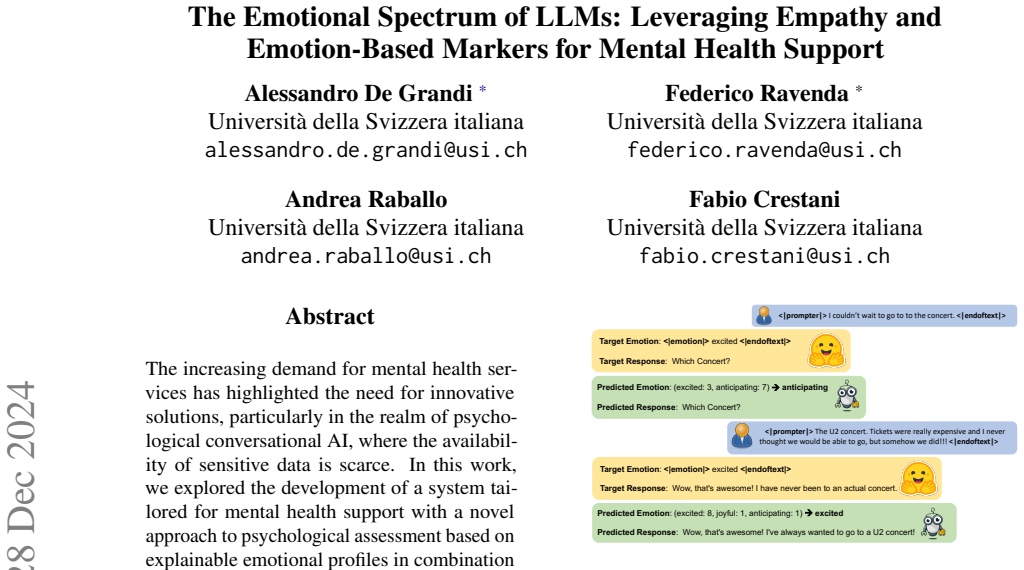
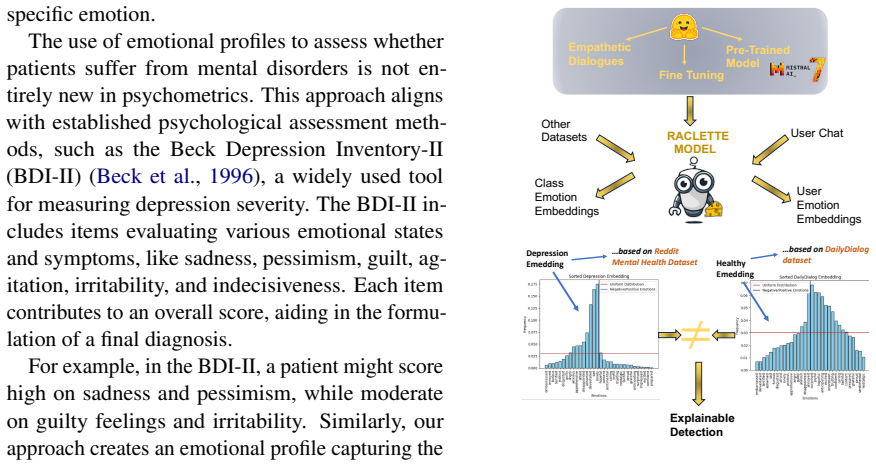
The load-bearing object is the emotion embedding: a probability vector over 32 emotion classes built by repeated Top-K sampling from the fine-tuned decoder. For each prompt the model predicts an emotion as a next token; sampling ten times produces an empirical distribution over emotions, and averaging those distributions across the turns of a conversation gives the user's emotional profile. The same procedure applied to subreddit posts produces reference disorder profiles, so the profile is simultaneously the input to the empathetic response (the predicted emotion is inserted into the three-turn prompt) and the marker compared against reference embeddings for screening. Because the embedding is a weighted sum of named emotions, every prediction can be inspected as a list of named emotions with weights rather than an opaque score.
What would settle it
Rebuild the reference embeddings from one randomly chosen half of the SuicideWatch and CasualConversation posts and re-run the 0.95-recall experiment on the other half; if recall on the held-out half falls far below the reported combined score, then part of the signal is the test posts' own contribution to the reference profiles rather than their emotional content. A second probe: swap the reference source, building the 'suicide' profile from a clinically validated corpus of suicide notes, and check whether recall on the same test set survives the swap.
Extended reading notes
Core claim
Mental states can be represented as mixtures of discrete emotions. By fine-tuning a generative decoder model on the Empathetic Dialogues dataset with a three-turn prompt–emotion–response structure, the paper obtains a conversational agent that predicts a speaker's emotion as autoregressive next-token generation, samples top-10 emotions ten times per prompt, and aggregates these empirical distributions over a conversation into an emotion embedding. Applying the same sampling procedure to 1,000 posts from each of 15 mental-health subreddits yields characteristic disorder profiles, and comparing a user profile against the suicide profile with KL or JS divergence or cosine similarity labels the text at risk. On a binary test set of SuicideWatch versus CasualConversation posts, the method reaches recall 0.95 for suicide risk in its combined variant, while the reference distributions remain visually and mathematically interpretable: depression sits closest to suicide, the depression-plus-schizophrenia embedding lands near bipolar, and control-group profiles from DailyDialog are dominated by positive emotions.
Load-bearing premise
The screening results assume that the posts used to measure suicide risk were not also used to build the reference emotional profiles; the paper draws both from the same set of subreddit posts and never states that the test posts were set aside.
Editorial extensions
If this is right
- A single fine-tuned LLM can handle both empathetic response generation and emotion classification, and conversation-level context improves emotion accuracy from 56% to 59% on the Empathetic Dialogues test set, beating the 51% of the CAiRE baseline.
- Emotional profiles of mental disorders are separable and psychologically coherent: suicide overlaps with depression, addiction with alcoholism, schizophrenia with PTSD, and summing the depression and schizophrenia embeddings places the result near bipolar in t-SNE space.
- Suicide-risk screening can be done without supervised clinical labels: comparing a post's emotion embedding to reference embeddings, with the combined KL/JS/cosine rule, achieves 0.95 recall for identifying suicidal text, at precision 0.63.
- Because the marker is a distribution over 32 named emotions, a clinician or user can inspect why a text was flagged, addressing the explainability gap of black-box classifiers.
- The approach avoids requiring sensitive real-world therapy conversations for training, using only public empathetic dialogues and public subreddit text.
Reading between the lines
- Implicit extension: the emotional profile is built cumulatively over conversation turns, so the same comparison could track whether a user's distribution drifts toward the suicide reference over time; the paper reports one-shot classification, not trajectories, so a longitudinal study is a natural next step.
- The near-arithmetic relation in the reduced space (depression + schizophrenia near bipolar) suggests emotional profiles might predict profiles for conditions with no dedicated community; testing this by synthesizing a profile and checking it against a held-out subreddit would confirm whether the arithmetic is semantically meaningful.
- The 32-emotion simplex is coarse for clinical use; converting the profile into a small set of named dominant emotions (e.g., 'devastated, lonely, ashamed' for the suicide reference) could produce a plain-language summary a non-specialist can read, which is the direction the authors gesture at but do not implement.
Editorial analysis
A structured set of objections, weighed in public.
Referee Report
Summary. The paper introduces RACLETTE, a Mistral-7B model fine-tuned on Empathetic Dialogues with a three-turn prompt/emotion/response format, and evaluates it on emotion recognition and empathetic response generation. The authors then define "emotion embeddings" by sampling top-k emotion tokens and aggregating them over sentences, construct reference embeddings from Reddit mental-health subreddits and DailyDialog, and use these reference embeddings to classify SuicideWatch versus CasualConversation posts in a binary suicide-risk task. The central claim is that emotional profiles built from LLM predictions can serve as interpretable markers for preliminary mental-health screening. The empirical support for this claim rests on Section 6's classification experiment, which reports recall up to 0.95.
Significance. If the screening claim were validated, the idea of using generative LLM emotion distributions as explainable, low-cost markers would be of practical interest for preliminary triage, especially because the approach avoids requiring labeled clinical text. The paper has real strengths: it gives concrete fine-tuning details, uses public datasets, and includes useful qualitative examples of coexisting emotions and model uncertainty. However, the current evaluation does not establish the screening claim: the Section 6 experiment does not document that the reference prototypes and test posts are disjoint, and the decision rule is essentially a nearest-centroid classifier over subreddit-derived prototypes. The emotion-classification comparison in Section 4 is also a single run compared against literature numbers under unspecified protocols. The paper's contribution is therefore better viewed as an unvalidated proof-of-concept than as a demonstrated screening tool.
major comments (4)
- [Sections 5–6, Table 4] The load-bearing issue is independence between the reference embeddings and the test set. Section 5 states that reference embeddings for each disorder are computed by processing 1,000 posts from each subreddit, while Section 6 states that a 5% random test set (about 10,585 samples) is taken from a Kaggle collection of SuicideWatch and CasualConversation posts. The paper never states that the test posts are excluded from the 1,000-post reference computations or from the CasualConversation negative prototype. If the test posts overlap with the reference set, then a SuicideWatch post is compared against a centroid that includes its own source population, and the reported recall of 0.95 in Table 4 may reflect self-similarity rather than any diagnostic signal. The authors must document and enforce a strict disjoint split, ideally at the user level, and report results on that split.
- [Section 6.1, positive/negative label definitions] The method is described as unsupervised, but the positive and negative label sets are manually defined from subreddit membership, and the prototypes are centroids of those labeled sets. The "Combined" rule is an OR-ensemble over three similarity metrics that is explicitly chosen to maximize recall, so the comparison with the BERT/RoBERTa k-means systems in Table 4 is not at a like-for-like operating point. Moreover, the positive label set includes seven disorder subreddits, which makes high recall easy to obtain by construction: any post whose nearest prototype is one of those seven is labeled positive. The 0.95 recall therefore cannot be interpreted as evidence that the emotion markers outperform the stated baselines.
- [Section 4, Table 2] The claim of "superior emotional accuracy" is based on a single run of RACLETTE (0.59) compared with accuracy values taken directly from other papers, with no error bars and no statement about whether those values use the same evaluation protocol (prompt-level vs. conversation-level, exact test split, model selection). This makes the comparison unverifiable. Please provide variance estimates over multiple seeds and, if possible, re-run the baselines under the identical protocol, or report all numbers with explicit protocol caveats.
- [Sections 5–6 and 8] The reference "disorder embeddings" are derived from self-selected subreddit communities rather than clinically assessed populations. The paper itself acknowledges in Section 8 that self-reported information and social-media expression are noisy proxies for mental disorders. As a result, the Section 6 experiment demonstrates, at most, that emotion profiles can distinguish two subreddit communities; it does not demonstrate discrimination between clinical conditions. The abstract's conclusion that the method provides "a novel approach to preliminary screening" goes beyond what the data can support. A revision should either add a clinical or validated-label evaluation, or carefully re-frame the contribution as a study of subreddit-community discrimination.
minor comments (7)
- [Abstract] The word "intrinsecaly" is a typo and should be "intrinsically".
- [Figure 1 caption] The caption contains "coversation", which should be "conversation".
- [Table 3] Several KL divergence values are reported as infinite (anxiety, lonely, healthAnxiety); please explain how zero probabilities are handled, or use a smoothed divergence so that all values are finite and comparable.
- [Section 4 / Appendix D.1] The conversation-level evaluation seems to append the target response, not the model's predicted response, to the context during evaluation; this is stated implicitly in Appendix D.1 but should be stated explicitly in the main text because it affects the interpretation of the conversation-level accuracy gain.
- [Appendix D.1] The text says "establishing 'exited' as the prominent emotion"; this should be "excited".
- [Figure 4(A)] t-SNE is stochastic; please report the perplexity, learning rate, and random seed for reproducibility.
- [Tables 2 and 4] The use of green shading to indicate better performance is not accessible in grayscale print; please add boldface or symbols to mark the best values.
Circularity Check
Screening evaluation reduces to nearest-centroid self-matching: reference profiles and test posts come from the same subreddits with no documented split, so Table 4's 0.95 recall may reflect self-similarity, not predictive screening.
-
fitted input called prediction
[Section 5 (reference embeddings) and Section 6 (suicide-risk evaluation, Table 4)]
"embeddings based on emotions obtained by processing 1,000 posts from each subreddit ... We used the two subreddits CasualConversation and SuicideWatch ... This dataset is part of a larger collection available on Kaggle ... We select 5% of the initial samples at random as a test set ... The final embedding aggregates these emotions across all sentences in the post, following a similar approach as used in Section 5 to extract reference embeddings."
The reference 'suicide' prototype is the normalized sum of RACLETTE emotion distributions over 1,000 r/suicidewatch posts (Section 5), and the positive test set is a random 5% sample from a SuicideWatch/CasualConversation collection (Section 6). The paper never states that the 1,000 reference posts are excluded from this test pool. As described, a positive prediction is 'nearest prototype to suicide embedding,' i.e., nearest to the average emotional profile of the very subreddit the test post came from; the same issue applies to the CasualConversation negative control. Table 4's recall therefore can be high from self-similarity alone, with no independent screening signal demonstrated.
full rationale
The RACLETTE emotion-classification and empathetic-response evaluation (Section 4, Tables 1-2) is a normal external benchmark on the Empathetic Dialogues test set; those results are not circular, and the literature comparisons are appropriate. The self-citations in the paper (Crestani et al. 2022; Sekulic et al. 2021, 2024; Cena et al. 2023) are contextual and not load-bearing. The circularity concern is concentrated in Section 6: the suicide-risk experiment reuses the same subreddit populations to build the reference emotion embeddings and to draw the test set, without any documented exclusion of test posts from the reference computation. Under the protocol as written, the reported screening prediction can be satisfied by comparing each post to a centroid of its own source population, which is a fitted input renamed as a screening prediction. This makes the central screening claim partially circular, although the conversational-model contribution stands independently. Score 6 reflects partial circularity in the screening claim rather than in the whole paper.
Assumptions & free parameters
free parameters (6)
- positive_label_set =
suicide, depression, bpd, bipolar, ptsd, addiction, schizophrenia
- negative_label_set =
normal (DailyDialog), uniform distribution, CasualConversation
- emotion_samples_per_prompt =
10
- top_k_sampling =
10
- posts_per_subreddit =
1000
- test_split_fraction =
5%
assumptions (5)
- domain assumption Subreddit membership is a valid proxy for clinically diagnosed mental disorders
- domain assumption The 32 Empathetic Dialogues emotion categories are sufficient to characterize mental-health-relevant emotional states
- domain assumption Averaging sampled emotion predictions over posts yields stable, meaningful disorder-level profiles
- domain assumption DailyDialog represents a non-clinical control population
- domain assumption Causal language-model fine-tuning on the 3-turn format lets one model act as both classifier and generator
invented entities (2)
-
Emotion embedding (emotional profile)
-
Reference disorder embeddings
Cite this review
Pith. "Pith review of The Emotional Spectrum of LLMs: Leveraging Empathy and Emotion-Based Markers for Mental Health Support." pith.science (2026). https://pith.science/paper/IXM3FSE2
@misc{pith2026241220068,
  author       = {Pith},
  title        = {Pith review of: The Emotional Spectrum of LLMs: Leveraging Empathy and Emotion-Based Markers for Mental Health Support},
  year         = {2026},
  howpublished = {\url{https://pith.science/paper/IXM3FSE2}},
  note         = {Machine review of arXiv:2412.20068}
}
read the original abstract
The increasing demand for mental health services has highlighted the need for innovative solutions, particularly in the realm of psychological conversational AI, where the availability of sensitive data is scarce. In this work, we explored the development of a system tailored for mental health support with a novel approach to psychological assessment based on explainable emotional profiles in combination with empathetic conversational models, offering a promising tool for augmenting traditional care, particularly where immediate expertise is unavailable. Our work can be divided into two main parts, intrinsecaly connected to each other. First, we present RACLETTE, a conversational system that demonstrates superior emotional accuracy compared to state-of-the-art benchmarks in both understanding users' emotional states and generating empathetic responses during conversations, while progressively building an emotional profile of the user through their interactions. Second, we show how the emotional profiles of a user can be used as interpretable markers for mental health assessment. These profiles can be compared with characteristic emotional patterns associated with different mental disorders, providing a novel approach to preliminary screening and support.
Figures

Figures from the paper (3 more)


Reference graph
Works this paper leans on
-
[1]
Alaa A Abd-Alrazaq, Mohannad Alajlani, Nashva Ali, Kerstin Denecke, Bridgette M Bewick, and Mowafa Househ. 2021. Perceptions and opinions of patients about mental health chatbots: scoping review. Journal of medical Internet research, 23(1):e17828
2021
-
[2]
Carla Agurto, Guillermo Cecchi, Sarah King, Elif K Eyigoz, Muhammad A Parvaz, Nelly Alia-Klein, and Rita Z Goldstein. 2023. Speak and you shall predict: speech at initial cocaine abstinence as a biomarker of long-term drug use behavior. bioRxiv
work page 2023
-
[3]
Carl Allen and Timothy Hospedales. 2019. Analogies explained: Towards understanding word embeddings. In International Conference on Machine Learning, pages 223--231. PMLR
work page 2019
-
[4]
Aaron T Beck, Robert A Steer, and Gregory Brown. 1996. Beck depression inventory--ii. Psychological assessment
work page 1996
-
[5]
Blei, Andrew Y
David M. Blei, Andrew Y. Ng, and Michael I. Jordan. 2003. Latent dirichlet allocation. J. Mach. Learn. Res., 3(null):993–1022
2003
-
[6]
Louise Br dvik. 2018. Suicide risk and mental disorders
work page 2018
-
[7]
Federica Cena, Luca Console, Marta Micheli, and Fabiana Vernero. 2023. Combining genetic algorithms and temporal constraint satisfaction for recommending personalized tourist itineraries. In International Conference of the Italian Association for Artificial Intelligence, pages 441--452. Springer
work page 2023
-
[8]
Xinhao Chen, Chong Yang, Man Lan, Li Cai, Yang Chen, Tu Hu, Xinlin Zhuang, and Aimin Zhou. 2024. Cause-aware empathetic response generation via chain-of-thought fine-tuning. arXiv preprint arXiv:2408.11599
arXiv 2024
Show all 52 references
-
[9]
Itsugun Cho, Dongyang Wang, Ryota Takahashi, and Hiroaki Saito. 2022. A personalized dialogue generator with implicit user persona detection. arXiv preprint arXiv:2204.07372
2022 arXiv
-
[10]
Cheryl M Corcoran, Vijay A Mittal, Carrie E Bearden, Raquel E Gur, Kasia Hitczenko, Zarina Bilgrami, Aleksandar Savic, Guillermo A Cecchi, and Phillip Wolff. 2020. Language as a biomarker for psychosis: a natural language processing approach. Schizophrenia research, 226:158--166
2020
-
[11]
Hugo Corona Hern \'a ndez, Cheryl Corcoran, Am \'e lie M Achim, Janna N De Boer, Tessel Boerma, Sanne G Brederoo, Guillermo A Cecchi, Silvia Ciampelli, Brita Elvev g, Riccardo Fusaroli, et al. 2023. Natural language processing markers for psychosis and other psychiatric disord...
2023
-
[12]
Fabio Crestani, David E Losada, and Javier Parapar. 2022. Early Detection of Mental Health Disorders by Social Media Monitoring: The First Five Years of the ERisk Project, volume 1018. Springer Nature
2022
-
[13]
Jean Decety. 2005. Perspective taking as the royal avenue to empathy. Other minds: How humans bridge the divide between self and others, 143:157
2005
-
[14]
Tim Dettmers, Artidoro Pagnoni, Ari Holtzman, and Luke Zettlemoyer. 2023. Qlora: Efficient finetuning of quantized llms. arXiv preprint arXiv:2305.14314
2023 arXiv
-
[15]
Jacob Devlin, Ming-Wei Chang, Kenton Lee, and Kristina Toutanova. 2019. https://arxiv.org/abs/1810.04805 Bert: Pre-training of deep bidirectional transformers for language understanding . Preprint, arXiv:1810.04805
2019 arXiv
-
[16]
Paul Dodemaide, Mark Merolli, Nicole Hill, and Lynette Joubert. 2022. Do social media impact young adult mental health and well-being? a qualitative study. The British Journal of Social Work, 52(8):4664--4683
2022
-
[17]
Bjarke Felbo, Alan Mislove, Anders S gaard, Iyad Rahwan, and Sune Lehmann. 2017. Using millions of emoji occurrences to learn any-domain representations for detecting sentiment, emotion and sarcasm. In Proceedings of the 2017 Conference on Empirical Methods in Natural Language...
2017
-
[18]
Jun Gao, Yuhan Liu, Haolin Deng, Wei Wang, Yu Cao, Jiachen Du, and Ruifeng Xu. 2021. Improving empathetic response generation by recognizing emotion cause in conversations. In Findings of the association for computational linguistics: EMNLP 2021, pages 807--819
2021
-
[19]
Giulia Gargano, Elisabetta Caletti, Cinzia Perlini, Nunzio Turtulici, Marcella Bellani, Carolina Bonivento, Marco Garzitto, Francesca Marzia Siri, Chiara Longo, Chiara Bonetto, et al. 2022. Language production impairments in patients with a first episode of psychosis. Plos one...
2022
-
[20]
Ayaan Haque, Viraaj Reddi, and Tyler Giallanza. 2021. Deep learning for suicide and depression identification with unsupervised label correction. In Artificial Neural Networks and Machine Learning--ICANN 2021: 30th International Conference on Artificial Neural Networks, Bratis...
2021
-
[21]
Rui He, Claudio Palominos, Han Zhang, Maria Francisca Alonso-Sánchez, Lena Palaniyappan, and Wolfram Hinzen. 2024. https://doi.org/10.1016/j.psychres.2024.115752 Navigating the semantic space: Unraveling the structure of meaning in psychosis using different computational langu...
2024
-
[22]
Ari Holtzman, Jan Buys, Li Du, Maxwell Forbes, and Yejin Choi. 2019. The curious case of neural text degeneration. arXiv preprint arXiv:1904.09751
2019 arXiv
-
[23]
Albert Q Jiang, Alexandre Sablayrolles, Arthur Mensch, Chris Bamford, Devendra Singh Chaplot, Diego de las Casas, Florian Bressand, Gianna Lengyel, Guillaume Lample, Lucile Saulnier, et al. 2023. Mistral 7b. arXiv preprint arXiv:2310.06825
2023 arXiv
-
[24]
Sandra A Just, Erik Haegert, Nora Ko r \'a nov \'a , Anna-Lena Br \"o cker, Ivan Nenchev, Jakob Funcke, Andreas Heinz, Felix Bermpohl, Manfred Stede, and Christiane Montag. 2020. Modeling incoherent discourse in non-affective psychosis. Frontiers in Psychiatry, 11:846
2020
-
[25]
Sidney H Kennedy. 2008. Core symptoms of major depressive disorder: relevance to diagnosis and treatment. Dialogues in clinical neuroscience, 10(3):271--277
2008
-
[26]
Filiz Kulacaoglu and Samet Kose. 2018. Borderline personality disorder (bpd): in the midst of vulnerability, chaos, and awe. Brain sciences, 8(11):201
2018
-
[27]
Aziliz Le Glaz, Yannis Haralambous, Deok-Hee Kim-Dufor, Philippe Lenca, Romain Billot, Taylor C Ryan, Jonathan Marsh, Jordan Devylder, Michel Walter, Sofian Berrouiguet, et al. 2021. Machine learning and natural language processing in mental health: systematic review. Journal ...
2021
-
[28]
Joosung Lee. 2022. The emotion is not one-hot encoding: Learning with grayscale label for emotion recognition in conversation. arXiv preprint arXiv:2206.07359
2022 arXiv
-
[29]
Qintong Li, Piji Li, Zhaochun Ren, Pengjie Ren, and Zhumin Chen. 2022. Knowledge bridging for empathetic dialogue generation. In Proceedings of the AAAI conference on artificial intelligence, volume 36, pages 10993--11001
2022
-
[30]
Yanran Li, Hui Su, Xiaoyu Shen, Wenjie Li, Ziqiang Cao, and Shuzi Niu. 2017. Dailydialog: A manually labelled multi-turn dialogue dataset. arXiv preprint arXiv:1710.03957
2017 arXiv
-
[31]
Zhaojiang Lin, Peng Xu, Genta Indra Winata, Farhad Bin Siddique, Zihan Liu, Jamin Shin, and Pascale Fung. 2020. Caire: An end-to-end empathetic chatbot. In Proceedings of the AAAI Conference on Artificial Intelligence, volume 34, pages 13622--13623
2020
-
[32]
Yinhan Liu, Myle Ott, Naman Goyal, Jingfei Du, Mandar Joshi, Danqi Chen, Omer Levy, Mike Lewis, Luke Zettlemoyer, and Veselin Stoyanov. 2019. Roberta: A robustly optimized bert pretraining approach. arXiv preprint arXiv:1907.11692
2019 arXiv
-
[33]
Daniel M Low, Laurie Rumker, Tanya Talkar, John Torous, Guillermo Cecchi, and Satrajit S Ghosh. 2020. Natural language processing reveals vulnerable mental health support groups and heightened health anxiety on reddit during covid-19: Observational study. Journal of medical In...
2020
-
[34]
Andrea Madotto, Zhaojiang Lin, Chien-Sheng Wu, and Pascale Fung. 2019. Personalizing dialogue agents via meta-learning. In Proceedings of the 57th annual meeting of the association for computational linguistics, pages 5454--5459
2019
-
[35]
Robert R Morris, Kareem Kouddous, Rohan Kshirsagar, and Stephen M Schueller. 2018. Towards an artificially empathic conversational agent for mental health applications: system design and user perceptions. Journal of medical Internet research, 20(6):e10148
2018
-
[36]
John A Naslund, Ameya Bondre, John Torous, and Kelly A Aschbrenner. 2020. Social media and mental health: benefits, risks, and opportunities for research and practice. Journal of technology in behavioral science, 5:245--257
2020
-
[37]
Aengus OConghaile and Lynn E DeLisi. 2015. Distinguishing schizophrenia from posttraumatic stress disorder with psychosis. Current opinion in psychiatry, 28(3):249--255
2015
-
[38]
Hannah Rashkin, Eric Michael Smith, Margaret Li, and Y-Lan Boureau. 2018. Towards empathetic open-domain conversation models: A new benchmark and dataset. arXiv preprint arXiv:1811.00207
2018 arXiv
-
[39]
Ivan Sekuli \' c , Mohammad Aliannejadi, and Fabio Crestani. 2021. User engagement prediction for clarification in search. In Advances in Information Retrieval - 43rd European Conference on IR Research, ECIR 2021 , pages 619--633
2021
-
[40]
Ivan Sekuli \'c , Silvia Terragni, Victor Guimar \ a es, Nghia Khau, Bruna Guedes, Modestas Filipavicius, Andre Ferreira Manso, and Roland Mathis. 2024. Reliable llm-based user simulator for task-oriented dialogue systems. In Proceedings of the 1st Workshop on Simulating Conve...
2024
-
[41]
Judy Hanwen Shen and Frank Rudzicz. 2017. Detecting anxiety through reddit. In Proceedings of the Fourth Workshop on Computational Linguistics and Clinical Psychology—From Linguistic Signal to Clinical Reality, pages 58--65
2017
-
[42]
Hyeongshin Shin, Hwaran Lee, and Kyomin Kim. 2019. Happybot: Generating empathetic dialogue responses by improving user experience look-ahead. In Proceedings of the 28th International Conference on Computational Linguistics, pages 6789--6794
2019
-
[43]
Yoojin Song, Sang Jin Rhee, Hyunju Lee, Min Ji Kim, Daun Shin, and Yong Min Ahn. 2020. Comparison of suicide risk by mental illness: a retrospective review of 14-year electronic medical records. Journal of Korean medical science, 35(47)
2020
-
[44]
Alvin Subakti, Hendri Murfi, and Nora Hariadi. 2022. The performance of bert as data representation of text clustering. Journal of big Data, 9(1):1--21
2022
-
[45]
Xiaofei Sun, Xiaoya Li, Jiwei Li, Fei Wu, Shangwei Guo, Tianwei Zhang, and Guoyin Wang. 2023. Text classification via large language models. arXiv preprint arXiv:2305.08377
2023 arXiv
-
[46]
Thomas Wolf, Lysandre Debut, Victor Sanh, Julien Chaumond, Clement Delangue, Anthony Moi, Pierric Cistac, Tim Rault, R \'e mi Louf, Morgan Funtowicz, et al. 2019. Huggingface's transformers: State-of-the-art natural language processing. arXiv preprint arXiv:1910.03771
2019 arXiv
-
[47]
Jiachen Xu, Xiaodong Wu, Zhe Wang, Yidong Feng, and Ping Wang. 2018. Emotion detection from text via ensemble classification using word embeddings. ACM Transactions on Internet Technology (TOIT), 18(4):1--17
2018
-
[48]
Sayyed M Zahiri and Jinho D Choi. 2017. Emotion detection on tv show transcripts with sequence-based convolutional neural networks. arXiv preprint arXiv:1708.04299
2017 arXiv
-
[49]
Tianyi Zhang, Varsha Kishore, Felix Wu, Kilian Q Weinberger, and Yoav Artzi. 2019. Bertscore: Evaluating text generation with bert. arXiv preprint arXiv:1904.09675
2019 arXiv
-
[50]
Ming Zhou, Minlie Huang, and Xiaoyan Zhu. 2020. Emotion-aware chatbots: A survey of recent advances and future research directions. Information Fusion, 59:103--127
2020
-
[51]
online" 'onlinestring :=
ENTRY address archivePrefix author booktitle chapter edition editor eid eprint eprinttype howpublished institution journal key month note number organization pages publisher school series title type volume year doi pubmed url lastchecked label extra.label sort.label short.list...
-
[52]
write newline
" write newline "" before.all 'output.state := FUNCTION n.dashify 't := "" t empty not t #1 #1 substring "-" = t #1 #2 substring "--" = not "--" * t #2 global.max substring 't := t #1 #1 substring "-" = "-" * t #2 global.max substring 't := while if t #1 #1 substring * t #2 gl...
Reviewed August 10, 2026 · model on record in the stance chip above.
Discussion (0). Continue with ORCID to comment.