HiGS: A Hierarchical Rendering Architecture for Real-Time 3D Gaussian Splatting
Pith reviewed 2026-06-28 22:29 UTC · model grok-4.3
The pith
HiGS decouples macro-tile partitioning from fine-tile rasterization in 3D Gaussian Splatting so dense regions no longer serialize work through single units.
A machine-rendered reading of the paper's core claim, the machinery that carries it, and where it could break.
Core claim
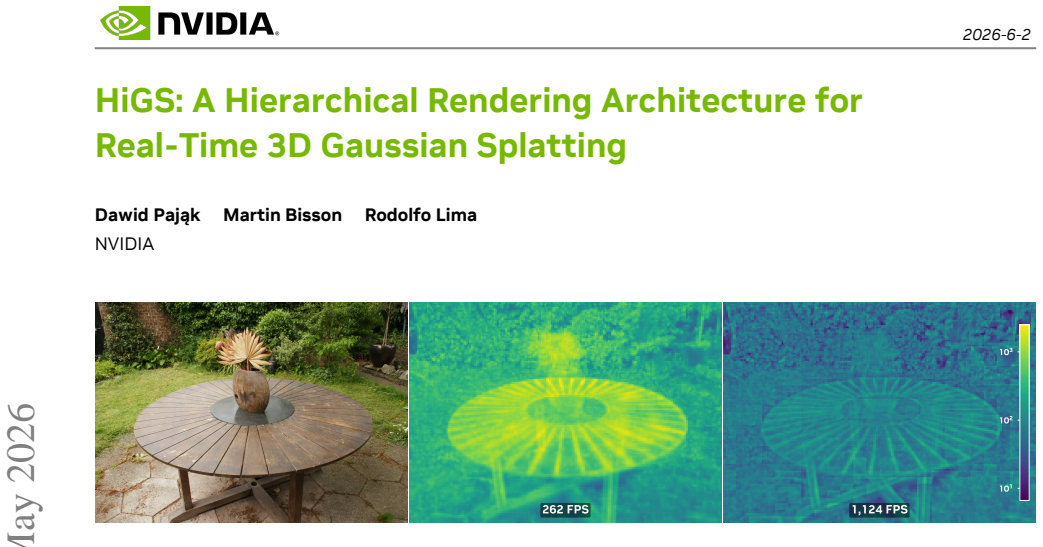
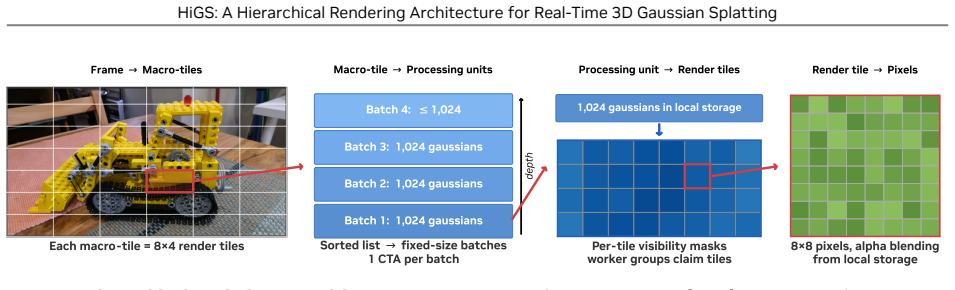
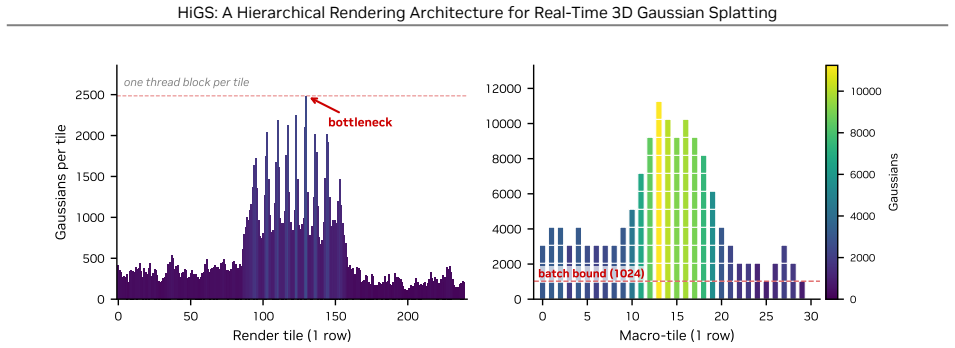
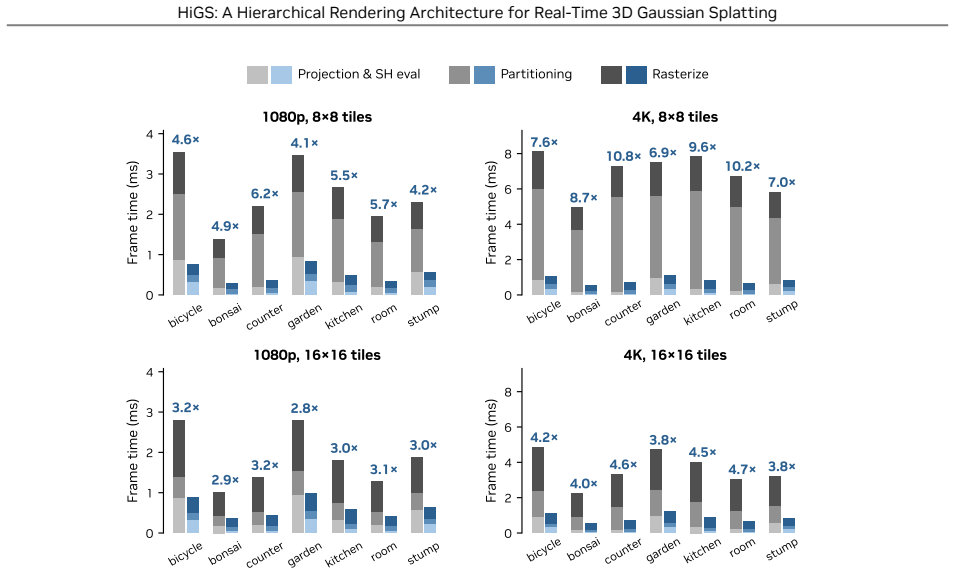
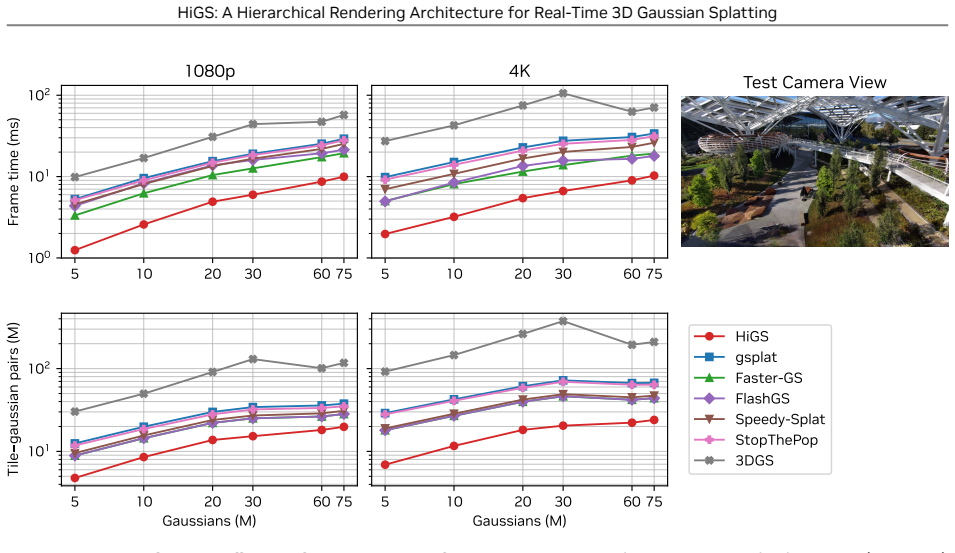
HiGS performs partitioning over coarse macro-tiles and rasterization over fine render tiles nested inside them, then distributes rasterization work according to the number of gaussians per macro-tile rather than per fine tile. This separation lets each stage use its own optimal scale and prevents a few dense tiles from dominating frame time. The method preserves exact front-to-back alpha compositing and delivers up to 15.8 times the speed of the original 3DGS pipeline across evaluated scenes.
What carries the argument
Hierarchically Tiled Gaussian Splatting (HiGS), which runs partitioning on coarse macro-tiles while rasterizing inside fine render tiles and issues work proportional to macro-tile gaussian counts.
If this is right
- Frame rates rise by as much as 15.8 times compared with the original 3DGS implementation.
- HiGS exceeds the speed of every other rasterizer evaluated while using the same compositing order.
- Partitioning cost drops because it operates at the coarser macro-tile scale.
- Rasterization cost drops because each fine tile processes fewer gaussians on average.
Where Pith is reading between the lines
- The same macro-tile distribution idea could be applied to other point-based or splat-based renderers that currently tie binning and shading to one tile size.
- Hardware with more parallel raster units would likely see larger relative gains because the load-balancing effect scales with available parallelism.
- Scenes with highly non-uniform gaussian density would benefit most, suggesting a possible automatic scene-adaptive macro-tile size choice.
Load-bearing premise
Macro-tile gaussian counts accurately predict and balance the true rasterization cost without extra overhead that would cancel the gains on the tested hardware.
What would settle it
Run the original 3DGS and HiGS on a new scene whose density distribution produces many macro-tiles whose internal fine-tile costs deviate sharply from their gaussian counts; measure whether the reported speedups disappear.
Figures
read the original abstract
3D Gaussian Splatting (3DGS) has become the standard for real-time novel view synthesis on commodity GPUs. Its pipeline ties spatial partitioning and rasterization to one tile size, yet the two pull in opposite directions: partitioning, which bins and depth-sorts gaussians, grows cheaper with larger tiles, while rasterization gets cheaper with smaller ones. Prior acceleration work reduces the cost of individual stages but keeps both locked to that single scale, where a few dense tiles dominate frame time. We present Hierarchically Tiled Gaussian Splatting (HiGS), which gives each its own scale: partitioning runs over coarse macro-tiles, while rasterization runs over the fine render tiles within them. Rasterization work is then issued in proportion to the gaussians in each macro-tile rather than per tile, so dense regions spread across many parallel units instead of serializing through one. Across tested scenes, HiGS renders up to 15.8x faster than the original 3DGS and outperforms every other rasterizer we evaluate, while preserving exact front-to-back alpha compositing.
Editorial analysis
A structured set of objections, weighed in public.
Referee Report
Summary. The paper introduces Hierarchically Tiled Gaussian Splatting (HiGS), a rendering architecture for 3D Gaussian Splatting that decouples spatial partitioning (over coarse macro-tiles) from rasterization (over fine render tiles). Work is issued to rasterization units in proportion to the Gaussian count per macro-tile rather than per fine tile, aiming to improve parallelism for dense regions. The central empirical claim is that this yields up to 15.8x speedup over the original 3DGS implementation across tested scenes, outperforms all evaluated alternative rasterizers, and preserves exact front-to-back alpha compositing.
Significance. If the reported speedups are reproducible and the hierarchical work distribution proves robust, the method would meaningfully advance real-time novel-view synthesis by resolving the inherent tile-size tension in 3DGS pipelines without altering the underlying splatting math or compositing order. The absence of any parameter fitting or invented entities in the presented claims is a positive attribute.
major comments (2)
- [Abstract] Abstract: the central performance claim (up to 15.8x speedup, outperforming every other rasterizer) is stated without any description of experimental protocol, scene selection, hardware, baselines, or verification method for the compositing preservation. This renders the claim impossible to assess from the provided text.
- [Abstract] Abstract: the speedup rests on the assumption that Gaussian count per macro-tile is a reliable proxy for actual rasterization load. No analysis or measurement is supplied addressing variance in projected screen-space footprint, depth complexity, or per-Gaussian tile coverage within a macro-tile, which the stress-test note correctly identifies as a potential source of load imbalance that could erode the reported gains.
Simulated Author's Rebuttal
We thank the referee for the constructive comments and the positive assessment of the method's potential impact. We address each major comment below.
read point-by-point responses
-
Referee: [Abstract] Abstract: the central performance claim (up to 15.8x speedup, outperforming every other rasterizer) is stated without any description of experimental protocol, scene selection, hardware, baselines, or verification method for the compositing preservation. This renders the claim impossible to assess from the provided text.
Authors: The abstract is written as a concise summary per standard conventions. The full experimental protocol—including scene selection from the 3DGS benchmark, hardware (RTX 4090-class GPUs), baselines (original 3DGS and evaluated alternative rasterizers), and verification of exact front-to-back compositing via direct pixel comparison—is detailed in Section 4. The claim is therefore fully assessable from the manuscript body. revision: no
-
Referee: [Abstract] Abstract: the speedup rests on the assumption that Gaussian count per macro-tile is a reliable proxy for actual rasterization load. No analysis or measurement is supplied addressing variance in projected screen-space footprint, depth complexity, or per-Gaussian tile coverage within a macro-tile, which the stress-test note correctly identifies as a potential source of load imbalance that could erode the reported gains.
Authors: Gaussian count per macro-tile is used as the distribution proxy because it directly determines the partitioning and work-issue volume; rasterization units then process the fine tiles within each macro-tile. While per-Gaussian footprint and depth variations can occur, the reported speedups were measured across diverse scenes with varying density, and the hierarchical issuance demonstrably avoids serializing dense regions through single units. A dedicated variance analysis was not present in the submission; we will add a short discussion and supporting measurements in revision. revision: partial
Circularity Check
No circularity; performance claims are empirical measurements only
full rationale
The paper presents a hierarchical macro-tile / fine-tile architecture for 3D Gaussian Splatting and states speedups (up to 15.8x) as measured outcomes on tested scenes. No equations, fitted parameters, or derivations appear that reduce by construction to the paper's own inputs. No self-citations are invoked as load-bearing uniqueness theorems or ansatzes. The central claims rest on implementation details and external benchmarking rather than any self-referential prediction or definition chain.
Axiom & Free-Parameter Ledger
Reference graph
Works this paper leans on
-
[1]
J. T. Barron, B. Mildenhall, D. Verbin, P. P. Srinivasan, and P. Hedman. Mip-NeRF 360: Unbounded anti-aliased neural radiance fields. InProceedings of the IEEE/CVF Conference on Computer Vision and Pattern Recognition (CVPR), 2022. 14, 18
2022
-
[2]
S. Durvasula, A. Zhao, F. Chen, R. Liang, P. K. Sanjaya, and N. Vijaykumar. DISTWAR: Fast differentiable rendering on raster-based rendering pipelines.arXiv preprint arXiv:2401.05345, 2024. 5
-
[3]
Z. Fan, K. Wang, K. Wen, Z. Zhu, D. Xu, and Z. Wang. LightGaussian: Unbounded 3D Gaussian compression with 15x reduction and 200+ fps. InAdvances in Neural Information Processing Systems (NeurIPS), 2024. 2, 3, 19
2024
-
[4]
Fang and B
G. Fang and B. Wang. Mini-splatting: Representing scenes with a constrained number of Gaussians. In European Conference on Computer Vision (ECCV), 2024. 3
2024
-
[5]
G. Feng, S. Chen, R. Fu, Z. Liao, Y. Wang, T. Liu, B. Hu, L. Xu, Z. Pei, H. Li, X. Li, N. Sun, X. Zhang, and B. Dai. FlashGS: Efficient 3D Gaussian splatting for large-scale and high-resolution rendering. InProceedings of the IEEE/CVF Conference on Computer Vision and Pattern Recognition (CVPR), pages 26652–26662, 2025. 2, 3, 5, 16, 19 19 HiGS: A Hierarch...
2025
-
[6]
Girish, K
S. Girish, K. Gupta, and A. Shrivastava. EAGLES: Efficient accelerated 3D Gaussians with lightweight encodings. InEuropean Conference on Computer Vision (ECCV), 2024. 3
2024
-
[7]
Green, R
O. Green, R. McColl, and D. A. Bader. GPU merge path: A GPU merging algorithm. InProceedings of the 26th ACM International Conference on Supercomputing, ICS ’12, pages 331–340. ACM, 2012. 12
2012
- [8]
-
[9]
Hahlbohm, L
F. Hahlbohm, L. Franke, M. Eisemann, and M. Magnor. Faster-gs: Analyzing and improving gaussian splatting optimization, 2026. 2, 3, 4, 5, 16, 19
2026
-
[10]
Hahlbohm, F
F. Hahlbohm, F. Friederichs, T. Weyrich, L. Franke, M. Kappel, S. Castillo, M. Stamminger, M. Eisemann, and M. Magnor. Efficient perspective-correct 3D Gaussian splatting using hybrid transparency.Computer Graphics Forum, 44(2), 2025. 4
2025
-
[11]
Hanson, A
A. Hanson, A. Tu, G. Lin, V. Singla, M. Zwicker, and T. Goldstein. Speedy-splat: Fast 3D Gaussian splatting with sparse pixels and sparse primitives. InProceedings of the Computer Vision and Pattern Recognition Conference (CVPR), pages 21537–21546, June 2025. 2, 3, 7, 12, 16
2025
-
[12]
Q. Hou, R. Rauwendaal, Z. Li, H. Le, F. Farhadzadeh, F. Porikli, A. Bourd, and A. Said. Sort-free Gaussian splatting via weighted sum rendering. InInternational Conference on Learning Representations (ICLR), 2025. 2, 3
2025
- [13]
-
[14]
Kerbl, G
B. Kerbl, G. Kopanas, T. Leimkühler, and G. Drettakis. 3d gaussian splatting for real-time radiance field rendering.ACM Transactions on Graphics, 42(4), 2023. 1, 3, 5, 6, 16, 18
2023
-
[15]
Kerbl, A
B. Kerbl, A. Meuleman, G. Kopanas, M. Wimmer, A. Lanvin, and G. Drettakis. A hierarchical 3D Gaussian representation for real-time rendering of very large datasets.ACM Transactions on Graphics, 43(4), 2024. 19
2024
-
[16]
Kheradmand, D
S. Kheradmand, D. Vicini, G. Kopanas, D. Lagun, K. M. Yi, M. Matthews, and A. Tagliasacchi. StochasticSplats: Stochastic rasterization for sorting-free 3D Gaussian splatting. InICCV, 2025. 2, 3
2025
-
[17]
J. Lee, S. Lee, J. Lee, J. Park, and J. Sim. GSCore: Efficient radiance field rendering via architectural support for 3D Gaussian splatting. InProceedings of the 29th ACM International Conference on Architectural Support for Programming Languages and Operating Systems, Volume 3 (ASPLOS ’24), 2024. 2, 4
2024
-
[18]
J. C. Lee, D. Rho, X. Sun, J. H. Ko, and E. Park. Compact 3D Gaussian representation for radiance field. InProceedings of the IEEE/CVF Conference on Computer Vision and Pattern Recognition (CVPR), pages 21719–21728, 2024. 3
2024
- [19]
-
[20]
S. Li, B. Keller, Y. Lin, and B. Khailany. GauRast: Enhancing GPU triangle rasterizers to accelerate 3D Gaussian splatting. InProceedings of the 62nd ACM/IEEE Design Automation Conference (DAC), 2025. 4
2025
-
[21]
Z. Liao, J. Ding, S. Cui, R. Gong, B. Hu, Y. Wang, H. Li, H. Wang, X. Zhang, and R. Fu. TC-GS: A faster Gaussian splatting module utilizing tensor cores. InSIGGRAPH Asia 2025 Conference Papers, 2025. 2, 3, 10, 16, 19
2025
-
[22]
S. S. Mallick, R. Goel, B. Kerbl, M. Steinberger, F. V. Carrasco, and F. De La Torre. Taming 3dgs: High-quality radiance fields with limited resources. InSIGGRAPH Asia 2024 Conference Papers, SA ’24, New York, NY, USA,
2024
-
[23]
Association for Computing Machinery. 3, 4
-
[24]
H. S. Malvar, G. J. Sullivan, and S. Srinivasan. Lifting-based reversible color transformations for image compression. InProc. SPIE 7073, Applications of Digital Image Processing XXXI, page 707307, 2008. 11
2008
-
[25]
Merrill and A
D. Merrill and A. S. Grimshaw. Revisiting sorting for GPGPU stream architectures. Technical Report CS2010-03, Department of Computer Science, University of Virginia, 2010. 12 20 HiGS: A Hierarchical Rendering Architecture for Real-Time 3D Gaussian Splatting
2010
-
[26]
Mildenhall, P
B. Mildenhall, P. P. Srinivasan, M. Tancik, J. T. Barron, R. Ramamoorthi, and R. Ng. NeRF: Representing scenes as neural radiance fields for view synthesis. InComputer Vision – ECCV 2020, pages 405–421. Springer, 2020. 1
2020
-
[27]
Moenne-Loccoz, A
N. Moenne-Loccoz, A. Mirzaei, O. Perel, R. de Lutio, J. Martinez Esturo, G. State, S. Fidler, N. Sharp, and Z. Gojcic. 3D Gaussian ray tracing: Fast tracing of particle scenes.ACM Transactions on Graphics, 43(6), 2024. 4
2024
-
[28]
Niedermayr, J
S. Niedermayr, J. Stumpfegger, and R. Westermann. Compressed 3D Gaussian splatting for accelerated novel view synthesis. InProceedings of the IEEE/CVF Conference on Computer Vision and Pattern Recognition (CVPR), pages 10349–10358, 2024. 3
2024
-
[29]
M. Niemeyer, F. Manhardt, M.-J. Rakotosaona, M. Oechsle, D. Duckworth, R. Gosula, K. Tateno, J. Bates, D. Kaeser, and F. Tombari. RadSplat: Radiance field-informed gaussian splatting for robust real-time rendering with 900+ fps.arXiv preprint arXiv:2403.13806, 2024. 3
-
[30]
CUDA programming guide: Programmatic dependent launch and synchronization
NVIDIA Corporation. CUDA programming guide: Programmatic dependent launch and synchronization. https://docs.nvidia.com/cuda/cuda-programming-guide/, 2025. Section 4.5. 12
2025
-
[31]
Parallel thread execution ISA version 9.3
NVIDIA Corporation. Parallel thread execution ISA version 9.3. https://docs.nvidia.com/cuda/ parallel-thread-execution/, 2025. 11
2025
-
[32]
Porter and T
T. Porter and T. Duff. Compositing digital images. InProceedings of the 11th Annual Conference on Computer Graphics and Interactive Techniques (SIGGRAPH ’84), pages 253–259. Association for Computing Machinery,
-
[33]
L. Radl, M. Steiner, M. Parger, A. Weinrauch, B. Kerbl, and M. Steinberger. StopThePop: Sorted Gaussian splatting for view-consistent real-time rendering. InACM SIGGRAPH, 2024. 2, 3, 4, 7, 16, 17, 19
2024
-
[34]
Schütz, C
M. Schütz, C. Peters, F. Hahlbohm, E. Eisemann, M. Magnor, and M. Wimmer. Splatshop: Efficiently editing large Gaussian splat models.Computer Graphics Forum (Proc. HPG), 44(8), 2025. 2, 3, 7, 19
2025
-
[35]
X. Wang, R. Yi, and L. Ma. AdR-Gaussian: Accelerating Gaussian splatting with adaptive radius. InSIGGRAPH Asia 2024 Conference Papers, 2024. 2, 3
2024
-
[36]
Z. Wang, A. C. Bovik, H. R. Sheikh, and E. P. Simoncelli. Image quality assessment: From error visibility to structural similarity.IEEE Transactions on Image Processing, 13(4):600–612, 2004. 18
2004
-
[37]
Q. Wu, J. Martinez Esturo, A. Mirzaei, N. Moenne-Loccoz, and Z. Gojcic. 3DGUT: Enabling distorted cameras and secondary rays in Gaussian splatting. InProceedings of the IEEE/CVF Conference on Computer Vision and Pattern Recognition (CVPR), 2025. 4
2025
-
[38]
M. Yang, Y. Wang, C.-P. Lo, X. Zhang, S. Oruganti, and J. P. Kulkarni. GSAcc: Accelerate 3D Gaussian splatting via depth speculation and Gaussian-centric rasterization. InProceedings of the 62nd ACM/IEEE Design Automation Conference (DAC), 2025. 4
2025
-
[39]
V. Ye, M. Turkulainen, and the nerfstudio team. gsplat: An open-source library for Gaussian splatting.Journal of Machine Learning Research, 26, 2024. 1, 3, 7, 16
2024
-
[40]
Z. Yu, A. Chen, B. Huang, T. Sattler, and A. Geiger. Mip-splatting: Alias-free 3D Gaussian splatting. InProceedings of the IEEE/CVF Conference on Computer Vision and Pattern Recognition (CVPR), pages 19447–19456, 2024. 4
2024
-
[41]
Y. Yuan and Q. He. Efficient differentiable hardware rasterization for 3D Gaussian splatting.arXiv preprint arXiv:2505.18764, 2025. 2, 3
-
[42]
Zhang, P
R. Zhang, P. Isola, A. A. Efros, E. Shechtman, and O. Wang. The unreasonable effectiveness of deep features as a perceptual metric. InProceedings of the IEEE/CVF Conference on Computer Vision and Pattern Recognition (CVPR), pages 586–595, 2018. 18 21
2018
discussion (0)
Sign in with ORCID, Apple, or X to comment. Anyone can read and Pith papers without signing in.