REVIEW 4 major objections 6 minor
Surfacing the Unsaid: CUE-Bench for Affective Stance in Chinese Discourse
T0 review · 4 major / 6 minor · reviewed 2026-08-12 · deepseek-v4-flash
Pith's one-line read The paper claims that structuring affect as a nine-cell explicit–implicit stance matrix lets LLMs infer pragmatic intent and fine-grained emotion more accurately, with gains of 7.8 and 3.5 percentage points over strong prompting baselines.
desk verdict A substantial Chinese affective benchmark with a clever stance matrix, but the dominant Veiled Negative class is under-verified and the headline gains rest on an unstated aggregation. read the letter →
The pith
A machine-rendered reading of the paper's core claim, the machinery that carries it, and where it could break.
The reading
What carries the argument
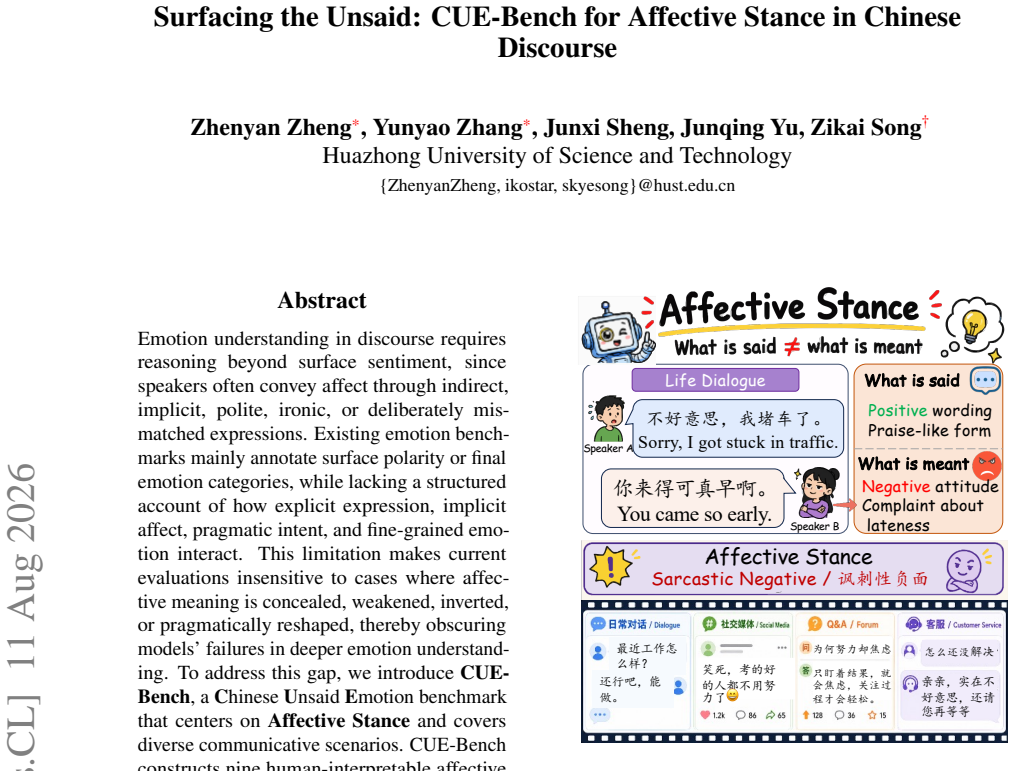
The Explicit-Implicit Stance Matrix is a $3\times3$ table: rows are the explicit affective signal $e_i\in\{+,0,-\}$, columns are the implicit affective tendency $h_i\in\{+,0,-\}$, and each cell is the Affective Stance $s_i=\phi(e_i,h_i)$. It is the load-bearing intermediate representation of the paper because the stance is not an independent judgment but a deterministic composition of the two affect layers, and the same ordered pair drives the annotation protocol, the conditional inter-annotator agreement analysis, and the Matrix-Guided Chain-of-Thought prompting protocol.
What would settle it
Take a random sample of 300 instances from the Veiled Negative class, remove the original gold label, have three fresh expert annotators independently select from the nine stances, and measure majority agreement with the gold label; if it falls below 60 percent, the most frequent class is too noisy to support the reported benchmark gains.
Extended reading notes
Core claim
On the paper's own terms, the discovery is that an utterance's affective stance can be defined as the composition of two low-cost signals: the explicit affective signal $e_i$ (the polarity anchored in surface wording) and the implicit affective tendency $h_i$ (the affect recoverable from context and pragmatic force). The map $\phi(e_i,h_i)$ fills a $3\times3$ matrix whose nine cells are named stances: Positive, Formulaic Positive, Sarcastic Negative, Understated Positive, Neutral, Veiled Negative, Affiliative Positive, Reportive Negative, and Negative. CUE-Bench annotates these layers on 51,823 Chinese instances and evaluates three connected tasks; its central experimental claim is that a Matrix-Guided Chain-of-Thought prompt, which forces the model to state explicit signal, implicit tendency, stance, intent, and then emotion, improves pragmatic intent detection by 7.8 percentage points and fine-grained emotion recognition by 3.5 percentage points over the strongest tested prompting baselines. The paper interprets these gains as evidence that the stance matrix is a structured intermediate representation, not just a label set.
Load-bearing premise
The whole result depends on the gold labels for the benchmark's most common category—neutral-sounding speech with a hidden negative attitude—being trustworthy, and the paper's own audit found problems in 62% of the sampled cases in that category.
Editorial extensions
If this is right
- Affective NLP evaluation can test the reasoning path rather than only the final label, so a model that guesses the right emotion for the wrong reason is no longer indistinguishable from one that recovers the stance.
- The same 51,823 instances support three connected tasks, letting developers pinpoint whether a dialogue system fails at surface reading, stance resolution, or final emotion discrimination.
- Matrix-guided prompting is a training-free intervention that yields consistent pragmatic-intent gains across all five tested LLM families, making it directly usable in deployed Chinese dialogue and customer-service systems.
- The smaller and less stable gains on fine-grained emotion identify category-level emotion discrimination, not stance recovery, as the remaining bottleneck.
Reading between the lines
- Because the most frequent stance, Veiled Negative, also has the highest problematic-case rate in the audit, aggregate accuracy is partly a score on the hardest cell of the matrix; a per-class headline would likely show the benchmark's difficulty is concentrated there.
- The 7.8-point and 3.5-point figures are accuracy- and weighted-F1-based; under macro-F1 the emotion gains are near zero or negative for several models, so the improvement should be read as distribution-weighted rather than class-balanced.
- A prompt-only control with an equally structured but semantically arbitrary intermediate schema (for example, surface polarity, topic, then final label) would separate the stance matrix's contribution from the general benefit of enforced structured reasoning.
Editorial analysis
A structured set of objections, weighed in public.
Referee Report
Summary. The paper introduces CUE-Bench, a Chinese benchmark for 'unsaid' emotion understanding built around an Explicit–Implicit Stance Matrix. For 51,823 context–target instances drawn from five Chinese discourse sources, it annotates explicit affective signal, implicit affective tendency, a derived nine-way Affective Stance, eight pragmatic intents, and twenty-five fine-grained emotions. The authors propose Matrix-Guided Chain-of-Thought prompting, in which an LLM first predicts explicit/implicit orientations, maps them through a fixed matrix to stance, then predicts intent and emotion. Experiments on five LLMs claim that this method improves fine-grained emotion recognition by 3.5 percentage points and pragmatic intent detection by 7.8 percentage points over strong baselines, and oracle-conditioning ablations are used to argue that stance is a useful intermediate representation.
Significance. The paper proposes a genuinely multi-layer affective annotation scheme that links surface expression to inferred affect, and the Explicit–Implicit Stance Matrix is simple and interpretable. If the gold labels are reliable, CUE-Bench would be a useful Chinese resource for evaluating pragmatic and affective inference, and the matrix-guided prompting recipe is practical and easy to reproduce. The authors also provide detailed annotation guidelines, a dataset card, conditional agreement analysis, and an explicit statement of limitations. However, the paper's own reliability evidence raises serious questions about the most frequent stance class, and two of the headline claims rest on aggregation and oracle-conditioning choices that overstate what is demonstrated.
major comments (4)
- [Abstract; §5.2, Table 3] The headline gains of 3.5 pp for fine-grained emotion and 7.8 pp for pragmatic intent are obtained by averaging the deltas over all five models and all three metrics (Acc/F1/W-F1) for each task, but this aggregation is never stated and the per-metric picture is weaker: macro-F1 for fine-grained emotion decreases on GPT-4o-mini (−0.006) and LLaMA-3.1-8B (−0.015), and several stance macro-F1 deltas are negative (Table 3). Please report per-metric aggregated deltas with sign and state the aggregation rule explicitly, or revise the abstract claims accordingly.
- [§5.4 RQ2; Figure 4; Appendix B.3; Table 2] The most load-bearing weakness is gold-label reliability for Veiled Negative, the most frequent stance (22.3%). The RQ2 audit of 1,500 model-disagreement instances finds 458 Veiled Negative instances marked problematic, i.e., 62% of audited instances of that class, yet the 20,000 model-agreement instances in Appendix B.3 receive no human review, and the 89% adjudicator-accuracy and 3.1% contamination estimates are computed from the disagreement pool. Moreover, stance α=0.52, intent α=0.34, and emotion α=0.31 (Table 2) are modest, and the conditional κ values are computed after excluding instances with inconsistent stance, which selects the easier subset. Since both benchmark validity and the prompting gains presuppose that gold labels are correct, please provide per-class reliability evidence for Veiled Negative, audit a sample of the agreement pool, and quantify how label noise affects the reported deltas.
- [§5.3; Table 4; §6] The oracle-conditioning ablations insert gold Affective Stance and gold Pragmatic Intent into the prompt and measure downstream intent/emotion prediction. This is an upper-bound exercise: it shows that gold intermediate labels are informative, not that the model's own predicted stance or intent helps. The conclusion (§6) that these ablations 'confirm the value of Affective Stance as an intermediate representation' is therefore too strong. Please either rephrase the claim or add an evaluation that conditions on the model's predicted stance.
- [§4.2; Appendix C.3] Because Affective Stance is defined as the deterministic map ϕ(e_i,h_i) and annotators are instructed to revisit the base signals rather than override the mapped stance (Appendix C.3), stance labels inherit any noise in the explicit/implicit sign labels and cannot serve as independent validation of the matrix. The paper should state this explicitly and treat stance reliability as a consequence of sign-label reliability, not as an independent guarantee.
minor comments (6)
- [Abstract] The benchmark name is written as 'CUE Bench' in the abstract but as 'CUE-Bench' elsewhere; please use a consistent spelling.
- [Table 3] The model name 'Qwen 3-8B' is inconsistent with 'Qwen-3-8B' used in §5.1; please unify.
- [Figure 4] The red line showing the problem-case rate is not labeled in the legend; please add a legend entry.
- [§5.2] The phrase 'strongest baseline' is not identified per model; from Table 3 the best baseline differs across models (e.g., CoT for DeepSeek-V4-Flash, Few-shot for LLaMA-3.1-8B). Please specify the baseline used for each reported delta.
- [§5.4 RQ2] The definition of 'problematic' conflates LLM adjudication inconsistency with human–LLM disagreement; please clarify whether the human review is treated as ground truth in this audit.
- [Table 7] The English stance names in Table 7 are inconsistent with the Chinese matrix labels shown in Figure 2 (e.g., 'POSITIVE' vs '一致性正面'); please unify the English terminology.
Circularity Check
No significant circularity; the stance/e-h composition is disclosed design, oracle ablations are labeled upper-bound, and self-citations are background.
full rationale
The paper's derivation chain is self-contained and does not reduce to its own inputs. The Explicit-Implicit Stance Matrix defines Affective Stance as a deterministic function of explicit and implicit orientations (s_i = phi(e_i, h_i)), and the annotation guideline explicitly derives stance from the ordered pair rather than inventing an independent label; this is a disclosed design choice, not a hidden reduction. The stance-recognition task being equivalent to predicting the (e, h) pair is an intended property of the taxonomy, and the paper does not present it as an empirical discovery. The oracle-conditioning ablations (Table 4) inject gold stance and intent only in explicitly labeled oracle settings (Appendix G.4), so they are transparent upper bounds rather than fitted parameters renamed as predictions. The headline 3.5-point and 7.8-point gains come from the main prompting comparison in Table 3, which does not use gold intermediates. Self-citations (Song et al. 2026, Zhang et al. 2026, Wu et al. 2026, etc.) appear only as background or source references and are not load-bearing; no uniqueness theorem or prior-work ansatz is imported to force the matrix. The benchmark's label-reliability limitations, including low Krippendorff's alpha and the 62% problematic Veiled Negative audit rate, are validity and correctness risks rather than circularity, and they are explicitly acknowledged in the paper. Hence no circular step meets the evidentiary bar.
Assumptions & free parameters
assumptions (4)
- domain assumption The three-way projection onto {+,0,-} is sufficient to represent explicit and implicit affective meaning for stance.
- ad hoc to paper The map from polarity pairs to nine stances is a valid compositional representation, and annotators must not override it.
- domain assumption LLM adjudication with forward-reverse consistency yields gold-quality labels for the retained instances.
- domain assumption The 300-instance IAA sample drawn from the human-verified gold subset is representative of the full dataset.
invented entities (2)
-
Nine-way Affective Stance taxonomy
-
Explicit-Implicit Stance Matrix
Cite this review
Pith. "Pith review of Surfacing the Unsaid: CUE-Bench for Affective Stance in Chinese Discourse." pith.science (2026). https://pith.science/paper/IYVV4UDF
@misc{pith2026260810810,
  author       = {Pith},
  title        = {Pith review of: Surfacing the Unsaid: CUE-Bench for Affective Stance in Chinese Discourse},
  year         = {2026},
  howpublished = {\url{https://pith.science/paper/IYVV4UDF}},
  note         = {Machine review of arXiv:2608.10810}
}
read the original abstract
Emotion understanding in discourse requires reasoning beyond surface sentiment because speakers often convey affect through indirect, implicit, polite, ironic, or deliberately mismatched expressions. Existing emotion benchmarks mainly annotate surface polarity or final emotion categories, while lacking a structured account of how explicit expression, implicit affect, pragmatic intent, and fine grained emotion interact. This limitation makes current evaluations insensitive to cases where affective meaning is concealed, weakened, inverted, or pragmatically reshaped, thereby obscuring model failures in deeper emotion understanding. To address this gap, we introduce CUE Bench, a Chinese Unsaid Emotion benchmark that centers on Affective Stance and covers diverse communicative scenarios. CUE Bench constructs nine human interpretable affective stances from explicit implicit polarity interaction and further provides intent and fine grained emotion annotations for structured affective inference. Experiments show that incorporating Affective Stance improves fine grained emotion recognition by 3.5 percentage points and pragmatic intent detection by 7.8 percentage points over strong baselines.
Figures


Figures from the paper (2 more)


Reviewed August 12, 2026 · model on record in the stance chip above.
Discussion (0). Continue with ORCID to comment.