REVIEW 4 major objections 5 minor 189 references
The Gr\"uneisen parameter applied to critical phenomena and experimental investigations of correlated phenomena in molecular conductors
T0 review · 4 major / 5 minor · reviewed 2026-08-12 · deepseek-v4-flash
Pith's one-line read Cosmic expansion is recast as a caloric effect through the effective Grüneisen parameter, identified with the equation-of-state parameter ω.
The pith
A machine-rendered reading of the paper's core claim, the machinery that carries it, and where it could break.
The reading
What carries the argument
The load-bearing object is the effective Grüneisen parameter $\Gamma_{\mathrm{eff}}=\alpha_p v_0 B_T/c_v=v_0(\partial p/\partial U)_v$, which measures the pressure change per internal-energy change at fixed volume. The thesis's central move is to recognize that the cosmological perfect-fluid equation of state $p=\omega\rho$ is formally the Mie-Grüneisen equation $p=\Gamma_{\mathrm{eff}}E/v$ once $\rho=E/v$, so the two dimensionless coefficients coincide. This identification, together with the perfect-fluid adiabatic temperature-evolution law integrated to $T v^{\Gamma_{\mathrm{eff}}}=\mathrm{constant}$, carries the entire cosmological argument; the other Grüneisen parameters (magnetic, electric, polar, elastic) are generated from Maxwell relations and quantify the corresponding caloric effects, connecting the same thermodynamic machinery to quantum criticality, the elastocaloric effect, and materials design.
What would settle it
Measure the late-time cosmic temperature evolution and compare with $T v^{\Gamma_{\mathrm{eff}}}=\mathrm{constant}$: for the claimed dark-energy value $\Gamma_{\mathrm{eff}}=-1$, the relation predicts $T\propto v\propto a^3$ as the universe expands, whereas cosmic microwave background temperature measurements give $T_{\mathrm{CMB}}\propto(1+z)\propto a^{-1}$; a continued decrease of $T_{\mathrm{CMB}}$ at low redshift would falsify the caloric reading.
Extended reading notes
Core claim
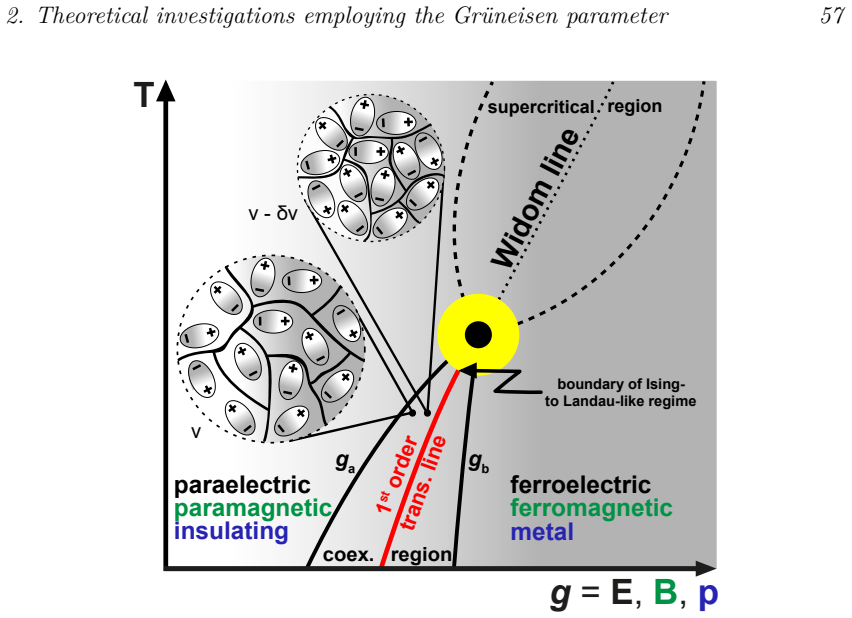
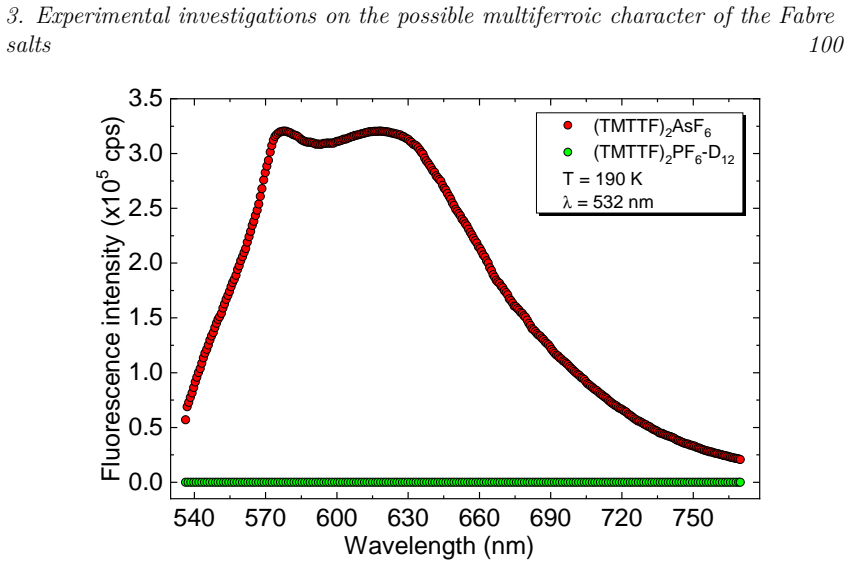
On its own terms, the thesis derives $\Gamma_{\mathrm{eff}}=v_0(\partial p/\partial U)_v$, recalls the perfect-fluid temperature evolution law $\dot{T}/T=(\partial p/\partial\rho)_n\,\dot{n}/n$, and identifies $(\partial p/\partial\rho)_n$ with $\omega$. Since $\rho=E/v$, this gives $\omega=v(\partial p/\partial E)_n$, which is exactly $\Gamma_{\mathrm{eff}}$. Writing $T_{\mu\nu}=(1+\omega)\rho u_\mu u_\nu+\rho\omega g_{\mu\nu}$ then shows that the Einstein equations can be written with $\Gamma_{\mathrm{eff}}$ in place of $\omega$. The thesis integrates the temperature-evolution law to $T v^{\Gamma_{\mathrm{eff}}}=\mathrm{constant}$, interprets the expansion as a barocaloric and inverse-barocaloric effect, and reads the sign change of $\Gamma_{\mathrm{eff}}$ from the matter-dominated to the dark-energy-dominated era as a condensed-matter-like critical-endpoint transition. The accompanying experiments probe possible multiferroic behavior in the Fabre salts: a dielectric constant maximum at the charge-ordering temperature, a magnetic-field suppression of a Raman mode, and a fluorescence background five orders of magnitude larger in the hydrogenated than in the deuterated salt.
Load-bearing premise
The load-bearing premise is that the universe, or each of its eras, is a perfect fluid obeying the Mie-Grüneisen equation of state $p = \Gamma_{\mathrm{eff}}E/v$; if that equation of state fails for the cosmological fluid, the equality $\Gamma_{\mathrm{eff}}=\omega$ becomes only a relabeling and the Einstein-equation embedding carries no new content.
Editorial extensions
If this is right
- If $\Gamma_{\mathrm{eff}}=\omega$ is correct, the two cosmic eras correspond to caloric effects: expansion cools the universe for $\Gamma_{\mathrm{eff}}>0$ and heats it for $\Gamma_{\mathrm{eff}}<0$.
- The decelerated-to-accelerated transition acquires a thermodynamic signature as a sign change in $\Gamma_{\mathrm{eff}}$, analogous to crossing a critical end point, with a possible symmetry-breaking reading via Noether's theorem.
- The dark-energy equation-of-state parameter would not be a fixed constant but would inherit the temperature and volume dependence of the thermodynamic coefficients inside $\Gamma_{\mathrm{eff}}$, implying a time-dependent $\Lambda(t)$ or $G(t)$ if the universe continues to cool and expand.
- Because the Einstein equations can be written with $\Gamma_{\mathrm{eff}}$ inside the energy-momentum tensor, anisotropic cosmic expansion could be studied with the elastic Grüneisen parameter $\Gamma_{\mathrm{ec}}$, giving a condensed-matter route to stress-tensor effects in cosmology.
- Within condensed matter, the same framework predicts that intrinsic local fields suppress the divergent Grüneisen signature of genuine zero-field quantum phase transitions, and that an adiabatic temperature increase can magnetize a paramagnet without applying an external magnetic field.
Reading between the lines
- If the equality $\Gamma_{\mathrm{eff}}=\omega$ is taken as physical rather than merely formal, it suggests importing condensed-matter measurement strategies—thermal expansion, heat capacity, compressibility—into cosmology, where the analogous quantities would have to be inferred from luminosity-distance or baryon-acoustic-oscillation data; that is a testable program, not something the thesis carri
- The relation $T v^{\Gamma_{\mathrm{eff}}}=\mathrm{constant}$ gives a clean discriminant for the eras: for $\Gamma_{\mathrm{eff}}=1/3$ it reproduces $T\propto a^{-1}$ for radiation, while for $\Gamma_{\mathrm{eff}}=-1$ it predicts $T\propto a^3$ for the dark-energy era; checking the temperature-redshift history at late times would test the cosmic side of the identification.
- The experimental finding that deuteration lowers the fluorescence background of the TMTTF salts by five orders of magnitude suggests a materials-design route to cleaner Raman and optical studies of charge ordering and magneto-optical effects in this family.
- The generalized Grüneisen construction from Maxwell relations is not limited to pressure, magnetic field, electric field, or polarization; the same derivation would generate new caloric coefficients for any adiabatically varied thermodynamic field, such as chemical potential or shear components, which could be tested in other correlated systems.
Editorial analysis
A structured set of objections, weighed in public.
Referee Report
Summary. This Ph.D. thesis derives and generalizes the Grüneisen parameter (effective, magnetic, electric, polar, and elastic) from Maxwell relations and applies it to model paramagnets, zero-field quantum phase transitions, caloric effects, and cosmology, where Γeff is identified with the cosmological equation-of-state parameter ω. The experimental part reports dielectric, Raman, and fluorescence measurements on the molecular conductors (TMTTF)2X, including a magnetic-field-induced reduction of a Raman line in deuterated (TMTTF)2PF6 and a large fluorescence contrast between (TMTTF)2AsF6 and deuterated (TMTTF)2PF6.
Significance. The thermodynamic derivations in Chapter 2 are mostly standard and the unified presentation of the various Grüneisen parameters via Maxwell relations is a useful pedagogical contribution. The magneto-optical Raman observation in Sec. 3.3.2, if confirmed, would be of interest to the organic-conductor community. However, the headline cosmological claim (Γeff = ω) is an identity under the assumed Mie-Grüneisen equation of state rather than a testable derivation; the zero-field QPT suppression and the adiabatic magnetization proposal rest on ad hoc model assumptions. The manuscript therefore does not deliver on its most ambitious claims, although several local results are sound and clearly presented.
major comments (4)
- [Sec. 2.3.10, Eq. (2.241)] The identification ω = (∂p/∂ρ)_n = v(∂p/∂E)_n = Γeff is definitional: combining p = ωρ with the Mie-Grüneisen EOS p = Γeff E/v and ρ = E/v forces ω = Γeff by construction. No independent physical content is added. Evaluated from the entropy definition (Eq. 2.48), Γeff becomes 0/0 for the pressureless matter era (S = 0) and for vacuum energy (S = 0), so the era values 1/3, 0, and −1 are imported from ΛCDM rather than computed. Correspondingly, Eq. (2.262) is the standard perfect-fluid energy-momentum tensor Tμν = (1+ω)ρuμuν + ρωgμν with ω renamed Γeff, so the claim that the Einstein field equations 'implicitly incorporate Γeff' is a relabeling rather than a new result.
- [Sec. 2.3.10, Eq. (2.249)] The temperature law T v^{Γeff} = const is not consistent with the observed CMB temperature T ∝ 1/a. For matter (Γeff→0) it predicts T = const, and for dark energy (Γeff = −1) it predicts T ∝ v, whereas the CMB temperature falls as 1/a through both eras. The text states that T is 'consistently reduced' during the matter-dominated era, which is contrary to what Eq. (2.249) actually gives.
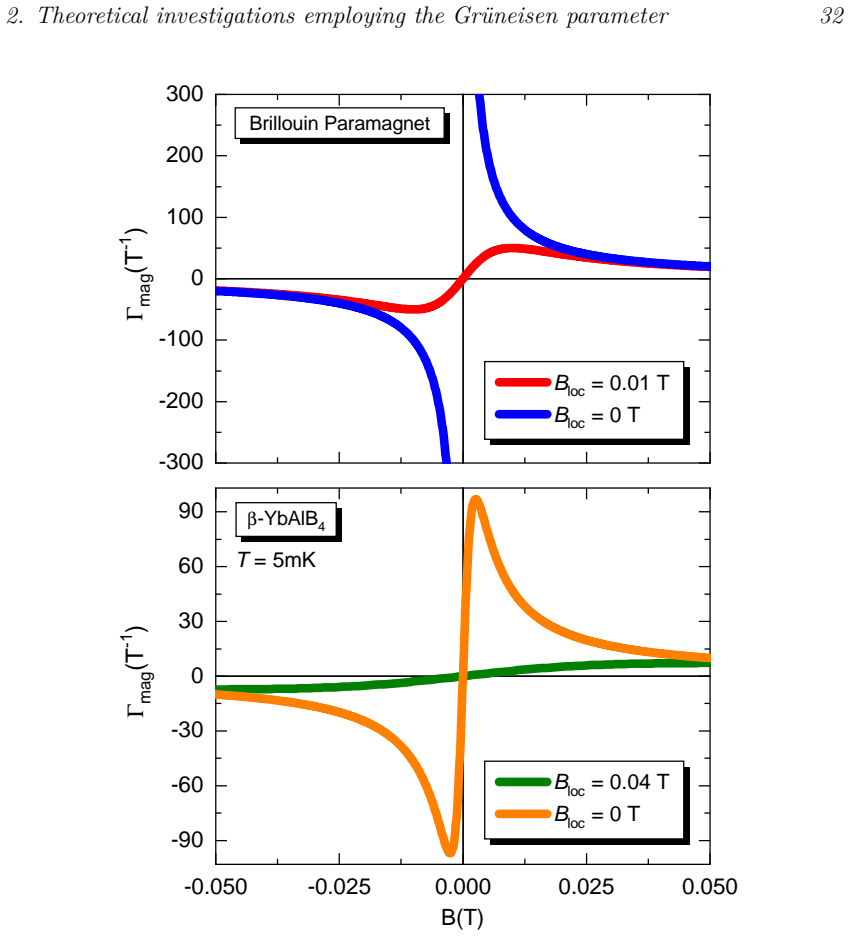
- [Sec. 2.3.2, Eqs. (2.77) and (2.130)] The suppression of the Γmag divergence at B→0 is introduced by assuming Br = √(B² + Bloc²) and adding Bloc as an offset, with the angle θ arbitrarily set to 90° in Eq. (2.76). The conclusion that real paramagnets cannot exhibit a genuine zero-field QPT is therefore a consequence of this model assumption, not an empirical finding. The estimate of Bloc for β-YbAlB4 uses only a dipolar formula (Eq. 2.74) and is not validated against the actual magnetic structure, so the claimed suppression of quantum criticality is not robust.
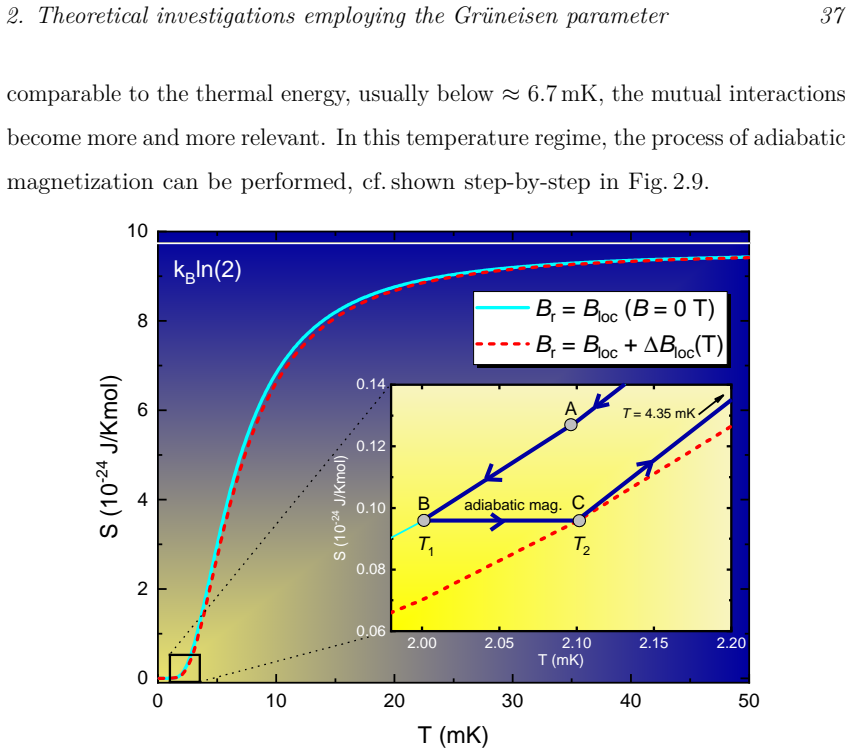
- [Sec. 2.3.4, Eq. (2.139)] The adiabatic magnetization proposal postulates that an adiabatic temperature increase raises Bloc by ΔBloc to conserve entropy. For a fixed dipolar configuration, Bloc is set by the lattice and interactions, not a free thermodynamic variable; the entropy of the Brillouin paramagnet depends on μB B/T, so an adiabatic increase of T at fixed B would change the spin populations without generating an internal-field increment. The mechanism is not derived from a microscopic Hamiltonian and is thus an ad hoc input to the model.
minor comments (5)
- [Throughout] The name 'Friedman' should be 'Friedmann' (e.g., Eqs. in Sec. 2.2.3 and throughout Sec. 2.3.10).
- [Eq. (2.211)] The Barrett formula as written has unmatched parentheses and unclear placement of the −T0 term; please rewrite it cleanly.
- [Fig. 2.17] The labels in this figure are corrupted (e.g., 'eff = ω = 1/3', 'eff = ω → 0', and 'eff = ω 1→'); the correct subscripts and arrows should be restored.
- [Sec. 3.3.2] The Raman and fluorescence results are based on single samples and, as the text acknowledges, lack reproducibility checks; they should be explicitly framed as preliminary observations rather than definitive experimental findings.
- [Sec. 2.3.10, reference [95]] The cosmological section cites 'Grüneisen meets Einstein (submitted)' as Ref. [95], but a published version exists (Results in Physics 57, 107344 (2024)); the published reference should be cited instead.
Circularity Check
The cosmological identification Γeff = ω (Eq. 2.241) is a relabeling: it is built in by the Mie-Grüneisen/perfect-fluid EOS, and Eq. 2.262 restates the standard perfect-fluid energy-momentum tensor with ω renamed Γeff.
-
self definitional
[Sec. 2.3.10, Eq. (2.241)]
"Considering the EOS of a perfect fluid, the term(∂p/∂ρ)n is recognized asω. Since ρ = E/v, we have: ω = (∂p/∂ρ)n = (∂p/∂[E/v])n = v(∂p/∂E)n. (2.241) The definition ofω in Eq.2.241 is exactly the same as the definition of the effective Grüneisen parameter Γeff, cf.Eq.2.47."
For the perfect-fluid EOS p=ωρ, the equality ω=(∂p/∂ρ)_n is itself the definition of ω. Rewriting ρ=E/v makes v(∂p/∂E)_n an algebraic identity, and Eq. 2.47 defines Γeff=v0(∂p/∂U)_v. Hence Γeff=ω holds by construction once the Mie-Grüneisen EOS is assumed; it is not derived from the material Grüneisen definition. The era values 1/3, 0, −1 are imported from ΛCDM rather than computed from Eq. 2.48, which gives 0/0 for pressureless matter and for vacuum energy.
-
renaming known result
[Sec. 2.3.10, Eq. (2.262)]
"Using the EOS of a perfect fluid,Tµν can be expressed as a function ofω as Tµν = (1 +ω)ρuµuν +ρωgµν [91]. Hence, Einstein field equations can be rewritten in terms ofΓeff so that: Rµν− 1/2gµνR + Λgµν = 8πG[(1 + Γeff )ρuµuν +ρΓeffgµν]. (2.262) It is then evident that Einstein field equations implicitly incorporateΓeff through Tµν."
The stress-energy tensor written here is the standard perfect-fluid form Tμν=(p+ρ)uμuν+pgμν with p=ωρ substituted, and then ω is relabeled Γeff. No independent property of Γeff enters beyond the ratio p/ρ. The claimed embedding into Einstein field equations therefore restates the perfect-fluid EOS in Grüneisen notation; the later anisotropic/imperfect-fluid discussion would require additional dissipative terms that were explicitly set to zero in the derivation of Eq. 2.240.
1 more flagged steps
-
self definitional
[Sec. 2.3.10, Eqs. (2.240)-(2.249)]
"Integrating both sides of Eq.2.242 and considering that(∂p/∂ρ)n =ω = Γeff, we have: ... ln (T ) +C1 = Γeff [ln (n) +C2] ... T v Γeff =constant. (2.249)"
Equation 2.249 is the standard adiabatic perfect-fluid temperature law T n^{-ω}=const, obtained after substituting the definitional identity ω=Γeff. Calling the resulting cooling a barocaloric effect, or the Γeff<0 case an inverse barocaloric effect, does not add testable content. Moreover, with the adopted matter-era value Γeff≈0 the law predicts T≈const, not the asserted temperature reduction during the matter-dominated era, so the interpretation is carried entirely by the imported ΛCDM values of ω.
full rationale
The thesis contains a long and largely self-contained set of thermodynamic derivations: the effective Grüneisen parameter from Eqs. 2.44-2.52, the magnetic Grüneisen parameter for the Brillouin paramagnet, the generalization of Grüneisen parameters from Maxwell relations, and the entropy-based caloric-effect analysis are all derived from standard definitions and are not circular. The zero-field QPT suppression is model-based rather than circular: a finite Bloc is postulated and then Γmag is recomputed with Br=(B^2+Bloc^2)^(1/2), so the non-divergence is a consequence of the assumed model, not a hidden fit. The substantive circularity is confined to Section 2.3.10. There, Eq. 2.241 identifies ω with Γeff using only the perfect-fluid EOS and the identity (∂p/∂ρ)_n=v(∂p/∂E)_n, which is exactly the definition of Γeff from Eq. 2.47 under the Mie-Grüneisen EOS. Every subsequent cosmological claim — the temperature law Eq. 2.249, the entropy-era relations Eqs. 2.251-2.254, the sign-change analogy near Eq. 2.260, and the Einstein-equation embedding Eq. 2.262 — inherits this relabeling rather than adding new physics. Since the central cosmological prediction reduces to construction while the rest of the thesis is independent, the appropriate score is 6, not higher. The self-citations to the authors' own papers (Refs. [95], [103], [49], [55]) are real prior publications but are not the load-bearing mechanism here; the circularity is definitional, not citational.
Assumptions & free parameters
free parameters (5)
- Bloc for Brillouin paramagnet =
0.01 T.
- Bloc for beta-YbAlB4 =
0.04 T.
- Angle theta between B and Bloc =
90 degrees.
- Adiabatic magnetization temperatures =
T1 = 2 mK and T2 = 2.1 mK.
- Barrett formula parameters =
A = 0, m = 8.4e4 K, T1 = 60 K, T0 = -35 K (inset); main-panel fit to kappa-(BEDT-TTF)2Cu2(CN)3.
assumptions (5)
- standard math Maxwell relations and standard thermodynamic identities are valid for the systems considered.
- domain assumption Real paramagnets always contain a local field Bloc ≈ 0.01-0.04 T from dipole interactions, and Br ≈ sqrt(B^2 + Bloc^2) with theta ≈ 90 degrees.
- domain assumption The universe is a perfect fluid whose pressure obeys the Mie-Grüneisen equation of state p = Γeff E/v with constant omega per era.
- ad hoc to paper Adiabatic temperature increase rearranges neighboring spins so that Bloc increases by ΔBloc to conserve entropy.
- domain assumption Barrett's formula describes quantum paraelectric dielectric response.
Cite this review
Pith. "Pith review of The Gr\"uneisen parameter applied to critical phenomena and experimental investigations of correlated phenomena in molecular conductors." pith.science (2026). https://pith.science/paper/IZAWPHOQ
@misc{pith2026241113743,
  author       = {Pith},
  title        = {Pith review of: The Gr\"uneisen parameter applied to critical phenomena and experimental investigations of correlated phenomena in molecular conductors},
  year         = {2026},
  howpublished = {\url{https://pith.science/paper/IZAWPHOQ}},
  note         = {Machine review of arXiv:2411.13743}
}
abstract
In this Ph.D. Thesis, a systematic review is performed on the derivation and generalization of the Gr\"uneisen parameter followed by its unprecedented applications to several distinct scenarios, such as magnetic model systems, zero-field quantum phase transitions, the maximization of caloric effects close to any critical-end point based on entropy arguments, the here-proposed adiabatic magnetization of a paramagnetic salt, as well as for Cosmology in the frame of the universe expansion. Since this Ph.D. Thesis is a symbiosis between theoretical and experimental results, an experimental investigation of correlated phenomena was carried out for molecular conductors of the (TMTTF)$_2$X family, where TMTTF is the base molecule tetramethyltetrathiafulvalene and X a monovalent counter-anion such as PF$_6$, SbF$_6$, or AsF$_6$. Such strongly correlated electron systems are considered suitable ones for the exploration of Mott insulating phase, charge-ordering, spin-Peierls, and superconductivity. In particular, the investigation of a possible multiferroic character in these salts was performed via quasi-static (low-frequency) dielectric constant $\varepsilon'$ measurements as a function of temperature where a maximum in $\varepsilon'$ as a function of temperature was observed at the corresponding charge-ordering temperature for both hydrogenated and 97.5% deuterated (TMTTF)$_2$SbF$_6$ salts. Furthermore, Raman measurements were performed on the 97.5% deuterated (TMTTF)$_2$PF$_6$, showing a possible magneto-optical effect on the $\nu_4(a_g)$ vibrational mode of the TMTTF molecule. Yet, fluorescence measurements demonstrated that the fully-hydrogenated (TMTTF)$_2$AsF$_6$ presents an expressive fluorescence background, which is roughly five orders of magnitude lower than that for the 97.5% deuterated variant of (TMTTF)$_2$PF$_6$.
Figures


Figures from the paper (41 more)










Reference graph
Works this paper leans on
-
[1]
Baierlein, Thermal Physics (Cambridge University Press, Cambridge, 1999)
R. Baierlein, Thermal Physics (Cambridge University Press, Cambridge, 1999)
1999
-
[2]
H. B. Callen, Thermodynamics and an Introduction to Thermostatistics (John Wiley & Sons, Singapore, 1985)
1985
-
[3]
Hawking, Physical Review D13, 191 (1976)
S.W. Hawking, Physical Review D13, 191 (1976)
1976
-
[4]
Weinberg, Philosophical Magazine93, 2576 (2012)
P. Weinberg, Philosophical Magazine93, 2576 (2012)
2012
-
[5]
Klosin et al., Science367, 464 (2020)
A. Klosin et al., Science367, 464 (2020)
2020
-
[6]
Moretti, M.A
P. Moretti, M.A. Muñoz, Nature Communications4, 2521 (2013)
2013
-
[7]
Squillante, Isys F
L. Squillante, Isys F. Mello, A.C. Seridonio, M. de Souza, Materials Research Bulletin 142, 111413 (2021)
2021
-
[8]
Lijun Zhu, Markus Garst, Achim Rosch and Qimiao Si, Physical Review Letters 91, 066404 (2003)
2003
Show all 189 references
-
[9]
de Souza, P
M. de Souza, P. Menegasso, R. Paupitz, A. Seridonio, R.E. Lagos, Eur. J. Phys. 37, 055105 (2016)
2016
-
[10]
Gegenwart, Philosophical magazine97, 3415 (2017)
P. Gegenwart, Philosophical magazine97, 3415 (2017)
2017
-
[11]
de Souza and J.-P
M. de Souza and J.-P. Pouget, Journal of Physics: Condensed Matter25, 343201 (2013)
2013
-
[12]
de Souza and L
M. de Souza and L. Bartosch, Journal of Physics: Condensed Matter27, 053203 (2015). 104 BIBLIOGRAPHY 105
2015
-
[13]
Monceauet al., Physical Review Letters86, 4080 (2001)
P. Monceauet al., Physical Review Letters86, 4080 (2001)
2001
-
[14]
de Souzaet al., Physical Review Letters101, 216403 (2008)
M. de Souzaet al., Physical Review Letters101, 216403 (2008)
2008
-
[16]
de Souzaet al., Physical Review B97, 045122 (2018)
M. de Souzaet al., Physical Review B97, 045122 (2018)
2018
-
[17]
Giovannetti et al., Physical Review B91, 125130 (2015)
G. Giovannetti et al., Physical Review B91, 125130 (2015)
2015
-
[18]
Putzke et al., Nature Communications5, 5679 (2014)
C. Putzke et al., Nature Communications5, 5679 (2014)
2014
-
[19]
Huang et al., Nature Communications6, 8188 (2015)
C.L. Huang et al., Nature Communications6, 8188 (2015)
2015
-
[20]
Hasselbach, L
K. Hasselbach, L. Taillefer, J. Flouquet, Physical Review Letters63, 93 (1989)
1989
-
[21]
de Visseret al., Physical Review Letters85, 3005 (2000)
A. de Visseret al., Physical Review Letters85, 3005 (2000)
2000
-
[22]
Reiss, D
P. Reiss, D. Graf, A.A. Haghighirad, T Vojta, A.I. Coldea, Physical Review Letters 127, 246402 (2021)
2021
-
[23]
Lorenz Bartosch, Mariano de Souza, and Michael Lang, Physical Review Letters 104, 245701 (2010)
2010
-
[24]
Sakai et al., Physical Review B94, 041105 (2016)
A. Sakai et al., Physical Review B94, 041105 (2016)
2016
-
[26]
Deguchi et al., Nature Materials11, 1013 (2012)
K. Deguchi et al., Nature Materials11, 1013 (2012)
2012
-
[27]
Poirier, Introduction to the Physics of the Earth’s interior (Cambridge University Press, Cambridge, 2000)
J.-P. Poirier, Introduction to the Physics of the Earth’s interior (Cambridge University Press, Cambridge, 2000)
2000
-
[28]
Stanley, Introduction to Phases Transitions and Critical Phenomena (Oxford Science Publications, New York, 1971)
H.E. Stanley, Introduction to Phases Transitions and Critical Phenomena (Oxford Science Publications, New York, 1971)
1971
-
[29]
Gr¨uneisen, Annalen der Physik Leibniz331, 393 (1908)
E. Gr¨uneisen, Annalen der Physik Leibniz331, 393 (1908). BIBLIOGRAPHY 106
1908
-
[30]
Mello, L
Isys F. Mello, L. Squillante, Antonio C. Seridonio, R.E. Lagos-Monaco, M. de Souza, Grüneisen parameter, the specific heat ratio, and phases coexistence regions (2023) (submitted)
2023
-
[31]
Wallace, Statistical Physics of crystals and liquids: a guide to highly accurate equations of state (World Scientific, 2002)
D.C. Wallace, Statistical Physics of crystals and liquids: a guide to highly accurate equations of state (World Scientific, 2002)
2002
-
[32]
Bludell, Magnetism in Condensed Matter (Oxford University Press, Oxford, 2001)
S. Bludell, Magnetism in Condensed Matter (Oxford University Press, Oxford, 2001)
2001
-
[33]
Charles Kittel, Introduction to Solid State Physics - Eighth Edition, John Wiley & Sons (2005)
2005
-
[34]
R. K. Pathria, Statistical Mechanics − Second Edition, Butterworth- Heinemann (1996)
1996
-
[35]
Tari, The Specific Heat of Matter at Low Temperatures
A. Tari, The Specific Heat of Matter at Low Temperatures. (Imperial college press, London, 2003)
2003
-
[36]
de Souza, R
M. de Souza, R. Paupitz, A. Seridonio, R.E. Lagos, Brazilian Journal of Physics 46, 206 (2016)
2016
-
[37]
N. W. Ashcroft and N. David Mermin, Solid State Physics, Saunders College Publishing (1976)
1976
-
[38]
Friedman, Z
A. Friedman, Z. Phys.10, 377-386 (1922)
1922
-
[39]
Ryden, Introduction to Cosmology - second edition (Cambridge University Press, 2017)
B. Ryden, Introduction to Cosmology - second edition (Cambridge University Press, 2017)
2017
-
[40]
Romeu, http://hdl.handle.net/2445/59759 (2014)
J.A. Romeu, http://hdl.handle.net/2445/59759 (2014)
2014
-
[41]
Hubble, PNAS15, 168 (1929)
E. Hubble, PNAS15, 168 (1929)
1929
-
[42]
Slipher, Lowell Observatory Bulletin2, 56 (1912)
V.M. Slipher, Lowell Observatory Bulletin2, 56 (1912)
1912
-
[43]
Riess et al., The Astronomical Journal116, 1009 (1998)
A.G. Riess et al., The Astronomical Journal116, 1009 (1998). BIBLIOGRAPHY 107
1998
-
[44]
Alonso, E.J
M. Alonso, E.J. Finn, Fundamental University Physics volume 1 - Mechanics (Addison Wesley, 1967)
1967
-
[46]
J. Prat, C. Hogan, C. Chang, J. Frieman, J. Cosmol. Astropart. Phys.06, 015 (2022)
2022
-
[47]
Gomes, L
G. Gomes, L. Squillante, A.C. Seridonio, A. Ney, R.E. Lagos, M. de Souza, Physical Review B100, 054446 (2019)
2019
-
[48]
Squillante, M
L. Squillante, M. de Souza, Investigation of molecular conductors, the magneto- caloric effect and the binary alloy FeSe1−x, Master dissertation (2017) - https://repositorio.unesp.br/handle/11449/152558
2017
-
[49]
Squillante, Isys F
L. Squillante, Isys F. Mello, Gabriel O. Gomes, A.C. Seridonio, R. E. Lagos- Monaco, H. Eugene Stanley, Mariano de Souza, Scientific Reports10, 7981 (2020)
2020
-
[50]
Macaluso et al., Chemical Materials19, 1918 (2007)
R.T. Macaluso et al., Chemical Materials19, 1918 (2007)
2007
-
[51]
Matsumoto et al., Science331, 316 (2011)
Y. Matsumoto et al., Science331, 316 (2011)
2011
-
[52]
R. V. Pound, Physical Review81, 156 (1951)
1951
-
[53]
Purcell and R.V
E.M. Purcell and R.V. Pound, Physical Review81, 279 (1951)
1951
-
[54]
Ikeda et al., Review of Scientific Instruments90, 083902 (2019)
M.S. Ikeda et al., Review of Scientific Instruments90, 083902 (2019)
2019
-
[55]
Squillante, Isys F
L. Squillante, Isys F. Mello, A.C. Seridonio, M. de Souza, Scientific Reports 11, 9431 (2021)
2021
-
[56]
Meyers, K.K
A.M. Meyers, K.K. Chawla, Mechanical Behavior of Materials (Cambridge University Press, 2009)
2009
-
[57]
Barron, J.G
T.H.K. Barron, J.G. Collins, G.K. White, Thermal expansion of solids at low temperatures 29, 609 (1980). BIBLIOGRAPHY 108
1980
-
[58]
Li et al., Nature607, 276 (2022)
Y.-S. Li et al., Nature607, 276 (2022)
2022
-
[59]
Ramsey, Physical Review103, 20 (1956)
N.F. Ramsey, Physical Review103, 20 (1956)
1956
-
[60]
Pomeranchuk,Zhurnal Eksperimental’noi i Teoreticheskoi Fiziki 20, 919 (1950)
I. Pomeranchuk,Zhurnal Eksperimental’noi i Teoreticheskoi Fiziki 20, 919 (1950)
1950
-
[61]
Hicks, M.E
C.W. Hicks, M.E. Edkins, S.D. Brodsky, D.O. Mackenzie, Review of Scientific Instruments 85, 065003 (2014)
2014
-
[62]
Gannon et al., Review of Scientific Instruments86, 103904 (2015)
L. Gannon et al., Review of Scientific Instruments86, 103904 (2015)
2015
-
[63]
Vasyukovet al., Nature Nanotechnology8, 639 (2013)
D. Vasyukovet al., Nature Nanotechnology8, 639 (2013)
2013
-
[64]
Giamarchi, C
T. Giamarchi, C. R¨uegg, O. Tchernyshyov, Nature Physics4, 198 (2008)
2008
-
[65]
Bramwell, M
S.T. Bramwell, M. J.-P. Gingras, Science294, 1495 (2001)
2001
-
[66]
Ehrenfest, Proceedings of the Academy of Science Amsterdan36, 153 (1933)
P. Ehrenfest, Proceedings of the Academy of Science Amsterdan36, 153 (1933)
1933
-
[67]
K. Mori, M. Hayashi, Journal of the Physical Society of Japan33, 1396 (1972)
1972
-
[68]
Benepe, W
J.W. Benepe, W. Reese, Physical Review B3, 3032 (1971)
1971
-
[69]
Mello, L
I.F. Mello, L. Squillante, G.O. Gomes, A.C. Seridonio, M. de Souza, Journal of Applied Physics128, 225102 (2020)
2020
-
[70]
Acessed in January 31st 2023
United Nations Goals website -https://sdgs.un.org/goals. Acessed in January 31st 2023
2023
-
[71]
Zacharias, L
M. Zacharias, L. Bartosch, M. Garst, Physical Review Letters109, 176401 (2012)
2012
-
[72]
J. Wu, L. Zhu, Q. Si, Journal of Physics: Conference Series273, 012019 (2011). BIBLIOGRAPHY 109
2011
-
[73]
Rost, R.S
A.W. Rost, R.S. Perry, J.-F. Mercure, A.P. Mackenzie, S.A. Grigera, Science 325, 1360 (2009)
2009
-
[74]
Maxwell, Electricity and Magnetism, vol
J.C. Maxwell, Electricity and Magnetism, vol. 1 (Oxford University Press, London, 1892)
-
[75]
Trautmann, C
T. Trautmann, C. Falter, Journal of Physics: Condensed Matter16, 5955 (2004)
2004
-
[76]
Pauling, Journal of the American Chemical Society57, 2680 (1935)
L. Pauling, Journal of the American Chemical Society57, 2680 (1935)
1935
-
[77]
Nair et al., Nature575, 468 (2019)
B. Nair et al., Nature575, 468 (2019)
2019
-
[78]
Muller, H
K.A. Muller, H. Burkard, Physical Review B19, 3593 (1979)
1979
-
[79]
Rowley et al., Nature Physics10, 367 (2014)
S.E. Rowley et al., Nature Physics10, 367 (2014)
2014
-
[80]
R¨osslhuber et al., Physical Review B103, 125111 (2021)
R. R¨osslhuber et al., Physical Review B103, 125111 (2021)
2021
-
[81]
Barrett, Physical Review86, 118 (1952)
J.H. Barrett, Physical Review86, 118 (1952)
1952
-
[82]
Shin et al., Physical Review B104, L060103 (2021)
D. Shin et al., Physical Review B104, L060103 (2021)
2021
-
[83]
Riess, A.V
A.G. Riess, A.V. Filippenko, P. Challis, A. Clocchiatti, A. Diercks, P.M. Garnavich, R.L. Gilliland, C.J. Hogan, S. Jha, R.P. Kirshner, Astron. J.116, 1009 (1998); S. Perlmutter, G. Aldering, G. Goldhaber, R.A. Knop, P. Nugent, P.G. Castro, S. Deustua, S. Fabbro, A. Goobar, D....
1998
-
[84]
Poulin, T
V. Poulin, T. L. Smith, T. Karwal, M. Kamionkowski, Phys. Rev. Lett.122, 221301 (2019)
2019
-
[85]
Aghanin et al., Astronomy & Astrophysics641, A6 (2020)
N. Aghanin et al., Astronomy & Astrophysics641, A6 (2020). BIBLIOGRAPHY 110
2020
-
[86]
Bonometto, L
S.A. Bonometto, L. Casarini, L.P.L. Colombo, R. Mainini,https://arXiv: astro-ph/0612672v1 (2006)
2006 arXiv
-
[87]
P. Wu, H. Yu, Phys. Lett. B644, 16-19 (2007)
2007
-
[88]
Grande, R
J. Grande, R. Opher, A. Pelinson, J. Solà, J. Cosmol. Astropart. Phys.2007, 007 (2007)
2007
-
[89]
Neupane, C
I.P. Neupane, C. Scherer, J. Cosmol. Astropart. Phys.2008, 1 (2008)
2008
-
[90]
Bullock, M
J.S. Bullock, M. Boylan-Kolchin, ARA&A55, 343 (2017)
2017
-
[91]
Weinberg, Gravitational and Cosmology: Principles and Applications of the General Theory of Relativity (John Wiley & Sons, Cambridge, 1972)
S. Weinberg, Gravitational and Cosmology: Principles and Applications of the General Theory of Relativity (John Wiley & Sons, Cambridge, 1972)
1972
-
[92]
Peebles, Astrophys
P.J.E. Peebles, Astrophys. J.284, 439 (1984)
1984
-
[93]
Chavanis, Eur
P.-H. Chavanis, Eur. Phys. J. Plus130, 130 (2015); P.-H. Chavanis, Phys. Lett. B 758, 59 (2016); P.-H. Chavanis, S. Kumar, J. Cosmol. Astropart. Phys. 2017, 1 (2017)
2015
-
[94]
Kamenshchik, U
A. Kamenshchik, U. Moschella, V. Pasquier, Phys. Lett. B511, 265 (2001)
2001
-
[95]
Gomes, I.F
Lucas Squillante, G.O. Gomes, I.F. Mello, G. Nogueira, A.C. Seridonio, R.E. Lagos-Monaco, M. de Souza, Gr¨uneisen meets Einstein (submitted), (2023)
2023
-
[96]
Zhu, Astron
Z.-H. Zhu, Astron. Astrophys.423, 421-426 (2004)
2004
-
[97]
Abdalla et al., J
E. Abdalla et al., J. High Energy Phys.34, 49 (2022)
2022
-
[98]
Frieman, M.S
J.A. Frieman, M.S. Turner, D. Huterer, ARA&A48, 385-432 (2008)
2008
-
[99]
Gr¨uneisen, Ann
E. Gr¨uneisen, Ann. Phys.331, 393-402 (1908)
1908
-
[100]
Eliezer, A
S. Eliezer, A. Ghatak, H. Hora, An Introduction to Equations of State: Theory and Applications (Cambridge University Press, New York, 1986)
1986
-
[101]
Chernyshev, Eur
A.P. Chernyshev, Eur. Phys. J. B79, 321-325 (2011). BIBLIOGRAPHY 111
2011
-
[102]
da Silva, R.S
H.H.B. da Silva, R.S. Junior, Setor escuro do universo: uma análise termodinâmica, Ph.D. Thesis, Federal University of Rio Grande do Norte (2014)
2014
-
[103]
Squillante, I
L. Squillante, I. Mello, A.C. Seridonio, M. de Souza, Sci. Rep.11, 9431 (2021)
2021
-
[104]
Melendres, J
C.A. Melendres, J. Mod. Phys.12, 1527 (2021)
2021
-
[105]
Mañosa, D
L. Mañosa, D. González-Alonso, A. Planes, M. Barrio, J.-L. Tamarit, I. S. Titov, M. Acet, A. Bhattacharyya, S. Majumdar, Nat. Commun.2, 595 (2011)
2011
-
[106]
Chiang, R
Y.-K. Chiang, R. Makiya, B. M’enard, E. Komatsu, Astrophys. J.902, 56 (2020)
2020
-
[107]
Lavenda, Where Physics Went Wrong (World Scientific, Singapore, 2015)
B. Lavenda, Where Physics Went Wrong (World Scientific, Singapore, 2015)
2015
-
[108]
Landau, E.M
L.D. Landau, E.M. Lifshitz, Statistical Physics - Part 1 (Pergamon Press Inc., Elmsford, 1980)
1980
-
[109]
Braun, J.P
S. Braun, J.P. Ronzheimer, M. Schreiber, S.S. Hodgman, T. Rom, I. Bloch, U. Schneider, Science339, 52 (2013)
2013
-
[110]
Ramsey, Phys
N.F. Ramsey, Phys. Rev.103, 20 (1956)
1956
-
[111]
Squillante, I.F
L. Squillante, I.F. Mello, G.O. Gomes, A.C. Seridonio, R.E. Lagos-Monaco, H. Eugene Stanley, Mariano de Souza, Sci. Rep.10, 7981 (2020)
2020
-
[112]
Di Valentino, E
E. Di Valentino, E. Melchiorri, J. Silk, Nat. Astron.4, 196 (2020)
2020
-
[113]
Cyr-Racine, F
F.-Y. Cyr-Racine, F. Ge, L. Knox, Phys. Rev. Lett.128, 201301 (2022)
2022
-
[114]
Busca, T
N.G. Busca, T. Delubac, J. Rich, S. Bailey, A. Font-Ribera, D. Kirkby, J.-M. Le Goff, M.M. Pieri, A. Slosar, É. Aubourg, J.E. Bautista, D. Bizyaev, M. Blomqvist, A.S. Bolton, J. Bovy, H. Brewington, A. Borde, J. Brinkmann, B. Carithers, R.A.C. Croft, K.S. Dawson, G. Ebelke, D....
2013
-
[115]
Mello, L
I.F. Mello, L. Squillante, G.O. Gomes, A.C. Seridonio, M. de Souza, J. Appl. Phys. 128, 225102 (2020)
2020
-
[116]
J. Hanc, S. Tuleja, M. Hancova, Amer. J. Phys.72, 428 (2004)
2004
-
[117]
Socorro, M
J. Socorro, M. Doleire, L.O. Pimentel, Astrophys. Space Sci.360, 20 (2015)
2015
-
[118]
Hanimeli, B
E.K. Hanimeli, B. Lamine, A. Blanchard, I. Tutusaus, Phys. Rev. D101, 063513 (2020)
2020
-
[119]
Tiwari, A.H.A
R.K. Tiwari, A.H.A. Alfedeel, D. Sofuoglu, A. Abebe, E.I. Hassan, B.K. Shukla, Front. Astron. Space Sci.9, 965652 (2022)
2022
-
[120]
Einstein, Ann
A. Einstein, Ann. Phys.354, 769 (1916)
1916
-
[121]
Dalarsson, N
M. Dalarsson, N. Dalarsson, Tensors, Relativity, and Cosmology (Academic Press, San Diego, 2015)
2015
-
[122]
Ehlers, I
J. Ehlers, I. Ozsv’ath, E.L. Sch¨ocking, Y. Shang, Phys. Rev. D72, 124003 (2005)
2005
-
[123]
Zimdahl, H.E.S
W. Zimdahl, H.E.S. Velten, W.C. Algoner, Universe5, 68 (2019)
2019
-
[124]
Migkas, G
K. Migkas, G. Schellenberger, T.H. Reiprich, F. Pacaud, M.E. Ramos-Ceja, L. Lovisari, A&A636, A15 (2020)
2020
-
[125]
Taylor, K
P.L. Taylor, K. Markovic, A. Pourtsidou, E. Huff, Phys. Rev. D105, 084007 (2022). BIBLIOGRAPHY 113
2022
-
[126]
Q. Wang, Z. Zhu, W.G. Unruh, Phys. Rev. D95, 103504 (2017)
2017
-
[127]
Bartosch, M
L. Bartosch, M. de Souza, M. Lang, Phys. Rev. Lett.104, 245701 (2010)
2010
-
[128]
de Souza, A
M. de Souza, A. Br¨ohl, Ch. Strack, B. Wolf, D. Schweitzer, M. Lang, Phys. Rev. Lett.99, 037003 (2007)
2007
-
[129]
Caldwell, M
R.R. Caldwell, M. Kamionkowski, N.N. Weinberg, Phys. Rev. Lett.91, 071301 (2003)
2003
-
[130]
Mack, The end of everything (Astrophysically speaking) (Scribner Book Company, 2020)
K. Mack, The end of everything (Astrophysically speaking) (Scribner Book Company, 2020)
2020
-
[131]
Skibba, Nature584, 187 (2020)
R. Skibba, Nature584, 187 (2020)
2020
-
[132]
H. K. Onnes, Commun. Phys. Lab. Univ. Leiden12, (1911)
1911
-
[133]
Meissner and R
W. Meissner and R. Ochsenfeld,Naturwissenschaften 21, 787 (1933)
1933
-
[134]
Bardeen, L
J. Bardeen, L. N. Cooper, and J. R. Schriefer, Physical Review108, 1175 (1957)
1957
-
[135]
J. E. Hirschet al., Physica C: Superconductivity and Its Applications514, 1 (2015)
2015
-
[136]
S. R. Foltynet al., Nature Materials6, 631 (2007)
2007
-
[137]
http://forschung-stromnetze.info/en/projects/superconductors-protecting- the-grid/
-
[138]
T. D. Laddet al., Nature464, 45 (2010)
2010
-
[139]
Hyung-Woo Lee, Ki-Chan Kim, and Ju Lee, IEEE Transactions on Magnetics 42, 1917 (2006)
2006
-
[140]
Buckel and R
W. Buckel and R. Kleiner, Superconductivity, Wiley-VHC (2004)
2004
-
[141]
Annett, Oxford University Press (2003)
Superconductivity, Superfluids and Condensates, James F. Annett, Oxford University Press (2003). BIBLIOGRAPHY 114
2003
-
[142]
Bednorz and K
J. Bednorz and K. M¨uller, Zeitschrift f ¨ur Physik B 64, 189 (1986)
1986
-
[143]
W. I. F. Davidet al., Nature327, 310 (1987)
1987
-
[144]
Kamihara et al., Journal of the American Chemical Society128, 31 (2006)
Y. Kamihara et al., Journal of the American Chemical Society128, 31 (2006)
2006
-
[145]
Paglione and R
J. Paglione and R. Greene, Nature Physics6, 646 (2010)
2010
-
[146]
M. R. Norman, Science332, 196 (2011)
2011
-
[147]
Steglich et al., Physical Review Letters43, 1892 (1979)
F. Steglich et al., Physical Review Letters43, 1892 (1979)
1979
-
[148]
Jérome, A
D. Jérome, A. Mazaud, M. Ribault, K. Bechgaard, Journal Physique Letters 41, L95 (1980)
1980
-
[149]
V. L. Ginzburg, Contemporary Physics33, 15 (1992)
1992
-
[150]
N. W. Ashcroft, Physical Review Letters21, 1748 (1968)
1968
-
[151]
N. W. Ashcroft, Physical Review Letters92, 187002 (2004)
2004
-
[152]
Wang and Y
Y. Wang and Y. Ma, The Journal of Chemical Physics140, 040901 (2014)
2014
-
[153]
A. P. Drozdovet al., Nature525, 73 (2015)
2015
-
[154]
Somayazulu et al., Physical Review Letters122, 027001 (2019)
M. Somayazulu et al., Physical Review Letters122, 027001 (2019)
2019
-
[155]
Liu et al., Proceedings of the National Academy of Sciences114, 6990 (2017)
H. Liu et al., Proceedings of the National Academy of Sciences114, 6990 (2017)
2017
-
[156]
Dasenbrock-Gammon et al., Nature615, 244 (2023)
N. Dasenbrock-Gammon et al., Nature615, 244 (2023)
2023
-
[157]
W. A. Little, Physical Review A134, 1416 (1964)
1964
-
[158]
Kanoda, Hyperfine Interactions104, 235 (1997)
K. Kanoda, Hyperfine Interactions104, 235 (1997)
1997
-
[159]
Monceau, F
P. Monceau, F. Ya Nad, and S. Brazovskii, Physical Review Letters86, 4080 (2001)
2001
-
[160]
A. C. Jackoet al., Physical Review B87, 155139 (2013). BIBLIOGRAPHY 115
2013
-
[161]
Kotliar and D
G. Kotliar and D. Vollhardt, Physics Today57, 53 (2004)
2004
-
[162]
Seo et al., Journal of the Physical Properties of Japan75, 051009 (2006)
H. Seo et al., Journal of the Physical Properties of Japan75, 051009 (2006)
2006
-
[163]
Dressel, Naturwissenschaften 94, 527 (2007)
M. Dressel, Naturwissenschaften 94, 527 (2007)
2007
-
[164]
N. F. Mott, Metal-Insulator Transitions− Second Edition, Taylor and Francis (1990)
1990
-
[166]
Seo and H
H. Seo and H. Fukuyama, Journal of the Physical Society of Japan66, 1249 (1997)
1997
-
[168]
Nad and P
F. Nad and P. Monceau, Journal of the Physical Society of Japan75, 051005 (2006)
2006
-
[169]
Fiebig, Journal of Physics D: Applied Physics38, 123 (2005)
M. Fiebig, Journal of Physics D: Applied Physics38, 123 (2005)
2005
-
[170]
S. W. Cheong and M. Mostovoy, Nature Materials6, 13 (2007)
2007
-
[171]
Eerestein and N
W. Eerestein and N. D. Mathur, Nature442, 759 (2006)
2006
-
[172]
Gianluca Giovanettiet al., Physical Review B91, 125130 (2015)
2015
-
[173]
Eerenstein, N.D
W. Eerenstein, N.D. Mathur, J.F. Scott, Nature442, 759 (2006)
2006
-
[174]
Khomskii, Physics2, 20 (2009)
D. Khomskii, Physics2, 20 (2009)
2009
-
[175]
Dressel, M
M. Dressel, M. Dumm, T. Knoblauch, and M. Masino, Crystals2, 528 (2012)
2012
-
[176]
Meneghetti et al., Journal of Chemical Physics80, 6210 (1984)
M. Meneghetti et al., Journal of Chemical Physics80, 6210 (1984)
1984
-
[177]
Shunsuke Kitou et al., Physical Review Letters119, 065701 (2017)
2017
-
[178]
Yee and J
L. Yee and J. R. Anderson, Zeolite molecular sieves: structure, chemistry, and use (John Wiley & Sons, 2013). BIBLIOGRAPHY 116
2013
-
[179]
Bello, Vacuum and ultravacuum: Physics and technology (CRC Press, 2018)
I. Bello, Vacuum and ultravacuum: Physics and technology (CRC Press, 2018)
2018
-
[180]
Ji et al., PNAS113, 2349 (2016)
J. Ji et al., PNAS113, 2349 (2016)
2016
-
[181]
Dressel et al., Crystals2, 528 (2012)
M. Dressel et al., Crystals2, 528 (2012)
2012
-
[182]
Oliveira, Tito J
Ivan S. Oliveira, Tito J. Bonagamba, Roberto S. Sarthour, Jair C.C. Freitas, Eduardo R. de Azevedo, NMR Quantum Information Processing (Elsevier, Amsterdan, 2007)
2007
-
[183]
Guimarães, Magnetism and Magnetic Resonance in Solids
A.P. Guimarães, Magnetism and Magnetic Resonance in Solids. (John Wiley & Sons, New York, 1998)
1998
-
[184]
Rather than love, than money, than fame, give me truth
Landau, L.D. & Lifshitz, E.M.Statistical Physics: Vol. 5 . (Pergamon Press, Oxford , 1959). "Rather than love, than money, than fame, give me truth." — Henry David Thoreau (1817 - 1862) 6 Appendices 6.1 Absence of a perfect alignment between⃗ µ and ⃗B The magnetic moment vecto...
1959
-
[185]
Figure extracted from Ref.[182]
Appendices 118 Figure 6.1: Schematic representation of the analogy between the precession of the angular momentum vector⃗L of a peon around the⃗ zaxis due to the gravitational fieldg and the precession of the magnetic moment vector⃗ µof a spinning nucleus around the⃗ zaxis due...
-
[186]
This means that both numerator and denominator of the fractionmj/ √ J(J + 1) in Eq.6.2 must be equal
Appendices 119 Note from Eq.6.2 that a perfect alignment between⃗ µand ⃗B means that either ϕ is 0◦ or 180◦, so thatcos (ϕ) is +1 or -1. This means that both numerator and denominator of the fractionmj/ √ J(J + 1) in Eq.6.2 must be equal. However, upon analysing Fig.6.2, the p...
-
[187]
Appendices 120 where S0 is the entropy before the deformation, K is the bulk modulus, and ull = (v−v0)/v0 refers to the relative volume change, beingv0 the initial volume of the specimen before the deformation. Since we are interested in the adiabatic case, the adiabatic bulk ...
-
[188]
Note that the consideration thatαp is constant lies on the adiabatic character of the uniaxial stress application, sinceαp =−1/v(∂S/∂p)T [1]
Appendices 121 the termull3. Note that the consideration thatαp is constant lies on the adiabatic character of the uniaxial stress application, sinceαp =−1/v(∂S/∂p)T [1]. Thus, if an adiabatic contraction takes place in a time-scale lower than the thermal relaxation time of th...
-
[189]
Following such arguments, it is straightforward to conclude that requirement (3) is also not fulfilled
Appendices 122 at odds with requirement (2). Following such arguments, it is straightforward to conclude that requirement (3) is also not fulfilled. Hence, the connection between adiabatic deformations and negative temperatures in connection with the Purcell and Pound’s experi...
-
[190]
I had the opportunity to spectate the fixing of a coaxial cable by soldering its tip on a R114.005.000 SMB connector, cf.Fig.6.3
Appendices 125 6.4 Technical aspects During the period of my Ph.D. I had the opportunity to spectate the fixing of a coaxial cable by soldering its tip on a R114.005.000 SMB connector, cf.Fig.6.3. Figure 6.3: a) All the individual parts of the SMB connector together with its d...
-
[191]
Mariano de Souza has given me, I became an active referee of Physical Review B and Physical Review Research
Appendices 126 Due to these great opportunities Prof. Mariano de Souza has given me, I became an active referee of Physical Review B and Physical Review Research. 6.6 Tutorships As part of my Ph.D. degree, I acted as a tutor in the following courses ministered by Prof.Dr.Maria...
2023
-
[192]
Giant caloric effects close toany critical end point
Appendices 127 • School on disordered elastic systems - ICTP-SAIFR/IFT-UNESP, São Paulo, SP (2022); • Autumn meeting of the Brazilian physical society - University of São Paulo (USP), São Paulo, SP (2022). Poster presented:Giant caloric effects close toany critical end point. ...
2022
-
[193]
Elastocaloric-effect-induces adiabatic magnetization in paramagnetic salts due to the mutual interactions
Appendices 128 • Best poster award of poster entitled “Elastocaloric-effect-induces adiabatic magnetization in paramagnetic salts due to the mutual interactions” presented at the First Iberoamerican Meeting on Quantum Materials and Electronic Structures: Theory and Experiments...
2023
-
[194]
High-pressure thermal conduc- tivity and compressional velocity of NaCl in B1 and B2 phase
Appendices 129 6.10 Published manuscripts as a co-author Apart from the topics investigated in the frame of this Thesis, I had the opportunity to participate as a co-author in the following articles: • I.F. Mello, L. Squillante, G.O. Gomes, A.C. Seridonio, Mariano de Souza, Gr...
2020
Reviewed August 12, 2026 · model on record in the stance chip above.
Discussion (0). Continue with ORCID to comment.