REVIEW 3 major objections 5 minor 69 references
Dynamic Reinforcement Learning for Actors
T0 review · 3 major / 5 minor · reviewed 2026-08-07 · deepseek-v4-flash
Pith's one-line read A per-neuron sensitivity rule steers a chaotic actor loop, replacing exploration noise and backpropagation through time; on two dynamic tasks it matches BPTT-trained success and adapts faster after environmental changes.
desk verdict SRL is a real novelty and the ablations are decent, but the paper's central local-to-global control claim is under-supported; send it to review, not desk reject. read the letter →
The pith
A machine-rendered reading of the paper's core claim, the machinery that carries it, and where it could break.
The reading
What carries the argument
The load-bearing object is the sensitivity index of Eq. (4), $s(U;w)=f'(U)\lVert w\rVert$, which measures how much a small perturbation of the input neighborhood is expanded or contracted by the neuron's processing. Under the hyperbolic tangent nonlinearity the sensitivity updates reduce to the fully local rules $\Delta w_t = -\eta_{\mathrm{SRL}}(\Delta t/\tau)\hat{r}_t(1-o_t^2)(w/\lVert w\rVert - 2 o_t \lVert w\rVert x_t)$ and $\Delta \theta_t = 2\eta_{\mathrm{SRL}}(\Delta t/\tau)\hat{r}_t o_t (1-o_t^2)\lVert w\rVert$, with SAL using the same gradients in the opposite direction when the moving-average sensitivity falls below a threshold. These formulas are the mechanism: they convert a scalar TD error into a state- and direction-dependent adjustment of local contraction or expansion, and through the chain of neurons into control of the global Lyapunov behavior of the agent-environment loop.
What would settle it
Measure the actual expansion of a tiny input perturbation through a single dynamic neuron with $\tau=5$ when its input is its own delayed output, and compare the measured ratio $|\Delta o|/\lVert \Delta x\rVert$ with the formula $f'(U)\lVert w\rVert$ over many steps; if the ratio deviates systematically from the formula on recurrent inputs, the sign-controlled update would be adjusting the wrong quantity.
Extended reading notes
Core claim
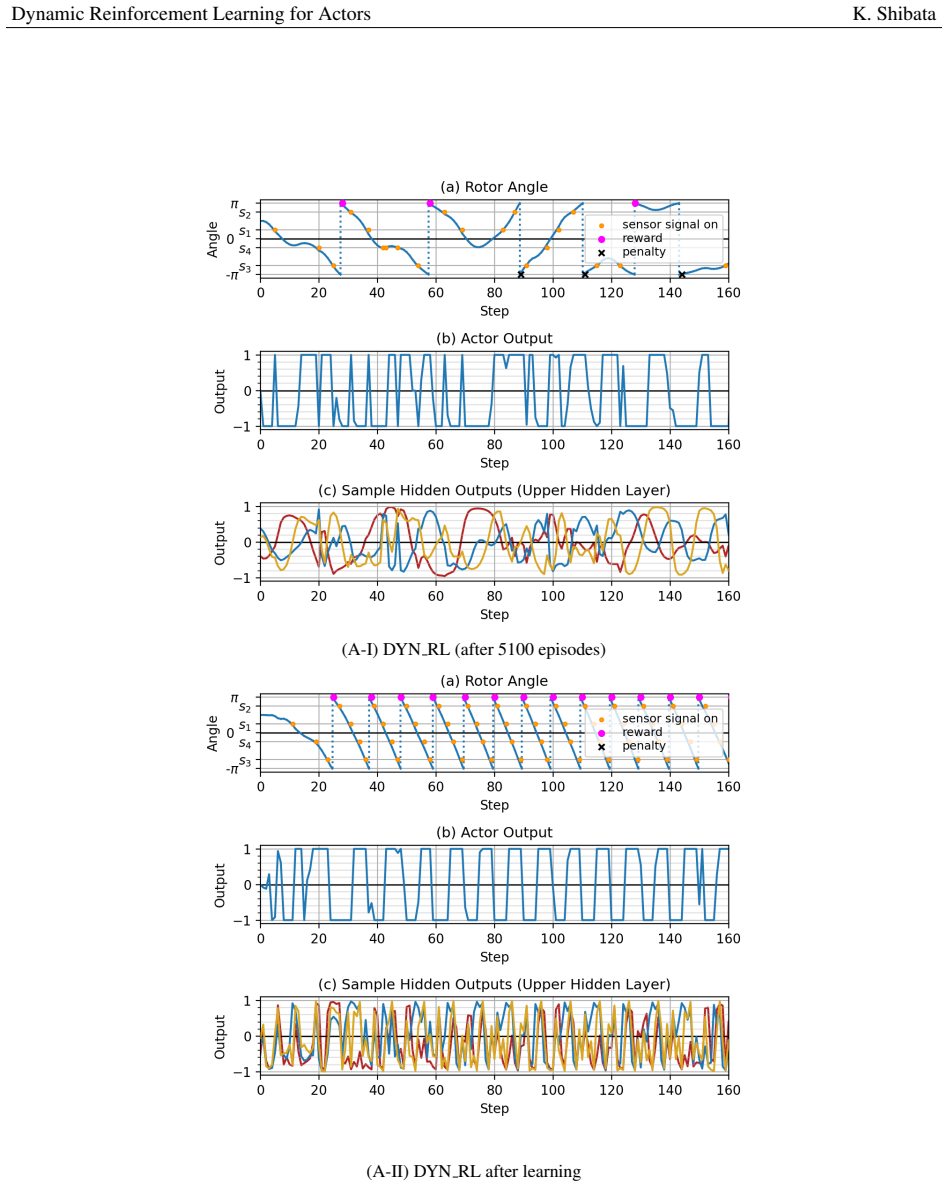
The central claim is that an actor RNN can learn dynamic, memory-dependent behavior without stochastic action selection and without backpropagation through time. What is controlled is the local convergence or divergence of state-space flow, quantified in each neuron by the sensitivity $s(U;w)=f'(U)\lVert w\rVert$, the Euclidean norm of the output gradient with respect to the neuron's input vector. The update equations (16)-(17) make a positive TD error reduce the neuron's sensitivity, rendering a good state transition reproducible, and a negative TD error increase sensitivity, restoring exploratory irregularity. In two tasks, a sequential navigation task requiring the agent to remember whether it has passed a subgoal and a slider-crank control task requiring periodic force generation, the proposed actor-critic is reported to reach success rates comparable to the conventional BPTT actor-critic with SAL (36 successes in 40 runs in navigation; the highest success count in slider-crank), while spending roughly one-eighth and one-fifth of the actor-network learning computation, and to recover markedly faster after the environment changes. The author reads the resulting shift from irregular to rational state transitions as the core evidence for the hypothesis that exploration and thinking lie on a single chaotic-dynamics continuum.
Load-bearing premise
The paper's update rule treats the sensitivity of a dynamic recurrent neuron as the static gradient $f'(U)\lVert w\rVert$, which is justified only if the neuron's input varies slowly compared with its time constant $\tau$; recurrent inputs are previous outputs and can change quickly, so this slow-input assumption is the point where the local index could stop measuring true convergence or divergence.
Editorial extensions
If this is right
- Actor learning cost per step drops to a fraction of the BPTT baseline because no temporal backpropagation and no random-number generator are required.
- After an environmental change, negative TD errors automatically raise sensitivity, so exploratory behavior resumes quickly without any explicit reset or schedule.
- SAL is load-bearing for both Dynamic RL and conventional BPTT: removing it lowers success rates, so maintaining per-neuron sensitivity is a general requirement for recurrent policy learning, not only for chaos-based learning.
- Because exploration is embedded in the actor output and cannot be switched off, test-time performance remains slightly worse and more irregular than a noise-free conventional actor.
- Applying SRL to hidden-to-hidden recurrent weights is what makes learning work; earlier chaos-based methods that left these weights unchanged did not improve.
Reading between the lines
- If the slow-input assumption is the real constraint, the natural stress test is to compare the local sensitivity gradient with a numerically computed Jacobian on recurrent paths; this could determine how much the method depends on large time constants.
- The same sensitivity argument could be ported to the critic network, which the paper leaves conventional; a dynamic critic that adjusts value-neuron sensitivity by TD error might stabilize value learning the way SRL stabilizes the actor.
- The two tasks suggest a scaling prediction: deeper or sparser-reward environments should select for larger target sensitivity thresholds, since exploration needs stronger chaoticity early in learning.
- The hypothesis that exploration grows into thinking predicts a measurable signature: as training progresses, trajectory divergence should remain positive but shrink, and after reward reversal it should spike; the exploration exponent computed in this paper is the natural observable for that prediction.
Editorial analysis
A structured set of objections, weighed in public.
Referee Report
Summary. The paper proposes 'Dynamic Reinforcement Learning for Actors,' in which an actor RNN is made chaotic and learns by locally adjusting each neuron's sensitivity s=f'(U)||w|| rather than by backpropagating errors through time. A sensitivity adjustment learning (SAL) rule keeps sensitivity above a threshold to preserve chaotic exploration, while a sensitivity-controlled RL (SRL) rule increases or decreases sensitivity according to the sign of the TD error. The method is tested on a sequential navigation task and a slider-crank control task, with comparisons to BPTT-based actor-critic learning, ablations of SAL and SRL, and measurements of an 'exploration exponent.' The paper reports comparable or better success rates, faster adaptation after environmental changes, and lower computational cost, and it connects the results to speculative claims about exploration, thinking, and existential risk.
Significance. If the central mechanism were established, the paper would offer a genuinely interesting local-learning alternative to BPTT for recurrent actor networks, eliminating backward computation through time and external exploration noise while retaining comparable task performance. The update rules in Eqs. (9)-(10) and (16)-(17) are derived arithmetically in a transparent way, and the simulations use 40 runs with explicit success/failure criteria and targeted ablations that show both SAL and SRL contribute to performance. Credit is also due for the honest enumeration of remaining problems in Section 4.1. However, the load-bearing claim that locally updating per-neuron sensitivity reliably controls global convergence/divergence of the closed-loop agent-environment system is not supported by a derivation or by sign-conditioned empirical evidence. The dynamic-neuron sensitivity is introduced under an unverified slow-input assumption, and the reported exploration exponent is an aggregate over episodes rather than a measure of transitions grouped by TD-error sign. These gaps make the paper a promising proposal rather than a fully established result.
major comments (3)
- [§2, Eqs. (1), (4), (6)] The sensitivity defined in Eq. (4) is the norm of the gradient of o_t with respect to x_t for a static neuron. For the dynamic neuron in Eq. (1), the one-step Jacobian is (Delta_t/tau) f'(U_t) w, so the sensitivity is (Delta_t/tau) f'(U_t) ||w||, not f'(U_t) ||w|| as used in Eq. (4). The paper invokes a slow-input assumption, but recurrent feedback inputs are outputs at time t-1 and need not vary slowly relative to tau. Moreover, the moving average sbar in Eq. (6) and the SAL/SRL switching condition in Fig. 4 use the unscaled static value, which for the upper hidden layer with tau=5 overstates sensitivity by a factor of 5 relative to the actual one-step sensitivity. This scale mismatch can place neurons in the wrong learning regime, and the manuscript should either define a correct dynamic sensitivity or demonstrate empirically that the mismatch does not affect the claimed mechanism.
- [§1.4, §4.1, Fig. 13] No theoretical or controlled empirical bridge is provided from per-neuron sensitivity to the global contraction/expansion of the recurrent agent-environment system. In a nonlinear recurrent system, local convergence or divergence is governed by products and alignments of local Jacobians, so a scalar per-neuron index does not by itself determine the spectral norm of the global state-transition Jacobian. The exploration exponent defined in Eq. (24) and plotted in Fig. 13 is an aggregate average over episodes, not conditioned on the sign of the TD error. Consequently, the data do not demonstrate that positive-TD updates specifically increase reproducibility or that negative-TD updates specifically increase divergence; the observed decrease of the exponent during learning could also arise from SAL, output-layer regularization, or other side effects of weight changes. The authors should add sign-conditioned measurements of sensitivity or local divergence, or an analytical statement relating the update to the global Lyapunov behavior.
- [§3.1, §3.2, Tables 2 and 4] The comparison between Dynamic RL and conventional BPTT is confounded by differences in initialization. In Table 2 the actor's upper-hidden self-feedback spectral radius is 3.0 for Dynamic RL but 1.3 for conventional RL, and in Table 4 the actor output-layer initial weights are 0.1 for Dynamic RL and 0.0 for conventional RL. Since the claims of comparable success rates and faster adaptation in Figs. 9, 10, 15, and 16 depend directly on this comparison, the authors should either match these initialization choices across methods or systematically vary them to show that the observed differences are not artifacts of the initial dynamics. The author's own statement in Section 4.1 that parameter adjustment was not systematic reinforces this concern.
minor comments (5)
- [§2, Eq. (7)] Eq. (7) contains an apparent typo: the right-hand side uses eta_SRL where the learning rate for SAL, eta_SAL, is intended; this should be corrected for consistency with Eq. (8) and the surrounding text.
- [§3.2 vs Tables 2 and 3] The text after Fig. 16 says the truncated BPTT steps were '10 in the sequential navigation task and 5 in this task,' but Table 2 reports 20 for the navigation task and Table 3 reports 10 for the slider-crank task; the numbers in the text and tables need to be reconciled.
- [Appendix C, Eq. (24)] The 'exploration exponent' is a finite-time average of log distance increments with reset thresholds, not a standard Lyapunov exponent. The description should state this explicitly and specify how the distance is reinitialized after a reset, how episodes with early termination are handled, and why the state space is restricted to the input and upper-hidden dimensions.
- [Figs. 9 and 15] Success counts over 40 runs are reported without confidence intervals or statistical tests; for example, 36-2-2 versus 36-4-0 is not obviously significant, and statements about the 'highest success rate' should be supported by an appropriate test or interval.
- [§3.1, Fig. 11] The comparison of test steps between Dynamic RL and conventional RL is inherently uneven because in conventional RL exploration noise is removed during testing while in Dynamic RL exploration cannot be separated from the output; the paper acknowledges this in Section 4.1, but the point should be stated at the first presentation of Fig. 11 to prevent overinterpretation.
Circularity Check
No significant circularity: Dynamic RL's SRL/SAL updates are definitions plus local gradients, and the global-control claims are validated by independent BPTT comparisons, ablations, and a measured exploration exponent.
full rationale
The derivation chain is not circular. The sensitivity s(U;w)=f'(U)||w|| (Eq. 4) is an explicit definition, and the SAL/SRL updates (Eqs. 7-17) are the corresponding local gradients of that sensitivity modulated by the TD error; this is algorithm construction, not a prediction of an independently defined target. The paper's substantive claims—that these updates control global convergence/divergence and improve learning—are tested outside the definition: against conventional BPTT actor-critic (Eqs. 18-19) on two tasks, through ablations (A, A-1, A-2 in Table 1), and with an independently computed exploration exponent (Appendix C) that is a measured Lyapunov-type quantity of the closed-loop system. The static-to-dynamic extension of Eq. (4) to the dynamic neuron of Eq. (1) is an explicit modeling assumption ('assuming that the infinitesimal variation dx of the input x changes slowly enough compared to the time constant tau'), not a circular reduction; its failure would be a correctness risk, not circularity. Self-citations—Shibata et al. 2021 for SAL and Shibata & Sakashita 2015 for chaos-based exploration—are not load-bearing: SAL is re-derived in Eqs. (7)-(10), and the chaotic-exploration claim is re-examined here through the measured exploration exponent and behavioral trajectories. The paper also acknowledges limitations (instability, output saturation, critic not yet dynamic, Sec. 4.1), which further indicates the results are presented as empirical findings rather than as consequences of the definitions. No fitted parameter is renamed as a prediction, and no uniqueness theorem is imported from the authors' prior work.
Assumptions & free parameters
free parameters (6)
- Target sensitivity threshold sth =
1.3 (navigation), 1.6 (slider-crank)
- Initial spectral radius of actor upper-hidden self-feedback weights =
3.0 (Dynamic RL), 1.3 (conventional RL)
- Per-layer learning rates =
Table 4 values, e.g., eta_SRL 0.01 in->hid for navigation, 0.002 hid2->hid2 for slider-crank
- Regularization rate eta_reg =
1e-6 (navigation), 1e-7 (slider-crank)
- Critic raising threshold C_th and rate eta_raise =
C_th=0.1; eta_raise=0.0005 (navigation), 0.0002 (slider-crank)
- Moving average constants alpha and beta =
alpha=0.001, beta=0.0001
assumptions (5)
- domain assumption For a dynamic neuron obeying Eq. (1), the static sensitivity definition s(U;w)=f'(U)||w|| remains valid when input variations are slow compared to tau.
- domain assumption Large random initial weights with spectral radius 3.0, maintained by SAL, produce chaotic agent-environment dynamics with a positive exploration exponent.
- domain assumption Reducing neuron sensitivity around positive-TD transitions increases reproducibility, and increasing it around negative-TD transitions increases exploration, in the full closed-loop system.
- domain assumption The TD error r_hat = gamma C_{t+1} + r_{t+1} - C_t is a sufficient scalar signal for adjusting dynamics.
- domain assumption The finite-time, single-perturbation exploration exponent in Appendix C captures the relevant chaoticity of the closed-loop system.
Cite this review
Pith. "Pith review of Dynamic Reinforcement Learning for Actors." pith.science (2026). https://pith.science/paper/IZRA3KFQ
@misc{pith2026250210200,
  author       = {Pith},
  title        = {Pith review of: Dynamic Reinforcement Learning for Actors},
  year         = {2026},
  howpublished = {\url{https://pith.science/paper/IZRA3KFQ}},
  note         = {Machine review of arXiv:2502.10200}
}
read the original abstract
Dynamic Reinforcement Learning (Dynamic RL), proposed in this paper, directly controls system dynamics, instead of the actor (action-generating neural network) outputs at each moment, bringing about a major qualitative shift in reinforcement learning (RL) from static to dynamic. The actor is initially designed to generate chaotic dynamics through the loop with its environment, enabling the agent to perform flexible and deterministic exploration. Dynamic RL controls global system dynamics using a local index called "sensitivity," which indicates how much the input neighborhood contracts or expands into the corresponding output neighborhood through each neuron's processing. While sensitivity adjustment learning (SAL) prevents excessive convergence of the dynamics, sensitivity-controlled reinforcement learning (SRL) adjusts them -- to converge more to improve reproducibility around better state transitions with positive TD error and to diverge more to enhance exploration around worse transitions with negative TD error. Dynamic RL was applied only to the actor in an Actor-Critic RL architecture while applying it to the critic remains a challenge. It was tested on two dynamic tasks and functioned effectively without external exploration noise or backward computation through time. Moreover, it exhibited excellent adaptability to new environments, although some problems remain. Drawing parallels between 'exploration' and 'thinking,' the author hypothesizes that "exploration grows into thinking through learning" and believes this RL could be a key technique for the emergence of thinking, including inspiration that cannot be reconstructed from massive existing text data. Finally, despite being presumptuous, the author presents the argument that this research should not proceed due to its potentially fatal risks, aiming to encourage discussion.
Figures


Figures from the paper (17 more)




Reference graph
Works this paper leans on
-
[1]
Can I say, now machines can think?
N. Aggarwal, G. J. Saxena, S. Singh, and A. Pundir. Can I say, now machines can think?, 2023. URL https://arxiv.org/abs/2307.07526
work page Pith review arXiv 2023
- [2]
-
[3]
S. Amari. Any target function exists in a neighborhood of any sufficiently wide random network: A geometrical perspective, 2020. URL https://arxiv.org/abs/2001.06931
work page Pith review arXiv 2020
-
[4]
M. Andrychowicz, F. Wolski, A. Ray, et al. Hindsight experience replay. In I. Guyon et al., editors, Advances in Neural Information Processing Systems, volume 30, pages 1--11. Curran Associates, Inc., 2017. URL https://proceedings.neurips.cc/paper_files/paper/2017/file/453fadbd8a1a3af50a9df4df899537b5-Paper.pdf
work page 2017
-
[5]
T. Azizi and G. Kerr. Application of stability theory in study of local dynamics of nonlinear systems. Journal of Applied Mathematics and Physic, 8: 0 1180--1192, 2020. doi:https://doi.org/10.4236/jamp.2020.86089
-
[6]
D. Berlyne and W. E. Vinacke. Thought (n.d.), 2025. URL https://www.britannica.com/topic/thought. In Encyclopaedia Britannica, Encyclopedia Britannica Inc. Retrieved January 11, 2025
work page 2025
- [7]
-
[8]
Center for AI Safety . Statement on AI risk, 2025 a . URL https://www.safe.ai/work/statement-on-ai-risk/
work page 2025
Show all 69 references
-
[9]
An overview of catastrophic AI risks, 2025 b
Center for AI Safety . An overview of catastrophic AI risks, 2025 b . URL https://www.safe.ai/ai-risk
2025
-
[10]
Chakrabarty, P
T. Chakrabarty, P. Laban, D. Agarwal, et al. Art or artifice? large language models and the false promise of creativity, 2024. URL https://arxiv.org/abs/2309.14556
2024 arXiv
-
[11]
The alternative uses test, 2018
CreativeHuddle. The alternative uses test, 2018. URL https://www.creativehuddle.co.uk/post/the-alternative-uses-test
2018
-
[12]
E. de Bono. The Use of Lateral Thinking. Avon Books, 1971
1971
-
[13]
K. Doya, A. Ema, H. Kitano, et al. Social impact and governance of AI and neurotechnologies. Neural Networks, 152: 0 542--554, 2022. ISSN 0893-6080. doi:https://doi.org/10.1016/j.neunet.2022.05.012. URL https://www.sciencedirect.com/science/article/pii/S0893608022001861
2022 doi
-
[14]
Franceschelli and M
G. Franceschelli and M. Musolesi. Creative beam search: Llm-as-a-judge for improving response generation, 2024. URL https://arxiv.org/abs/2405.00099v4
2024 arXiv
-
[15]
W. J. Freeman. The physiology of perception. Scientific American, 264 0 (2): 0 78--85, February 1991
1991
-
[16]
Fujimoto, H
S. Fujimoto, H. van Hoof, and D. Meger. Addressing function approximation error in actor-critic methods. In Proceedings of the International Conference on Machine Learning (ICML), pages 1587--1596, 2018
2018
-
[17]
Research priorities for robust and beneficial artificial intelligence: An open letter, 2015
Future of Life Institute . Research priorities for robust and beneficial artificial intelligence: An open letter, 2015. URL https://futureoflife.org/open-letter/ai-open-letter/
2015
-
[18]
Gendron, Q
G. Gendron, Q. Bao, M. Witbrock, and G. Dobbie. Large language models are not strong abstract reasoners, 2024. URL https://arxiv.org/abs/2305.19555
2024 arXiv
-
[19]
Goto and K
K. Goto and K. Shibata. Acquisition of deterministic exploration and purposive memory through reinforcement learning with a recurrent neural network. In Proc. of SICE Annual Conf. 2010, pages FB03--1, 2010
2010
-
[20]
J. P. Guilford. The nature of human intelligence. McGraw-Hill, 1967
1967
-
[21]
E. E. Guzik, C. Byrge, and C. Gilde. The originality of machines: AI takes the torrance test. Journal of Creativity, 33 0 (3): 0 100065, 2023. ISSN 2713-3745. doi:https://doi.org/10.1016/j.yjoc.2023.100065. URL https://www.sciencedirect.com/science/article/pii/S2713374523000249
2023
-
[22]
Haarnoja, A
T. Haarnoja, A. Zhou, P. Abbeel, and S. Levine. Soft actor-critic: Off-policy maximum entropy deep reinforcement learning with a stochastic actor. In Proceedings of the International Conference on Machine Learning (ICML), pages 1861--1870, 2018
2018
-
[23]
Huang, S
S. Huang, S. Ma, Y. Li, et al. Lateval: An interactive llms evaluation benchmark with incomplete information from lateral thinking puzzles. In Proc. of LREC-COLING 2024 Torino, pages 10186--10197, 2024
2024
-
[24]
Ismayilzada, D
M. Ismayilzada, D. Paul, A. Bosselut, and L. van der Plas. Creativity in AI : Progresses and challenges, 2024. URL https://arxiv.org/abs/2410.17218
2024 arXiv
-
[25]
Jiang, F
Y. Jiang, F. Ilievski, K. Ma, and Z. Sourati. Brainteaser: Lateral thinking puzzles for large language models, 2023. URL https://arxiv.org/abs/2310.05057
2023 arXiv
-
[26]
Creativity
J.P.Guilford. Creativity. The American Psychologist, 13: 0 444--454, 1950
1950
-
[27]
Khachaturyan, S
A. Khachaturyan, S. Semenovskaya, and B. Vainshtein. The thermodynamic approach to the structure analysis of crystals. Acta Cryst., A37: 0 742--754, 1981
1981
-
[28]
Koivisto and S
M. Koivisto and S. Grassini. Best humans still outperform artificial intelligence in a creative divergent thinking task. Scientific Report, 13 0 (13601), 2023
2023
-
[29]
T. H. Kung, M. Cheatham, A. Medenilla, et al. Performance of ChatGPT on USMLE : Potential for AI -assisted medical education using large language models. PLOS Digital Health, 2 0 (2): 0 e0000198, 2023
2023
-
[30]
Kurzweil
R. Kurzweil. The age of spiritual machines: when computers exceed human intelligence. Viking Press, USA, 1998. ISBN 0670882178
1998
-
[31]
X. Lu, M. Sclar, S. Hallinan, et al. AI as humanity's Salieri : Quantifying linguistic creativity of language models via systematic attribution of machine text against web text, 2025. URL https://arxiv.org/abs/2410.04265
2025 arXiv
-
[32]
Matsuki and K
T. Matsuki and K. Shibata. Adaptive balancing of exploration and exploitation around the edge of chaos in internal-chaos-based learning. Neural Networks, 132: 0 19--29, 2020
2020
-
[33]
Matsuki, Y
T. Matsuki, Y. Sakemi, and K. Aihara. Chaos-based reinforcement learning with TD3 , 2024. URL https://arxiv.org/abs/2405.09086
2024
-
[34]
McCulloch and W
W. McCulloch and W. Pitts. A logical calculus of the ideas immanent in nervous activity. Bulletin of Mathematical Biophysics, 5: 0 115--133, 1943
1943
-
[35]
Mitchell, A
M. Mitchell, A. B. Palmarini, and A. Moskvichev. Comparing humans, GPT-4 , and GPT-4V on abstraction and reasoning tasks, 2023. URL https://arxiv.org/abs/2311.09247
2023 arXiv
-
[36]
V. Mnih, K. Kavukcuoglu, D. Silver, et al. Human-level control through deep reinforcement learning. Nature, 518 0 (7540): 0 529--533, 2015. doi:10.1038/nature14236. URL https://doi.org/10.1038/nature14236
2015 doi
-
[37]
V. Mnih, A. P. Badia, M. Mirza, et al. Asynchronous methods for deep reinforcement learning, 2016. URL https://arxiv.org/abs/1602.01783
2016 arXiv
-
[38]
S. S. Nath, P. Dayan, and C. Stevenson. Characterising the creative process in humans and large language models, 2024. URL https://arxiv.org/abs/2405.00899
2024 arXiv
-
[39]
Newell, J
A. Newell, J. C. Shaw, and H. A. Simon. The processes of creative thinking. In Symposium on Creative Thinking, pages 1--82 (P--1320), 1959
1959
-
[40]
OpenAI Five , 2019
OpenAI . OpenAI Five , 2019. URL https://openai.com/index/openai-five-defeats-dota-2-world-champions/. Accessed: 2024-08-24
2019
-
[41]
GPT-4 , 2023
OpenAI. GPT-4 , 2023. URL https://openai.com/index/gpt-4-research/. Accessed: 2025-1-26
2023
-
[42]
Achiam, et al
OpenAI , J. Achiam, et al. GPT-4 technical report, 2024. URL https://arxiv.org/abs/2303.08774
2024 arXiv
-
[43]
Peeperkorn, T
M. Peeperkorn, T. Kouwenhoven, D. Brown, and A. Jordanous. Is temperature the creativity parameter of large language models?, 2024. URL https://arxiv.org/abs/2405.00492
2024 arXiv
-
[44]
Pichai, D
S. Pichai, D. Hassabis, and K. Kavukcuoglu. Gemini: An adaptive multi-modal AI system, 2024. URL https://blog.google/technology/google-deepmind/google-gemini-ai-update-december-2024/. Accessed: 2025-1-26
2024
-
[45]
M. E. Raichle, A. M. MacLeod, A. Z. Snyder, et al. A default mode of brain function. Proceedings of the National Academy of Sciences - PNAS, 98 0 (2): 0 676--682, 2001. ISSN 0027-8424
2001
-
[46]
D. E. Rumelhart and J. L. McClelland. Parallel Distributed Processing: Explorations in the Microstructure of Cognition, Vol. 1: Foundations. MIT Press, 1986
1986
-
[47]
Sawatsubashi, M
Y. Sawatsubashi, M. F. bin Samsudin, and K. Shibata. Emergence of discrete and abstract state representation through reinforcement learning in a continuous input task. In Advances in Intelligent Systems and Computing, Robot Intelligence Technology and Applications 2012, pages ...
2012
-
[48]
Schaul, J
T. Schaul, J. Quan, I. Antonoglou, and D. Silver. Prioritized experience replay, 2016. URL https://arxiv.org/abs/1511.05952
2016 arXiv
-
[49]
Schrittwieser, I
J. Schrittwieser, I. Antonoglou, T. Hubert, et al. Mastering Atari, Go , chess and shogi by planning with a learned model. Nature, 588 0 (7839): 0 604--609, Dec. 2020. ISSN 1476-4687. doi:10.1038/s41586-020-03051-4. URL http://dx.doi.org/10.1038/s41586-020-03051-4
2020 doi
-
[50]
Schulman, F
J. Schulman, F. Wolski, P. Dhariwal, et al. Proximal policy optimization algorithms. In Proceedings of the International Conference on Machine Learning (ICML), pages 1--9, 2017
2017
-
[51]
K. Shibata. Learning of deterministic exploration and temporal abstraction in reinforcement learning. In Proc. of SICE-ICCAS (SICE-ICASE Int'l Joint Conf.), pages 4569--4574, 2006
2006
-
[52]
K. Shibata. Emergence of intelligence through reinforcement learning with a neural network. In A. Mellouk, editor, Advances in Reinforcement Learning, chapter 6, pages 99--120. IntechOpen, 2011. doi:10.5772/13443. URL https://doi.org/10.5772/13443
2011 doi
-
[53]
K. Shibata. Communications that emerge through reinforcement learning using a (recurrent) neural network, 2017 a . URL https://arxiv.org/abs/1703.03543
2017 arXiv
-
[54]
K. Shibata. Functions that emerge through end-to-end reinforcement learning - the direction for artificial general intelligence -, 2017 b . URL https://arxiv.org/abs/1703.02239
2017 arXiv
-
[55]
Shibata and K
K. Shibata and K. Ito. Emergence of communication for negotiation by a recurrent neural network. In Proc. of ISADS (Int'l Symposium on Autonomous Decentralized System) '99, pages 294--301, 1999
1999
-
[56]
Shibata and Y
K. Shibata and Y. Okabe. Reinforcement learning when visual sensory signals are directly given as inputs. In Proc. of ICNN (Int'l Conf. on Neural Networks) '97 Houston, volume 3, pages 1716--1720, 1997
1997
-
[57]
Shibata and Y
K. Shibata and Y. Sakashita. Reinforcement learning with internal-dynamics-based exploration using a chaotic neural network. In Proc. of Int'l Joint Conf. on Neural Networks (IJCNN) 2015, page \#15231, 2015
2015
-
[58]
Shibata, T
K. Shibata, T. Ejima, Y. Tokumaru, and T. Matsuki. Sensitivity -- local index to control chaoticity or gradient globally --. Neural Networks, 143: 0 436--451, 2021. ISSN 0893-6080
2021
-
[59]
C. A. Skarda and W. J. Freeman. How brains make chaos in order to make sense of the world. Behavioral and brain sciences, 10: 0 161--173, 1987
1987
-
[60]
R. S. Sutton and A. G. Barto. Reinforcement Learning: An Introduction. The MIT Press, second edition, 2018
2018
-
[61]
D. Tam, A. Mascarenhas, S. Zhang, et al. Evaluating the factual consistency of large language models through news summarization, 2023. URL https://arxiv.org/abs/2211.08412
2023 arXiv
-
[62]
E. P. Torrance. Torrance tests of creative thinking, 2018. URL https://www.ststesting.com/gift/TTCT_InterpMOD.2018.pdf
2018
-
[63]
A. M. Turing. Computing machinery and intelligence. Mind, New Series, 59 0 (236): 0 433--460, 1950. URL https://www.jstor.org/stable/2251299
1950
-
[64]
Vaswani, N
A. Vaswani, N. Shazeer, N. Parmar, et al. Attention is all you need, 2023. URL https://arxiv.org/abs/1706.03762
2023 arXiv
-
[65]
Vinyals, I
O. Vinyals, I. Babuschkin, W. Czarnecki, et al. Grandmaster level in StarCraft II using multi-agent reinforcement learning. Nature, 575: 0 350--354, 2019. doi:10.1038/s41586-019-1724-z. URL https://doi.org/10.1038/s41586-019-1724-z
2019 doi
-
[66]
R. Woolf. Plato and the norms of thought. Mind, 122: 0 171--216, 2013. URL https://doi.org/10.1093/mind/fzt012
2013 doi
-
[67]
Yamashita and J
Y. Yamashita and J. Tani. Emergence of Functional Hierarchy in a Multiple Timescale Neural Network Model: A Humanoid Robot Experiment . PLOS Computational Biology, 6 0 (10), 2010. doi:10.1371/journal.pcbi.1000220
2010 doi
-
[68]
Yudkowsky
E. Yudkowsky. Pausing AI developments isn't enough. we need to shut it all down. Time Magazine, 2023. URL https://time.com/6266923/ai-eliezer-yudkowsky-open-letter\ -not-enough/
2023
-
[69]
Y. Zhao, R. Zhang, W. Li, et al. Assessing and understanding creativity in large language models, 2024. URL https://arxiv.org/pdf/2401.12491v1
2024 arXiv
Reviewed August 7, 2026 · model on record in the stance chip above.
Discussion (0). Continue with ORCID to comment.