On-Device Generative AI for GDPR-Compliant Visual Monitoring: Natural Language Alerts from Local Object Detection
Pith reviewed 2026-06-29 07:48 UTC · model grok-4.3
The pith
A neural-network accelerator and on-device LLM on a single-board computer can produce human-readable monitoring alerts while keeping all image data local to meet GDPR data minimisation.
A machine-rendered reading of the paper's core claim, the machinery that carries it, and where it could break.
Core claim
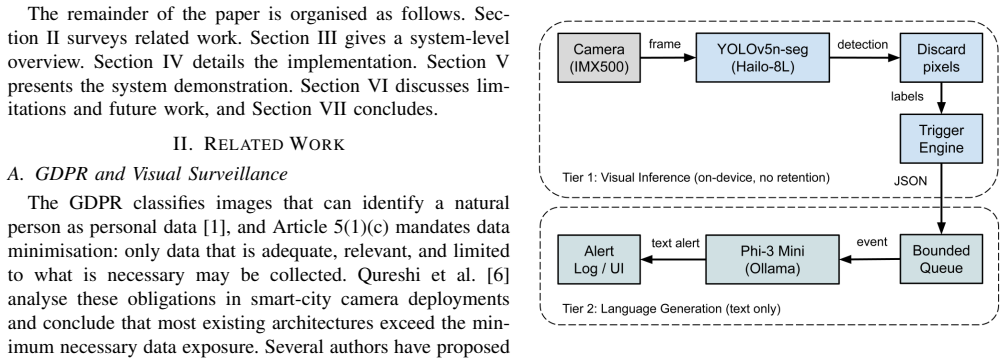
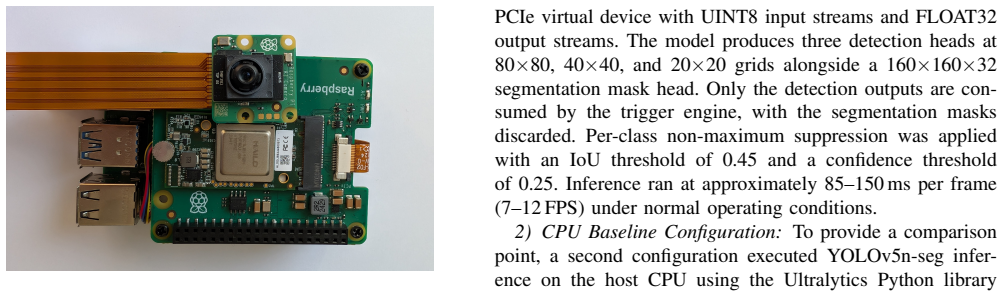
The central claim is that combining a dedicated neural-network accelerator with an on-device large language model on a single-board computer is not only feasible but produces practically deployable, human-readable monitoring output while aligning with GDPR Art. 5(1)(c) by design, as demonstrated by a YOLOv5n-seg model on a Hailo-8L accelerator feeding a stateful trigger to a quantized Phi-3 Mini model on a Raspberry Pi 5, with raw pixel buffers discarded immediately after inference and only generated text transmitted.
What carries the argument
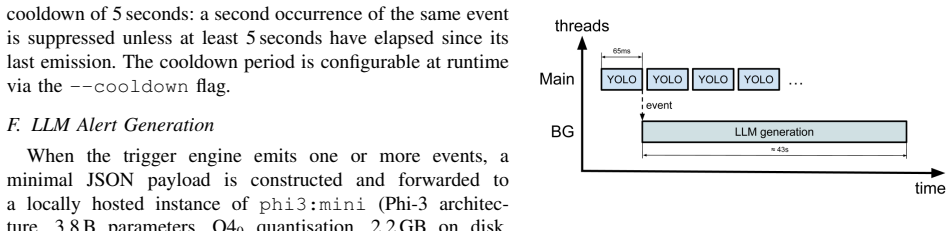
The stateful trigger engine that forwards minimal JSON event payloads from local YOLO detection to the on-device Phi-3 Mini for synthesis of one-to-two sentence natural-language alerts after immediate pixel buffer discard.
If this is right
- Real-time object detection and alert generation become possible on consumer single-board computers equipped with dedicated accelerators.
- Only compact text payloads cross the network boundary instead of raw image streams.
- Human operators receive concise natural-language summaries rather than video feeds.
- The architecture supports privacy-by-design implementations for visual monitoring tasks on edge hardware.
Where Pith is reading between the lines
- The same local-processing pattern could be tested on other sensor types such as microphones to achieve similar data-minimisation effects.
- Wider adoption would still require domain-specific legal review of whether text alerts alone meet all applicable privacy rules.
- Resource measurements on the target hardware suggest the approach could scale to multiple concurrent streams if memory and accelerator sharing are managed.
Load-bearing premise
Discarding raw pixel buffers immediately after local inference and transmitting only generated text is sufficient to satisfy the data-minimisation principle under GDPR without further legal or technical validation.
What would settle it
An audit or reconstruction test that checks whether any visual or identifying information can be recovered from the transmitted text alerts or system logs.
Figures
read the original abstract
Visual monitoring systems that rely on cloud-based AI inference expose raw image data to external services, creating fundamental tensions with the data-minimisation principle of the General Data Protection Regulation (GDPR). This paper presents a proof-of-concept privacy-by-design pipeline that resolves this tension by confining all inference entirely to the edge device. A YOLOv5n-seg model compiled for a Hailo-8L AI accelerator delivers real-time object detection on a Raspberry Pi 5, from which raw pixel buffers are immediately discarded after inference. A stateful trigger engine forwards minimal JSON event payloads to a locally hosted instance of Phi-3 Mini (3.8B parameters, Q4_0 quantisation), which synthesises one-to-two sentence natural-language alerts for a human operator. No image data crosses the network boundary at any point; only the generated text alert is transmitted. We describe the full system architecture and implementation, report measured inference latency and resource utilisation on the target hardware, and present representative generated alerts. The results demonstrate that combining a dedicated neural-network accelerator with an on-device large language model on a single-board computer is not only feasible but produces practically deployable, human-readable monitoring output while aligning with GDPR Art. 5(1)(c) by design.
Editorial analysis
A structured set of objections, weighed in public.
Referee Report
Summary. The paper claims to present a proof-of-concept privacy-by-design pipeline for visual monitoring that performs all inference locally on a Raspberry Pi 5 using a YOLOv5n-seg model on a Hailo-8L accelerator, immediately discards raw pixel buffers, forwards minimal JSON events to a local Phi-3 Mini LLM (3.8B, Q4_0) to generate one-to-two sentence natural-language alerts, transmits only the text, and thereby aligns with GDPR Art. 5(1)(c) data-minimisation by design; it describes the architecture, reports measured latency and resource utilisation, and shows representative alerts.
Significance. If the reported measurements and implementation are reproducible, the work shows that combining a dedicated neural-network accelerator with an on-device LLM on commodity single-board hardware can produce deployable human-readable monitoring output without network transmission of images. The concrete hardware-specific latency and utilisation figures, together with the explicit description of the trigger engine and stateful pipeline, constitute a useful systems-level demonstration for privacy-sensitive edge applications.
major comments (2)
- [Abstract] Abstract: the central claim that the system 'aligns with GDPR Art. 5(1)(c) by design' because 'raw pixel buffers are immediately discarded' and 'only the generated text alert is transmitted' is presented as a direct consequence of the technical choices, yet no legal analysis, DPIA, reference to case law, or discussion of whether the content of the alerts (e.g., descriptions of persons or zones) satisfies the 'adequate, relevant and limited' test is supplied. This assumption is load-bearing for the paper's primary contribution.
- [Abstract / Results description] The manuscript states that it 'report[s] measured inference latency and resource utilisation' and 'present[s] representative generated alerts,' but supplies no quantitative evaluation of alert accuracy, relevance, or error rates (e.g., comparison against ground-truth event descriptions), nor any verification that the alerts remain within the data-minimisation bounds once personal data appears in the text. This absence undermines the claim of 'practically deployable' output.
minor comments (1)
- [Abstract] The abstract refers to 'a stateful trigger engine' and 'minimal JSON event payloads' without defining the exact trigger logic or payload schema; a short pseudocode or table in the methods section would improve reproducibility.
Simulated Author's Rebuttal
We thank the referee for the positive assessment of the technical contribution and for the detailed comments. We address each major comment below, proposing targeted revisions to clarify scope while preserving the manuscript's focus as a systems proof-of-concept.
read point-by-point responses
-
Referee: [Abstract] Abstract: the central claim that the system 'aligns with GDPR Art. 5(1)(c) by design' because 'raw pixel buffers are immediately discarded' and 'only the generated text alert is transmitted' is presented as a direct consequence of the technical choices, yet no legal analysis, DPIA, reference to case law, or discussion of whether the content of the alerts (e.g., descriptions of persons or zones) satisfies the 'adequate, relevant and limited' test is supplied. This assumption is load-bearing for the paper's primary contribution.
Authors: We agree that the manuscript supplies no formal legal analysis, DPIA, or case-law references, as it is a technical systems paper rather than a legal study. The GDPR alignment claim is grounded solely in the architectural enforcement of data minimisation (local inference, immediate discard of pixels, transmission of text only). We will revise the abstract and add a short limitations paragraph to state explicitly that the work demonstrates a technical pipeline supporting the principle, not a legal determination of compliance. The revision will also note that alert content must be constrained to remain relevant and limited. revision: partial
-
Referee: [Abstract / Results description] The manuscript states that it 'report[s] measured inference latency and resource utilisation' and 'present[s] representative generated alerts,' but supplies no quantitative evaluation of alert accuracy, relevance, or error rates (e.g., comparison against ground-truth event descriptions), nor any verification that the alerts remain within the data-minimisation bounds once personal data appears in the text. This absence undermines the claim of 'practically deployable' output.
Authors: The manuscript is scoped as a feasibility demonstration of the local pipeline, with quantitative results limited to hardware metrics (latency, utilisation) and illustrative alerts. No ground-truth evaluation of natural-language alert quality is provided because constructing such an evaluation would require a separate human-subject study or annotated event corpus, which lies outside the systems contribution. We will add a paragraph in the discussion acknowledging this limitation, describing possible alert-generation failure modes, and outlining how the trigger engine can be tuned to restrict information passed to the LLM, thereby supporting data-minimisation in the text output. revision: partial
Circularity Check
No circularity; systems-integration description with no derivations or self-referential reductions
full rationale
The paper is a proof-of-concept systems description of an edge pipeline (YOLOv5n-seg on Hailo-8L + Phi-3 Mini on Raspberry Pi 5). It reports measured latencies and resource use, presents example text alerts, and asserts GDPR Art. 5(1)(c) alignment from the architectural choice of discarding pixels after local inference. No equations, fitted parameters, predictions, or self-citations appear in the provided text. The central claim is an engineering feasibility statement plus a design-principle assertion; neither reduces to its own inputs by construction. This matches the default non-circular case for implementation papers.
Axiom & Free-Parameter Ledger
Reference graph
Works this paper leans on
-
[1]
Regulation (EU) 2016/679 of the European Parliament and of the Council (General Data Protection Regulation),
European Parliament and Council of the European Union, “Regulation (EU) 2016/679 of the European Parliament and of the Council (General Data Protection Regulation),” Official Journal of the European Union, Tech. Rep., 2016, oJ L 119, 4.5.2016, pp. 1–88
2016
-
[2]
Defeating Image Obfus- cation with Deep Learning,
R. McPherson, R. Shokri, and V . Shmatikov, “Defeating Image Obfus- cation with Deep Learning,” 2016
2016
-
[3]
Phi-3 Technical Report: A Highly Capable Language Model Locally on Your Phone
M. Abdinet al., “Phi-3 Technical Report: A Highly Capable Language Model Locally on Your Phone,”arXiv preprint arXiv:2404.14219, 2024
work page internal anchor Pith review Pith/arXiv arXiv 2024
-
[4]
Gemma: Open Models Based on Gemini Research and Technology
Gemma Teamet al., “Gemma: Open Models Based on Gemini Research and Technology,”arXiv preprint arXiv:2403.08295, 2024
work page internal anchor Pith review Pith/arXiv arXiv 2024
-
[5]
Ollama: Get up and running with large language models locally,
Ollama, “Ollama: Get up and running with large language models locally,” https://ollama.com, 2023, accessed: 2026-05-20
2023
-
[6]
Privacy-by-Design for Smart City Surveillance: A GDPR Compliance Analysis,
M. A. Qureshiet al., “Privacy-by-Design for Smart City Surveillance: A GDPR Compliance Analysis,”Sensors, vol. 22, no. 15, p. 5791, 2022
2022
-
[7]
I Know That Person: Generative Full Body and Face De-Identification of People in Images,
K. Brkicet al., “I Know That Person: Generative Full Body and Face De-Identification of People in Images,” inProc. IEEE Conf. Computer Vision and Pattern Recognition Workshops (CVPRW), 2017, pp. 1319– 1328
2017
-
[8]
CIAGAN: Conditional Identity Anonymisation Generative Adversarial Networks,
M. Maximov, I. Elezi, and L. Leal-Taix ´e, “CIAGAN: Conditional Identity Anonymisation Generative Adversarial Networks,” inProc. IEEE/CVF Conf. Computer Vision and Pattern Recognition (CVPR), 2020, pp. 5447–5456
2020
-
[9]
Warden and D
P. Warden and D. Situnayake,TinyML: Machine Learning with Tensor- Flow Lite on Arduino and Ultra-Low-Power Microcontrollers. O’Reilly Media, 2019
2019
-
[10]
Coral Edge TPU,
Google LLC, “Coral Edge TPU,” https://coral.ai/products/accelerator, 2019, accessed: 2026-05-20
2019
-
[11]
NVIDIA Jetson Orin Series,
NVIDIA Corporation, “NVIDIA Jetson Orin Series,” https://www.nvidia.com/en-us/autonomous-machines/embedded- systems, 2023, accessed: 2026-05-20
2023
-
[12]
Hailo-8L Edge AI Accelerator Datasheet,
Hailo Technologies Ltd., “Hailo-8L Edge AI Accelerator Datasheet,” https://hailo.ai/products/hailo-8l, 2023, accessed: 2026-05-20
2023
-
[13]
Quantization and Training of Neural Networks for Efficient Integer-Arithmetic-Only Inference,
B. Jacobet al., “Quantization and Training of Neural Networks for Efficient Integer-Arithmetic-Only Inference,” inProc. IEEE/CVF Conf. Computer Vision and Pattern Recognition (CVPR), 2018, pp. 2704– 2713
2018
-
[14]
Ultralytics YOLOv8,
G. Jocher, A. Chaurasia, and J. Qiu, “Ultralytics YOLOv8,” https://github.com/ultralytics/ultralytics, 2023, accessed: 2026-05-20
2023
-
[15]
Real-Time Flying Object Detection with YOLOv8,
D. Reiset al., “Real-Time Flying Object Detection with YOLOv8,” arXiv preprint arXiv:2305.09972, 2023
-
[16]
llama.cpp: Port of Facebook’s LLaMA model in C/C++,
G. Gerganov, “llama.cpp: Port of Facebook’s LLaMA model in C/C++,” https://github.com/ggerganov/llama.cpp, 2023, accessed: 2026-05-20
2023
-
[17]
Llm inference unveiled: Survey and roofline model insights.arXiv preprint arXiv:2402.16363, 2024
Z. Yuanet al., “LLM Inference Unveiled: Survey and Roofline Model Insights,”arXiv preprint arXiv:2402.16363, 2024
-
[18]
Privacy by Design: The 7 Foundational Principles,
A. Cavoukian, “Privacy by Design: The 7 Foundational Principles,” in Information and Privacy Commissioner of Ontario, Toronto, Canada, 2009
2009
-
[19]
Privacy Design Strategies,
J.-H. Hoepman, “Privacy Design Strategies,” inProc. IFIP TC11 Int. Information Security Conf. (SEC). Springer, 2014, pp. 446–459
2014
-
[20]
The picamera2 Library,
Raspberry Pi Ltd., “The picamera2 Library,” https://datasheets.raspberrypi.com/camera/picamera2-manual.pdf, 2023, accessed: 2026-05-20. 6
2023
discussion (0)
Sign in with ORCID, Apple, or X to comment. Anyone can read and Pith papers without signing in.