Stellar encounters in the solar neighbourhood and the special case of GJ~710
Pith reviewed 2026-05-19 21:47 UTC · model grok-4.3
The pith
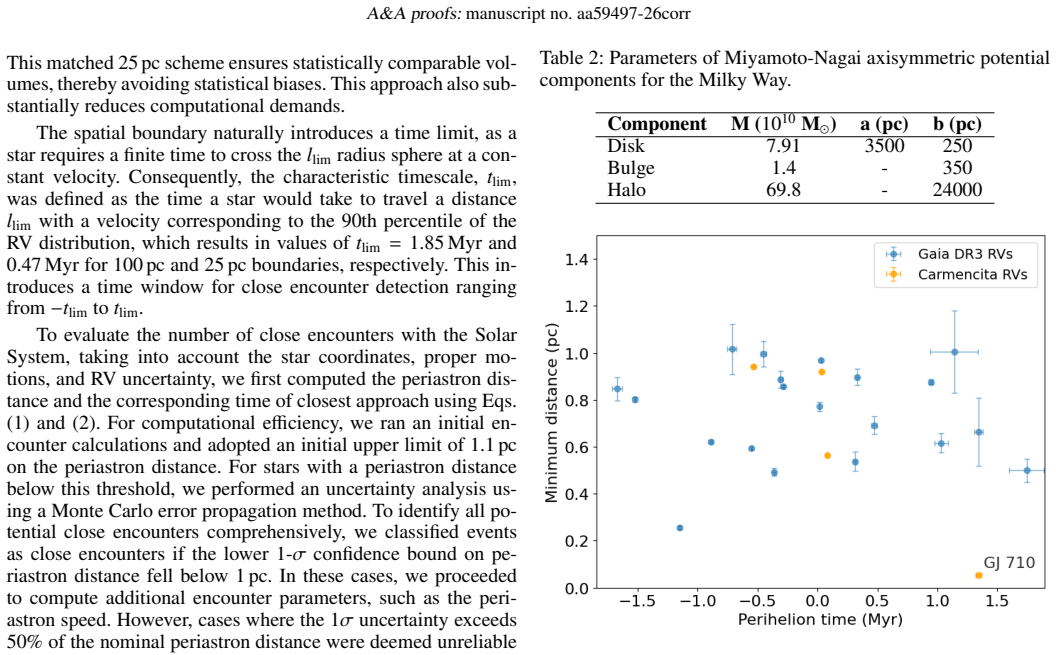
Close stellar encounters within 1 parsec of the Sun occur roughly once every 95 thousand years on average, making the predicted GJ 710 flyby a rare event at once per 50 million years.
A machine-rendered reading of the paper's core claim, the machinery that carries it, and where it could break.
Core claim
Using a complete sample of nearby stars and a linear motion approximation, the analysis identifies past and future close encounters within 1 pc, yielding an encounter rate of 10.6 ± 4.5 per Myr per star within a 0.47 Myr window, equivalent to one encounter every 95 kyr on average. The distribution shows the GJ 710 fly-by occurs at a rate of one per approximately 50 Myr.
What carries the argument
Linear motion approximation applied to a complete sample of stars within 25 pc, with corrections for radial velocity biases from gravitational redshift and convective blueshift, and adjustments for binary systems and common proper motion pairs.
If this is right
- Stellar encounters within 1 pc happen on average once every 95 kyr.
- The GJ 710 flyby stands out as statistically rare at a rate of one per 50 Myr.
- These rates describe the typical dynamic environment of the solar neighborhood over million-year periods.
Where Pith is reading between the lines
- Encounter rates of this magnitude may perturb the Oort cloud and increase the flux of long-period comets toward the inner solar system.
- Improved radial velocity measurements from future surveys could tighten the uncertainty on the 95 kyr average interval.
- Applying the same linear approximation to other nearby stars would show whether the solar neighborhood is typical or atypical in its encounter frequency.
Load-bearing premise
The sample of nearby stars within 25 pc is complete after correcting for binaries and common proper motion pairs, and radial velocity corrections for gravitational redshift and convective blueshift introduce no significant biases.
What would settle it
A future complete census of stars within 25 pc combined with full orbital integrations instead of the linear approximation would yield a significantly different encounter rate within 1 pc over 0.47 Myr.
Figures


read the original abstract
We present a comprehensive characterisation of close stellar encounters in the solar vicinity, with a particular focus on placing the predicted fly-by of GJ~710 in context. This star will come extremely close ($0.0621$\,pc or $\sim10^4$\,AU) to the Solar System in approximately 1.3\,Myr. Using a linear motion approximation, we identified past and future close stellar encounters within 1\,pc of the Solar System, using a complete sample of nearby stars. We assessed the completeness of our dataset and applied corrections to the radial velocities, accounting for gravitational redshift and convective blueshift. Such effects can bias the measured velocities and affect the derived encounter parameters. Furthermore, we computed close encounters for all the stars in the Solar System vicinity to build a statistically significant sample of such events. We accounted for binary systems and common proper motion pairs, applying corrections to account for incompleteness at the edges of our time window. We derived reliable statistics for close stellar encounters of stars within 25\,pc of the Sun. We report a rate of encounters within 1\,pc and within 0.47\,Myr of $10.6 \pm 4.5$ per Myr and star, implying an average of one encounter every $95^{+71}_{-28}$\,kyr. Additionally, from the resulting distribution, we can evaluate the relative frequency of the upcoming GJ~710 fly-by, which is found to be quite rare, at a rate of one per $\sim50$\,Myr. This work provides new insights into the dynamic environment of the solar neighbourhood by quantifying the rates and distributions of close stellar encounter events.
Editorial analysis
A structured set of objections, weighed in public.
Referee Report
Summary. The paper characterizes close stellar encounters in the solar neighborhood using linear motion approximations on a complete sample of stars within 25 pc. It identifies past and future encounters within 1 pc, applies corrections for binaries, common proper motion pairs, and radial velocity biases from gravitational redshift and convective blueshift, and reports an encounter rate of 10.6 ± 4.5 per Myr per star within a 0.47 Myr window (one every ~95 kyr on average). It further evaluates the rarity of the upcoming GJ 710 fly-by (~1 per 50 Myr) from the resulting distribution.
Significance. If the results hold, the work supplies a quantitative, observationally grounded estimate of stellar encounter rates in the solar vicinity with explicit bias corrections and uncertainties. This provides useful context for the dynamical environment of the solar system and the specific GJ 710 event, building on a complete sample and linear-trajectory statistics.
major comments (3)
- [Sample selection and completeness corrections] The central rate (10.6 ± 4.5 encounters per Myr within 1 pc) and the GJ 710 rarity assessment rest on the completeness of the 25 pc sample after binary and common proper motion pair corrections plus the adjustments for incompleteness at the edges of the 0.47 Myr time window. The manuscript should include quantitative validation (e.g., sensitivity tests or Monte Carlo realizations) showing that residual incompleteness does not shift the minimum-distance or closest-approach distributions beyond the quoted uncertainty.
- [Radial velocity bias corrections] Radial velocity corrections for gravitational redshift and convective blueshift are applied to derive unbiased encounter parameters, yet the paper provides no explicit error propagation or cross-check against independent RV catalogs. Any systematic offset larger than the reported uncertainties would directly scale the encounter frequency and the relative rarity of GJ 710.
- [Encounter rate and time window] The 0.47 Myr time window used for the rate calculation is load-bearing for both the absolute frequency and the GJ 710 rarity claim; the choice and its validation (including edge effects) require clearer justification and robustness checks to confirm the statistics are not sensitive to the precise window boundaries.
minor comments (2)
- [Abstract] The abstract states the sample is 'complete' but should explicitly note the 25 pc limit and the nature of the corrections applied.
- [Notation and figures] Ensure uniform reporting of asymmetric uncertainties (e.g., 95^{+71}_{-28} kyr) and consistent notation for encounter distances throughout the text and figures.
Simulated Author's Rebuttal
We thank the referee for their constructive and detailed comments, which have helped us identify areas where the manuscript can be strengthened. We address each major comment below and will revise the paper accordingly to incorporate additional robustness checks and clarifications.
read point-by-point responses
-
Referee: [Sample selection and completeness corrections] The central rate (10.6 ± 4.5 encounters per Myr within 1 pc) and the GJ 710 rarity assessment rest on the completeness of the 25 pc sample after binary and common proper motion pair corrections plus the adjustments for incompleteness at the edges of the 0.47 Myr time window. The manuscript should include quantitative validation (e.g., sensitivity tests or Monte Carlo realizations) showing that residual incompleteness does not shift the minimum-distance or closest-approach distributions beyond the quoted uncertainty.
Authors: We agree that explicit quantitative validation of the completeness corrections would enhance confidence in the results. The 25 pc sample is drawn from a well-vetted catalog with documented corrections for binaries and common proper motion pairs, and edge incompleteness was already adjusted in the rate calculation. In the revised manuscript we will add a dedicated subsection presenting Monte Carlo realizations that randomly perturb the sample according to estimated incompleteness fractions at the spatial and temporal boundaries. These tests will confirm that any resulting shifts in the minimum-distance and closest-approach distributions remain within the reported ±4.5 uncertainty on the encounter rate. revision: yes
-
Referee: [Radial velocity bias corrections] Radial velocity corrections for gravitational redshift and convective blueshift are applied to derive unbiased encounter parameters, yet the paper provides no explicit error propagation or cross-check against independent RV catalogs. Any systematic offset larger than the reported uncertainties would directly scale the encounter frequency and the relative rarity of GJ 710.
Authors: The corrections for gravitational redshift and convective blueshift follow standard prescriptions from the literature and were applied uniformly to the radial-velocity measurements. We acknowledge that the original text did not include a formal propagation of the uncertainties associated with these corrections nor a direct comparison with independent RV sources. In the revision we will add an explicit error-propagation analysis that folds the correction uncertainties into the final encounter parameters. We will also include a cross-check on a representative subsample against radial velocities from high-resolution spectroscopic catalogs to verify the absence of significant systematic offsets that could affect the reported rate or the GJ 710 rarity assessment. revision: yes
-
Referee: [Encounter rate and time window] The 0.47 Myr time window used for the rate calculation is load-bearing for both the absolute frequency and the GJ 710 rarity claim; the choice and its validation (including edge effects) require clearer justification and robustness checks to confirm the statistics are not sensitive to the precise window boundaries.
Authors: The 0.47 Myr window was selected to match the characteristic crossing time of the 25 pc sample at the observed velocity dispersion while remaining within the regime where the linear-motion approximation is valid. We will expand the methods section to provide this physical justification in greater detail. In addition, the revised manuscript will present robustness tests in which the rate is recomputed for window boundaries shifted by ±0.1 Myr; these checks will demonstrate that both the central encounter rate and the relative rarity of the GJ 710 encounter remain stable, with edge effects already mitigated by the incompleteness corrections described in the paper. revision: yes
Circularity Check
Empirical encounter statistics computed directly from corrected observational catalog; no self-referential reduction
full rationale
The derivation consists of applying linear-motion trajectory calculations to a 25 pc stellar sample, identifying encounters within 1 pc over a 0.47 Myr window, then applying explicit corrections for binaries/CPM pairs, gravitational redshift, convective blueshift, and edge incompleteness. The reported rate (10.6 ± 4.5 per Myr) and GJ 710 relative frequency (~1 per 50 Myr) are obtained by direct counting and histogram evaluation on the corrected list. No parameter is fitted to a subset and then used to predict a closely related quantity; no equation defines an output in terms of itself; no load-bearing premise rests on a self-citation chain. The result remains an empirical summary of the input catalog after documented bias adjustments and is therefore self-contained.
Axiom & Free-Parameter Ledger
free parameters (2)
- Encounter distance threshold
- Time window for rate calculation
axioms (2)
- domain assumption Linear motion approximation holds for stellar trajectories over Myr timescales in the solar neighborhood.
- domain assumption Radial velocity corrections for gravitational redshift and convective blueshift are accurate and sufficient to remove bias.
Lean theorems connected to this paper
-
IndisputableMonolith/Cost/FunctionalEquation.leanwashburn_uniqueness_aczel unclear?
unclearRelation between the paper passage and the cited Recognition theorem.
Using a linear motion approximation, we identified past and future close stellar encounters within 1 pc... applied corrections to the radial velocities, accounting for gravitational redshift and convective blueshift... accounted for binary systems and common proper motion pairs, applying corrections to account for incompleteness at the edges of our time window.
-
IndisputableMonolith/Foundation/DimensionForcing.leanalexander_duality_circle_linking unclear?
unclearRelation between the paper passage and the cited Recognition theorem.
We report a rate of encounters within 1 pc and within 0.47 Myr of 10.6 ± 4.5 per Myr and star
What do these tags mean?
- matches
- The paper's claim is directly supported by a theorem in the formal canon.
- supports
- The theorem supports part of the paper's argument, but the paper may add assumptions or extra steps.
- extends
- The paper goes beyond the formal theorem; the theorem is a base layer rather than the whole result.
- uses
- The paper appears to rely on the theorem as machinery.
- contradicts
- The paper's claim conflicts with a theorem or certificate in the canon.
- unclear
- Pith found a possible connection, but the passage is too broad, indirect, or ambiguous to say the theorem truly supports the claim.
Reference graph
Works this paper leans on
-
[1]
Amelin, Y ., Krot, A. N., Hutcheon, I. D., & Ulyanov, A. A. 2002, Science, 297, 1678
work page 2002
-
[2]
Babusiaux, C., Fabricius, C., Khanna, S., et al. 2023, A&A, 674, A32
work page 2023
- [3]
-
[4]
Bailer-Jones, C. A. L. 2015, A&A, 575, A35
work page 2015
-
[5]
Bailer-Jones, C. A. L. 2018, A&A, 609, A8
work page 2018
-
[6]
Bailer-Jones, C. A. L. 2022, ApJ, 935, L9
work page 2022
-
[7]
Bailer-Jones, C. A. L., Rybizki, J., Andrae, R., & Fouesneau, M. 2018, A&A, 616, A37
work page 2018
- [8]
-
[9]
Biermann, L., Huebner, W. F., & Lust, R. 1983, Proceedings of the National Academy of Science, 80, 5151
work page 1983
-
[10]
Bobylev, V . V . & Bajkova, A. T. 2017, Astronomy Letters, 43, 559
work page 2017
-
[11]
Bobylev, V . V . & Bajkova, A. T. 2020, Astronomy Letters, 46, 245
work page 2020
-
[12]
Brasser, R., Duncan, M. J., Levison, H. F., Schwamb, M. E., & Brown, M. E. 2012, Icarus, 217, 1
work page 2012
-
[13]
A., Guàrdia, J., López del Fresno, M., et al
Caballero, J. A., Guàrdia, J., López del Fresno, M., et al. 2016, in Society of Photo-Optical Instrumentation Engineers (SPIE) Conference Series, V ol. 9910, Observatory Operations: Strategies, Processes, and Systems VI, ed. A. B. Peck, R. L. Seaman, & C. R. Benn, 99100E
work page 2016
-
[14]
Carroll-Nellenback, J., Frank, A., Wright, J., & Scharf, C. 2019, AJ, 158, 117
work page 2019
- [15]
- [16]
- [17]
-
[18]
T., Zacharias, N., & Jao, W.-C
Finch, C. T., Zacharias, N., & Jao, W.-C. 2018, AJ, 155, 176 Gaia Collaboration, Brown, A. G. A., Vallenari, A., et al. 2018, A&A, 616, A1 Gaia Collaboration, Brown, A. G. A., Vallenari, A., et al. 2016a, A&A, 595, A2 Gaia Collaboration, Prusti, T., de Bruijne, J. H. J., et al. 2016b, A&A, 595, A1 Gaia Collaboration, Prusti, T., de Bruijne, J. H. J., et a...
work page 2018
- [19]
-
[20]
Hansen, B. M. S. & Zuckerman, B. 2021, AJ, 161, 145
work page 2021
-
[21]
Heggie, D. C. & Rasio, F. A. 1996, MNRAS, 282, 1064
work page 1996
-
[22]
Higuchi, A. & Kokubo, E. 2015, AJ, 150, 26 Jiménez-Torres, J. J., Pichardo, B., Lake, G., & Throop, H. 2011, MNRAS, 418, 1272
work page 2015
-
[23]
Johnson, D. R. H. & Soderblom, D. R. 1987, AJ, 93, 864
work page 1987
-
[24]
Kaib, N. A. & Raymond, S. N. 2025, Icarus, 439, 116632
work page 2025
- [25]
-
[26]
D., Villaver, E., & Bagnulo, S
Landstreet, J. D., Villaver, E., & Bagnulo, S. 2023, ApJ, 952, 129
work page 2023
-
[27]
F., Morbidelli, A., & Dones, L
Levison, H. F., Morbidelli, A., & Dones, L. 2004, AJ, 128, 2553
work page 2004
- [28]
- [29]
- [30]
-
[31]
V ., Reiners, A., & Zechmeister, M
Liebing, F., Jeffers, S. V ., Reiners, A., & Zechmeister, M. 2021, A&A, 654, A168
work page 2021
- [32]
-
[33]
Mamajek, E. E., Barenfeld, S. A., Ivanov, V . D., et al. 2015, ApJ, 800, L17
work page 2015
-
[34]
Matthews, R. A. J. 1994, QJRAS, 35, 1
work page 1994
- [35]
-
[36]
Oort, J. H. 1950, Bull. Astron. Inst. Netherlands, 11, 91 Pérez-Couto, X., Torres, S., Villaver, E., Mustill, A. J., & Manteiga, M. 2026, ApJ, 1001, 146
work page 1950
-
[37]
Perryman, M. A. C., Lindegren, L., Kovalevsky, J., et al. 1997, A&A, 323, L49
work page 1997
-
[38]
Pyne, T., Banyal, R. K., Swastik, C., & De, A. 2025, AJ, 169, 13
work page 2025
-
[39]
1976, Bulletin of the Astronomical Institutes of Czechoslovakia, 27, 92
Rickman, H. 1976, Bulletin of the Astronomical Institutes of Czechoslovakia, 27, 92
work page 1976
-
[40]
Rogers, L. K., Debes, J., Anslow, R. J., et al. 2024, MNRAS, 527, 977
work page 2024
-
[41]
Torres, S., Cai, M. X., Brown, A. G. A., & Portegies Zwart, S. 2019, A&A, 629, A139
work page 2019
-
[42]
Torres, S., Portegies Zwart, S., & Brown, A. G. A. 2018, in IAU Symposium, V ol. 330, Astrometry and Astrophysics in the Gaia Sky, ed. A. Recio-Blanco, P. de Laverny, A. G. A. Brown, & T. Prusti, 269–270
work page 2018
-
[43]
Weissman, P. R. 1996, Earth Moon and Planets, 72, 25
work page 1996
-
[44]
Zeebe, R. E. & Hernandez, D. M. 2025, AJ, 170, 71 Article number, page 9
work page 2025
discussion (0)
Sign in with ORCID, Apple, or X to comment. Anyone can read and Pith papers without signing in.