REVIEW 3 major objections 4 minor 52 references
Transfer Learning of Surrogate Models: Integrating Domain Warping and Affine Transformations
T0 review · 3 major / 4 minor · reviewed 2026-08-09 · deepseek-v4-flash
Pith's one-line read A pre-trained surrogate transfers to a new task by fitting a nonlinear input warp, a rotation, and a translation from only a handful of target points.
desk verdict A useful incremental extension to surrogate transfer, with honest caveats but a circular synthetic benchmark and an overstated abstract. read the letter →
The pith
A machine-rendered reading of the paper's core claim, the machinery that carries it, and where it could break.
The reading
What carries the argument
The central object is the re-parameterized predictive map $\hat{f}_S(W\phi(x;\theta)+v)$, where $\phi$ applies a $\beta$ CDF $\int_0^{x_i} u^{\alpha_i-1}(1-u)^{\beta_i-1}/B(\alpha_i,\beta_i)\,du$ to each coordinate, $W$ is a rotation matrix in $SO(d)$, and $v$ is a translation. Fitting $(\theta,W,v)$ by minimizing MSE on the transfer set is carried out with Riemannian gradient descent for differentiable surrogates, which projects the Euclidean gradient of the rotation onto the tangent space of $SO(d)$ and takes steps along geodesics via the exponential map, and with CMA-ES over a flat $\mathfrak{so}(d)$ representation for non-differentiable surrogates. The warp reshapes the source model's contours to match the target, and for fixed-kernel Gaussian processes it effectively materializes a non-stationary autocorrelation function.
What would settle it
Construct a target $f_T(x)=f_S(W\phi(x)+v)$ with $\phi$ deliberately outside the $\beta$-CDF family, for example a non-monotonic coordinate map such as a sine perturbation, and compare the transferred and scratch-trained Gaussian processes on a 20-point transfer set; if the transferred model does not beat the scratch model on average, the claim that the $\beta$-CDF parameterization captures the relevant nonlinearity is refuted.
Extended reading notes
Core claim
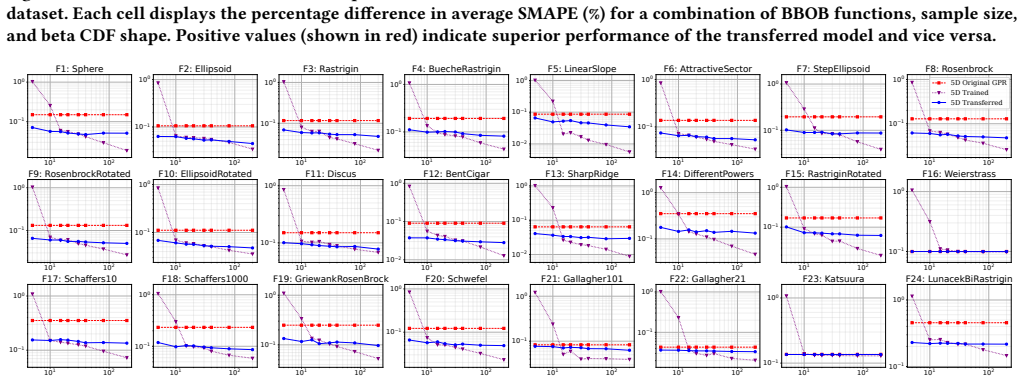
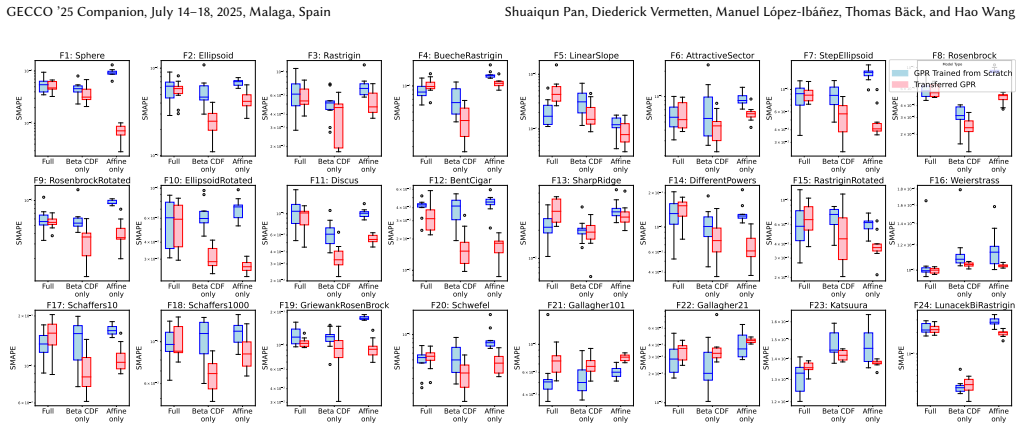
The central claim is that modeling the source-to-target relation as $f_T(x)=f_S(W\phi(x)+v)$, with $\phi$ a coordinatewise $\beta$ CDF and $W\in SO(d)$, turns a pre-trained surrogate $\hat{f}_S$ into an accurate model of $f_T$ after fitting only the parameters $W$, $v$, and the $\beta$ shape parameters on a tiny transfer set. The paper reports that with 20 transfer samples on 2D BBOB problems the transferred model beats a Gaussian process trained from scratch on most functions, and in 10D it remains strongly superior at 40 to 80 samples because scratch Gaussian processes collapse with so few points. On the automotive benchmark, the full warp-plus-affine model consistently outperforms an affine-only transfer baseline, and it beats scratch training for transfer sets smaller than roughly 30 points, with transfers involving one particular automotive instance identified as a failure case where the source-target relation is too intricate to capture.
Load-bearing premise
The method assumes the target is the source composed with a rotation, a translation, and a coordinatewise beta-CDF warp; if the true relation between source and target does not lie in this family, transfer can underperform training from scratch on the same data.
Editorial extensions
If this is right
- With only 20 target samples, transferred Gaussian processes beat scratch-trained Gaussian processes on most 2D and 5D BBOB functions and on nearly all 10D functions.
- In 10D, scratch-trained Gaussian processes have very high SMAPE at 40 to 80 samples, so the transferred model's advantage is largest exactly where data is scarcest.
- The advantage erodes as transfer data grows; by 80 to 200 samples, scratch training becomes competitive or better, making the method a low-data technique rather than a large-data one.
- The full warp-plus-affine method outperforms affine-only transfer on the automotive benchmark, indicating that nonlinear warping captures source-target relations that affine maps miss.
- Transfer fails or underperforms on rugged, multimodal functions such as F16 and F23-F24, where the original surrogate is already inaccurate, so the benefit depends on the source model having reached a baseline level of accuracy.
Reading between the lines
- A natural extension is to replace the beta CDF with a cheaper parametric warp such as the Kumaraswamy CDF, which the paper lists as future work and which would preserve the optimization setup while reducing cost.
- The results suggest an active-learning regime: if each transferred sample is chosen to maximize disagreement between candidate warps, even fewer than 20 points might suffice, though the paper does not test this.
- Boundary effects from rotation and translation can map out-of-domain regions into the target domain; the paper's in-domain ablation suggests that restricting to mapped-back transfer data sometimes helps, so a penalty discouraging out-of-domain mappings could improve robustness on real problems.
- Because the method only re-parameterizes inputs, it is agnostic to the surrogate class; the same fitted warp should transfer random forests or neural networks provided parameter optimization is handled by a derivative-free method.
Signed reviews
Editorial analysis
A structured set of objections, weighed in public.
Referee Report
Summary. The paper proposes a transfer learning method for surrogate models in which a pre-trained source surrogate f_hat_S is re-parameterized as f_hat_S(W phi(x) + v), where phi is a coordinatewise beta CDF input warping, W is a rotation in SO(d), and v is a translation. The parameters are fit by minimizing mean squared error on a small transfer set from the target function. For differentiable surrogates such as Gaussian process regression, the authors derive gradients and use Riemannian gradient descent on SO(d); for non-differentiable surrogates they outline a CMA-ES approach on the Lie algebra of SO(d). Experiments compare the transferred GPR with the original GPR and with a GPR trained from scratch on BBOB synthetic transfer problems (in 2D, 5D, and 10D, with four warp geometries and several sample sizes) and on an automotive ABS benchmark, with additional ablations for beta-CDF-only and affine-only transfer.
Significance. The method is a natural and simple extension of affine-only transfer learning to nonlinear input warpings, and the gradient derivation in Eqs. (5)-(14) is sound. The paper provides broad experimental coverage: 24 BBOB functions, multiple dimensions, several transfer sample sizes, four beta-CDF shape regimes, ablations, and an independent real-world automotive benchmark. The authors also make code and supplementary material available via Zenodo, and the 'in-domain' ablation addresses an important boundary-effect issue. If the central claims were fully supported, this would be a useful GECCO contribution. However, the BBOB validation is largely self-referential because the targets are constructed inside the method's own model family, and the real-world ABS results are mixed; the abstract's unqualified claim that the transferred surrogate 'significantly outperforms' both baselines is stronger than the evidence supports.
major comments (3)
- [§4 and §5.3] The BBOB experiments do not test the adequacy of the assumed transformation family, because the targets are generated inside that family: the text states 'we construct the target f_T by applying a beta CDF transformation, followed by random rotation and translation transformations, to the base function.' The paper itself acknowledges in §5.3 that 'In the BBOB problem suite, our target functions are explicitly designed so that a perfect transformation exists.' Consequently, the BBOB results primarily demonstrate parameter recovery within the correct model class, not robustness to misspecification. This is a load-bearing gap for the abstract's claim of general effectiveness. I recommend adding out-of-family experiments, for example targets generated with a different warping (tanh, spline, Kumaraswamy) or with BBOB's own instance transformations, and/or substantially qualifying the abstract and Section 1 claims.
- [§3, Eq. (1)-(2), and §4] The beta CDF in Eq. (2) is defined as an integral from 0 to x_i, which is only valid on the support [0,1] of the beta distribution, yet the experiments sample inputs in [-5,5]^d. The paper never states how inputs are normalized into [0,1] before applying phi, nor how the subsequent rotation and translation map the warped coordinates back to the source domain. This is not a minor formalism issue: without the normalization and domain-mapping details, the experiments and the gradient formulas in Eqs. (5)-(14) are not fully reproducible. The 'in-domain' ablation in §5.2 is a partial treatment of boundary effects, but the base normalization should be specified explicitly.
- [§5.3 and Fig. 23] The real-world ABS results do not support the abstract's universal claim. Fig. 23 shows that for transfers involving instance3, the scratch-trained GPR is the best performer and the transferred model fails, and the text in §5.3 states that 'the scratch-trained model remains the top performer among all GPR variants' and that 'there are specific scenarios, such as transferring related to problem instance3, where the transfer learning approach fails.' The conclusion section is appropriately hedged, but the abstract and Section 1 claim that the transferred model 'significantly outperforms both the original surrogate and the one built from scratch' without these caveats. The claims should be made conditional on the transformation family being approximately correct and on the data-scarce regime.
minor comments (4)
- [§3.1, Eq. (15)] The projection formula for the Riemannian gradient is ambiguous as typeset; it should read P(M) = W (W^T M - M^T W) / 2. Please clarify the parentheses.
- [§3, Remark (1)] The remark that the beta CDF 'preserves the convexity of the surrogate' is not correct in general: monotonicity alone does not preserve convexity under composition, since a concave coordinate warping composed with a convex function need not remain convex. Please revise or remove this claim.
- [§3.2] The extension to non-differentiable surrogates via CMA-ES is described but never evaluated in the experiments. If this is intended as a contribution, add at least one experiment or explicitly label it as future work.
- [§4] The sample-size description is inconsistent: the text mentions 'a larger dataset of 80 points for the 10-dimensional problems,' but Table 3 and Fig. 11 report 40, 80, and 400 samples for 10D. Please reconcile the text with the actual experimental settings.
Circularity Check
BBOB validation is circular: targets are generated from the same beta-CDF+rotation family the method fits, so the low-data advantage is partly by construction; ABS gives independent but mixed evidence.
-
self definitional
[Section 4, 'Synthetic tasks based on BBOB']
"we use the first instance of each BBOB function as the source 𝑓 S, and construct the target 𝑓 T by applying a beta CDF transformation, followed by random rotation and translation transformations, to the base function"
The method's core assumption (Section 3, Context) is that f_T(x)=f_S(g(x)) with g(x)=W phi(x)+v, where phi is a coordinatewise beta CDF and W is a rotation. The BBOB target generation applies exactly this same construction to the source function. Thus every BBOB target lies inside the method's hypothesis space by definition, so the reported gains over training from scratch only demonstrate that the optimizer can recover parameters within a correctly specified family. This does not test whether the assumed family captures real transfer relations.
full rationale
The optimization framework itself is not circular: parameters (W, v, alpha, beta) are genuinely fitted to transfer data by minimizing MSE, and the evaluation on held-out test points is a standard supervised protocol. However, the principal quantitative evidence for the abstract's claim of significant advantages in data-scarce scenarios comes from the BBOB experiments, where the target functions are constructed by the same beta-CDF-plus-affine transformation that the method assumes. This makes the BBOB validation partially circular: the perfect transformation exists by construction, so success is assured if the optimizer works. The paper's own Section 5.3 admission ('target functions are explicitly designed so that a perfect transformation exists') confirms this. The real-world ABS benchmark provides independent, out-of-family grounding, but it is mixed: on instance3 the scratch-trained model is best and transfer fails, and on other pairs the full method is not consistently superior. Hence the central claim retains independent content, but the BBOB-based evidence reduces by construction, warranting a partial circularity score of 4.
Assumptions & free parameters
free parameters (4)
- beta CDF shape parameters (alpha_i, beta_i) per dimension, i=1..d =
not reported; optimized on each transfer set
- rotation matrix W in SO(d) =
d(d-1)/2 parameters, not reported
- translation vector v in R^d =
not reported
- transfer-learning hyperparameters (learning rate, batch size, epochs, decay rate) =
not reported; tuned per BBOB function with SMAC3
assumptions (4)
- domain assumption There exists g = W phi(x) + v with phi a coordinatewise beta CDF such that f_T(x) = f_S(g(x)) for all x in the domain.
- ad hoc to paper The beta CDF is computed on inputs normalized to [0,1].
- domain assumption The source surrogate f_hat_S is accurate enough that re-parameterizing it beats retraining.
- standard math Riemannian gradient descent and the exponential map on SO(d) are used correctly (standard geometry of the rotation group).
Cite this review
Pith. "Pith review of Transfer Learning of Surrogate Models: Integrating Domain Warping and Affine Transformations." pith.science (2026). https://pith.science/paper/J3A36TKA
@misc{pith2026250118344,
  author       = {Pith},
  title        = {Pith review of: Transfer Learning of Surrogate Models: Integrating Domain Warping and Affine Transformations},
  year         = {2026},
  howpublished = {\url{https://pith.science/paper/J3A36TKA}},
  note         = {Machine review of arXiv:2501.18344}
}
read the original abstract
Surrogate models provide efficient alternatives to computationally demanding real world processes but often require large datasets for effective training. A promising solution to this limitation is the transfer of pre-trained surrogate models to new tasks. Previous studies have investigated the transfer of differentiable and non-differentiable surrogate models, typically assuming an affine transformation between the source and target functions. This paper extends previous research by addressing a broader range of transformations, including linear and nonlinear variations. Specifically, we consider the combination of an unknown input warping, such as one modeled by the beta cumulative distribution function, with an unspecified affine transformation. Our approach achieves transfer learning by employing a limited number of data points from the target task to optimize these transformations, minimizing empirical loss on the transfer dataset. We validate the proposed method on the widely used Black-Box Optimization Benchmark (BBOB) testbed and a real-world transfer learning task from the automobile industry. The results underscore the significant advantages of the approach, revealing that the transferred surrogate significantly outperforms both the original surrogate and the one built from scratch using the transfer dataset, particularly in data-scarce scenarios.
Figures


Figures from the paper (20 more)






Reference graph
Works this paper leans on
-
[1]
Anestis Antoniadis, Sophie Lambert-Lacroix, and Jean-Michel Poggi. 2021. Ran- dom forests for global sensitivity analysis: A selective review. Reliability Engi- neering & System Safety 206 (2021), 107312. doi:10.1016/J.RESS.2020.107312
arXiv 2021
-
[2]
Atharv Bhosekar and Marianthi Ierapetritou. 2018. Advances in surrogate based modeling, feasibility analysis, and optimization: A review.Computers & Chemical Engineering 108 (2018), 250–267. doi:10.1016/J.COMPCHEMENG.2017.09.017
-
[3]
Adam D. Bull. 2011. Convergence Rates of Efficient Global Optimization Algo- rithms. Journal of Machine Learning Research 12 (2011), 2879–2904. doi:10.5555/ 1953048.2078198
arXiv 2011
-
[4]
Bin Cao, Sinno Jialin Pan, Yu Zhang, Dit-Yan Yeung, and Qiang Yang. 2010. Adaptive Transfer Learning. InProceedings of the Twenty-Fourth AAAI Conference on Artificial Intelligence, AAAI 2010, Atlanta, Georgia, USA, July 11-15, 2010 , Maria Fox and David Poole (Eds.). AAAI Press, Atlanta, Georgia, USA, 407–412. doi:10.1609/AAAI.V24I1.7682
-
[5]
Yutian Chen, Xingyou Song, Chansoo Lee, Zi Wang, Richard Zhang, David Dohan, Kazuya Kawakami, Greg Kochanski, Arnaud Doucet, Marc’Aurelio Ranzato, Sagi Perel, and Nando de Freitas. 2022. Towards Learning Universal Hyperparameter Optimizers with Transformers. In Advances in Neural Information Processing Systems. New Orleans, LA, USA. http://papers.nips.cc/...
work page 2022
-
[6]
Alexander I Cowen-Rivers, Wenlong Lyu, Rasul Tutunov, Zhi Wang, Antoine Grosnit, Ryan Rhys Griffiths, Alexandre Max Maraval, Hao Jianye, Jun Wang, Jan Peters, et al. 2022. Hebo: Pushing the limits of sample-efficient hyper-parameter optimisation. Journal of Artificial Intelligence Research 74 (2022), 1269–1349
2022
-
[7]
Bingshui Da, Yew-Soon Ong, Abhishek Gupta, Liang Feng, and Haitao Liu. 2019. Fast transfer Gaussian process regression with large-scale sources. Knowledge- Based Systems 165 (2019), 208–218. doi:10.1016/J.KNOSYS.2018.11.029
-
[8]
Hal Daumé. 2009. Frustratingly Easy Domain Adaptation. CoRR abs/0907.1815 (2009). arXiv:0907.1815 http://arxiv.org/abs/0907.1815
arXiv 2009
Show all 52 references
-
[9]
Jacob de Nobel, Furong Ye, Diederick Vermetten, Hao Wang, Carola Doerr, and Thomas Bäck. 2024. IOHexperimenter: Benchmarking Platform for Iterative Optimization Heuristics. Evolutionary Computation (2024), 1–6. doi:10.1162/ evco_a_00342
2024
-
[10]
Du, Jayanth Koushik, Aarti Singh, and Barnabás Póczos
Simon S. Du, Jayanth Koushik, Aarti Singh, and Barnabás Póczos. 2017. Hy- pothesis Transfer Learning via Transformation Functions. In Advances in Neural Information Processing Systems 30: Annual Conference on Neural Information Pro- cessing Systems 2017, December 4-9, 2017, Lo...
2017
-
[11]
Shir, and Hao Wang
Michael Emmerich, Ofer M. Shir, and Hao Wang. 2018. Evolution Strategies. In Handbook of Heuristics, Rafael Martí, Panos M. Pardalos, and Mauricio G. C. Resende (Eds.). Springer, 89–119. doi:10.1007/978-3-319-07124-4_13
2018 doi
-
[12]
Jianguang Fang, Guangyong Sun, Na Qiu, Nam H Kim, and Qing Li. 2017. On de- sign optimization for structural crashworthiness and its state of the art.Structural and Multidisciplinary Optimization 55 (2017), 1091–1119
2017
-
[13]
Benito E. Flores. 1986. A pragmatic view of accuracy measurement in forecasting. Omega 14, 2 (1986), 93–98
1986
-
[14]
Alexander IJ Forrester and Andy J Keane. 2009. Recent advances in surrogate- based optimization. Progress in aerospace sciences 45, 1-3 (2009), 50–79
2009
-
[15]
Alexander I. J. Forrester, Andras Sobester, and Andy J. Keane. 2008. Engineer- ing Design via Surrogate Modelling - A Practical Guide . Wiley. doi:10.1002/ 9780470770801
2008
-
[16]
Nikolaus Hansen. 2006. The CMA Evolution Strategy: A Comparing Review. In Towards a New Evolutionary Computation - Advances in the Estimation of Distribution Algorithms, José Antonio Lozano, Pedro Larrañaga, Iñaki Inza, and Endika Bengoetxea (Eds.). Studies in Fuzziness and So...
2006 doi
-
[17]
Nikolaus Hansen. 2016. The CMA Evolution Strategy: A Tutorial. CoRR abs/1604.00772 (2016). arXiv:1604.00772 http://arxiv.org/abs/1604.00772
2016 arXiv
-
[18]
Nikolaus Hansen, Anne Auger, Raymond Ros, Olaf Mersmann, Tea Tušar, and Dimo Brockhoff. 2020. COCO: A platform for comparing continuous optimizers in a black-box setting. Optimization Methods and Software 36, 1 (2020), 1–31. doi:10.1080/10556788.2020.1808977
2020
-
[19]
Nikolaus Hansen, Steffen Finck, Raymond Ros, and Anne Auger. 2009. Real- Parameter Black-Box Optimization Benchmarking 2009: Noiseless Functions Defini- tions. Technical Report RR-6829. INRIA, France. Updated February 2010
2009
-
[20]
Nikolaus Hansen, Steffen Finck, Raymond Ros, and Anne Auger. 2009. Real- Parameter Black-Box Optimization Benchmarking 2009: Noiseless Functions Def- initions. Research Report RR-6829. INRIA. https://hal.inria.fr/inria-00362633/ document
2009
-
[21]
Morteza Kiani and Ali R Yildiz. 2016. A comparative study of non-traditional methods for vehicle crashworthiness and NVH optimization. Archives of Compu- tational Methods in Engineering 23 (2016), 723–734
2016
-
[22]
Marius Thomas Lindauer, Katharina Eggensperger, Matthias Feurer, André Biedenkapp, Difan Deng, Carolin Benjamins, Tim Ruhkopf, René Sass, and Frank Hutter. 2022. SMAC3: A Versatile Bayesian Optimization Package for Hyperpa- rameter Optimization. Journal of Machine Learning Res...
2022
-
[23]
Shuaiqun Pan, Diederick Vermetten, Manuel López-Ibáñez, Thomas Bäck, and Hao Wang. 2024. Transfer Learning of Surrogate Models via Domain Affine Transformation. In Proceedings of the Genetic and Evolutionary Computation Conference, GECCO 2024, Julia Handl and Xiaodong Li (Eds....
2024
- [24]
-
[25]
Shuaiqun Pan, Diederick Vermetten, Manuel López-Ibáñez, Thomas Bäck, and Hao Wang. 2025. Transfer Learning of Surrogate Models: Integrating Domain Warping and Affine Transformations (Supplementary Material). doi:10.5281/ zenodo.14728764
2025
-
[26]
Sinno Jialin Pan and Qiang Yang. 2010. A Survey on Transfer Learning. IEEE Transactions on Knowledge and Data Engineering 22, 10 (2010), 1345–1359. doi:10. 1109/TKDE.2009.191
2010
-
[27]
Milan Papez and Anthony Quinn. 2022. Transferring model structure in Bayesian transfer learning for Gaussian process regression. Knowledge-Based Systems 251 (2022), 108875. doi:10.1016/J.KNOSYS.2022.108875
2022
-
[28]
Wainwright
Reese Pathak, Cong Ma, and Martin J. Wainwright. 2022. A new similarity measure for covariate shift with applications to nonparametric regression. In In- ternational Conference on Machine Learning, ICML 2022, 17-23 July 2022, Baltimore, Maryland, USA (Proceedings of Machine Le...
2022
-
[29]
Tony Pourmohamad. 2021. Surrogates: Gaussian Process Modeling, Design, and Optimization for the Applied Sciences. Technometrics 63, 1 (2021), 144–145. doi:10.1080/00401706.2020.1865008
2021
-
[30]
Na Qiu, Yunkai Gao, Jianguang Fang, Guangyong Sun, Qing Li, and Nam H Kim
-
[31]
Dushhyanth Rajaram, Tejas G Puranik, Ashwin Renganathan, Woong Je Sung, Olivia J Pinon-Fischer, Dimitri N Mavris, and Arun Ramamurthy. 2020. Deep Gaussian process enabled surrogate models for aerodynamic flows. In American Institute of Aeronautics and Astronautics (AIAA) Scite...
2020
-
[32]
Danilo Jimenez Rezende and Shakir Mohamed. 2015. Variational Inference with Normalizing Flows. InProceedings of the 32nd International Conference on Machine Learning, ICML 2015, Lille, France, 6-11 July 2015 (JMLR Workshop and Conference Proceedings, Vol. 37), Francis R. Bach ...
2015
-
[33]
Taisei Saida and Mayuko Nishio. 2023. Transfer learning Gaussian process regression surrogate model with explainability for structural reliability analysis under variation in uncertainties. Computers & Structures 281 (2023), 107014
2023
-
[34]
Pramudita Satria Palar, Lavi Rizki Zuhal, and Koji Shimoyama. 2020. Gaussian process surrogate model with composite kernel learning for engineering design. American Institute of Aeronautics and Astronautics (AIAA) Journal 58, 4 (2020), 1864–1880
2020
-
[35]
Hidetoshi Shimodaira. 2000. Improving predictive inference under covariate shift by weighting the log-likelihood function. Journal of Statistical Planning and Inference 90, 2 (2000), 227–244. doi:10.1016/S0378-3758(00)00115-4
2000 doi
-
[36]
Priyanka Singh and Pragya Dwivedi. 2018. Integration of new evolutionary approach with artificial neural network for solving short term load forecast problem. Applied Energy 217 (2018), 537–549
2018
-
[37]
Jasper Snoek, Kevin Swersky, Rich Zemel, and Ryan Adams. 2014. Input Warping for Bayesian Optimization of Non-Stationary Functions. In Proceedings of the 31st International Conference on Machine Learning (Proceedings of Machine Learning Research, Vol. 32) , Eric P. Xing and To...
2014
-
[38]
Masashi Sugiyama, Matthias Krauledat, and Klaus-Robert Müller. 2007. Covariate Shift Adaptation by Importance Weighted Cross Validation. Journal of Machine Learning Research 8 (2007), 985–1005. doi:10.5555/1314498.1390324
2007
-
[39]
Kononova
André Thomaser, Marc-Eric Vogt, Thomas Bäck, and Anna V. Kononova. 2023. Real-World Optimization Benchmark from Vehicle Dynamics: Specification of Problems in 2D and Methodology for Transferring (Meta-)Optimized Algorithm Parameters. In Proceedings of the 15th International Jo...
2023 doi
-
[40]
Ye Tian, Shichen Peng, Xingyi Zhang, Tobias Rodemann, Kay Chen Tan, and Yaochu Jin. 2020. A Recommender System for Metaheuristic Algorithms for Continuous Optimization Based on Deep Recurrent Neural Networks. IEEE Transactions on Artificial Intelligence 1, 1 (2020), 5–18. doi:...
2020 doi
-
[41]
Minku, and Xin Yao
Hao Tong, Changwu Huang, Leandro L. Minku, and Xin Yao. 2021. Surrogate models in evolutionary single-objective optimization: A new taxonomy and GECCO ’25 Companion, July 14–18, 2025, Malaga, Spain Shuaiqun Pan, Diederick Vermetten, Manuel López-Ibáñez, Thomas Bäck, and Hao Wa...
2021 doi
-
[42]
Van Der Vaart and J
Aad W. Van Der Vaart and J. Harry Van Zanten. 2008. Rates of Contraction of Posterior Distributions Based on Gaussian Process Priors. The Annals of Statistics 36, 3 (2008), 1435–1463
2008
-
[43]
Handing Wang and Yaochu Jin. 2020. A Random Forest-Assisted Evolutionary Algorithm for Data-Driven Constrained Multiobjective Combinatorial Optimiza- tion of Trauma Systems. IEEE Transactions on Cybernetics 50, 2 (2020), 536–549. doi:10.1109/TCYB.2018.2869674
2020
-
[44]
Pengfei Wei, Thanh Vinh Vo, Xinghua Qu, Yew Soon Ong, and Zejun Ma. 2023. Transfer Kernel Learning for Multi-Source Transfer Gaussian Process Regression. IEEE Transactions on Pattern Analysis and Machine Intelligence 45, 3 (2023), 3862–
2023
-
[45]
Weiss, Taghi M
Karl R. Weiss, Taghi M. Khoshgoftaar, and Dingding Wang. 2016. A survey of transfer learning. Journal of Big Data 3 (2016), 9. doi:10.1186/S40537-016-0043-6
2016 doi
-
[46]
Kaifeng Yang and Michael Affenzeller. 2023. Surrogate-assisted Multi-objective Optimization via Genetic Programming Based Symbolic Regression. In Evolu- tionary Multi-Criterion Optimization - 12th International Conference, EMO 2023, Leiden, The Netherlands, March 20-24, 2023, ...
2023
-
[47]
Xi Zhang, Guo Yu, Yaochu Jin, and Feng Qian. 2023. An adaptive Gaussian process based manifold transfer learning to expensive dynamic multi-objective optimization. Neurocomputing 538 (2023), 126212. doi:10.1016/j.neucom.2023.03. 073
2023 doi
-
[48]
Xiubin Zhu, Dan Wang, Witold Pedrycz, and Zhiwu Li. 2023. Transfer Learning Realized With Nonlinearly Transformed Input Space.IEEE Transactions on Emerg- ing Topics in Computing 11, 2 (2023), 448–460. doi:10.1109/TETC.2022.3210568
2023
-
[49]
in domain
Fuzhen Zhuang, Zhiyuan Qi, Keyu Duan, Dongbo Xi, Yongchun Zhu, Hengshu Zhu, Hui Xiong, and Qing He. 2021. A Comprehensive Survey on Transfer Learning. Proc. IEEE 109, 1 (2021), 43–76. doi:10.1109/JPROC.2020.3004555 Transfer Learning of Surrogate Models: Integrating Domain Warp...
2021
-
[1538]
http://proceedings.mlr.press/v37/rezende15.html
-
[2018]
Thin-Walled Structures 129 (2018), 457–472
Crashworthiness optimization with uncertainty from surrogate model and numerical error. Thin-Walled Structures 129 (2018), 457–472
2018
-
[3876]
doi:10.1109/TPAMI.2022.3184696
2022
Reviewed August 9, 2026 · model on record in the stance chip above.
Discussion (0). Continue with ORCID to comment.