A Multi-Resolution Finite-Volume Inspired Deep Learning Framework for Spatiotemporal Dynamics Prediction
Pith reviewed 2026-07-02 03:45 UTC · model grok-4.3
The pith
MuRFiV embeds finite-volume conservation into a multi-resolution network to deliver stable long-term PDE predictions.
A machine-rendered reading of the paper's core claim, the machinery that carries it, and where it could break.
Core claim
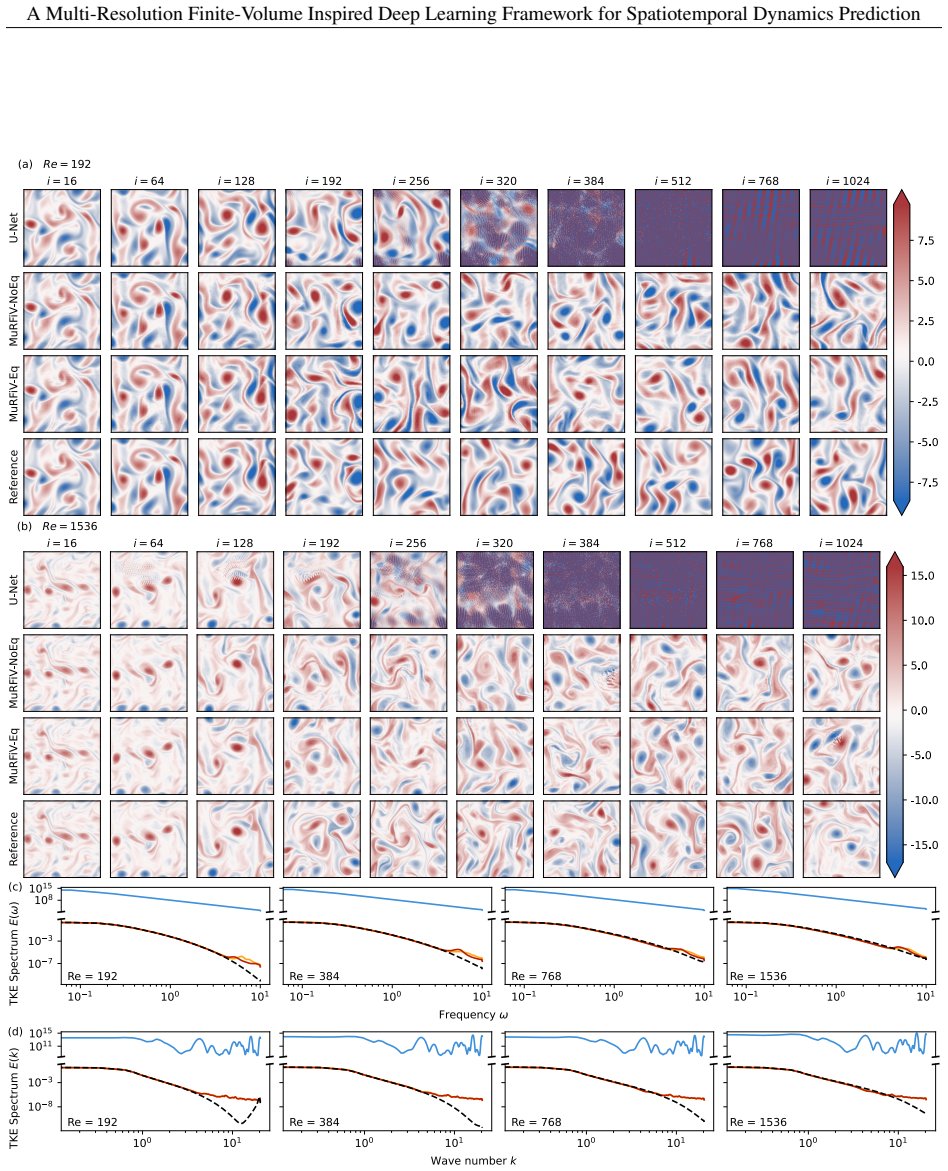
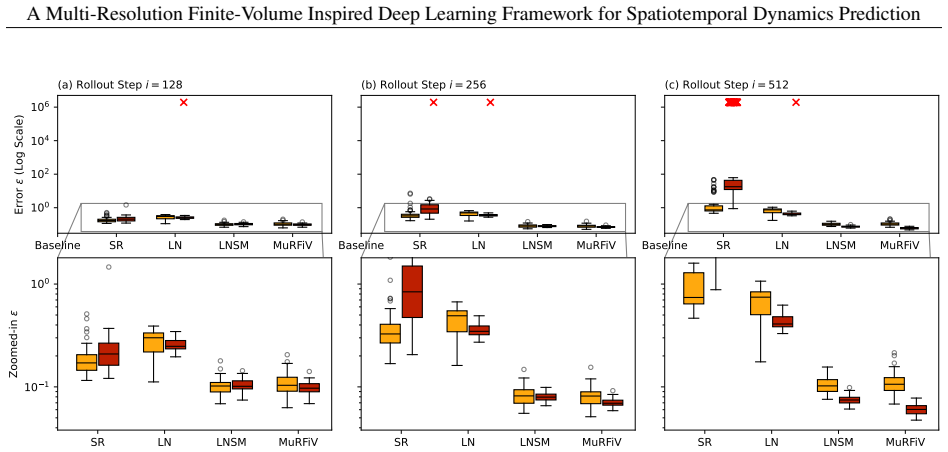
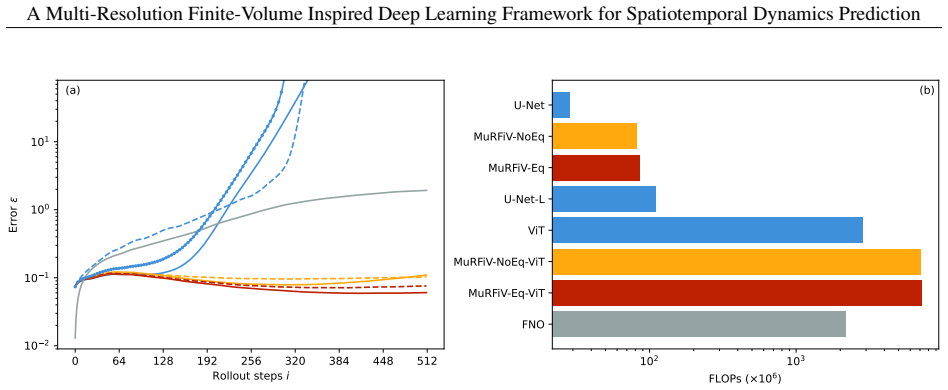
MuRFiV capitalizes on the conservative property of finite volume on the global scale and the expressive power of deep learning on the local scale within a multi-resolution framework, achieving strong long-term prediction accuracy and stability over very long autoregressive rollouts on several PDE systems while outperforming data-driven baselines.
What carries the argument
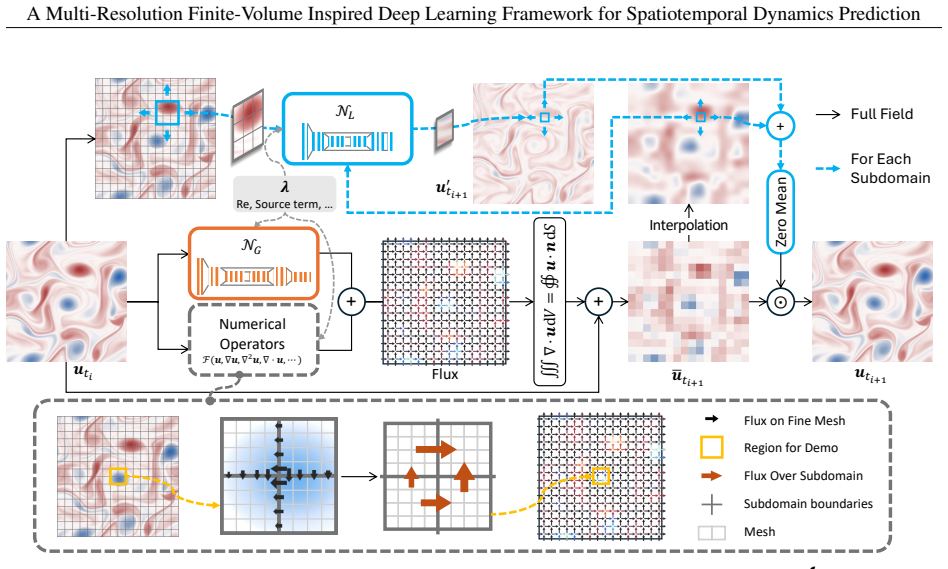
MuRFiV, a multi-resolution neural network that incorporates finite-volume conservation as an inductive bias to enforce global properties while learning local dynamics.
If this is right
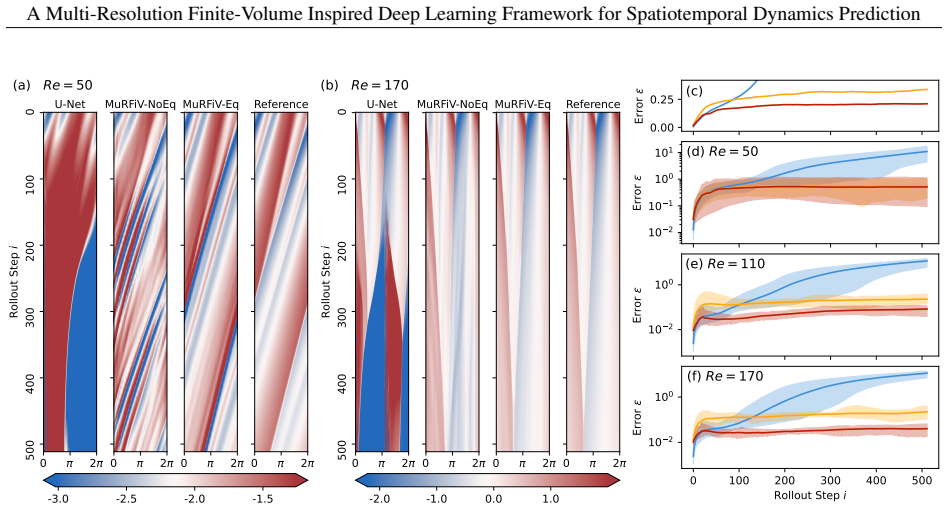
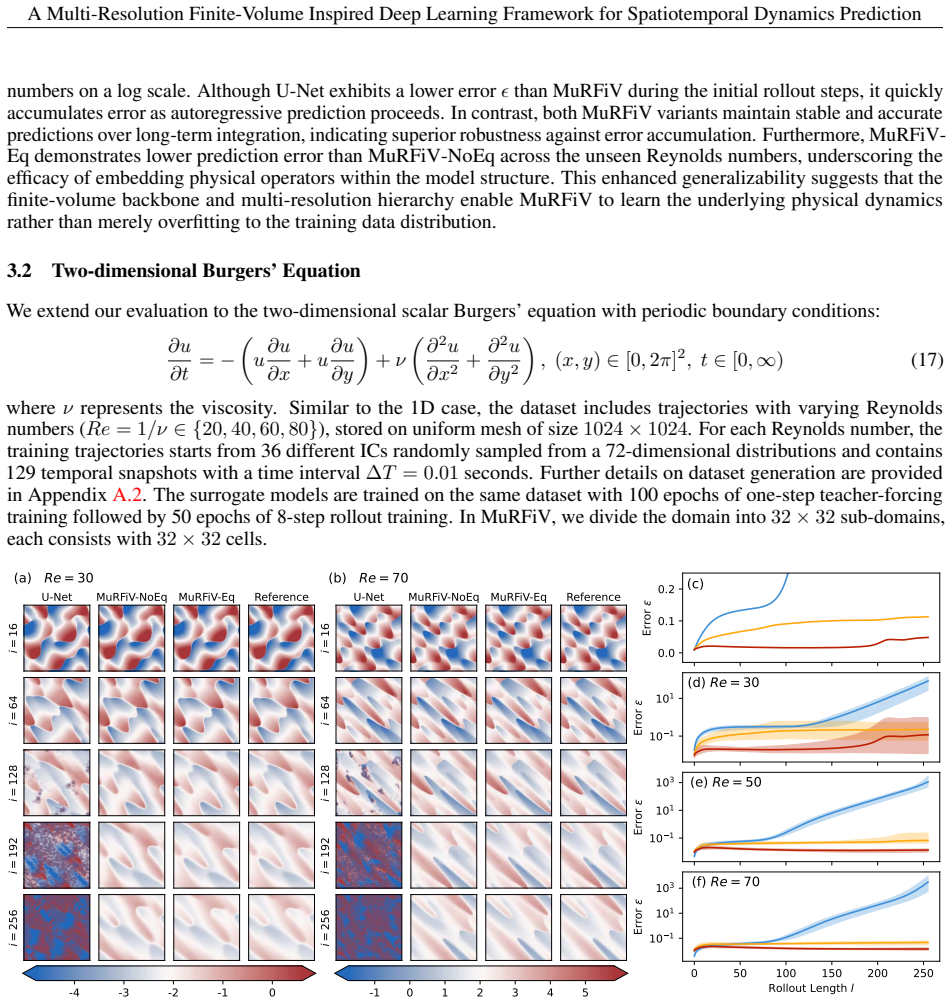
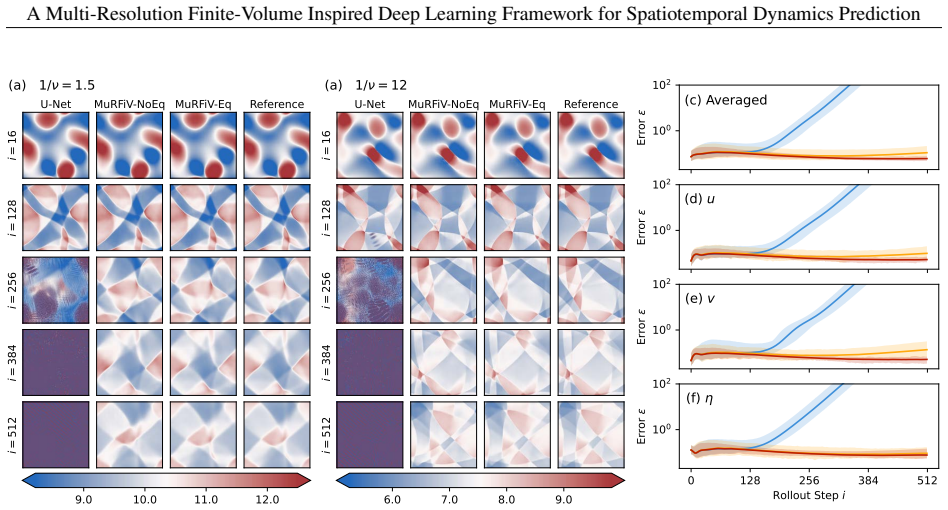
- MuRFiV remains stable over very long autoregressive rollouts on tested PDE systems.
- The approach significantly outperforms data-driven neural network baselines in long-term accuracy.
- Embedding PDE information into the architecture improves generalizability to unseen parameters.
- The method reduces error accumulation compared to standard neural networks for spatiotemporal prediction.
Where Pith is reading between the lines
- The same inductive bias could be tested on other conservation-law systems such as magnetohydrodynamics or traffic flow models.
- Multi-resolution structure might support adaptive computation for problems with localized features without explicit remeshing.
- If the bias transfers across scales, the framework could lower data requirements for training on new physical regimes.
Load-bearing premise
The conservative property of finite volume on the global scale can be translated into an effective inductive bias inside a multi-resolution neural network without introducing new instabilities or requiring problem-specific tuning that undermines the claimed generality.
What would settle it
A demonstration that MuRFiV produces non-physical drift in conserved quantities or loses stability during long rollouts on a PDE system outside the demonstrated set would falsify the central claim.
Figures
read the original abstract
Predicting complex spatiotemporal dynamics in physical processes often demands computationally expensive numerical methods or data-driven neural networks that suffer from high training costs, error accumulation, and limited generalizability to unseen parameters. An effective approach to address these challenges is leveraging physics priors in training neural networks, known as physics-informed deep learning (PiDL). In this work, we introduce the Multi-Resolution Finite-Volume-inspired network, MuRFiV, designed to capitalize on the conservative property of finite volume on the global scale and the expressive power of deep learning on the local scale. We demonstrate the effectiveness of MuRFiV on several spatio-temporal systems governed by partial differential equations (PDEs), including Burgers' equation, shallow water equations, and incompressible Navier-Stokes equations. By embedding PDE information into the deep learning architecture, MuRFiV achieves strong long-term prediction accuracy and remains stable over very long autoregressive rollouts, significantly outperforming data-driven neural network baselines. This result highlights the promise of combining multiresolution learning with finite-volume-inspired inductive bias for accurate and robust long-term prediction of complex dynamics.
Editorial analysis
A structured set of objections, weighed in public.
Circularity Check
No significant circularity; derivation is self-contained
full rationale
The abstract and description introduce MuRFiV as a network that embeds PDE information via a finite-volume-inspired inductive bias at global scale combined with multi-resolution deep learning at local scale. No equations, parameter-fitting steps, or self-citations are shown that would reduce the claimed long-term autoregressive predictions to quantities defined by the same data or prior author results. The approach is presented as a standard physics-informed architecture choice whose performance is evaluated against external baselines, with no load-bearing step that collapses by construction to its inputs.
Axiom & Free-Parameter Ledger
Reference graph
Works this paper leans on
-
[1]
Super-resolution reconstruction of turbulent flows with machine learning.Journal of Fluid Mechanics, 870:106–120, 2019
Kai Fukami, Koji Fukagata, and Kunihiko Taira. Super-resolution reconstruction of turbulent flows with machine learning.Journal of Fluid Mechanics, 870:106–120, 2019
2019
-
[2]
Learning mesh-based simulation with graph networks
Tobias Pfaff, Meire Fortunato, Alvaro Sanchez-Gonzalez, and Peter Battaglia. Learning mesh-based simulation with graph networks. InInternational conference on learning representations, 2020
2020
-
[3]
Xu Han, Han Gao, Tobias Pfaff, Jian-Xun Wang, and Li-Ping Liu. Predicting physics in mesh-reduced space with temporal attention.arXiv preprint arXiv:2201.09113, 2022
-
[4]
Fourier Neural Operator for Parametric Partial Differential Equations
Zongyi Li, Nikola Kovachki, Kamyar Azizzadenesheli, Burigede Liu, Kaushik Bhattacharya, Andrew Stuart, and Anima Anandkumar. Fourier neural operator for parametric partial differential equations.arXiv preprint arXiv:2010.08895, 2020
work page internal anchor Pith review Pith/arXiv arXiv 2010
-
[5]
Learning nonlinear operators via deeponet based on the universal approximation theorem of operators.Nature machine intelligence, 3(3):218–229, 2021
Lu Lu, Pengzhan Jin, Guofei Pang, Zhongqiang Zhang, and George Em Karniadakis. Learning nonlinear operators via deeponet based on the universal approximation theorem of operators.Nature machine intelligence, 3(3):218–229, 2021
2021
-
[6]
Maziar Raissi, Paris Perdikaris, and George E Karniadakis. Physics-informed neural networks: A deep learning framework for solving forward and inverse problems involving nonlinear partial differential equations.Journal of Computational physics, 378:686–707, 2019
2019
-
[7]
Surrogate modeling for fluid flows based on physics- constrained deep learning without simulation data.Computer Methods in Applied Mechanics and Engineering, 361:112732, 2020
Luning Sun, Han Gao, Shaowu Pan, and Jian-Xun Wang. Surrogate modeling for fluid flows based on physics- constrained deep learning without simulation data.Computer Methods in Applied Mechanics and Engineering, 361:112732, 2020
2020
-
[8]
Learning data-driven discretizations for partial differential equations.Proceedings of the National Academy of Sciences, 116(31):15344–15349, 2019
Yohai Bar-Sinai, Stephan Hoyer, Jason Hickey, and Michael P Brenner. Learning data-driven discretizations for partial differential equations.Proceedings of the National Academy of Sciences, 116(31):15344–15349, 2019
2019
-
[9]
Ma- chine learning–accelerated computational fluid dynamics.Proceedings of the National Academy of Sciences, 118(21):e2101784118, 2021
Dmitrii Kochkov, Jamie A Smith, Ayya Alieva, Qing Wang, Michael P Brenner, and Stephan Hoyer. Ma- chine learning–accelerated computational fluid dynamics.Proceedings of the National Academy of Sciences, 118(21):e2101784118, 2021
2021
-
[10]
Differentiable hybrid neural modeling for fluid-structure interaction.Journal of Computational Physics, 496:112584, 2024
Xiantao Fan and Jian-Xun Wang. Differentiable hybrid neural modeling for fluid-structure interaction.Journal of Computational Physics, 496:112584, 2024
2024
-
[11]
Solver-in-the-loop: Learning from differentiable physics to interact with iterative pde-solvers.Advances in neural information processing systems, 33:6111–6122, 2020
Kiwon Um, Robert Brand, Yun Raymond Fei, Philipp Holl, and Nils Thuerey. Solver-in-the-loop: Learning from differentiable physics to interact with iterative pde-solvers.Advances in neural information processing systems, 33:6111–6122, 2020
2020
-
[12]
Multi-resolution partial differential equations preserved learning framework for spatiotemporal dynamics.Communications Physics, 7(1):31, 2024
Xin-Yang Liu, Min Zhu, Lu Lu, Hao Sun, and Jian-Xun Wang. Multi-resolution partial differential equations preserved learning framework for spatiotemporal dynamics.Communications Physics, 7(1):31, 2024
2024
-
[13]
P 2C2Net: PDE-preserved coarse correction network for efficient prediction of spatiotemporal dynamics.Advances in Neural Information Processing Systems, 37:68897–68925, 2024
Qi Wang, Pu Ren, Hao Zhou, Xin-Yang Liu, Zhiwen Deng, Yi Zhang, Ruizhi Chengze, Hongsheng Liu, Zidong Wang, Jian-Xun Wang, et al. P 2C2Net: PDE-preserved coarse correction network for efficient prediction of spatiotemporal dynamics.Advances in Neural Information Processing Systems, 37:68897–68925, 2024
2024
-
[14]
Learnable-differentiable finite volume solver for accelerated simulation of flows
Mengtao Yan, Qi Wang, Haining Wang, Ruizhi Chengze, Yi Zhang, Hongsheng Liu, Zidong Wang, Fan Yu, Qi Qi, and Hao Sun. Learnable-differentiable finite volume solver for accelerated simulation of flows. InProceedings of the 31st ACM SIGKDD Conference on Knowledge Discovery and Data Mining V . 2, pages 3471–3482, 2025
2025
-
[15]
Data-driven whitney forms for structure-preserving control volume analysis.Journal of Computational Physics, 496:112520, 2024
Jonas A Actor, Xiaozhe Hu, Andy Huang, Scott A Roberts, and Nathaniel Trask. Data-driven whitney forms for structure-preserving control volume analysis.Journal of Computational Physics, 496:112520, 2024
2024
-
[16]
Noem: efficient and scalable finite element method enabled by reusable neural operators.Nature Computational Science, 6(4):417–429, 2026
Weihang Ouyang, Yeonjong Shin, Si-Wei Liu, and Lu Lu. Noem: efficient and scalable finite element method enabled by reusable neural operators.Nature Computational Science, 6(4):417–429, 2026
2026
-
[17]
An Image is Worth 16x16 Words: Transformers for Image Recognition at Scale
Alexey Dosovitskiy, Lucas Beyer, Alexander Kolesnikov, Dirk Weissenborn, Xiaohua Zhai, Thomas Unterthiner, Mostafa Dehghani, Matthias Minderer, Georg Heigold, Sylvain Gelly, et al. An image is worth 16x16 words: Transformers for image recognition at scale.arXiv preprint arXiv:2010.11929, 2020
work page internal anchor Pith review Pith/arXiv arXiv 2010
-
[18]
JAX: composable transforma- tions of Python+NumPy programs, 2018
James Bradbury, Roy Frostig, Peter Hawkins, Matthew James Johnson, Chris Leary, Dougal Maclaurin, George Necula, Adam Paszke, Jake VanderPlas, Skye Wanderman-Milne, and Qiao Zhang. JAX: composable transforma- tions of Python+NumPy programs, 2018. 14 A Multi-Resolution Finite-V olume Inspired Deep Learning Framework for Spatiotemporal Dynamics Prediction A...
2018
-
[19]
extrapolation
While the velocity is initialized as zero field. We then use first order schemes for both the spatial and temporal derivatives, with a numerical time step size1×10 −6s. The data is collected every 5×10 3 numerical steps. We discard the first 16 collection steps, to allow the solution field to develop moving waves. To resolve the near-discontinuous wave in...
2048
discussion (0)
Sign in with ORCID, Apple, or X to comment. Anyone can read and Pith papers without signing in.