REVIEW 4 major objections 4 minor 41 references
Geometry on the manifold of Gaussian quantum channels
T0 review · 4 major / 4 minor · reviewed 2026-08-14 · deepseek-v4-flash
Pith's one-line read By putting a measure on the space of one-mode Gaussian channels, the paper computes exactly how common entanglement breaking and incompatibility breaking channels are.
desk verdict Useful and likely correct, but the two load-bearing computations—the volume-element Jacobian and the closed-form integrals—are asserted rather than shown. read the letter →
The pith
A machine-rendered reading of the paper's core claim, the machinery that carries it, and where it could break.
The reading
What carries the argument
The central object is the Choi–Jamiołkowski state $\rho_{AB} = (\Lambda \otimes \mathbb{1}_B)(\rho_\Omega)$, a two-mode Gaussian state whose covariance matrix carries the channel data $(M,N)$. The decisive step is the factorization of the Hilbert–Schmidt volume element in local symplectic invariants, the purity–seralian coordinates $\mu_A, \mu_\sigma, \mu, \Delta$: $dV = \frac{\mu^{11/2}}{64\sqrt{2}\,\mu_A^3 \mu_\sigma^2}\, d\mu_A\, d\mu\, d\Delta\, d\theta\, dm(S_A)$. Because the integral over the non-compact symplectic group $\mathrm{Sp}(2)$ appears only as an overall factor $C = \int dm(S_A) \int_0^{2\pi} d\theta$, and because the regions defined by the determinant inequalities do not involve the symplectic variable, $C$ cancels in every relative-volume ratio.
What would settle it
Take the paper's measure, generate one-mode Gaussian channels numerically with a cutoff $s_{\max}$ on the local squeezing parameter, and check whether the sampled fraction of channels satisfying $\det N \ge (\det M + 1)^2$ converges to the paper's formula as $s_{\max}$ increases; if the fraction drifts with the cutoff, the cancellation of the divergent factor $C$ is not legitimate.
Extended reading notes
Core claim
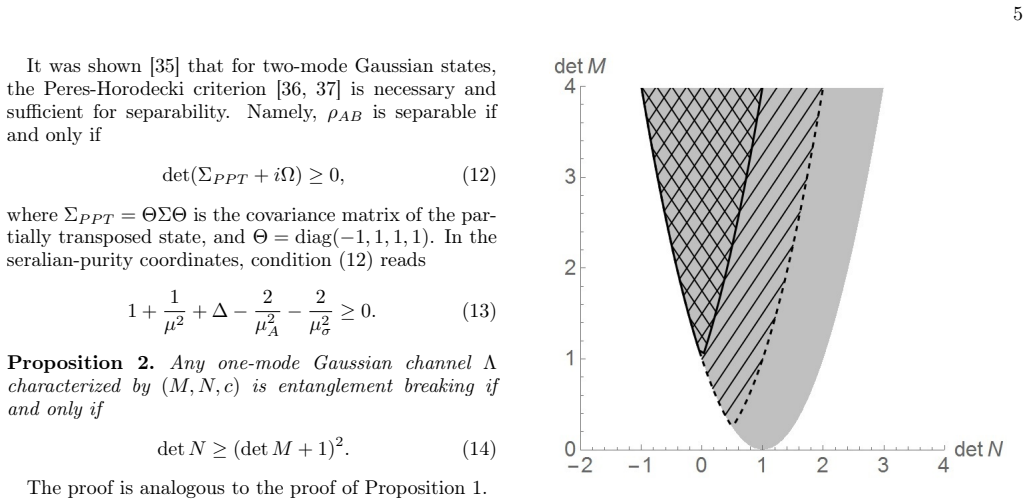
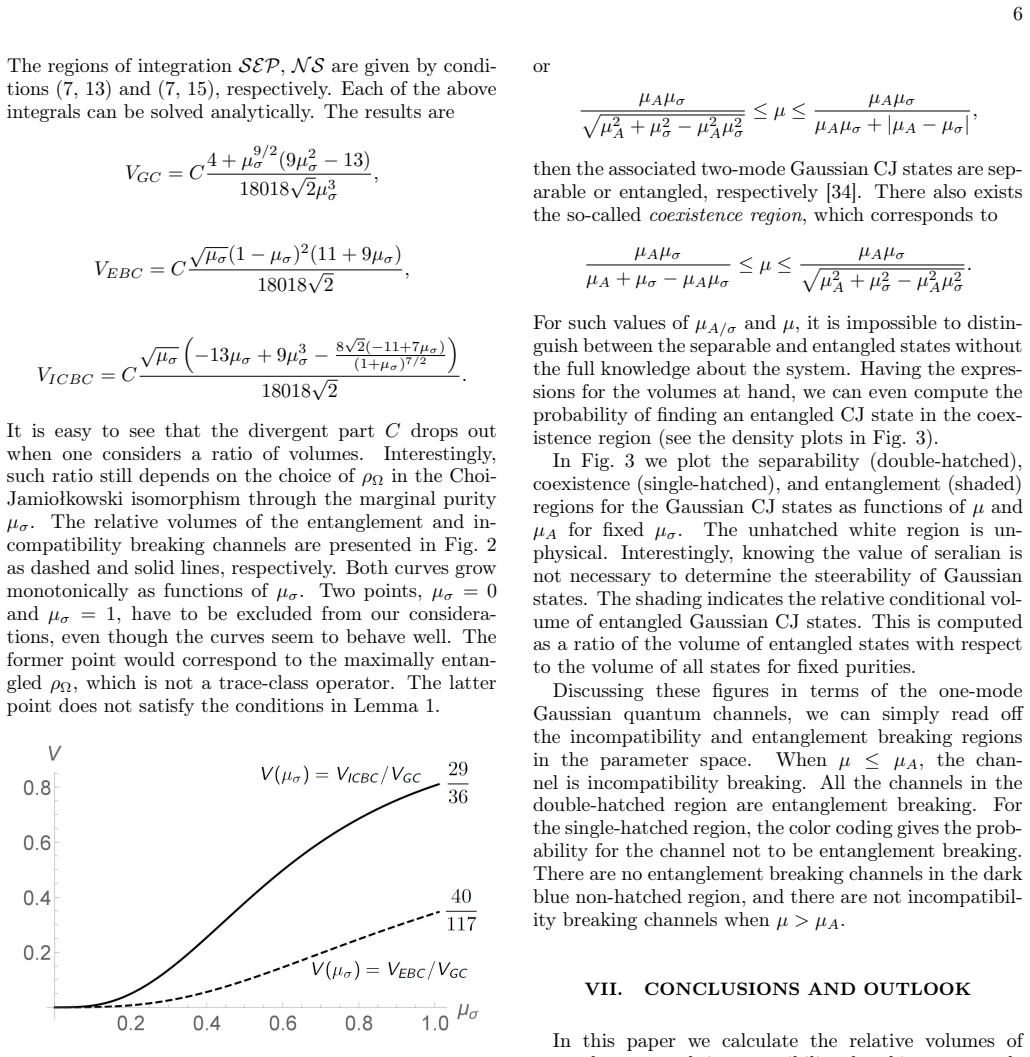
One-mode Gaussian channels are completely described by two matrices, $M$ and $N$, and the paper shows that the three classes studied here are exactly the regions $\det N \ge (\det M - 1)^2$ (complete positivity), $\det N \ge (\det M + 1)^2$ (entanglement breaking), and $\det N \ge \det M^2$ (incompatibility breaking). Integrating the Hilbert–Schmidt volume element over the corresponding regions of the Choi–Jamiołkowski state manifold gives, up to a common divergent factor $C$ that cancels in ratios, $V_{\rm GC} = C\,\frac{4 + \mu_\sigma^{9/2}(9\mu_\sigma^2 - 13)}{18018\sqrt{2}\,\mu_\sigma^3}$, $V_{\rm EBC} = C\,\frac{\sqrt{\mu_\sigma}(1-\mu_\sigma)^2(11+9\mu_\sigma)}{18018\sqrt{2}}$, and $V_{\rm ICBC} = C\,\frac{\sqrt{\mu_\sigma}\left[-13\mu_\sigma + 9\mu_\sigma^3 - \frac{8\sqrt{2}(-11+7\mu_\sigma)}{(1+\mu_\sigma)^{7/2}}\right]}{18018\sqrt{2}}$. The relative volumes therefore depend only on the marginal purity $\mu_\sigma$ of the reference Gaussian state $\rho_\Omega$ chosen for the Choi–Jamiołkowski map, and both grow monotonically with $\mu_\sigma$.
Load-bearing premise
The entire relative-volume calculation rests on the assumption that the infinite part of the volume coming from the local symplectic group separates cleanly from the part describing the channel, so that the same factor multiplies every class; if the allowed squeezing range depended on the other channel parameters, the ratios would not be well-defined.
Editorial extensions
If this is right
- The entanglement-breaking share $V_{\rm EBC}/V_{\rm GC}$ grows monotonically with the reference purity $\mu_\sigma$ and approaches 0 as $\mu_\sigma \to 0$.
- The incompatibility-breaking share $V_{\rm ICBC}/V_{\rm GC}$ is always larger than the entanglement-breaking share, because the entanglement-breaking region is contained in the incompatibility-breaking region.
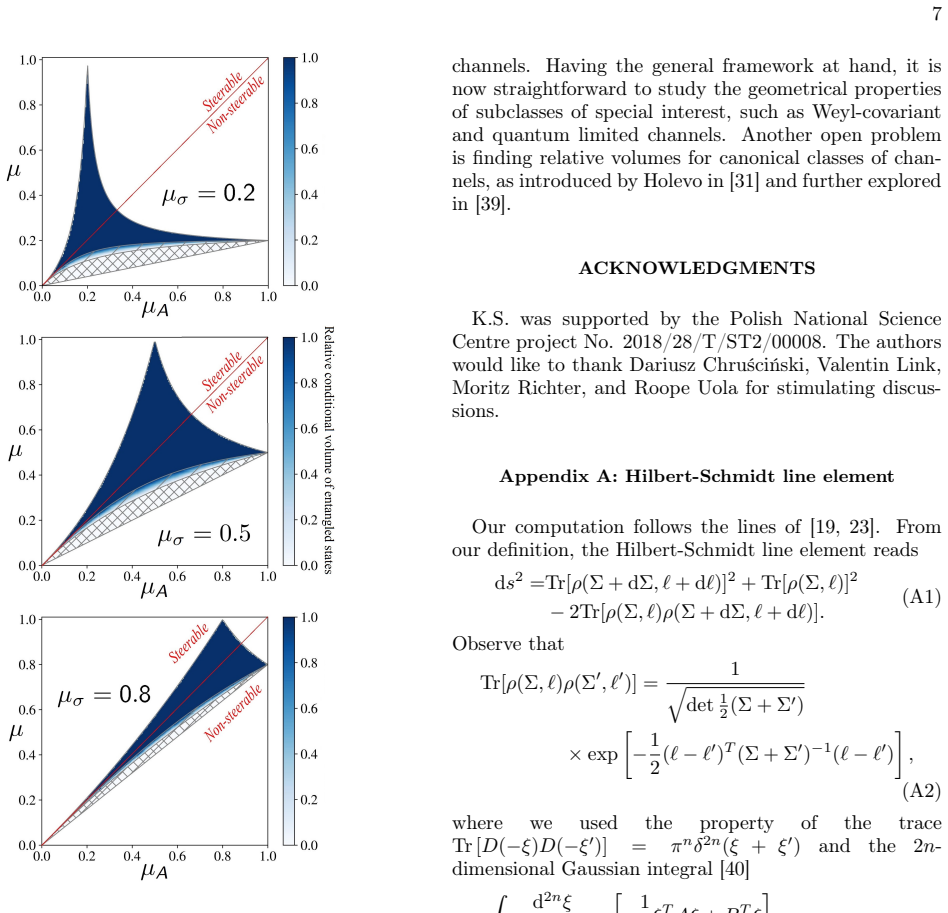
- A channel is incompatibility breaking exactly when the total purity $\mu$ of its Choi–Jamiołkowski state satisfies $\mu \le \mu_A$, so the seralian $\Delta$ is not needed for that decision.
- Complete positivity, entanglement breaking, and incompatibility breaking are each characterized by a single determinant inequality in $M$ and $N$, so classifying a one-mode Gaussian channel is a matter of two determinant calculations.
- The same integration scheme can be applied to subclasses such as Weyl-covariant and quantum-limited Gaussian channels, which the paper identifies as immediate next targets.
Reading between the lines
- One implication the paper leaves implicit is that the determinant inequalities give an operational classification: for any one-mode Gaussian channel, computing $\det M$ and $\det N$ fixes whether it is entanglement breaking or incompatibility breaking before any full process tomography.
- A natural extension is to recompute the relative volumes with the Bures or Fisher–Rao metric; if those geometries change the dependence on $\mu_\sigma$, the monotonic growth found here is a property of the Hilbert–Schmidt choice rather than of the channels themselves.
- The cancellation of the divergent factor $C$ predicts a concrete numerical signature: Monte Carlo sampling of Gaussian channels with a large but finite squeezing cutoff should yield ratios that are independent of the cutoff; measuring a drift would indicate the factorization assumption breaks down.
Signed reviews
Editorial analysis
A structured set of objections, weighed in public.
Referee Report
Summary. The manuscript constructs a Hilbert–Schmidt geometry on the space of one-mode Gaussian quantum channels by mapping channels to two-mode Gaussian Choi–Jamiołkowski states with a fixed reference marginal of purity μσ. The authors express the Hilbert–Schmidt volume element in purity–seralian local symplectic invariants, recover the complete-positivity, entanglement-breaking, and incompatibility-breaking conditions as determinant inequalities detN ≥ (detM − 1)^2, detN ≥ (detM + 1)^2, and detN ≥ detM^2, and state closed-form integrals for the total volumes of the CP, EB, and ICB regions. The relative volumes V_EBC/V_GC and V_ICBC/V_GC are plotted as functions of μσ, and a purity-based criterion for incompatibility breaking is discussed.
Significance. If the volume formulas are correct, the paper provides the first analytic typicality estimates for entanglement-breaking and incompatibility-breaking one-mode Gaussian channels under a natural measure inherited from the Hilbert–Schmidt geometry of states, with an explicit dependence on the Choi–Jamiołkowski reference state. The determinant unification in Propositions 1–3 is a clean and useful observation, and the paper correctly emphasizes that the results are metric-dependent. The main weakness is that the central numerical claims are not independently verifiable from the submitted text: the Jacobian to the purity–seralian coordinates and the three definite integrals are not shown.
major comments (4)
- [Section IV] The transformation from (ν_A, γ_+, γ_-) to the purity–seralian coordinates (μ_A, μ, Δ) is stated only through the final formula dV = μ^(11/2)/(64√2 μ_A^3 μ_σ^2) dμ_A dμ dΔ dθ dm(S_A). The Jacobian of this change of variables is not displayed. Since any algebraic error in this prefactor changes every later ratio, this step must be shown explicitly or placed in a fully reproducible appendix.
- [Section VI, volume integrals] The three integrated volumes V_GC, V_EBC, and V_ICBC are presented immediately after the sentence 'Each of the above integrals can be solved analytically', with no order of integration, substitution, or antiderivatives. The integration regions CP, SEP, and NS are explicitly defined by the inequalities (7), (13), and (15), but the reader cannot verify the displayed rational and square-root expressions without repeating the computation. Because these closed forms are the central quantitative claim of the paper, the derivation must be included.
- [Section VI, divergent factor C] The paper defines C = ∫ dm(S_A) ∫ dθ, where Sp(2) is non-compact, so C is an infinite constant. The sentence 'It is easy to see that the divergent part C drops out' therefore requires a careful limiting or regularizing prescription; formally, a ratio of two infinite volumes is not defined. The claim that the admissible domain of S_A is the full Sp(2) for every allowed invariant quadruple is plausible and should be stated explicitly, but a definition of the relative volume as the limit of regularized ratios should be given.
- [Section IV and Appendix B] The assertion that the displacement vector can be set to zero 'without the loss of generality' is not justified in measure-theoretic terms. A nonzero displacement multiplies the volume element by a positive factor, and although it should not affect the EB/ICB classification of the channel, the paper should explain how this contribution is handled when defining the relative volumes.
minor comments (4)
- [Equation (3)] The expression '2Tr[Σ^{-1}dΣ]2 + [Tr(Σ^{-1}dΣ)]2' is ambiguous; if the intended first term is 2Tr[(Σ^{-1}dΣ)^2], this should be written explicitly.
- [Appendix B, Eq. (B6)] The symbol R appears in the displayed line element without any definition; the derivation should clarify whether this is W dH, dH^T W, or another term, and should show the reduction to the reported volume element.
- [Section VI] The paper should state explicitly that μσ is held fixed during the integration and that the plotted ratios are conditional on the chosen reference state; this is clear from the formulas but should be made explicit in the text around Fig. 2.
- [References] Reference [2] contains a typesetting error in the author name: 'G"ohne' should be 'Gühne'.
Circularity Check
No significant circularity; the volume-ratio calculation is a forward integration from a declared metric and known channel criteria.
full rationale
The paper's derivation chain is a forward calculation: it defines a channel-space metric through the Choi-Jamiolkowski isomorphism and the Hilbert-Schmidt distance, derives the volume element in Appendices A and B, applies known separability and steerability criteria (Propositions 1-3; inequalities (13) and (15)), and integrates the same volume element over the CP, SEP, and NS regions. No parameter is fitted to the target volumes, and the reported relative volumes are not inputs re-expressed as outputs: the entanglement-breaking and incompatibility-breaking conditions are external criteria imported from the cited literature and then reformulated in terms of det M and det N. The divergent factor C cancels because the integration domains depend only on symplectic invariants, not on the local symplectic variable S_A, so the factorization of the volume element is legitimate rather than a hidden redefinition. The dependence of the results on the reference state in the CJ isomorphism is explicitly disclosed. The only author-overlapping citations, [19] and [23], provide a published, parameter-free method for the Gaussian-state volume element whose assumptions do not include the channel-volume results, and the present paper re-derives the relevant volume-element steps rather than merely citing them. The unsupplied algebra of the three definite integrals is a reproducibility or correctness concern, but it is not circularity: an omitted calculation is not an input disguised as a prediction. Accordingly, no step reduces to its own assumptions by construction.
Assumptions & free parameters
free parameters (1)
- marginal purity μσ of the CJ reference state =
not fixed; varies in (0,1), endpoints excluded
assumptions (6)
- domain assumption The Hilbert-Schmidt line element ds^2 = Tr(dρ^2) yields the metric on the channel manifold via the Choi-Jamiolkowski isomorphism.
- domain assumption Lemma 1 (CJ isomorphism for Gaussian states, quoted from Kiukas et al. [28]) holds for marginals σ of full symplectic rank.
- standard math The separability of two-mode Gaussian states is equivalent to the Peres-Horodecki criterion (Simon's condition det(Σ_PPT + iΩ) ≥ 0).
- domain assumption The steering/ICB condition for one-mode Gaussian channels is μ ≤ μA (eq. 15), quoted from [18,34].
- domain assumption The complete-positivity region for one-mode Gaussian channels is given by conditions (7) from Adesso et al. [34].
- domain assumption The volume element factorizes into a local symplectic part and an invariant part, with the integration region a product; the divergent group factor C cancels in volume ratios.
Cite this review
Pith. "Pith review of Geometry on the manifold of Gaussian quantum channels." pith.science (2026). https://pith.science/paper/J3VL7KAW
@misc{pith2026190807285,
  author       = {Pith},
  title        = {Pith review of: Geometry on the manifold of Gaussian quantum channels},
  year         = {2026},
  howpublished = {\url{https://pith.science/paper/J3VL7KAW}},
  note         = {Machine review of arXiv:1908.07285}
}
read the original abstract
In the space of quantum channels, we establish the geometry that allows us to make statistical predictions about relative volumes of entanglement breaking channels among all the Gaussian quantum channels. The underlying metric is constructed using the Choi-Jamio{\l}kowski isomorphism between the continuous-variable Gaussian states and channels. This construction involves the Hilbert-Schmidt distance in quantum state space. The volume element of the one-mode Gaussian channels can be expressed in terms of local symplectic invariants. We analytically compute the relative volumes of the one-mode Gaussian entanglement breaking and incompatibility breaking channels. Finally, we show that, when given the purities of the Choi-Jamio{\l}kowski state of the channel, one can determine whether or not such channel is incompatibility breaking.
Figures
Reference graph
Works this paper leans on
-
[1]
Brunner, D
N. Brunner, D. Cavalcanti, S. Pironio, V. Scarani, and S. Wehner, Rev. Mod. Phys.86, 419 (2014)
2014
-
[2]
R. Uola, A. C. S. Costa, H. C. Nguyen, and O. G "ohne, Quantum Steering (2019), arXiv:1903.06663 [quant-ph]
arXiv 2019
-
[3]
Horodecki, P
R. Horodecki, P. Horodecki, M. Horodecki, and K. Horodecki, Rev. Mod. Phys.81, 865 (2009)
2009
- [4]
- [5]
-
[6]
Yu and J
T. Yu and J. H. Eberly, Science323, 598 (2009)
2009
-
[7]
H.-P. Breuer and F. Petruccione,The Theory of Open Quantum Systems, Oxford University Press, Oxford 2003
work page 2003
-
[8]
M. Horodecki, P. W. Shor, and M. B. Ruskai, Rev. Math. Phys. 15, 629–641 (2003)
work page 2003
Show all 41 references
-
[9]
Heinosaari, J
T. Heinosaari, J. Kiukas, D. Reitzner, and J. Schultz, J. Math. Phys. A: Math. Theor.48, 435301 (2015)
2015
-
[10]
Heinosaari, T
T. Heinosaari, T. Miyadera, and M. Ziman, J. Math. Phys. A: Math. Theor.49, 123001 (2016)
2016
-
[11]
Ferraro, S
A. Ferraro, S. Olivares, and M. G. A. Paris, Gaus- sian states in continuous variable quantum information (2005), arXiv:quant-ph/0503237
2005 arXiv
-
[12]
Olivares, Eur
S. Olivares, Eur. Phys. J. Spec. Top.203, 3–24 (2012)
2012
-
[13]
A. S. Holevo, IEEE Trans. Info. Theor. 44, 269–273 (1998)
1998
-
[14]
Adesso, S
G. Adesso, S. Ragy, and A. R. Lee, Open. Syst. Inf. Dyn. 21, 1440001 (2014)
2014
-
[15]
S. L. Braunstein and P. van Loock, Rev. Mod. Phys.77, 513 (2005)
2005
-
[16]
Weedbrook, S
C. Weedbrook, S. Pirandola, R. Garcia-Patron, N. J. Cerf, T. C. Ralph, J. H. Shapiro, and S. Lloyd, Rev. Mod. Phys. 84, 621 (2012)
2012
-
[17]
A. S. Holevo, Probl. Inform. Transm.44, 171–184 (2008)
2008
-
[18]
Heinosaari, J
T. Heinosaari, J. Kiukas, and J. Schultz, J. Math. Phys. 56, 082202 (2015)
2015
-
[19]
Link and W
V. Link and W. T. Strunz, J. Phys. A: Math. Theor.48, 275301 (2015)
2015
-
[20]
Felice, M
D. Felice, M. H. Quang, and S. Mancini, J. Math. Phys. 58, 012201 (2017)
2017
-
[21]
O. C. O. Dahlsten, C. Lupo, S. Mancini, and A. Serafini, J. Phys. A: Math. Theor.47, 363001 (2014)
2014
-
[22]
Serafini, O
A. Serafini, O. C. O. Dahlsten, D. Gross, and M. B. Ple- nio, J. Phys. A: Math. Theor.40, 9551 (2007)
2007
-
[23]
P. Sohr, V. Link, K. Luoma, and W. T. Strunz, J. Phys. A: Math. Theor.52, 035301 (2018)
2018
-
[24]
Monras and F
A. Monras and F. Illuminati, Phys. Rev. A81, 062326 (2010)
2010
-
[25]
Choi, Linear Algebra Appl.10, 285–290 (1975)
M.-D. Choi, Linear Algebra Appl.10, 285–290 (1975)
1975
-
[26]
Jamiołkowski, Rep
A. Jamiołkowski, Rep. Math. Phys.3, 275–278 (1972)
1972
-
[27]
A. S. Holevo, J. Math. Phys.52, 042202 (2011)
2011
-
[28]
Kiukas, C
J. Kiukas, C. Budroni, R. Uola, and J.-P. Pellonpää, Phys. Rev. A96, 042331 (2017)
2017
-
[29]
K. K. Sabapathy, J. S. Ivan, R. García-Patrón, and R. Si- mon, Phys. Rev. A97, 022339 (2018)
2018
-
[30]
M.Hillery, R.O’Connell, M.Scully, andE.Wigner, Phys. Rep. 106, 121–167 (1984)
1984
-
[31]
A. S. Holevo, Probl. Inform. Transm.43, 1–11 (2007)
2007
-
[32]
A. S. Holevo, Probabilistic and Statistical Aspects of Quantum Theory, Edizioni Della Normale 2011
2011
-
[33]
Bengtsson and K
I. Bengtsson and K. Życzkowski, Geometry of Quan- tum States: An Introduction to Quantum Entanglement, Cambridge University Press, Cambridge 2007
2007
-
[34]
Adesso, A
G. Adesso, A. Serafini, and F. Illuminati, Phys. Rev. Lett. 92, 087901 (2004)
2004
-
[35]
Simon, Phys
R. Simon, Phys. Rev. Lett.84, 2726 (2000)
2000
-
[36]
Peres, Phys
A. Peres, Phys. Rev. Lett.77, 1413 (1996). 9
1996
-
[37]
Horodecki, Phys
P. Horodecki, Phys. Lett. A232, 333–339 (1997)
1997
-
[38]
Adesso and F
G. Adesso and F. Illuminati, J. Phys. A: Math. Theor. 40, 7821 (2007)
2007
-
[39]
Caruso, V
F. Caruso, V. Giovannetti, and A. S. Holevo, New J. Phys. 8, 310 (2006)
2006
-
[40]
Byron and R
F. Byron and R. Fuller, Mathematics of Classical and Quantum Physics, Dover Publications, New York 2012
2012
-
[41]
L.-M. Duan, G. Giedke, J. I. Cirac, and P. Zoller, Phys. Rev. Lett. 84, 2722 (2000)
2000
Reviewed August 14, 2026 · model on record in the stance chip above.
Discussion (0). Continue with ORCID to comment.