REVIEW 3 major objections 7 minor 1 cited by
Unsupervised categorization of similarity measures
T0 review · 3 major / 7 minor · reviewed 2026-08-08 · deepseek-v4-flash
Pith's one-line read An autoencoder trained with a commutative swap loss separates color and shape into distinct latent subspaces without feature labels.
desk verdict A correct but narrowly scoped result: the commutative loss works on a two-feature synthetic task, but the 'autonomous categorization' claim outruns the fixed two-slot architecture. read the letter →
The pith
A machine-rendered reading of the paper's core claim, the machinery that carries it, and where it could break.
The reading
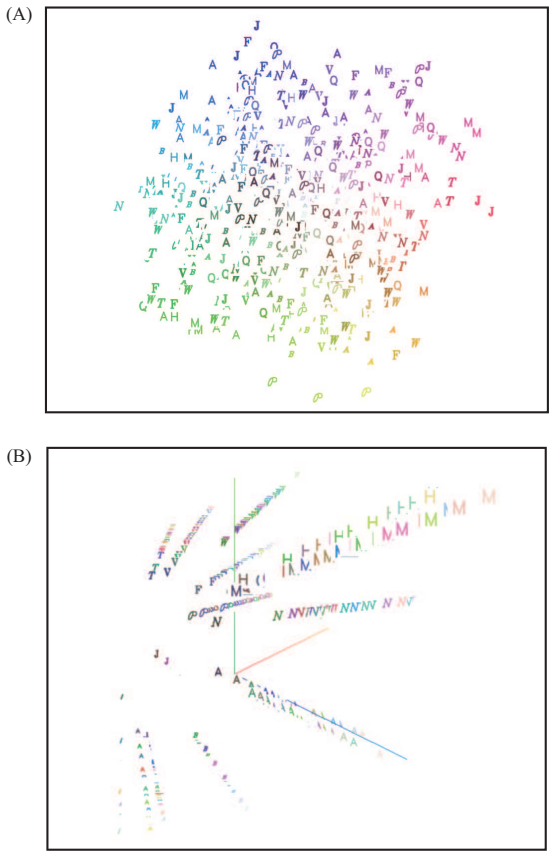
The mathematical framing calls this 'algebraic independence' between transformations: two operations that commute and have unique parameters. The paper proves that if such independence holds in the latent space and the encoder-decoder pair is consistent, then the same independence holds for the image-level transformations. The experiments use 26 letters in 12 fonts and 7 colors. In 98 of 100 runs, the network learned that one code section changed only color and the other changed only shape. Removing the commutative part of the loss made the network collapse, with one transformation doing everything and the other doing nothing.
The result is a concrete demonstration, but it relies on knowing in advance that there are exactly two features and on fixing the size of each code section. The paper does not compare against standard disentanglement baselines, and the theorem assumes a perfectly invertible decoder, which the actual network does not provide.
Extended reading notes
Core claim
The paper's central claim is that satisfying algebraic independence between transformations through the loss ||Y - F1F0X|| + ||Y - F0F1X|| makes the neural network autonomously categorize metric spaces: 'we show that the artificial neural network system can autonomously categorize metric spaces through representation learning to satisfy the algebraic independence between neural networks' (Abstract). If correct, the network separates color and shape into two independent latent metric spaces and produces single-feature transformations F0X and F1X that preserve the other feature.
Load-bearing premise
The method assumes the number of independent metric spaces is known a priori and the latent code is hard-split into that many fixed subspaces (two encoders GP0 and GP1 in Section 4). The 'categorization' is therefore a mapping of features onto pre-defined slots, not a discovery of how many similarity measures exist; the discussion concedes 'our experiment is limited to the categorization of two features' (Section 6). If the number of spaces or the split were unknown, the swap operations in Eqs. (17)-(18) would be undefined.
Editorial analysis
A structured set of objections, weighed in public.
Referee Report
Summary. The paper proposes that imposing algebraic independence between transformations, realized through a commutativity/swap loss on a two-encoder autoencoder, enables a neural network to 'autonomously categorize metric spaces.' After a theoretical result (Theorem 1) connecting algebraic independence of latent transformations to that of observation-space transformations under an exact encoder-decoder inverse condition, the authors define a swap-based reconstruction loss (Eq. 23) and test it on a synthetic dataset of colored letters and digits. They report that the control condition yields color-only and shape-only transformations and separates the latent spaces, whereas an ablation without the commutativity term fails. The paper also reports 2/100 failure cases due to identity solutions and explicitly acknowledges that the experiment is limited to the categorization of two features.
Significance. Strengths: the paper states a crisp theoretical claim, releases code, and reports transparent experiments including failure cases; the proposed loss is simple and the observed separation between color and shape is qualitatively clear. If the theoretical conditions were actually met, the link between algebraic independence and invariant transformations would be a useful contribution to representation learning. However, the significance is limited by two gaps: the theory assumes exact bijectivity and exact commutativity while training only approximates both, and the method does not discover the number or identity of metric spaces because the two-subspace split is fixed by the architecture. The paper's central 'autonomous categorization' claim is therefore overstated relative to what the experiments demonstrate.
major comments (3)
- [§3, Theorem 1; §4 Network Structure; §5] The proof of Theorem 1 relies on GN being bijective and on exact GP-F commutativity (Eqs. (1)-(2)), so that GP GN acts as the identity on the latent space. The implemented decoder is a globally injective ReLU network (Section 4), which is injective but not surjective, and the loss (23) minimizes reconstruction errors rather than enforcing the equalities in Eqs. (11)-(12) exactly. Therefore the trained system does not satisfy the theorem's assumptions, and the text does not state how approximate commutativity or non-surjectivity affects the guarantees. This gap is load-bearing because the proof is the paper's main theoretical contribution; please either relax the assumptions, add an approximate-commutativity argument, or explicitly state that the theorem is a formal result that the experiments illustrate only heuristically.
- [§3, Eqs. (7)-(18); §6 Discussion] The central claim of 'autonomous categorization' is not supported by the model's structure: the number of metric spaces (two) and their exact split (x0 from GP0, x1 from GP1) are fixed before training, and the swap operations (17)-(18) are defined only for this preassigned two-slot decomposition. The loss (23) can therefore assign color and shape to the two available slots, but it cannot discover that there are two similarity measures, or that they should be grouped differently. The Discussion concedes that 'our experiment is limited to the categorization of two features,' but this is not a minor scope restriction: it means the number of categories is an input rather than an output. The abstract and title should be revised to state what is actually learned (unsupervised assignment of pre-specified feature types to pre-defined subspaces), or the method should be extended to decide the number of spaces.
- [§5 Results vs §1 Introduction] The Introduction motivates the method by claiming that constraining axes to be mutually independent cannot categorize feature spaces, but the experiments only compare the proposed loss with an ablation (α=0) and never with an axis-wise independence constraint (e.g., a β-VAE-style penalty) or with a baseline that fixes the same two-slot split but uses a different objective. Without such a comparison, the empirical evidence does not support the paper's main contrast with conventional methods. At minimum, report the invariance metric for a β-VAE or for a variant with a latent-axis orthogonality penalty.
minor comments (7)
- [Eq. (5)] Equation (5) is missing a closing bracket: '= GN f0(λ0)GP X' should read '= GN f0(λ0)GP [X]'.
- [Figure 1 caption] The Figure 1 caption refers to f1 and f2, while the text and equations use f0 and f1; please unify the notation.
- [Section 5 / Figure 2f] The reported P-value for the commutative-loss comparison is inconsistent: the main text states P < 2 × 10⁻¹⁴, while the caption of Fig. 2f states P < 2.025 × 10⁻⁴; the correct value should be given.
- [Section 5, Figure 3] 'principle component analysis' should be 'principal component analysis'.
- [Section 4, Network Structure] The latent dimension is described as 32, but each of GP0 and GP1 outputs a 32-dimensional vector, so the total latent space is 64-dimensional; please clarify whether the latent dimension refers to each subspace or to the full vector.
- [Section 4, Evaluation] The evaluation assigns F0 and F1 to roles by comparing their color/shape invariances; this is reasonable for testing separation, but the definition should be stated as an evaluation heuristic rather than as a property of the learned transformations.
- [Figure 3] Figure 3 mentions 16 letters and 32 colors, which does not match the 26-letter / 7-color dataset described in Section 4; please clarify the sampling procedure.
Circularity Check
Partial circularity: the two metric spaces and the latent split are fixed a priori, so the network demonstrates assignment of two known features into pre-specified slots; the feature assignment itself retains independent empirical content.
-
self definitional
[Section 3, 'Design of latent space transformation', Eqs. (7)-(14); see also Section 4, Eqs. (15)-(18)]
"We construct multiple metric spaces to measure similarity using two norms of the transformation parameters, ||lambda_0|| and ||lambda_1||. Therefore, the points X and Y project to two latent spaces, Q0 in R^{n0} and Q1 in R^{n1}, respectively. ... We defined the latent vectors, x and y, on R^(n0+n1) as follows: x = (x0, x1) = (GP0[X], GP1[X]) = GP[X] ... x0, y0 in Q0; x1, y1 in Q1 ... Consider the transformations f0(lambda_0): x0 -> y0 and f1(lambda_1): x1 -> y1, which are transformations on different latent spaces."
The two metric spaces Q0 and Q1 are created by the architecture before any learning: the latent code is hard-split into two fixed subspaces with two separate encoders GP0 and GP1, and the swap operations F0X=GN(y0,x1), F1X=GN(x0,y1) and the loss (23) are defined in terms of that split. The distances (13)-(14) then simply measure the norms inside these pre-assigned subspaces. Thus the network cannot discover how many independent similarity measures exist or propose a different grouping; the 'autonomous categorization' of metric spaces reduces to learning which of two known feature types lands in which of two pre-specified slots. The paper itself concedes 'our experiment is limited to the categorization of two features,' confirming that the number of categories is an input, not an output.
full rationale
The paper's loss (23) imposes a genuine algebraic-independence constraint, and the color/shape invariance evaluation is external to the loss, so the empirical finding that color and shape land in the two slots is not entirely forced. The identity-function failures (2/100) further show that the loss does not by itself guarantee a feature split. However, the central claim of 'autonomously categorize metric spaces' is not derived: the number of metric spaces (two), the latent split, and the swap operations are fixed a priori, and the Discussion explicitly limits the experiment to two features. The categorization therefore reduces by construction to the chosen architecture, while only the assignment of features to the pre-specified spaces retains independent empirical content. No load-bearing self-citation was found; the cited algebraic-independence and injective-ReLU results are external and not used to force the paper's conclusion.
Assumptions & free parameters
free parameters (4)
- number of metric spaces =
2 (fixed)
- latent subspace dimension =
32
- loss weight alpha =
1 in control, 0 in ablation
- binarization thresholds tau_c, tau_s =
0.1
assumptions (4)
- domain assumption The observation space S is a countable subset of RN
- domain assumption GN is a bijective decoder
- domain assumption GP-F commutativity holds exactly (GP F_i = f_i GP)
- ad hoc to paper The number of independent features is two and each latent code is split into two fixed subspaces a priori
Cite this review
Pith. "Pith review of Unsupervised categorization of similarity measures." pith.science (2026). https://pith.science/paper/J47CDAYP
@misc{pith2026250208098,
  author       = {Pith},
  title        = {Pith review of: Unsupervised categorization of similarity measures},
  year         = {2026},
  howpublished = {\url{https://pith.science/paper/J47CDAYP}},
  note         = {Machine review of arXiv:2502.08098}
}
read the original abstract
In general, objects can be distinguished on the basis of their features, such as color or shape. In particular, it is assumed that similarity judgments about such features can be processed independently in different metric spaces. However, the unsupervised categorization mechanism of metric spaces corresponding to object features remains unknown. Here, we show that the artificial neural network system can autonomously categorize metric spaces through representation learning to satisfy the algebraic independence between neural networks, and project sensory information onto multiple high-dimensional metric spaces to independently evaluate the differences and similarities between features. Conventional methods often constrain the axes of the latent space to be mutually independent or orthogonal. However, the independent axes are not suitable for categorizing metric spaces. High-dimensional metric spaces that are independent of each other are not uniquely determined by the mutually independent axes, because any combination of independent axes can form mutually independent spaces. In other words, the mutually independent axes cannot be used to naturally categorize different feature spaces, such as color space and shape space. Therefore, constraining the axes to be mutually independent makes it difficult to categorize high-dimensional metric spaces. To overcome this problem, we developed a method to constrain only the spaces to be mutually independent and not the composed axes to be independent. Our theory provides general conditions for the unsupervised categorization of independent metric spaces, thus advancing the mathematical theory of functional differentiation of neural networks.
Figures


Forward citations
Cited by 1 Pith paper
-
Feature-Based Lie Group Transformer for Real-World Applications
A feature-based Lie group transformer learns to categorize object motion into two transformations and to segment the moving object from a static background without supervision.
Reference graph
Works this paper leans on
- [1]
-
[2]
A. K. Jain, Data clustering: 50 years beyond k-means, Pattern Recognit. Lett. 31 (2010) 651–666
work page 2010
-
[3]
Taha, Semi-supervised and un-supervised clustering: A revie w and experimental evaluation, Inf
K. Taha, Semi-supervised and un-supervised clustering: A revie w and experimental evaluation, Inf. Syst. 114 (2023) 102178
work page 2023
- [4]
-
[5]
Simpson, Category-theoretic structure for independence and condi- tional independence, Electron
A. Simpson, Category-theoretic structure for independence and condi- tional independence, Electron. Notes Theor. Comput. Sci. 336 (2 018) 281–297
-
[6]
I. Higgins, et al., β -vae: Learning basic visual concepts with a con- strained variational framework, Proc. of ICLR (2017)
work page 2017
-
[7]
A. Hyv¨ arinen, E. Oja, Independent component analysis: algor ithm and applications, Neural Networks 13 (2000) 411–430
work page 2000
-
[8]
I. Higgins, et al., Towards a definition of disentangled representa tion, arXiv preprint (2018) arXiv:1812.02230
arXiv 2018
Show all 16 references
-
[9]
Otsu, Recognition of shape and transformation–an invariant - theoretical foundation, Science on form (1986) 413–420
N. Otsu, Recognition of shape and transformation–an invariant - theoretical foundation, Science on form (1986) 413–420
1986
-
[10]
Takada, Y
T. Takada, Y. Ohmura, Y. Kuniyoshi, Unsupervised learning of s hape- invariant lie group transformer by embedding ordinary differential e qua- tion, Proc. of ICDL (2021). 13
2021
-
[11]
Cohen, M
T. Cohen, M. Welling, Learning the irreducible representation of com- mutative lie group, Proc. of ICML (2014)
2014
-
[12]
Krizhevsky, I
A. Krizhevsky, I. Sutskever, G. E. Hinton, Imagenet classific ation with deep convolutional neural networks, Adv. In Neural Inf. Proce s. Syst. 25 (2012) 1097–1105
2012
-
[13]
Puthawala, et al., Globally injective relu networks, J
M. Puthawala, et al., Globally injective relu networks, J. Mach. Le arn. Res. 23 (2022) 1–55
2022
-
[14]
M. Lin, Q. Chen, S. Yan, Network in network, arXiv preprint (20 14) arXiv: 1312.4400
-
[15]
Liu, et al., On the variance of the adaptive learning rate and be yond, Proc
L. Liu, et al., On the variance of the adaptive learning rate and be yond, Proc. of ICLR (2020)
2020
-
[16]
Paszke, et al., An imperative style, high-performance deep le arning library, Adv
A. Paszke, et al., An imperative style, high-performance deep le arning library, Adv. in Neural Inf. Process Syst. 32 (2019) 8024–8035. Code availability Source codes are available at https://github.com/Yoshiyuki-Ohmura/CommutativeLearning. Acknowledgements This paper is based...
2019
Reviewed August 8, 2026 · model on record in the stance chip above.
Discussion (0). Continue with ORCID to comment.