REVIEW 4 major objections 6 minor 39 references
ConMem keeps only the inspection-log segments that most help diagnose equipment faults, cutting tokens by 88% while raising early-warning accuracy to 76%.
Reviewed by Pith at T0; open to challenge. T0 means a machine referee read the full paper against a public rubric. the ladder, T0–T4 →
T0 review · grok-4.5
2026-07-31 17:04 UTC pith:J4M3EPWM
load-bearing objection Solid applied industrial memory system with real deployment gains; the Shapley story is the soft joint, not the empirical stack. the 4 major comments →
ConMem: Contribution-Aware Memory for Long-Horizon Manufacturing Inspection Logs
The pith
A machine-rendered reading of the paper's core claim, the machinery that carries it, and where it could break.
Core claim
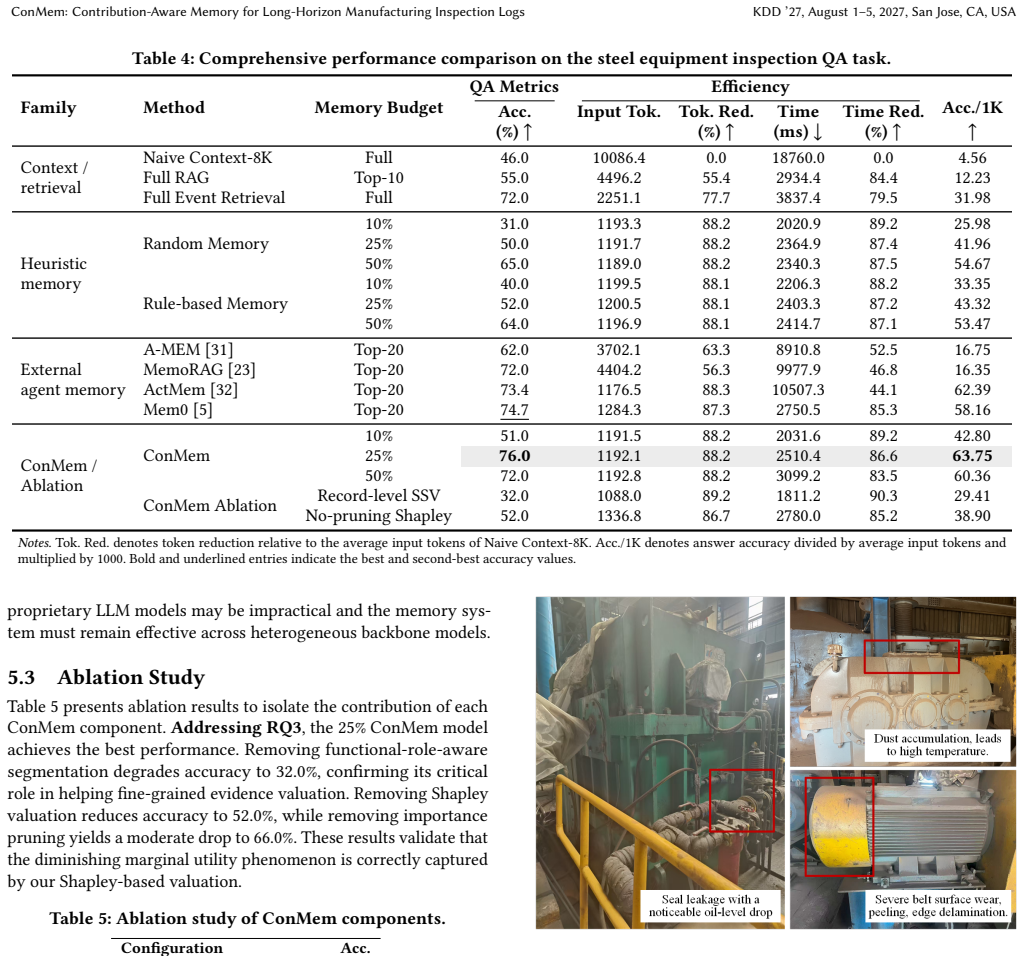
Contribution-aware memory—functional-role segmentation of inspection logs, Shapley-style valuation of each evidence unit against a fixed diagnosis utility, and priority retention of the top-ranked quartile—lets an LLM agent preserve the weak multi-cycle signals needed for early-risk screening while discarding most low-value routine entries, delivering 76% accuracy and large token and latency reductions on real steel-equipment data.
What carries the argument
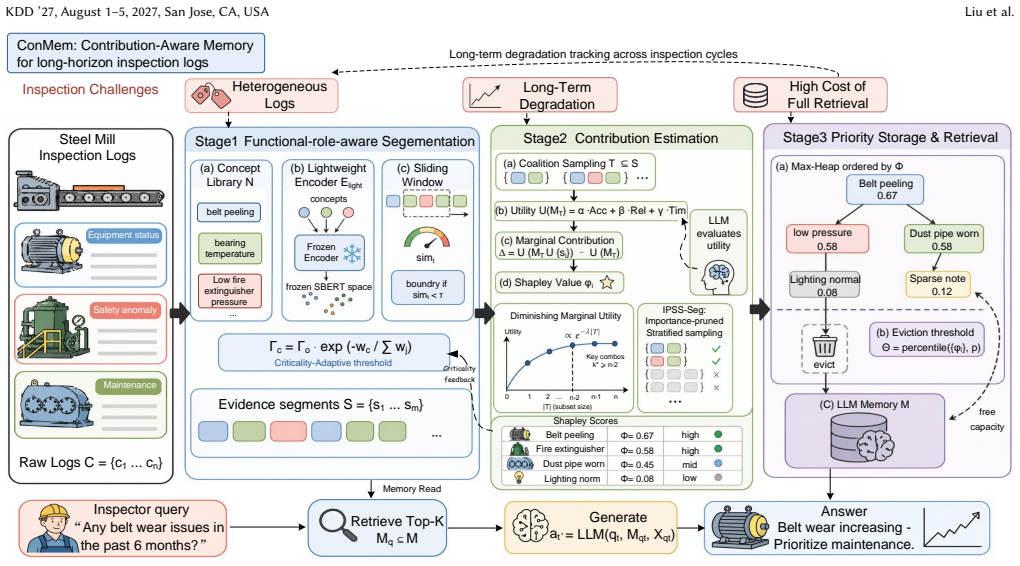
Shapley-style contribution scores on functional evidence units: each segment’s value is its average marginal gain on a training-only utility (accuracy + relevance + timeliness) over high-order coalitions, then stored in a max-heap so only high-contribution units survive the memory budget.
Load-bearing premise
Contribution ranks computed once on earlier labeled training coalitions, with a fixed utility and high-order truncation, remain valid for later test and deployment queries even when equipment, faults, and query mix drift.
What would settle it
On a later year or different plant with shifted fault mix, re-computing Shapley ranks (or simply ranking by recency) under the same 25% budget yields equal or higher recall and lead time on subsequently confirmed abnormalities than the frozen training-derived ranks.
If this is right
- Inspectors can be directed to components showing weak multi-cycle degradation days before conventional thresholds fire.
- Retaining only the top 25% of contribution-ranked evidence is enough for peak accuracy; fuller retention can lower it.
- Functional-role segmentation is required; valuing whole raw records instead collapses accuracy.
- The same priority heap supports sub-second retrieval for routine plant queries.
- Memory management stays effective across weaker backbone LLMs because ranking is not left to the model.
Where Pith is reading between the lines
- The same diminishing-marginal-utility truncation could compress other long-horizon industrial logs without redesigning the utility.
- Stored contribution scores can serve as an audit trail explaining why a particular early alert was raised.
- Periodic online re-estimation of scores when new confirmed faults arrive would close the train–deploy drift gap left open by the paper.
- Priority memory may transfer to any agent setting in which a few rare anomalies dominate decision value.
Editorial analysis
A structured set of objections, weighed in public.
Referee Report
Summary. ConMem is a contribution-aware external memory for LLM-assisted steel-equipment inspection. It segments heterogeneous inspection logs into functional-role evidence units (status, safety anomalies, maintenance), scores units with a training-only Shapley-style estimator under a utility U=αAcc+βRel+γTim, and retains high-φ units in a priority heap under a memory budget. On a real ~30k-entry corpus with year-based split, ConMem at 25% budget reports 76.0% QA accuracy, large token/time cuts vs naive 8K context, gains over Full RAG and several agent-memory baselines, supportive ablations, seasonal slices, and a 15-day field trial (78.7% recall of later-confirmed abnormalities, ~12-day average lead). An appendix gives an approximation bound under high-order coalition truncation (k*≥n−2).
Significance. If the contribution ranks truly transfer and the truncation is faithful, the work is a solid applied contribution: domain-structured memory plus value-aware retention for long-horizon industrial logs, backed by a real corpus, multi-family baselines, ablations, and an on-site trial with lead-time reporting. Strengths include the year split, frozen train-only U, explicit human-in-the-loop framing, code availability note, and deployment TP/FP-style counts. The main scientific stake is whether Shapley-style contribution (not generic similarity or recency) is what drives the 76% / early-seal results under realistic n and drift.
major comments (4)
- [§4.3, Table 2, Appendix A Thm. 1] §4.3 (Eq. 6) asserts strong diminishing marginal utility (marginal gains decay with |T|, with the narrative that after ~top-3 segments further context barely helps), while valuation and Appendix A Theorem 1 rely on evaluating only high-order coalitions |T|∈{n−2,n−1,n}. Under strong diminishing returns the informative marginals live at small |T|; at |T|≈n−2 every Δ_i is near zero, so rank recovery is not implied by the DMU story. Table 2 only exhaustively checks n=8. The operating regime is n≲20 anomaly segments per batch (§4.5). Please either (i) report Spearman/top-K overlap of the high-order estimator vs full or Monte-Carlo Shapley for n in {10,15,20} on held-out training batches, or (ii) justify why high-order strata remain discriminative under your measured λ, and report the empirical ε of Assumption 3. Without this, the mechanism behind Table 4’s 76% @ 25% budget is under-supported.
- [§4.3, §5.1–5.2, Table 4] The load-bearing transfer claim is that φ̂ from fixed train-only U (α=β=0.45, γ=0.1; W=366, h_d=14) remains a valid ranking for test and deployment under component/fault/query drift (§4.3, §5.1). Table 3 and the 25% peak are consistent with a useful ranking on the reported split, but there is no direct stability check (e.g., rank correlation of φ̂ across years, or top-25% membership overlap between train-estimated and oracle test utilities). If top-25% membership scrambles, ConMem should collapse toward Random/Rule-based memory (≤65% at 50% budget, Table 4). A short stability or re-fit sensitivity experiment is needed to underwrite both the QA claim and the deployment early-seal narrative.
- [Table 4, Table 7, Fig. 4] Main results (Table 4) and deployment (Table 7) report point accuracies/recalls with no confidence intervals, bootstrap, or significance tests against the strongest baselines (Mem0 74.7%, ActMem 73.4%, Full Event 72%). The abstract’s “exceeding the strongest directly comparable baseline” and the 4% early-warning claim in the contributions list need uncertainty quantification, especially given seasonal N as small as 18–19 in Fig. 4. Please add error bars or paired tests on the same query set.
- [§4.3 Eq. (5), Definition 4] Utility definition (§4.3, Eq. 5): Acc is “factual accuracy against ground-truth inspection records” with y_t set retrospectively from confirmations in (t, t+h_d]. Clarify exactly what the LLM is scored against when evaluating coalitions (answer match to later fault label vs. evidence faithfulness), and confirm no test-time leakage of post-t outcomes into U or into retrieved memory for q_t. A one-paragraph leakage checklist (what timestamps are visible to segmentation, U, heap, and generation) would make the supervised-valuation setup auditable.
minor comments (6)
- [Table 1 vs Table 4] Table 1 in the introduction reports A-MEM at 62% / 3702 tokens, while Table 4 repeats similar numbers; keep a single canonical baseline table and avoid early partial comparisons that look like final results.
- [§1 contributions] Contributions bullet claims “improving early warning accuracy by up to 4% while reducing token overhead by up to 72.9%,” which does not match the abstract’s 88.2% token cut vs naive 8K or the Mem0 gap (~1.3 points). Align all headline deltas to the same baseline.
- [§3–4, Algorithm 1, Appendix A] Notation drift: memory unit m=(e,c,C,t) vs evidence units C={v_S,v_A,v_M}; Algorithm 1 uses φ_i and M; appendix renumbers equations from (1). Unify symbols and equation numbering across main text and appendix.
- [Fig. 1–3, Table 6] Typos/grammar: “Eqipment”, “Thereshold”, “Loosing bolts”, “in time anomaly detection”, “segementation” in Fig. 2; ACM ref year 2027 / arXiv date 2026 is fine for submission but should be consistent in camera-ready.
- [Fig. 4] Fig. 4 seasonal panels would be clearer with absolute counts (TP/n) and the same y-scale annotation of method order; N=18–37 is small—state that these are descriptive slices.
- [§2] Related work is adequate but could briefly position against other data-valuation / influence-function memory selection lines beyond generic agent memory, given the Shapley framing.
Circularity Check
No significant circularity: Shapley ranks come from frozen train-only utilities and are scored on held-out/deployment metrics, not identities with those metrics.
full rationale
ConMem’s load-bearing chain is (1) functional-role segmentation of logs, (2) Shapley-style scores from a fixed utility U=αAcc+βRel+γTim estimated only on chronologically earlier training coalitions, (3) max-heap retention of top contribution mass, (4) empirical QA accuracy, token/time, and field-trial recall on later data. Train and test are year-partitioned; confirmed outcomes enter memory only after confirmation time; reported 76% @ 25% budget and deployment 78.7% recall / ~12-day lead are measured against held-out or prospective labels, not algebraically fixed by the training fit (Random/Rule-based under the same budget land much lower). Citations for Shapley/SHAP and external memory systems are standard third-party references, not author-unique theorems used to forbid alternatives. Hyperparameter choices (α,β,γ, k*=n−2, retention percentile) are domain tuning and affect correctness risk, but they do not make the test metric equal the fitted input by construction. Appendix Theorem 1’s bound in terms of an unmeasured ε is a weak/near-definitional inequality and does not force the main empirical claims. No self-definitional loop, fitted-quantity-renamed-as-prediction, or load-bearing self-citation chain is present.
Axiom & Free-Parameter Ledger
free parameters (6)
- utility weights α, β, γ =
0.45, 0.45, 0.1
- segmentation threshold τ / criticality-adaptive τ_c =
τ_0 and w_c not fully numerically specified
- coalition truncation k* and sampling budget ρ =
k*=n-2 (typical n≤20)
- retention percentile p / memory budget fraction =
25% primary; also 10%/50% sweeps
- look-back W and follow-up horizon h_d =
W=366 days; h_d=14 days (deployment confirm window 12h–14d)
- diminishing-utility decay λ =
not numerically reported
axioms (5)
- domain assumption Shapley axioms / marginal-contribution averaging as the right notion of memory unit value for downstream diagnosis
- domain assumption Diminishing marginal utility of added inspection segments beyond small context sets
- ad hoc to paper High-order contribution rank stability (ranks from |C|∈{n-2,n-1,n} track full Shapley)
- domain assumption Training-time utility on earlier labeled queries transfers to test-time early-risk screening
- domain assumption Standard embedding similarity and NLP noun-phrase pipelines can detect functional-role boundaries in logs
invented entities (3)
-
Functional-role evidence units {v_S, v_A, v_M}
no independent evidence
-
Inspection-specific utility U(M)=αAcc+βRel+γTim
no independent evidence
-
IPSS-Seg / importance-pruned stratified Shapley sampling for logs
no independent evidence
read the original abstract
Long-horizon steel-equipment inspection requires reasoning over heterogeneous records accumulated across repeated inspection cycles. Existing retrieval-augmented generation systems treat historical logs as a static corpus and retain records without estimating their diagnostic value, failing to report early risk. To this end, we propose ConMem, a contribution-aware memory framework for LLM-assisted equipment inspection, supporting a human-in-the-loop early-risk screening system. Specifically, our ConMem first segments inspection logs into functional evidence units, then estimates each memory unit's contribution to downstream diagnosis through a Shapley-style estimation, and finally retains high-value evidence under a constrained memory budget. In experiments, we evaluate ConMem on real-world dataset and ConMem achieves 76.0% QA accuracy, exceeding the strongest directly comparable baseline. Relative to the naive 8K-context LLM baselines, it reduces the average number of input tokens by 88.2% and response time by 86.6%. Ablation studies also show that the functional-role-aware segmentation and contribution-based valuation are helping prioritize weak degradation signals for targeted field inspection. Practical deployments further confirm that ConMem retains the weak early signal across three inspection cycles, providing an early-stage seal-wear alert targeted for on-site inspectors.
Figures


Reference graph
Works this paper leans on
-
[1]
Alsaif, Aiiad A
Khalid M. Alsaif, Aiiad A. Albeshri, Maher A. Khemakhem, and Fathy E. Eassa
-
[2]
Apiradee Boonmee, Kritsada Wongsuwan, and Pimchanok Sukjai. 2024. Consul- tation on industrial machine faults with large language models.arXiv preprint arXiv:2410.03223(2024)
Pith/arXiv arXiv 2024
-
[3]
Xiangang Cao, Wangtao Xu, Jiangbin Zhao, Yong Duan, and Xin Yang. 2024. Research on Large Language Model for Coal Mine Equipment Maintenance Based on Multi-Source Text.Applied Sciences14, 7 (2024)
2024
-
[4]
Jianshu Chao, Ruoyun Liu, Deyu An, Cheng Zhu, Bangjiang Lin, et al . 2026. Semantic segmentation of power equipment guided by multi-modal and multi- level wavelet for UAV inspections.Pattern Recognition179 (2026), 113914
2026
-
[5]
Prateek Chhikara, Dev Khant, Saket Aryan, Taranjeet Singh, and Deshraj Yadav
-
[6]
Amirata Ghorbani and James Zou. 2019. Data shapley: Equitable valuation of data for machine learning. InICML. PMLR, 2242–2251
2019
-
[7]
Team Glm, Aohan Zeng, Bin Xu, Bowen Wang, Chenhui Zhang, Da Yin, Dan Zhang, Diego Rojas, Guanyu Feng, Hanlin Zhao, et al. 2024. Chatglm: A fam- ily of large language models from glm-130b to glm-4 all tools.arXiv preprint arXiv:2406.12793(2024)
Pith/arXiv arXiv 2024
-
[8]
Daochun Huang, Yiming Wang, and Huipeng Li. 2024. Study on UAV Inspection Safety Distance of Substation High-Voltage and Current-Carrying Equipment Based on Power-Frequency Magnetic Field.IEEE Transactions on Instrumentation and Measurement73 (2024), 1–8
2024
-
[9]
Aaron Hurst, Adam Lerer, Adam P Goucher, Adam Perelman, Aditya Ramesh, Aidan Clark, AJ Ostrow, Akila Welihinda, Alan Hayes, Alec Radford, et al. 2024. Gpt-4o system card.arXiv preprint arXiv:2410.21276(2024)
Pith/arXiv arXiv 2024
-
[10]
Qian Jiang, Yadong Liu, Yingjie Yan, Xianyin Mao, Haoyu Xu, et al. 2024. BIM- Based 3-D Multimodal Reconstruction for Substation Equipment Inspection Images.IEEE Transactions on Instrumentation and Measurement73 (2024), 1–14
2024
-
[11]
Vladimir Karpukhin, Barlas Oguz, Min, et al. 2020. Dense passage retrieval for open-domain question answering. InEMNLP. 6769–6781
2020
-
[12]
Jingoo Lee, Seungjun Lee, Young-Joo Lee, and Jaebeom Lee. 2025. Virtual sensing of seismic floor responses for rapid prioritization of critical equipment inspection in nuclear power plants.Computer-Aided Civil and Infrastructure Engineering40, 26 (2025), 4669–4688
2025
-
[13]
Jianming Liu, Duanjiao Li, Ying Zhang, Yun Chen, Shengbo Liu, et al . 2025. Relative Pose Estimation of Substation Equipment for UAV Inspection via Deep Point Cloud Registration. InICIRA. 483–494
2025
-
[14]
Mincong Liu, Tusongjiang Kari, Aishan Yimamu, Yuanxiang Zhou, and Xiaojing Ma. 2025. MC-YOLOv8: A Hybrid Attention and Adaptive Convolution Model for Power Equipment Fault Inspection: M. Liu et al.Signal, Image and Video Processing19, 8 (2025), 653
2025
-
[15]
Junru Lu, Siyu An, Mingbao Lin, Gabriele Pergola, Yulan He, et al. 2023. Mem- oChat: Tuning LLMs to Use Memos for Consistent Long-Range Open-Domain Conversation.arXiv preprint arXiv:2308.08239(2023)
Pith/arXiv arXiv 2023
-
[16]
Shouyin Lu, Yanping Li, and Tao Zhang. 2009. Design and implement of control system for power substation equipment inspection robot. (2009), 93–96
2009
-
[17]
Weizhi Lu, Qiang Li, Weijian Zhang, Lin Mei, Di Cai, et al. 2024. Management of power equipment inspection informationization through intelligent unmanned aerial vehicles.Artificial Life and Robotics29, 4 (2024), 579–584
2024
-
[18]
Scott M Lundberg and Su-In Lee. 2017. A unified approach to interpreting model predictions.NeurIPS30 (2017)
2017
-
[19]
Yuya Okada, Hiroki Sugawara, Hiroaki Soya, and Takeshi Hatanaka. 2025. Feasibility-aware hierarchical task assignment for equipment inspection robots with heterogeneous work efficiency.Advanced Robotics39, 2 (2025), 114–126
2025
-
[20]
Charles Packer, Vivian Fang, Shishir_G Patil, Kevin Lin, Sarah Wooders, and Joseph_E Gonzalez. 2023. MemGPT: towards LLMs as operating systems. (2023)
2023
-
[21]
Joon Sung Park, Joseph O’Brien, Carrie Jun Cai, Meredith Ringel Morris, Percy Liang, and Michael S Bernstein. 2023. Generative agents: Interactive simulacra of human behavior. InUIST. 1–22
2023
-
[22]
Yuhuai Peng, Chenlu Wang, Yue Hao, Li Zhen, Guolong Chen, et al. 2024. High- Precision Surface Crack Detection for Rolling Steel Production Equipment in ICPS.IEEE Internet of Things Journal11, 3 (2024), 4586–4599
2024
-
[23]
Hongjin Qian, Peitian Zhang, Zheng Liu, Kelong Mao, and Zhicheng Dou. 2024. MemoRAG: Moving towards Next-Gen RAG via Memory-Inspired Knowledge Discovery.arXiv preprint arXiv:2409.05591(2024)
Pith/arXiv arXiv 2024
-
[24]
Atta Rahman, Fahad Abdullah Alatallah, Abdullah Jafar Almubarak, Haider Ali Alkhazal, Hasan Ali Alzayer, Younis Zaki Shaaban, Nasro Min-Allah, Aghiad Bakry, and Khalid Aloup. 2025. Deep learning-based automated inspection of generic personal protective equipment.Computers, Materials, & Continua85, 2 (2025), 3507
2025
-
[25]
Preston Rasmussen, Pavlo Paliychuk, Travis Beauvais, Jack Ryan, and Daniel Chalef. 2025. Zep: a temporal knowledge graph architecture for agent memory. arXiv preprint arXiv:2501.13956(2025)
Pith/arXiv arXiv 2025
-
[26]
Lloyd S Shapley et al. 1953. A value for n-person games. (1953)
1953
-
[27]
Jihoon Tack, Jaehyung Kim, Eric Mitchell, Jinwoo Shin, Yee Whye Teh, and Jonathan Richard Schwarz. 2024. Online adaptation of language models with a memory of amortized contexts.NeurIPS37 (2024), 130109–130135
2024
-
[28]
Bing Wang, Xinnian Liang, Jian Yang, Hui Huang, Zhenhe Wu, ShuangZhi Wu, Zejun Ma, and Zhoujun Li. 2025. Scm: Enhancing large language model with self- controlled memory framework. InInternational Conference on Database Systems for Advanced Applications. Springer, 188–203
2025
-
[29]
Wenhui Wang, Furu Wei, Li Dong, Hangbo Bao, Nan Yang, and Ming Zhou
-
[30]
Zora Zhiruo Wang, Jiayuan Mao, Daniel Fried, and Graham Neubig. 2024. Agent Workflow Memory. arXiv:2409.07429 [cs.CL] https://arxiv.org/abs/2409.07429
Pith/arXiv arXiv 2024
-
[31]
Wujiang Xu, Zujie Liang, Kai Mei, Hang Gao, Juntao Tan, and Yongfeng Zhang
-
[32]
Xiaohui Zhang, Zequn Sun, Chengyuan Yang, Yaqin Jin, Yazhong Zhang, et al
-
[33]
Wanjun Zhong, Lianghong Guo, Qiqi Gao, He Ye, and Yanlin Wang. 2024. Mem- orybank: Enhancing large language models with long-term memory. InAAAI, Vol. 38. 19724–19731
2024
-
[34]
Has the belt shown degradation over the past three months?
Jiang Zhu, Chonggao Fan, Saisi Li, Keheng Nie, Jianqi Li, et al . 2025. SEDNet: Substation Equipment Detection Network With an Attention Mechanism for UAV Automatic Power Inspection.IEEE Transactions on Instrumentation and Measurement74 (2025), 1–14. A Theoretical Analysis of ConMem Approximation In this appendix, we provide a rigorous theoretical analysi...
2025
-
[37]
ActMem: Bridging the Gap Between Memory Retrieval and Reasoning in LLM Agents.arXiv preprint arXiv:2603.00026(2026)
Pith/arXiv arXiv 2026
-
[2020]
Minilm: Deep self-attention distillation for task-agnostic compression of pre-trained transformers.NeurIPS33 (2020), 5776–5788
2020
-
[2024]
Multimodal Large Language Model-Based Fault Detection and Diagnosis in Context of Industry 4.0.Electronics13, 24 (2024)
2024
-
[2025]
Mem0: Building Production-Ready AI Agents with Scalable Long-Term Memory.arXiv preprint arXiv:2504.19413(2025)
Pith/arXiv arXiv 2025
-
[2026]
A-mem: Agentic memory for llm agents.NeurIPS38 (2026), 17577–17604
2026
discussion (0)
Sign in with ORCID, Apple, or X to comment. Anyone can read and Pith papers without signing in.